

Microsoft’s four-decade arc from a two‑person startup to a global software, cloud and AI powerhouse is a study in adaptation: born in 1975 as a tiny software shop, defined by the Windows era of the 1990s, retooled for the cloud in the 2010s, and now reshaping itself again around artificial intelligence and silicon‑aware features. This anniversary is both a celebration of enduring engineering and a checkpoint that forces a sober assessment of where scale, platform control and AI integration converge—and where they collide with privacy, regulatory and compatibility challenges.
Microsoft’s origin story is compact and decisive: Bill Gates and Paul Allen founded Microsoft in 1975 with ambitions to put software at the center of computing. That early focus on software—starting with BASIC for the Altair—led to MS‑DOS, which laid the commercial rails for the later Windows ecosystem. Over time Microsoft grew from a developer tool company into the vendor of an operating system that would become the default interface for billions of users.
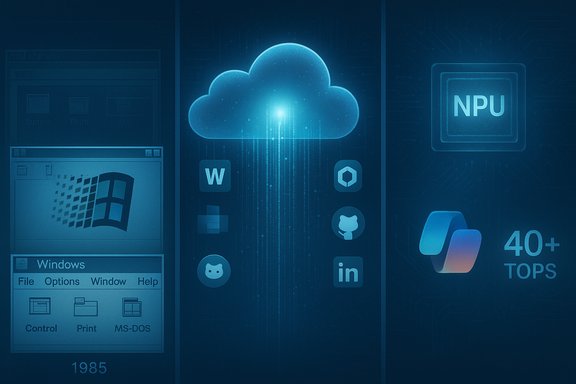
The Windows product family traces back to the release to manufacturing of Windows 1.0 on November 20, 1985, a modest GUI shell layered on MS‑DOS that bundled simple apps like Notepad, Calculator and Paint and introduced a mouse‑centric way of interacting with a personal computer. That modest experiment seeded decades of design decisions—backward compatibility, broad hardware support and developer ecosystem commitments—that still influence the company’s product calculus today.
In recent years Microsoft has navigated another major pivot. Under Satya Nadella’s leadership the company prioritized cloud infrastructure with Microsoft Azure, moved aggressively into enterprise services, and began integrating advanced AI across Windows, Microsoft 365 and developer tools—shifts that redefined Microsoft from a traditional software vendor into a diversified, platform‑centric technology company.
Azure, meanwhile, is the infrastructure backbone that makes integrated AI features possible at scale. What used to be isolated desktop features now tie back into cloud compute, model hosting and data services; for enterprises, that’s both an advantage—centralized management, scale and security—and a strategic lock‑in consideration. Azure’s growth from its early days to a primary cloud competitor demonstrates Microsoft’s successful repositioning of its business model.
This diversification has concrete benefits for Windows: tighter integration with developer tools (GitHub), new content and engagement models (Mojang and Activision), and business intelligence from enterprise social graphs (LinkedIn). But it also expands Microsoft’s regulatory surface, invites cross‑market antitrust scrutiny, and raises questions about how integrated experiences will be monetized and governed across product boundaries.
A technical hallmark of the current era is the company’s emphasis on silicon‑aware AI: Microsoft is promoting hardware tiers (Copilot+ PCs) with specific on‑device NPU capabilities—publicly described in product guidance as a 40+ TOPS floor for some premium on‑device AI features—encouraging OEMs to ship machines with dedicated AI acceleration. That approach tightly couples software capabilities to hardware baselines and will shape the PC upgrade cycle for years.
Source: The Hans India Microsoft at 40: Four Decades of Innovation and a Tech Legacy That Shaped the World
 Background / Overview
Microsoft’s origin story is compact and decisive: Bill Gates and Paul Allen founded Microsoft in 1975 with ambitions to put software at the center of computing. That early focus on software—starting with BASIC for the Altair—led to MS‑DOS, which laid the commercial rails for the later Windows ecosystem. Over time Microsoft grew from a developer tool company into the vendor of an operating system that would become the default interface for billions of users.The Windows product family traces back to the release to manufacturing of Windows 1.0 on November 20, 1985, a modest GUI shell layered on MS‑DOS that bundled simple apps like Notepad, Calculator and Paint and introduced a mouse‑centric way of interacting with a personal computer. That modest experiment seeded decades of design decisions—backward compatibility, broad hardware support and developer ecosystem commitments—that still influence the company’s product calculus today.
In recent years Microsoft has navigated another major pivot. Under Satya Nadella’s leadership the company prioritized cloud infrastructure with Microsoft Azure, moved aggressively into enterprise services, and began integrating advanced AI across Windows, Microsoft 365 and developer tools—shifts that redefined Microsoft from a traditional software vendor into a diversified, platform‑centric technology company.
The Windows era: design, dominance and backward compatibility
From tiled windows to mass adoption
Windows 1.0 was a constrained experiment in a resource‑scarce era, but its metaphors—menus, dialogs, windows—persisted and matured. Windows 3.0 and then Windows 95 were the releases that turned Windows into a household brand; Windows 95 in particular introduced the Start menu and taskbar and normalized the PC as an appliance for non‑technical users. These releases created the developer and OEM ecosystems that locked Windows into workplaces and homes for decades.Enterprise consolidation and the long tail
Windows XP (retail release October 25, 2001) became a long‑running standard in both consumer and enterprise contexts. The enduring commitment to backward compatibility—often painful for engineers but essential for enterprise IT—meant Microsoft became the safest path for businesses standardizing on software, device management and compliance tooling. This institutional lock‑in is a defining technical and commercial strength.The modern redesign and AI infusion
Windows 11’s public availability (initially rolled out in October 2021) reframed the OS as both a visual refresh and a security baseline (TPM 2.0, secure boot), while also creating a platform canvas for later AI and Copilot integrations. The company has layered AI assistants and silicon‑aware features on top of that base, signaling an intent to make the PC an AI‑native workspace rather than only a local runtime.Productivity and platforms: Office, Cloud and Copilot
Microsoft Office moved from packaged software in the late 1980s to a cloud‑centric subscription model and then to AI‑assisted workflows. Office became the default productivity suite for enterprises and is now a key vector for Microsoft’s AI integrations—embedding assistance, automation and natural language capabilities directly into Word, Excel, PowerPoint and Teams. The rebranding to Microsoft 365 and the introduction of Copilot designate the suite as a live, AI‑enabled service rather than a static collection of apps.Azure, meanwhile, is the infrastructure backbone that makes integrated AI features possible at scale. What used to be isolated desktop features now tie back into cloud compute, model hosting and data services; for enterprises, that’s both an advantage—centralized management, scale and security—and a strategic lock‑in consideration. Azure’s growth from its early days to a primary cloud competitor demonstrates Microsoft’s successful repositioning of its business model.
Diversification through acquisition: building an ecosystem
Microsoft’s acquisition strategy over the past decade illustrates deliberate diversification. Notable purchases include LinkedIn, GitHub, Mojang (maker of Minecraft) and Activision Blizzard, which expanded Microsoft’s reach into professional networking, developer platforms, consumer gaming and entertainment. Those moves reflect a shift away from being a pure software vendor to running a technology ecosystem that spans productivity, cloud, developers and games.This diversification has concrete benefits for Windows: tighter integration with developer tools (GitHub), new content and engagement models (Mojang and Activision), and business intelligence from enterprise social graphs (LinkedIn). But it also expands Microsoft’s regulatory surface, invites cross‑market antitrust scrutiny, and raises questions about how integrated experiences will be monetized and governed across product boundaries.
Gaming and consumer presence: Xbox as a strategic anchor
Microsoft’s entry into consoles with Xbox in 2001, followed by Xbox Live in 2002, moved the company into living rooms and diversified its customer relationships. The Xbox platform reinforced Windows’ relevance to gaming—DirectX innovations, cross‑platform services and game streaming strategies have blurred the lines between PC and console ecosystems. Gaming is both a growth engine and a testbed for Microsoft’s ambitions around cloud gaming, subscription services and platform‑level content control.The Nadella era: culture, cloud and the AI pivot
Satya Nadella’s leadership is widely credited with refocusing Microsoft around cloud services, open‑source developer engagement and a culture of learning. The strategic pivot—embracing Azure, acquiring developer and social platforms, and integrating into open ecosystems—helped reverse a narrative of stagnation and reposition Microsoft as a modern enterprise cloud leader. This cultural and strategic reset is the underpinning for today’s AI push.A technical hallmark of the current era is the company’s emphasis on silicon‑aware AI: Microsoft is promoting hardware tiers (Copilot+ PCs) with specific on‑device NPU capabilities—publicly described in product guidance as a 40+ TOPS floor for some premium on‑device AI features—encouraging OEMs to ship machines with dedicated AI acceleration. That approach tightly couples software capabilities to hardware baselines and will shape the PC upgrade cycle for years.
Strengths: what Microsoft still does better than most
- Scale and distribution: a global OEM channel and enterprise contracts that make Windows the default endpoint in many organizations.
- Ecosystem breadth: from developer platforms to enterprise services to gaming, Microsoft spans diverse markets and leverages cross‑product synergies.
- Backward compatibility: engineering choices that prioritize legacy support continue to reduce migration friction for enterprises.
- Cloud and AI infrastructure: Azure, Microsoft 365 and GitHub form an integrated stack for deploying and operationalizing AI and services.
- Financial muscle and execution: sustained revenue and investment capacity enable multiyear projects like Copilot integration and hardware partnerships.
Risks, tensions and unresolved trade‑offs
Privacy, telemetry and user control
Embedding AI into the OS and productivity stack increases telemetry volume and introduces new data governance challenges. Shipping convenience features that collect deep telemetry without clear, user‑centric controls risks regulatory pushback and user distrust. Microsoft’s next decade depends heavily on how transparently it handles telemetry and local vs. cloud processing choices.Hardware gating and fragmentation
The Copilot+ device strategy—tying advanced features to an on‑device NPU threshold—creates a premium tier of PCs. While this can accelerate adoption of dedicated AI silicon, it risks fragmenting the Windows experience into tiers: premium AI devices and a long tail of older, unsupported hardware. That fragmentation would complicate enterprise management and widen security exposure if legacy devices remain in critical roles.Regulatory pressure and antitrust history
Microsoft has weathered major antitrust challenges before, and its recent acquisitions and increasing platform control invite renewed scrutiny. Cross‑market acquisitions and tight integrations across cloud, developer tooling and consumer experiences increase the chance of regulatory intervention or conditional approvals in certain jurisdictions. These dynamics can slow product rollouts and require structural changes to business models.User experience overload
For power users and enterprise IT, aggressive UI overlays or forced AI integrations can increase cognitive load and unpredictability. The challenge is to add AI that helps without undermining predictability, reliability and established workflows—especially in regulated industries where reproducibility matters.What the next decade could look like
If Microsoft executes on a measured strategy, Windows can become a dominant AI workspace where contextual assistants automate routine tasks, unify local and cloud data and deliver searchable narratives across documents and apps. Achieving that requires three hard technical and policy wins:- Broader, efficient on‑device model runtimes and NPUs across more price points so advanced features aren’t gated to ultra‑premium hardware.
- Clear privacy guarantees and enterprise controls that satisfy regulators, auditors and compliance frameworks.
- Developer and partner ecosystems that can safely extend Copilot’s abilities without compromising user trust or opening new attack surfaces.
Practical guidance for users and IT leaders
- Prioritize migrations: plan Windows 10‑to‑Windows 11 transitions now and validate legacy apps in virtualized or containerized environments to avoid last‑minute compatibility surprises.
- Audit telemetry: inventory what data is being sent to cloud services and structure privacy and compliance contracts around data minimization and auditability.
- Hardware strategy: when evaluating Copilot‑enhanced hardware, quantify which on‑device AI features are material to workflows and negotiate procurement terms that allow staged rollouts.
- Dev governance: use isolation, model‑scoring policies and supply‑chain checks when integrating third‑party Copilot extensions or AI connectors.
- Diversify backup and recovery: as the stack becomes more cloud‑centric, ensure robust offline and cross‑cloud recovery plans to mitigate provider outage risks.
Verification of key technical claims and dates
- Windows 1.0 release to manufacturing: November 20, 1985—this date appears consistently in product histories and anniversary retrospectives.
- Windows 95 retail release spotlight (Start menu and taskbar): August 24, 1995—an industry pivot that set modern desktop conventions.
- Windows XP retail release: October 25, 2001—consolidated Windows’ enterprise presence for years.
- Windows 11 general availability: October 5, 2021—positioned as the security and design baseline for the current OS family.
- Windows 10 end of standard servicing for consumer SKUs: October 14, 2025—an inflection point prompting large migration projects.
- Copilot+ on‑device NPU threshold: Microsoft’s public guidance references a 40+ TOPS floor for certain premium features—this is a platform engineering statement that has implications for OEM hardware planning. Where single figures are cited, they are sourced to Microsoft product pages and corroborated in multiple rollout guides; readers should treat hardware TOPS numbers as evolving benchmarks rather than immutable standards.
Notable strengths and measurable wins — a quick recap
- Microsoft converted a legacy software model into a cloud subscription business, preserving revenue growth while modernizing product delivery.
- The company reestablished developer trust through acquisitions like GitHub and investment in open‑source tooling, which helped power innovations such as GitHub Copilot.
- Gaming and media investments broadened consumer engagement and provided cross‑platform synergies for Xbox and Windows ecosystems.
Questions that remain and claims to watch
- Will Copilot’s AI assistance be primarily cloud‑first (with stronger privacy controls) or device‑first (requiring ubiquitous NPUs)? The company’s public materials indicate a hybrid trajectory, but the balance of local vs. cloud processing will determine privacy outcomes and upgrade pressures.
- How will regulators treat deep integrations between cloud services, developer tooling and consumer platforms after major acquisitions? Past antitrust history and the scale of Microsoft’s ecosystem make this an active area of risk.
- Can Microsoft avoid fragmenting the Windows experience into premium AI tiers and a legacy base that falls behind in security and features? Solving this will require either broadening hardware support for on‑device AI or maintaining strong cloud‑first feature parity for older devices.
Conclusion
Microsoft at forty is both an archive of the modern computing era and an active experiment in how a platform company manages the transition to an AI‑centric future. Its history—MS‑DOS, Windows’ decades of dominance, Office’s ubiquity, Azure’s cloud foundations, and a string of strategic acquisitions—gives it unique leverage in shaping the next generation of tools. Yet that same scale produces acute responsibilities: to protect user privacy, avoid brittle tiering of the platform, and operate transparently under increasing regulatory scrutiny. The company’s choices over the next five years—on hardware baselines, privacy guarantees and developer openness—will determine whether Windows remains a trusted, ubiquitous workspace or becomes a fractured set of experiences divided by silicon, subscription and compliance. The anniversary is not merely a celebration; it is a strategic inflection point that will set the tone for the platform’s next decade.Source: The Hans India Microsoft at 40: Four Decades of Innovation and a Tech Legacy That Shaped the World
