

Microsoft reported on April 29, 2026, that Azure and other cloud services revenue grew 40 percent year over year in its fiscal third quarter, while its AI business reached a $37 billion annual revenue run rate and contracted cloud obligations climbed to $627 billion. The headline is not that Microsoft has found demand for AI; it is that demand has found the physical limits of Microsoft. The company is selling the future faster than it can pour concrete, energize substations, install chillers, and bring GPU clusters online. For the first time in this AI cycle, Microsoft’s strongest numbers may also be its clearest warning.
For years, Azure growth was mostly a software story wrapped in a data center story. Microsoft could talk about developer tools, enterprise migrations, database modernization, security bundles, and hybrid cloud, while the underlying infrastructure expansion remained mostly invisible to customers. The cloud was marketed as elastic, and for many workloads it felt that way.
AI has changed the physics of that promise. Training and inference workloads do not merely consume “cloud capacity” in the abstract. They consume accelerators, high-bandwidth memory, high-density racks, specialized networking, liquid cooling loops, backup power systems, utility interconnects, transformers, water strategies, and land near electrical capacity that is often already spoken for.
That is why Microsoft’s quarter reads less like a conventional earnings beat than a dispatch from the front line of industrial computing. Revenue rose 18 percent to $82.9 billion, net income climbed 23 percent to $31.8 billion, and Intelligent Cloud revenue reached $34.7 billion, up 30 percent. Those are magnificent software-company numbers. But the more revealing figure is commercial remaining performance obligations, or RPO, which nearly doubled year over year to $627 billion.
RPO is not the same thing as a capacity shortage, and it should not be treated as a perfect map of Azure data center demand. It includes contracted future revenue across Microsoft’s commercial business, and the mix matters. Still, when RPO balloons at the same time Azure accelerates and Microsoft says AI has become a $37 billion run-rate business, the direction of travel is unmistakable. Microsoft has a backlog that looks less like deferred paperwork and more like a queue at the power gate.
AI has not destroyed that abstraction, but it has made it more expensive to maintain. A general-purpose virtual machine can be scheduled across a large pool of relatively standardized capacity. A frontier AI training cluster or a serious inference deployment is a different animal. It requires dense concentrations of accelerators, low-latency interconnects, power delivery designed for extreme rack loads, and cooling systems that look increasingly unlike the raised-floor air-cooled facilities of an earlier cloud era.
That shift changes the meaning of Azure growth. A 40 percent rise in Azure and other cloud services revenue is not just a sign that customers are consuming more storage, compute, and databases. It reflects a mix shift toward scarce, capital-intensive, power-hungry resources whose deployment timelines are harder to compress.
This is why the old cloud trope of “capacity expansion” now sounds too tidy. Microsoft is not merely adding more servers. It is assembling industrial campuses around electrical infrastructure and thermal management constraints, often in competition with other hyperscalers, colocation giants, AI labs, crypto miners, manufacturing projects, and local communities wary of power and water consumption.
The result is a market where demand can be created in a boardroom faster than capacity can be created in a county planning process. A CIO can approve an AI platform strategy this quarter. Microsoft may need many quarters, or years, to bring the necessary physical plant online.
Microsoft’s $627 billion in commercial RPO is therefore both comforting and uncomfortable. It says customers are locked in. It also says Microsoft’s future revenue claims are increasingly tied to execution in the least software-like parts of the business.
The Data Center Knowledge report puts the issue bluntly: Microsoft has effectively sold more AI capacity than it can currently deliver. That does not mean the company is failing. It means it is living with the consequence of success in a market where the bottleneck has migrated from product-market fit to industrial deployment.
Steven Dickens of HyperFrame Research reportedly told the publication that demand is outstripping available capacity by nearly three to one in key Tier-1 regions, and that delivery windows that once looked like six months have stretched to 18 months or more. Those figures should be treated as analyst estimates rather than Microsoft disclosures. But they align with what the industry has been saying more broadly for more than a year: the limiting factors are no longer only chips.
That distinction matters. The early AI infrastructure narrative was dominated by Nvidia GPU availability. Whoever could secure the accelerators could win the cloud customer. That is still partly true, but it is no longer sufficient. A GPU sitting in a warehouse is not Azure capacity. It becomes Azure capacity only when it is installed into a system, connected to networking, cooled, powered, monitored, secured, and integrated into a platform customers can actually use.
Transformers, switchgear, substations, utility interconnection queues, and local generation constraints now shape deployment schedules. High-density AI campuses can require enormous blocks of power, and those blocks are not available everywhere on demand. In some markets, utilities are being asked to plan for data center loads that resemble industrial megaprojects rather than office parks.
This is where Microsoft’s cloud expansion becomes a public-infrastructure story. The company can sign contracts, order servers, and announce AI services. It cannot unilaterally manufacture transmission capacity in Northern Virginia, Dublin, Phoenix, London, Singapore, or any other constrained market. It must negotiate with utilities, regulators, landowners, contractors, local governments, and communities that may not share Wall Street’s enthusiasm for AI growth.
The data center industry has always been constrained by power, but AI changes the steepness of the curve. Higher rack density means more power per square foot and more heat per rack. Liquid cooling helps move that heat more efficiently, but it adds its own procurement, engineering, operational, and maintenance complexity. Retrofitting older facilities is not always simple, and new builds require specialized designs that may not match the assumptions behind earlier hyperscale campuses.
Microsoft’s problem, in other words, is not that it lacks ambition. It is that ambition now runs through the slowest systems in technology: permitting, power delivery, construction, and utility planning.
That is precisely why the capacity gap matters. The stronger the business, the more costly every delayed deployment becomes. If Azure AI capacity is scarce, Microsoft must decide which customers, regions, and internal workloads receive priority. Those decisions carry strategic consequences.
OpenAI workloads, enterprise Azure commitments, Microsoft 365 Copilot features, GitHub Copilot, security products, Dynamics AI features, Bing infrastructure, and Windows-adjacent AI services all compete, directly or indirectly, for the same broad infrastructure pool. Microsoft can optimize across that portfolio better than almost anyone, but optimization is not magic. Scarcity still creates trade-offs.
The company’s gross margin story also becomes more complicated. AI revenue is not automatically equivalent to traditional SaaS revenue. Training and inference can be capital-intensive, depreciation-heavy, and sensitive to utilization. If customers reserve capacity and use it heavily, Microsoft can justify enormous infrastructure spending. If demand shifts, models become more efficient, or competitive pricing falls faster than expected, today’s capacity scramble could become tomorrow’s margin debate.
For now, Microsoft’s numbers suggest demand is more than real enough. The question is whether the company can convert that demand into delivered services without letting capital intensity outrun the economics that made the cloud business so attractive in the first place.
In the old cloud market, a smaller infrastructure provider competing with Microsoft, Amazon, or Google looked structurally disadvantaged. The hyperscalers had global footprints, procurement muscle, integrated platforms, enterprise sales channels, and balance sheets that could crush most rivals. AI has opened a window for specialists because speed, density, and access to GPUs can matter more than breadth.
That does not mean neoclouds will displace Azure. Most enterprises still want identity, compliance, observability, security, data services, and integration with existing workflows. Microsoft’s advantage is not just that it can rent GPUs; it can attach those GPUs to the operating fabric of enterprise IT. But overflow markets can become strategic markets if shortages persist long enough.
For Microsoft, specialized providers are both useful and threatening. They can absorb demand that Microsoft cannot immediately serve, helping the ecosystem continue growing. They can also train customers to think of AI infrastructure as separable from the hyperscale cloud stack, particularly for model builders and AI-native companies that care more about accelerator access than bundled enterprise services.
The longer delivery windows stretch, the more credible these alternatives become. Scarcity does not merely delay revenue. It changes customer behavior.
If your organization is planning serious AI workloads on Azure, capacity conversations need to happen earlier. Region choice, data residency, latency requirements, compliance boundaries, GPU type, cooling-dependent availability, and reservation strategy may all influence whether a project launches on schedule. The assumption that capacity will simply be there when the app team is ready is increasingly risky.
This is especially true for regulated enterprises and public-sector customers that cannot freely move workloads among regions. A startup may chase available GPUs wherever they exist. A bank, hospital, defense contractor, or government agency may not have that flexibility. For those buyers, local capacity constraints can become project constraints.
Microsoft’s sales motion will also matter. Customers with large strategic commitments may receive better visibility into future capacity than smaller buyers. That is not new in enterprise technology, but AI makes the stakes higher because scarce capacity can determine whether an organization gets to deploy a competitive capability this year or next.
IT leaders should therefore treat AI infrastructure as a dependency with lead times, not as a utility switch. The planning conversation should include procurement, legal, security, facilities, finance, and architecture. AI pilots can be improvised. Production AI platforms cannot.
Copilot in Windows, Microsoft 365 Copilot, cloud-backed security analytics, developer assistants, AI-powered search, endpoint management intelligence, and agentic workflows all depend on back-end inference capacity. Some tasks may move to local NPUs on Copilot+ PCs, and Microsoft will continue pushing hybrid AI that blends device and cloud execution. But the most capable models, the freshest enterprise graph context, and the heaviest reasoning workloads still pull from data centers.
That creates an interesting tension in Microsoft’s platform strategy. On-device AI is partly a user-experience play, partly a privacy play, and partly a capacity hedge. The more useful local models become, the less every interaction must traverse expensive cloud infrastructure. But local AI also fragments the experience, because device capability varies widely across the installed base.
For sysadmins, this means AI features will not arrive as a single clean layer. They will be distributed across Windows hardware, Microsoft 365 services, Azure back ends, security portals, and management planes. Capacity constraints in the cloud may influence rollout pacing, licensing tiers, regional availability, and the difference between preview features and broadly dependable production tools.
The Windows ecosystem has lived through hardware transitions before. This one is unusual because the hardware transition is happening both under the user’s desk and inside Microsoft’s data centers at the same time.
This is the central tension of the AI infrastructure cycle. Everyone can see demand today. Nobody can perfectly forecast the shape of demand in 2028 or 2030. The industry does not yet know how much inference will be needed per user, how much model optimization will reduce compute intensity, how much on-device AI will absorb common tasks, or how pricing will evolve as supply expands.
Microsoft has advantages in that uncertainty. Its AI demand is diversified across Azure customers, OpenAI-related workloads, Microsoft 365, GitHub, security, developer tools, and business applications. It does not have to bet on a single consumer chatbot or one class of model training. Its enterprise relationships give it visibility into customer road maps that smaller providers lack.
But even Microsoft cannot escape the timing risk. Data centers are long-lived assets. Power contracts, land acquisitions, cooling designs, and networking architectures encode assumptions about future workloads. In fast-moving software markets, a wrong assumption can be patched. In infrastructure, a wrong assumption can sit on the balance sheet for years.
That is why the capacity gap is not merely an operational nuisance. It is a strategic forcing function. Microsoft must build enough to defend and expand its AI lead, but not so blindly that the cloud business becomes hostage to yesterday’s view of tomorrow’s compute needs.
This matters because hyperscale AI is no longer a purely private transaction between Microsoft and its customers. When a new campus requires hundreds of megawatts, the consequences spill into regional planning. Transmission upgrades, generation mix, backup power, water systems, and local permitting all become part of the AI value chain.
Microsoft has spent years positioning itself as a responsible operator, with commitments around carbon, water, and sustainability. AI growth makes those commitments harder to satisfy. The company can buy renewable energy, invest in efficiency, and design better cooling systems, but the sheer scale of demand increases scrutiny. A more efficient data center can still consume a staggering amount of power if the total buildout is large enough.
There is also a national competitiveness angle. Governments increasingly view AI infrastructure as strategic capacity, not just commercial real estate. The same cloud regions that serve enterprise software now support defense, health care, finance, scientific research, and public administration. If power constraints limit AI deployment in one country or region, investment may shift elsewhere.
For Microsoft, this means the next phase of cloud competition will be fought not only with models and software platforms, but with utility relationships, regulatory credibility, and the ability to persuade communities that AI infrastructure is worth hosting.
Microsoft can point to Azure’s 40 percent growth, a $37 billion AI annual revenue run rate, and commercial RPO of $627 billion as evidence that customers are not merely experimenting. They are committing. They are signing contracts, moving workloads, and building strategies around Microsoft’s AI stack.
But AI capacity is not a normal software subscription. It must be manufactured continuously out of physical inputs that have their own bottlenecks. The risk is not that Microsoft lacks customers. The risk is that customers discover the wait time between strategic intent and usable capacity is longer than the AI hype cycle led them to expect.
That mismatch could shape the next year of enterprise AI adoption. Some projects will be delayed. Some will be resized. Some will shift regions. Some will use smaller models, different architectures, or third-party GPU clouds. Some will move toward hybrid inference, with local devices handling more work than originally planned.
This is not the end of cloud elasticity. It is the end of pretending elasticity is infinite in the face of AI-scale demand.
Source: Data Center Knowledge Microsoft AI Surge Exposes Data Center Capacity Gap
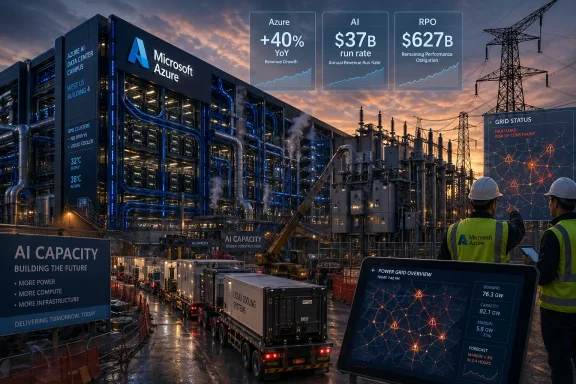 Microsoft’s AI Boom Has Become a Construction Problem
For years, Azure growth was mostly a software story wrapped in a data center story. Microsoft could talk about developer tools, enterprise migrations, database modernization, security bundles, and hybrid cloud, while the underlying infrastructure expansion remained mostly invisible to customers. The cloud was marketed as elastic, and for many workloads it felt that way.AI has changed the physics of that promise. Training and inference workloads do not merely consume “cloud capacity” in the abstract. They consume accelerators, high-bandwidth memory, high-density racks, specialized networking, liquid cooling loops, backup power systems, utility interconnects, transformers, water strategies, and land near electrical capacity that is often already spoken for.
That is why Microsoft’s quarter reads less like a conventional earnings beat than a dispatch from the front line of industrial computing. Revenue rose 18 percent to $82.9 billion, net income climbed 23 percent to $31.8 billion, and Intelligent Cloud revenue reached $34.7 billion, up 30 percent. Those are magnificent software-company numbers. But the more revealing figure is commercial remaining performance obligations, or RPO, which nearly doubled year over year to $627 billion.
RPO is not the same thing as a capacity shortage, and it should not be treated as a perfect map of Azure data center demand. It includes contracted future revenue across Microsoft’s commercial business, and the mix matters. Still, when RPO balloons at the same time Azure accelerates and Microsoft says AI has become a $37 billion run-rate business, the direction of travel is unmistakable. Microsoft has a backlog that looks less like deferred paperwork and more like a queue at the power gate.
The Cloud’s Old Metaphor Is Breaking Under AI Load
The great trick of cloud computing was to make infrastructure feel weightless. Developers clicked buttons, enterprises signed agreements, and compute appeared as if from nowhere. Even sophisticated IT buyers who understood the machinery behind the curtain benefited from a commercial abstraction: Microsoft, Amazon, and Google would worry about data center logistics so customers would not have to.AI has not destroyed that abstraction, but it has made it more expensive to maintain. A general-purpose virtual machine can be scheduled across a large pool of relatively standardized capacity. A frontier AI training cluster or a serious inference deployment is a different animal. It requires dense concentrations of accelerators, low-latency interconnects, power delivery designed for extreme rack loads, and cooling systems that look increasingly unlike the raised-floor air-cooled facilities of an earlier cloud era.
That shift changes the meaning of Azure growth. A 40 percent rise in Azure and other cloud services revenue is not just a sign that customers are consuming more storage, compute, and databases. It reflects a mix shift toward scarce, capital-intensive, power-hungry resources whose deployment timelines are harder to compress.
This is why the old cloud trope of “capacity expansion” now sounds too tidy. Microsoft is not merely adding more servers. It is assembling industrial campuses around electrical infrastructure and thermal management constraints, often in competition with other hyperscalers, colocation giants, AI labs, crypto miners, manufacturing projects, and local communities wary of power and water consumption.
The result is a market where demand can be created in a boardroom faster than capacity can be created in a county planning process. A CIO can approve an AI platform strategy this quarter. Microsoft may need many quarters, or years, to bring the necessary physical plant online.
Backlog Is the New Capacity Signal
Investors like backlog because it implies future revenue. Operators read it differently. To a data center builder, backlog is also a measure of obligations that must eventually become energized floor space, delivered hardware, and service-level commitments.Microsoft’s $627 billion in commercial RPO is therefore both comforting and uncomfortable. It says customers are locked in. It also says Microsoft’s future revenue claims are increasingly tied to execution in the least software-like parts of the business.
The Data Center Knowledge report puts the issue bluntly: Microsoft has effectively sold more AI capacity than it can currently deliver. That does not mean the company is failing. It means it is living with the consequence of success in a market where the bottleneck has migrated from product-market fit to industrial deployment.
Steven Dickens of HyperFrame Research reportedly told the publication that demand is outstripping available capacity by nearly three to one in key Tier-1 regions, and that delivery windows that once looked like six months have stretched to 18 months or more. Those figures should be treated as analyst estimates rather than Microsoft disclosures. But they align with what the industry has been saying more broadly for more than a year: the limiting factors are no longer only chips.
That distinction matters. The early AI infrastructure narrative was dominated by Nvidia GPU availability. Whoever could secure the accelerators could win the cloud customer. That is still partly true, but it is no longer sufficient. A GPU sitting in a warehouse is not Azure capacity. It becomes Azure capacity only when it is installed into a system, connected to networking, cooled, powered, monitored, secured, and integrated into a platform customers can actually use.
The Bottleneck Has Moved From Silicon to the Grid
AI infrastructure is often discussed as if it were a semiconductor supply chain problem with a data center footnote. That framing is increasingly backwards. The semiconductor supply chain remains critical, but the frontier has moved outward to the grid-to-chip interface.Transformers, switchgear, substations, utility interconnection queues, and local generation constraints now shape deployment schedules. High-density AI campuses can require enormous blocks of power, and those blocks are not available everywhere on demand. In some markets, utilities are being asked to plan for data center loads that resemble industrial megaprojects rather than office parks.
This is where Microsoft’s cloud expansion becomes a public-infrastructure story. The company can sign contracts, order servers, and announce AI services. It cannot unilaterally manufacture transmission capacity in Northern Virginia, Dublin, Phoenix, London, Singapore, or any other constrained market. It must negotiate with utilities, regulators, landowners, contractors, local governments, and communities that may not share Wall Street’s enthusiasm for AI growth.
The data center industry has always been constrained by power, but AI changes the steepness of the curve. Higher rack density means more power per square foot and more heat per rack. Liquid cooling helps move that heat more efficiently, but it adds its own procurement, engineering, operational, and maintenance complexity. Retrofitting older facilities is not always simple, and new builds require specialized designs that may not match the assumptions behind earlier hyperscale campuses.
Microsoft’s problem, in other words, is not that it lacks ambition. It is that ambition now runs through the slowest systems in technology: permitting, power delivery, construction, and utility planning.
The Profit Machine Still Works, Which Makes the Constraint More Urgent
It would be easy to misread this as a bearish story about Microsoft. It is not, at least not in the simple sense. The company’s fiscal third-quarter results show a business with extraordinary demand, pricing power, and operating leverage. Few companies on earth can report $82.9 billion in quarterly revenue and $31.8 billion in quarterly net income while arguing that their biggest problem is they cannot build fast enough.That is precisely why the capacity gap matters. The stronger the business, the more costly every delayed deployment becomes. If Azure AI capacity is scarce, Microsoft must decide which customers, regions, and internal workloads receive priority. Those decisions carry strategic consequences.
OpenAI workloads, enterprise Azure commitments, Microsoft 365 Copilot features, GitHub Copilot, security products, Dynamics AI features, Bing infrastructure, and Windows-adjacent AI services all compete, directly or indirectly, for the same broad infrastructure pool. Microsoft can optimize across that portfolio better than almost anyone, but optimization is not magic. Scarcity still creates trade-offs.
The company’s gross margin story also becomes more complicated. AI revenue is not automatically equivalent to traditional SaaS revenue. Training and inference can be capital-intensive, depreciation-heavy, and sensitive to utilization. If customers reserve capacity and use it heavily, Microsoft can justify enormous infrastructure spending. If demand shifts, models become more efficient, or competitive pricing falls faster than expected, today’s capacity scramble could become tomorrow’s margin debate.
For now, Microsoft’s numbers suggest demand is more than real enough. The question is whether the company can convert that demand into delivered services without letting capital intensity outrun the economics that made the cloud business so attractive in the first place.
Neoclouds Are Not a Sideshow Anymore
The capacity gap also explains the rise of specialized GPU cloud providers. Companies such as CoreWeave are often described as AI boom beneficiaries, but that undersells their role. They exist because the hyperscalers cannot satisfy all demand quickly enough, and because some customers want direct access to accelerator-heavy infrastructure without waiting for the largest cloud platforms to provision it.In the old cloud market, a smaller infrastructure provider competing with Microsoft, Amazon, or Google looked structurally disadvantaged. The hyperscalers had global footprints, procurement muscle, integrated platforms, enterprise sales channels, and balance sheets that could crush most rivals. AI has opened a window for specialists because speed, density, and access to GPUs can matter more than breadth.
That does not mean neoclouds will displace Azure. Most enterprises still want identity, compliance, observability, security, data services, and integration with existing workflows. Microsoft’s advantage is not just that it can rent GPUs; it can attach those GPUs to the operating fabric of enterprise IT. But overflow markets can become strategic markets if shortages persist long enough.
For Microsoft, specialized providers are both useful and threatening. They can absorb demand that Microsoft cannot immediately serve, helping the ecosystem continue growing. They can also train customers to think of AI infrastructure as separable from the hyperscale cloud stack, particularly for model builders and AI-native companies that care more about accelerator access than bundled enterprise services.
The longer delivery windows stretch, the more credible these alternatives become. Scarcity does not merely delay revenue. It changes customer behavior.
Enterprise IT Now Has to Plan Around Cloud Scarcity
For WindowsForum.com readers, the practical lesson is not that Azure is unreliable or that Microsoft’s AI strategy is collapsing. The lesson is that the cloud is entering a planning regime that looks more like enterprise hardware procurement than the on-demand model many teams have internalized.If your organization is planning serious AI workloads on Azure, capacity conversations need to happen earlier. Region choice, data residency, latency requirements, compliance boundaries, GPU type, cooling-dependent availability, and reservation strategy may all influence whether a project launches on schedule. The assumption that capacity will simply be there when the app team is ready is increasingly risky.
This is especially true for regulated enterprises and public-sector customers that cannot freely move workloads among regions. A startup may chase available GPUs wherever they exist. A bank, hospital, defense contractor, or government agency may not have that flexibility. For those buyers, local capacity constraints can become project constraints.
Microsoft’s sales motion will also matter. Customers with large strategic commitments may receive better visibility into future capacity than smaller buyers. That is not new in enterprise technology, but AI makes the stakes higher because scarce capacity can determine whether an organization gets to deploy a competitive capability this year or next.
IT leaders should therefore treat AI infrastructure as a dependency with lead times, not as a utility switch. The planning conversation should include procurement, legal, security, facilities, finance, and architecture. AI pilots can be improvised. Production AI platforms cannot.
Windows Is Not Outside This Story
At first glance, a data center capacity gap might seem distant from Windows users and administrators. It is not. Microsoft’s client and productivity strategies increasingly assume abundant cloud-side AI capacity.Copilot in Windows, Microsoft 365 Copilot, cloud-backed security analytics, developer assistants, AI-powered search, endpoint management intelligence, and agentic workflows all depend on back-end inference capacity. Some tasks may move to local NPUs on Copilot+ PCs, and Microsoft will continue pushing hybrid AI that blends device and cloud execution. But the most capable models, the freshest enterprise graph context, and the heaviest reasoning workloads still pull from data centers.
That creates an interesting tension in Microsoft’s platform strategy. On-device AI is partly a user-experience play, partly a privacy play, and partly a capacity hedge. The more useful local models become, the less every interaction must traverse expensive cloud infrastructure. But local AI also fragments the experience, because device capability varies widely across the installed base.
For sysadmins, this means AI features will not arrive as a single clean layer. They will be distributed across Windows hardware, Microsoft 365 services, Azure back ends, security portals, and management planes. Capacity constraints in the cloud may influence rollout pacing, licensing tiers, regional availability, and the difference between preview features and broadly dependable production tools.
The Windows ecosystem has lived through hardware transitions before. This one is unusual because the hardware transition is happening both under the user’s desk and inside Microsoft’s data centers at the same time.
Microsoft’s Capital Spending Is a Bet on Timing
The most difficult part of Microsoft’s AI buildout is not deciding whether AI demand exists. It is deciding how much infrastructure to build before the demand curve is fully knowable. Build too slowly, and Microsoft leaves revenue and strategic influence on the table. Build too aggressively, and it risks saddling itself with expensive capacity in a market where model efficiency, chip performance, and competitive dynamics change quickly.This is the central tension of the AI infrastructure cycle. Everyone can see demand today. Nobody can perfectly forecast the shape of demand in 2028 or 2030. The industry does not yet know how much inference will be needed per user, how much model optimization will reduce compute intensity, how much on-device AI will absorb common tasks, or how pricing will evolve as supply expands.
Microsoft has advantages in that uncertainty. Its AI demand is diversified across Azure customers, OpenAI-related workloads, Microsoft 365, GitHub, security, developer tools, and business applications. It does not have to bet on a single consumer chatbot or one class of model training. Its enterprise relationships give it visibility into customer road maps that smaller providers lack.
But even Microsoft cannot escape the timing risk. Data centers are long-lived assets. Power contracts, land acquisitions, cooling designs, and networking architectures encode assumptions about future workloads. In fast-moving software markets, a wrong assumption can be patched. In infrastructure, a wrong assumption can sit on the balance sheet for years.
That is why the capacity gap is not merely an operational nuisance. It is a strategic forcing function. Microsoft must build enough to defend and expand its AI lead, but not so blindly that the cloud business becomes hostage to yesterday’s view of tomorrow’s compute needs.
The AI Supply Chain Is Becoming Political
As data center constraints move closer to the grid, Microsoft’s AI expansion becomes more exposed to politics. Communities are asking harder questions about electricity demand, water use, tax incentives, land consumption, and whether data centers create enough local jobs to justify their footprint. Utilities are wrestling with how to serve enormous new loads without raising costs for households and other businesses.This matters because hyperscale AI is no longer a purely private transaction between Microsoft and its customers. When a new campus requires hundreds of megawatts, the consequences spill into regional planning. Transmission upgrades, generation mix, backup power, water systems, and local permitting all become part of the AI value chain.
Microsoft has spent years positioning itself as a responsible operator, with commitments around carbon, water, and sustainability. AI growth makes those commitments harder to satisfy. The company can buy renewable energy, invest in efficiency, and design better cooling systems, but the sheer scale of demand increases scrutiny. A more efficient data center can still consume a staggering amount of power if the total buildout is large enough.
There is also a national competitiveness angle. Governments increasingly view AI infrastructure as strategic capacity, not just commercial real estate. The same cloud regions that serve enterprise software now support defense, health care, finance, scientific research, and public administration. If power constraints limit AI deployment in one country or region, investment may shift elsewhere.
For Microsoft, this means the next phase of cloud competition will be fought not only with models and software platforms, but with utility relationships, regulatory credibility, and the ability to persuade communities that AI infrastructure is worth hosting.
The Numbers Say Yes, the Substation Says Not Yet
The cleanest way to understand Microsoft’s quarter is to separate demand from deliverability. The demand side is emphatic. The deliverability side is where the story becomes complicated.Microsoft can point to Azure’s 40 percent growth, a $37 billion AI annual revenue run rate, and commercial RPO of $627 billion as evidence that customers are not merely experimenting. They are committing. They are signing contracts, moving workloads, and building strategies around Microsoft’s AI stack.
But AI capacity is not a normal software subscription. It must be manufactured continuously out of physical inputs that have their own bottlenecks. The risk is not that Microsoft lacks customers. The risk is that customers discover the wait time between strategic intent and usable capacity is longer than the AI hype cycle led them to expect.
That mismatch could shape the next year of enterprise AI adoption. Some projects will be delayed. Some will be resized. Some will shift regions. Some will use smaller models, different architectures, or third-party GPU clouds. Some will move toward hybrid inference, with local devices handling more work than originally planned.
This is not the end of cloud elasticity. It is the end of pretending elasticity is infinite in the face of AI-scale demand.
The Practical Reading for Microsoft Shops
The most important message for IT teams is that Microsoft’s AI surge is real, but so are the constraints around it. Treat both as operating facts, not as competing narratives.- Microsoft’s fiscal third-quarter results showed exceptionally strong cloud and AI demand, with Azure and other cloud services revenue up 40 percent year over year.
- The company’s $627 billion in commercial remaining performance obligations signals deep contracted demand, but it also highlights the execution burden of turning commitments into delivered capacity.
- AI infrastructure constraints now extend beyond GPUs into power availability, transformers, cooling systems, facility readiness, and regional utility capacity.
- Enterprise customers planning production AI workloads on Azure should start capacity, region, compliance, and reservation discussions earlier than they would for conventional cloud projects.
- Specialized GPU cloud providers are gaining relevance because hyperscale capacity is scarce, not because the hyperscalers have lost their structural advantages.
- Microsoft’s long-term AI position will depend as much on industrial execution as on model quality, software integration, or enterprise licensing.
Source: Data Center Knowledge Microsoft AI Surge Exposes Data Center Capacity Gap
