• Thread Author
Microsoft’s cloud and AI engines — the same infrastructure the company says it polices through terms of service — are now the focus of a renewed debate over corporate responsibility after leaked documents showed U.S. Immigration and Customs Enforcement (ICE) dramatically expanded its Azure footprint, and Microsoft workers and allied activists demanded the company cut ties with the agency.

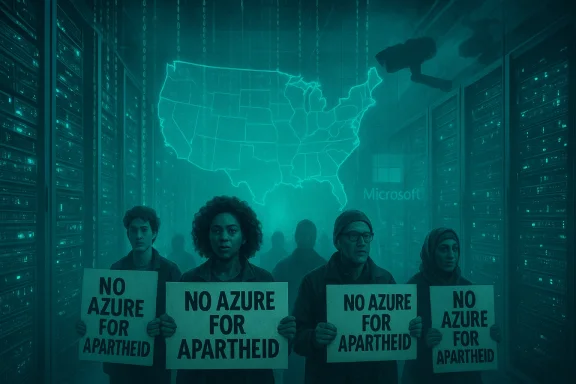
Protesters in a data center hold 'No Azure for Apartheid' signs under a glowing map of the United States.Background​

In mid‑February 2026, reporting led by The Guardian and partner outlets revealed that ICE’s data stored on Microsoft’s Azure cloud rose from roughly 400 terabytes in July 2025 to nearly 1,400 terabytes by January 2026 — a more than threefold increase in six months. The reporting, which relied on procurement records and leaked documents, also said ICE used Microsoft productivity suites and AI‑driven tools to search and analyse that data, and that the agency had bought virtual machines and vision/video analysis capabilities.
The revelations arrived against a fraught backdrop for Microsoft. In September 2025, the company publicly disclosed that it had “ceased and disabled a set of services” for a unit inside Israel’s Ministry of Defence after independent reporting alleged that those services were used to ingest and analyse mass quantities of intercepted Palestinian communications. Microsoft said the action was taken to enforce its terms of service, which prohibit using its products for mass surveillance of civilians.
Those two threads — Microsoft’s limited enforcement against an Israeli military unit, and now the agency use case in the United States — have been stitched together by worker‑led groups and activists under the banner No Azure for Apartheid and allied campaigns. They argue that the identical cloud and AI building blocks that can be used to power surveillance in one theatre are being deployed by enforcement agencies elsewhere with similar human‑cost consequences. PC Gamer published a direct statement from No Azure for Apartheid that echoed those concerns and reiterated long‑standing demands for Microsoft to sever ties with ICE.

What the leaked files say (and what they don’t)​

Key claims from the reporting​

  • ICE’s Azure storage rose from ~400 TB to ~1,400 TB between July 2025 and January 2026.
  • The procurement records link that shift to increased purchases of blob storage, virtual machines, and AI‑enabled video and image analysis tools on Azure.
  • Microsoft’s public response framed its relationship as delivering “cloud‑based productivity and collaboration tools to DHS and ICE, delivered through our key partners,” and reiterated that its policies “do not allow our technology to be used for the mass surveillance of civilians.”

Important gaps and caveats​

The leaked procurement materials are specific about capacity and product lines, but they do not by themselves prove how ICE is using particular data sets, nor do they show whether Azure-hosted systems are directly ingesting intercepted communications versus supporting administrative systems, detention logistics, or other operational software. The reporting notes this ambiguity and Microsoft reiterates that it does not have visibility into the content of customer data where privacy protections apply. That distinction matters for legal and ethical analysis — and it must be stated plainly when weighing the strength of the allegations.

Who is No Azure for Apartheid and what are they demanding?​

No Azure for Apartheid is a worker‑led movement originally formed inside Microsoft by employees and ex‑employees critical of the company’s contracts with the Israeli military and other security agencies. The group has staged public protests, internal petitions and occupation actions in Redmond and made repeated demands that Microsoft end relationships that, in the activists’ view, enable state violence and mass surveillance. Their most recent statement connects the ICE reporting to the group’s earlier activism and calls for Microsoft to cut ties with ICE — a demand the organization frames as consistent with earlier employee campaigns that began in 2018.
Their public framing emphasizes a moral equivalence: the same cloud and AI stacks that power large‑scale surveillance elsewhere are being repurposed to target migrant communities and other vulnerable populations in the U.S. The group also points to the opacity of government contracts and to the ways companies sometimes rely on resellers or partners, which activists say can mask the extent of involvement.

Microsoft’s official stance and the limits of corporate visibility​

Microsoft’s public statements on both the Israeli military episode and the ICE revelations follow a consistent pattern:
  • Reaffirmation of contractual terms and acceptable‑use policies that prohibit the mass surveillance of civilians.
  • A claim that the company lacks direct visibility into customer content where privacy rules and customer controls apply.
  • An argument that enforcement of acceptable‑use obligations is applied through audits and review processes; in some cases, Microsoft has said it disabled specific subscriptions when internal reviews found evidence of misuse.
But the language matters. Microsoft’s phrasing — that it “provides cloud‑based productivity and collaboration tools to DHS and ICE, delivered through our key partners” — raises three operational questions worth noting:
  • What portion of the service relationship is direct vs. brokered through resellers and systems integrators? When third parties provision or manage services, the principal vendor’s operational visibility can diminish.
  • Which Azure features are being used — customer‑managed storage, PaaS services, or managed services hosted and controlled by the vendor or its partners? Each model has different implications for auditability and contractual enforcement.
  • How robust are Microsoft’s telemetry and contractual audit provisions for high‑risk public‑sector customers? Public statements reference reviews and disabling of subscriptions, but do not detail the technical or contractual mechanisms that would prevent misuse over time.

Technical anatomy: how Azure could be repurposed for surveillance and analysis​

To evaluate the risk profile, we need to be concrete about the technologies named in the reporting and how they are commonly used:
  • Blob storage (object storage) — Scales to petabytes and is typical for storing raw media (audio, video) and large CSV/JSON datasets. Large‑scale storage makes it feasible to aggregate long histories of communications or footage for later retrieval. Leaked procurement documents specifically reference Azure storage capacity increases.
  • Virtual machines and compute instances — Provide the CPU/GPU cycles to run indexing, search, and analysis pipelines; these may host ingestion services, metadata extractors, or transcription workflows for audio files.
  • AI‑driven vision and video analysis — Commercial cloud offerings now provide prebuilt or managed models that perform face detection, object tracking, OCR, and content indexing at scale. These can be chained into pipelines that turn raw footage into searchable metadata.
  • Search and indexing services — When coupled with large object stores and compute, search tools enable investigators to query and cross‑reference people, phone numbers, locations and timestamps. AI tools can accelerate triage and target identification.
  • Productivity and collaboration tools — These are used for case management, documentation, and workflows. While less sensational technocratically, they can amplify operational capacity by making datasets and analysis results widely available inside an agency.
The combination matters. Storage alone is inert; it’s the compute, indexing, and AI layers that turn raw files into operationally useful intelligence. That is what activists worry about when they point to “the same technology” powering both overseas surveillance and domestic enforcement.

Policy and legal context: what the law says (and what it doesn’t)​

There is no single U.S. statute that expressly bans federal agencies from using private‑sector cloud or AI capabilities for investigative or enforcement purposes. Instead, federal procurement is governed by a patchwork of acquisition rules, privacy statutes (e.g., Privacy Act), criminal procedure protections, and internal agency policies. Oversight typically exists through Congress, IG offices, and courts — but the scale and speed of AI adoption often outruns those mechanisms.
Key governance weaknesses highlighted by the current situation include:
  • Procurement opacity: Agencies can purchase cloud capacity through multiple contracting vehicles, and when partners or resellers are used, disclosure and public transparency are reduced. Leaked procurement documents often surface only when whistleblowers or investigative journalists obtain them.
  • Lack of clear statutory limits for AI surveillance: Policymakers are only now debating the contours of acceptable AI use by law enforcement and immigration agencies. Until clear legal limits are set, corporate terms of service and internal agency policies become primary mitigants — and those are variable in their enforceability.
  • Patchwork oversight: Office of Inspector General reviews, congressional inquiries, and litigation can reveal misuse after the fact, but they do not necessarily prevent real‑time harm. The Microsoft‑IMOD review showed the company can act defensively, but its action was reactive and limited in scope.

Corporate responsibility: what Microsoft can (and can’t) do​

Microsoft’s response to the Israeli military reporting — disabling some subscriptions after an internal and external review — sets a precedent that the company can, in certain circumstances, restrict customers. But several factors constrain what a vendor can do:
  • Contractual limits: Cloud contracts typically define services, SLAs, and acceptable use; enforcement requires evidence and due process. Broad, pre‑emptive blocks could provoke contract disputes or even national security concerns when sovereign customers are involved.
  • Technical visibility: When customers control encryption keys and host workloads behind customer‑managed environments, vendor telemetry into content is limited. Microsoft’s claim that it “does not have visibility” into certain customer usage is a technical reality for many cloud deployments.
  • Market competition and procurement incentives: Microsoft (and other hyperscalers) competes for public‑sector business. Companies that refuse controversial customers may cede market share to rivals willing to accept risk, unless consistent industry standards or regulation align incentives.
  • Operational dependence and the ‘essential services’ argument: Vendors sometimes point to the cybersecurity or continuity services they provide as reasons to maintain overall relationships even while restricting certain products or subscriptions. Microsoft said its disabling action did not affect broader cybersecurity work for Israel, which suggests fine‑grained selective enforcement is technically possible — but politically and operationally sensitive.

Civil society and worker leverage: tactics, leverage points, and limits​

No Azure for Apartheid and allied campaigns have used multiple tactics to press Microsoft: internal petitions, public protests, sit‑ins, press campaigns, and public policy advocacy. Those tactics create reputational and operational pressure that can push companies to explain or change practices, as seen with the September 2025 action against IMOD subscriptions.
Where worker and activist leverage is strongest:
  • Reputational risk: Sustained coverage and employee unrest can affect talent retention, investor relations, and customer perception. That creates incentives for public statements and reassessments.
  • Operational friction: Protest actions and internal dissent can interfere with product roadmaps and morale, encouraging executives to engage.
  • Policy advocacy: Activists can push for legislative or regulatory scrutiny, which changes the operating environment for vendors and customers.
Limits include legal exposure for disruptive actions, the scale and profitability of government contracts (which can make walking away costly), and the challenge of proving downstream misuse when vendors legitimately claim limited visibility into customer's content.

Risks and tradeoffs: surveillance, mission creep, and dual‑use AI​

The ICE‑Azure reporting raises several concrete risks:
  • Mass indexing of vulnerable populations: The storage and AI stack that makes it feasible to index millions of calls or hours of footage turns routine bureaucratic tasks into broad surveillance opportunities with chilling civil‑liberties implications.
  • Function creep: Administrative or efficiency tools (case management, translation, search) can be repurposed for targeting and enforcement escalation, especially if oversight is weak.
  • Vendor lock‑in and concentration risk: Hyperscalers provide economies of scale that agencies prize; but concentration means a single supplier’s policy choices reverberate widely across government practice.
  • Evasion and shadow procurement: Agencies can move workloads between providers, or use intermediaries to obscure operations — complicating transparency and accountability.

Practical recommendations: what stakeholders should do now​

For Microsoft (and other hyperscalers)​

  • Publish clearer contractual guardrails for high‑risk public‑sector customers that include mandatory audit rights, transparency reporting, and independent review triggers when abuse is alleged.
  • Enhance technical controls that enable vendor‑enforced constraints without undermining legitimate privacy protections, including fine‑grained service flags and conditional access tied to documented uses.
  • Create an independent escalation mechanism: An externally supervised process (with civil‑society observers and technical experts) that can rapidly adjudicate claims of misuse and recommend proportional actions.

For policymakers and oversight bodies​

  • Mandate procurement transparency for law‑enforcement and immigration contracts that involve cloud or AI services, with redaction rules to protect sensitive operations but public disclosure of service categories and capacities.
  • Set statutory limits on mass‑scale surveillance and create specific restrictions for AI‑enabled indexing of sensitive personal data.
  • **Fund independent auditAI deployments and require audit trails that cannot be erased without authorization.

For civil society and technologists​

  • Demand and support independent technical audits of suspicious deployments, and invest in investigative capacity that can parse procurement trails and configuration artifacts.
  • Push for employee protections that enable responsible whistleblowing and internal reporting without retaliation.

The larger lesson: corporate power, public accountability, and a fast‑moving tech landscape​

The ICE‑Azure episode is not only about a single vendor and a single agency. It is a case study in how modern cloud and AI platforms concentrate power and capability in the hands of a few private firms — and how that concentration reshapes the levers of governance. When procurement, contracts, and technical architectures converge in opaque ways, accountability becomes diffuse and slow, while capacity for harm grows rapidly.
Microsoft’s prior action in September 2025 to disable certain services used by an Israeli military unit demonstrated the company can, under pressure, restrict subscriptions — but it also revealed that such measures are reactive, often limited, and politically fraught. The new ICE reporting throws a mirror back at those events: the same features that sparked global protest over overseas use can, domestically, produce outcomes civil‑liberties advocates find equally alarming.

Conclusion​

The leaked procurement records linking ICE’s surge in Azure usage to expanded storage, compute and AI services have refocused a broader debate about the ethics of cloud and AI supply chains. Worker groups such as No Azure for Apartheid are pushing Microsoft to make a hard choice: end relationships with agencies they argue are causing harm, or continue to service those customers and manage the mounting political and ethical cost. Microsoft’s public posture — invoking contractual terms and limited visibility into customer content — answers some questions but leaves others open about enforceability, transparency, and the technical levers that could prevent misuse.
This episode highlights a structural problem: tools that scale and lower the cost of complex analysis do not come with matched public governance. If the public, Congress, regulators, and technology companies do not close that gap with concrete rules, independent audits, and stronger procurement transparency, then the same platforms that bring enormous public benefit will continue to be repurposed in ways that can inflict real and lasting harm.

(Technical background and discussion also informed by internal discussion threads and community reporting collated from public forums and investigative threads.)

Source: Rock Paper Shotgun No Azure for Apartheid call on Microsoft to cut ties with ICE, amid reports of agency deepening reliance on company's cloud and AI
 

Microsoft employees and allied activists have renewed pressure on the company to sever its ties with U.S. Immigration and Customs Enforcement (ICE) after leaked documents showed ICE dramatically expanded its use of Microsoft Azure cloud services during a recent enforcement surge. The revelations — which indicate ICE’s Azure storage ballooned from roughly 400 terabytes to nearly 1,400 terabytes over six months — have reignited debates inside Microsoft about corporate responsibility, surveillance risk, and the limits of vendor neutrality. A prominent in‑house group, No Azure for Apartheid, is now explicitly demanding that Microsoft stop supplying cloud, AI, or analytics tools to ICE, arguing those services materially enable enforcement practices that activists say amount to human-rights abuses. Microsoft has pushed back, saying its terms forbid mass surveillance and that it does not believe ICE is using its tools for that purpose. The clash exposes a difficult crossroads for large cloud providers: balancing lucrative government business against employee activism, reputational risk, and fast‑evolving ethical norms around AI and surveillance.

Protesters with NO AI and ETHICS signs confront a looming Azure cloud above ICE.Background​

What the documents claim​

Leaked files reviewed by investigative reporters show a rapid rise in ICE’s consumption of commercial cloud services through the second half of last year. The files indicate ICE’s stored data on Microsoft Azure climbed from around 400 TB in mid‑2025 to about 1,400 TB by January 2026. They also list the use of a mix of Azure services — object/blob storage, virtual machines (VMs), and AI‑enabled media and vision tools — that are commonly used to index, transcribe, analyze, and search large collections of images, audio, and video.
Crucially, the documents do not publicly disclose the actual contents of that storage: the files describe capacity and services in use, but they stop short of naming which specific datasets — surveillance footage, detention or case records, location logs, or administrative files — were stored or processed on Azure. That distinction matters: capacity and capability do not, by themselves, prove a particular abusive use, but they do show how quickly a law‑enforcement agency can scale up data processing when vendor services are in place.

Why this matters now​

The increase in Azure holdings occurred alongside a large expansion in ICE’s budget and workforce, which has fueled a simultaneous escalation in arrests, deportations, and field operations. Because modern enforcement increasingly relies on data analysis and multimedia intelligence, outsized cloud capacity combined with AI indexing services effectively accelerates an agency’s ability to extract searchable insights from raw media. For civil‑liberties advocates and many tech workers, that creates an urgent question: when a vendor supplies a platform capable of face detection, OCR, and automated video or audio indexing, what responsibility does it bear for downstream enforcement outcomes?

Overview of the actors​

ICE: enforcement and digital expansion​

ICE is a federal law‑enforcement agency responsible for immigration enforcement and related investigations. In the last 18 months its funding and headcount reportedly increased substantially, and the agency has been acquiring new technical capabilities for data ingestion, analysis, and field support. That procurement trend mirrors a broader pattern across many law‑enforcement and homeland‑security agencies that have outsourced large parts of their data infrastructure to hyperscale cloud vendors.

Microsoft: cloud vendor and corporate steward​

Microsoft is one of the largest cloud providers globally and supplies core infrastructure and AI services through Azure. The company also sells productivity suites, identity and access management, and a growing catalog of AI inferencing and media‑analysis tools. Internally, Microsoft has a sizable community of employees who publicly and privately press leadership on ethical concerns. The No Azure for Apartheid group — part of a broader No Tech for Apartheid network — has led sustained campaigns demanding Microsoft end cloud and AI support for certain government and military actors.

No Azure for Apartheid and employee activism​

No Azure for Apartheid began as a worker‑led campaign focused on Microsoft’s relationships with the Israeli military and broadened into general activism against perceived corporate complicity in state violence. The group has organized protests on campus, circulated petitions and demands, and publicly called for Microsoft to cut ties with agencies they believe perpetuate human‑rights abuses — including ICE. The current ICE revelations have given those demands renewed traction inside the company and among allied civil‑society groups.

What Azure can (and can’t) do: technical capabilities relevant to surveillance​

Relevant Azure services​

Microsoft’s Azure platform includes a range of services that are material to modern media analysis and search:
  • Blob/object storage: inexpensive, scalable storage for large media collections (images, video, audio), enabling agencies to centralize disparate datasets.
  • Virtual machines (VMs): cloud machines that run agency software, analytics pipelines, or custom tools without on‑premises hardware.
  • Azure AI Video Indexer and Video Analyzer: services that extract transcripts from audio, run OCR on video frames, detect objects and scenes, flag audio events (gunshots, sirens), and index facial metadata where enabled.
  • Azure Cognitive Services (Computer Vision, Face, Speech): APIs that support face bounding boxes, identity matching (in limited access scenarios), object detection, sentiment and emotion inference, and speech‑to‑text transcription.
  • Search and analytics stacks: managed databases, search indexes, and big‑data processing services that let users build low‑latency queries across massive collections.
Microsoft documentation and product pages confirm that these services can produce rich, machine‑readable metadata from unstructured media. Depending on configuration, that metadata — when linked with identity records or other databases — can make individuals or events quickly discoverable across large temporal and spatial datasets.

Access controls and “limited access” features​

Microsoft’s public documentation indicates it restricts certain sensitive capabilities — notably facial identification and celebrity recognition — under a “Limited Access” regime that requires registration and approved use cases (typically media/entertainment or benign archival workflows). Other features such as face detection, OCR, and object labeling are more broadly available. The existence of access controls is relevant; it shows Microsoft recognizes higher‑risk features require governance. The key operational question is whether and how those controls are enforced for government customers using reseller chains or third‑party integrators.

What the documents do and don’t demonstrate technically​

The leaked files name the types of services and capacity ICE purchased or used. They do not, however, provide forensic proof that Azure’s facial identification pipelines were actively used to target civilians in the field. Nor do they list the actual metadata outputs, linking records, or downstream analytics code. That makes technical verification partial: the architecture and capability are evident; the precise operational uses remain, in public view, insufficiently specified.

Corporate policy and legal context​

Microsoft’s stated policy stance​

Microsoft has repeatedly stated that its commercial terms and Responsible AI policies prohibit the use of its technology for mass surveillance of civilians. Company statements also note that some restricted AI capabilities are only available under strict registration and approved commercial use cases. Nevertheless, Microsoft acknowledged to employees in internal communications that it maintains contracts with DHS and ICE for certain cloud and productivity services — though it says it “does not presently maintain AI services contracts tied specifically to enforcement activities.”

The limits of vendor terms​

Contractual prohibitions are only as effective as monitoring, auditing, and enforceable contractual remedies. In complex supply chains, government agencies often procure through resellers, prime contractors, or intergovernmental agreements, which can blur visibility into specific deployments. Additionally, legal standards for “surveillance” can be narrow; a service used for administrative flight logs or detention management may still enable surveillance when linked with other data sources.

Regulatory and oversight pressures​

The ICE revelations add to a widening set of political and regulatory pressures: lawmakers, civil‑liberties groups, and internal employee activists are all calling for clearer legal lines around government use of AI and cloud tools. Microsoft has publicly urged Congress and the courts to define the allowable scope for emerging technologies — a sign the company seeks a legal framework to settle ambiguity. At the same time, regulatory developments around platform liability, procurement transparency, and export controls could affect how cloud vendors sell to law‑enforcement customers in the near term.

Ethical analysis: obligations, harms, and the vendor’s role​

The case for stricter vendor limits​

  • Capability enables harm: When a vendor provides scalable AI indexing and face‑matching tools, it materially lowers the cost and time to identify, locate, and process people. That capability magnifies any existing policy or operational bias in enforcement agencies.
  • Moral proximity: Vendors are not passive utilities. Design choices, default settings, access controls, and contractual clauses shape downstream outcomes. Many ethicists argue that firms supplying potentially harmful capabilities bear responsibility to refuse or condition sales where misuse is foreseeable.
  • Employee and public trust: The corporate social license depends on perceived alignment between a company’s values and its business partners. Sustained worker activism inside Microsoft shows employees interpret ongoing sales as ethical compromise, raising retention and reputational risks.

The countervailing arguments​

  • Neutral infrastructure argument: Vendors often argue they provide neutral infrastructure used across many lawful purposes; refusing service to government customers risks ceding oversight to less scrupulous vendors and may be viewed as abdication of civic duty.
  • Lawful purpose and oversight: Companies note that many legitimate, lawful uses exist for cloud and AI tools — administrative efficiency, human‑trafficking investigations, disaster response — and that vendor terms and limited access controls aim to prevent misuse.
  • Practical enforceability: Contractual restrictions are hard to police in practice; a strict vendor ban may be theatrical without accompanying industry‑wide standards or legal requirements.

Weighing responsibility and risk​

The ethical center of gravity shifts when a vendor’s tools clearly accelerate state action that many independent observers, courts, or oversight bodies deem abusive. In those circumstances, continuing to provide unrestricted or poorly governed access becomes harder to justify. The leaked documents suggest Microsoft’s tech has been positioned to scale ICE’s capacity quickly; whether that should trigger an immediate halt to services depends on several factors: the specific services in use, the immediacy of harm, contractual language, and whether Microsoft can implement short‑term mitigation that forestalls abuse while the company pursues structural fixes.

Business and operational risks for Microsoft​

Reputational and financial impacts​

  • Employee unrest and attrition: Public protests, campus occupations, and mass petitions harm internal morale and can accelerate talent loss in sensitive engineering teams.
  • Customer churn: Enterprises and public customers mindful of ethics may reassess partnerships with a vendor perceived to enable contentious government actions.
  • Regulatory scrutiny: Continued revelations invite oversight hearings, procurement audits, and possibly loss of certain government business if policies or terms are found wanting.

Legal and contractual risk​

  • Contract enforcement and liability: If evidence emerges that Microsoft’s services were used in unlawful operations, plaintiffs or oversight bodies could press for contractual remedies, penalties, or changes to procurement rules.
  • Supply chain exposure: Selling via resellers complicates Microsoft’s ability to enforce use‑case restrictions; that obfuscation itself is a risk vector.

Market and competitive considerations​

Cutting off a large government buyer would reduce near‑term revenue and could push agencies toward other providers — an outcome Microsoft must weigh against long‑term brand trust and employee retention. Conversely, proactive governance could become a competitive differentiator in an era where ethical cloud supply chains matter to enterprise customers.

What Microsoft could do next: practical policies and steps​

Microsoft is at a decision point where it must choose a path that balances law, ethics, and business realities. The following moves are actionable and scalable:
  • Implement immediate, targeted access audits
  • Conduct an independent forensic review (with oversight) of exactly which Azure features ICE uses, how resellers are involved, and which datasets are being processed. Prioritize transparency where permissible by law.
  • Enforce and tighten Limited Access controls
  • Expand enforcement, logging, and third‑party audits for any facial identification or identity‑matching features used by government customers.
  • Establish conditional sale policies for sensitive capabilities
  • Require explicit, narrowly defined use cases, contractually enforceable audits, and human‑rights risk assessments prior to enabling high‑risk features for law‑enforcement customers.
  • Create an emergency suspension clause
  • Build contract language that allows suspension of services where credible evidence shows usage facilitating mass, indiscriminate surveillance or systemic rights abuses.
  • Increase employee engagement and whistleblower protections
  • Strengthen internal reporting channels and publish an annual transparency report on government contracts and human‑rights risk assessments.
  • Advocate for public regulation
  • Work with Congress and regulators to define clear legal limits on certain surveillance technologies, so companies are judged against external rules rather than ad hoc internal decisions.
These steps combine technical, contractual, and governance measures. They are not costless, but they create a defensible posture that aligns legal compliance with ethical stewardship.

How other stakeholders will respond​

Activists and employees​

Expect amplified demands: petitions, coordinated actions across big tech, and targeted public campaigns. No Azure for Apartheid has already broadened its focus beyond Israel to include domestic agencies such as ICE, and the current revelations will likely intensify pressure on Microsoft’s leadership and board.

Lawmakers and regulators​

Politicians across the spectrum will use the disclosures to call for hearings, procurement transparency, and potentially new constraints on how government agencies may purchase or use AI‑enabled cloud services. Some lawmakers may push for restrictions that limit the export of certain AI capabilities to federal agencies without explicit oversight.

Competitors and customers​

Rivals may seize the moment to pitch more restrictive governance or sovereign cloud options. Large enterprise customers sensitive to reputation risk will watch Microsoft’s response closely and demand clearer commitments on human‑rights due diligence.

Risks and unintended consequences​

  • Vendor cutoffs can push buyers to less regulated suppliers: If Microsoft abruptly withdraws services, agencies may turn to smaller vendors with weaker governance, increasing misuse risk.
  • Political backlash and procurement wars: A public split between big tech and government agencies may trigger legislative responses to enforce procurement continuity or to punish vendors perceived as obstructing enforcement.
  • Operational disruption: Rapid service termination could disrupt legitimate operations (immigration court schedules, aid coordination, or lawful investigations) if not carefully managed.
These trade‑offs underscore why thoughtful, transparent transitions and binding guardrails are more effective than reflexive bans.

Verdict: a practical, principled path forward​

The leaked documents make one thing clear: modern cloud and AI capabilities materially change the scale and speed of law‑enforcement data processing. That reality creates responsibility for vendors that goes beyond traditional contract law. Microsoft’s existing policies and “limited access” features are a necessary first step, but the company’s public statements — while insisting services are not being used for mass surveillance — do not by themselves resolve the underlying governance gap.
A principled, pragmatic approach would combine immediate technical safeguards with longer‑term policy commitments:
  • Rapid, independent audits to establish facts about feature usage and data holdings.
  • Stronger contractual controls, including narrow use‑case approvals, external audits, and enforceable suspension rights.
  • Public transparency reports about government customers and the human‑rights risk assessments applied to sensitive sales.
  • Active engagement with lawmakers to help draft clear legal rules that set consistent industry standards.
These measures protect civil liberties while avoiding the perverse outcome of pushing government surveillance to less accountable vendors. They also respond to employees’ ethical demands in a substantive way, rather than with rhetorical assurances alone.

Conclusion​

The ICE‑Azure revelations are a stress test for the tech industry’s promises about responsible AI and ethical cloud stewardship. Microsoft sits at the intersection of enormous technological capability, intense political pressure, and an increasingly vocal workforce that expects ethical alignment with company values. The company can choose to treat this episode as a reputational crisis to manage or as an inflection point to reshape how hyperscale cloud providers govern high‑risk government customers. Smart, transparent governance — not silence or purely legalistic denials — will be necessary if Microsoft wants to retain the trust of employees, customers, and the public while operating in a world where cloud platforms are central to both civic life and civil liberties.

Source: TheGamer Microsoft Workers Call On Company To Cut Ties With ICE
 

The U.S. immigration agency ICE more than tripled the amount of data it was storing on Microsoft’s Azure cloud — from roughly 400 terabytes in July 2025 to about 1,400 terabytes by January 2026 — at the same time the agency expanded its use of Azure’s AI video and vision tools, a surge that raises urgent questions about cloud governance, AI surveillance, and corporate responsibility.

Cloud computing in a data center with silhouettes and flowing data streams.Background​

The reporting that first detailed the surge in cloud usage draws on leaked procurement and usage records obtained by investigative outlets. Those files show a steady increase in Azure “blob” storage holdings and an expansion of virtual machine and AI service consumption inside ICE accounts during the second half of 2025. The documents do not, however, publish the raw datasets themselves or catalog the precise content types stored inside those terabytes.
This revelation arrives amid a broader political and budgetary context: ICE’s budget and workforce experienced major growth through 2025, and the agency has been an active buyer of cloud, analytics, and surveillance-adjacent technologies. The timing — a sharp capacity increase across half a year — is what makes the numbers newsworthy and legally and ethically consequential.

What the files say — and what they don’t​

The headline numbers​

  • ICE’s Azure storage footprint reportedly rose from ~400 TB in July 2025 to ~1,400 TB by January 2026, a near-tripling of stored capacity in six months. This is the central numerical claim driving the coverage.
  • The same set of files points to increased use of virtual machines, expanded licensing for productivity apps and AI chat capabilities, and references to Azure AI media analysis services. That combination suggests both raw storage growth and growing compute/analytics consumption.

Crucial limits of the evidence​

The leaked procurement records and usage logs show capacity and service types, but they do not establish the specific content of ICE’s stored data (e.g., whether it is primarily surveillance video, administrative records, or system backups) nor do they directly connect specific AI analyses to individual enforcement outcomes. Ig highlights the capabilities present in the environment but stops short of publishing the datasets themselves. That gap is important: capacity and capability do not automatically prove misuse, but they do create the potential for large-scale automated analysis.
(Internal forum threads and community summaries circulated alongside the reporting further underscore the ambiguity: they repeatedly note that the files show capacity and services, but not the exact contents of what was indexed or processed.)

The AI tools ICE reportedly used — technical reality, not conjecture​

The reporting links ICE accounts to Microsoft’s media AI stack — most notably Azure AI Video Indexer and Azure Vision/Face capabilities. Those services are designed to extract metadata and signal-rich insights from audio and video at scale: transcription, OCR, scene and shot segmentation, object detection, face detection/grouping, celebrity recognition (where permitted), and cross-channel emotion analysis. In short, the features reported in the leaked files exist as production-ready capabilities on Azure today.
Key capabilities relevant to law enforcement-style workflows include:
  • Face detection and grouping: automatically finds and groups faces that appear in video, enabling search by visual similarity or by previously enrolled identities. �
  • Object and scene detection: labels objects and actions (vehicles, backpacks, doors) and segments scenes and shots for fast human review.
  • Optical Character Recognition (OCR): extracts text from visual media (documents, signage, license plates).
  • Audio transcription and emotion/sentiment inference: converts speech to text and analyzes vocal tonality and semantic content to infer emotional states in some workflows.
Microsoft documents make clear these services are commercial, mature, and accessible via APIs and portal workflows — meaning an agency with the right subscriptions and compute can process large volumes of multimedia at scale.

Important product restrictions and policy guardrails​

Microsoft’s documentation and corporate statements also show there are restrictions and eligibility gates for high-risk features — notably for face identification and other sensitive modalities. Microsoft has publicly stated it limits access to certain face-identification and customization features, and it has historically restricted the sale of facial recognition tech to U.S. police departments until human-rights-aligned regulation is in place. Those constraints exist on paper and in policy, but operational enforcement of such gates, especially across reseller and partner sales channels, has been a focus of scrutiny.

Microsoft’s public position and the Israel precedent​

Facing questions from reporters and lawmakers, Microsoft has made a series of public statements designed to draw a line between providing general-purpose cloud services and explicitly enabling law enforcement surveillance.
  • Microsoft has confirmed it provides cloud productivity and collaboration tools to DHS and ICE, often delivered through partners and resellers. The company’s public spokespersons have said its policies and terms of service “do not allow our technology to be used for the mass surveillance of civilians,” and that Microsoft “does not believe ICE is engaged in such activity.”
  • Microsoft’s internal response to an earlier, similar controversy is instructive. In September 2025 the company announced it had “ceased and disabled” a set of Azure and AI subscriptions for a specific unit inside the Israel Ministry of Defense after an independent review found elements of investigative reporting to be supported by Microsoft’s business records. That decision — explained to employees by Brad Smith, Microsoft’s President and Vice Chair — is the clearest example to date of Microsoft enforcing its mass-surveillance policies by revoking services.
Taken together, Microsoft’s position is: it supplies the infrastructure; its contracts and policies forbid mass surveillance; and when it finds evidence that its services are being used for such purposes it will act. Critics dispute whether the company’s enforcement is sufficiently proactive or consistent, pointing to differences in how it handled the Israel case versus its relationship with U.S. agencies.

The procurement and reseller question — why “who bought what” matters​

Cloud sales to government agencies are often indirect. Agencies can purchase through prime contractors, resellers, or cloud integrators rather than directly via hyperscaler sales teams. That procurement path can blur visibility: a cloud provider’s telemetry and billing records will show consumption, but the contractual entitlements, integration work, and specialized software layers are frequently assembled by third parties.
This matters for two reasons:
  • Visibility: Microsoft and other hyperscalers can legitimately claim they don’t have direct visibility into how customers process content inside their own tenants, especially when partners provision subscriptions and run managed services — but usage telemetry and billing records can still show service-level consumption (storage, VM hours, API calls).
  • Policy enforcement: gating access to sensitive features (e.g., face identification) requires a combination of contract language, pre-sales eligibility checks, and post-provisioning audits. When services are purchased through layers of resellers or integrated into bespoke toolchains, enforcing those gates becomes operationally complex. The documents suggest ICE’s environment contained the raw capacity and services necessary to run large-scale media analytics — whether Microsoft was the final authorizer of every capability is less clear.

Civil liberties, legal lines, and the enforcement gap​

Civil-rights organizations and privacy advocates warn that the combination of expanded storage and powerful AI analysis creates a surveillance architecture capable of automatic pattern detection across immigrant communities. Automated face grouping, OCR-based document extraction, and cross-modal indexing (speech + text + vision) enable discovery and correlation at speeds and scales impossible before cloud AI. That’s the underlying fear driving public pressure and calls for congressional oversight.
From a legal perspective, there are multiple overlapping levers that could be engaged:
  • Contractual compliance and terms-of-service enforcement: Hyperscalers can revoke or alter customer entitlements when a contract breaches policy, as Microsoft demonstrated in the Israel case.
  • Legislation and regulation: In the absence of uniform federal limits on use cases for facial recognition, OCR-driven data-mining, and automated profiling, the legal line between acceptable investigative practice and mass civil surveillance remains contested and increasingly a matter for Congress and the courts.
  • Procurement rules: Agencies often purchase at scale through established vehicles; reforming procurement transparency and human-rights/ civil-liberties tests could change how these deals are evaluated.
Advocates argue that companies must do more than rely on contract language; they should adopt operational transparency and pre-procurement human rights assessments as a routine part of government sales. Critics counter that vigorous regulatory frameworks are the more durable path, because private enforcement is inconsistent.

Employee dissent and corporate ethics: history repeating​

Tech worker activism over government contracts has a well-documented history, and Microsoft is no exception. Internal petitions and public protests in 2018 and after called on Microsoft and other firms to cut ties with ICE and to refuse technology that could facilitate human-rights abuses. Those movements helped spark public debate and pressured tech companies to publish AI and ethics principles — but they did not produce a universal company-wide ban on work for immigration enforcement.
In 2018 many Microsoft employees (and thousands across the industry) publicly objected when contracts with U.S. immigration and defense agencies were disclosed. The employee activism set a precedent: when workers believe company actions violate corporate ethics principles, they organize, petition, and sometimes walk out. Observers say that pattern has resurfaced as the ICE-Azure revelations spread.

Technical assessment: what can be done inside Azure, realistically​

From a purely technical lens, a government tenant with 1,400 TB of “blob” storage and access to Azure AI video and vision capabilities can perform a set of high-value analyses:
  • Bulk-aligned ingestion pipelines that take in video streams and index them for search (time-coded transcripts, face instances, object labels).
  • Automated enrichment: OCR on documents and photos, entity extraction, and keyword indexing make archival content queryable.
  • Near-real-time analytics: using virtual machines and containerized inference pipelines, live or near-live streams (from border cameras or detention centers) can be processed for events of interest.
But there are operational caveats: accuracy at scale is not perfect, and facial recognition accuracy fluctuates by dataset, camera angle, lighting, and demographic skew. False positives can have severe consequences in enforcement contexts, and models trained on general media datasets do not always perform reliably on government-collected footage. Responsible deployments require validation, human review, and clear accountability channels.

Risks — technical, ethical, and political​

  • Mission creep and scope expansion: general-purpose storage and analysis stacks can be repurposed for progressively broader surveillance tasks beyond originally stated purposes. That risk grows when procurement emphasizes capacity rather than use-case constraints. ([theguardian.com](ICE reliance on Microsoft technology surged amid immigration crackdown, documents show
  • Auditability and traceability gaps: when third parties set up or manage environments, hyperscalers may have limited real-time visibility into what customers actually index and analyze — complicating post-hoc policy enforcement.
  • False positives and human cost: automated face matches or emotion inferences can mischaracterize people or situations, which is especially dangerous in enforcement settings. Errors cascade when automated flags trigger detention or surveillance escalations.
  • Unequal enforcement and minority exposure: tools that aggregate disparate data sources can disproportionately expose marginalized groups, amplifying existing power imbalances. Advocacy groups argue this is already happening in other national contexts and warn of similar outcomes domestically.

What corporate and policy fixes would reduce harm?​

To bridge the gap between capability and ethical restraint, we can consider a layered approach combining immediate corporate steps and longer-term public policy:
  • Corporations should implement pre-procurement human-rights impact assessments for government sales and require demonstrable, contractually bound use-case limits for high-risk customers. Independent audits of high-risk subscriptions should be routine.
  • Hyperscalers must enforce feature-level gating more transparently: sensitive features (face identification, bulk emotion analysis) should require an explicit review and signed attestation that they will not be used for prohibited mass surveillance. The technical gating should be backed by automated tooling to detect misuse.
  • Lawmakers should adopt clear legal boundaries for when law enforcement and immigration agencies may deploy automated biometric and multimodal analytics, including warrant standards, retention limits, and oversight mechanisms. Microsoft itself has urged legislative clarity in public statements.
  • Procurement reform can mandate transparency about resellers and managed-services arrangements so that downstream integrations can be audited against both contract terms and human-rights commitments.

Where the evidence is thin — and why cautious language matters​

There is a difference between capability and documented misuse. The leaked files are convincing about scale (the storage numbers) and about service consumption (the product names and service classes); they are not, by themselves, a public record proving that Microsoft’s specific AI features were used to carry out unlawful enforcement acts. Responsible reporting — and responsible corporate action — requires recognizing that distinction while still holding companies and agencies accountable for preventing foreseeable harms.
Community and internal forum reactions captured alongside the reporting reflect that nuance: commentators repeatedly emphasize the operational potential embedded in the stack while acknowledging the evidentiary gap around exact data contents and concrete outcomes.

What to watch next​

  • Congressional inquiries and oversight hearings that seek procurement and contract documents detailing what was purchased, how features were provisioned, and which resellers or integrators performed the work.
  • Any Microsoft follow-up review or escalation that documents whether eligibility gates for identity features were applied or bypassed, and whether Microsoft disabled services tied to policy violations as it did in the Israel Unit 8200 case.
  • Independent audits or NGO reports that acquire and analyze additional documents clarifying the precise contents of the stored data and the operational patterns of ICE’s analytics workflows.

Conclusion​

The ICE-Azure disclosures form a cautionary tale for the AI era: the combination of elastic cloud storage and mature media-AI tooling transforms what used to be episodic manual review into a scalable, automated capability. That transformation creates enormous public benefit in some contexts — media search, accessibility, and humanitarian analysis — but it also creates structural risk when deployed in enforcement settings without clear, enforceable legal limits and robust corporate controls.
Microsoft’s publicly stated policies and the company’s decision to disable services for a foreign military unit earlier last year show a willingness to act after the fact. The ICE files prove one thing emphatically: capability is now ubiquitous. The remaining, harder task is converting broad contractual promises and engineering controls into consistent, auditable practice that prevents those capabilities from morphing into instruments of mass surveillance. The scope and speed of ICE’s cloud expansion demands nothing less.

Source: WinBuzzer ICE Triples Azure Usage to 1,400TB Using Microsoft's AI Surveillance Tools
 

Microsoft’s cloud and AI relationship with U.S. Immigration and Customs Enforcement (ICE) has erupted into a renewed ethical and practical showdown for the company — and for the wider cloud industry — after leaked procurement files and investigative reporting showed a dramatic expansion of ICE’s use of Microsoft Azure during a recent enforcement surge. The revelations have prompted worker-led advocacy groups to call for an immediate end to Microsoft’s ties with ICE, while the company insists its terms of service forbid use of its technology for “mass civilian surveillance” and that it lacks direct visibility into how customers use their cloud instances.

Protesters in a data center hold signs beneath a cloud bearing the scales of justice.Background / Overview​

The story that pushed this controversy into public view began with a set of leaked documents and investigative articles that reported ICE increased its stored footprint on Azure from roughly 400 terabytes in July 2025 to about 1,400 terabytes by January 2026. Those same reports said the agency expanded its use of Azure-hosted AI tools — including video/vision and text processing capabilities — at the same time as an uptick in enforcement activity. The reporting drew on internal procurement records and usage logs made available to journalists and watchdogs.
At the center of the response is a coalition of current and former Microsoft employees and aligned activists organized under banners such as No Azure for Apartheid, which have demanded Microsoft sever ties with both the Israeli military services implicated by earlier reporting and ICE. These groups frame the issue not simply as a contractual or commercial dispute but as a moral failure: the same cloud-and-AI infrastructure that can accelerate productivity is, they argue, being repurposed to surveil and harass vulnerable communities.
Microsoft’s public posture has been consistent: the company says it enforces acceptable-use terms that prohibit “mass civilian surveillance” and claims it does not believe ICE is using its technologies for that purpose. At the same time Microsoft has acknowledged limits to its downstream visibility — it says it cannot see the specific content customers store or how they configure on-prem integrations or third-party systems that connect to Azure. That tension between contractual restrictions and practical visibility is the flashpoint of the debate.

What the leaks and reporting actually show​

The raw numbers and product footprint​

According to the leaked procurement and usage documents reported by multiple outlets and summarized in advocacy and industry commentary, ICE’s Azure storage appeared to triple over a six-month period — from roughly 400 TB in mid-2025 to approximately 1,400 TB in January 2026. Those filings also show increased consumption of cloud-hosted AI services — notably image/video analysis, optical character recognition or translation tools, and large-scale blob/object storage — which, when combined, can support high-volume ingestion, indexing, and automated analysis of multimedia evidence.
These are technical building blocks that, in legitimate government uses, can accelerate investigations, evidence management, and translation of foreign-language materials. But in the context of civil‑liberties concerns, they are the same primitives that enable bulk ingestion, association, and automated inference across very large datasets. The leaked documents do not, according to reporting, include the raw contents of the stored data or a definitive manifest of file types — they primarily show contract values, storage volumes, and product lines consumed. That means the files describe scale and capability but do not offer a full forensic trail of how data was collected or exactly what was stored.

What remains unverified​

It is critical to separate what the procurement records demonstrate (scale and service usage) from what they do not demonstrate (the exact nature of the data and the upstream methods used to collect it). The leaked records show large-scale storage allocations and AI product consumption, but they do not provide a content-level inventory that would confirm claims of “mass surveillance of U.S. citizens.” Multiple outlets emphasize this gap; Microsoft itself repeats that it has “no visibility” into the specific content customers place in their cloud environments. Because of that opacity, assertions about how data was acquired, who is targeted, or how the outputs are used require careful qualification.

Microsoft’s formal position and the limits of contract enforcement​

Company statements and policy posture​

Microsoft has responded to scrutiny with two lines of defense. First, it points to its acceptable‑use policies and contractual terms which, in principle, prohibit the platform’s use for mass civilian surveillance and other abusive uses. Second, the company emphasizes operational limits: cloud vendors typically cannot see customer data stored in object/blob stores without explicit rights or legal process, and customers often run hybrid architectures that combine cloud and on-prem systems in ways outside a vendor’s telemetry. Microsoft has used the same arguments in related controversies, including its earlier publicized review and partial suspension of services to an Israeli government unit after investigative reporting.
This twofold stance — a normative promise backed by contractual language, plus a technical claim of limited downstream visibility — is standard for hyperscalers, but it raises an obvious problem: enforcement of acceptable‑use policies depends on detection. When customer workloads are opaque by design, enforcement becomes reactive (when wrongdoing is shown) rather than systemic. Critics argue that this reactive posture is insufficient for ethically risky, high-impact government contracts.

How enforcement works in practice​

In practice, when vendors suspect misuse, actions range from internal review to disabling discrete subscriptions or accounts, and in extreme cases contract termination. Microsoft’s prior decisions — such as disabling specific Azure subscriptions tied to the Israeli Ministry of Defense unit after an internal review — show the company is willing to act when an external review or internal telemetry corroborates problematic use. But critics note that disabling specific subscriptions does not address the ecosystem-level risk posed by the underlying technology base and the overall business relationship.

Worker and civil-society pressure: No Azure for Apartheid and allied campaigns​

The demands and their logic​

Worker-led groups and allied civil society organizations are applying sustained pressure with three core demands:
  • Immediate termination of Microsoft contracts with ICE.
  • Public transparency about the company’s risk assessments and compliance actions regarding law‑enforcement customers.
  • A broader halt to services that can enable what these groups call digital violence against marginalized communities.
Groups such as No Azure for Apartheid frame this as a continuity across Microsoft’s dealings: the same cloud-and-AI capabilities deployed in conflict zones or against Palestinians are, they contend, being repurposed domestically to surveil migrants and communities. Their statements tie corporate responsibility to human-rights outcomes and seek a permanent severing of ties rather than single-account suspensions.

Industry worker tactics and public impact​

Microsoft has experienced organized employee protest and direct action in past episodes relating to government contracts, including sit-ins and internal petitions. Those tactics intend to raise reputational costs and force corporate boards and executives to reckon with non-financial liabilities. The recent disclosures about ICE’s Azure usage have amplified those tactics and brought outside tech professionals into petition drives that call for legislative or executive limits on law‑enforcement procurement of certain AI capabilities. The effect on corporate behavior is uneven: vendors may adjust policies or suspend services in narrowly defined cases, but broader systemic change requires regulatory or procurement reform.

Technical unpacking: what 1,400 TB plus AI tooling practically enables​

The capabilities in plain terms​

When an agency combines large-scale object/blob storage with video/image analysis, speech-to-text transcription, translation, and search/indexing services, several practical capabilities emerge:
  • Bulk ingestion and long-term archival of audio, video, and sensor data.
  • Automated transcription and translation of recorded media at scale.
  • Visual analytics for object, face, and scene detection across video streams.
  • Searchable indexes that correlate text, metadata, facial features, geolocation, and timestamps.
    These building blocks can accelerate case processing and reduce manual workloads, but they also enable association across diverse datasets — a key structural element of surveillance.

What “blob storage” and “AI video/vision” mean for governance​

Object or “blob” storage is a commodity cloud service optimized for high-volume, often-unstructured data. It’s cheap, scalable, and well-suited for multimedia. Paired with cloud AI services that can automatically extract structured metadata (names, faces, locations, speech transcripts), blob storage transforms opaque archive holdings into richly indexable intelligence. From an audit and governance perspective, this transformation is precisely the point at which acceptable-use concerns must be assessed: storage by itself is passive; the application of AI and search is what generates actionable inferences. The leaked documents show capacity and capability, but not the chain of custody or how those tools were operationalized.

Legal, policy, and procurement implications​

Contract law vs. public-interest regulation​

Contractual terms are necessary but not sufficient. The Microsoft case underscores a classic governance gap: private contracts attempt to set boundaries, but they cannot unilaterally change the legal or policy environment in which law enforcement operates. If a government agency has lawful authority and the operational need, it can procure services within applicable procurement rules. That reality means meaningful change likely depends on:
  • Clearer procurement standards that define prohibited uses of AI and surveillance tech.
  • Stronger transparency mandates so civil-society and oversight bodies can audit high-risk contracts.
  • Legislative or regulatory limits on particular classes of surveillance capabilities.

Oversight mechanisms that could help​

Several mechanisms could reduce the risk of misuse without banning cloud services outright:
  • Mandatory impact assessments for high‑risk procurements that evaluate privacy and civil‑liberties harms.
  • Audit rights and independent third‑party reviews as a condition of contract award.
  • Data minimization clauses and strict retention limits enforced by contractual and technical controls.
  • Public reporting of aggregate service consumption and redaction where necessary for operational security.
Each option faces political and practical hurdles, but together they form a multi-layered governance model that is more robust than contract language alone.

Strengths and legitimate uses — why vendors and agencies resist a blanket disconnect​

It is important to acknowledge the legitimate, beneficial uses of cloud and AI tools in public‑safety contexts. Large-scale cloud platforms provide:
  • Resilience and rapid scalability during disaster response.
  • Secure evidence management that supports chain-of-custody when configured properly.
  • Language translation and accessibility functions that can improve communication with non‑English speaking communities.
  • Analytical horsepower for complex investigations that would be infeasible using only on-prem resources.
Companies and many government units argue that cutting off providers wholesale would disrupt legitimate operations and public-safety functions that benefit communities. This is the central tension: the same toolset that can protect and assist can also be misapplied when suited safeguards are not in place.

Risks and worst-case scenarios​

  • Function creep: Systems deployed for narrow, legitimate purposes can expand in scope without appropriate oversight, enabling broader surveillance than originally intended.
  • Aggregation risk: Combining disparate datasets (e.g., video, phone records, social media scraps) can create inferences about people’s associations, movements, or political views that were never anticipated.
  • Opaque accountability: When cloud customers sit behind complex reseller chains, third-party integrators, or hybrid architectures, vendor visibility and accountability erode.
  • Export and cross-border risk: Cloud systems whose data loci cross jurisdictions raise legal complexity, especially when foreign‑policy implications intersect with procurement choices.
    These risks are not theoretical; they are precisely the governance failures that advocacy groups warn about when they point to reuse of the same infrastructure across contexts of conflict and domestic enforcement.

What Microsoft could — and should — do next​

Below are practical actions Microsoft could adopt that would square its policy statements with demonstrable oversight:
  • Public, audited disclosures for high‑risk law‑enforcement contracts that summarize capabilities purchased (not operational intelligence), retention limits, and third-party integrators engaged.
  • Mandatory external compliance reviews as contract conditions, including independent validation of acceptable-use enforcement procedures.
  • Technical hardening for contracts involving sensitive personal data, such as pre‑configured policy guards, differential access controls, and encryption keys over which the vendor retains escrowed oversight.
  • Expanded procurement red‑flagging in partnership with civil‑liberty experts to detect “mass surveillance” risk profiles before contracts are executed.
  • A transparent remediation framework for when violations are discovered: timelines, clear remedies, and public reporting on enforcement actions.
    Each of these steps would increase the operational burden on Microsoft and its customers, but they would also materially reduce the governance gap that currently fuels distrust.

Beyond Microsoft: industry-wide questions​

This episode is not merely a Microsoft story. It is a case study for the entire hyperscale cloud market about how commercial infrastructure interacts with state power. Other vendors are involved in government procurement, and the business models that make hyperscale cloud cheap and easy to use also lower the barrier for large-scale ingestion and analysis of personal data.
Policymakers, procurement officers, and technologists need to work together to:
  • Define prohibited patterns of evidence collection and analysis.
  • Establish cross-industry best practices for contract language and technical safeguards.
  • Build oversight institutions with the right blend of technical competence and independence to exercise audit and enforcement authority.
If these structural changes are not pursued, future controversies will almost certainly reappear under new headlines and with different vendors.

What to watch next​

  • Whether Microsoft will publish additional transparency reporting about its ICE contracts and any external reviews it conducts. Microsoft’s prior actions in response to related reporting did include targeted disablements and external reviews, indicating the company may use similar measures again.
  • Whether Congress, state attorneys general, or other oversight entities will demand procurement transparency, audit rights, or statutory limits on law‑enforcement use of certain AI capabilities.
  • The evolution of employee and civil‑society pressure campaigns; worker activism has historically pushed vendors to make public commitments that ripple through industry practice.

Conclusion: technology, accountability, and the public interest​

The ICE‑Azure disclosures illuminate a hard truth of our era: the architecture of convenience — cloud scale, on-demand AI, and global storage — is double-edged. It offers enormous public-value potential while enabling forms of power that are easy to misuse. The leaked procurement logs and the advocacy responses have forced a conversation about how a corporation like Microsoft can reconcile contractual terms and ethical commitments with the hard reality of limited downstream visibility.
This is not a call for reflexive deplatforming; it is a demand for structural accountability. If Microsoft and its peers want to credibly say their platforms will not be used to harm civilians, they must pair contractual language with verifiable, enforceable technical and governance controls — and they must accept a new normal in which high‑risk government use of cloud and AI services triggers independent review, enhanced transparency, and meaningful oversight.
Until those systems are widely adopted, the debate over cloud ethics will continue to be led not by corporate legalese but by the people and communities most affected when modern computing power is turned against them. The responses from workers, civil society, and reporters are a necessary pressure test. How Microsoft and policymakers answer it will shape whether cloud computing remains a neutral utility — or becomes an instrument whose users are only as accountable as the weakest governance link in a vast technological chain.

Source: rswebsols Microsoft Faces Criticism Over ICE Partnership and Surveillance Claims
 

Microsoft’s gaming organization entered a dramatic new chapter this week when Phil Spencer, the architect of Xbox’s modern era, announced his retirement and Satya Nadella tapped Asha Sharma — a senior Microsoft AI executive — to lead Microsoft Gaming. The move replaces a long‑standing, games‑first leadership model with one headed by an executive steeped in CoreAI product and platform work, and it comes with an immediate reshuffle: Matt Booty is promoted to Chief Content Officer, and Xbox President Sarah Bond is departing. This story matters because it rewrites the leadership playbook for one of the biggest players in interactive entertainment and because it places an AI native at the helm of a creative industry that has both embraced and resisted automation.

Silhouette of a person standing in a high-tech Xbox AI lab with engineers at work.Background​

Microsoft’s decisions here are the culmination of a long arc. Phil Spencer led Xbox and Microsoft Gaming through acquisitions, services growth, and technical pivots for more than a decade; he joined Microsoft in the late 1980s and became the public face of Xbox leadership in 2014. Under his watch Xbox expanded beyond consoles into PC, cloud, and subscription services, notably scaling Xbox Game Pass into a central consumer product and steering major studio acquisitions that reshaped the industry’s competitive landscape. Spencer’s departure closes a 38‑year Microsoft career and a 12‑year run leading gaming.
At the same time, Microsoft has been reorganizing its AI work at scale. The CoreAI product group — which Asha Sharma led as president before this appointment — consolidates many of Microsoft’s AI platform efforts (Azure AI Foundry, model access, developer tools) and represents a company‑level bet that AI will reframe software and services across enterprise and consumer lines. The elevation of an AI product leader into gaming is therefore both a personnel change and a signal: Microsoft intends to bring its AI platform strategy closer to gaming’s product surface.

Who is Asha Sharma? The short résumé and what it signals​

Asha Sharma is not a familiar name to many gamers, but she has been a visible figure inside Microsoft’s AI stack. Her profile inside Microsoft shows a string of product and platform leadership roles tied to CoreAI and to the company’s investment in agentic AI, model choice, and infrastructure. Prior to joining Microsoft she held senior product and engineering roles at Meta and served as chief operating officer at Instacart — a background rooted more in platforms, consumer product operations, and scaling than in shipping blockbuster games.
Key career points that matter for gaming readers:
  • Former head of Microsoft’s CoreAI product organization; public author on Azure AI Foundry topics and agent development.
  • Past senior product and engineering leadership roles at Meta and operational executive experience at Instacart.
  • Joined Microsoft roughly two years before this move and rose quickly inside the company’s AI platform leadership.
What this means in practice: Sharma brings deep experience in scaling product platforms, developer ecosystems, and enterprise AI infrastructure. She is not, by trade, a studio executive or a game director. That matters because Microsoft’s new leadership deliberately splits responsibilities: content and creative stewardship remain under a longtime industry hand, Matt Booty, while the broader cross‑platform business, platform engineering, and strategic product priorities will report to Sharma.

The official lines: “the return of Xbox” and “no soulless AI slop”​

In her first message to the organization, Sharma framed three immediate priorities: invest in great games, stage a return of Xbox with renewed console focus, and expand Xbox across PC, mobile, and cloud in a seamless way. She directly addressed concerns about AI‑driven content by writing that Microsoft would not “chase short‑term efficiency or flood our ecosystem with soulless AI slop,” and emphasized that “games are and always will be art, crafted by humans.” Those lines appear intended to reassure developers and players that AI will be applied as an enabler, not a replacement of human creativity.
A careful reading, though, reveals nuance: promising not to flood the ecosystem with low‑value automated content is different from promising not to use AI at all. Sharma’s public message stresses a balanced, developer‑centric approach — invest in studios and creative excellence first, then apply technology to reduce friction and expand reach, rather than using AI primarily for short‑term margin gains. That rhetorical framing matters, and it will be judged by subsequent product and investment decisions.

Immediate organizational changes and why they matter​

The leadership transition includes three linked moves with operational consequences:
  • Phil Spencer retires after 38 years at Microsoft and 12 years leading the gaming business; he will remain in an advisory role for a transition period.
  • Asha Sharma is named Executive Vice President and CEO of Microsoft Gaming, reporting to CEO Satya Nadella.
  • Matt Booty, a long‑time Xbox studio executive, is promoted to Executive Vice President and Chief Content Officer and will oversee studio operations and content strategy; Xbox President Sarah Bond is resigning.
Why this structure matters: Microsoft has deliberately separated the platform/strategy membership (Sharma) from content creative leadership (Booty). That hedges against a single leader needing deep creative chops while also ensuring a product and engineering leader can coordinate across Microsoft’s massive AI, cloud, and platform investments. It effectively pairs a technical operator with a creative steward — a design that echoes other technology companies that pair a product CEO with a content chief when entering media or entertainment markets.

What prompted the change? Context and pressures​

Several threads make this moment intelligible:
  • Financial and competitive pressures. Microsoft’s gaming revenue has experienced softness, and public filings showed declines quarter over quarter, with Xbox reporting revenue headwinds and impairment charges in recent results. That creates urgency to re‑examine product, hardware, and service mixes.
  • Strategic consolidation around AI. Microsoft’s enterprise‑grade push into AI — CoreAI, Azure AI Foundry, partnerships with model providers, and a concentrated engineering drive — has made AI a first‑class concern across the company. Bringing an AI platform leader into gaming aligns Xbox with the broader corporate architecture.
  • The need to protect franchise value amid new distribution models. Game ecosystems are being reshaped by cloud streaming, subscription economics, and multi‑device play. Microsoft’s leadership likely believes an engineering and platform leader can better coordinate cross‑device product engineering, subscription monetization, and technical deployment at scale.
  • Internal succession planning and timing. Reports indicate Spencer and Nadella had discussed a transition and that the company accelerated timing after internal leaks, indicating this was not a purely emergent decision but a planned move with tactical timing.

Opportunities: Where this could pay off​

Asha Sharma’s appointment opens several tactical and strategic opportunities for Microsoft Gaming:
  • Better platform‑level integration. Placing an AI platform leader in charge can reduce friction between Azure AI, Xbox Cloud, and developer tools, potentially unlocking new services (agentic assistants for live ops, smarter matchmaking, automated QA pipelines) that require cross‑company coordination. This could improve developer productivity and accelerate features that span consoles, PC, and cloud.
  • A refocus on consoles plus multi‑device polish. Sharma’s public memo emphasizes recommitting to consoles while making Xbox feel “seamless” across devices. A leader who understands both platform economics and large‑scale infrastructure might be better placed to balance hardware investments with cloud and mobile expansion.
  • Operational efficiency for studio support. Sharma’s background in scaling operations could translate to more consistent tooling, telemetry, and release pipelines across Microsoft’s studio ecosystem — important when the company runs dozens of studios with varying maturity and tech stack needs.
  • Responsible, applied AI as a product differentiator. If Microsoft executes on applying AI to augment human creativity — better analytics for game design, intelligent assistive tools for artists, voice‑driven interfaces, or accessible features — it could set Xbox apart without eroding developer trust. Sharma’s explicit pledge against low‑value automated content signals awareness of this sensitivity.

Risks and red flags: Why the industry — and players — will watch closely​

The appointment also raises immediate, nontrivial risks. Below are the most salient.
  • Creative trust versus automation. Games are cultural products built by teams of writers, artists, designers, and musicians. Any perception that AI is being used primarily as a headcount substitute or a content‑factory will provoke backlash from developers and players. Sharma’s memo attempts to preempt this, but words need to be backed by budgets, hiring patterns, and studio autonomy. Failure to demonstrate that will erode trust quickly.
  • Perception of corporate priorities. The optics of an AI boss replacing a games veteran can be interpreted as Microsoft prioritizing technology scale over creative leadership. Even with Booty in charge of content, external partners and third‑party studios may worry about shifting KPIs toward cost‑efficiency and data‑driven metrics at the expense of creative risk taking.
  • Talent flight and morale. Leadership changes at this level — especially with an internal executive reshuffle and the departure of a public figure like Sarah Bond — often trigger departures. Microsoft will need to stabilize studio leadership and reassure creative teams that they control IP direction. If studios perceive centralization or excessive standardization, key creators could leave.
  • Regulatory and antitrust tail risk. Microsoft’s prior acquisitions (Activision Blizzard, ZeniMax, Minecraft) were subject to intense regulatory scrutiny. Any major changes in how games are packaged, distributed, or monetized — particularly across platform boundaries — can invite renewed attention from antitrust authorities, especially if those changes leverage Microsoft’s cloud and AI advantages to create lock‑in. This is a long‑term risk to monitor.
  • Execution risk: breadth vs. depth. Sharma’s strengths are at platform scale. But shipping great, imaginative content requires patient investment, long development timelines, and creative leadership that tolerates failure. Microsoft’s new structure must avoid starving studios of time and resources in favor of rapid platform or AI feature rollouts.

What this means for gamers: consoles, Game Pass, and the player experience​

From the consumer angle, Sharma’s memo and Microsoft’s choices in leadership imply several near‑term expectations:
  • A renewed console focus. Sharma wrote explicitly about recommitting to consoles as the “starting point” of Xbox identity. That suggests Microsoft will continue investing in hardware and first‑party experiences that showcase console capabilities. Whether that leads to a new console refresh, price repositioning, or differentiated hardware bundles will depend on economics and supply dynamics.
  • Continued emphasis on multi‑device access. Microsoft will still push the vision of “build once, reach everywhere,” which favors cloud and cross‑platform compatibility. Players should expect tighter integration between Xbox services on consoles, Windows, mobile, and cloud streaming.
  • Game Pass will remain central. Subscription services are a core strategic asset for Microsoft; under new leadership the company is likely to continue investing in content and pricing strategies that grow Game Pass, but the balance between exclusives and cross‑platform availability will be a key battleground.
  • AI features will appear, but the form matters. Expect to see AI augmentations that reduce friction (faster matchmaking, better QA, accessibility features, in‑game assistants) before you see AI‑authored blockbuster narratives. How those features are rolled out, whether they are optional for players, and how studios retain editorial control will be the litmus test for acceptance.

Industry reaction so far and what to watch for next​

Initial reporting shows a mixture of surprise and cautious optimism. Technology press frames the move as a bold bet on platform and AI integration; gaming outlets emphasize the unusual nature of replacing a games veteran with an AI executive. Developers and players will be looking for fast follow‑up signals:
  • Budget allocations and hiring: Will Microsoft increase funding for first‑party studios, or will it shift investments toward platform tooling and AI teams? Studio budgets, headcount plans, and release roadmaps will signal priorities.
  • Governance and creative autonomy: Will Matt Booty’s new role include explicit guarantees of studio autonomy over IP decisions, creative direction, and release schedules? Public commitments and governance documents will be important.
  • Product roadmaps that show AI as augmentation: Concrete product plans — for example, pilot projects that give artists AI tools while preserving human authorship, or optional in‑game assistant features that respect player control — will be the proof‑point that Microsoft means what it says.
  • External partnerships and third‑party sentiment: Major third‑party developers will read this as a signal about how collaborative and predictable Microsoft is as a platform partner. Positive or negative shifts in third‑party deal behavior will be a key indicator.

A pragmatic checklist for Microsoft’s new leadership (what success looks like)​

If Sharma’s tenure is to be judged as successful by players, developers, and investors, Microsoft should pursue these concrete steps:
  • Commit to multi‑year funding plans for major first‑party franchises and new creative bets.
  • Publish a developer charter guaranteeing studio autonomy and clear creative governance.
  • Launch pilot AI tools that demonstrably increase creative throughput without replacing human decisions (transparency required).
  • Make Game Pass and multi‑device play central while protecting platform neutrality for third parties.
  • Create visible, independent oversight on AI ethics and content authenticity for in‑game AI features.
These actions would convert reassuring rhetoric into durable policy and practice, reducing the credibility gap that can form when organizational priorities shift abruptly.

Verdict: Bold, risky, and unmistakably Microsoft​

This is a bold corporate move that reflects Microsoft’s commitment to tying its AI platform ambitions to consumer product surfaces. It is also a risky one: replacing a veteran, popular gaming executive with an AI platform leader fundamentally changes the perception of priorities inside an industry that highly values creative independence.
The leadership split — an AI product veteran overseeing the business and a veteran studio chief heading content — is a defensible architecture if the company honors creative autonomy, funds studios adequately, and applies AI as a tool rather than a replacement. If Microsoft can deliver on that balance, the company could realize powerful cross‑product synergies: better development tooling, richer cloud features, and accessibility advances enabled by AI, while still shipping the kinds of human‑crafted, story‑driven games that define the medium.
But if rhetoric about avoiding “soulless AI slop” is not matched with protective policies, explicit studio funding, and transparent product roadmaps, Microsoft risks alienating creators and consumers at precisely the moment it needs trust to execute long‑range bets. The initial statements from Asha Sharma and the promotion of Matt Booty are an intentional combination of platform and creative stewardship — a design that will succeed only if Microsoft’s incentives, budgets, and governance structures consistently put human creativity first.

How to follow this story (what readers should watch next)​

  • Official Microsoft memos and Q&A sessions with studios: look for commitments on funding and governance.
  • Product announcements that demonstrate AI usage patterns: are features opt‑in, and do they preserve authorial control?
  • Studio leadership stability and hiring trends: watch whether key creative leads depart or are reassured.
  • Game Pass roadmap and first‑party release timelines: these will show whether console and creative investments are accelerating or slowing.

In short: Microsoft has chosen a new path that places an AI native at the top of a creative organization. That path offers efficiency, scale, and technical opportunity — but it also demands care. The pledge not to “flood our ecosystem with soulless AI slop” is an important start, but it will mean little without transparent policies, creative investment, and governance that keeps human authorship at the center of game-making. Players, developers, and industry observers should expect an early period of testing: small pilots, governance statements, and, crucially, the budgets that reveal what Microsoft values in practice. The coming months will show whether this leadership change is a masterstroke of platform integration or a cautionary example of misaligned priorities in an industry that prizes human creativity above all.

Source: Hindustan Times Asha Sharma: 5 key things about Microsoft AI replacing Phil Spencer as Xbox boss
 

The last calendar year rewrote the playbook for late‑stage venture finance: a handful of AI titans pulled in unprecedented sums, driving the largest private fundraising tally in recent memory and leaving the rest of the startup ecosystem scrambling to make sense of concentrated capital, towering infrastructure bills, and the downstream consequences for enterprise IT and the jobs market.

Four professionals study holographic data and a 3D city model in a high-tech meeting room.Background / Overview​

In 2025 the largest private U.S. companies collectively raised roughly $150 billion, a headline figure that dwarfs the previous late‑stage peak and reflects the intensity of investor interest in frontier artificial intelligence. Much of that total was concentrated in a very small number of megadeals — large rounds and strategic acquisitions that funded compute, talent, and long lead‑time projects rather than consumer go‑to‑market blitzes.
Those single‑company megadeals are striking in both scale and intent. OpenAI closed what has been reported as a roughly $40 billion private financing round in early 2025, a transaction presented as the largest private technology financing ever and pitched by investors as necessary to underwrite the company’s aggressive infrastructure plans. Anthropic followed with a reported $13 billion Series F that pushed its valuation into the hundreds of billions, and Elon Musk’s xAI raised tens of billions in combined debt and equity arrangements during the year. Meta’s strategic, near‑billion‑dollar‑plus step into data‑labeling infrastructure via Scale AI (reported at roughly $14–15 billion) further illustrated the premium companies place on exclusive dataset access and annotation capabilities.
Those are the load‑bearing facts that will shape technology spending and risk calculations in 2026: massive private capital injections; gargantuan commitments to data centers, GPUs, and specialized chips; and a market structure that increasingly concentrates upside — and downside — in a handful of incumbents.

Why the money flowed: the infrastructure imperative​

The cost of frontier AI is an order of magnitude higher​

Training and deploying frontier generative models is a capital‑intensive exercise. Modern LLMs demand dense GPU clusters, long model‑training windows, specialized networking, and custom infrastructure for efficient cooling and power delivery. Those requirements translate into multibillion‑dollar commitments months — sometimes years — before any revenue is recognized.
Investors and operators repeatedly framed large capital infusions as defensive as much as offensive: companies are building “fortress balance sheets” to survive a potential retrenchment while they lock in compute capacity and pay to recruit specialized engineers, safety researchers, and product talent. That narrative is explicit in investor presentations and sector commentary from private‑market analysts.

Hyperscalers and the private capital gap​

Public cloud providers and hyperscalers are simultaneously scaling their own AI stacks, creating both opportunities and bottlenecks. Many private AI firms need guaranteed, cheap access to cloud GPUs and custom accelerators — and that has pushed them to secure capital large enough to make long‑term reservations, buy capacity, and, where feasible, build their own data centers. Estimates across industry analysts put hyperscaler and Big Tech AI capital expenditures for 2026 in the high hundreds of billions, with several widely circulated projections exceeding $500 billion, reflecting server fleets, interconnect, power and networking build‑outs, and colocation commitments.

The megadeals that defined 2025​

OpenAI’s record round: scale, valuation, and questions​

OpenAI’s reported $40 billion raise — led in substantial part by a sovereign or large strategic investor consortium — became the defining private capital event of the year. The company’s post‑money valuation, as reported by multiple outlets, landed in the very high hundreds of billions (figures have ranged in reporting). The message to markets was clear: OpenAI’s backers want the company to own as much of the frontier AI stack as possible before public markets can price the opportunity.
Why it matters for Windows and enterprise IT: companies building on Windows and Microsoft’s stack should expect deeper integration bets and co‑investment dynamics. Microsoft — already a high‑profile partner — retains strategic exposure to OpenAI’s roadmap, and that has direct implications for Copilot integrations, Azure compute demand, and developer tools available to enterprise customers.
Caveats and unresolved questions: the size of the round and the valuations are historically large and, as with any concentrated private market valuation, carry execution risk. Large private commitments can insulate companies from short‑term market discipline and may extend timelines before valuation correction is visible in public markets. Several financial commentators and private‑market analysts have explicitly warned about long‑term systemic risk from such concentration.

Anthropic’s $13B Series F and safety‑first messaging​

Anthropic’s reported $13 billion raise at a multibillion‑dollar valuation was presented as a balance between commercial scale‑up and doubling down on safety research. Anthropic’s leadership has emphasized both enterprise adoption and robustness in alignment work; the funding round was publicly described as supporting both priorities. Coverage from mainstream outlets confirmed deal terms and investor lists.
Why it matters: Anthropic’s capital enables heavy enterprise sales motions and expanded cloud partnerships. For Windows‑first organizations, the competition between Anthropic and other model vendors will reshape enterprise licensing, fine‑tuning services, and on‑premises/hybrid deployment strategies.

xAI’s capital strategy: debt, equity, vertical moves​

xAI’s reported financing included a mix of debt and strategic equity to accelerate Grok model development and build out data center capacity. The use of debt to augment equity raises underscores a theme from 2025: founders and strategic investors are increasingly willing to use leverage to scale compute footprints quickly.
Enterprise signal: leverage‑backed capacity expansion can compress time‑to‑market for aggressive features but raises cash‑flow and refinancing risk should demand or model economics evolve differently than expected.

Meta and Scale AI: buying the data stack​

Rather than a typical VC round, part of 2025’s drama was a very large strategic transaction by Meta that put data‑labeling and annotation services at the center of a company’s competitive strategy. The reported $14–15 billion engagement tied Scale AI’s annotation talent and dataset access directly to Meta’s roadmap for advanced AI research. That deal, positioned as both a talent acquisition and a supply‑chain play, underscores a basic fact: in a data‑hungry era, exclusive access to high‑quality labeled data commands a premium.
Implication for practitioners: enterprises relying on human‑in‑the‑loop labeling or third‑party annotation should reassess vendor concentration risk and consider multi‑sourcing or private labeling strategies.

Concentration risk and the “hectocorn” problem​

When the top of the market carries the systemic weight​

A consistent critique from analysts is that capital has become dangerously concentrated: a very small set of companies captured a disproportionate share of private funding. PitchBook analysts and other market watchers flagged that the top few deals accounted for more than 30% of the total deal value in the reported dataset — a concentration that creates outsized dependency on the success of a handful of firms.
This concentration has three structural consequences:
  • It increases systemic exposure for limited partners (LPs) and institutional investors who hold large private allocations to AI leaders.
  • It narrows exit pathways for venture funds that bet on broader ecosystems rather than the handful of platform winners.
  • It creates market power asymmetries that can raise cost structures for downstream customers (higher cloud prices, exclusive dataset controls).

Fortress balance sheets: sensible insurance or misallocated capital?​

Startups building “fortress balance sheets” — large cash reserves to run through protracted R&D cycles — are using capital defensively. That defensive posture makes sense if the technology runway and monetization windows are long, but it also means more capital is parked in companies that may not yield proportional, near‑term economic return. The net effect: less capital flowing to smaller, potentially more innovative or niche startups that convert earlier to revenue.

Labor, ethics, and the hidden costs of scale​

Data labeling, gig work, and geopolitical risk​

Massive investments in annotation and labeling (illustrated by Meta’s Scale AI move) expose a tension between aggregate dollars and the conditions of the people doing the work. Reporting throughout the year surfaced concerns about the pay and protections for gig workers who perform annotation tasks — a labor ecosystem that remains fragmented, dependent on low margins, and vulnerable to concentration decisions by large acquirers.
Geopolitically, access restrictions and export controls are also shaping who can be a buyer or seller of critical datasets and compute, particularly where national security questions arise. Firms are explicitly changing go‑to‑market rules to accommodate regulatory scrutiny and to avoid selling to flagged jurisdictions. That dynamic is reshaping global market access for certain AI vendors.

The automation battleground and early‑career impact​

AI productivity gains already affect junior and entry‑level roles by automating rote or repeatable work. That has political consequences — from calls to strengthen worker protections to legislative scrutiny of automation’s labor impacts. The net effect may be elevated political risk for large AI platforms and their commercial partners, including enterprise IT departments that must balance efficiency gains with retraining and redeployment obligations.

Technical and energy constraints: the supply‑side bottlenecks​

GPU, silicon, and cooling shortages​

Beyond money, the real constraints are physical: GPUs, custom ASICs, and the energy to run exaflop‑scale compute. Industry reporting and analyst notes through 2025 repeatedly highlighted supply chain and power distribution as binding constraints. Companies that can secure a hardware lead — or verticalize chip design — gain a durable advantage, which explains why some of the biggest rounds explicitly reference chip and data‑center capex.
For enterprise IT teams, this means:
  • Expect higher costs and longer lead times for AI‑optimized on‑prem hardware.
  • Hybrid architectures will remain complex: moving latency‑sensitive workloads on‑prem while reserving training or large inference runs to cloud partners.
  • Windows‑centric organizations will need concrete procurement and lifecycle plans for GPUs and energy budgets, or rely more heavily on Azure and partner clouds to carry capacity risk.

Energy and sustainability trade‑offs​

Training large models consumes non‑trivial energy. As companies scale, regulators, investors, and enterprise customers will increasingly ask for transparency on carbon intensity and the lifecycle emissions of model pipelines. Those questions will matter for procurement, reporting, and long‑term operational planning in organizations that adopt AI at scale.

Public markets, IPO timing, and the path to realization​

Are these companies going public in 2026?​

A number of reports in late 2025 and early 2026 speculated that SpaceX, OpenAI, Anthropic, and other heavily capitalized firms could list shares as early as 2026. That speculation reflects both pressure from investors seeking liquidity and management teams’ desire to secure permanent capital structures. But public market timing is contingent on macro conditions, regulatory clarity around AI, and each company’s revenue and margin trajectories. In short: IPOs are plausible and frequently mentioned, but not guaranteed.

Valuation realism and the “paper” economy​

Large private valuation marks are often unrealized until an exit event occurs. That reality matters for retirement funds, sovereign wealth, and institutional LPs that now carry significant private exposure to a few AI names. If public markets reassess those valuations, the re‑pricing could be swift and painful — particularly for later‑stage investors who paid peak prices. Analysts have warned specifically about the difficulty of translating private market marks into realizable, liquid market value.

What this means for Windows users, IT architects, and enterprise buyers​

1. Expect richer AI integrations across Microsoft stacks — and higher vendor lock‑in risk​

Microsoft’s deep commercial ties to large AI vendors mean that Windows and Microsoft 365 customers will see more integrated AI features (Copilot, developer SDKs, enterprise APIs). That improves productivity but also deepens vendor lock‑in and potentially raises switching costs. Enterprise architects should model vendor dependency scenarios and maintain multi‑cloud or multi‑model escape plans.

2. Procurement and capital planning must cover compute and talent​

Organizations adopting generative AI should plan for the non‑trivial capital and operational costs required to run production workloads: GPU procurement, model governance, data labeling pipelines, legal and compliance workflows, and energy provisioning. Consider these actions:
  • Audit where models will run (cloud vs. on‑prem) and quantify long‑term unit economics.
  • Negotiate capacity reservations or committed usage agreements with cloud partners.
  • Budget for labeling and human‑in‑the‑loop systems as recurring operational costs.

3. Security, compliance, and model governance become first‑order features​

As models become central to workflows, governance frameworks — RBAC for model access, data lineage for training datasets, and incident response for hallucinations or data leaks — will become mandatory. Windows‑centric organizations should look for integrated governance tools that tie into existing identity and management systems.

The upside: productivity, new classes of applications, and “AI agents”​

Despite the obvious risks and concentration dynamics, the potential upside is tangible. Advances in agent‑style systems — autonomous assistants that can understand intent and carry out multi‑step tasks — promise to restructure workflows across finance, legal, engineering, and creative professions. If executed responsibly, the next wave of AI tools could materially boost productivity, enable new kinds of automation, and spawn large markets for model fine‑tuning, verification, and verticalized applications.
For Windows developers and IT teams, agent capabilities will create new product opportunities:
  • Build vertical agents for industry workflows (healthcare, legal, manufacturing).
  • Focus on explainability and audit trails as differentiators.
  • Offer hybrid deployment models that preserve data locality and compliance.

Risks to watch in 2026​

  • Market re‑pricing: If growth or margin expectations for the AI titans disappoint, private valuation marks may compress rapidly.
  • Compute and energy constraints: GPU shortages or energy bottlenecks could slow product roadmaps and increase costs.
  • Regulatory pushback: Governments are increasingly attentive to AI’s labor, safety, and national security implications; new regulations could reshape business models.
  • Talent concentration: A small pool of top researchers and engineers is driving up compensation and making it hard for smaller firms and enterprises to hire.
  • Ethical and social backlash: Cases of biased outputs, privacy violations, or labor abuses in annotation chains could spur adverse headlines and policy responses.

Conclusion — a practical ledger for the coming year​

2025’s megadeals rewrote the investment frontier for AI, concentrating unprecedented capital in a small set of companies while surfacing clear downstream implications for infrastructure, labor, and public markets. For Windows‑focused organizations and IT leaders, the immediate task is pragmatic: plan for higher compute costs, harden governance and security, and build procurement flexibility that anticipates both surges in demand and the risk of vendor lock‑in.
Longer term, the industry faces a test that goes beyond valuations: can large models and agents generate sustained, economy‑wide productivity gains that justify the extraordinary capital now being deployed? If they can, the winners stand to reshape software and enterprise computing for a generation. If they cannot, the concentrated nature of this cycle means the fallout could be broad and swift — and the cost will not only be measured in dollars but also in trust, jobs, and policy constraints.
What organizations can do now, in practical terms:
  • Inventory AI exposures across business units and quantify compute and data dependencies.
  • Negotiate flexible contracts with cloud providers and consider committed capacity where price predictability matters.
  • Invest in governance, logging, and model‑risk frameworks before a production incident forces urgent remediation.
  • Plan workforce transitions that pair AI augmentation with reskilling for affected roles.
The capital that flowed in 2025 bought time and options; how that time is spent — on responsible scaling, durable product‑market fit, or on speculative expansion — will determine whether the current era is remembered as the beginning of a productivity revolution or as another episode of financial excess. The coming year will tell which of those narratives wins out.

Source: AOL.com The biggest startups raised a record amount in 2025, dominated by AI
 

Microsoft has publicly rejected claims that U.S. Immigration and Customs Enforcement (ICE) is using its cloud and AI products to carry out “mass surveillance of civilians,” a terse denial that follows a high‑profile investigative report and a fresh round of employee and public scrutiny over the role of hyperscale cloud vendors in controversial government operations. (theguardian.com)

A glowing blue cloud streams data onto server racks, symbolizing mass surveillance.Background​

The immediate controversy began with reporting that leaked procurement and usage documents show ICE greatly expanded its use of Microsoft’s Azure cloud during the second half of 2025, increasing the agency’s stored footprint on Azure from roughly 400 terabytes to about 1,400 terabytes in the six months leading up to January 2026. The reporting — led by The Guardian in partnership with +972 Magazine and Local Call — says those files indicate ICE is using a mix of Azure services including blob storage, virtual machines, and AI tools to search and analyze data. (theguardian.com)
Microsoft responded publicly by saying it provides “cloud‑based productivity and collaboration tools to DHS and ICE, delivered through our key partners,” that its policies and terms of service prohibit the use of its technology for mass civilian surveillance, and that the company “does not believe ICE is engaged in such activity.” Microsoft further said that the proper place to set legal boundaries for law‑enforcement use of emerging technologies is Congress, the executive branch and the courts. That statement was reported by Reuters and other outlets.
The story sits at the intersection of three trends: (1) federal agencies are rapidly expanding cloud and AI consumption as budgets and enforcement activity increase; (2) investigative reporting and whistleblower material are revealing how private cloud platforms and third‑party integrators fit into government toolchains; and (3) the tech industry is under pressure from employees and rights groups to refuse products that enable human‑rights harms. (theguardian.com)

What the leaked documents actually say (and what they don’t)​

The concrete claims​

  • ICE’s Azure storage reportedly climbed from ~400 TB in July 2025 to ~1,400 TB by January 2026. The files named specific cloud constructs — for example, use of blob storage, virtual machines (VMs) and references to AI‑assisted image/video analysis and text translation tools. Those increases coincided with a major growth in ICE’s budget and workforce. (theguardian.com)
  • The documents suggest ICE increased purchases of cloud storage, compute (VMs), and subscriptions to productivity suites that include AI chat and document‑search features; they do not, according to the reporting, provide itemized lists of the content held in those stores. The Guardian explicitly noted the files do not specify the kinds of information stored, only the services and volumes. (theguardian.com)

Important gaps and limitations​

  • The leaked procurement data is operational and billing in nature: it shows what was bought and the scale of consumption, not a searchable index of content. That leaves a critical evidentiary gap between “ICE stores more data in Azure” and “ICE is conducting mass surveillance of civilians using Microsoft tools.” The former is documentable in procurement and telemetry; the latter requires proof of how that data was collected, processed, and acted on. (theguardian.com)
  • Even where files reference AI tools and video/image analysis, the precise product names, configurations, and downstream workflows — for instance whether analysis ran on customer‑supplied models on customer‑managed VMs, or inside Microsoft‑managed AI services — are not fully detailed in the reporting. That nuance matters for who controls access, logs, and data protections. (theguardian.com)
Given those limits, reporting and corporate denials are both covering partial slices of the truth: journalists rely on procurement telemetry and internal documents; Microsoft speaks to contractual terms of service and the absence of direct evidence it provided mass‑surveillance tooling. The public record now consists largely of corroborated procurement spikes and statements from corporate and agency spokespeople rather than a forensic trail of content‑level misuse. (theguardian.com)

How Microsoft frames its responsibility — and the precedent it has set​

Microsoft’s core public claim is procedural and contractual: its standard terms of service prohibit using Microsoft products to facilitate “mass surveillance of civilians,” and the company says it enforces those rules when evidence warrants. That framing emphasizes a vendor’s acceptable use policies as the primary control.
But Microsoft does not claim omniscience: the company has repeatedly said it often lacks visibility into how sovereign or enterprise customers deploy software on their own infrastructure — a point Microsoft reiterated during a highly publicized September 2025 episode in which the company said it had “ceased and disabled a set of services” to a unit within the Israel Ministry of Defence after evidence supported parts of a Guardian investigation. Microsoft’s internal review in that case produced operational changes, but also underscored how opaque some customer use cases can be until third‑party reporting surfaces them.
That September action is a vital precedent for two reasons:
  • It shows a hyperscale vendor can and will take intrusive steps — disabling subscriptions, revoking service access — when an internal/external review finds violations of policy.
  • It also revealed the limits of such interventions: only specific subscriptions were disabled, not a wholesale end to government business, and questions remained about whether such surgical steps reliably prevent misuse given the distributed relationships between vendors, resellers and system integrators.
Taken together, Microsoft’s posture is legally cautious: assert contractual prohibitions, act when evidence surfaces, and call for clearer statutory or regulatory rules to govern law‑enforcement use of new technologies. That stance defers many substantive policy questions to public institutions, even as private infrastructure increasingly shapes enforcement capacity.

The procurement ecosystem: who else is involved, and why it matters​

This is not a Microsoft‑only story. Federal agencies procure through a web of primes, resellers and integrators. Public reporting and procurement trackers identify multiple major contractors that deliver hardware, networking, analytics and software to ICE and DHS:
  • Palantir: awarded a major contract for investigative case management operations and enhancements; watchdog databases and contract summaries point to a 2022 award worth about $139.3 million for ICM and related services. Palantir’s platform is already deeply integrated into many ICE workflows.
  • Dell: Dell’s government contracting arm was reported to have received roughly $18.8 million in April 2025 to support ICE’s chief information officer, including the purchase of Microsoft Enterprise software licenses — highlighting how resellers can bundle vendor software into agency procurements.
  • AT&T: telecom and networking contracts provide connectivity and managed IT services. Reporting lists a 2021 contract valued at $90.7 million for IT and network solutions with an option that could extend the deal’s value over time. These contracts illustrate the full‑stack nature of modern enforcement systems: storage and compute are only part of the chain.
The procurement picture matters because technical capability is the product of multiple commercial relationships. When an investigative team sees a spike in Azure consumption, that footprint may include direct Microsoft‑managed services, partner‑resold licenses, virtual machines run by ICE on Azure, or third‑party applications hosted on Microsoft infrastructure. Tracing responsibility therefore requires unraveling a layered supply chain of products and contracts — not just a vendor label. (theguardian.com)

Why cloud scale changes the ethics and risk calculus​

Cloud platforms convert previously expensive, specialized infrastructure into on‑demand capacity. A modest increase in budget or a single reseller order can unlock:
  • Vast storage for long‑term retention of photos, call metadata, or video.
  • On‑demand GPU/VM clusters for rapid analysis of audio, images and text.
  • Managed AI services that can index, translate, transcribe and surface people or patterns at scale.
Those capabilities are neutral in engineering terms but consequential in effect: they lower the marginal cost of building surveillance pipelines that can be aggregated across disparate data sources. Put plainly, a spike from 400 TB to 1,400 TB can transform the kinds of queries an agency can run and the speed at which it can operationalize results. The Guardian’s reporting signals that cloud scale matters; it does not by itself prove intent to surveil unlawfully, but it does show capability and opportunity. (theguardian.com)

Governance, accountability, and technical controls that matter​

If governments, vendors and civil society accept that cloud + AI materially change enforcement capabilities, the next question is: what safeguards are practicable?
Key technical and governance levers include:
  • Customer‑managed encryption keys (CMKs): ensure that a single vendor cannot unilaterally decrypt sensitive content without the customer’s key. This shifts control but may be limited when the customer is the government agency.
  • Separation of duties and privileged access logs: strong, immutable logging and third‑party audits can make it far harder to hide mass‑processing operations. Logs should be tamper‑resistant and available to independent oversight bodies under appropriate protections.
  • Granular contractual restrictions and sanctions: standard terms of service can be tightened by explicit contractual clauses (with audit rights and termination triggers) when selling to risky customers or resellers. Microsoft’s precedent for disabling services shows this is feasible in theory.
  • External, independent audits: civil‑liberties groups and expert auditors should be able to review whether cloud purchases align with stated uses and legal limits. Transparency reports — even redacted — would improve public accountability.
  • Data minimization and retention limits: agencies should be required to justify retention windows for sensitive datasets and to apply differential privacy or aggregation techniques where feasible.
  • Policy requirements for AI usage: when AI models are run against sensitive datasets, the rules for human review, false‑positive handling, and legal thresholds for action should be mandated.
No single technical measure solves the political and legal questions, but a combination of contractual, technical, and statutory guardrails can make mass misuse harder to achieve and easier to detect.

What Microsoft (and other vendors) could do differently — and what they already have done​

Microsoft’s Sept 2025 action to cease and disable specific services for an Israeli military unit demonstrates one path: selective enforcement of terms of service when investigation validates misuse. That same toolset — selective disabling, external reviews, and public statements — can be applied in domestic contexts where abuse is alleged.
Practical steps vendors can implement now:
  • Expand standardized, auditable contract clauses for government customers that define permissible AI and surveillance use.
  • Offer higher‑assurance “sovereign” or “sensitive” cloud configurations with mandatory transparency reporting, escrowed audit access, and restricted AI capabilities.
  • Build reseller and systems‑integrator accountability into procurement pipelines: enforce that third parties must disclose downstream integrations and subject them to the same acceptable‑use terms.
Those steps raise commercial and political tradeoffs: vendors worry about losing customers, being accused of taking political sides, or facing government pushback — but they also face reputational, legal, and employee‑activism costs if they appear complicit in rights abuses. The balance between corporate neutrality and active policing of customer use is now a central strategic decision for hyperscalers.

Legal and democratic levers: why the company’s call for “clear legal lines” matters​

Microsoft’s public remarks emphasize that Congress, the executive branch and the courts should delineate permissible uses of emerging tech by law enforcement. That is not merely deflection; the question of what counts as lawful intelligence or investigatory activity — and what counts as unlawful mass surveillance — is fundamentally statutory and constitutional. Courts interpret Fourth Amendment protections, Congress sets procurement and civil‑rights guardrails, and executive agencies write implementing rules. Without clear statutory standards, vendors, agencies and judges will continue to operate in a grey zone.
Yet legislative and judicial solutions are slow to arrive. In the interim, the combination of investigative journalism, employee organizing, and targeted corporate enforcement actions creates the only near‑term accountability vector available to citizens. That ad hoc accountability will remain imperfect until formal rules are adopted. (theguardian.com)

Risks and unintended consequences to watch​

  • Normalization of surveillance tooling: incremental vendor sales and reseller bundling can normalize powerful data‑fusion capabilities across many agencies without accompanying legal oversight. (theguardian.com)
  • Opaque subcontracting: critical capabilities can be hidden behind reseller SKUs and third‑party integrators, making it difficult for civil society to spot problematic deployments until leaks occur.
  • Vendor enforcement limits: disabling subscriptions is a blunt instrument and may not prevent a determined actor from migrating workloads or using alternative suppliers. The September 2025 case showed action is possible but may be limited in scope and impact.
  • Chilling of legitimate public‑safety uses: a hardline vendor exit or legislative overreach could hinder lawful, beneficial uses of AI and cloud for public safety, healthcare and disaster response. Policy design must avoid throwing the baby out with the bathwater.

Recommendations — a pragmatic roadmap​

For vendors:
  • Publish a standard government‑use transparency framework that includes contract clauses, audit rights, and a process for independent forensic review when misuse is alleged.
For Congress and regulators:
  • Define minimal transparency and logging standards for procurement of cloud/AI services by law‑enforcement agencies, including retention and access policies for sensitive datasets.
For DHS/ICE:
  • Publicly inventory high‑level categories of cloud services in use, retention schedules, and the legal authority for collection and retention — with sensitive details protected for operational security but audited by independent oversight. (theguardian.com)
For civil society and journalists:
  • Push for procurement‑level transparency and maintain the capacity to review contracts, bills of sale, and telemetry to hold public actors to account. Investigative reporting has repeatedly been the catalyst for change. (theguardian.com)
For employees and internal auditors:
  • Use internal escalation channels, external whistleblower protections, and independent audit partners to surface and validate potential misuse as early as possible. Microsoft’s internal reports and employee actions have proven influential in shaping vendor responses.

Conclusion​

The dispute over whether ICE used Microsoft technology for “mass surveillance of civilians” is a test case for how modern cloud economics and AI capabilities reconfigure the balance between state power, corporate responsibility, and democratic oversight. The Guardian’s leaked documents established a clear technical reality — a rapid, large‑scale increase in Azure consumption by ICE — while Microsoft’s public denial rests on contractual prohibitions and the absence of direct evidence of mass surveillance conducted with its products. Both perspectives are consequential: procurement spikes show capability and risk; vendor denials and precedents show the limits and levers of private governance. (theguardian.com)
What the record now demands is layered accountability: stronger contracts and technical controls from vendors, enforceable statutory guardrails from lawmakers, transparent oversight by independent auditors, and continued investigative scrutiny. Absent those reforms, the combination of abundant cloud capacity, advanced AI tooling and opaque procurement chains will keep producing hard policy questions — and occasional crises where the public learns only after the tools are already in place. The Microsoft‑ICE episode is not the end of that debate; it is an inflection point demanding clearer rules, better technical design, and more public transparency about how modern technology is used in the name of public safety. (theguardian.com)

Source: News18 https://www.news18.com/india/micros...-mass-civilian-surveillance-ws-l-9922019.html
 

Microsoft’s terse denial — that it “does not believe” U.S. Immigration and Customs Enforcement (ICE) is using its technology for mass civilian surveillance — has landed at the center of a fresh debate about cloud scale, algorithmic capabilities, and corporate responsibility after reporting that ICE dramatically increased its footprint on Microsoft’s Azure cloud during the second half of 2025.

Blue, high-tech data center with a glowing ICE Azure cloud logo and streaming light trails.Background / Overview​

The controversy began with investigative reports drawing on leaked procurement records that, according to reporting, show ICE’s stored data on Microsoft’s Azure platform climbed from roughly 400 terabytes in mid‑2025 to about 1,400 terabytes by January 2026. The same reporting links that growth to a broader expansion of ICE’s budget and workforce, and suggests the agency was consuming a mix of storage, virtual machines and AI‑enabled services — the types of building blocks that, when combined, can make large‑scale search and automated analysis of data feasible.
Microsoft’s public response was short and pointed: it confirmed that it supplies cloud‑based productivity and collaboration tools to the Department of Homeland Security and ICE (often via partners), asserted that its terms of service prohibit the use of its products for mass civilian surveillance, and said the company does not believe ICE is engaged in such activity. Microsoft also reiterated a position it has voiced previously: Congress, the executive branch and the courts should draw clearer legal lines around law enforcement’s use of emerging technologies.
The leaked figures and Microsoft’s reaction have prompted two parallel conversations. First, a technical and operational one: what does an increase in storage and compute actually mean in practice, and how easily could those resources be turned into surveillance capabilities? Second, an ethical and governance conversation about what vendors should do — contractually and technically — when delivering off‑the‑shelf AI and cloud services to law‑enforcement customers whose mandates and practices may spark civil‑liberties concerns.

What the reports actually show — and what they don’t​

The load‑bearing facts​

  • The procurement data reportedly shows a more than threefold growth in Azure storage assigned to ICE over a six‑month period that finished in January 2026.
  • The documents mention the purchase or operation of blob storage, virtual machines, and subscriptions to productivity and AI services — the canonical cloud components used to store, process and analyze large datasets.
  • The leaked records appear to include line‑items and invoices that indicate increasing consumption of compute and AI‑adjacent services, but they do not produce an itemized inventory of what specific datasets were stored.

What’s not proven by the leaked procurement files​

  • The records are billing and provisioning artifacts: they show scale and capability, not case files, query logs, or explicit evidence that particular analytic workflows (for example, facial recognition across population‑scale CCTV or bulk interception of communications) were executed.
  • Capability ≠ confirmed misuse. A jump in storage and compute is a red flag for capability, but it is not, by itself, proof that mass surveillance took place. The operational logs, search histories, role‑based access records and legal process that would confirm concrete surveillance activity are not contained in the published leak.
Those caveats matter. Journalistic integrity and technical accuracy require us to treat leaked procurement data as important evidence of increased capability while resisting the temptation to leap from capability straight to proven abuse. At the same time, capability in the hands of an agency whose mission is interior enforcement creates legitimate risk and public concern.

Why scale matters: cloud architecture, analytics, and AI make capability cheap​

Modern cloud platforms are designed to make scale and capability accessible. Several architectural and product realities explain why a spike in storage and compute can substantially change what an agency can do.
  • Cloud blob storage can ingest and retain vast quantities of unstructured data — CCTV footage, dashcam video, mobile device images, phone metadata, scanned documents and more — without upfront capital investment.
  • Virtual machines and containerized compute let agencies spin up transient or sustained analysis pipelines for batch jobs, including conversion, indexing and enrichment of raw material.
  • AI and media‑analysis services (for example, voice‑to‑text, OCR, object detection and face‑matching functions offered by major cloud providers) can automatically extract searchable metadata and identity attributes from previously opaque raw files.
  • Productivity suites with integrated search and AI assistants reduce the friction for analysts to ask natural‑language queries across indexed documents and media.
When these pieces are combined, the human cost and time required to produce actionable leads can drop dramatically. The same automation that benefits legitimate administrative workflows — e‑discovery, records search, internal audits — can be repurposed for bulk analysis across populations if governance and access controls are insufficient.

Microsoft’s official position and the limits of vendor assurances​

Microsoft’s statement stresses three points: (1) it supplies productivity and collaboration tools to DHS and ICE through partners, (2) its policies and terms of service do not allow customer use of its technologies for mass civilian surveillance, and (3) the company does not believe ICE is engaged in that practice. Microsoft has also previously acted to block or restrict government access to specific services in response to credible allegations of misuse.
Vendor denials and contractual promises have real value, but they are not absolute safeguards. There are several structural limitations to relying on vendor policy statements alone:
  • Platform providers can set policy and revoke access, but they do not automatically have visibility into every downstream usage pattern or into every integration written against their APIs, especially when partners and resellers are involved.
  • Contracts and terms of service are enforceable instruments, but enforcement requires detection (logging, telemetry, audits) and resources to act. Detection depends on what telemetry the provider collects and what it is permitted to examine under contract and law.
  • Companies often deliver services through resellers or systems integrators — introducing additional actors and potential gaps in how technology is configured, monitored and governed.
In other words, a vendor’s intent or its standard policies matter, but they do not obviate the need for technical controls, auditability and independent oversight when powerful capabilities are delivered to government entities.

Historical context: why this echoes previous controversies​

Microsoft is not new to disputes over the downstream use of its technology. In 2025 the company restricted access for a specific foreign military intelligence unit after investigative reporting alleged the unit had used cloud resources for broad surveillance of civilians. That episode triggered internal protests at Microsoft and public criticism from human‑rights organizations, and it illustrates the real reputational and ethical stakes for large cloud providers.
Those past episodes are instructive because they reveal the limits of both contract and corporate policy in the face of geopolitically sensitive uses. They also demonstrate that employee activism and external advocacy can move corporate behavior — but those actions are reactive, often coming after abuse has been reported rather than preventing potential misuse at the point of sale or deployment.

Technical and governance risks: how mass surveillance could happen, and how to reduce the risk​

Practical risks created by increased cloud consumption​

  • Aggregation risk: disparate datasets (border apprehensions, license‑plate readers, CCTV, administrative records) that are harmless in isolation become powerful when linked and searchable.
  • Search and matching risk: automated indexing and entity resolution can enable near real‑time identification and tracking of individuals across systems.
  • Function creep: tools purchased for case management or administrative efficiency can be repurposed for broad interior enforcement.
  • Opaque decisioning: AI models and indexing services can create explanations that are hard to audit, increasing the risk of erroneous or discriminatory outcomes going undetected.

Technical mitigations vendors and customers should adopt​

  • Strong default encryption with customer‑controlled keys (bring‑your‑own‑key) so that cloud providers cannot unilaterally search or decrypt stored content.
  • Minimum‑necessary data collection and retention policies enforced by platform quotas and automated lifecycle management.
  • Fine‑grained, auditable access controls with immutable logs that can be independently reviewed under a legal process or oversight mechanism.
  • Requirement of independent, third‑party audits for government customers that operate law‑enforcement functions and exceed defined scale thresholds.
  • Use of homomorphic encryption, secure enclaves, or federated analytics where feasible for high‑risk workloads that require collaboration without exposing raw data.
These mitigations are not panaceas, but they reduce the ease with which mass analysis can be performed—and they create audit trails that policymakers and courts can inspect.

Policy and legal questions that must be resolved​

The current moment exposes gaps in policy and law.
  • Who gets to define mass civilian surveillance in statute or regulation? A clear, statutory definition would help vendors and agencies know what is permitted.
  • What due‑process, oversight and judicial authorizations are required for bulk searches across retained civilian datasets?
  • How should procurement documents, system architectures and audit logs be treated under public‑records laws and oversight mechanisms?
  • What contractual terms should major vendors put in place to prevent misuse, and how should compliance be tested?
Microsoft’s call for clearer legal lines — directed at Congress, the executive and the judiciary — is sensible. Transactional vendor policies cannot substitute for public law that sets boundaries for government power and protects civil liberties.

The civil‑liberties perspective: why advocates are alarmed​

Civil‑liberties groups see the combination of ICE’s expanded enforcement mandate, budgetary growth, and access to modern cloud and AI tooling as a recipe for disproportionate impact on marginalized communities.
Concerns include:
  • Automated surveillance can entrench bias present in training datasets or in the design of analytic pipelines.
  • Bulk identification and prioritization systems can erode due process by producing opaque, automated leads that drive enforcement activity.
  • Aggregated administrative data can be used to construct detailed behavioral profiles without individualized suspicion.
Those worries are intensified when procurement records show both dramatic scale increases and procurement of analytic capabilities, even if the records do not prove abusive action. The mere possibility of population‑scale analysis is enough to justify independent oversight and stringent contractual safeguards.

What responsible procurement should look like​

Government agencies and vendors can — and should — adopt practices that preserve public safety benefits while minimizing civil‑liberties risks.
  • Define acceptable use: contracts should include explicit prohibitions on population‑scale surveillance and clear definitions of prohibited practices.
  • Mandatory impact assessments: require privacy and civil‑liberties impact assessments before procurement of high‑risk services.
  • Auditable architecture: designs must include end‑to‑end auditing, independent review mechanisms and retention limits.
  • Transparency to oversight bodies: allow appropriate legislative, judicial and inspector‑general access to logs and system configurations under controlled conditions.
  • Red‑teams and independent testing: mandate adversarial testing and transparency about false‑positive / false‑negative characteristics of AI systems used for identification.
These procurement principles will not be popular in all corners of government procurement, but they provide a framework that balances operational needs against public oversight.

Recommendations for Microsoft and other cloud providers​

  • Implement stricter contractual safeguards for law‑enforcement customers that include explicit technical constraints and audit requirements when use exceeds specified scale thresholds.
  • Require customer‑side key management and prohibit provider access to plaintext for high‑risk datasets by default.
  • Expand pre‑sale risk assessments: evaluate use cases and likely downstream integrations before accepting contracts for sensitive sectors.
  • Establish rapid‑response investigative teams with independent oversight to examine credible allegations of misuse and to suspend access when appropriate.
  • Publish transparency reports that go beyond aggregate spending to describe the kinds of services and data classes (not case specifics) being provisioned to high‑risk government customers.
The technology industry cannot be the only arbiter of whether its products are used responsibly. But vendors can make misuse harder and more detectable by default.

Recommendations for policymakers and oversight institutions​

  • Adopt a statutory definition of mass surveillance that triggers specific procedural protections and audit requirements.
  • Require judicial oversight or warrants for bulk queries that search across datasets containing sensitive personal data.
  • Empower inspector generals and independent auditors with the authority and resources to examine cloud logs, procurement records and system configurations under confidentiality protections.
  • Update procurement rules to mandate privacy impact assessments, red‑team testing and retention limits for cloud services used by law enforcement.
  • Consider funding independent bodies to certify and monitor the use of AI and media‑analysis services in high‑risk government contexts.
Without legal clarity and empowered oversight, vendor policy statements will remain necessary but insufficient safeguards.

How journalists and researchers should approach similar leaks​

  • Distinguish capability from confirmed misuse. Procurement records are invaluable but require corroboration from operational logs or human sources before asserting abuse.
  • Seek cross‑verification. Triangulate procurement leaks with contracts, internal emails, employee testimony and FOIAed documents.
  • Focus reporting on systemic risk and governance, not just sensational headlines. Explaining architecture, likely workflows and plausible harm helps public debate be both informed and constructive.
  • Protect sources and validate authenticity of leaked records through forensic checks and corroborating metadata.
Good investigative reporting can prod necessary reforms, but it must avoid speculative leaps that blur the line between possibility and proof.

Conclusion: capability demands governance​

The reported tripling of ICE’s Azure footprint is a wake‑up call about how fast capability can outpace governance in the cloud era. Microsoft’s denial that it believes ICE is using its products for mass civilian surveillance and its invocation of contractual prohibitions are important parts of the public record. But they are not a substitute for technical safeguards, independent audits, legal clarity, and democratic oversight.
Cloud scale and AI make formerly expensive analysis cheap. That’s valuable for legitimate law enforcement and public safety tasks. It is also a new risk vector for civil liberties. Facing that reality will require coordinated action: vendors hardening default protections, agencies adopting auditable architectures and constrained use policies, and policymakers writing the legal definitions and oversight mechanisms that keep power from becoming unaccountable.
The debate sparked by the ICE‑Azure revelations is not just about the actions of one agency or the statements of one vendor. It is a test of public institutions and corporate governance in an era when storage and compute can turn administrative archives into instruments of broad civic surveillance — unless we choose, as a society, to put limits and checks in place before capability becomes practice.

Source: surfcoastnews.com.au Microsoft says it doesnt believe ICE is using its technology for mass civilian surveillance.
 

Back
Top