• Thread Author
The leaked files published this week show that U.S. Immigration and Customs Enforcement dramatically increased its use of Microsoft’s Azure cloud during the second half of 2025 — more than tripling stored volumes on Azure in six months and expanding the agency’s consumption of Microsoft productivity and AI tools — raising hard questions about how commercial cloud platforms, resellers and third‑party integrations are shaping a sweeping interior‑enforcement campaign.

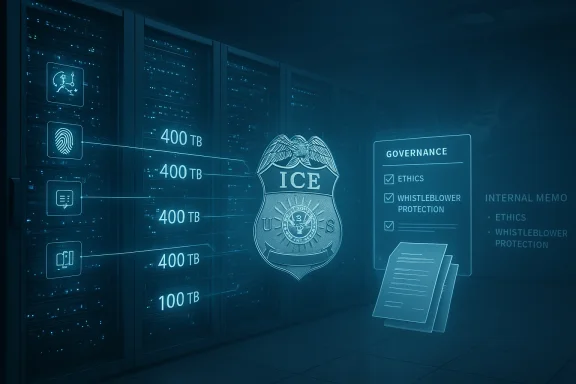
Futuristic data center featuring an ICE badge, 400 TB storage lines, and a governance checklist.Background​

In 2025 the federal government sharply increased funding and operational emphasis on interior immigration enforcement. Public and independent analyses put ICE’s available enforcement resources in 2025 in the high‑$20 billions when regular appropriations and later reconciliation supplements are counted, and legislative packages discussed publicly included multi‑year allocations that advocacy groups and some analysts described as a $75 billion program of enforcement spending spread over several years. Those headline numbers have been widely reported and debated; they reflect a combination of annual appropriations and larger reconciliation or supplemental allocations rather than a single, immediate cash transfer to the agency.
At the same time, reporting and contract records show a large uptick in ICE purchases of cloud services and software licenses from major vendors and resellers. Public federal contracting documents and investigative reporting show tens of millions of dollars of new cloud purchases from Microsoft and Amazon during 2025. Those procurement moves occurred alongside an aggressive enforcement posture that produced record levels of detentions and at‑large arrests, according to independent analyses and major newsroom investigations.
The new Guardian reporting — the documents at the center of this article — was published alongside partner outlets and appears to derive from leaked internal records describing ICE’s Azure consumption and related technical configurations. Because the files are leaked material, some specific claims cannot be independently corroborated in public contract logs; that distinction matters and will be highlighted below where appropriate.

What the leaked files say — the headline technical claims​

The documents published by the Guardian and partners state the following core technical claims:
  • ICE increased the amount of data held on Microsoft Azure from roughly 400 terabytes in July 2025 to about 1,400 terabytes in January 2026. The files describe Azure “blob” storage as a primary mechanism for raw data storage and suggest the growth was driven by the agency ramping up intake and processing of multimedia and records.
  • ICE is reported to be using virtual machines (VMs) on Azure — effectively renting high‑performance compute — and to be running some agency applications on Microsoft infrastructure. The files name Azure services for image/video analysis and automated translation as being used for analytics.
  • The documents imply that ICE’s expanded workforce and operational tempo were accompanied by increased access to Microsoft productivity suites and an AI chatbot made available through those productivity bundles. They also indicate third‑party reseller arrangements (for example, license buys via Dell and others) were part of how ICE procured some services.
Those are the load‑bearing technical claims in the leak. As with any leak, the underlying documents are the primary evidence; independent public confirmation of every line item in secret procurement and internal architecture diagrams is not yet available. I treat the leaked assertions as credible signals that demand technical and policy scrutiny, and where public sources confirm aspects of the picture I cite them separately.

Why the storage numbers matter (and what they really mean)​

The jump from 400 TB to 1,400 TB is alarming in plain terms: if that capacity were purely image files, it would equal hundreds of millions of photos. But raw terabyte figures can mask how data is used and structured.
  • Blob storage on Azure is a general‑purpose object store used for backups, video and image archives, logs, and dataset lakes. A rapid increase in blob usage can reflect bulk ingestion of video, body‑cam footage, phone extractions, scanned documents, or large‑scale exports from other databases. The leaked files explicitly reference blob usage as a repository for raw data.
  • Compute costs and VM use matter for analytics. Running virtual machines at scale lets an agency not only store but actively process, transcode and run machine‑learning models against incoming datasets. The files indicate ICE rented compute instances, which is a practical necessity if the agency is doing automated image and video analytics in‑house rather than simply archiving material.
  • Interpretation caveat: terabytes alone do not reveal what data was stored, for how long, nor whether it was encrypted at rest with keys controlled by ICE. The leak does not publicly disclose dataset labels or retention policies; therefore claims about specific uses (for example, programmatic mass surveillance or targeted investigative analytics) should be judged carefully and flagged as not fully verifiable without access to the raw files or accounts from officials.

How ICE’s cloud consumption fits into the broader enforcement surge​

ICE’s technology purchases and cloud use did not happen in a vacuum. Two parallel facts help explain the context:
  • Congress and the administration increased enforcement resources in 2025, creating both hiring and mission expansion pressure on ICE’s operations. Analyses that combine regular appropriations with reconciliation/supplemental appropriations place ICE’s accessible enforcement funding in 2025 near $28.7–$29.9 billion, and some reporting framed multi‑year packages as up to $75 billion over several years for enforcement priorities — figures that are best read as funding envelopes rather than instant, fungible cash sitting in a single account. Those increases gave the agency the means to expand personnel and purchases.
  • Independent contract records reviewed by reporters show a fresh wave of purchases for cloud infrastructure, licenses and services from resellers during 2025, including significant buys routed through established government resellers (for example, Dell federal channels) and direct AWS and Microsoft purchases. This mirrors the leaked files’ timeline and supports the broader assertion that ICE’s cloud footprint grew substantially in late 2025.
Operationally, a bigger workforce plus a data volume spike and increased compute capacity together produce a system capable — in principle — of ingesting, searching and automating analysis over large swathes of material. That capability is standard for modern IT but carries specific civil‑liberties and governance risks when used by ies engaged in mass interior enforcement.

Microsoft’s public position and internal employee concern​

Microsoft’s public response — as reported in the Guardian coverage — was that the company provides productivity and collaboration tools to DHS and ICE through partners, that its terms prohibit mass surveillance of civilians, and that the company does not believe ICE is engaged in mass surveillance. The company has also told some employees that it “does not presently maintain AI services contracts tied specifically to enforcement activities.” Those statements, as presented to staff and press, attempt to draw a line between selling baseline cloud and productivity services and actively enabling targeted enforcement workflows.
At the same time, multiple internal Microsoft sources — and contemporaneous worker organizing captured in uploaded internal threads and memos — show persistent employee unease about government contracts that touch biometric processing, AI analytics and law‑enforcement integrations. The files uploaded to this conversation include employee organizing materials, petitions and risk assessments arguing that tech firms must adopt moratoria on new enforcement‑related sales and strengthen whistleblower protections. Those internal discussions are consistent with similar movements that have pressured other cloud vendors in recent years.
Two points are important:
  • Corporate public statements that a vendor “does not presently maintain AI services contracts tied specifically to enforcement” can be technically accurate while still leaving room for substantial indirect exposure: reseller sales, system integrators, platform hosting, managed services and bespoke engineering support can enable downstream enforcement workflows without an explicit “AI enforcement” line item on a vendor’s balance sheet. Public declarations must therefore be examined alongside procurement data and third‑party integrations.
  • Employees raising ethics reports are a significant indicator of reputational and operational risk. The uploaded internal threads detail worker campaigns, petitions and policy recommendations that map directly onto the public controversy; when a company faces sustained internal pressure on public‑policy grounds, it signals governance blind spots that boards and regulators should note.

Procurement channels, resellers and the messy reality of cloud governance​

The Guardian’s leak and contract reporting reveal that resellers and integrators have been an important pathway for ICE to acquire Microsoft and Amazon cloud products. This matters for two reasons:
  • Reseller sales can be less visible in public cloud vendor press releases yet still grant agencies enterprise licenses, engineering support or deployment assistance. Public contract registries often show resellers such as large federal integrators (for example, Dell federal channels) as the contracting vehicle even when the underlying product is Azure or AWS. That pattern complicates transparency and auditing.
  • Many cloud deployments involve layered responsibilities: the hyperscaler provides infrastructure, a systems integrator configures and sometimes manages the environment, and the agency consumes the end product. That chain increases the number of actors who need to be covered by legal safeguards (data residency, access controls, logging, redaction) and increases the risk that governance gaps will be exploited or unmonitored. The uploaded employee documents repeatedly call for clearer contractual limits on downstream use and stricter audit rights — exactly the governance levers that matter in layered procurements.

Technical risks and failure modes​

Putting significant enforcement workloads onto a public cloud raises distinct technical and security risks that should be assessed explicitly:
  • Access control and insider threat: More vendors, partners and resellers touching an environment create more privileged access points. Without strict key management and zero‑trust enforcement, sensitive PII and biometrics can be exposed to a larger set of human actors. The leaked files do not publicly disclose key management practices, which is a material omission for risk assessment.
  • Data residency and cross‑border transfers: Cloud providers operate multi‑region storage and may move or replicate data across geographies for resilience. That has legal consequences where data protection regimes or third‑party subpoenas differ across jurisdictions. The Guardian’s prior reporting on Microsoft and Israeli military use underscores how cross‑border storage can become an accountability vector in high‑stakes deployments.
  • Model‑based amplification and false positives: If ICE is using automated image‑and‑video analytics, the risk of misidentification grows when models are applied at scale to low‑quality footage or biased datasets. False positives in face recognition or inaccurate entity linking can cascade into wrongful arrests or other harms; these are not hypothetical — they are a documented failure mode of current algorithms. Public vendors and integrators have a responsibility to require human‑in‑the‑loop controls and transparent error‑rate disclosures.
  • Supply‑chain and software risk: Many agency applications are built on open‑source components and third‑party modules; undocumented or poorly audited dependencies can introduce vulnerabilities into law‑enforcement systems. Running such workloads on shared cloud infrastructure increases blast radius if an application is exploited.

Civil‑liberties and legal implications​

The expansion of cloud‑backed analytics for immigration enforcement implicates several legal and democratic risk vectors:
  • Mass surveillance vs. targeted investigation: The distinction is legal and moral: targeted investigative use (with warranted data collection and judicial oversight) is different from blanket, frictionless ingestion of people’s data for profiling. Leaked terabyte figures and AI‑tool references raise legitimate concerns that cloud scale could be used to operationalize broad surveillance if adequate constraints are not codified and enforced. Where the leak cannot conclusively show intent to mass‑surveil, it does create an evidentiary basis to demand clarity from vendors and agencies.
  • Due process and remediation: Automated flags and prioritization systems can shape who is arrested, detained or deported — and those systems are often opaque. Civil‑liberties organizations and courts have repeatedly warned that algorithmic tools require transparency, explainability and meaningful avenues for people to contest automated decisions. The recent surge in arrests and detentions heightens the stakes for ensuring these protections are in place.
  • Corporate legal exposure: Vendors and integrators could face reputational, shareholder and regulatory risk if their products are shown to materially enable rights violations. Employee activism and regulator inquiries following Microsoft’s earlier Israel‑related service restrictions show the reputational damage vendors can incur when public policy lines are perceived to be crossed.

What independent reporting and contract records confirm (and what remains unverified)​

Cross‑referencing the Guardian’s leaked documents with public contract data and investigative reporting yields the following verified picture and gaps:
  • Verified: Federal procurement records and reporting show a meaningful increase in cloud and software spending by ICE and CBP in 2025, including significant reseller‑facilitated purchases from Microsoft and AWS. That confirmation makes the leak’s procurement timeline plausible. (forbes.com)
  • Verified: Independent analyses document a surge in ICE enforcement activity and detentions in 2025, which aligns temporally with increased operational spending and staffing. Those operational pressures plausibly explain increased demand for storage and computing.
  • Not independently verified from public records: The leak’s exact internal architecture diagrams, the precise contents of stored datasets, and operational directives that would prove whether Azure storage was used specifically to support particular surveillance streams (for example, phone intercepts, drone feeds, or cellphone extraction pipelines). The public contract logs do not reveal dataset labels or internal engineering details; therefore, the most sensitive technical claims remain anchored to the leaked files themselves and to the Guardian’s reporting. Readers should treat those claims as important but not yet independently audited evidence.

Practical steps vendors and policymakers can take now​

The risks above are real and fixable only with concrete, technical and legal remedies. Based on the evidence available, these are immediate, implementable steps worth considering:
  • Vendors and resellers should adopt explicit contractual clauses for law‑enforcement customers that:
  • Require granular, auditable logging and proof of judicial authorizations for sensitive analytic workloads.
  • Prevent downstream sharing of raw biometric identifiers except under narrow, audited legal processes.
  • Mandate independent human‑rights and privacy impact assessments before scaled deployment of AI analytics.
  • Agencies should publish non‑classified system architecture summaries and data‑minimization policies that specify:
  • Data sources, retention windows, and key‑management arrangements (who holds encryption keys).
  • Human‑in‑the‑loop thresholds for automated flags leading to arrests or detention.
  • Congress and oversight bodies should require:
  • A public audit of major procurement pathways for federal enforcement agencies (including reseller flows).
  • Regular reporting on algorithmic use in enforcement, with redress channels for affected people.
  • Strengthened whistleblower protections for vendor and contractor employees who raise concerns about misuse.
  • Companies should strengthen internal governance:
  • Create rapid review teams for government contracts involving biometrics or AI.
  • Publish redacted contract summaries and the policy rationale for any exceptions to standard privacy safeguards.

What to watch next​

  • Will Microsoft and other cloud providers produce a transparent accounting of reseller‑channel sales and the extent to which they offer managed services or engineering support to enforcement agencies? Public clarity here would materially reduce uncertainty.
  • Will independent auditors be given access to ICE deployments on Azure to verify that encryption, access controls and human oversight meet the public standards vendors claim they enforce?
  • Will Congress use hearings and appropriations oversight to tighten policy guardrails on the downstream use of cloud and AI services by enforcement agencies, or will procurement continue to outpace governance?
Track those outcomes; they will determine whether the technical scale described in the leaks becomes a durable tool that is constrained by safeguards — or a capability that migrates into opaque, high‑impact enforcement workflows.

Conclusion​

The Guardian’s leaked documents add a new, granular dimension to a debate we have been following for years: the extent to which global cloud firms and integration partners can be said to enable state power. The technical data points — a rapid rise in stored terabytes, expanded virtual‑machine use, and widespread productivity access — are plausible and are corroborated in part by procurement records and the broader enforcement expansion of 2025. But the most sensitive claims about precise datasets and operational use remain tied to the leaked files and require independent audit to be fully validated.
That uncertainty is not an excuse for inaction. The combination of high enforcement budgets, rising agency headcount, and easy access to scalable cloud AI creates real potential for rights‑eroding outcomes. The appropriate response is not ideological — it is technical and legal: require auditable constraints, publish independent assessments, limit downstream sharing of biometric and location data, and strengthen whistleblower channels for both vendor and agency staff. The public, Congress and the courts must insist on those safeguards now, before cloud scale turns into institutionalized opacity with human costs that are harder to reverse.

Source: The Guardian ICE reliance on Microsoft technology surged amid immigration crackdown, documents show
 

Newly obtained records and multiple independent news reports show U.S. Immigration and Customs Enforcement dramatically expanded its reliance on Microsoft’s cloud and AI tools during a recent surge in enforcement activity — a shift that transforms routine immigration operations into a high-scale, cloud‑powered surveillance apparatus and raises urgent questions about corporate responsibility, government procurement, and civil liberties.

Neon blue cloud computing scene over a city, with circuit patterns and human silhouettes.Background​

The central factual claim in the recent disclosures is stark: between July 2025 and January 2026, ICE’s footprint on Microsoft Azure reportedly grew from roughly 400 terabytes to nearly 1,400 terabytes, while the agency also increased use of AI-driven video and image analytics and cloud virtual machines. That spike, documented in leaked procurement and usage files reported by investigative teams, coincides with a major funding and staffing expansion at ICE and with an intensification of arrest and deportation operations.
What the files show, and what they do not, is crucial: the documents specify the types of Azure services in play — blob/object storage, virtual machines, and AI‑based image/video analysis tools such as video indexers and vision APIs — de a line‑by‑line inventory of the datasets ICE has placed on Azure. That gap matters: the presence of large storage volumes and analytic tooling signals capability, but it does not by itself prove precisely how those capabilities were used. The reporting teams, and the documents they obtained, repeatedly highlight that the contents of that storage are not exhaustively enumerated.

Overview of the technology involved​

What ICE reportedly bought and deployed​

The leaked material, cross‑checked against reporting, suggests ICE’s cloud expansion included:
  • Large volumes of Azure blob/object storage to hold images, video, and other unstructured data.
  • Virtual machines (VMs) run on Azure to host agency software and data‑processing pipelines.
  • AI‑enabled services for image and video analysis — services that can transcribe audio, extract scene metadata, detect faces and objects, read on‑screen text, and surface keywords or phrases from spoken content.
  • Expanded access to Microsoft productivity and collaboration tools, some of which include embedded AI assistants and document‑search features.
These are mainstream commercial cloud capabilities — the same building blocks used by retail companies to analyze customer video streams or by hospitals to index medical imagery. In the hands of a law‑enforcement agency, however, the same tools enable automated triage of hours of footage, rapid cross‑referencing against databases, and the extraction of geo‑temporal patterns that previously required large human investigation teams.

The capabilities that worry civil‑liberties advocates​

AI video indexers and computer‑vision pipelines are capable of:
  • Detecting faces and linking them to identity databases (face detection + face recognition).
  • Reading text on clothing, signs, or documents via OCR.
  • Transcribing speech and performing keyword/semantic searches over audio.
  • Classifying scenes, actions, and “emotion” proxies at scale.
  • Stitching location metadata from multiple sources to reconstruct movement patterns.
When combined with cross‑system joins — for example, matching a face from a dashcam still to a government photo database or correlating a phone‑location ping with surveillance video — these capabilities escalate routine enforcement into systemic, automated surveillance. The leaked records indicate ICE purchased or consumed services that would enable many of these capabilities; the files stop short of cataloguing exactly which operational pipelines were built. That distinction remains necessary but does not obviate concern.

Why this matters: the surveillance problem in plain terms​

The expansion of cloud‑scale surveillance capability changes two fundamental things about government monitoring:
  • Scale — Cloud storage and compute allow agencies to collect and retain orders of magnitude more data than was practical before. The jump from hundreds to over a thousand terabytes is not symbolic; it reflects the operational capacity to hold massive amounts of imagery, video, and logs that can be analyzed retrospectively.
  • Automation — Off‑the‑shelf AI tools turn previously manual, slow processes into automated searches that can surface persons, places, and patterns within minutes. That accelerant turns a narrow investigation into a broad sweep unless constrained by policy.
Put together, the effect is a system where every camera, phone ping, and administrative record can become part of an indexed, searchable corpus, and where enforcement actions can be directed not only by human judgment but by machine‑prioritized leads. That combination raises canonical civil‑liberties concerns — profiling, disparate enforcement, mission creep, and opaque decision‑making — on a much larger technical canvas.

What the documents say — and wd​

The key, load‑bearing claims in the reporting are:
  • ICE’s Azure holdings rose from approximately 400 TB in July 2025 to roughly 1,400 TB in January 2026.
  • The agency purchased or consumed AI video/image analysis services — specifically, products comparable to Microsoft’s Azure Video Indexer and vision APIs. These tools can extract faces, perform OCR, and analyze audio.
  • Microsoft provides cloud productivity and collaboration tools to DHS and ICE through partners; Microsoft’s public statement says its terms prohibit mass surveillance and that the company does not believe ICE is engaged in it.
What the records do not prove, and therefore must be treated with caution:
  • The documents do not supply a forensic inventory of the data types (for example: the exact volumes of dashcam footage, detention‑center CCTV, phone intercepts, or administrative records) held in Azure. Until procurement line items are matched to dataset inventories, content‑specific claims remain partially unverifiable.
  • The mere availability of analytic tools does not prove they were used to perform specific surveillance actions (e.g., face‑matching a protester to a database). That requires operational logs, query histories, or case files that are not published in the currently available leak.
Given those limits, rigorous reporting and analysis must avoid conflating capability with confirmed usage while still recognizing that capability itself creates real risk.

Context: a pattern across vendors and governments​

This episode echoes earlier controversies around other governments and cloud providers. In 2025, Microsoft itself disabled a set of Azure subscriptions tied to an Israeli defense unit after investigative reporting alleged the company’s services were used for mass interception and analysis of Palestinian calls — a high‑profile example showing how commercial cloud capacity can be repurposed for mass surveillance and how vendor actions can materially affect state operations. That precedent is directly relevant: it demonstrates both the scale of modern cloud dependencies and the limited tools vendors have to police downstream misuse beyond contractual terms and selective enforcement.
The broader pattern is clear: public‑sector buyers have rapidly adopted cloud and AI, while governance mechanisms—procurement transparency, independent audits, and legislative limits—have lagged behind. That gap produces opaque purchase relationships (resellers, multi‑year contracts, data‑residency clauses) that are difficult for the public to oversee.

The corporate posture: Microsoft’s stated limits and the tension they create​

Microsoft has publicly said it does not provide technology to facilitate the mass surveillance of civilians and that it believes its policies prohibit such uses. The company has previously taken enforcement action — disabling certain services for an Israeli military unit after an external review — but it also emphasizes that it serves many public‑sector customers and often delivers through resellers. That creates a complexity: the company is a gatekeeper of infrastructure but often does not control how downstream customers configure or use third‑party integrations and custom pipelines.
This duality — between vendor principles and vendor market reality — leaves policy and ethics in an uneasy middle ground. Vendors can write acceptable‑use terms and can terminate specific subscriptions, but they cannot on their own define legal use cases for law enforcement; those lines are set by law, regulation, and procurement oversight.

The risks: mission creep, discrimination, and transparency failures​

  • Function creep: Tools purchased for “biometric processing for detainee identification” or “video indexing for case management” can be repurposed to monitor protests, journalists, or entire communities, especially if the systems are designed to be general‑purpose search platforms. The capacity for historical queries on long‑retained footage makes retrospective sweeps possible.
  • Disparate impact: Automated systems trained on biased data or tuned for efficiency can disproportionately target communities already overpoliced — for example, immigrant communities with lower political capital and limited recourse.
  • Opaque decision‑making: If ICE uses AI pipelines to prioritize leads or flag individuals for investigation, those decisions must be explainable. Currently, many analytic services offer little in the way of human‑readable reasoning for why a video clip or person was flagged.
  • Weak transparency and accountability: Leaks and investigative reporting are playing the role of oversight when procurement and operational details are otherwise not publicly disclosed. That reactive model is inadequate for democratic governance of intrusive systems.
  • Supply‑chain complexity: Many cloud deployments involve third‑party resellers, managed‑service providers, and local integrators. Each layer raises the risk of contractual loopholes or unmonitored data exports.

What’s at stake for Microsoft, for ICE, and for the public​

For Microsoft:
  • Reputational risk and employee unrest — Microsoft has faced internal protests over government contracts in the past. Repeated headlines about possible misuse of its platforms increase pressure on the company’s governance and can trigger investor and regulatory scrutiny.
For ICE:
  • Operational dependence on commercial vendors can create brittle dependencies and raise legal questions about where data lives, who can access it, and under what legal authority. Large cloud footprints also create attractive targets for leaks, legal discovery, or subpoena pressure.
For the public:
  • The public interest is not only in whether ICE acted lawfully in individual cases but in whether a structural balance exists between effective enforcement and protection of civil liberties. The expansion of cloud‑scale capabilities without clear legal guardrails risks hardening intrusive practices into standard operating procedure.

What good oversight would look like​

Policymakers, procurement officers, vendors, and civil‑society stakeholders can pursue concrete changes to reduce the risks while preserving legitimate public‑safety functions. Key reforms include:
  • Mandatory procurement transparency — public registries of law‑enforcement cloud contracts, including vendor names, core services procured, contract value bands, and high‑level descriptions of intended use cases.
  • Dataset inventories for sensitive systems — a catalog that identifies the types of personal data stored, retention periods, and access controls, subject to regular independent audits.
  • Purpose and access limitations written into contracts — hard commitments that data and analytic outputs may only be used for narrowly defined, auditable functions.
  • Independent, technical audits of AI tools — auditors should test for biased performance, false positives, and explainability claims before deployment.
  • Regulatory backstops — legislative standards for biometric and mass‑surveillance uses, including warrant requirements, minimization rules, and redress pathways.
These controls would not eliminate risk but would move governance from reactive whistleblowing and leaks toward prospective accountability.

Practical questions that need answering now​

  • Exactly what datasets are on Azure? Are ICE’s Azure stores populated with surveillance footage, detention center records, third‑party data purchases, or internal administrative files? The existing leak does not provide a forensic inventory. Until that is disclosed or subpoenaed, conclusions about specific uses are only partially verified.
  • Who controls the keys and access logs? If ICE controls account access and query logs, the agency’s internal auditability matters; if resellers or third parties manage key material, chain‑of‑custody issues emerge.
  • What search and identity‑matching tools were actually run against the stores? The presence of analytic services does not prove a given match pipeline was executed in a given case; operational logs would be necessary to show that.
  • What legal authorities were relied on to collect and analyze any personal data? That hinge point — statutory warrant rules, administrative authorities, or interagency data‑sharing agreements — determines whether the operational activities fell within legal bounds.
Answering these questions requires proactive disclosure by ICE and Microsoft, or compelled production through oversight channels. The public reporting so far illuminates capability and procurement growth but leaves crucial operational questions open.

Strengths and counterarguments​

It is important to acknowledge the legitimate public‑safety arguments behind modernizing law‑enforcement technology:
  • Operational efficiency: Large datasets, cloud compute, and AI can reduce the time officers spend on back‑office work, allowing more focus on fieldwork and investigations that require human judgment.
  • Scale of evidence: Modern investigations often involve massive amounts of digital content; cloud tools make it feasible to manage that data rather than ignoring it.
  • Interoperability and continuity: Cloud services can centralize data access across field offices, which can be operationally beneficial for coordination and case continuity.
These are real benefits. The policy challenge is ensuring those benefits are realized without undermining civil‑liberties protections or creating unreviewable systems. A narrow view that treats all AI and cloud use as inherently malign would throw out useful tools; a permissive view that fails to require oversight risks normalizing mass data grabs.

Recommendations for IT teams, journalists, and watchdogs​

  • IT teams in public‑sector organizations should embed privacy‑by‑design: document retention schedules, encryption‑at‑rest with auditable key management, and role‑based access controls that limit who can run identity‑matching queries.
  • Journalists should press for procurement documents, invoice line items, reseller agreements, and sample access logs through public‑records requests and targeted FOI opriate.
  • Civil‑society and oversight bodies should demand independent audits and algorithmic impact assessments before any biometric or video‑analysis tool operates at population scale.
  • Vendors should strengthen contractual clauses that require customers to disclose downstream use cases that involve biometric or mass‑surveillance functions and impose clear remediation steps in case of misuse.

How this episode could reshape policy and industry practice​

The confluence of investigative reporting, leaked procurement records, and prior vendor actions (like Microsoft’s 2025 suspension of certain Israeli military subscriptions) is creating a new template for accountability: public scrutiny can prompt vendor review; vendor enforcement can alter state operational posture; and the visible political cost nudges both governments and vendors toward clearer governance.
Legislatures are already paying attention. The public visibility of cloud‑scale surveillance debates increases the likelihood of statutory interventions — from biometric bans in local jurisdictions to federal procurement rules that require privacy safeguards, explains, and transparency. Whether those laws will be sufficiently technical and agile to keep pace with cloud and AI advances is the next test.

Takeaway: capability demands rules​

The recent surge in ICE’s Azure footprint is a real inflection point: the technical capacity to index and search vast amounts of image and video data exists now, and public records show a government agency expanded its consumption of those capabilities amid an enforcement surge. That combination should prompt a sober policy response: not a reflexive rejection of cloud or AI, but a deliberate, legally grounded framework that constrains uses that threaten civil liberties while preserving legitimate investigative tools.
The public should insist on three nonnegotiable elements: transparency about what data is stored and for how long; independent auditability of identity‑matching and automated decision systems; and clear, enforceable legal limits on intrusive uses. Without those guardrails, the functional logic is clear: tools bought to help manage cases today can become the infrastructure for expansive surveillance tomorrow. The technology’s power to scale means that governance must scale in parallel — or the costs will be borne by communities with the least power to resist.

Conclusion
The intersection of government enforcement, cloud computing, and commercial AI has arrived at a practical crossroads. Recent disclosures about ICE’s use of Microsoft Azure underscore how quickly capability can outpace oversight. The public debate that follows should not be about whether the cloud is useful — it is — but about how to ensure constitutional protections, civil‑liberties safeguards, and democratic accountability keep pace with the technical power now in routine operational use. Only through concrete transparency, contractual safeguards, independent audits, and legislative clarity can society harness these tools without surrendering essential privacy and due‑process protections.

Source: Gadget Review ICE Teams Up With Microsoft as Surveillance Powers Quietly Expand
 

Microsoft has publicly rejected claims that Immigration and Customs Enforcement is using its cloud and AI tools to conduct mass civilian surveillance, even as investigative reporting and leaked procurement files show a dramatic expansion of ICE’s use of Microsoft-powered cloud services during a period of stepped-up immigration enforcement.

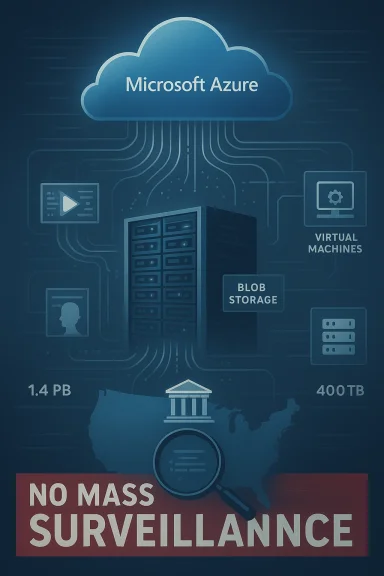
Microsoft Azure cloud data center illustration with a No Mass Surveillance banner.Background​

The story began with a detailed investigative report that drew on leaked internal documents showing ICE’s cloud footprint on Microsoft Azure ballooned in the second half of 2025. According to the reporting, ICE’s Azure storage climbed from roughly 400 terabytes in July 2025 to about 1,400 terabytes in January 2026, a growth of more than 300% in six months — and the files suggest the agency added both raw “blob” storage and rented virtual machines to run compute-intensive analysis and AI workloads.
Microsoft responded with a short-but-firm public line: the company does provide cloud-based productivity and collaboration tools to DHS and ICE (often delivered through reseller partners), its terms of service prohibit the platform’s use for mass civilian surveillance, and the company does not believe ICE is using its technology for that purpose. Microsoft also called for clearer legal boundaries and oversight about how law enforcement may use emerging technologies.
The raw numbers and the technical product names matter because they describe capability. Azure Blob Storage, Azure virtual machines, and Azure AI/Video Indexer are precisely the kinds of services that can ingest, hold, transcode, index, and run automated analysis over images, audio and video — turning raw media into searchable, tagged datasets at scale. Microsoft documents describe Blob Storage as a massively scalable object store designed to hold petabytes of unstructured data, while Azure AI Video Indexer is explicitly a service for extracting searchable metadata, faces, OCR, and speech-to-text from video and audio. Those product capabilities are commercially documented by Microsoft.
At the same time, the reporting leaves crucial gaps: the leaked procurement and capacity files do not include a verified inventory of the types of data stored, nor query logs showing what analytics ICE actually ran. That technical ambiguity is central to the debate: scale and capability are visible; the precise downstream uses that would prove unlawful or mass surveillance are not publicly present in the materials as of publication. Independent reporting therefore faces the twin duties of: (1) accurately describing capability and procurement; and (2) resisting the leap from capability to confirmed operational misuse without further forensic evidence.

What the leaked files actually show — a technical read​

Storage and compute: the building blocks of mass indexing​

The files published alongside the investigative report list increased purchases and larger allocations for Azure blob/object storage and virtual machine instances. In cloud architectures, that combination is the canonical stack for running large-scale indexing:
  • Blob/object storage stores raw unstructured data (images, video, audio, extracted phone dumps, logs).
  • Virtual machines (VMs) provide on-demand compute for transcoding, batch analysis, and running machine-learning models.
  • AI services such as Azure AI Video Indexer add out-of-the-box capabilities for face detection, OCR, automated transcription, translation, and object detection.
The combination is not exotic: it is how newsrooms, media platforms, and law enforcement worldwide build searchable archives and investigative indexes. What makes this instance politically and legally consequential is the scale reported (1.4 PB is non-trivial) and the agency using it — a domestic immigration enforcement body with growing arrest and deportation operations.

What the numbers mean in plain terms​

To make the numbers more concrete: 1,400 terabytes equals about 1.4 petabytes. If that capacity were only photos at an average 3 MB each, it would approximately equal hundreds of millions of images. If the data were compressed video, it could represent hundreds of thousands of hours of footage. Those mental models demonstrate why civil-liberties advocates reacted strongly when the capacity increases became public. But they do not, by themselves, prove what content populated that capacity.

Microsoft’s position and the legal/contractual frame​

Microsoft’s public statement is two-fold: it confirms the company supplies productivity and collaboration tools to DHS and ICE (frequently through partners), and it insists its terms of service and policies bar uses that constitute mass surveillance of civilians. Microsoft also urged lawmakers and courts to draw clearer legal lines about acceptable law enforcement uses of new technology.
That stance mirrors earlier episodes in which Microsoft publicly enforced — or at least invoked — contractual restrictions in response to contested government uses. In 2025 the company moved to cease or disable selected Azure and AI subscriptions used by an Israeli Ministry of Defense unit after an internal review found evidence supporting investigative reporting that some Microsoft services were being used at scale to ingest and analyze intercepted communications; that action and the internal protests that followed are now an important precedent for how Microsoft says it will handle downstream risk.
But corporate policies and contractual promises are only as effective as their enforcement mechanisms. Key questions remain:
  • Who audits downstream usage to verify policy compliance?
  • Do reseller channels create opaque chains that dilute vendor visibility into how services are configured and what data is fed into them?
  • Can terms of service be enforced in near real time to prevent misuse, or only after an investigation and remedial action?
Microsoft’s public language on enforcement and calls for legal clarity reflect both a defensive posture and a recognition that vendor-side rules alone cannot substitute for regulation and oversight.

Why the claim of “no mass surveillance” is not the same as “no risk”​

Microsoft’s denial — “we do not believe ICE is engaged in mass surveillance” — is an important corporate assertion, but it does not erase the policy, technical, or governance concerns raised by the leaked capacity data.
  • Capability ≠ confirmed action. The presence of storage and analytics capability does not prove those tools were used to run nationwide, indiscriminate biometric matching or phone interception programs. The leaked files do not include complete operational logs or case files that would show how ICE executed searches, with what legal authorizations, or on which datasets.
  • Capability + scale + weak oversight = risk. When a law enforcement agency gains massive cloud-scale capacity, the potential for mission creep, error, discriminatory outcomes from automated systems, and abuse increases — especially in contexts with sparse oversight or opaque policies. The ability to cross-index video, location data, social media, and administrative databases is precisely the plumbing that—if directed improperly—creates de facto mass surveillance.
  • Reseller complexity. Multiple reporting strands show large vendors frequently sell through resellers and federal channels; those intermediaries can complicate vendor visibility into downstream, operational configurations and make contractual enforcement harder. That partly explains why some vendor statements emphasize partner-delivery language.
The correct journalistic stance is to report what is visible (procurement, capacity, product types) while insisting on targeted, independent oversight to determine the operational facts that would confirm misuse.

The policy and civil‑liberties dimension​

What oversight should look like​

Civil liberties organizations and technology policy experts have advanced several practical interventions that would reduce the risk of cloud-enabled mass surveillance:
  • Mandatory transparency reports from agencies detailing data types, retention periods, and the legal basis for mass indexing or automated face recognition use.
  • Independent audits of query logs and model outputs by privacy commissioners, inspector generals, or court-appointed auditors with the authority to access RSOs (raw system operations).
  • Contractual and technical guardrails built into vendor offerings — for example, mandatory attestation, audit logs delivered to neutral third parties, or cryptographic separation where cloud providers cannot decrypt certain data without judicial authorization.
  • Narrow, statute-based prohibitions that stop specific real-time, mobile biometric identifications in public places without judicial oversight.
Those options are not novel; they are adaptations of long-standing accountability practices updated to the scale and speed of cloud and AI platforms. The public debate must now decide whether vendor policies plus voluntary audits are sufficient, or whether Congress and state legislatures need to mandate limits on types of surveillance work.

The political context matters​

This episode does not occur in a political vacuum. ICE’s enforcement posture and budget expansion during 2025 became a political flashpoint domestically, and civil‑society groups have long challenged the agency’s use of surveillance technologies. The timing of increased enforcement budgets, hiring, and procurement spending under a presidential administration prioritizing aggressive immigration enforcement is what fresh reporting connects to the rapid expansion of cloud capacity. Those political drivers are relevant because they help explain why, at scale, capability was acquired quickly and at a budgetary moment when oversight mechanisms did not expand at the same pace.

Technical mitigation: what vendors can and cannot do​

Vendors like Microsoft can (and have) taken partial steps to reduce downstream risk, but there are technical and contractual limits.
  • Programmatic enforcement. Vendors can program retention limits, deny certain API capabilities for customers in certain sectors, or require attestation before enabling sensitive features (for example, face recognition for law enforcement). Those changes can stop some misuse, but they may be resisted by sovereign customers who claim national-security exemptions or by procurement channels that bypass direct vendor-customer relationships. Microsoft’s prior disabling of specific subscriptions for the Israeli military unit demonstrates both the possibility of vendor action and its limits: it was targeted and reactive, not universal.
  • Visibility gaps. Clouds are elastic and configurable. If resellers or integrators create bespoke deployments and manage keys, vendors may have limited visibility into how systems are wired to external data feeds. That means contractual prohibitions are meaningful, but they require auditing regimes to be effective.
  • Technical design options. There are architectural approaches that can reduce vendor liability or misuse risk, such as customer-controlled encryption keys, policy-as-code enforcement at the API layer, and pipeline-level logging that produces tamper-evident audit trails. Implementing them at scale across all government customers would be expensive and politically contested, but they are feasible.

Strengths and weaknesses of the reporting so far​

Strengths​

  • Concrete metrics: The leaked procurement and capacity files provide concrete, verifiable numbers (for example, reported terabyte counts and purchase orders) that journalists can explain and contextualize. That makes the debate less rhetorical and more technical, allowing citizens and policymakers to see the scale of capability.
  • Product-level detail: The files name types of services (blob storage, VMs, AI/video indexing) that clearly map to documented vendor capabilities, allowing fact-based analysis of potential use cases.
  • Independent precedent: Microsoft’s earlier, well-documented action to disable certain subscriptions in response to investigative reporting provides a real-world comparator for vendor response and demonstrates that companies can take meaningful, albeit partial, remedial steps.

Weaknesses and gaps​

  • Lack of content-level evidence: Procurement files show capacity and services, not the content of the data. Without dataset inventories, query logs, or operations logs, it is impossible to prove specific claims about targeted or indiscriminate surveillance. That gap complicates both legal assessment and public debate.
  • Chains of custody and reseller opacity: When procurement flows through third-party resellers and integrators, the vendor’s visibility into everyday operational use is reduced — complicating both corporate and legal accountability. Current public records do not fully map that chain.
  • Political and legal ambiguity: The absence of clear statutory lines governing these technologies in domestic law means determinations about “acceptable” use are being made in public debate rather than in statute, producing reactive rather than proactive governance. Microsoft itself has called for legislative clarity.

What independent oversight should demand next​

If policymakers, auditors, and advocacy groups want to move from alarm to actionable control, they should press for a limited, prioritized set of verifications:
  • Immediate independent audit access to a representative sample of ICE cloud deployments that were active during the reported expansion window, including:
  • Dataset inventories and metadata (not necessarily content) to establish the types of data held.
  • Query logs and access histories for AI/face recognition endpoints to determine the scale and scope of searches.
  • Statutory requirements for transparency reports that cover retention policy, data sources, and the legal authority for mass indexing.
  • A durable governance model requiring third-party attestation (auditors) before enabling high-risk AI features for law enforcement agencies.
  • Binding procurement clauses for reseller transparency, so vendors can trace how their services are configured downstream and must report suspicious or non-compliant configurations.
These four pragmatic steps would not eliminate lawful, targeted law enforcement usage — but they would create the conditions under which misuse can be detected and remediated in a timely way.

What this means for technologists and enterprises​

For IT leaders, systems architects, and procurement officers in government and industry, the episode is a cautionary lesson:
  • Design for auditability. Any system ingesting personal data at scale must be built with tamper-evident logs, data catalogs, and role-based access controls that survive contract changes and personnel turnover.
  • Prefer clear separation. Where possible, separate capabilities for administrative functions (detention records, logistics) from high-risk indexing functions (face recognition, cross-source entity resolution) and require discrete approvals for the latter.
  • Vendor engagement. Enterprises and agencies should demand contractual clauses that make vendor enforcement rights and remediation steps explicit, and ensure resellers and integrators are held to the same reporting standards.

Conclusion​

The leaked documents and subsequent coverage have done the public a service by illuminating how a government agency acquired significant cloud-scale capacity and modern AI services in a compressed timeframe. The numbers themselves — from roughly 400 TB to 1,400 TB in six months — are striking and technically meaningful, and they map to product capabilities documented by Microsoft (Azure Blob Storage, VMs, and Azure AI Video Indexer).
Microsoft’s denial of mass-surveillance usage and its insistence that its terms of service forbid such activity are important, but they are not a substitute for independent verification and robust governance. The most urgent and realistic path forward combines targeted audits, clearer procurement and reseller transparency, and statutory guardrails that define acceptable law-enforcement uses of high-risk AI and cloud features. In the absence of those checks, capability will routinely outpace oversight — and in cloud platforms, that gap can be scaled overnight.
This episode should be read as a clarion call: cloud platforms make modern analytics cheap and fast, which is an economic and operational advantage — but it also concentrates power. If democratic societies are to retain meaningful privacy protections and legal accountability, the legal, technical, and contractual mechanisms that constrain those platforms must be strengthened—and fast.

Source: Fine Day 102.3 Microsoft Denies ICE Uses Its Technology for Mass Civilian Surveillance
 

Microsoft’s public denial came fast, but the questions it raises about cloud governance, law‑enforcement use of AI, and corporate responsibility are anything but settled.

Neon scales of justice balancing cloud computing and data security.Background​

In mid‑February 2026 a batch of leaked documents reported by major investigative outlets showed that U.S. Immigration and Customs Enforcement (ICE) dramatically increased its use of Microsoft’s cloud services in the second half of 2025. The files, as reported, indicate ICE’s stored footprint on Microsoft Azure rose from roughly 400 terabytes in July 2025 to about 1,400 terabytes by January 2026 — an increase of more than triple in six months. At the same time, reporting said ICE expanded both headcount and enforcement operations, and appears to have been using a mix of Azure blob storage, rented virtual machines, and AI services to search, transcribe and analyze data. Microsoft responded by confirming it supplies cloud‑based productivity and collaboration tools to ICE and DHS, reiterating a policy line that its services “do not allow” mass surveillance of civilians and saying it does not believe ICE is engaged in that activity.
These revelations arrive in the shadow of prior high‑profile controversies involving Microsoft and other hyperscalers: in 2025 Microsoft publicly disabled a set of services used by an Israeli defense unit after investigative reporting and internal review suggested mass‑surveillance use of cloud tools. The company’s previous action set an important precedent — it demonstrated that commercial cloud providers can and will take contractual steps when their telemetry and business records indicate misuse — but it also laid bare the practical limits of such measures.
This article reviews what the reporting shows, explains the technical mechanics that underlie the claims, evaluates Microsoft’s options and obligations, and lays out the legal, ethical, and operational gaps that deserve urgent attention from companies, regulators, and civil society.

What the leaked documents and subsequent reporting claim​

The headline numbers and the gaps behind them​

  • Reported storage increase: ICE’s Azure storage rose from about 400 TB (July 2025) to ~1,400 TB (January 2026).
  • Reported services in play: blob/object storage, virtual machines, and AI tools for image/video analysis, speech transcription, and translation.
  • Reported context: an expanded ICE budget and workforce in 2025 coincided with the rapid increase in cloud consumption.
It is important to be precise about what is — and is not — proven by the public reporting. The leaked files, as presented by investigative outlets, document consumption, account configurations, and product usage patterns; they do not, in the public record, provide a detailed manifest of the types of content stored (for example, whether the blobs were photos, intercepted communications, detention logs, or administrative data). That means the telemetry that shows capacity and feature usage is real and consequential; the nature of the stored data is reported as plausible but not exhaustively disclosed in the leaked materials.

Why the numbers matter​

Cloud capacity is cheap at scale, but the jump from hundreds to well over a thousand terabytes in half a year is material. To put it in engineering terms: if an organisation is storing many terabytes of imagery, audio, or video and coupling that with AI pipelines (speech‑to‑text, translation, object detection), the workload profile shifts from standard archiving to sustained, high‑throughput analytics. That combination — bulk storage + AI indexing — is what turns passive archives into searchable, actionable intelligence repositories.

Microsoft’s public response and the policy context​

What Microsoft said — the highlights​

Microsoft publicly confirmed that:
  • It provides cloud productivity and collaboration tools to DHS and ICE through partners.
  • Its policies and terms of service prohibit use of its technology to facilitate the mass surveillance of civilians.
  • Based on its understanding, Microsoft does not believe ICE is engaged in mass civilian surveillance.
  • Microsoft urged lawmakers, the executive branch, and courts to draw clearer legal lines on how emerging technologies are used by law enforcement.
Those statements are consistent with previous Microsoft positions: the company has for years published ethical commitments around AI use and has contract provisions (acceptable‑use clauses) forbidding customer uses that enable mass surveillance. The 2025 case involving an Israeli military unit remains the most visible precedent in which Microsoft enforced those terms by disabling specific subscriptions and services while continuing other contractual relationships.

What the public statements do — and do not — accomplish​

Microsoft’s response is legally cautious and reputationally calibrated. It achieves three immediate objectives:
  • Reassures shareholders and parts of the public that Microsoft recognizes the risk and claims to have guardrails.
  • Signals to customers that terms-of-service enforcement is an available tool.
  • Deflects immediate, categorical blame by asserting the company’s belief that ICE is not engaged in prohibited activity.
What the statements do not do is disclose the underlying evidence Microsoft used to reach its view, nor do they explain how the company would detect or act if telemetry suggested a customer had crossed the line into mass surveillance. That reticence stems from the technical reality that cloud vendors have limited direct visibility into encrypted customer content and are bound by privacy and contract obligations that constrain forensic access without legal process.

The technical mechanics: how Azure could be used — and how enforcement works​

Building blocks that enable large‑scale analytics​

Modern cloud platforms — including Microsoft Azure — are modular. A hypothetical pipeline for large‑scale, searchable analytics typically uses:
  • Blob/object storage: cheap, scalable storage for images, audio files, and raw data.
  • Compute (virtual machines / containers): ephemeral or reserved VMs to run ingestion, processing, or indexing workloads.
  • AI and cognitive services: speech‑to‑text (transcription), translation, computer vision, and video indexing to convert unstructured audio/video into searchable metadata and text.
  • Search and indexing tools: services that organize extracted text, objects, and timecodes into queryable indices.
Azure offers the exact capabilities the reporting cites — speech transcription and translation, computer vision, video indexing and moderation, and large blob stores — as part of its Cognitive Services and associated tooling. When combined, these pieces enable a system that can ingest bulk audio or imagery and make those assets discoverable by keyword, face, object, or speech content.

Control plane vs data plane: why providers can see consumption patterns but not always content​

Cloud vendors operate two overlapping planes:
  • The control plane (billing, account metadata, subscription telemetry, API calls, service usage) — visible to the provider and used for routeing, billing, and security signals.
  • The data plane (the actual customer objects, encrypted content, keys) — often controlled by the customer and not routinely inspected by the provider.
Because of this separation, hyperscalers can detect changes in storage consumption, the provisioning of large VM fleets, or spikes in calls to certain AI endpoints — all of which are powerful indicators of new, large‑scale use cases. But the content stored inside customer blobs is frequently encrypted and is not examined without the customer’s keys or legal compulsion. That technical architecture explains why providers rely on telemetry and business records to assess misuse, but also why their ability to verify what exactly is stored or processed is limited.

Enforcement mechanics available to cloud vendors​

When a provider concludes a customer may be in breach, it generally has a narrow toolkit:
  • Disable or cease specific subscriptions or services (control‑plane action).
  • Revoke access credentials and suspend API keys.
  • Refuse renewal of a contract or refuse to accept further provisioning.
  • In rare cases, cooperate with lawful process where compelled by court order.
Notably absent from public practice is any routine, independent forensic read of encrypted customer content. Vendors repeatedly cite privacy commitments and liabilities as reasons they cannot — and will not — search customer-owned content as a matter of course.

Legal and regulatory fault lines​

The accountability gap​

The current regime leaves three overlapping accountability gaps:
  • Transparency gap: Customers and the public rarely see the contracts and resellers involved, making it difficult to trace how data flows from field collection to cloud storage and AI processing.
  • Visibility gap: Providers can detect resource usage but not content; civil‑rights risk assessments require content context that providers often do not have.
  • Remediation gap: Contractual enforcement (disabling services) is blunt and can disrupt legitimate public‑safety or humanitarian functions if misapplied. It is also reactive — typically triggered only after an external expose.
These gaps are exacerbated by third‑party resellers and integrators. Large agencies often acquire cloud credits, managed services, or software stacks through intermediaries; billing lines and account names can be obfuscated by reseller relationships, complicating any external audit trail.

Where legislation and courts fit in​

Microsoft’s public call for Congress, the executive branch, and the courts to draw clearer lines is not rhetorical. The technical and contractual limits we’ve described are not just engineering problems; they are legal and policy problems. Lawmakers could:
  • Define permissible scopes for the use of AI and cloud tools by domestic law enforcement.
  • Set mandatory transparency standards for federal procurement of cloud and AI services.
  • Require impact assessments and independent audits when agencies use AI for surveillance or mass indexing.
  • Clarify when and how cloud providers can be compelled to cooperate with audits or disclosures without breaching customer privacy.
Absent such statutory clarity, vendors face a lose‑lose choice: either adopt broad, precautionary cutoffs that restrict legitimate use, or continue to operate with partial visibility and take remedial action only after reputationally costly exposures.

Microsoft’s prior enforcement precedent and its limits​

In 2025 Microsoft disabled a set of services used by an Israeli defense unit after external reporting and an internal review supported parts of that reporting. That action was a watershed: it proved that a hyperscaler could take targeted contractual steps to prevent further misuse without terminating all customer relationships. At the same time, Microsoft was careful to highlight that its review relied on business records, telemetry and contracts, not on directly reading customer files.
The precedent is valuable for two reasons. First, it demonstrates an enforcement pathway that respects customer data confidentiality. Second, it sets expectations among employees, investors, and civil society that vendors can and will intervene.
But the limits are clear: the enforcement was surgical because Microsoft had sufficient account‑level signals and a credible external reporting trail. In many cases — particularly when agencies use opaque resellers, or when data is encrypted with customer‑managed keys — providers will have less leverage or fewer signals to act upon.

Risks and reputational exposure for Microsoft and cloud providers​

Reputational and operational risks​

  • Employee unrest: High‑profile controversies trigger internal protests, resignations, and productivity and recruitment challenges in talent markets sensitive to ethical concerns.
  • Investor pressure: Institutional investors increasingly require disclosures on human‑rights risks and AI governance; repeated incidents invite shareholder proposals and scrutiny.
  • Regulatory risk: Reputational controversies can lead to regulatory investigations, audits, and potential fines depending on the jurisdiction and the data types implicated.
  • Customer churn: Overzealous enforcement or vague standards can push legitimate public‑sector customers toward alternative vendors, or toward private on‑premises solutions, with broader national-security implications.

Operational risks specific to law‑enforcement customers​

  • Continuity of critical services: Blanket or poorly targeted suspensions can inadvertently disrupt essential services for legitimate public‑safety work (e.g., disaster response, public-health coordination).
  • Reseller circumvention: If resellers or integrators mask the true downstream use of cloud services, enforcement becomes much harder.
  • Global policy complexity: Multijurisdictional conflicts arise when a provider’s human‑rights commitments collide with local legal demands or national security exceptions.

What Microsoft — and other hyperscalers — should (and can) do differently​

Immediate operational steps​

  • Publish clear, case‑level summaries after enforcement actions that explain the telemetry, legal rationale and technical steps taken — without revealing customer data — to build public trust through transparency.
  • Strengthen reseller due diligence by requiring resellers and managed‑service partners to meet the same acceptable‑use standards and to disclose downstream integrations that materially alter risk profiles.
  • Offer stronger contractual controls for sensitive workloads (explicit controls around law‑enforcement ingestion pipelines), including metadata tagging and logging requirements that preserve privacy while giving vendors improved detection signals for misuse.
  • Expand independent audits for particularly high‑risk government customers, using third‑party technical teams that can review compliance without revealing content publicly.

Longer‑term product and policy design​

  • Privacy‑preserving telemetry: design telemetry channels that can reveal anomalous usage patterns without exposing content; for example, richer control‑plane signals that indicate the nature of a pipeline (indexing vs. archive) without sending customer data to Microsoft.
  • Customer‑facing impact assessments: require agencies to submit AI and privacy impact assessments before deploying bulk indexing or speech‑to‑text on sensitive data.
  • Tiered product offerings: provide a “high assurance” cloud tier for sensitive law‑enforcement workloads where both vendor and customer agree on auditability and acceptable use up front.

What lawmakers and civil society should demand​

  • Mandatory procurement transparency: full disclosure of cloud‑service contracts (at least metadata and procurement channels) for law‑enforcement agencies using AI and large‑scale analytics.
  • Independent audits: legally mandated, periodic audits of agency AI deployments where the risk to civil liberties is significant.
  • Clear statutory limits: legislation that defines "mass surveillance" in operational terms and specifies permissible use cases for AI analytics in law enforcement.
  • Whistleblower protections: safeguards for public‑sector and vendor employees who raise concerns about misuse.
These measures are complementary: transparency without enforceable legal boundaries leaves suppliers managing risk on a case‑by‑case basis; legal clarity without transparency reduces public accountability.

Strengths and weak points in the current dynamic​

Notable strengths​

  • Contractual levers exist: Microsoft and other vendors can and do act when evidence is strong enough, demonstrating that some private‑sector checks are possible.
  • Technical capability to detect anomalous usage: control‑plane telemetry can reliably surface massive, rapid changes in consumption patterns — the same signals that informed the recent reporting.
  • Growing public pressure and investor activism: these forces increase the reputational cost of inaction and spur vendors to strengthen policies.

Potential risks and weaknesses​

  • Detection limits: telemetry cannot definitively reveal content or intent; providers can be blindsided by encrypted or mislabelled workloads.
  • Reactive posture: vendor enforcement typically follows journalistic exposes rather than routine, proactive audits.
  • Policy ambiguity: lack of statutory clarity leaves too much discretion to vendors, resellers, and agency program managers — and this ambiguity will be exploited in crises.
  • Market fragmentation risk: heavy handed or inconsistent enforcement might push agencies to less transparent vendors or on‑prem solutions that are harder to audit.

Practical recommendations — an operational to‑do list​

  • For cloud providers:
  • Build a public enforcement playbook that explains, in non‑technical terms, how and when control‑plane actions happen.
  • Require reseller transparency clauses and standardize incident reporting for government customers.
  • Invest in privacy‑preserving telemetry and contract provisions that permit limited, auditable verification by trusted third parties.
  • For lawmakers:
  • Pass targeted transparency rules for AI and cloud procurement in federal law enforcement.
  • Mandate independent audits for programs that use AI for mass indexing or surveillance.
  • Define prohibited use cases and the thresholds for “mass surveillance” in statute.
  • For civil society and researchers:
  • Demand machine‑readable procurement registries and standardized red‑flag indicators for risky deployments.
  • Collaborate with technologists to design audit protocols that can operate without exposing personal data.

Conclusion​

The recent reporting about ICE’s increased use of Microsoft Azure highlights a fundamental tension at the center of modern governance: powerful, general‑purpose cloud tools and AI are neutral in design but not neutral in consequence. Microsoft’s public posture — prohibiting mass surveillance in contracts but acknowledging limited visibility into customer content — is an honest reflection of current technical and legal realities. It is also a warning: the combination of rapid budget growth at enforcement agencies, off‑the‑shelf AI services for transcription and image analysis, and complex procurement channels creates a fertile environment for mass indexing and searchability of personal data unless clearer rules and stronger safeguards are put in place.
The right outcome is not an ideological standoff between vendors and governments, nor a simple corporate abdication of responsibility. It requires a three‑part equilibrium: tech companies must adopt clearer, more auditable enforcement mechanisms; governments must accept statutory clarity and transparency obligations; and civil society must insist on independent oversight. Absent that, we will continue to see episodic revelations followed by narrow remedial actions — reactive patchwork that leaves the most vulnerable populations exposed to systemic risk.
For technology professionals, policy makers, and citizens who care about both public safety and civil liberties, the moment demands realism and urgency. The technical building blocks for large‑scale surveillance were already in place; the debate now is about where the line between lawful, legitimate investigative work and mass surveillance of civilians should be drawn, and who — law makers, courts, or corporate boards — will be empowered to enforce it.

Source: Devdiscourse Microsoft's Cloud Under Scrutiny Over ICE Use
 

Back
Top