

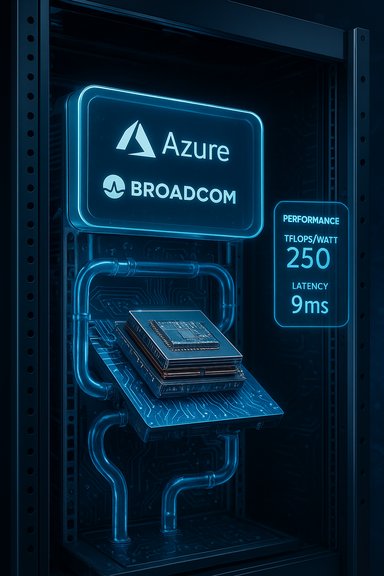
Microsoft is reportedly in advanced talks with Broadcom to co-design custom AI chips for Azure, a development that — if finalized — would sharpen the industry’s move toward vertically integrated, hyperscaler-owned silicon and reshape cloud AI infrastructure economics and competition.
The last 24 months have seen hyperscale cloud providers accelerate investments in custom silicon to escape the cost, supply and performance constraints of relying solely on off-the-shelf GPUs. Microsoft’s internal chip program — built around the Azure Maia AI Accelerator and the Arm‑based Cobalt CPU family — already reflects this strategy, and recent reporting indicates Microsoft may be preparing a more extensive partnership with Broadcom to design future generations of bespoke AI accelerators for Azure. At the same time, Broadcom has secured high‑profile custom chip engagements with leading AI labs, amplifying its credentials as a partner for hyperscalers seeking tailored silicon.
These negotiations, described publicly as advanced, are said to involve Microsoft switching at least some of its custom‑chip design work away from Marvell, which has been a notable supplier in the hyperscale custom ASIC market. Market reaction to the news has been immediate: names tied to custom silicon and hyperscale supply chains moved in price as investors priced in higher concentration of design work under Broadcom’s umbrella and the potential loss of business for rivals.
This isn’t an isolated trend. AWS, Google Cloud, and others have long pursued their own accelerators (Inferentia and Trainium at AWS; Tensor Processing Units at Google), proving that vertically integrated hardware can materially improve the price/performance of certain AI workloads. Microsoft’s alleged Broadcom talks would be the next step in that industry shift.
The result is an AI infrastructure landscape that looks increasingly like an arms race in vertical integration. That will yield benefits — cost‑efficient AI at scale, innovative system architectures, and more diverse hardware choices — but also new fragmentation pressures and supply‑chain complexities. Customers and developers will benefit from greater competition, but they’ll also need to adapt to an ecosystem where portability and abstraction layers are more critical than ever.
However, the path from talk to production is long and capital intensive. Large upfront investment, software ecosystem work, supply‑chain commitments, and the risk of hardware obsolescence are non‑trivial challenges. For Microsoft, the upside is strategic control and potential cost and performance leadership in targeted AI workloads. For Broadcom, the opportunity would expand its already growing role as the custom‑chip partner of choice for hyperscalers and AI labs.
The immediate next steps to watch are any official announcements, technical previews, and supplier confirmations that indicate committed volume and tangible roadmap specifics. Those signals will determine whether this is a strategic posture — common in the semiconductor world — or the start of a transformative pact that reshapes cloud AI hardware for years to come.
Source: Markets Financial Content https://markets.financialcontent.co...m-ai-chip-partnership-a-new-era-for-cloud-ai/
 Background
The last 24 months have seen hyperscale cloud providers accelerate investments in custom silicon to escape the cost, supply and performance constraints of relying solely on off-the-shelf GPUs. Microsoft’s internal chip program — built around the Azure Maia AI Accelerator and the Arm‑based Cobalt CPU family — already reflects this strategy, and recent reporting indicates Microsoft may be preparing a more extensive partnership with Broadcom to design future generations of bespoke AI accelerators for Azure. At the same time, Broadcom has secured high‑profile custom chip engagements with leading AI labs, amplifying its credentials as a partner for hyperscalers seeking tailored silicon.These negotiations, described publicly as advanced, are said to involve Microsoft switching at least some of its custom‑chip design work away from Marvell, which has been a notable supplier in the hyperscale custom ASIC market. Market reaction to the news has been immediate: names tied to custom silicon and hyperscale supply chains moved in price as investors priced in higher concentration of design work under Broadcom’s umbrella and the potential loss of business for rivals.
This isn’t an isolated trend. AWS, Google Cloud, and others have long pursued their own accelerators (Inferentia and Trainium at AWS; Tensor Processing Units at Google), proving that vertically integrated hardware can materially improve the price/performance of certain AI workloads. Microsoft’s alleged Broadcom talks would be the next step in that industry shift.
Technical overview: what “custom AI chips” mean for Azure
What insurers of the cloud mean by “custom AI chips”
When hyperscalers speak of “custom AI chips,” they usually mean Application‑Specific Integrated Circuits (ASICs) or highly specialized accelerators that are co‑designed with software and system architecture in mind. These chips are not generically useful graphics processors; instead, they prioritize the precise operations most common in modern deep learning:- Extremely high throughput for matrix multiplication and tensor operations.
- Memory hierarchies optimized for massive model parameter movement.
- Low‑latency interconnects to stitch many chips together into training pods.
- Power efficiency and thermal envelopes tuned to datacenter rack architectures.
Why ASICs routinely beat general‑purpose GPUs for specific workloads
GPUs offer unmatched flexibility and an enormous developer ecosystem, but that flexibility carries overhead. Purpose‑built ASICs can eliminate functionality that isn’t necessary for inference or targeted training patterns, reallocate transistor budgets to high‑value datapaths (systolic arrays, matrix units), and bind memory and network choices tightly to the compute fabric. The result is measurable:- Better performance per watt, because silicon area and power go directly to useful operations.
- Lower latency for common inference kernels thanks to minimized software stack indirection.
- Improved price/performance once volumes scale, because a streamlined design uses fewer expensive components for a given workload.
Key hardware building blocks Microsoft and Broadcom would focus on
Any credible custom‑chip program for hyperscale training and inference will center on several technical pillars:- High‑Bandwidth Memory (HBM): HBM generations (HBM3, HBM3E and now HBM4 in discussions across the industry) are the de facto memory choice for training accelerators because they provide terabytes‑per‑second bandwidth in a compact package. Designing memory capacity and bandwidth into the package is central to scaling modern large language models.
- Chiplet and advanced packaging (CoWoS / 2.5D / 3D integration): Advanced packaging allows multiple compute dielets and HBM stacks to sit in tight proximity, reducing latency and enabling higher aggregate bandwidth without requiring a single monolithic reticle.
- Systolic arrays / Matrix Multiply Engines: Hardware that accelerates dense linear algebra (matrix‑multiply) directly on silicon delivers the bulk of speedups for transformer inference and training.
- Custom interconnects and rack fabrics: At hyperscale, the chip is only one element. Microsoft’s prior projects show it thinks about racks, cooling, and network fabrics as part of a coherent system. Broadcom’s networking pedigree would be strategically useful here.
- Power and thermal innovations: Liquid cooling and novel approaches like microfluidic cooling can enable higher power density for accelerators, increasing per‑rack throughput.
- Software stack and compiler toolchains: Hardware without a mature compiler and runtime yields poor utilization. Co‑designing compilers, tensor compilers, and runtime scheduling is part of what makes custom silicon win in practice.
Competitive landscape and market implications
Microsoft’s playbook and why Broadcom fits
Microsoft has long signaled a desire to reduce dependence on external GPU suppliers for the most cost‑sensitive and scale‑sensitive AI workloads. Its Maia and Cobalt programs show the company has been serious about this effort for years. Partnering with Broadcom — a vendor that has recently demonstrated capacity to build large custom accelerator programs and a robust networking portfolio — would solve multiple strategic problems at once:- Access to a partner with proven systems‑level engineering experience.
- Tight integration of compute accelerators with datacenter networking solutions.
- Potential for scale agreements that strengthen Microsoft’s negotiating leverage with foundries and packaging vendors.
What this would mean for rivals and the market
- NVIDIA: Nvidia’s GPU dominance is unlikely to evaporate overnight. However, any large shift toward hyperscaler‑owned accelerators reduces the fraction of compute demand going to third‑party GPUs. That can change pricing dynamics and force GPU vendors to compete more on ecosystem and software integration.
- AWS and Google: Both already have production custom silicon. AWS’s Trainium/Inferentia family and Google’s TPU lines have set the competitive benchmark. Microsoft moving more deeply into custom silicon would intensify competition — not only on hardware but on software portability and cloud economics.
- Marvell and other ASIC vendors: Vendors who currently do design work for hyperscalers face client concentration risk. Losing a major client can materially affect revenue and R&D plans. At the same time, new opportunities will open for smaller or niche design houses to co‑innovate with organizations that lack Broadcom‑scale resources.
- Startups: The rise of hyperscaler custom silicon is a two‑edged sword for startups. It can reduce addressable market for commodity accelerator startups, but it also increases demand for complementary IP (memory, packaging, optical interconnects) and for design partners who can service mid‑market customers.
Market dynamics: supply chain and volume economics
Custom chips only pay off at scale. The hyperscaler must commit to large volume buys and coordinate with foundries and packaging centers to secure capacity (e.g., TSMC CoWoS slots). Broadcom’s ability to manage this supply chain — plus its recent multibillion‑dollar engagements with leading AI labs — makes it a logical partner. But the economics hinge on long‑term volume commitments, wafer capacity, and advanced packaging lead times.Strengths of a Microsoft–Broadcom alliance
- Systems expertise: Microsoft brings cloud software and workload profiling; Broadcom brings silicon, packaging and networking systems know‑how. Together they could realize tighter hardware‑software co‑design than either could alone.
- Supply‑chain leverage: A partnership backed by sizable long‑term orders can win prioritized TSMC capacity and advanced packaging resources, reducing the scheduling friction that has hobbled smaller chip programs.
- Energy and cost efficiency: Well‑designed ASICs coupled with tailored cooling and rack architecture can cut cost per inference and cost per training epoch — the metrics that matter most to enterprise AI deployments.
- Strategic control: Owning more of the stack allows Microsoft to set roadmaps that match its product cadence (Copilot, Azure OpenAI, etc., reduce vendor lock‑in risks, and maintain more predictable operating costs.
- Network and integration advantages: Broadcom’s networking portfolio could fuse compute and network into higher performing rack and pod designs, yielding real throughput improvements for distributed training.
Risks, unknowns and potential downsides
- Huge upfront cost and long lead times: Designing custom silicon, qualifying it, ramping to volume and deploying at scale requires billions of dollars and many quarters of coordination. This is not a quick path to savings and is capital intensive.
- Software fragmentation: New silicon often demands new compiler toolchains, optimized kernels and runtime changes. Fragmentation can slow developer adoption and increase internal support costs unless Microsoft commits serious resources to developer‑facing tooling.
- Model evolution risk: AI model architectures and precision formats evolve rapidly. A chip optimized for today’s transformer patterns or precision formats might be suboptimal for tomorrow’s innovations. Co‑design reduces but does not eliminate this risk.
- Supply chain and geopolitical exposure: Advanced packaging and leading‑node foundries are geographically concentrated. Any geopolitical disruption could delay shipments or raise costs.
- Vendor concentration and client risk: If Microsoft moves large volumes to Broadcom, Microsoft becomes dependent on Broadcom for critical infrastructure. That concentration can be risky if Broadcom faces manufacturing, legal, or financial issues.
- Execution complexity: Integrating a new custom architecture across Azure’s global regions, with backward compatibility for customer workloads and SLOs, is an enormous operational challenge.
- Market reaction and competitive retaliation: Suppliers and rivals may respond aggressively — through pricing, exclusive partnerships, or accelerated product launches — raising the stakes for timely delivery.
Practical implications for Azure customers and developers
For enterprise customers
- Potential for lower cost AI services over time if custom chips drive down Azure’s unit economics.
- New instance types optimized for inference or specific large models could offer superior throughput per dollar.
- Transitional complexity: preview phases and staged rollouts will be the norm; customers may need to revalidate model performance across hardware generations.
For ISVs and AI developers
- Portability of models may require more abstraction layers; Microsoft would likely provide tooling to hide hardware differences, but full parity is rarely immediate.
- Developers targeting lowest‑latency inference scenarios may benefit from specialized SDKs and runtime libraries co‑optimized for the new chips.
- Open standards and cross‑platform toolchains will be key to minimizing lock‑in.
What to watch next: milestones and signals
- Formal announcement of a multi‑year design and supply agreement with concrete capacity commitments.
- Technical previews from Microsoft showing end‑to‑end benchmarks (price/perf, TFLOPS/Watt, latency) across representative LLM workloads.
- Evidence of foundry and packaging reservations (public comments, supplier guidance) indicating committed volumes.
- Roadmap clarity from Broadcom on packaging, memory generation (HBM3/HBM3E/HBM4), and networking integration.
- Microsoft guidance on software toolchains, compiler support and open‑source SDKs to facilitate developer adoption.
Strategic playbook Microsoft could follow (practical steps)
- Lock in long‑lead capacity at foundries and advanced packaging houses to ensure manufacturing throughput and avoid midstream bottlenecks.
- Define a multi‑generation roadmap that pairs chip design cadence with software releases and data center deployment plans, reducing the risk that silicon becomes outdated.
- Invest heavily in compiler and runtime layers — including easy integration for popular frameworks (e.g., PyTorch, TensorFlow) — to minimize migration friction for customers.
- Pilot chips in targeted Azure regions and workloads to gather telemetry and refine both hardware and software before broad rollout.
- Maintain a heterogeneous compute strategy — continue to offer GPU and third‑party accelerator instances so customers can choose the best fit and Microsoft mitigates supplier concentration risks.
Long‑term outlook: hardware‑software co‑design as the default
The industry moved from CPU‑only stacks to GPU‑accelerated designs over the last decade. The next phase is not simply faster GPUs but purpose‑built accelerators that are integrated from silicon all the way up to service APIs. A Microsoft‑Broadcom partnership, if it comes to pass at meaningful scale, would accelerate that trend and likely push other hyperscalers to deepen their own silicon strategies or forge similar supply relationships.The result is an AI infrastructure landscape that looks increasingly like an arms race in vertical integration. That will yield benefits — cost‑efficient AI at scale, innovative system architectures, and more diverse hardware choices — but also new fragmentation pressures and supply‑chain complexities. Customers and developers will benefit from greater competition, but they’ll also need to adapt to an ecosystem where portability and abstraction layers are more critical than ever.
Conclusion
Reports that Microsoft is in advanced talks with Broadcom to co‑design custom AI chips are a logical next chapter in the hyperscaler silicon narrative. The combination of Microsoft’s cloud scale and Broadcom’s systems and semiconductor capabilities could produce a tightly integrated, high‑efficiency compute platform tailored to Azure’s AI ambitions. The move would deepen the industry shift to bespoke silicon, reduce dependence on off‑the‑shelf GPUs for certain workloads, and raise the bar on how cloud providers design hardware and software together.However, the path from talk to production is long and capital intensive. Large upfront investment, software ecosystem work, supply‑chain commitments, and the risk of hardware obsolescence are non‑trivial challenges. For Microsoft, the upside is strategic control and potential cost and performance leadership in targeted AI workloads. For Broadcom, the opportunity would expand its already growing role as the custom‑chip partner of choice for hyperscalers and AI labs.
The immediate next steps to watch are any official announcements, technical previews, and supplier confirmations that indicate committed volume and tangible roadmap specifics. Those signals will determine whether this is a strategic posture — common in the semiconductor world — or the start of a transformative pact that reshapes cloud AI hardware for years to come.
Source: Markets Financial Content https://markets.financialcontent.co...m-ai-chip-partnership-a-new-era-for-cloud-ai/
