

Microsoft Build 2026 begins June 2 in San Francisco and online, with Microsoft’s official live coverage starting at 9:30 a.m. Pacific time ahead of a two-day developer conference focused on AI-powered tools, Copilot, Azure, GitHub, Windows, and the agent software stack. The practical answer is simple: you can watch it free online, while in-person attendees paid conference pricing to be in the room. The more important answer is that Build is now less a Windows showcase than a referendum on Microsoft’s bet that agents are the next application platform. If the company gets that story right, Build 2026 could define how Windows PCs, Office documents, developer tools, and cloud services behave for the next several years.
Build has always been where Microsoft explains itself to developers, but the explanation has changed. A decade ago, the company needed to persuade developers that Windows, Azure, and Visual Studio were still the gravitational center of software work. In 2026, it needs to persuade them that Copilot is not merely a chatbot bolted onto Microsoft 365, but the interface layer for a new kind of computing.
That is why this year’s event matters even if no single consumer product announcement dominates the keynote. Microsoft does not need a surprise gadget to make Build consequential. It needs to show developers, administrators, and enterprise buyers that the pieces it has been scattering across Windows, GitHub, Azure, and Office now form a coherent platform.
The timing is not accidental. Google I/O has already put AI into the bloodstream of search, Android, Chrome, and developer tooling. Apple’s WWDC is close enough that Microsoft knows every AI claim it makes will be compared with Cupertino’s more device-centered pitch. Build therefore becomes Microsoft’s chance to argue that its advantage is not a model, a PC, or a productivity app in isolation, but the connective tissue between them.
That is also why the conference’s San Francisco setting feels symbolic. Microsoft is bringing Build closer to the AI startup ecosystem even as it tries to convince enterprises that it can industrialize what the labs and open-source communities have been improvising. The message is not subtle: the AI platform war is moving from demos to deployment, and Microsoft wants to own the boring, lucrative middle.
That matters because Build is not just a stage show. The keynote will carry the headlines, but the session catalog is where Microsoft tends to reveal what it actually expects developers to build. If the keynote says “agents,” the breakout sessions explain where those agents will run, which APIs they will call, how identity will be handled, and what security model Microsoft believes administrators should accept.
For WindowsForum readers, the most useful way to watch is with two tabs open: the keynote stream and the session schedule. The keynote will tell you Microsoft’s preferred narrative. The sessions will tell you which teams got budget, engineering attention, and executive backing.
Expect the first day to be heavy on platform language: Copilot, agents, Azure AI, GitHub Copilot, developer workflows, Microsoft 365 integration, and Windows as an AI-capable endpoint. Expect the second day to become more concrete, with demos and technical sessions that reveal whether Microsoft’s agent story is a set of products or a disciplined architecture.
The company’s pitch is moving from ask a bot to delegate a workflow. That sounds like marketing until you consider the difference between a synchronous assistant and an asynchronous coworker. A synchronous assistant waits for prompts and replies in a chat pane. An asynchronous agent takes a goal, runs for a while, touches files and services, makes decisions within boundaries, and returns with something closer to completed work.
That distinction is the heart of Build 2026. If Microsoft can make agentic workflows manageable inside Microsoft 365, GitHub, Azure, and Windows, it will have converted Copilot from an upsell into infrastructure. If it cannot, Copilot risks becoming the Clippy joke with a larger GPU bill.
The Office angle will be especially important. Word, Excel, PowerPoint, Outlook, and Teams are where Microsoft has the strongest claim that AI can save time because the work is already structured around documents, meetings, mail, and spreadsheets. But they are also where mistakes carry social and business consequences. An AI that drafts a memo is useful; an AI that files the wrong report, sends the wrong email, or misreads a spreadsheet can become expensive very quickly.
Build should therefore be judged less by how magical the Copilot demos look and more by how carefully Microsoft explains permissions, audit trails, rollback, supervision, and administrative control. The future Microsoft is selling depends on users trusting agents enough to let them act. That trust will not come from a better animation in the sidebar.
Microsoft has a particular reason to lean hard into this idea. Its most durable businesses are platforms: Windows for PCs, Office for productivity, Azure for cloud computing, Active Directory and Entra for identity, GitHub for code, and Defender for security. Agents give Microsoft a way to stitch those assets together under a single conceptual roof.
This is also where Microsoft has an advantage over companies that only own a model or a chat app. Enterprise agents need access to documents, calendars, repositories, tickets, logs, policies, secrets, endpoints, and identity graphs. Microsoft already sits across much of that terrain in large organizations, which means it can present agents as an extension of existing infrastructure rather than a foreign layer.
But the same integration creates the danger. An agent with shallow access is unimpressive. An agent with deep access is risky. Microsoft’s challenge at Build is to convince IT departments that it can make delegation granular enough to be useful and constrained enough to be safe.
That is not a small ask. The classic enterprise security model assumed humans were the actors and software was the tool. Agentic AI blurs that line by making software an actor that uses other software on behalf of humans. Build 2026 is where Microsoft must show whether its identity, compliance, and observability systems are ready for that inversion.
GitHub Copilot has already evolved from autocomplete into chat, code explanation, test generation, pull request help, and more ambitious coding assistance. Build 2026 is likely to push that progression further. The rumored direction is unsurprising: more specialized models, more autonomous coding workflows, deeper repository context, and tighter integration with GitHub’s issue and review systems.
The coding model speculation is worth watching, but the more important question is not whether Microsoft introduces another model name. It is whether GitHub Copilot can become an accountable participant in software delivery. Developers do not merely need code suggestions; they need traceable changes, reproducible reasoning, tests that matter, and confidence that generated work does not smuggle in vulnerabilities or licensing surprises.
For enterprises, this is where AI optimism meets procurement reality. A coding agent that can open pull requests is useful only if organizations can govern what repositories it sees, what actions it can take, what secrets it cannot touch, and how its output is reviewed. The same basic problem appears in Microsoft 365, but code makes it sharper because software mistakes scale.
Expect Microsoft to frame GitHub Copilot as the developer-facing edge of the agent platform. That framing is smart. Developers are both the first customers and the necessary evangelists. If Microsoft cannot convince them that agentic workflows are more than autocomplete with ambition, it will struggle to convince the rest of the enterprise.
That may frustrate enthusiasts who want a clean break from Windows 11. There is a real appetite for a release that feels more coherent, less ad-heavy, less nagging, and less like a rolling experiment in AI placement. Microsoft could generate excitement by showing a future Windows that is faster, more disciplined, and more respectful of user intent.
But the company may prefer a different story: Windows as a constantly updated AI endpoint. That means new runtime components, local models, developer APIs, Copilot integration, and hardware acceleration can arrive without the drama of a new major version. For Microsoft, that is operationally easier. For users, it is emotionally less satisfying.
The Windows 12 speculation also exposes a deeper problem. Many Windows users are not asking for a new version because they crave novelty. They are asking because Windows 11 has trained them to associate change with imposition: more cloud prompts, more account nudges, more AI surfaces, more settings that move around, and more features that feel designed for Microsoft’s business model before the user’s workflow.
If Build has a Windows story, it should address that trust deficit directly. A smarter Windows is not automatically a better Windows. The decisive question is whether Microsoft can make AI features feel optional, legible, and controllable, especially for power users and managed environments.
Local AI matters for three reasons. First, latency improves when simple inference tasks do not have to round-trip to the cloud. Second, privacy and data residency become easier to argue when sensitive content can remain on-device. Third, Microsoft needs a reason for users and businesses to buy new Windows hardware at a time when many existing PCs are good enough.
The difficulty is fragmentation. Windows runs on a vast range of devices, from budget laptops to high-end workstations to Arm-based ultraportables. If Microsoft wants developers to build AI-native Windows apps, it has to make the target less chaotic. A developer cannot optimize for a marketing term.
That is why Build’s Windows sessions may be more important than any Windows keynote tease. Watch for how Microsoft talks about the Copilot Runtime, ONNX, NPUs, local model deployment, privacy boundaries, and developer tooling. The future of Windows AI will be decided less by whether Copilot can summarize a document and more by whether third-party developers can build useful features that behave consistently across real hardware.
There is a defensible version of this strategy. Windows could become the place where cloud-scale agents meet local context: your files, your apps, your device state, your corporate policies, and your hardware accelerator. But that vision requires restraint. Without it, Windows becomes the place where every surface asks to be an assistant.
OpenClaw’s presence in the broader Build conversation is revealing because it represents a bottom-up version of the future Microsoft wants to package. Developers and power users are not waiting for polished corporate agents. They are wiring together tools that browse, edit, message, call APIs, and manipulate local files, often with permissions that would make a security architect reach for coffee and aspirin.
That creates a strategic tension. Microsoft wants to harness the excitement around personal and organizational agents, but it also wants to be the adult in the room. Its business depends on telling enterprises that agent workflows can be governed, secured, audited, and insured against disaster. The more chaotic the agent ecosystem becomes, the more valuable Microsoft’s managed alternative looks.
But Microsoft cannot simply scold the open agent world. Some of the most compelling patterns will come from exactly that messy experimentation. If Build treats OpenClaw-style tools only as a security problem, Microsoft will sound like a platform owner protecting its moat. If it treats them only as inspiration, it will underplay the real risks.
The mature position is harder: acknowledge that autonomous tools with broad access change the threat model, then show developers how to build useful agents without turning every workstation into a soft target. This is where Microsoft’s security messaging has to be more than a compliance slide. Agent safety is not a decorative concern; it is the condition under which the entire category becomes deployable.
When agents perform those steps, the security model changes. Prompt injection stops being an amusing chatbot exploit and becomes a way to influence software that can act. Data leakage stops being only a search problem and becomes an execution problem. Identity stops being a login event and becomes a continuing question of what an agent may do in a user’s name.
Microsoft is one of the few companies with a plausible full-stack answer here. It has Entra for identity, Purview for compliance, Defender for security, Intune for device management, GitHub for development workflows, and Azure for infrastructure. That portfolio gives it the raw material for governed agents.
The risk is that Microsoft will sell the portfolio as proof of safety rather than proving safety in the product behavior. Administrators will need policy controls that are comprehensible. Security teams will need logs that explain agent actions in human terms. End users will need consent prompts that do not become meaningless wallpaper.
Build 2026 should therefore be watched with a skeptical administrator’s eye. Every agent demo should trigger the same questions: Who authorized that action? Where is the record? Can it be undone? What data did the model see? What happens if an instruction hidden in a document conflicts with the user’s intent?
This is where the company’s AI strategy becomes more durable than any individual assistant. If developers build agent systems using Azure AI services, GitHub, Microsoft identity, and Microsoft’s data tools, then Copilot becomes only the most visible expression of a much larger platform capture. The real prize is not getting users to open a chat pane. It is getting organizations to build their next generation of workflow automation on Microsoft infrastructure.
Expect Microsoft to emphasize model choice. The company has learned that enterprises do not want to hear that one model will rule them all. They want performance, price flexibility, regional availability, compliance posture, and the ability to switch models as capabilities change. Azure’s value proposition is increasingly that it can be the control plane for a changing model marketplace.
That pitch is compelling, but not frictionless. AI workloads are expensive, unpredictable, and difficult to benchmark across real enterprise tasks. Developers want capability; finance departments want cost control. IT leaders want innovation; security teams want boundaries. Azure has to satisfy all of them without turning agent development into a procurement labyrinth.
Build’s Azure announcements will probably be less flashy than the Copilot demos, but they may matter more. The companies that actually deploy agents at scale will care about monitoring, evaluation, governance, and integration. That is boring only until the first autonomous workflow touches production data.
But Microsoft 365 is also where AI runs into organizational reality. A company’s documents are full of stale plans, contradictory drafts, sensitive personnel details, half-formed strategy, legal exposure, and accidental oversharing. An agent that sees “everything the user can see” may inherit years of messy permissions that nobody has audited.
This is why Build’s Microsoft 365 story should not be judged only by feature count. The key issue is whether Microsoft helps organizations prepare their information estate for agentic access. Many companies are already discovering that Copilot readiness is really data governance readiness with a more fashionable name.
The shift from assistant to coworker makes that more urgent. A summarization tool can expose bad permissions. An action-taking agent can operationalize them. That is a profound difference.
Microsoft will likely present agents as a way to reduce busywork and accelerate teams. That can be true. But the hidden prerequisite is disciplined information architecture, and many organizations do not have it. Build may inspire enthusiasm; it should also inspire cleanup projects.
The recent pullback from bringing Copilot deeper into console experiences suggests Microsoft understands the sensitivity. Gamers are not clamoring for an AI assistant to mediate play, and the Xbox brand has enough challenges without becoming another test surface for corporate AI enthusiasm. Build attendees care more about APIs, cloud infrastructure, Windows, and developer tools than whether Copilot can explain an achievement.
That does not mean gaming is irrelevant to Microsoft’s platform story. Game development pushes hardware, graphics, networking, identity, marketplaces, and content pipelines. AI tools for game developers could plausibly appear in a broader developer context. But Xbox as a consumer platform is unlikely to drive the keynote.
There is a lesson here for Windows as well. Not every surface needs Copilot simply because Copilot exists. Microsoft’s strongest AI deployments will be the ones where the assistant or agent clearly improves a workflow. Its weakest will be the ones where AI feels like a corporate mandate in search of a user problem.
The harder version is what matters after the stream ends. Can administrators control these agents without reading a thesis? Can developers build against stable interfaces? Can users tell when an agent is acting, what it is doing, and how to stop it? Can Microsoft separate serious productivity gains from the ambient pressure to paste AI into every corner of the product line?
Microsoft has been here before in different form. The company has repeatedly tried to define new layers of computing: Windows APIs, .NET, Azure, Teams as a platform, Microsoft Graph, Power Platform, and now Copilot. Some became durable foundations. Others became confusing brands wrapped around useful but uneven technology.
Agents could go either way. They might become the next real abstraction in enterprise software, sitting above apps and coordinating work across them. Or they might become a costly UX fad that forces users to supervise unreliable automation while pretending that supervision is productivity.
The difference will be execution, and Build is where Microsoft must show its work. Not just the polished prompt. Not just the happy path. The permissions, logs, failures, constraints, and developer ergonomics are the product now.
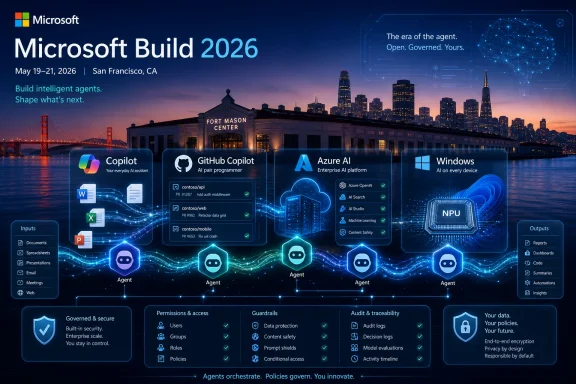 Microsoft Moves Build to the Center of the Agent Economy
Build has always been where Microsoft explains itself to developers, but the explanation has changed. A decade ago, the company needed to persuade developers that Windows, Azure, and Visual Studio were still the gravitational center of software work. In 2026, it needs to persuade them that Copilot is not merely a chatbot bolted onto Microsoft 365, but the interface layer for a new kind of computing.That is why this year’s event matters even if no single consumer product announcement dominates the keynote. Microsoft does not need a surprise gadget to make Build consequential. It needs to show developers, administrators, and enterprise buyers that the pieces it has been scattering across Windows, GitHub, Azure, and Office now form a coherent platform.
The timing is not accidental. Google I/O has already put AI into the bloodstream of search, Android, Chrome, and developer tooling. Apple’s WWDC is close enough that Microsoft knows every AI claim it makes will be compared with Cupertino’s more device-centered pitch. Build therefore becomes Microsoft’s chance to argue that its advantage is not a model, a PC, or a productivity app in isolation, but the connective tissue between them.
That is also why the conference’s San Francisco setting feels symbolic. Microsoft is bringing Build closer to the AI startup ecosystem even as it tries to convince enterprises that it can industrialize what the labs and open-source communities have been improvising. The message is not subtle: the AI platform war is moving from demos to deployment, and Microsoft wants to own the boring, lucrative middle.
Watching Build Is Easy; Understanding the Stakes Is Harder
For viewers, the logistics are straightforward. Microsoft is streaming Build online, with official coverage beginning on the morning of June 2, and the company is also making sessions available through its event site and video channels. The in-person version runs June 2–3 at Fort Mason Center in San Francisco, but the online audience is clearly part of the intended constituency, not an afterthought.That matters because Build is not just a stage show. The keynote will carry the headlines, but the session catalog is where Microsoft tends to reveal what it actually expects developers to build. If the keynote says “agents,” the breakout sessions explain where those agents will run, which APIs they will call, how identity will be handled, and what security model Microsoft believes administrators should accept.
For WindowsForum readers, the most useful way to watch is with two tabs open: the keynote stream and the session schedule. The keynote will tell you Microsoft’s preferred narrative. The sessions will tell you which teams got budget, engineering attention, and executive backing.
Expect the first day to be heavy on platform language: Copilot, agents, Azure AI, GitHub Copilot, developer workflows, Microsoft 365 integration, and Windows as an AI-capable endpoint. Expect the second day to become more concrete, with demos and technical sessions that reveal whether Microsoft’s agent story is a set of products or a disciplined architecture.
Copilot Is No Longer the Feature; It Is the Distribution Channel
The most important shift going into Build 2026 is that Copilot has stopped being a single product. Microsoft now uses the name as a wrapper for consumer assistance, enterprise automation, Office productivity, developer tooling, security operations, Windows search, and cloud orchestration. That branding sprawl can be annoying, but it also tells us where Microsoft is placing its bet.The company’s pitch is moving from ask a bot to delegate a workflow. That sounds like marketing until you consider the difference between a synchronous assistant and an asynchronous coworker. A synchronous assistant waits for prompts and replies in a chat pane. An asynchronous agent takes a goal, runs for a while, touches files and services, makes decisions within boundaries, and returns with something closer to completed work.
That distinction is the heart of Build 2026. If Microsoft can make agentic workflows manageable inside Microsoft 365, GitHub, Azure, and Windows, it will have converted Copilot from an upsell into infrastructure. If it cannot, Copilot risks becoming the Clippy joke with a larger GPU bill.
The Office angle will be especially important. Word, Excel, PowerPoint, Outlook, and Teams are where Microsoft has the strongest claim that AI can save time because the work is already structured around documents, meetings, mail, and spreadsheets. But they are also where mistakes carry social and business consequences. An AI that drafts a memo is useful; an AI that files the wrong report, sends the wrong email, or misreads a spreadsheet can become expensive very quickly.
Build should therefore be judged less by how magical the Copilot demos look and more by how carefully Microsoft explains permissions, audit trails, rollback, supervision, and administrative control. The future Microsoft is selling depends on users trusting agents enough to let them act. That trust will not come from a better animation in the sidebar.
Agentic AI Is the Theme Because Microsoft Needs a New Platform Story
Every major tech company is talking about agents because agents promise what chatbots alone do not: recurring utility. A chatbot can answer a question. An agent can monitor a project, modify a file, schedule a meeting, open a pull request, triage alerts, or coordinate a chain of tasks across services. That makes it easier to charge for, easier to embed, and easier to justify to executives.Microsoft has a particular reason to lean hard into this idea. Its most durable businesses are platforms: Windows for PCs, Office for productivity, Azure for cloud computing, Active Directory and Entra for identity, GitHub for code, and Defender for security. Agents give Microsoft a way to stitch those assets together under a single conceptual roof.
This is also where Microsoft has an advantage over companies that only own a model or a chat app. Enterprise agents need access to documents, calendars, repositories, tickets, logs, policies, secrets, endpoints, and identity graphs. Microsoft already sits across much of that terrain in large organizations, which means it can present agents as an extension of existing infrastructure rather than a foreign layer.
But the same integration creates the danger. An agent with shallow access is unimpressive. An agent with deep access is risky. Microsoft’s challenge at Build is to convince IT departments that it can make delegation granular enough to be useful and constrained enough to be safe.
That is not a small ask. The classic enterprise security model assumed humans were the actors and software was the tool. Agentic AI blurs that line by making software an actor that uses other software on behalf of humans. Build 2026 is where Microsoft must show whether its identity, compliance, and observability systems are ready for that inversion.
GitHub Copilot Becomes the Laboratory for Microsoft’s Bolder Claims
If Microsoft wants to prove that agents can do serious work, GitHub is the obvious stage. Developers already accept automation in their workflow, from CI pipelines to code formatters to dependency bots. They are also more likely than average office workers to understand what went wrong when an AI-generated change breaks something.GitHub Copilot has already evolved from autocomplete into chat, code explanation, test generation, pull request help, and more ambitious coding assistance. Build 2026 is likely to push that progression further. The rumored direction is unsurprising: more specialized models, more autonomous coding workflows, deeper repository context, and tighter integration with GitHub’s issue and review systems.
The coding model speculation is worth watching, but the more important question is not whether Microsoft introduces another model name. It is whether GitHub Copilot can become an accountable participant in software delivery. Developers do not merely need code suggestions; they need traceable changes, reproducible reasoning, tests that matter, and confidence that generated work does not smuggle in vulnerabilities or licensing surprises.
For enterprises, this is where AI optimism meets procurement reality. A coding agent that can open pull requests is useful only if organizations can govern what repositories it sees, what actions it can take, what secrets it cannot touch, and how its output is reviewed. The same basic problem appears in Microsoft 365, but code makes it sharper because software mistakes scale.
Expect Microsoft to frame GitHub Copilot as the developer-facing edge of the agent platform. That framing is smart. Developers are both the first customers and the necessary evangelists. If Microsoft cannot convince them that agentic workflows are more than autocomplete with ambition, it will struggle to convince the rest of the enterprise.
Windows 12 Is the Tempting Headline Microsoft Probably Does Not Need
The obvious consumer question is whether Build 2026 will bring Windows 12. The honest answer is that Microsoft has not clearly signaled such an announcement, and Build has become a less natural venue for a traditional Windows version reveal than it once was. Windows still matters enormously, but Microsoft’s strategy no longer depends on saving features for a new number on the box.That may frustrate enthusiasts who want a clean break from Windows 11. There is a real appetite for a release that feels more coherent, less ad-heavy, less nagging, and less like a rolling experiment in AI placement. Microsoft could generate excitement by showing a future Windows that is faster, more disciplined, and more respectful of user intent.
But the company may prefer a different story: Windows as a constantly updated AI endpoint. That means new runtime components, local models, developer APIs, Copilot integration, and hardware acceleration can arrive without the drama of a new major version. For Microsoft, that is operationally easier. For users, it is emotionally less satisfying.
The Windows 12 speculation also exposes a deeper problem. Many Windows users are not asking for a new version because they crave novelty. They are asking because Windows 11 has trained them to associate change with imposition: more cloud prompts, more account nudges, more AI surfaces, more settings that move around, and more features that feel designed for Microsoft’s business model before the user’s workflow.
If Build has a Windows story, it should address that trust deficit directly. A smarter Windows is not automatically a better Windows. The decisive question is whether Microsoft can make AI features feel optional, legible, and controllable, especially for power users and managed environments.
Local AI on Windows Is Where the PC Story Gets Interesting
The strongest Windows-related case Microsoft can make at Build is not “Windows 12.” It is that Windows PCs are becoming viable local inference machines. Copilot+ PCs started that conversation, but developers need more than branding. They need runtimes, APIs, documentation, performance targets, and predictable hardware capabilities.Local AI matters for three reasons. First, latency improves when simple inference tasks do not have to round-trip to the cloud. Second, privacy and data residency become easier to argue when sensitive content can remain on-device. Third, Microsoft needs a reason for users and businesses to buy new Windows hardware at a time when many existing PCs are good enough.
The difficulty is fragmentation. Windows runs on a vast range of devices, from budget laptops to high-end workstations to Arm-based ultraportables. If Microsoft wants developers to build AI-native Windows apps, it has to make the target less chaotic. A developer cannot optimize for a marketing term.
That is why Build’s Windows sessions may be more important than any Windows keynote tease. Watch for how Microsoft talks about the Copilot Runtime, ONNX, NPUs, local model deployment, privacy boundaries, and developer tooling. The future of Windows AI will be decided less by whether Copilot can summarize a document and more by whether third-party developers can build useful features that behave consistently across real hardware.
There is a defensible version of this strategy. Windows could become the place where cloud-scale agents meet local context: your files, your apps, your device state, your corporate policies, and your hardware accelerator. But that vision requires restraint. Without it, Windows becomes the place where every surface asks to be an assistant.
OpenClaw Forces Microsoft to Talk About the Dangerous Version of Its Own Dream
One reason Build 2026 feels more interesting than the average AI conference is the OpenClaw factor. The viral agent tool has become shorthand for both the promise and danger of personal AI agents: powerful, extensible, self-hosted, and capable of acting across real services. Its popularity makes it impossible for Microsoft to pretend that agentic AI is only happening inside carefully managed enterprise products.OpenClaw’s presence in the broader Build conversation is revealing because it represents a bottom-up version of the future Microsoft wants to package. Developers and power users are not waiting for polished corporate agents. They are wiring together tools that browse, edit, message, call APIs, and manipulate local files, often with permissions that would make a security architect reach for coffee and aspirin.
That creates a strategic tension. Microsoft wants to harness the excitement around personal and organizational agents, but it also wants to be the adult in the room. Its business depends on telling enterprises that agent workflows can be governed, secured, audited, and insured against disaster. The more chaotic the agent ecosystem becomes, the more valuable Microsoft’s managed alternative looks.
But Microsoft cannot simply scold the open agent world. Some of the most compelling patterns will come from exactly that messy experimentation. If Build treats OpenClaw-style tools only as a security problem, Microsoft will sound like a platform owner protecting its moat. If it treats them only as inspiration, it will underplay the real risks.
The mature position is harder: acknowledge that autonomous tools with broad access change the threat model, then show developers how to build useful agents without turning every workstation into a soft target. This is where Microsoft’s security messaging has to be more than a compliance slide. Agent safety is not a decorative concern; it is the condition under which the entire category becomes deployable.
Security Is the Plot Twist Hiding Inside Every Agent Demo
The agent pitch is seductive because it compresses work. Tell the system what you want, and it does the tedious parts. But every tedious part is also a control point: reading the right document, choosing the right recipient, verifying a command, checking a permission, confirming a payment, opening a port, merging a change.When agents perform those steps, the security model changes. Prompt injection stops being an amusing chatbot exploit and becomes a way to influence software that can act. Data leakage stops being only a search problem and becomes an execution problem. Identity stops being a login event and becomes a continuing question of what an agent may do in a user’s name.
Microsoft is one of the few companies with a plausible full-stack answer here. It has Entra for identity, Purview for compliance, Defender for security, Intune for device management, GitHub for development workflows, and Azure for infrastructure. That portfolio gives it the raw material for governed agents.
The risk is that Microsoft will sell the portfolio as proof of safety rather than proving safety in the product behavior. Administrators will need policy controls that are comprehensible. Security teams will need logs that explain agent actions in human terms. End users will need consent prompts that do not become meaningless wallpaper.
Build 2026 should therefore be watched with a skeptical administrator’s eye. Every agent demo should trigger the same questions: Who authorized that action? Where is the record? Can it be undone? What data did the model see? What happens if an instruction hidden in a document conflicts with the user’s intent?
Azure Is the Factory Floor Behind the AI Keynote
Even when Build appears to be about Copilot, much of the commercial action is in Azure. Agents need models, orchestration, storage, retrieval, observability, security boundaries, deployment pipelines, and billing. Microsoft would like as much of that machinery as possible to run through Azure.This is where the company’s AI strategy becomes more durable than any individual assistant. If developers build agent systems using Azure AI services, GitHub, Microsoft identity, and Microsoft’s data tools, then Copilot becomes only the most visible expression of a much larger platform capture. The real prize is not getting users to open a chat pane. It is getting organizations to build their next generation of workflow automation on Microsoft infrastructure.
Expect Microsoft to emphasize model choice. The company has learned that enterprises do not want to hear that one model will rule them all. They want performance, price flexibility, regional availability, compliance posture, and the ability to switch models as capabilities change. Azure’s value proposition is increasingly that it can be the control plane for a changing model marketplace.
That pitch is compelling, but not frictionless. AI workloads are expensive, unpredictable, and difficult to benchmark across real enterprise tasks. Developers want capability; finance departments want cost control. IT leaders want innovation; security teams want boundaries. Azure has to satisfy all of them without turning agent development into a procurement labyrinth.
Build’s Azure announcements will probably be less flashy than the Copilot demos, but they may matter more. The companies that actually deploy agents at scale will care about monitoring, evaluation, governance, and integration. That is boring only until the first autonomous workflow touches production data.
Microsoft 365 Is Where Agents Meet Office Politics
Microsoft 365 Copilot is the most natural home for business agents because the work is already there. Documents, mail, calendars, meetings, spreadsheets, presentations, and chats form the everyday substrate of white-collar productivity. If agents cannot help there, the category’s enterprise promise shrinks dramatically.But Microsoft 365 is also where AI runs into organizational reality. A company’s documents are full of stale plans, contradictory drafts, sensitive personnel details, half-formed strategy, legal exposure, and accidental oversharing. An agent that sees “everything the user can see” may inherit years of messy permissions that nobody has audited.
This is why Build’s Microsoft 365 story should not be judged only by feature count. The key issue is whether Microsoft helps organizations prepare their information estate for agentic access. Many companies are already discovering that Copilot readiness is really data governance readiness with a more fashionable name.
The shift from assistant to coworker makes that more urgent. A summarization tool can expose bad permissions. An action-taking agent can operationalize them. That is a profound difference.
Microsoft will likely present agents as a way to reduce busywork and accelerate teams. That can be true. But the hidden prerequisite is disciplined information architecture, and many organizations do not have it. Build may inspire enthusiasm; it should also inspire cleanup projects.
Xbox Belongs at a Different Show
Gaming is unlikely to be the center of Build 2026, and that is probably appropriate. Build is a developer conference, but not every developer story belongs there. Xbox has its own strategic problems, its own audience, and its own awkward relationship with Microsoft’s AI branding.The recent pullback from bringing Copilot deeper into console experiences suggests Microsoft understands the sensitivity. Gamers are not clamoring for an AI assistant to mediate play, and the Xbox brand has enough challenges without becoming another test surface for corporate AI enthusiasm. Build attendees care more about APIs, cloud infrastructure, Windows, and developer tools than whether Copilot can explain an achievement.
That does not mean gaming is irrelevant to Microsoft’s platform story. Game development pushes hardware, graphics, networking, identity, marketplaces, and content pipelines. AI tools for game developers could plausibly appear in a broader developer context. But Xbox as a consumer platform is unlikely to drive the keynote.
There is a lesson here for Windows as well. Not every surface needs Copilot simply because Copilot exists. Microsoft’s strongest AI deployments will be the ones where the assistant or agent clearly improves a workflow. Its weakest will be the ones where AI feels like a corporate mandate in search of a user problem.
The Real Build Test Is Whether Microsoft Can Make AI Feel Governed
The easy version of Build 2026 is predictable: Satya Nadella talks about a platform shift, Copilot demos grow more autonomous, GitHub gets smarter, Azure gets more AI services, and Windows receives more developer hooks for local inference. That version will generate headlines and a few impressive clips. It may even include a surprise or two.The harder version is what matters after the stream ends. Can administrators control these agents without reading a thesis? Can developers build against stable interfaces? Can users tell when an agent is acting, what it is doing, and how to stop it? Can Microsoft separate serious productivity gains from the ambient pressure to paste AI into every corner of the product line?
Microsoft has been here before in different form. The company has repeatedly tried to define new layers of computing: Windows APIs, .NET, Azure, Teams as a platform, Microsoft Graph, Power Platform, and now Copilot. Some became durable foundations. Others became confusing brands wrapped around useful but uneven technology.
Agents could go either way. They might become the next real abstraction in enterprise software, sitting above apps and coordinating work across them. Or they might become a costly UX fad that forces users to supervise unreliable automation while pretending that supervision is productivity.
The difference will be execution, and Build is where Microsoft must show its work. Not just the polished prompt. Not just the happy path. The permissions, logs, failures, constraints, and developer ergonomics are the product now.
The Build 2026 Scorecard Belongs on the Admin’s Desk
Build 2026 is worth watching not because every announcement will matter, but because Microsoft is trying to turn AI agents into the next default layer of work. The most useful lens is practical: what changes for the people who run Windows fleets, build software, secure tenants, and support users when the assistant becomes an actor?- Microsoft Build 2026 runs June 2–3 in San Francisco and online, with official streaming coverage beginning on the morning of June 2 Pacific time.
- Copilot will almost certainly dominate the conference, but the real story is Microsoft’s attempt to make agents a governed platform rather than a collection of chat features.
- Windows 12 is possible as a headline tease, but Microsoft does not need a new Windows version number to advance its AI strategy on the PC.
- GitHub Copilot is likely to be the clearest test case for whether autonomous agents can produce useful work inside reviewable, auditable workflows.
- Azure will be the commercial backbone of the announcements because serious agents need orchestration, model choice, monitoring, identity, and governance.
- Security and permissions should be treated as first-order product features, not as caveats attached after the demo.
References
- Primary source: CNET
Published: 2026-06-01T23:50:28.144091
Loading…
www.cnet.com - Related coverage: techradar.com
Loading…
www.techradar.com - Related coverage: nvidia.com

- Official source: news.microsoft.com
Microsoft Build 2026
 news.microsoft.com
- Related coverage: notebookcheck.net
Microsoft Build 2026: What to expect from the June 2 keynote
Microsoft Build 2026 opens June 2 in San Francisco with AI agents, GitHub Copilot updates, and Windows local AI. Here is what developers can expect. www.notebookcheck.net
- Related coverage: notebookcheck.com
Microsoft Build 2026: Das erwartet Zuschauer bei der Keynote am 2. Juni
Die Microsoft Build 2026 beginnt am 2. Juni in San Francisco. Im Mittelpunkt stehen KI-Agenten, Neuerungen für GitHub Copilot sowie lokale KI-Funktionen für Windows. Das können Entwickler von der Konferenz erwarten. www.notebookcheck.com
- Official source: build.microsoft.com

Microsoft Build
Go deep on real code and real systems with the teams building and scaling AI at Microsoft Build, June 2–3, 2026, in San Francisco and online.build.microsoft.com
- Related coverage: bighatgroup.com
Microsoft's OpenClaw-Inspired Copilot Initiative: Ocean 11 Team and Build 2026 Preview
Microsoft is building OpenClaw-inspired autonomous agents into M365 Copilot. The Ocean 11 team, led by Omar Shahine, is developing always-on proactive AI agents for enterprise. Early preview expected at Microsoft Build 2026 on June 2. www.bighatgroup.com
- Related coverage: tomsguide.com
Loading…
www.tomsguide.com - Related coverage: lensmor.com
Microsoft Build 2026: Sessions & Speakers | Lensmor
Get the Microsoft Build 2026: Sessions & Speakers guide: exhibitor lists, key dates & venue details. Updated 2026 B2B event intelligence from Lensmor.www.lensmor.com
- Official source: microsoft.com
Microsoft Build 2026: Skalierbare KI-Systeme und -Agenten im Fokus - TechWiese
Die Microsoft Build 2026 rückt die Entwicklung und Skalierung von Agenten-Workflows sowie Multi-Model-Systemen für die globale Developer-Community in den Mittelpunkt.www.microsoft.com - Related coverage: techspot.com
Loading…
www.techspot.com - Related coverage: windowscentral.com
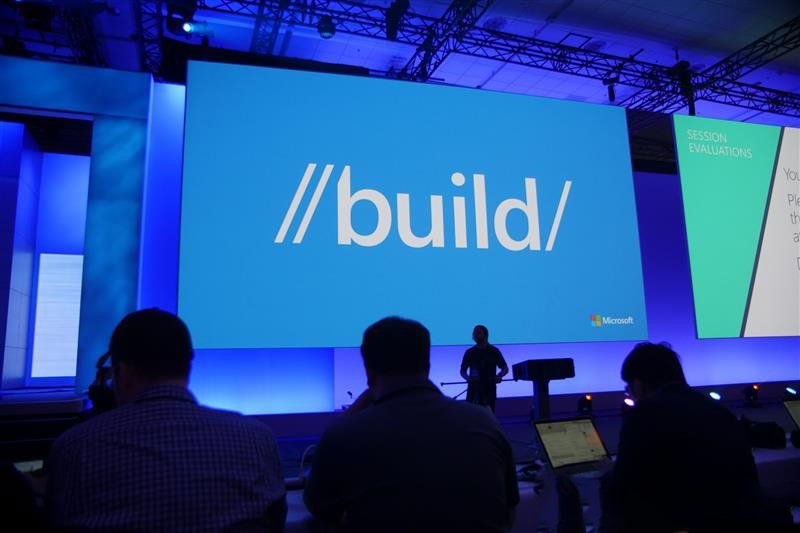
BUILD leaving May for June? That’s a plot twist
A leaked asset has seemingly confirmed that Microsoft is moving its Build developer conference out of May and into June, while also changing up its location. www.windowscentral.com
- Related coverage: insiderllm.com
Loading…
insiderllm.com - Official source: learn.microsoft.com
Loading…
learn.microsoft.com