

Microsoft used Build 2026 in San Francisco to push AI development away from a cloud-only model, announcing the Surface RTX Spark Dev Box and previewing Project Solara as hardware and platform moves for running agents locally, across PCs, desktops, wearables, and cloud-connected devices. The announcement is not merely another Surface experiment or developer workstation refresh. It is Microsoft’s clearest admission yet that the next phase of Windows AI cannot live entirely in Azure. If agents are going to be persistent, contextual, and useful outside canned demos, Microsoft needs intelligence closer to the user — and much closer to the machine.
For the past two years, Microsoft’s AI story has been dominated by cloud scale. Copilot, Azure OpenAI Service, GitHub Copilot, Microsoft 365 Copilot, and the company’s expanding model catalog all reinforced the same architecture: users ask, cloud models answer, and Microsoft meters the transaction somewhere in the stack. That made sense for the first wave of generative AI, where large models were scarce, expensive, and operationally exotic.
Build 2026 suggested a shift in emphasis. Microsoft is not abandoning the cloud — far from it — but it is trying to make the edge respectable again. The company’s phrase for this is “unmetered intelligence,” a neat bit of positioning that means developers and users should be able to run local models and agents without every experiment becoming an Azure billable event.
The word “unmetered” is doing a lot of work. It appeals to developers who want to iterate without watching tokens evaporate into a cost center. It appeals to enterprises that want sensitive data and workflows closer to their own hardware. It also lets Microsoft frame local AI not as a rejection of Azure, but as a pressure valve that makes cloud AI more usable.
That framing matters because the AI PC story has so far been uneven. Neural processing units have appeared in laptops before the everyday workloads compellingly justified them. Copilot+ PCs created a marketing category, but much of the heaviest AI work still depended on cloud services. Surface RTX Spark Dev Box and Project Solara are Microsoft’s attempt to make local AI feel less like a checkbox and more like an architecture.
That is a different proposition from a mainstream AI laptop. The Dev Box is not being pitched as a thin-and-light productivity device with a Copilot button. It is a machine for people building the software layer Microsoft wants Windows to host: agents, model pipelines, local inference tools, and hybrid applications that move between the device and the cloud.
The hardware numbers are meant to change developer behavior. A system that can run models up to the 120-billion-parameter class locally, depending on quantization and workload constraints, gives developers room to prototype without waiting on remote infrastructure. It also gives Microsoft a credible Windows answer to the increasingly popular local AI workstation setups that developers have been assembling with high-end GPUs, Linux boxes, and open-source model tooling.
This is where the Surface branding becomes interesting. Surface has often served as Microsoft’s hardware argument for where Windows should go next: tablets during the Windows 8 era, premium laptops during the ultrabook wars, Arm developer kits during the Windows-on-Arm transition. The RTX Spark Dev Box plays the same role for agentic AI. It is a reference machine disguised as a product.
Microsoft says the box will ship later this year in the United States, with developer tools such as Visual Studio Code and GitHub Copilot preinstalled. Pricing remains the missing variable, and it is not a small one. If the system lands as a premium niche workstation, it may influence OEMs more than it sells in volume. That may be enough.
That message is aimed at a real problem. AI development has often treated Windows as the front-end machine and Linux as the place where the serious model work happens. Windows Subsystem for Linux helped bridge that gap, but the cultural default among many AI developers has remained cloud notebooks, Linux servers, or dedicated GPU rigs. A Microsoft-designed NVIDIA dev box is a bid to collapse that split.
It also gives NVIDIA another path into the PC’s future. The company already owns much of the cloud training and inference story through its data-center GPUs. RTX Spark-style systems extend that advantage down into developer desktops and high-end local inference boxes. If the AI PC becomes less about a small NPU running background features and more about a heterogeneous local AI node, NVIDIA is well positioned.
There is a strategic tension here for Microsoft. The company has spent years trying to diversify Windows across Arm and x86, while also pushing NPUs through the Copilot+ PC program. A GPU-first AI workstation does not replace that strategy, but it does acknowledge that today’s serious local model work still wants memory bandwidth, mature tooling, and GPU acceleration. The future may be heterogeneous; the present still has a green logo on much of it.
For Windows users, that means the next round of AI hardware may not be as tidy as the Copilot+ branding implied. Some features will run well on NPUs. Some development workloads will demand discrete or integrated high-end GPUs. Some agents will hop between local execution and cloud models depending on policy, cost, latency, and privacy. The PC is becoming less a single device class than a negotiated compute fabric.
Local AI changes that rhythm. A developer can run models overnight, test agent loops repeatedly, and fine-tune smaller workloads without asking finance to bless another cloud budget. That does not eliminate cloud costs, but it changes which parts of the work are expensive. The cloud becomes the place for scale, distribution, frontier models, and enterprise orchestration; the edge becomes the place for iteration, context, and responsiveness.
Enterprises will hear a different version of the same pitch. Local execution can reduce latency, improve resilience, and keep some data on managed hardware rather than sending every prompt or file fragment to a remote service. That does not automatically make local AI secure, compliant, or cheaper, but it gives IT departments more architectural choices.
The risk is that “unmetered” becomes a marketing gloss over new forms of complexity. Local AI still consumes power, hardware budgets, admin time, endpoint security attention, and lifecycle management. A dev box that runs powerful models locally is also a machine that must be patched, secured, monitored, and governed. The meter does not disappear; it moves.
That is why Microsoft’s enterprise hooks matter. Surface RTX Spark Dev Box is described as a secured-core Windows 11 PC with support for familiar management and security layers such as BitLocker, Microsoft Defender, Entra ID, and Intune. Those details are not glamorous, but they are the difference between a lab toy and something an enterprise might allow onto the network.
That sounds speculative because it is. But it also points to where Microsoft thinks the PC is going. The next computer, in this framing, is not a single box. It is a “constellation” of devices that share context, identity, and agent state across the desk, the meeting room, the hallway, and the cloud.
This is Microsoft trying to avoid fighting the last war. The company missed the smartphone platform shift, then spent years rebuilding relevance through cloud services, productivity software, and cross-platform apps. Agentic computing threatens another shift in where users spend their attention. If agents become the interface, Microsoft wants them grounded in Microsoft 365, Windows, Azure, and enterprise identity — not trapped inside someone else’s handset or assistant.
The ID badge concept is telling. A badge is not a general-purpose computer in the old sense. It is a workplace object, identity token, sensor platform, and potential voice or context interface. Microsoft’s example use cases, including healthcare and hands-free workflows, suggest environments where the laptop is too bulky, the phone is too distracting, and the cloud alone is too distant.
The desktop ambient device points in another direction. It imagines a shared or semi-shared workspace surface where a worker can walk up, authenticate, and access Microsoft 365 Copilot or a Windows 365 cloud PC through a protected handoff. That sounds like a future kiosk, thin client, smart display, and AI assistant mashed into one object. It also sounds like a device category that will only work if IT trusts the identity and data boundaries.
That is why “handoff” and “context” are the real themes beneath the hardware news. A local agent that only knows what is happening on one machine is useful but limited. An enterprise agent that can understand calendar state, documents, chats, meetings, device presence, and workflow history becomes far more powerful. It also becomes far more sensitive.
Microsoft has an advantage here because of Microsoft 365. The company already hosts much of the enterprise context it wants agents to reason over. Work IQ, Copilot, Entra, Intune, Windows 365, and Azure form an unusually complete control plane for identity, policy, documents, devices, and cloud desktops. Project Solara is best understood as an attempt to stretch that control plane into new hardware.
That could make Windows more relevant, not less. A Windows PC might become the workstation where developers build agents, the secure endpoint where sensitive local execution happens, and the companion to smaller agentic devices that cannot carry the whole workload themselves. The PC’s role changes from “the place where apps run” to “the trusted anchor for a mesh of agents and devices.”
But there is a danger in abstraction. Users already struggle to understand where their data lives, what Copilot can see, and which policy controls apply across services. Add local models, wearable agents, ambient devices, and cloud PCs, and the mental model becomes harder. Microsoft’s challenge is not only to build the system. It is to make the system explainable.
A sensible agentic application may use a small local model for quick classification, a larger local model for private document analysis, and a cloud model for complex reasoning or broader knowledge tasks. It may need to respect enterprise policy that forbids certain data from leaving a device. It may need to degrade gracefully when local compute is unavailable, the user moves to battery power, or a workload exceeds the device’s memory budget.
That is a different development model from simply calling an API. It resembles distributed systems work, except the distributed system includes a user’s laptop, a local GPU, an NPU, enterprise identity, cloud models, and maybe a badge clipped to a nurse’s scrubs. The agent may be the user-facing abstraction, but developers still have to manage the plumbing.
Microsoft knows this, which is why the Dev Box is paired with tools rather than marketed as raw hardware alone. Visual Studio Code, GitHub Copilot, Windows developer platform updates, WSL support, and NVIDIA compatibility all matter because they reduce the distance between local experimentation and deployable software. The company is trying to make Windows not just a place where AI apps are consumed, but where they are built.
The open question is whether Microsoft can make this feel coherent across devices and silicon vendors. NVIDIA, Qualcomm, MediaTek, Arm, x86, NPUs, GPUs, cloud PCs, and Windows endpoints all appear somewhere in the story. That breadth is powerful. It is also exactly where Windows ecosystems can become messy if the abstractions leak.
The security model for this world cannot stop at device encryption and antivirus. Agents need permissions. Models need provenance. Local stores of embeddings, prompts, outputs, and workflow traces need retention policies. Admins need to know which models are installed, which workloads can call them, and whether a supposedly local agent is quietly handing off data to a cloud service.
Microsoft is better placed than most vendors to answer those questions because it already owns so much of the enterprise management stack. Intune can manage devices. Entra can govern identity. Defender can monitor threats. Purview can support compliance and data governance. The difficulty is integrating those layers into agent behavior that is transparent enough for auditors and controllable enough for administrators.
The other concern is lifecycle. A powerful AI dev box may be useful for years, but the model ecosystem moves quickly. Today’s local model target can look cramped tomorrow. Hardware purchased for one class of agentic workload may struggle with the next. Enterprises will need to decide whether edge AI hardware is a workstation category, a server category, an appliance category, or something new.
That classification matters for budgeting and support. A developer workstation can be refreshed on one cadence. A regulated clinical device has another. A shared ambient workplace terminal has another still. Project Solara’s “constellation” language is elegant, but constellations are easier to draw than to manage.
That is a classic platform move. Microsoft is telling developers and enterprises that they can participate in the next computing shift without abandoning the last one. Keep Windows. Keep your management plane. Keep your productivity data. Add local AI hardware and agent-first devices around it.
This is not guaranteed to work. The history of computing is full of platform owners trying to domesticate a new paradigm with old distribution advantages. Sometimes the incumbent wins because it owns the customer, the tools, and the ecosystem. Sometimes the new interaction model escapes before the incumbent can package it.
Microsoft’s advantage is that agentic AI is not arriving as a purely consumer phenomenon. Much of the immediate value is in work: coding, summarizing, planning, triaging, retrieving, drafting, automating, and coordinating across enterprise systems. That is Microsoft’s home turf. If the agent era begins in the workplace, Microsoft has a better chance of defining its hardware and identity assumptions.
Still, the company must prove that the local-agent experience is more than demo choreography. A PC you can “text” while away from your desk is an appealing image, especially when Jensen Huang describes it as the evolution from personal computer to personal AI. But the difference between magic and misfire will be reliability: whether the agent understands context, uses tools safely, recovers from mistakes, and makes its actions visible.
That does not mean the cloud becomes less important. In fact, hybrid AI may make the cloud more strategic because it becomes the coordination layer for distributed intelligence. Models, policies, updates, identity, telemetry, and large-scale reasoning still need centralized infrastructure. The edge does not replace the cloud; it gives the cloud more places to act.
The practical question is where the boundary settles. Latency-sensitive, privacy-sensitive, repetitive, and exploratory workloads are good candidates for local execution. Frontier reasoning, broad retrieval, fleet-scale orchestration, and large shared services remain cloud-friendly. Most real applications will blend both, which is why Microsoft’s emphasis on “local and cloud” matters more than the hardware specs alone.
For WindowsForum readers, the immediate consequence is that Windows hardware buying decisions may become more workload-specific. The old question was whether a machine had enough CPU, RAM, and storage. The newer question added GPU and NPU capacity. The next question will be whether a device can participate in an agentic workflow under the right policy, with the right local models, and with enough memory to keep context useful.
That is a more complicated purchasing conversation, but it is also a more interesting one. The PC market has spent years searching for reasons to upgrade beyond thinner bezels and better battery life. Local AI is not automatically that reason for every user. For developers and some enterprise teams, it may finally be a credible one.
 Microsoft’s AI Pitch Moves From the Data Center to the Desk
For the past two years, Microsoft’s AI story has been dominated by cloud scale. Copilot, Azure OpenAI Service, GitHub Copilot, Microsoft 365 Copilot, and the company’s expanding model catalog all reinforced the same architecture: users ask, cloud models answer, and Microsoft meters the transaction somewhere in the stack. That made sense for the first wave of generative AI, where large models were scarce, expensive, and operationally exotic.Build 2026 suggested a shift in emphasis. Microsoft is not abandoning the cloud — far from it — but it is trying to make the edge respectable again. The company’s phrase for this is “unmetered intelligence,” a neat bit of positioning that means developers and users should be able to run local models and agents without every experiment becoming an Azure billable event.
The word “unmetered” is doing a lot of work. It appeals to developers who want to iterate without watching tokens evaporate into a cost center. It appeals to enterprises that want sensitive data and workflows closer to their own hardware. It also lets Microsoft frame local AI not as a rejection of Azure, but as a pressure valve that makes cloud AI more usable.
That framing matters because the AI PC story has so far been uneven. Neural processing units have appeared in laptops before the everyday workloads compellingly justified them. Copilot+ PCs created a marketing category, but much of the heaviest AI work still depended on cloud services. Surface RTX Spark Dev Box and Project Solara are Microsoft’s attempt to make local AI feel less like a checkbox and more like an architecture.
The Surface RTX Spark Dev Box Is a Developer Machine With a Message
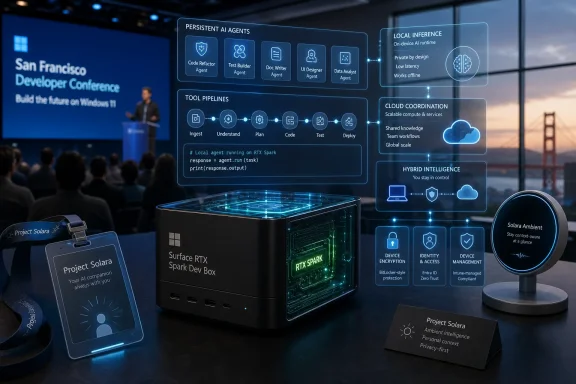
The Surface RTX Spark Dev Box is the most concrete part of the announcement. It is a compact Windows 11 developer PC built around NVIDIA’s RTX Spark silicon, with up to one petaflop of AI compute and 128GB of unified memory. Microsoft says it is designed for local-first AI development, long-running agentic workflows, model fine-tuning, and running large models locally.That is a different proposition from a mainstream AI laptop. The Dev Box is not being pitched as a thin-and-light productivity device with a Copilot button. It is a machine for people building the software layer Microsoft wants Windows to host: agents, model pipelines, local inference tools, and hybrid applications that move between the device and the cloud.
The hardware numbers are meant to change developer behavior. A system that can run models up to the 120-billion-parameter class locally, depending on quantization and workload constraints, gives developers room to prototype without waiting on remote infrastructure. It also gives Microsoft a credible Windows answer to the increasingly popular local AI workstation setups that developers have been assembling with high-end GPUs, Linux boxes, and open-source model tooling.
This is where the Surface branding becomes interesting. Surface has often served as Microsoft’s hardware argument for where Windows should go next: tablets during the Windows 8 era, premium laptops during the ultrabook wars, Arm developer kits during the Windows-on-Arm transition. The RTX Spark Dev Box plays the same role for agentic AI. It is a reference machine disguised as a product.
Microsoft says the box will ship later this year in the United States, with developer tools such as Visual Studio Code and GitHub Copilot preinstalled. Pricing remains the missing variable, and it is not a small one. If the system lands as a premium niche workstation, it may influence OEMs more than it sells in volume. That may be enough.
NVIDIA Gets a New Beachhead Inside Windows
The NVIDIA partnership is not incidental. Microsoft’s local AI ambitions need silicon that developers already know how to use, and NVIDIA’s CUDA ecosystem remains the gravitational center of serious AI development. By building a Surface-class development machine around RTX Spark, Microsoft is effectively telling developers that Windows can be a first-class local AI environment without forcing them to abandon familiar GPU tooling.That message is aimed at a real problem. AI development has often treated Windows as the front-end machine and Linux as the place where the serious model work happens. Windows Subsystem for Linux helped bridge that gap, but the cultural default among many AI developers has remained cloud notebooks, Linux servers, or dedicated GPU rigs. A Microsoft-designed NVIDIA dev box is a bid to collapse that split.
It also gives NVIDIA another path into the PC’s future. The company already owns much of the cloud training and inference story through its data-center GPUs. RTX Spark-style systems extend that advantage down into developer desktops and high-end local inference boxes. If the AI PC becomes less about a small NPU running background features and more about a heterogeneous local AI node, NVIDIA is well positioned.
There is a strategic tension here for Microsoft. The company has spent years trying to diversify Windows across Arm and x86, while also pushing NPUs through the Copilot+ PC program. A GPU-first AI workstation does not replace that strategy, but it does acknowledge that today’s serious local model work still wants memory bandwidth, mature tooling, and GPU acceleration. The future may be heterogeneous; the present still has a green logo on much of it.
For Windows users, that means the next round of AI hardware may not be as tidy as the Copilot+ branding implied. Some features will run well on NPUs. Some development workloads will demand discrete or integrated high-end GPUs. Some agents will hop between local execution and cloud models depending on policy, cost, latency, and privacy. The PC is becoming less a single device class than a negotiated compute fabric.
“Unmetered Intelligence” Is Also a Cost Argument
Microsoft’s phrase “unmetered intelligence” sounds lofty, but its appeal is practical. Developers hate artificial friction during experimentation. If every agent test, model run, or workflow iteration consumes cloud credits, experimentation slows or moves elsewhere.Local AI changes that rhythm. A developer can run models overnight, test agent loops repeatedly, and fine-tune smaller workloads without asking finance to bless another cloud budget. That does not eliminate cloud costs, but it changes which parts of the work are expensive. The cloud becomes the place for scale, distribution, frontier models, and enterprise orchestration; the edge becomes the place for iteration, context, and responsiveness.
Enterprises will hear a different version of the same pitch. Local execution can reduce latency, improve resilience, and keep some data on managed hardware rather than sending every prompt or file fragment to a remote service. That does not automatically make local AI secure, compliant, or cheaper, but it gives IT departments more architectural choices.
The risk is that “unmetered” becomes a marketing gloss over new forms of complexity. Local AI still consumes power, hardware budgets, admin time, endpoint security attention, and lifecycle management. A dev box that runs powerful models locally is also a machine that must be patched, secured, monitored, and governed. The meter does not disappear; it moves.
That is why Microsoft’s enterprise hooks matter. Surface RTX Spark Dev Box is described as a secured-core Windows 11 PC with support for familiar management and security layers such as BitLocker, Microsoft Defender, Entra ID, and Intune. Those details are not glamorous, but they are the difference between a lab toy and something an enterprise might allow onto the network.
Project Solara Reveals the Bigger Bet
If the Dev Box is the product developers can picture on a desk, Project Solara is the stranger and more ambitious idea. Microsoft describes Solara as a chip-to-cloud platform for agent-first devices, spanning new form factors and workflows. The company showed reference designs including an ID badge-style device using Qualcomm wearable silicon and a desktop ambient device built around a MediaTek system on a chip.That sounds speculative because it is. But it also points to where Microsoft thinks the PC is going. The next computer, in this framing, is not a single box. It is a “constellation” of devices that share context, identity, and agent state across the desk, the meeting room, the hallway, and the cloud.
This is Microsoft trying to avoid fighting the last war. The company missed the smartphone platform shift, then spent years rebuilding relevance through cloud services, productivity software, and cross-platform apps. Agentic computing threatens another shift in where users spend their attention. If agents become the interface, Microsoft wants them grounded in Microsoft 365, Windows, Azure, and enterprise identity — not trapped inside someone else’s handset or assistant.
The ID badge concept is telling. A badge is not a general-purpose computer in the old sense. It is a workplace object, identity token, sensor platform, and potential voice or context interface. Microsoft’s example use cases, including healthcare and hands-free workflows, suggest environments where the laptop is too bulky, the phone is too distracting, and the cloud alone is too distant.
The desktop ambient device points in another direction. It imagines a shared or semi-shared workspace surface where a worker can walk up, authenticate, and access Microsoft 365 Copilot or a Windows 365 cloud PC through a protected handoff. That sounds like a future kiosk, thin client, smart display, and AI assistant mashed into one object. It also sounds like a device category that will only work if IT trusts the identity and data boundaries.
The PC Becomes a Node, Not the Whole System
For decades, Windows was built around the assumption that the PC was the center of the user’s computing life. Cloud storage weakened that assumption. Smartphones shattered it for consumers. Enterprise SaaS made the browser an operating environment of its own. Microsoft’s current AI hardware push accepts that the PC is no longer the whole system — then tries to make it the most important node inside a larger one.That is why “handoff” and “context” are the real themes beneath the hardware news. A local agent that only knows what is happening on one machine is useful but limited. An enterprise agent that can understand calendar state, documents, chats, meetings, device presence, and workflow history becomes far more powerful. It also becomes far more sensitive.
Microsoft has an advantage here because of Microsoft 365. The company already hosts much of the enterprise context it wants agents to reason over. Work IQ, Copilot, Entra, Intune, Windows 365, and Azure form an unusually complete control plane for identity, policy, documents, devices, and cloud desktops. Project Solara is best understood as an attempt to stretch that control plane into new hardware.
That could make Windows more relevant, not less. A Windows PC might become the workstation where developers build agents, the secure endpoint where sensitive local execution happens, and the companion to smaller agentic devices that cannot carry the whole workload themselves. The PC’s role changes from “the place where apps run” to “the trusted anchor for a mesh of agents and devices.”
But there is a danger in abstraction. Users already struggle to understand where their data lives, what Copilot can see, and which policy controls apply across services. Add local models, wearable agents, ambient devices, and cloud PCs, and the mental model becomes harder. Microsoft’s challenge is not only to build the system. It is to make the system explainable.
Developers Get Power, But Also a New Testing Matrix
For developers, the hardware news is exciting in the way new compute is always exciting: more local headroom, fewer round trips, faster iteration. But the practical consequence is also a more complicated target environment. Applications will increasingly need to decide where AI work should run and why.A sensible agentic application may use a small local model for quick classification, a larger local model for private document analysis, and a cloud model for complex reasoning or broader knowledge tasks. It may need to respect enterprise policy that forbids certain data from leaving a device. It may need to degrade gracefully when local compute is unavailable, the user moves to battery power, or a workload exceeds the device’s memory budget.
That is a different development model from simply calling an API. It resembles distributed systems work, except the distributed system includes a user’s laptop, a local GPU, an NPU, enterprise identity, cloud models, and maybe a badge clipped to a nurse’s scrubs. The agent may be the user-facing abstraction, but developers still have to manage the plumbing.
Microsoft knows this, which is why the Dev Box is paired with tools rather than marketed as raw hardware alone. Visual Studio Code, GitHub Copilot, Windows developer platform updates, WSL support, and NVIDIA compatibility all matter because they reduce the distance between local experimentation and deployable software. The company is trying to make Windows not just a place where AI apps are consumed, but where they are built.
The open question is whether Microsoft can make this feel coherent across devices and silicon vendors. NVIDIA, Qualcomm, MediaTek, Arm, x86, NPUs, GPUs, cloud PCs, and Windows endpoints all appear somewhere in the story. That breadth is powerful. It is also exactly where Windows ecosystems can become messy if the abstractions leak.
Enterprise IT Will Like the Control and Fear the Sprawl
For IT departments, Microsoft’s edge AI turn is both welcome and alarming. It is welcome because cloud-only AI has always raised concerns around data residency, latency, regulatory exposure, and recurring cost. It is alarming because local AI turns endpoints into places where powerful models, sensitive data, and autonomous workflows may meet.The security model for this world cannot stop at device encryption and antivirus. Agents need permissions. Models need provenance. Local stores of embeddings, prompts, outputs, and workflow traces need retention policies. Admins need to know which models are installed, which workloads can call them, and whether a supposedly local agent is quietly handing off data to a cloud service.
Microsoft is better placed than most vendors to answer those questions because it already owns so much of the enterprise management stack. Intune can manage devices. Entra can govern identity. Defender can monitor threats. Purview can support compliance and data governance. The difficulty is integrating those layers into agent behavior that is transparent enough for auditors and controllable enough for administrators.
The other concern is lifecycle. A powerful AI dev box may be useful for years, but the model ecosystem moves quickly. Today’s local model target can look cramped tomorrow. Hardware purchased for one class of agentic workload may struggle with the next. Enterprises will need to decide whether edge AI hardware is a workstation category, a server category, an appliance category, or something new.
That classification matters for budgeting and support. A developer workstation can be refreshed on one cadence. A regulated clinical device has another. A shared ambient workplace terminal has another still. Project Solara’s “constellation” language is elegant, but constellations are easier to draw than to manage.
Microsoft Is Selling Continuity Through a Discontinuity
The most interesting part of Microsoft’s pitch is how familiar it tries to make a disruptive idea. Agents may change the interface. Local models may change the economics. New form factors may change where computing happens. Yet Microsoft’s answer is to wrap those changes in Windows, Surface, Microsoft 365, Azure, Entra, Intune, and Copilot.That is a classic platform move. Microsoft is telling developers and enterprises that they can participate in the next computing shift without abandoning the last one. Keep Windows. Keep your management plane. Keep your productivity data. Add local AI hardware and agent-first devices around it.
This is not guaranteed to work. The history of computing is full of platform owners trying to domesticate a new paradigm with old distribution advantages. Sometimes the incumbent wins because it owns the customer, the tools, and the ecosystem. Sometimes the new interaction model escapes before the incumbent can package it.
Microsoft’s advantage is that agentic AI is not arriving as a purely consumer phenomenon. Much of the immediate value is in work: coding, summarizing, planning, triaging, retrieving, drafting, automating, and coordinating across enterprise systems. That is Microsoft’s home turf. If the agent era begins in the workplace, Microsoft has a better chance of defining its hardware and identity assumptions.
Still, the company must prove that the local-agent experience is more than demo choreography. A PC you can “text” while away from your desk is an appealing image, especially when Jensen Huang describes it as the evolution from personal computer to personal AI. But the difference between magic and misfire will be reliability: whether the agent understands context, uses tools safely, recovers from mistakes, and makes its actions visible.
The Edge AI Story Finally Has Hardware Attached
The industry has talked about edge AI for years, often in abstractions. Microsoft’s Build announcements make the idea more tangible. The edge is no longer just a factory sensor, a retail camera, or a telecom slide deck. It is a developer’s desk, a workplace badge, a companion device, and a Windows machine with enough local compute to run meaningful models.That does not mean the cloud becomes less important. In fact, hybrid AI may make the cloud more strategic because it becomes the coordination layer for distributed intelligence. Models, policies, updates, identity, telemetry, and large-scale reasoning still need centralized infrastructure. The edge does not replace the cloud; it gives the cloud more places to act.
The practical question is where the boundary settles. Latency-sensitive, privacy-sensitive, repetitive, and exploratory workloads are good candidates for local execution. Frontier reasoning, broad retrieval, fleet-scale orchestration, and large shared services remain cloud-friendly. Most real applications will blend both, which is why Microsoft’s emphasis on “local and cloud” matters more than the hardware specs alone.
For WindowsForum readers, the immediate consequence is that Windows hardware buying decisions may become more workload-specific. The old question was whether a machine had enough CPU, RAM, and storage. The newer question added GPU and NPU capacity. The next question will be whether a device can participate in an agentic workflow under the right policy, with the right local models, and with enough memory to keep context useful.
That is a more complicated purchasing conversation, but it is also a more interesting one. The PC market has spent years searching for reasons to upgrade beyond thinner bezels and better battery life. Local AI is not automatically that reason for every user. For developers and some enterprise teams, it may finally be a credible one.
The New Windows AI Stack Leaves a Trail of Practical Clues
Microsoft’s announcements are still early enough that pricing, real-world performance, thermals, and developer adoption will determine how seriously the market takes them. But the direction is now visible. Build 2026 was less about a single gadget than about a Windows ecosystem that treats local compute, cloud services, and agentic interfaces as one continuum.- Microsoft is positioning Surface RTX Spark Dev Box as a local-first AI development machine, not as a mainstream consumer PC.
- The company’s “unmetered intelligence” message is aimed at reducing developer friction and cloud-cost anxiety during AI experimentation.
- Project Solara shows that Microsoft sees agentic computing as a multi-device platform problem, not merely a Windows feature update.
- NVIDIA’s role reinforces that serious local AI development still depends heavily on mature GPU tooling and high-memory systems.
- Enterprise adoption will depend less on demos than on governance, identity, security, lifecycle management, and clear data-boundary controls.
- The Windows PC is being recast as a trusted node in a broader AI device constellation rather than the sole center of computing.
References
- Primary source: Cloud Wars
Published: Tue, 09 Jun 2026 15:23:31 GMT
Microsoft Hardware Pushes More AI Development and Execution to the Edge - Cloud Wars
NVIDIA-powered 'Dev Box' delivers horsepower to execute massive AI models from local systems on an 'unmetered' basis, while reference designs aim to make AI computing ubiquitous.cloudwars.com - Related coverage: windowscentral.com
Microsoft's biggest week of the year: Surface Laptop Ultra, NVIDIA RTX Spark, Build, and much more | Windows Central
A packed week filled with major announcements gives Windows 11 its strongest momentum in years.www.windowscentral.com - Related coverage: tomshardware.com
Surface Laptop Ultra targets 110W TDP for RTX Spark Superchip — Microsoft reveals power budget of its high-end 15" system in hands-on session | Tom's Hardware
Disclosure gives us an idea of the thermal and power ballpark the RTX Spark Superchip might play inwww.tomshardware.com - Official source: microsoft.com
Surface RTX Spark Dev Box: The new dev box | Microsoft Surface
Discover the new Surface RTX Spark Dev Box built for developers. Small enough to sit on your desktop. Powerful enough to create the future. Right out of the box.www.microsoft.com - Official source: news.microsoft.com
Microsoft Build en directo
El lugar donde seguir en tiempo real las últimas noticias a medida que se anuncien desde el Microsoft Build, los días 2 y 3 de junio de 2026.news.microsoft.com - Related coverage: thetechportal.com
Microsoft introduces Surface RTX Spark Dev Box, GitHub Copilot app, Project Solara, and new AI models at Build 2026 - The Tech Portal
Microsoft unveiled a series of major AI-focused announcements at its Build 2026 developer conference, including the new Surface thetechportal.com
- Official source: blogs.windows.com
Build 2026: Furthering Windows as the trusted platform for development
Build is one of our favorite moments each year - a chance to connect with the global developer community and share what we’ve been building. Over the past year, we have connected with many developers pushing the boundaries of what’s possible onblogs.windows.com - Related coverage: siliconangle.com
Microsoft announces Surface RTX Spark AI supercomputer development box - SiliconANGLE
Microsoft announces Surface RTX Spark AI supercomputer development box - SiliconANGLE siliconangle.com
- Related coverage: thewincentral.com
Microsoft Surface RTX Spark Dev Box Debuts at Build 2026 - WinCentral
Microsoft unveils the Surface RTX Spark Dev Box, a compact AI-powered developer PC built for local AI models, agents, and Windows development. - Read in Latest News on WinCentral thewincentral.com
- Related coverage: axios.com
Microsoft debuts Nvidia-powered Microsoft Surface Ultra laptop
Microsoft is trying again to redefine the PC for the AI era.www.axios.com
- Official source: wwps.microsoft.com
- Official source: cdn-dynmedia-1.microsoft.com
