

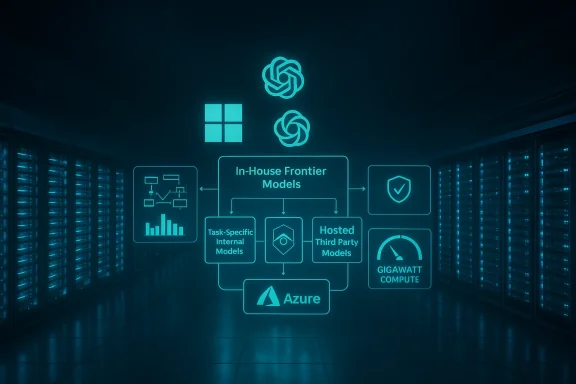
Microsoft’s senior AI leadership has openly signaled a strategic shift: the company is preparing to build its own frontier-grade foundation models and the gigawatt-scale compute to train them, reducing operational dependence on OpenAI even as commercial ties remain in place.
Background
Microsoft’s relationship with OpenAI has been one of the defining public tech partnerships of the last several years. The collaboration brought OpenAI models into Microsoft products—Bing Chat, GitHub Copilot, and Microsoft 365 Copilot among them—and came with significant financial and infrastructure commitments. Those ties created fast access to frontier capabilities while placing a strategic piece of Microsoft’s product roadmap on a third-party foundation.In recent public comments, Mustafa Suleyman—Microsoft’s chief of AI and a co‑founder of DeepMind—stated that Microsoft must develop “our own foundation models” supported by very large-scale compute and first‑rate training teams. Suleyman’s remarks, reported by multiple outlets and summarized in company comment threads, were explicit: Microsoft intends to expand internal model development aimed at frontier capability, not merely produce small optimized models. He indicated Microsoft expects to ship internally developed frontier models sometime in 2026.
At the same time, company communications emphasize a multi-model approach. Microsoft says OpenAI “has a huge role for us,” while confirming that Microsoft is building its own frontier systems for specific use cases and product-level control. The practical result is less of a rupture than a repositioning—OpenAI remains a partner, but Microsoft is moving to reduce single‑vendor dependency.
What Microsoft is actually planning
Frontier models, gigawatt compute, and training teams
Suleyman’s language—frontier models plus gigawatt‑scale compute—is deliberately evocative. It signals an intent to operate at the same class of capability as the labs that currently dominate the highest end of the AI stack. That means:- Building large training clusters measured in tens of thousands of accelerator GPUs (or equivalent specialized silicon).
- Funding continuous pretraining and large-scale fine‑tuning pipelines.
- Assembling research and engineering teams focused on model architecture, safety and alignment, and production reliability.
Multi-supplier, task-specialized product architecture
Microsoft is not proposing a single-monolithic replacement of OpenAI across all workloads. Instead, its product architecture looks to be multi-layered:- Smaller, task-specific in‑house models for latency‑sensitive or high‑volume workloads inside Microsoft 365 and developer tools.
- Frontier-grade internal models for cases that require the broadest reasoning/generalization capabilities.
- Hosted third‑party models (Anthropic, Mistral, etc.) integrated where they are best‑fit or cost‑effective.
- Retained OpenAI access for selected frontier capabilities where those models are preferable or required by product design.
Why this matters: strategic and economic drivers
1) Supply‑chain risk and product continuity
Relying on an external lab for the models that power core productivity experiences creates a business‑continuity vulnerability. Microsoft’s Copilot family is embedded in large enterprises; ensuring predictable uptime, versioning, and fine‑grained control over behavior and data handling is essential. Bringing models in‑house reduces a single point of failure and gives Microsoft control over upgrade schedules and fallback strategies.2) Unit economics and scale optimization
Frontier models are expensive to run at enterprise scale. The per‑inference cost of third‑party APIs can be significant at hundreds of thousands or millions of seats. By developing models tailored to typical Copilot workloads, Microsoft can:- Reduce inference cost through optimized model architectures.
- Trade a modestly lower absolute peak capability for dramatic improvements in cost-per-task and latency.
- Apply hardware co‑design and software optimizations within Azure to squeeze more throughput from the same compute footprint.
3) Competitive positioning vs. hyperscalers and cloud customers
Other cloud providers (Google, Amazon, and others) are rapidly building their own high‑capability models and tightly integrating them with their clouds. Owning its own frontier models allows Microsoft to:- Differentiate Azure with proprietary, optimized model tiers.
- Offer customers predictable SLAs and better vertical integration for regulated industries.
- Negotiate from a position of real autonomy rather than being a reselling channel for another company’s breakthroughs.
4) Regulatory, compliance, and IP control
Enterprises operating under privacy and data‑residency constraints will favor models that Microsoft can warranty, host, and customize in‑cloud or on‑premises. Owning model IP and the training/fine‑tuning pipelines simplifies compliance engineering around data access, logging, and redaction. The restructured agreements between Microsoft and OpenAI reportedly contain IP and hosting rights extending into the 2030s—yet Microsoft’s move to its own models is an insurance policy against potential future legal or commercial friction.What this means for OpenAI
Microsoft’s move is not a clean break. Contractual relationships and equity stakes remain; reporting suggests Microsoft retains a meaningful position in OpenAI’s for‑profit arm and specific IP rights through 2032. But the strategic landscape changes materially:- OpenAI loses exclusivity of product integration with its largest enterprise channel.
- OpenAI may face increased competition for cloud compute and enterprise contracts as Microsoft, Google, and AWS lean on their own stacks.
- If OpenAI’s reported capital and legal pressures intensify, the company could find itself negotiating with multiple clouds and customers rather than relying on a single anchor partner.
Signals, evidence, and what is still uncertain
Confirmed signals
- Public comments by Mustafa Suleyman calling for Microsoft‑developed foundation models and gigawatt‑scale compute.
- Microsoft leadership messaging that the company will continue working with OpenAI while building its own frontier-grade systems.
- Media and internal reporting of Microsoft experimenting with in‑house models and smaller task‑optimized families for Copilot workloads.
Strongly reported but partially unverifiable claims
- Precise ownership and stake percentages (commonly cited as ~27% of OpenAI’s for‑profit arm) and IP hosting rights timelines through 2032 are reported broadly in the press but depend on internal contracts and redacted agreements; treat precise dollar amounts and contractual clauses as company/press estimates unless the official filings are publicly available. Caution advised.
Open questions that matter
- How Microsoft’s in‑house frontier models will compare on benchmarks and safety alignment to OpenAI and other leading labs when released.
- The exact timetable for Microsoft’s production‑grade frontier model launches in 2026 and how broadly Microsoft will expose those models (internally vs. commercial tiers).
- The economic model Microsoft will use: will it price in‑house frontier calls below OpenAI’s current enterprise API, and will that drive migrations?
Technical implications: compute, hardware, and engineering scale
Training frontier models at the scale Suleyman describes is not a one‑quarter program. It requires:- Hardware procurement at hyperscale (thousands to tens of thousands of accelerators).
- Data pipelines for multi‑modal, diverse, and continuously curated corpora.
- Software stacks for distributed training, model parallelism, optimizer tuning, and checkpointing.
- Substantial engineering investment in tooling for long‑running experiments and reproducible fine‑tuning.
Product impact: Copilot, GitHub, and enterprise customers
For end users, the near‑term experience is unlikely to change dramatically; Microsoft aims to migrate parts of the Copilot workload to cheaper, faster, task-optimized in‑house models and reserve frontier calls for problems that need them. Practical outcomes may include:- Faster response times for routine Copilot tasks as optimized internal models reduce latency.
- Lower operating costs for customers (and Microsoft) as cheaper inferencing replaces expensive API calls.
- Better customization for regulated customers who need model behavior guarantees and data‑locality.
- Potential differences in capability: for some edge cases, Microsoft’s internal models may not match the most recent OpenAI capabilities immediately. Microsoft will have to weigh the trade‑off between cost and peak capability carefully.
Competitive dynamics: how hyperscalers and startups respond
The AI model market is moving fast toward a multi‑model equilibrium. Key competitive consequences include:- Hyperscalers (Google Cloud, AWS) will continue to lock in customers with their own vertically integrated models and tooling.
- Startups and specialized labs (Anthropic, Mistral, and others) gain opportunities to partner with clouds or be integrated as first‑class options inside product stacks.
- Enterprise customers will increasingly demand model choice, portability, and predictable economics; those that provide flexible multi‑model operating layers will have a market edge.
Risks and downsides
No strategic pivot is without trade‑offs. The primary risks to watch are:- Execution risk: Training frontier models at scale is technically complex and expensive. Talent competition for top researchers and engineers is fierce.
- Capital expenditure and power constraints: Building gigawatt‑class compute carries substantial capex and operational costs. Power availability, cooling, and data center capacity are real constraints.
- Safety and alignment liabilities: Moving from a partner lab to in‑house frontier models shifts the burden of safety research, internal audits, and regulatory compliance to Microsoft. Failures or harms could have larger legal and reputational consequences.
- Market fragmentation: If every hyperscaler builds slightly different frontier stacks, enterprise interoperability and model portability could suffer, imposing additional integration burdens on customers.
- Potential regulatory scrutiny: Greater vertical integration and control of models may invite regulatory interest in market power, data practices, and competition.
Practical advice for enterprise IT and product leaders
Enterprises considering AI adoption or expansion should prepare for a multi‑model, multi‑cloud world. Practical steps:- Audit current AI dependencies: map which products rely on which external models and assess vendor concentration risk.
- Build abstraction layers: implement model-agnostic middleware that can route calls to different model vendors or to internal models with minimal friction.
- Negotiate cloud and model SLAs: ask vendors for explicit performance, availability, and data‑handling commitments.
- Invest in evaluation tooling: benchmark models on your actual tasks (not generic public benchmarks) to choose the right model for each workload.
- Prepare compliance and safety processes: have playbooks for alignment testing, bias audits, and incident response when model outputs affect business decisions.
Bottom line: evolution, not apocalypse
Microsoft’s public statements and internal moves signal a deliberate shift from heavy reliance on a single external model provider to a diversified, partially internalized model strategy. This is a strategic evolution rather than an abrupt divorce: OpenAI remains important to Microsoft’s frontier ambitions even as Microsoft prepares an independent path. The consequences for competition, enterprise procurement, and product engineering are significant.Expect the next 12–24 months to be characterized by:
- Rapid model releases and repeated price/performance comparisons across vendors.
- Increased enterprise demand for multi‑model management and portability.
- Continued public debate over safety, IP, and the economics of frontier compute.
In an era where models are becoming foundational infrastructure, the companies that control, optimize, and responsibly operate those models will shape the next phase of enterprise computing. Microsoft’s pivot places it squarely in that contest.
Source: vocal.media Microsoft Signals Shift Away From OpenAI as It Prepares Its Own Frontier AI Models
