

Microsoft’s abrupt decision to shutter long‑running employee libraries across several campuses and pivot staff learning toward an “AI‑powered” Skilling Hub crystallizes a broader corporate tension: heavy investment in generative AI and infrastructure on one hand, and the removal of human‑curated knowledge, subscriptions, and physical learning spaces on the other.
For decades, Microsoft maintained on‑campus libraries that blended physical collections, librarian curation, and institutional subscriptions to specialist publications—services employees used for technical research, management development, and longform context. Those libraries are now being repurposed into collaborative “Skilling Hub” spaces and paired with a centralized AI learning experience that Microsoft says will deliver personalized training at scale. The company’s internal communications reportedly frame this as modernization, but multiple reportsso coincides with the non‑renewal of longstanding institutional subscriptions. This shift happens amid an intense corporate focus on AI: Microsoft has publicly signalled massive capital expenditure to expand AI infrastructure, while simultaneously reshaping workforce composition and internal services to align with an “ose strategic trade‑offs—between capital investment in compute and recurring spend on vendors, between algorithmic scale and human curation—are at the heart of the current debate.
Key numbers and claims—such as Microsoft’s large FY2025 AI capex plan and multiple recent rounds of workforce reductions—are widely reported and consistent across analyst and trade coverage, but some operational specifics (for example, the exact list of cancelled subscriptions or the permanent fate of every library location) vary between reports and remain best‑effort reconstructions. Where public claims diverge, those details should be treated as provisional pending company disclosures.
Microsoft’s library closures are far more than an employee perk revision; they are a lens into how large enterprises reconfigure knowledge, trust, and people economics in the age of AI. The right path forward combines technological ambition with explicit institutional safeguards—so that the speed and scale of AI‑powered learning enhance judgment rather than erode the very foundations that make judgment reliable.
Source: Analytics Insight https://www.analyticsinsight.net/am...mid-layoffs-debate-as-ai-learning-takes-over]
 Background / Overview
For decades, Microsoft maintained on‑campus libraries that blended physical collections, librarian curation, and institutional subscriptions to specialist publications—services employees used for technical research, management development, and longform context. Those libraries are now being repurposed into collaborative “Skilling Hub” spaces and paired with a centralized AI learning experience that Microsoft says will deliver personalized training at scale. The company’s internal communications reportedly frame this as modernization, but multiple reportsso coincides with the non‑renewal of longstanding institutional subscriptions. This shift happens amid an intense corporate focus on AI: Microsoft has publicly signalled massive capital expenditure to expand AI infrastructure, while simultaneously reshaping workforce composition and internal services to align with an “ose strategic trade‑offs—between capital investment in compute and recurring spend on vendors, between algorithmic scale and human curation—are at the heart of the current debate. What changed — the mechanics of the closure
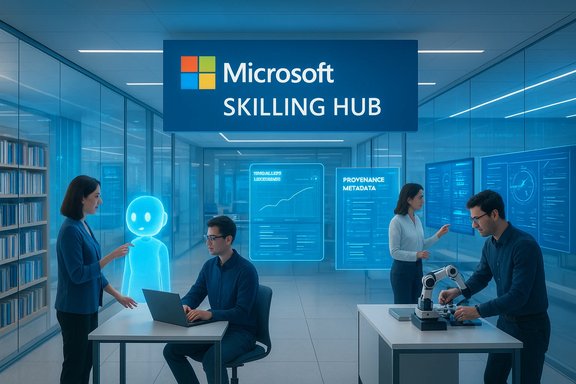
Microsoft’s change is not a sn but a bundled operational decision with several moving parts:- Physical library spaces across multiple campuses are being closed or repurposed into collaborative Skilling Hubs designed for group training, labs, and AI experimentation.
- Institutional subscriptions that employees once accesslets and research services used for deep analysis—were reportedly not renewed or were reduced as the company rebalanced vendor spend. Reports identify titles used inside Microsoft’s libraries that have been impacted.
- The Skilling Hub initiative, as described internally, will centralize learning, deliver personalized pathways, and surface AI‑generated summaries and micro‑learning modules instead of the previous mix of librarian recommendations, books, and loMicrosoft frames the move as an evolution—matching corporate learning to modern consumption patterns, improving discoverability, and making learning measurable at enterprise scale. Yet the operational reality is a net reduction in some kinds of access that employees previously relied on for depth and provenance.
Why this matters: provenance, trust, and institutional knowledge
AI‑driven summarization and personalized pathways offer real advantages—speed, scale, and tailoring to role‑specific needs. But exchanging human editorial curation and primary sources fo creates distinct risks.- Provenance loss. Books and specialist reports carry authorial context, citations, and arguments that are crucial when making high‑stakes decisions. AI summaries that do not preserve provenance can mask where information originated and why assertions were made.
- Hallucination risk. Generative models can produce fluent yet fabricated information—so‑called “hallucinations”—which, if unvetted, can become actionable intelligence. Recent high‑profile incidents demonstrate that AI misinformation can migrate into official decision‑making with serious consequences.
- Concentration and selection bias. Centralizing learning within a single platform increases dependence on its curation algorithms, vendor licensing, and ranking rules. This can narrow the intellectual diet available to employees, unintentionally filtering out contrarian or specialist perspectives.
Case study: Copilot, an AI hallucination, and real‑world consequences
In November 2025, West Midlands Police relied on an intelligence package that included a reference to a football match that, according to later investigations, never occurred. That erroneous entry was traced to an AI output produced by Microsoft’s Copilot assistant; the fabricated match reference contributed to a recommendation that led to a ban on visiting fans. Subsequent inquiries found multiple inaccuracies in the force’s intelligence and prompted political fallout, inspectorate review, and public loss of confidence. This incident illustrates three critical points that apply directly to Microsoft’s Skilling Hub decision:- AI outputs can be persuasive and appear authoritative even when incorrect.
- Organizations that use AI in decision‑making must pair automated synthesis with robust human verification and clear provenance trails.
- When organizational incentives favour speed and scale over depth, the chances that an AI hallucination becomes treated as fact increase substantially.
The broader labour debate: layoffs, reskilling, and the optics of change
Microsoft’s employee library closures are being interpreted by many—internally and externally—as part of a larger cost‑rationalization and strategic pivot toward AI. That reading is reinforced by recent rounds of workforce reductions anmitments to AI infrastructure.- Microsoft has signalled very large AI‑oriented capital expenditures across FY2025, figures widely reported and summarized by analysts and trade press, which helps explain a corporate rationale to reallocate recurring operating spend toward one‑time infrastructure and platform investment.
- The company’s workforce reshaping—reported over multiple months and waves—has left staff sensitive to any perceived benefit cuts. For employees who experienced layoffs or who saw subscriptions and on‑campus services curtaile reductions, library closures look less like modernization and more like another round of trimming.
Strengths of the Skilling Hub approach
The Skilling Hub and AI‑powered learning model are not without merit. If executed prudently, the model can nefits:- Scalability and personalization. AI can adapt courses to role, tenure, and skill gaps, delivering tailored micro‑learning at enterprise scale—a real advantage for a workforce spread across geographies.
- Faster content delivery. For fast‑moving technical content—APIs, SDK updates, security advisories—an AI layer that aggregates and highlights changes can keep engineers current in near real time.
- Cost and operational efficiency. Centralizing subscriptions and consolidating vendor spend can reduce recurring costs and simplify management, freeing budget for critical AI infrastructure. This is a tangible leeway for a company committing substantial capex to scale AI offerings.
Risks, weaknesses, and governance failures to watch for
The trade‑offs are concrete and operationally meaningful. Organizationrst learning must mitigate several tangible risks:- Unchecked hallucination risk. If the Skilling Hub surface layers allow generated summaries to be used without citations or verification, employees may internalize incorrect facts. Critical decisions based on those outputs—technical architecture choices, security mitigations, legal or compliance inte costly consequences.
- Loss of deep context. Books and longform reporting teach readers how ated. AI cutdowns that prioritize concise answers risk flattening nuance and eroding employees’ ability to think critically across complex, cross‑disciplinary problems.
- Vendor‑ecosystem impacts. Cutting subscriptions affects publishers and specialist vendors whose revenue and reach depend on institutional distribution.e diverse perspectives and deep analyses that cannot be trivially supplanted by synthesized feeds. A reduced vendor ecosystem narrows the inputs an AI can meaningfully reference.
- Cultural and morale costs. Libraries and curated collections are symbolic investments in a learning culture. Removing these perks—especially after layoffs—can damage trust and increase attrition among staff who value institutional learning support.
- Concentration risk and algorithmic bias. Entrusting a single platform with the entire learning lifecycle concentrates influence over what employees see and value. Ranking algorithms, training data composition, and contractual licensing decisions will shape the company’s collective knowledge base, for better or worse.
Governance checklist: minimum controls for responsible AI learning
Organizations that plan similar moves should enforce a minimum set of controls before retiring human‑curated revery AI‑generated summary to include explicit provenance metadata and links to original sources.- Maintain an archive of high‑value vendor and specialist content behind a searchable, read‑only repository before cancelling subscriptions.
- Institute human editorial oversight for subject areas with legal, safety, or regulatory implications.
- Define clear escalation and verification pathways for outputs used in oce decisions.
- Publish transparent measurement: use audits, user surveys, and outcome metrics (not just engagement) to verify the Hub improves skill and decision quality.
Practical implications for IT leaders, Windows professionals, andders and Windows professionals, the Microsoft move is a useful case study in enterprise change management. Practical steps to consider:
- Preserve critical vendor content now. If your organization is discontinuing subscriptitransition windows and archive essential materials under controlled access.
- Treat AI outputs as first drafts. Require human verification before relying on generated summaries for procurement, security, compliance, or operational decisions.
- Negotiate transparency clauses. If sourcing an internal Skilling Hub or third‑party platform, demand contractual transparency about training data, model provenance, and ranking logic.
- Prepare governance for prompt‑level security. As Copilot‑style systems integrate into workflows, security teams must add reprompt, prompt injection, and exfiltration scenarios to tabletop exercises and incident playbooks.
- Communicate clearly. If your organization contemplates similoyees with robust reskilling, librarian‑led curation alternatives, and clear rationales that emphasize—not hide—trade‑offs.
Is Microsoft saving money or trading depth for scale?
The short answer: both. Centralized AI platforms can reduce recurring subscription fees and operational overhead while delivering personalized learning at scale. But the cost of that bargain is a potential reduction in depth, editorial diversity, and traceable provenance. For a company pitching billions of dollars into AI infrastructure, shifting budget from subscriptions to capital makes financial sense—but the intangible costs are risky and not trivially reversible.Key numbers and claims—such as Microsoft’s large FY2025 AI capex plan and multiple recent rounds of workforce reductions—are widely reported and consistent across analyst and trade coverage, but some operational specifics (for example, the exact list of cancelled subscriptions or the permanent fate of every library location) vary between reports and remain best‑effort reconstructions. Where public claims diverge, those details should be treated as provisional pending company disclosures.
A pragmatic conclusion: modernize with a human safety net
The Skilling Hub concept aligns with modern learning science: micro‑learning, personalization, and measurable ois not the promise of AI—it's the implementation choices and governance design.- Modernize, but keep the safety net. Preserve archival copies of high‑value content, maintain librarian roles (retooled for AI oversight), and require provenance metadata for every synthesized output.
- Treat AI outputs as assistants, not arbiters. Human judgment must remain the final authority, especially when outputs influence safety, legal, or reputational outcomes.
- Communicate transparently with staff. Explain the trade‑offs, the budgeting story, and the reskilling investments—with timelines and measurable commitments—so modernization is understood as investment, not mere cost cutting.
Microsoft’s library closures are far more than an employee perk revision; they are a lens into how large enterprises reconfigure knowledge, trust, and people economics in the age of AI. The right path forward combines technological ambition with explicit institutional safeguards—so that the speed and scale of AI‑powered learning enhance judgment rather than erode the very foundations that make judgment reliable.
Source: Analytics Insight https://www.analyticsinsight.net/am...mid-layoffs-debate-as-ai-learning-takes-over]
