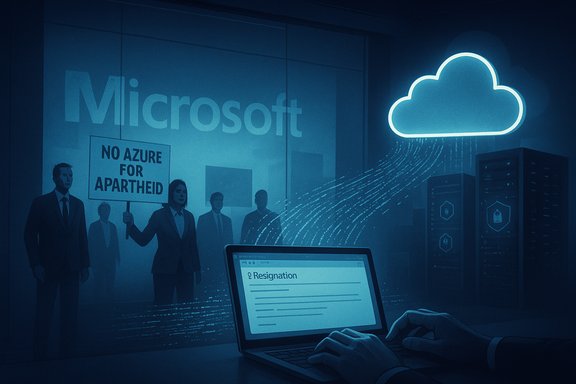
A senior Microsoft engineer’s mass resignation email — delivered to thousands of colleagues and slammed onto social feeds worldwide — crystallizes months of employee unrest over the company’s cloud contracts with the Israeli military and reopens a broader debate about corporate responsibility, cloud governance, and the limits of vendor visibility in conflict zones. The departure, made public in a widely shared Economic Times report, quoted the engineer as saying he “can no longer accept enabling what may be the worst atrocities of our time,” and followed a year of campus protests, stinging internal petitions and high‑profile disciplinary actions that have left Microsoft’s internal trust deficit exposed.
Employee dissent at Microsoft is not new, but recent events represent a sustained escalation. Over the last several months a coalition of current and former employees organized under the banner No Azure for Apartheid has staged petitions, encampments and office disruptions to demand transparent audits and the termination of cloud contracts they say have enabled surveillance and targeted violence. Those actions culminated earlier in on‑campus sit‑ins and the termination of multiple employees for what Microsoft called policy breaches, which in turn intensified activism and public scrutiny.
The resignation in question — by Scott Sutfin‑Glowski, a 13‑year Microsoft veteran according to press accounts — was unusual not only for its content but for its method: a mass email to thousands of employees that went viral externally. The letter framed the choice as a moral refusal to be complicit, and came at a moment when the company had already announced limited service restrictions to one military unit after prior investigative reporting. Public outlets quickly reported his departure, amplifying internal controversy into a public relations and governance challenge.
Key public facts that can be corroborated:
Source: The Economic Times Microsoft engineer's resignation letter to thousands of employees goes viral, says he "can't work in a company..." - The Economic Times
 Background: how a resignation became a flashpoint
Employee dissent at Microsoft is not new, but recent events represent a sustained escalation. Over the last several months a coalition of current and former employees organized under the banner No Azure for Apartheid has staged petitions, encampments and office disruptions to demand transparent audits and the termination of cloud contracts they say have enabled surveillance and targeted violence. Those actions culminated earlier in on‑campus sit‑ins and the termination of multiple employees for what Microsoft called policy breaches, which in turn intensified activism and public scrutiny.The resignation in question — by Scott Sutfin‑Glowski, a 13‑year Microsoft veteran according to press accounts — was unusual not only for its content but for its method: a mass email to thousands of employees that went viral externally. The letter framed the choice as a moral refusal to be complicit, and came at a moment when the company had already announced limited service restrictions to one military unit after prior investigative reporting. Public outlets quickly reported his departure, amplifying internal controversy into a public relations and governance challenge.
Overview: what the resignation says — and what it does not
The email’s central claim is simple and stark: an engineer who built, maintained or supported cloud services concluded that the company’s continued contracting and support for certain military customers made his work morally untenable. He framed resignation as preferable to remaining and potentially facing termination for dissenting actions.Key public facts that can be corroborated:
- The resignation and mass email were reported by multiple outlets and republished widely.
- The resignation ties directly to broader employee protests directed at Microsoft’s cloud relationships and alleged downstream uses.
- The exact technical chain of events by which specific Microsoft systems were used in particular military operations. Multiple investigative reports have alleged large‑scale use of cloud tools, but forensic linkage between vendor telemetry and battlefield decisions requires comprehensive log access and neutral forensic review — access that is often limited by sovereign controls and contract terms. These precise cause‑and‑effect chains are therefore flagged as unverified until independent audits are made public.
Timeline: how escalation reached this moment
- Investigative reporting published allegations that military intelligence units used commercial cloud services, including Azure, to ingest and analyze vast quantities of intercepted communications. Those reports set off the first wave of internal concern.
- Employee organizing under No Azure for Apartheid escalated with petitions, open letters and public demonstrations. Some employees staged sit‑ins and encampments at Redmond and other sites, leading to arrests and terminations that further polarized the workforce.
- Microsoft commissioned external legal and technical reviews; it also stated it had limited or cut specific services to one military unit in response to the reporting, while insisting most contracts remained active and subject to the company’s policies and controls.
- The mass resignation email arrived amid ongoing protests and periodic operational responses by Microsoft, immediately going viral and drawing new media attention.
Anatomy of the resignation message
The publicly reported excerpts of the resignation emphasize moral refusal and a sense of futility with internal grievance channels. The engineer wrote that he could no longer “accept enabling what may be the worst atrocities of our time,” and chose to resign rather than face termination for dissent. That framing echoes other resignation letters and public statements by employees who have left tech firms over ethics disputes: a combination of conscience, frustration with internal processes, and the calculation that a highly visible departure can amplify demands for external accountability. This style of exit — an explicit, public refusal embedded in workplace communication — serves multiple functions:- It signals to colleagues the moral basis for departure and invites solidarity.
- It publicizes the internal dispute to outsiders, increasing reputational pressure on the employer.
- It avoids private, likely ineffective escalation channels that activists argue have repeatedly failed them.
The technical and contractual realities at play
To evaluate the resignation’s substance, it is necessary to parse the technical and contractual architecture of modern cloud deployments — and the limits those architectures impose on vendor enforcement.Visibility and “sovereign” or customer‑controlled environments
Cloud providers often host services in configurations that give customers strong operational control: sovereign clouds, customer‑owned tenancies and on‑premises deployments can limit the vendor’s telemetry, log collection and auditability. In those contexts, vendors may supply software, infrastructure and even engineering support but lack unfettered access to downstream usage logs that would prove how data or capabilities were applied. This architectural reality is central to Microsoft’s public defenses and to critics’ demands for independent verification.Engineering support vs. accountability
Independent reporting has alleged that vendor engineers provided thousands of hours of support to certain government customers. Providing technical assistance — for migration, configuration, or troubleshooting — is standard commercial practice. The governance question is whether the presence of vendor engineering support converts the vendor into an operational actor with legal or ethical responsibility for downstream misuse. That is a contested legal and normative question: corporations point to contractual limits and acceptable‑use policies, while critics argue that provision of bespoke technical support constitutes complicity if it materially enables abusive operations. Public reporting on these help‑hours and their scope varies between outlets and remains difficult to verify at scale without full contract and billing transparency.The auditability gap
When concerned parties demand forensic certainty — timestamps, tenancy logs, and command histories that show which API calls influenced which operational decisions — they frequently collide with the real problem: the data needed for such verification often sits within customer systems or under national‑security classification, beyond the vendor’s unilateral access and beyond many auditors’ purview. That creates a structural accountability gap that neither cleanly exonerates nor definitively convicts the vendor on public evidence alone.Microsoft’s public responses and policy moves
Microsoft has taken a mixture of operational and communicative actions: it has asserted that its Acceptable Use Policies prohibit mass civilian surveillance; it has said it cut some services access to specific units following reporting; and it has launched external legal and technical reviews. The company has also defended disciplinary actions taken against employees who breached campus rules during protests, asserting safety and code‑of‑conduct concerns. These steps are defensible from a corporate governance perspective, but they have not satisfied many employees or activists who call for broader, transparent audits and contract-level reforms. Strengths of Microsoft’s approach include the rapid commissioning of outside counsel and technical advisors and clear enforcement of campus security policies. Weaknesses include the optics of silencing or disciplining dissenters without providing a mechanism for independent verification that would credibly address the underlying human‑rights allegations. This tradeoff has deep reputational consequences not just for Microsoft, but for the cloud sector broadly.Why this matters to IT leaders, customers and partners
- Procurement risk: Public controversies spotlight the necessity of precise contractual language. Enterprises engaging cloud vendors for sensitive work should insist on explicit audit rights, access to pertinent logs, and well‑defined allowed and disallowed end uses.
- Vendor risk management: Organizations must evaluate whether a vendor’s contractual and engineering support model exposes them to third‑party governance disputes or supply‑chain reputational fallout.
- Operational resilience: Customers reliant on global providers must understand the risks of bilateral migration should a vendor be forced to restrict services or change contractual postures in response to political pressure.
The human dimension: morale, free speech and the consequences of discipline
The engineer’s resignation sits atop a larger human story: employees who want their employers to align actions with stated corporate values are increasingly willing to take public stands. The consequences are real: terminations, arrests, and tighter internal moderation of communication channels have all been part of Microsoft’s recent months. Those responses can deter disruptive behavior but also risk alienating talent and driving an exodus of employees who value public ethics alignment. Internal channels that become perceived as dead ends will only push activism outward, raising regulatory and reputational stakes.What can be verified — and what should be treated with caution
- Verified: high‑profile on‑campus protests, terminations of employees for code‑of‑conduct breaches, and the existence of substantial employee organizing around Microsoft’s cloud contracts. These facts are documented and independently corroborated.
- Contested or unverified: precise technical measurements cited in some activist materials — petabyte totals, counts like “a million calls an hour,” or single‑contract dollar figures — are inconsistent across reports and rely on leaked documents or second‑hand accounts. Such numbers should be treated as allegations until neutral forensic audits or contract disclosures confirm them.
Practical recommendations for Microsoft and enterprise customers
For Microsoft (and other hyperscalers)
- Publish the scope, methodology and independent findings of any external review where possible; when evidence is classified, provide a redacted forensic summary to an agreed governance body. Transparency builds credibility.
- Strengthen procurement and contract templates for sovereign or government deployments to include binding audit clauses, escrowed logs, and clear definitions of acceptable engineering support activities.
- Reopen and credibly protect employee grievance channels, including safe, independently overseen whistleblower mechanisms for ethics concerns. That reduces pressure to escalate to public protest.
- Create standardized human‑rights due‑diligence requirements for high‑risk contracts that include independent attestations and lifecycle auditability.
For enterprise and public‑sector customers
- Demand contractual rights to audit and independent verification when procuring cloud services for sensitive or surveillance‑capable use cases.
- Treat vendor support hours and bespoke engineering as a contract risk; require provenance, scope-of-work constraints and clear logging of all privileged interventions.
- Build internal policies that define acceptable uses of vendor tooling and mandate review for any high‑risk operational uses.
Legal and regulatory implications
The political and legal risk profile of vendor contracts has shifted. If independent reviews reveal operational involvement beyond neutral infrastructure provision — especially when that involvement contributes to human‑rights abuses — vendors and customers could face regulatory scrutiny, sanctions, or litigation in jurisdictions with robust human‑rights or export‑control regimes. Conversely, if banned uses occurred within customer‑controlled enclaves beyond vendor sight, regulators will still press for stronger contractual and technical controls to ensure accountability. The only durable fix will be a combination of technical auditability, contractual clarity, and, where necessary, public oversight.Critical analysis: strengths, weaknesses and systemic risks
Strengths
- Microsoft has taken concrete steps — external reviews and some service restrictions — that acknowledge the gravity of the allegations. Commissioning outside counsel and technical advisors is a defensible governance move.
- The company’s enforcement of campus safety rules and RTO policies reflects an understandable managerial focus on security, continuity and execution in a period of strategic concentration on AI and cloud.
Weaknesses and risks
- Transparency gap: the absence of an independent, fully empowered forensic audit undermines public confidence. When activists insist “no evidence” is insufficient without full disclosure, the company faces a credibility problem that procedural statements won’t fix.
- Employee relations: punitive discipline that appears uneven risks deepening morale problems and driving talent out — a particular risk for an employer that publicly markets its mission and values.
- Systemic policy gap: cloud architectures and sovereign deployments create a repeatable problem for the entire industry; absent structural change, similar controversies will recur across other providers and contracts.
How to read resignations like this one: an interpretive frame
Resignations framed as moral refusals are simultaneously symbolic acts and strategic communications. They are symbolic because they state an ethical position in a way that internal memos rarely do. They are strategic because they mobilize colleagues, attract media attention, and increase reputational pressure on an employer. For Microsoft, the resignation functions as both a human‑resources headache and a governance stress test: it exposes the friction between legalistic corporate defenses and employees’ demand for moral accountability. The company’s future credibility will depend less on sanitized statements and more on verifiable reforms that close the auditability gap.Conclusion: an inflection point for cloud governance
The viral resignation email from a senior Microsoft engineer is more than an individual act of conscience; it is a lens on a broader governance challenge that cuts across cloud computing, corporate ethics and modern labor dynamics. The technical realities of sovereign deployments and limited vendor visibility create real accountability gaps that cannot be bridged by rhetoric alone. Microsoft’s immediate choices — the scope and transparency of its external reviews, the contractual reforms it adopts, and how it balances security with employee voice — will determine whether this moment becomes a catalyst for substantive change or a replayed pattern that haunts cloud providers for years to come. For IT leaders and procurement officers, the lesson is tangible: insist on enforceable audit rights, define engineering support boundaries in contracts, and treat vendor governance statements as operational risk factors in themselves. The industry will be watching whether Microsoft translates the moral clarity signaled by this resignation into technical, legal and contractual clarity that prevents future tragedies of governance.Source: The Economic Times Microsoft engineer's resignation letter to thousands of employees goes viral, says he "can't work in a company..." - The Economic Times