

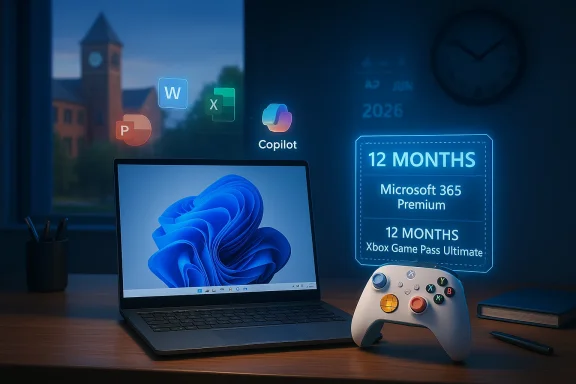
Microsoft is revving up its education playbook with a new Microsoft College Offer that bundles a year of Microsoft 365 Premium, a year of Xbox Game Pass Ultimate, and a custom Xbox controller for eligible U.S. college students buying a new Windows 11 PC. The promotion, which runs from April 15, 2026, through June 30, 2026, is designed to make a new laptop purchase feel less like a hardware transaction and more like a full-stack ecosystem entry point. For Microsoft, the move is about more than giveaways; it is about locking in student habits at the exact moment platform loyalty is still up for grabs.
Microsoft’s latest student bundle lands at a moment when the company is pushing hard to make AI-first productivity feel normal, useful, and unavoidable. The company has spent the last two years weaving Copilot deeper into its consumer and education story, and this offer extends that effort into a high-visibility hardware incentive. By attaching software subscriptions and a physical reward to a new PC purchase, Microsoft is trying to reshape the value equation for students who might otherwise buy whichever laptop is cheapest or most familiar.
The structure of the promotion matters. Eligible students must be physically located in the United States, verify with a valid .edu email address, and purchase a qualifying Windows 11 PC from one of several major brands or retailers. Microsoft says the offer is limited to one eligible PC per verified student and Microsoft account, and it is only available while supplies last. In other words, this is not a broad rebate; it is a tightly controlled acquisition funnel.
The timing also tells a story. Microsoft is pairing the student offer with a marketplace where Windows hardware is already under pressure from aggressive pricing and a crowded Copilot+ PC segment. Surface pricing has moved upward on the company’s own store, while select Surface laptops and bundles are still being marketed with discounts elsewhere, creating a complicated shopping environment for students who may compare the promotion against alternative Windows PCs. That tension makes the bundle more important than it might look at first glance.
But the strategic value is even more interesting. Microsoft is not just subsidizing a purchase; it is subsidizing behavior. A student who starts the semester using Microsoft 365 for papers, spreadsheets, and presentations, and Game Pass for leisure, is more likely to keep that footprint long after graduation. That is the kind of habit formation software companies prize, and it is exactly why student offers remain so potent.
That evolution began in earnest when Microsoft started adding Copilot features to consumer subscriptions. In January 2025, Microsoft said Copilot would be included in Microsoft 365 Personal and Family, marking a major consumer packaging change and signaling that AI was no longer a premium add-on for a small set of power users. By the time Microsoft launched Microsoft 365 Premium in October 2025, the direction was clear: Microsoft wanted a single consumer subscription that blended productivity, AI, and premium usage allowances.
The student offer also fits into Microsoft’s broader push to position Copilot as a practical classroom tool rather than a flashy demo. The company has repeatedly described students as an audience especially receptive to AI-enhanced productivity, and its education marketing now tends to frame Copilot as a study partner, research helper, and presentation assistant. That framing is not accidental; it is meant to make AI feel like an academic utility rather than a novelty.
At the same time, Microsoft faces a reality that complicates the pitch. Many students have grown up using Google Docs, Gmail, and other cloud-first tools that are free or nearly free. Convincing them to shift ecosystems requires either strong convenience or strong incentives, and Microsoft is clearly choosing both. The subscriptions help with utility; the controller and gaming perk help with emotion.
That matters because software ecosystems rarely change through one feature. They change when a user’s everyday tasks are spread across a platform’s tools. If Microsoft can become the place where a student writes, presents, researches, chats, and plays, it gets much closer to being indispensable. That is the real prize.
Microsoft 365 Premium is the more interesting component from a product strategy perspective. Microsoft positions it as the consumer subscription that combines Office apps with expansive Copilot access, including features such as image generation, Deep Research, Copilot Vision, and access to Microsoft’s Researcher, Analyst, and Photos AI agents. That makes the software bundle feel much larger than a simple Office subscription.
Xbox Game Pass Ultimate is the obvious crowd-pleaser. Microsoft’s latest pricing update set Ultimate at $29.99 per month, which makes a 12-month giveaway especially valuable in dollar terms. For students, that means a year of premium gaming access can be framed as both a money saver and a stress reliever, two arguments that resonate strongly in college marketing.
For Microsoft, that sticker shock is part of the marketing. If the bundle feels expensive enough on its face, the freebie becomes a stronger psychological driver. Students who were already considering a PC upgrade may now feel they are leaving money on the table by buying outside the program. That is exactly how these offers are supposed to work.
It also extends Microsoft’s gaming reach beyond the console itself. A student who buys a Windows PC and receives Game Pass Ultimate plus a controller is being invited into the Xbox identity even if they never own a console. That is a subtle but important ecosystem move.
There are also timing constraints that make this more than a casual bonus. The promotion itself ends on June 30, 2026, but redemption must be completed by July 31, 2026. Microsoft also notes that verification happens after purchase, and that if Game Pass Ultimate is activated before student verification, the student must complete verification within five days or risk deactivation. That is a fairly strict operational model.
Those constraints matter because they limit abuse and simplify accounting. Microsoft does not want this offer to become a generic discount accessible to anyone with a borrowed email address or a used device purchase. The company is clearly balancing generosity with fraud prevention, which is why the terms are so detailed.
A second issue is the “new subscribers only” language. Existing subscribers to Microsoft 365 Premium or Game Pass Ultimate may not get the same benefit unless they meet the specific upgrade path described in the terms. That means the offer is best suited to students who are either new to Microsoft’s premium ecosystem or ready to switch into it wholesale.
That approach also benefits hardware partners. Acer, Asus, Dell, HP, Lenovo, and Microsoft-branded PCs all participate in the program, which means the promo serves as a shared channel incentive rather than a Surface-only initiative. For the Windows ecosystem, that makes the offer larger and more effective.
This is where the offer becomes revealing. Microsoft is not really trying to sell a Surface machine to every student; it is trying to keep students inside Windows, regardless of which hardware vendor wins the sale. That gives OEM partners room to compete on price and form factor while Microsoft captures the software relationship.
Still, there is a branding tradeoff. Surface is supposed to be Microsoft’s premium showcase for the Windows experience, but the price posture makes it harder to position as the default student recommendation. When the company’s own hardware looks expensive next to the market, it implicitly strengthens the case for third-party PCs.
In practice, the offer may function as a premium attach rate booster for midrange and budget OEMs. An HP or Lenovo laptop that comes in meaningfully below Surface pricing suddenly looks even better when a year of subscriptions and a controller are layered on top. That could shift students away from Microsoft’s own hardware and toward the broader Windows ecosystem.
This matters because students are often early adopters of tools that later spread into workplaces. If Microsoft can normalize AI-assisted drafting, summarization, and planning during college, it creates a pathway to future professional dependence. That is a powerful long-game play, even if it takes years to fully pay off.
The challenge is credibility. Microsoft Copilot has improved rapidly, but many users still compare it unfavorably with alternatives such as ChatGPT or Claude in terms of reputation and perceived capability. Microsoft’s task is not only to advertise features, but to convince students that those features are genuinely useful for schoolwork, not just bundled extras.
The deeper implication is that Microsoft is trying to own the student workflow, not just the student account. Once the AI helper is embedded in Word, Excel, and PowerPoint, the subscription starts to feel like infrastructure. That is the kind of positioning that can survive a lot of competitive noise.
The pricing change to $29.99 per month makes the giveaway even more compelling. A year of Ultimate is a substantial value proposition, especially when students are trying to stretch budgets across rent, food, books, and devices. The company is effectively front-loading the cost of loyalty in exchange for long-term ecosystem familiarity.
There is also an identity play here. Xbox is no longer only about the console sitting under a TV; it is increasingly a cross-device brand that travels with the user. Game Pass on a Windows PC lets Microsoft turn the student’s laptop into a gaming endpoint, reinforcing the idea that Windows is where work and play coexist.
The controller reinforces that loop. It gives the student a physical artifact that makes Game Pass feel tangible, and it subtly nudges them toward the broader Xbox ecosystem. That kind of tactile brand reinforcement is old-fashioned in the best possible way.
The most direct competition is probably not even Mac versus PC, but budget Windows versus ChromeOS. If Microsoft can persuade students that a Windows 11 laptop with bundled AI productivity and gaming is worth the premium over a bare-bones Chromebook, it can defend the category that matters most to its ecosystem. The student offer is therefore as much about retention as conquest.
For OEMs, the promotion is a mixed blessing. It should increase conversion for qualifying devices, but it also raises the bar for what students expect from a purchase. Hardware sellers may now need to think of software and services as part of the sales pitch, not just accessories. That could permanently shift how student laptop bundles are marketed.
That is why the offer may matter even if only a subset of students redeem it. Microsoft does not need every buyer to become a subscriber forever. It needs enough of them to adopt Microsoft 365 and Game Pass as defaults, then carry those defaults into adult life. That is a long-term bet, but one Microsoft has shown a willingness to make repeatedly.
What will matter most is whether students actually keep using the subscriptions after the free year ends. If Microsoft can translate one-time bundle redemptions into durable habits, the promotion will have done far more than move laptops. It will have helped train the next generation of Windows and Microsoft 365 users before they ever enter the job market.
Source: Thurrott.com US College Students Can Get 12 Months of Microsoft 365 Premium and Game Pass By Purchasing a New PC
 Overview
Microsoft’s latest student bundle lands at a moment when the company is pushing hard to make AI-first productivity feel normal, useful, and unavoidable. The company has spent the last two years weaving Copilot deeper into its consumer and education story, and this offer extends that effort into a high-visibility hardware incentive. By attaching software subscriptions and a physical reward to a new PC purchase, Microsoft is trying to reshape the value equation for students who might otherwise buy whichever laptop is cheapest or most familiar.The structure of the promotion matters. Eligible students must be physically located in the United States, verify with a valid .edu email address, and purchase a qualifying Windows 11 PC from one of several major brands or retailers. Microsoft says the offer is limited to one eligible PC per verified student and Microsoft account, and it is only available while supplies last. In other words, this is not a broad rebate; it is a tightly controlled acquisition funnel.
The timing also tells a story. Microsoft is pairing the student offer with a marketplace where Windows hardware is already under pressure from aggressive pricing and a crowded Copilot+ PC segment. Surface pricing has moved upward on the company’s own store, while select Surface laptops and bundles are still being marketed with discounts elsewhere, creating a complicated shopping environment for students who may compare the promotion against alternative Windows PCs. That tension makes the bundle more important than it might look at first glance.
Why this offer stands out
The headline value is obvious: Microsoft says the bundle includes a year of Microsoft 365 Premium worth $199.99, a year of Xbox Game Pass Ultimate worth $359.88, and an Xbox Design Lab controller valued at $79.99. On paper, that adds up to more than $500 in extras before any hardware discount enters the picture. For a student already planning to buy a PC, the incentive can materially lower the effective cost of choosing Windows.But the strategic value is even more interesting. Microsoft is not just subsidizing a purchase; it is subsidizing behavior. A student who starts the semester using Microsoft 365 for papers, spreadsheets, and presentations, and Game Pass for leisure, is more likely to keep that footprint long after graduation. That is the kind of habit formation software companies prize, and it is exactly why student offers remain so potent.
- The promotion is time-limited and tied to eligible PC inventory.
- Students must verify eligibility with a .edu email address.
- The offer targets new subscribers for both major subscriptions.
- The bundle combines productivity, entertainment, and a physical accessory.
- The deal is being distributed through both Microsoft and major retail partners.
Background
Microsoft has long treated education as a strategic channel, but the shape of that strategy has evolved. In earlier years, student offers were mostly about making Office cheaper or easier to access. Today the pitch is broader: sell the PC, make the student dependent on Microsoft 365, and gradually normalize Copilot-assisted workflows in school and beyond. The company’s consumer bundle strategy has become more integrated, and this latest offer reflects that shift.That evolution began in earnest when Microsoft started adding Copilot features to consumer subscriptions. In January 2025, Microsoft said Copilot would be included in Microsoft 365 Personal and Family, marking a major consumer packaging change and signaling that AI was no longer a premium add-on for a small set of power users. By the time Microsoft launched Microsoft 365 Premium in October 2025, the direction was clear: Microsoft wanted a single consumer subscription that blended productivity, AI, and premium usage allowances.
The student offer also fits into Microsoft’s broader push to position Copilot as a practical classroom tool rather than a flashy demo. The company has repeatedly described students as an audience especially receptive to AI-enhanced productivity, and its education marketing now tends to frame Copilot as a study partner, research helper, and presentation assistant. That framing is not accidental; it is meant to make AI feel like an academic utility rather than a novelty.
At the same time, Microsoft faces a reality that complicates the pitch. Many students have grown up using Google Docs, Gmail, and other cloud-first tools that are free or nearly free. Convincing them to shift ecosystems requires either strong convenience or strong incentives, and Microsoft is clearly choosing both. The subscriptions help with utility; the controller and gaming perk help with emotion.
From Office bundle to AI platform
The old Microsoft student bundle was easy to understand: you got Office because that was the standard tool for school. The new bundle is more ambitious because it tries to sell a lifestyle stack, not just a productivity suite. Microsoft 365 Premium includes AI access, Office apps, cloud storage, and consumer security protections, which means the student gets a broader software identity, not just a document editor.That matters because software ecosystems rarely change through one feature. They change when a user’s everyday tasks are spread across a platform’s tools. If Microsoft can become the place where a student writes, presents, researches, chats, and plays, it gets much closer to being indispensable. That is the real prize.
- Office compatibility still matters, but AI now anchors the pitch.
- Microsoft is using student life as a gateway to long-term subscription retention.
- The offer is designed to make Windows feel like a complete ecosystem, not just an operating system.
- Bundling entertainment with productivity creates a stronger emotional hook than software alone.
What the Offer Includes
The bundle is unusually generous for a hardware promotion. Microsoft says eligible verified college students get 12 months of Microsoft 365 Premium, 12 months of Xbox Game Pass Ultimate, and a free Xbox Design Lab Wireless Controller with color customization subject to availability. If custom-color controllers run out, Microsoft will substitute a standard Xbox Wireless Controller in a preset color.Microsoft 365 Premium is the more interesting component from a product strategy perspective. Microsoft positions it as the consumer subscription that combines Office apps with expansive Copilot access, including features such as image generation, Deep Research, Copilot Vision, and access to Microsoft’s Researcher, Analyst, and Photos AI agents. That makes the software bundle feel much larger than a simple Office subscription.
Xbox Game Pass Ultimate is the obvious crowd-pleaser. Microsoft’s latest pricing update set Ultimate at $29.99 per month, which makes a 12-month giveaway especially valuable in dollar terms. For students, that means a year of premium gaming access can be framed as both a money saver and a stress reliever, two arguments that resonate strongly in college marketing.
The math behind the bundle
Microsoft’s own offer page assigns the bundle’s individual values, and the numbers are hard to ignore. The Microsoft 365 Premium subscription is valued at $199.99, Game Pass Ultimate at $359.88, and the controller at $79.99. That is before any intangible value from convenience, status, or ecosystem lock-in is counted.For Microsoft, that sticker shock is part of the marketing. If the bundle feels expensive enough on its face, the freebie becomes a stronger psychological driver. Students who were already considering a PC upgrade may now feel they are leaving money on the table by buying outside the program. That is exactly how these offers are supposed to work.
Why the controller matters
The custom controller is not just a throw-in. It turns the offer from a software rebate into something tangible and social, which increases perceived generosity. A free year of software is useful; a personalized controller is memorable, and memorability is marketing gold.It also extends Microsoft’s gaming reach beyond the console itself. A student who buys a Windows PC and receives Game Pass Ultimate plus a controller is being invited into the Xbox identity even if they never own a console. That is a subtle but important ecosystem move.
- Microsoft 365 Premium is the anchor for productivity and AI.
- Game Pass Ultimate adds immediate entertainment value.
- The controller creates a physical, gift-like reward.
- The bundle is more persuasive because it spans both work and play.
Eligibility and Redemption
The offer is narrowly targeted. Microsoft says it is valid only for verified college or university students physically located in the United States at the time of the qualifying PC purchase. Students must be new subscribers for the promotional subscriptions, and the redemption process requires a Microsoft account plus a valid .edu email address from an accredited U.S. college or university.There are also timing constraints that make this more than a casual bonus. The promotion itself ends on June 30, 2026, but redemption must be completed by July 31, 2026. Microsoft also notes that verification happens after purchase, and that if Game Pass Ultimate is activated before student verification, the student must complete verification within five days or risk deactivation. That is a fairly strict operational model.
Those constraints matter because they limit abuse and simplify accounting. Microsoft does not want this offer to become a generic discount accessible to anyone with a borrowed email address or a used device purchase. The company is clearly balancing generosity with fraud prevention, which is why the terms are so detailed.
What students need to know
The most important practical point is that this is a purchase-linked offer, not a free-standing subscription giveaway. Students need to buy an eligible new Windows 11 PC first, then verify eligibility, then redeem the included subscriptions and controller. That sequencing can be easy to miss, especially for students who assume they can claim the bundle first and buy later.A second issue is the “new subscribers only” language. Existing subscribers to Microsoft 365 Premium or Game Pass Ultimate may not get the same benefit unless they meet the specific upgrade path described in the terms. That means the offer is best suited to students who are either new to Microsoft’s premium ecosystem or ready to switch into it wholesale.
The retailer angle
Microsoft says the promotion is available through its own store and through major U.S. retail channels including Amazon, Best Buy, Dell.com, HP.com, and Walmart. That broad distribution is important because students rarely shop in one place anymore. They comparison-shop aggressively, and Microsoft appears to be following them across the retail landscape rather than forcing them into a single storefront.That approach also benefits hardware partners. Acer, Asus, Dell, HP, Lenovo, and Microsoft-branded PCs all participate in the program, which means the promo serves as a shared channel incentive rather than a Surface-only initiative. For the Windows ecosystem, that makes the offer larger and more effective.
- Students must buy an eligible Windows 11 PC first.
- Verification depends on a .edu address from an accredited U.S. institution.
- The subscriptions are for new users only, with limited exceptions for upgrades.
- Redemption has a hard deadline after the purchase window closes.
The Surface Problem
Microsoft’s own hardware story complicates the offer in an interesting way. The company recently raised U.S. Surface pricing, and current Microsoft Store listings show no Surface Pro or Surface Laptop models under $1,000 in the configurations highlighted on the product pages. That makes Surface a less obvious fit for budget-conscious students trying to maximize the value of the bundle.This is where the offer becomes revealing. Microsoft is not really trying to sell a Surface machine to every student; it is trying to keep students inside Windows, regardless of which hardware vendor wins the sale. That gives OEM partners room to compete on price and form factor while Microsoft captures the software relationship.
Still, there is a branding tradeoff. Surface is supposed to be Microsoft’s premium showcase for the Windows experience, but the price posture makes it harder to position as the default student recommendation. When the company’s own hardware looks expensive next to the market, it implicitly strengthens the case for third-party PCs.
Surface versus value PCs
A student shopping on price is likely to notice that some Surface configurations are still bundled with savings, but the entry point remains high relative to many Windows alternatives. That is not necessarily a problem for Microsoft, because the company benefits either way if the student ends up on Windows with Microsoft services attached. The issue is more about perception than economics.In practice, the offer may function as a premium attach rate booster for midrange and budget OEMs. An HP or Lenovo laptop that comes in meaningfully below Surface pricing suddenly looks even better when a year of subscriptions and a controller are layered on top. That could shift students away from Microsoft’s own hardware and toward the broader Windows ecosystem.
- Surface’s higher entry price makes the student offer less Surface-centric.
- The promotion still helps Microsoft by expanding Windows and subscription adoption.
- OEM partners may benefit more than Microsoft hardware from the value comparison.
- The pricing gap may reinforce the role of Surface as a premium rather than default option.
Microsoft 365 Premium and the AI Bet
Microsoft 365 Premium is the true strategic centerpiece of the bundle. The subscription combines core productivity apps with advanced Copilot features, including substantial AI usage allowances and tools such as Researcher and Analyst. That makes it much more than a rebranding of Office; it is Microsoft’s attempt to make consumer AI feel indispensable in daily work.This matters because students are often early adopters of tools that later spread into workplaces. If Microsoft can normalize AI-assisted drafting, summarization, and planning during college, it creates a pathway to future professional dependence. That is a powerful long-game play, even if it takes years to fully pay off.
The challenge is credibility. Microsoft Copilot has improved rapidly, but many users still compare it unfavorably with alternatives such as ChatGPT or Claude in terms of reputation and perceived capability. Microsoft’s task is not only to advertise features, but to convince students that those features are genuinely useful for schoolwork, not just bundled extras.
AI as a study utility
Microsoft’s own language leans into the “study partner” framing, emphasizing research, planning, creating, and protection. That framing is smart because it avoids overselling AI as magical and instead presents it as practical assistance. Students are more likely to trust a tool that helps them finish an essay or build a presentation than one that promises to change education overnight.The deeper implication is that Microsoft is trying to own the student workflow, not just the student account. Once the AI helper is embedded in Word, Excel, and PowerPoint, the subscription starts to feel like infrastructure. That is the kind of positioning that can survive a lot of competitive noise.
- Microsoft 365 Premium is positioned as an AI-powered productivity layer.
- The company is normalizing Copilot as a study tool rather than a novelty.
- The offer is designed to convert students before they enter the workforce.
- Competitors face the harder task of displacing a workflow, not just a single app.
Xbox Game Pass as the Emotional Hook
Game Pass Ultimate is the emotional center of the bundle. In a college setting, entertainment value matters because it makes the offer feel relevant beyond academics, and Microsoft knows that a student’s attention spans classrooms, dorms, and downtime. By offering a full year of top-tier gaming access, Microsoft makes the promotion feel like a lifestyle upgrade rather than a software upsell.The pricing change to $29.99 per month makes the giveaway even more compelling. A year of Ultimate is a substantial value proposition, especially when students are trying to stretch budgets across rent, food, books, and devices. The company is effectively front-loading the cost of loyalty in exchange for long-term ecosystem familiarity.
There is also an identity play here. Xbox is no longer only about the console sitting under a TV; it is increasingly a cross-device brand that travels with the user. Game Pass on a Windows PC lets Microsoft turn the student’s laptop into a gaming endpoint, reinforcing the idea that Windows is where work and play coexist.
Why gamers matter to Windows
Students who game are often among the most engaged PC users, and that engagement creates more opportunities for Microsoft services to stick. A student who plays on a Windows machine is more likely to care about performance, drivers, peripherals, and subscriptions, which deepens platform attachment. Microsoft is trying to capture not just the first laptop purchase, but the habits that follow.The controller reinforces that loop. It gives the student a physical artifact that makes Game Pass feel tangible, and it subtly nudges them toward the broader Xbox ecosystem. That kind of tactile brand reinforcement is old-fashioned in the best possible way.
- Game Pass Ultimate is a high-engagement hook for students.
- The $29.99 monthly price makes the 12-month bundle feel unusually generous.
- Microsoft is tying gaming to the Windows laptop lifecycle.
- The controller makes the offer feel personal and collectible.
Competitive Implications
For Apple, Google, and the broader Chromebook ecosystem, the offer is a reminder that Microsoft still believes it can compete for students on more than OS familiarity. Apple sells lifestyle and longevity. Google sells simplicity and low cost. Microsoft is now trying to sell a hybrid of value, productivity, and entertainment that says Windows can be both practical and fun.The most direct competition is probably not even Mac versus PC, but budget Windows versus ChromeOS. If Microsoft can persuade students that a Windows 11 laptop with bundled AI productivity and gaming is worth the premium over a bare-bones Chromebook, it can defend the category that matters most to its ecosystem. The student offer is therefore as much about retention as conquest.
For OEMs, the promotion is a mixed blessing. It should increase conversion for qualifying devices, but it also raises the bar for what students expect from a purchase. Hardware sellers may now need to think of software and services as part of the sales pitch, not just accessories. That could permanently shift how student laptop bundles are marketed.
The broader market shift
Microsoft’s strategy also signals a larger industry trend: hardware is becoming a vehicle for recurring revenue. Subscriptions, AI services, and cloud experiences increasingly determine whether a device sale is truly valuable to a vendor. In that environment, a student promotion is not a side campaign; it is a customer-acquisition engine.That is why the offer may matter even if only a subset of students redeem it. Microsoft does not need every buyer to become a subscriber forever. It needs enough of them to adopt Microsoft 365 and Game Pass as defaults, then carry those defaults into adult life. That is a long-term bet, but one Microsoft has shown a willingness to make repeatedly.
- Apple must compete on premium simplicity.
- Google must compete on low-friction cloud work.
- Chromebook vendors must compete on price and ease.
- Windows OEMs benefit from a stronger software-plus-hardware bundle.
- Microsoft is pushing the industry toward recurring revenue thinking.
Strengths and Opportunities
Microsoft’s student offer is unusually strong because it combines three things students actually care about: productivity, entertainment, and a premium hardware-adjacent reward. The result is a package that feels practical without being boring, and generous without being random. It also arrives at a moment when AI and subscription ecosystems are reshaping what a “good” laptop purchase means.- It creates a clear value proposition for first-time PC buyers.
- It encourages long-term Microsoft 365 adoption.
- It gives Game Pass a strong college-age audience.
- It strengthens the perception of Windows as a work-and-play platform.
- It gives OEM partners a more compelling retail story.
- It may increase student familiarity with Copilot workflows.
- It helps Microsoft compete on ecosystem value, not just device specs.
Risks and Concerns
The biggest risk is that the promotion may feel more valuable to Microsoft than to the student. Not every student wants AI subscriptions, not every student games on PC, and not every student wants to sign up for another recurring billing relationship after the free year ends. Bundles can be powerful, but they can also feel bloated if the customer only values one component.- The “new subscribers only” rule may frustrate existing users.
- The post-free-year billing model could create subscription fatigue.
- Some students may prefer free Google tools or lower-cost alternatives.
- The offer could be undermined if eligible PC inventory runs tight.
- Surface’s higher pricing may complicate the Microsoft hardware narrative.
- The promo may attract attention more for the controller than for the software.
- Heavy emphasis on Copilot risks overpromising if user expectations are not managed carefully.
Looking Ahead
Microsoft’s student offer is likely a preview of where the company wants consumer education marketing to go next. Expect more deals that combine hardware, AI services, cloud storage, and gaming in ways that make the Microsoft account central to a student’s digital life. The company has made it clear that it sees AI not as a niche feature, but as a new baseline for what premium personal computing should include.What will matter most is whether students actually keep using the subscriptions after the free year ends. If Microsoft can translate one-time bundle redemptions into durable habits, the promotion will have done far more than move laptops. It will have helped train the next generation of Windows and Microsoft 365 users before they ever enter the job market.
- Watch whether redemption rates are strong through the summer.
- Watch whether students choose Surface or third-party PCs.
- Watch how aggressively Microsoft and retailers promote the bundle in-store and online.
- Watch whether Microsoft extends similar offers to other regions or customer segments.
- Watch whether Copilot usage among students becomes a retention lever for Microsoft 365.
Source: Thurrott.com US College Students Can Get 12 Months of Microsoft 365 Premium and Game Pass By Purchasing a New PC
Last edited:
