

Microsoft’s latest public push to expand AI-ready datacenters comes with an explicit promise: the company says it will “pay its own way” so local household electricity bills do not rise as a result of its buildouts, and it pairs that pledge with targets on water, jobs, taxes and community investments that together form a new corporate playbook for hyperscale infrastructure.
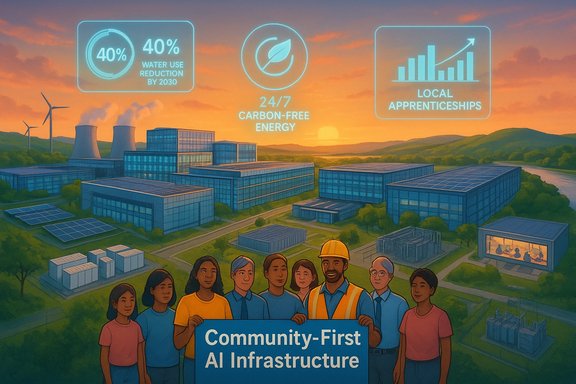
Microsoft launched a public-facing framework — described by the company as a “Community‑First AI Infrastructure” plan — that articulates five headline commitments for its U.S. datacenter expansion. These commitments include a pledge to prevent residential rate increases tied to datacenter-driven grid upgrades, a 40% fleet-wide improvement in datacenter water‑use intensity by 2030, promises to create local jobs and training pathways, explicit fiscal contributions to host communities, and investments in local AI education and nonprofits. The plan was rolled out publicly in mid‑January 2026 and presented as both an engineering roadmap and a community-negotiation strategy.
The announcement lands inside a volatile policy and public‑opinion environment. Regulators, community groups and federal officials have increasingly pressed hyperscalers to internalize the costs of rapid capacity growth rather than allowing distribution and interconnection costs to be socialized across all utility customers. Microsoft’s pledge is a direct response to that pressure and to organized local resistance from groups that cite concerns ranging from water consumption to noise, land use and the risk of higher local electricity bills.
Why this matters in plain terms: modern AI workloads drive very large, sustained power demand and denser cooling requirements than typical cloud services. A single AI campus can impose peak loads comparable to a small municipality, creating a set of technical and regulatory challenges for utilities and public utility commissions (PUCs). How those challenges are allocated — who pays for substations, transmission taps, or distribution “make‑ready” work — determines whether the cost burden falls on the hyperscaler or is spread across residential ratepayers. Microsoft’s public promise is therefore both operational and political: if enforceable, it could reshape how states and utilities treat very large electric loads.
Yet the promise’s civic value depends entirely on execution. The next phase — whether utilities and PUCs accept and codify those terms in tariffs, interconnection agreements, and rate cases — will determine whether communities see durable benefits or merely polished public relations. Key watchpoints include public filings showing grid upgrade contributions, verifiable hourly clean‑energy matching data, and independent audits of water replenishment. Without those enforceable elements, the pledge is a welcome opening line in a negotiation, not its conclusion.
For regulators, community leaders and utilities, the imperative is clear: translate corporate intent into legally binding, auditable and transparent agreements so that the technical promise — more compute, cleaner energy, and local jobs — does not come at the cost of higher bills, strained water supplies, or uneven community outcomes. If Microsoft follows through in the fine print, its approach could become the template that allows the next wave of AI infrastructure growth to proceed without shifting its true costs onto households. If it does not, the announcement will remain a high‑profile pledge whose civic usefulness will depend on subsequent disclosures and enforcement.
Source: findarticles.com Microsoft Expands Data Centers, Promises No Bill Increases
 Background
Microsoft launched a public-facing framework — described by the company as a “Community‑First AI Infrastructure” plan — that articulates five headline commitments for its U.S. datacenter expansion. These commitments include a pledge to prevent residential rate increases tied to datacenter-driven grid upgrades, a 40% fleet-wide improvement in datacenter water‑use intensity by 2030, promises to create local jobs and training pathways, explicit fiscal contributions to host communities, and investments in local AI education and nonprofits. The plan was rolled out publicly in mid‑January 2026 and presented as both an engineering roadmap and a community-negotiation strategy.The announcement lands inside a volatile policy and public‑opinion environment. Regulators, community groups and federal officials have increasingly pressed hyperscalers to internalize the costs of rapid capacity growth rather than allowing distribution and interconnection costs to be socialized across all utility customers. Microsoft’s pledge is a direct response to that pressure and to organized local resistance from groups that cite concerns ranging from water consumption to noise, land use and the risk of higher local electricity bills.
Why this matters in plain terms: modern AI workloads drive very large, sustained power demand and denser cooling requirements than typical cloud services. A single AI campus can impose peak loads comparable to a small municipality, creating a set of technical and regulatory challenges for utilities and public utility commissions (PUCs). How those challenges are allocated — who pays for substations, transmission taps, or distribution “make‑ready” work — determines whether the cost burden falls on the hyperscaler or is spread across residential ratepayers. Microsoft’s public promise is therefore both operational and political: if enforceable, it could reshape how states and utilities treat very large electric loads.
What Microsoft Is Promising (The Five Commitments)
Microsoft’s framework breaks down into five visible pillars. Each pillar is tied to operational levers the company says it will use — but the real test is converting those promises into enforceable contracts, tariffs and public filings.1) “We’ll pay our way” — electricity and grid impacts
- Microsoft pledges to negotiate tariffs and special contracts that reflect cost causation, to directly fund grid upgrades where necessary, and to pursue long‑term clean energy purchases and on‑site generation so incremental grid costs do not fall on households. The firm also says it will commit to demand flexibility — curtailing or shifting non‑urgent compute during peaks — and to deploy storage to smooth load.
- The company cites technical levers such as financing substation and “make‑ready” distribution work, signing PPAs (power purchase agreements) for new capacity, and contracting on‑site or near‑site generation and storage to reduce local supply pressure. Microsoft has also claimed significant contracted generation additions in certain regional footprints as evidence of intent.
2) Water stewardship and cooling
- Microsoft commits to a 40% improvement in datacenter water‑use intensity by 2030 across its fleet, to deploy closed‑loop and near‑zero evaporative cooling where climate allows, and to replenish more water than specific facilities withdraw from local basins. The company also promises site‑level reporting on water use and seasonal performance.
- The technology levers highlighted include closed‑loop chip‑level liquid cooling and air‑cooled or hybrid thermal management that substantially reduce potable water demand compared with traditional evaporative towers.
3) Local jobs, training and workforce development
- The company promises construction employment during the build phase and to scale programs like Datacenter Academy to provide local operational skills, apprenticeships and certifications. Microsoft frames these investments as durable workforce pipelines to reduce hiring shortfalls in data center operations.
- Construction-phase employment is typically the largest near-term economic impact; permanent staffing levels are far smaller but more specialized. Microsoft’s commitment to accredited training and local partnerships aims to convert transitory construction jobs into longer-term career pathways. Independent observers note that sustained benefits require formal agreements with local colleges, unions or apprenticeship programs.
4) Fiscal contributions and tax posture
- Microsoft says it will pay full property taxes, avoid seeking tax deals that shift public costs onto other taxpayers, and be transparent about contributions to local fiscal health. The company has cited past local infrastructure investments — for example, multi‑million dollar water and sewer contributions — as precedents for this posture.
- For local governments, property taxes and negotiated community benefit packages are important offsets to service demands that accompany large campus builds. Microsoft’s pledge is meant to pre-empt arguments that datacenters are net negatives for municipal budgets.
5) Community investments and AI literacy
- Microsoft vowed investments in AI literacy, local nonprofits, K‑12 and community college programs, and broader philanthropic commitments near its sites. The company frames this as a means to diffuse the benefits of proximity to AI infrastructure beyond construction payrolls.
Technical and Regulatory Mechanics: How “No Bill Increases” Could Work
Promises are one thing; regulatory realities are another. There are several concrete tools that, if applied and written into public records, can protect residential customers from bearing datacenter-related costs:- Targeted rate schedules and tariffs that allocate interconnection and distribution costs to the large customer rather than socializing them across all customers. These include demand charges, economic development riders and interruptible service rates.
- Contributions in aid of construction (CIAC) or “make‑ready” arrangements where the developer funds substation and distribution upgrades needed to serve the load. When combined with transparent accounting, these contributions prevent those costs from entering the utility’s rate base.
- Long‑term PPAs and firm zero‑carbon contracts — including options that pair with firming resources such as storage or dispatchable generation — that both supply incremental energy and anchor price certainty for the region. Microsoft cites interest in 24/7 carbon‑free supply contracts as a way to stabilize pricing and emissions.
- Demand flexibility mechanisms and on‑site storage to shave peak demand. By shifting non‑urgent compute or using batteries to reduce instantaneous peak draws, a datacenter can materially reduce the scale of infrastructure upgrades needed. Grid operators and EPRI modeling show that flexible demand can lower peak-related costs that often drive retail rate increases.
- Binding public filings and third‑party audits. Verifiable commitments require inclusion in utility dockets, tariff filings, interconnection agreements or municipal development agreements so regulators and community stakeholders can enforce and monitor outcomes.
Independent Verification: What to Watch For
Microsoft’s plan is credible on paper because it ties specific engineering choices to community outcomes. Still, a string of independent checks will be required to validate the promises:- Will Microsoft publish site‑level hourly matching data to back any 24/7 carbon‑free claims, and will third parties be allowed to audit it? Transparent hourly matching is necessary to substantiate claims of zero‑carbon supply on a continuous basis rather than in annual net terms.
- Will the company file and itemize grid‑upgrade contributions in utility dockets or interconnection agreements so regulators can verify that those costs were not absorbed by local ratepayers? Public filings are the only dependable way to make corporate pledges enforceable.
- Will site‑level water use and replenishment outcomes be audited and reported seasonally so communities can assess true water impacts rather than relying on modelled projections? Local hydrology matters; replenishment must be grounded in basin-level science.
- Will Microsoft accept binding, time‑limited commitments to demand response (curtailment) and storage dispatch that are enforceable through tariffs or contractual obligations? Voluntary promises are helpful; concrete tariff language is far stronger.
Strengths: Where the Pledge Scores
- Practicality: Microsoft’s plan links engineering choices (closed‑loop cooling, on‑site storage, PPAs) to measurable targets (40% water‑use intensity reduction by 2030). That alignment makes the pledge actionable rather than purely rhetorical.
- Political responsiveness: The company directly addresses a key public demand — that hyperscalers “pay their own way” — thereby opening a pathway to smoother permitting and community relations if the promises are implemented credibly.
- Multi‑pronged mitigation: By combining direct funding for distribution upgrades with demand flexibility and clean energy procurement, Microsoft adopts a layered approach that lowers the probability the company will rely on a single, failure‑prone mitigation tactic.
- Potential industry ripple effect: If these commitments are codified in public utility dockets and municipal agreements and survive scrutiny, they could set a replicable standard that compels other hyperscalers to internalize infrastructure costs. That would be a meaningful structural reform to how data center externalities have historically been handled.
Risks, Gaps and Remaining Questions
- Enforcement risk: The biggest structural weakness is that public statements are not the same as tariffs, interconnection agreements, or regulatory orders. Unless commitments are memorialized in enforceable instruments, promises can be reinterpreted, delayed, or watered down.
- Wholesale market exposure: Even when Microsoft funds local upgrades, regional wholesale prices can still move with aggregate demand. Those broader market effects are not fully neutralized by paying for local infrastructure and may still have indirect impacts on end‑use rates in some regulatory models. This is a complex, system‑level dynamic that a single corporate pledge cannot fully erase.
- Verification and data transparency: Microsoft’s water and carbon claims hinge on reporting and independent audits. The company’s pledge to publish site‑level data is promising, but the devil is in the detail: who audits, what metrics are measured, and how often data is updated. Communities rightly demand independent verification.
- Local political capture and uneven bargaining power: Smaller municipalities may lack the negotiating capacity to secure enforceable guarantees. There is a risk that deals will vary widely in quality across jurisdictions, producing winners and losers. Advocates argue for state-level guardrails to ensure minimum protections regardless of local negotiation skill.
- Water renewability credibility: Replenishment promises must be proximate and hydrologically meaningful. Offsets delivered far from impacted basins or via unproven recharge schemes will not satisfy local stakeholders. Independent hydrological review is required.
Practical Signals Regulators and Communities Should Demand
To move from promise to practice, the following signals are essential:- Public filings that itemize and document any direct contributions to grid upgrades and the exact cost allocation language in tariffs or interconnection agreements. Regulators should require line‑item disclosure in utility dockets.
- Legally-binding tariff language or interconnection agreements that specify who pays for what and include triggers for enforcement or penalty if commitments are not met.
- Independent third‑party audits of both water use and hourly energy matching for 24/7 claims, with results published on a frequent cadence (monthly or quarterly) and accessible to local stakeholders.
- Demand response and storage procurement commitments with clear operational parameters (e.g., minimum battery dispatch hours during grid peaks) written into agreements with utilities or system operators.
- Workforce and community benefit agreements that include measurable milestones (number of local apprentices, percentage of permanent hires from local talent pools, educational scholarships) and reporting schedules.
How This Could Reshape the Data Center Playbook
If Microsoft converts its public pledge into enforceable, audited agreements and regulators require the same of other hyperscalers, several structural changes may follow:- Standardized expectations that very large power users must pay directly for interconnection and distribution upgrades, reducing hidden cross‑subsidies in retail rates.
- Broader adoption of low‑water cooling architectures across the industry and increased investment in closed‑loop chip cooling to minimize water footprints in drought‑sensitive regions.
- Increased use of demand flexibility contracts and distributed storage as a planning tool, not merely as backup, which helps smooth peaks and postpone or avoid expensive network reinforcements.
- The normalization of community benefits — workforce pipelines, education investments, and fiscal transparency — as expected elements of datacenter proposals rather than optional goodwill.
Conclusion
Microsoft’s public commitment to expand AI‑ready datacenters while ensuring household electricity bills do not rise is a consequential development in the ongoing national debate about hyperscale infrastructure. The plan’s strengths lie in its specificity: water‑use intensity targets, technical design choices, and a stated willingness to finance grid upgrades. Those elements make the pledge more credible than many previous corporate sustainability statements.Yet the promise’s civic value depends entirely on execution. The next phase — whether utilities and PUCs accept and codify those terms in tariffs, interconnection agreements, and rate cases — will determine whether communities see durable benefits or merely polished public relations. Key watchpoints include public filings showing grid upgrade contributions, verifiable hourly clean‑energy matching data, and independent audits of water replenishment. Without those enforceable elements, the pledge is a welcome opening line in a negotiation, not its conclusion.
For regulators, community leaders and utilities, the imperative is clear: translate corporate intent into legally binding, auditable and transparent agreements so that the technical promise — more compute, cleaner energy, and local jobs — does not come at the cost of higher bills, strained water supplies, or uneven community outcomes. If Microsoft follows through in the fine print, its approach could become the template that allows the next wave of AI infrastructure growth to proceed without shifting its true costs onto households. If it does not, the announcement will remain a high‑profile pledge whose civic usefulness will depend on subsequent disclosures and enforcement.
Source: findarticles.com Microsoft Expands Data Centers, Promises No Bill Increases
