

Microsoft investors were urged on July 1, 2026, by Bronstein, Gewirtz & Grossman to act in a pending securities class action alleging Microsoft misled shareholders between May 1, 2025, and January 28, 2026, about Copilot adoption, AI infrastructure costs, and competitive pressure. The lawsuit is not a verdict, and its claims remain allegations. But it puts a sharp legal frame around the question that has been shadowing Microsoft’s AI strategy for more than a year: whether Copilot is a productivity revolution, a capital-intensive defensive maneuver, or both at once.
For most Windows users, Copilot has been a feature, an icon, a sidebar, a subscription pitch, and sometimes an annoyance. For Microsoft, it has been something much larger: the public interface for a multibillion-dollar claim that generative AI will reshape Office, Windows, Azure, GitHub, security, customer service, and enterprise software buying.
The investor lawsuit attacks that story at the level Wall Street cares about most. It alleges that Microsoft and certain officers made false or misleading statements by failing to disclose problems with Copilot’s positioning, user experience, usage, data silos, compute capacity, organization, and interoperability. That is a wide net, but the unifying idea is simple: investors were allegedly sold a cleaner AI adoption curve than Microsoft’s business realities supported.
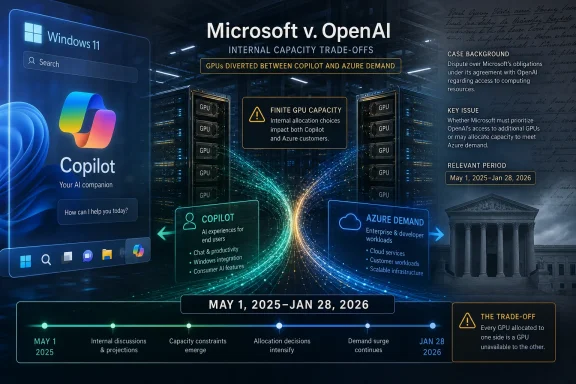
The case also alleges that Microsoft’s own AI model performance lagged rivals on benchmarks, and that the company had to increase capital spending by billions while diverting GPU and CPU capacity away from Azure demand to shore up its Copilot ambitions. That is the most consequential claim for IT readers. It connects the button in the Windows taskbar to the data center bill behind it.
Microsoft has not been found liable for anything here. Securities suits often begin with aggressive allegations, and plaintiffs must still clear difficult legal hurdles around falsity, scienter, loss causation, and damages. But the complaint’s framing is notable because it does not merely say Microsoft spent too much on AI. It says the company’s AI narrative and its infrastructure economics may have diverged in ways investors should have been told about sooner.
Yet the market’s reaction focused on the cost of turning AI enthusiasm into operating reality. Microsoft disclosed capital expenditures of $37.5 billion for the quarter, with roughly two-thirds tied to short-lived assets such as GPUs and CPUs. The company also discussed the balancing act of allocating incoming compute supply among Azure customers, first-party AI products like Microsoft 365 Copilot and GitHub Copilot, internal research, and infrastructure refresh.
That balancing act is the heart of the controversy. Azure is not just another Microsoft business; it is one of the company’s central growth engines and a pillar of its valuation. If AI infrastructure is scarce, every GPU assigned to Copilot, internal research, or OpenAI workloads is a GPU not immediately available for other Azure demand. In boom times, allocation discipline becomes a strategic question. In a securities complaint, it becomes a disclosure question.
The lawsuit’s theory appears to be that investors were not given enough visibility into how much Microsoft’s AI ambitions were competing internally for capacity and capital. That is a harder claim to prove than it is to write in a press release, but it maps onto a real tension Microsoft itself has acknowledged: demand for AI compute has been outrunning supply, and the company must choose where the next tranche of infrastructure goes.
The problem is that “growing” and “worth the spend” are not the same claim. A product can add users quickly and still disappoint against the expectations baked into a trillion-dollar company’s stock price. A subscription can be strategically important and still convert only a fraction of the addressable base. A feature can be visible everywhere and still struggle with everyday usefulness, trust, governance, or integration.
That distinction is especially familiar to enterprise IT. Administrators do not deploy Copilot because a keynote slide says “AI transformation.” They deploy it when licensing, identity, data governance, compliance, user training, and measurable workflow value line up. The lawsuit’s allegations about data siloing and interoperability problems may be legal claims, but they echo the practical friction many organizations face when trying to turn generic AI assistance into controlled, auditable business process improvement.
Microsoft’s challenge is that Copilot is not one product. It is a family name stretched across Windows, Microsoft 365, GitHub, Security, Dynamics, Edge, Bing, and more. That breadth helps Microsoft tell a platform story, but it also creates brand and user-experience risk. When everything is Copilot, the word can start to mean “AI feature Microsoft would like you to pay attention to,” rather than a specific capability with a clear value proposition.
That matters because Azure has a different role in Microsoft’s economics than Copilot. Azure sells infrastructure and platform capacity to customers building their own workloads. Copilot is Microsoft’s attempt to package AI into high-margin software experiences layered onto its existing franchises. The first is demand Microsoft already knows how to monetize at scale. The second is a bet that AI will justify new pricing across software categories customers already buy.
If compute is abundant, Microsoft can pursue both with little tension. If compute is constrained, the company must choose between fulfilling external cloud demand, supporting partner and model-provider workloads, powering internal AI features, and accelerating research. That is not a scandal by itself. It is what hyperscale cloud management looks like in the AI era.
But the lawsuit suggests investors may not have fully understood the cost of those choices. For shareholders, the question is not whether Microsoft should invest in AI. It is whether the company accurately represented the pace at which that investment would translate into revenue, margins, and durable competitive advantage.
For WindowsForum readers, this is where the financial story becomes operational. The same infrastructure constraints that show up in capital expenditure lines also shape product availability, latency, regional rollout, model quality, and enterprise readiness. The AI assistant in Word is only as good as the compute, retrieval architecture, permissions model, and integration work behind it.
But as the market matured, the story became messier. Google, Anthropic, OpenAI itself, Meta, Amazon, and a swarm of enterprise AI vendors all pushed competing models, assistants, agents, and developer tools. Benchmarks moved quickly. Model leadership changed hands. Customers learned that the hard part was often not access to a chatbot, but connecting it securely to business data without producing hallucinated nonsense at enterprise scale.
That is where Copilot’s positioning problem becomes meaningful. Microsoft wants Copilot to be understood as a work companion, an automation layer, a natural-language interface, and a business process accelerator. Those are related ideas, but they are not identical. Each demands different proof.
A user asking Copilot to summarize a meeting has a different success threshold than a compliance officer asking Security Copilot to investigate an incident, or a developer trusting GitHub Copilot to generate production code, or a CFO approving thousands of Microsoft 365 Copilot seats. If Microsoft markets all of these under one banner, weakness in one area can bleed into perceptions of the whole family.
The securities complaint effectively says Microsoft presented the banner as stronger than the fabric underneath. That remains to be proven, but the allegation lands because the market already understood that Big Tech’s AI race had become a capital-spending contest with uncertain near-term returns.
For consumers, the concern is whether Microsoft’s desire to prove Copilot adoption leads to more aggressive bundling, more prompts, more defaults, and more cloud-dependent features. The company has already faced user skepticism when AI features feel imposed rather than earned. A lawsuit alleging adoption weakness does not prove that skepticism is widespread, but it does sharpen the incentive problem: Microsoft needs usage metrics, and users do not always want another assistant.
For sysadmins, the stakes are more concrete. Copilot deployments can require careful attention to licensing, data exposure, sensitivity labels, SharePoint hygiene, retention policies, identity boundaries, and user education. Poorly governed Microsoft 365 environments do not become safer because an AI assistant can search them faster. They become riskier.
For developers, the picture is different again. GitHub Copilot has arguably had the cleanest adoption story because code completion and developer assistance map naturally onto existing workflows. Even there, organizations still have to weigh IP concerns, security review, model behavior, and productivity claims against subscription cost. The broader Copilot brand benefits from GitHub Copilot’s credibility, but it cannot simply borrow its proof.
The lawsuit should therefore be read as a signal, not a product review. It signals that the gap between AI demos and operational adoption is now large enough to attract securities litigation. That gap is where IT departments live.
None of that makes the allegations true or false. Investor-rights firms routinely circulate notices after securities complaints, and multiple firms often advertise around the same case. The legal process will determine whether the complaint survives motions to dismiss, whether a class is certified, whether discovery uncovers supporting evidence, and whether the case settles or proceeds.
The important point is that the allegations are specific enough to reflect the new pressure points of the AI market. Earlier technology securities suits often revolved around user growth, revenue recognition, product defects, channel stuffing, or regulatory risk. This one is about model performance, compute allocation, AI product adoption, infrastructure capital intensity, and whether a platform company adequately disclosed frictions inside its flagship AI push.
That is a very 2026 kind of lawsuit. It treats AI not as speculative magic, but as a set of measurable bottlenecks: chips, data, user conversion, benchmarks, interoperability, margins, and competitive share. The legal language may be boilerplate in places, but the underlying business anxiety is not.
That defense has force. Microsoft is not a distressed AI startup hoping a chatbot saves its balance sheet. It is a diversified giant with Windows, Office, Azure, Xbox, LinkedIn, GitHub, security, database products, developer tools, and enterprise relationships that reach nearly every major industry. Its ability to fund AI infrastructure is itself a competitive advantage.
But scale cuts both ways. Because Microsoft is so central to enterprise computing, its AI representations carry unusual weight. When Microsoft says Copilot is transforming work, CIOs listen. When it describes demand and capacity, investors build models around those statements. When it embeds AI across Windows and Microsoft 365, admins inherit the consequences.
The company’s strongest business argument may be that AI infrastructure spending looks excessive only if judged on too short a time horizon. Data centers, model optimization, custom silicon, networking, and AI product integration are not quarterly experiments. They are the foundation of Microsoft’s attempt to keep its software franchises relevant as natural-language interfaces and agentic workflows mature.
The plaintiffs’ strongest argument is likely to be that strategic necessity does not excuse selective optimism. A company can be right about the future and still be misleading about the present. That distinction is where securities cases live.
Microsoft’s public AI strategy has also been unusual because it blends proprietary work, OpenAI models, smaller task-specific models, and platform services. The company does not need every Microsoft-branded model to beat every rival on every leaderboard for Copilot to be commercially useful. What matters is whether the system delivers reliable value inside Microsoft’s products at acceptable cost and latency.
Still, benchmark weakness can matter if it undermines marketing claims or forces more spending to compensate. If a product depends on expensive inference, complex orchestration, or third-party model access to match competitors, the economics look different from a story built around efficient in-house advantage. That is why the model-performance allegation connects back to capex and R&D.
For IT buyers, the lesson is straightforward: do not buy AI on leaderboard vibes. Evaluate the workflow, the governance model, the failure modes, the integration cost, and the support lifecycle. The best benchmark is the one that resembles the work your users actually do.
But there is a cost to making one word do too many jobs. In Windows, Copilot can feel like a consumer assistant. In Microsoft 365, it is a workplace productivity layer. In GitHub, it is a developer tool. In Security, it is an analyst accelerator. In Dynamics, it is a business-process helper. In Azure, it is part of a broader AI platform story.
Those products do not share the same buyer, maturity curve, or tolerance for error. A bad answer in a consumer chat window is irritating. A bad answer in an incident response workflow can be dangerous. A vague summary in Word may waste time; an over-permissive retrieval result in a regulated company may create legal exposure.
This is why the allegation of brand-positioning and user-experience problems should not be dismissed as marketing fluff. In enterprise technology, positioning shapes deployment. If customers cannot tell whether Copilot is a feature, a platform, an add-on license, an agent framework, or an interface strategy, sales friction follows.
Microsoft can solve some of this with packaging and documentation, but the deeper fix is product proof. Users forgive branding clutter when the tool becomes indispensable. They notice every inconsistency when it does not.
For Microsoft, the governance issue is sharper because its AI investment sits across several overlapping narratives. It is building Azure capacity for customers. It is supporting OpenAI-related demand. It is embedding AI in first-party products. It is competing with Google and others in productivity software. It is defending Windows as a relevant client platform. It is also trying to create new categories of paid AI usage before competitors define them first.
That is a lot of strategy to run through the same capital pipeline. Investors are entitled to ask which workloads are consuming capacity, which products are generating profitable revenue, and how quickly expensive hardware turns into durable gross profit. Customers are entitled to ask whether Microsoft’s AI roadmap is being shaped by their needs or by the company’s need to justify infrastructure buildout.
The answer is probably both. Microsoft is responding to real demand, but it is also manufacturing demand through bundling, defaults, and product redesign. That duality is not inherently improper. It is how platform companies operate. But it is exactly why disclosure matters.
Microsoft’s AI business will not wait. Copilot will continue evolving. Pricing may change. Bundles may shift. Windows integration may deepen or retreat depending on user response. Azure capacity will expand, but so will demand. Competitors will keep moving.
That mismatch between legal tempo and technology tempo is important. By the time a court rules on whether earlier statements were misleading, the products at issue may look materially different. Copilot in late 2026 may be more agentic, more integrated, more governed, and more useful than Copilot in mid-2025. Or it may remain a broad brand searching for a few killer workflows.
For investors, that means the lawsuit is backward-looking but the investment question is forward-looking. For IT professionals, it means the practical evaluation cannot wait for litigation. Organizations still need to decide whether Copilot is worth deploying, where it is safe, and how to measure success.
That is healthy. The first wave of generative AI was powered by awe and fear of missing out. The second wave is being powered by procurement reviews, security assessments, utilization metrics, power constraints, depreciation schedules, and shareholder lawsuits. Hype has not disappeared, but it now has to share the room with accounting.
For Microsoft, this is an uncomfortable but predictable transition. The company wanted Copilot to be the proof that its OpenAI partnership, cloud scale, and productivity-software dominance could be fused into a new platform layer. The lawsuit argues that the proof was weaker, costlier, and more competitively pressured than investors were led to believe.
Whether that argument prevails in court is uncertain. Whether the underlying pressure is real is not.
 The Lawsuit Turns Copilot From Product Story Into Disclosure Story
For most Windows users, Copilot has been a feature, an icon, a sidebar, a subscription pitch, and sometimes an annoyance. For Microsoft, it has been something much larger: the public interface for a multibillion-dollar claim that generative AI will reshape Office, Windows, Azure, GitHub, security, customer service, and enterprise software buying.The investor lawsuit attacks that story at the level Wall Street cares about most. It alleges that Microsoft and certain officers made false or misleading statements by failing to disclose problems with Copilot’s positioning, user experience, usage, data silos, compute capacity, organization, and interoperability. That is a wide net, but the unifying idea is simple: investors were allegedly sold a cleaner AI adoption curve than Microsoft’s business realities supported.
The case also alleges that Microsoft’s own AI model performance lagged rivals on benchmarks, and that the company had to increase capital spending by billions while diverting GPU and CPU capacity away from Azure demand to shore up its Copilot ambitions. That is the most consequential claim for IT readers. It connects the button in the Windows taskbar to the data center bill behind it.
Microsoft has not been found liable for anything here. Securities suits often begin with aggressive allegations, and plaintiffs must still clear difficult legal hurdles around falsity, scienter, loss causation, and damages. But the complaint’s framing is notable because it does not merely say Microsoft spent too much on AI. It says the company’s AI narrative and its infrastructure economics may have diverged in ways investors should have been told about sooner.
January 28 Became the Date the AI Bill Came Due
The proposed class period ends on January 28, 2026, the day Microsoft reported fiscal second-quarter results and held its earnings call. That date matters because Microsoft’s numbers simultaneously showed strength and strain. Revenue was large, cloud demand remained enormous, and Microsoft continued to describe Copilot adoption as growing rapidly.Yet the market’s reaction focused on the cost of turning AI enthusiasm into operating reality. Microsoft disclosed capital expenditures of $37.5 billion for the quarter, with roughly two-thirds tied to short-lived assets such as GPUs and CPUs. The company also discussed the balancing act of allocating incoming compute supply among Azure customers, first-party AI products like Microsoft 365 Copilot and GitHub Copilot, internal research, and infrastructure refresh.
That balancing act is the heart of the controversy. Azure is not just another Microsoft business; it is one of the company’s central growth engines and a pillar of its valuation. If AI infrastructure is scarce, every GPU assigned to Copilot, internal research, or OpenAI workloads is a GPU not immediately available for other Azure demand. In boom times, allocation discipline becomes a strategic question. In a securities complaint, it becomes a disclosure question.
The lawsuit’s theory appears to be that investors were not given enough visibility into how much Microsoft’s AI ambitions were competing internally for capacity and capital. That is a harder claim to prove than it is to write in a press release, but it maps onto a real tension Microsoft itself has acknowledged: demand for AI compute has been outrunning supply, and the company must choose where the next tranche of infrastructure goes.
Copilot’s Success Is Real Enough to Be Expensive
One reason this case is interesting is that it does not require Copilot to be a total failure. Microsoft has said Microsoft 365 Copilot seat additions rose sharply year over year, and the company has repeatedly argued that AI is becoming embedded across its product portfolio. GitHub Copilot has also become one of the clearest examples of paid AI adoption in software development.The problem is that “growing” and “worth the spend” are not the same claim. A product can add users quickly and still disappoint against the expectations baked into a trillion-dollar company’s stock price. A subscription can be strategically important and still convert only a fraction of the addressable base. A feature can be visible everywhere and still struggle with everyday usefulness, trust, governance, or integration.
That distinction is especially familiar to enterprise IT. Administrators do not deploy Copilot because a keynote slide says “AI transformation.” They deploy it when licensing, identity, data governance, compliance, user training, and measurable workflow value line up. The lawsuit’s allegations about data siloing and interoperability problems may be legal claims, but they echo the practical friction many organizations face when trying to turn generic AI assistance into controlled, auditable business process improvement.
Microsoft’s challenge is that Copilot is not one product. It is a family name stretched across Windows, Microsoft 365, GitHub, Security, Dynamics, Edge, Bing, and more. That breadth helps Microsoft tell a platform story, but it also creates brand and user-experience risk. When everything is Copilot, the word can start to mean “AI feature Microsoft would like you to pay attention to,” rather than a specific capability with a clear value proposition.
The Azure Trade-Off Is the Case’s Most Important Claim
The most explosive allegation is not that some users disliked Copilot or that Microsoft had branding problems. It is that Microsoft allegedly needed to divert GPU and CPU capacity away from profitable Azure services to improve Copilot’s competitive position and expand AI R&D.That matters because Azure has a different role in Microsoft’s economics than Copilot. Azure sells infrastructure and platform capacity to customers building their own workloads. Copilot is Microsoft’s attempt to package AI into high-margin software experiences layered onto its existing franchises. The first is demand Microsoft already knows how to monetize at scale. The second is a bet that AI will justify new pricing across software categories customers already buy.
If compute is abundant, Microsoft can pursue both with little tension. If compute is constrained, the company must choose between fulfilling external cloud demand, supporting partner and model-provider workloads, powering internal AI features, and accelerating research. That is not a scandal by itself. It is what hyperscale cloud management looks like in the AI era.
But the lawsuit suggests investors may not have fully understood the cost of those choices. For shareholders, the question is not whether Microsoft should invest in AI. It is whether the company accurately represented the pace at which that investment would translate into revenue, margins, and durable competitive advantage.
For WindowsForum readers, this is where the financial story becomes operational. The same infrastructure constraints that show up in capital expenditure lines also shape product availability, latency, regional rollout, model quality, and enterprise readiness. The AI assistant in Word is only as good as the compute, retrieval architecture, permissions model, and integration work behind it.
Microsoft’s AI Message Has Been Both Triumphant and Defensive
Microsoft has spent the past several years presenting itself as the enterprise AI default. It had the early OpenAI partnership, the first-mover narrative, the Office distribution advantage, and the Azure backend. That combination made the company look less like a software vendor adding AI and more like the platform on which business AI would standardize.But as the market matured, the story became messier. Google, Anthropic, OpenAI itself, Meta, Amazon, and a swarm of enterprise AI vendors all pushed competing models, assistants, agents, and developer tools. Benchmarks moved quickly. Model leadership changed hands. Customers learned that the hard part was often not access to a chatbot, but connecting it securely to business data without producing hallucinated nonsense at enterprise scale.
That is where Copilot’s positioning problem becomes meaningful. Microsoft wants Copilot to be understood as a work companion, an automation layer, a natural-language interface, and a business process accelerator. Those are related ideas, but they are not identical. Each demands different proof.
A user asking Copilot to summarize a meeting has a different success threshold than a compliance officer asking Security Copilot to investigate an incident, or a developer trusting GitHub Copilot to generate production code, or a CFO approving thousands of Microsoft 365 Copilot seats. If Microsoft markets all of these under one banner, weakness in one area can bleed into perceptions of the whole family.
The securities complaint effectively says Microsoft presented the banner as stronger than the fabric underneath. That remains to be proven, but the allegation lands because the market already understood that Big Tech’s AI race had become a capital-spending contest with uncertain near-term returns.
Windows Users Are Not Bystanders in a Wall Street Fight
It is tempting to treat securities litigation as background noise for investors and lawyers. But this case intersects directly with the Windows ecosystem because Copilot is Microsoft’s chosen front end for the next phase of personal computing. Windows 11, Microsoft 365, Edge, and enterprise management are all being reshaped around AI expectations.For consumers, the concern is whether Microsoft’s desire to prove Copilot adoption leads to more aggressive bundling, more prompts, more defaults, and more cloud-dependent features. The company has already faced user skepticism when AI features feel imposed rather than earned. A lawsuit alleging adoption weakness does not prove that skepticism is widespread, but it does sharpen the incentive problem: Microsoft needs usage metrics, and users do not always want another assistant.
For sysadmins, the stakes are more concrete. Copilot deployments can require careful attention to licensing, data exposure, sensitivity labels, SharePoint hygiene, retention policies, identity boundaries, and user education. Poorly governed Microsoft 365 environments do not become safer because an AI assistant can search them faster. They become riskier.
For developers, the picture is different again. GitHub Copilot has arguably had the cleanest adoption story because code completion and developer assistance map naturally onto existing workflows. Even there, organizations still have to weigh IP concerns, security review, model behavior, and productivity claims against subscription cost. The broader Copilot brand benefits from GitHub Copilot’s credibility, but it cannot simply borrow its proof.
The lawsuit should therefore be read as a signal, not a product review. It signals that the gap between AI demos and operational adoption is now large enough to attract securities litigation. That gap is where IT departments live.
The Complaint Leans on a Familiar Securities-Class-Action Playbook
The law-firm notice follows a recognizable pattern. A class action has been filed. Investors who purchased or acquired Microsoft securities during a defined period are told they may seek appointment as lead plaintiff by a deadline. The firm emphasizes contingency fees, shareholder recovery, and corporate accountability.None of that makes the allegations true or false. Investor-rights firms routinely circulate notices after securities complaints, and multiple firms often advertise around the same case. The legal process will determine whether the complaint survives motions to dismiss, whether a class is certified, whether discovery uncovers supporting evidence, and whether the case settles or proceeds.
The important point is that the allegations are specific enough to reflect the new pressure points of the AI market. Earlier technology securities suits often revolved around user growth, revenue recognition, product defects, channel stuffing, or regulatory risk. This one is about model performance, compute allocation, AI product adoption, infrastructure capital intensity, and whether a platform company adequately disclosed frictions inside its flagship AI push.
That is a very 2026 kind of lawsuit. It treats AI not as speculative magic, but as a set of measurable bottlenecks: chips, data, user conversion, benchmarks, interoperability, margins, and competitive share. The legal language may be boilerplate in places, but the underlying business anxiety is not.
Microsoft’s Defense Will Likely Start With Scale
If Microsoft contests the allegations, its broad defense in the court of public opinion is obvious: the company can point to massive revenue, strong cloud demand, growing Copilot seats, expanding AI usage, and the strategic necessity of investing ahead of demand. It can argue that capacity constraints are evidence of customer appetite, not concealment. It can also argue that capital spending was repeatedly discussed and that forward-looking statements were accompanied by appropriate cautions.That defense has force. Microsoft is not a distressed AI startup hoping a chatbot saves its balance sheet. It is a diversified giant with Windows, Office, Azure, Xbox, LinkedIn, GitHub, security, database products, developer tools, and enterprise relationships that reach nearly every major industry. Its ability to fund AI infrastructure is itself a competitive advantage.
But scale cuts both ways. Because Microsoft is so central to enterprise computing, its AI representations carry unusual weight. When Microsoft says Copilot is transforming work, CIOs listen. When it describes demand and capacity, investors build models around those statements. When it embeds AI across Windows and Microsoft 365, admins inherit the consequences.
The company’s strongest business argument may be that AI infrastructure spending looks excessive only if judged on too short a time horizon. Data centers, model optimization, custom silicon, networking, and AI product integration are not quarterly experiments. They are the foundation of Microsoft’s attempt to keep its software franchises relevant as natural-language interfaces and agentic workflows mature.
The plaintiffs’ strongest argument is likely to be that strategic necessity does not excuse selective optimism. A company can be right about the future and still be misleading about the present. That distinction is where securities cases live.
The Benchmark Claim Is Less Simple Than It Sounds
The complaint’s reference to Microsoft’s flagship proprietary AI model ranking below competitors on benchmark tests is eye-catching, but benchmarks are a tricky battlefield. AI model evaluation is fragmented, fast-moving, and often contested. A model can underperform on one public benchmark while performing well in a specific enterprise workflow, especially when integrated with retrieval, permissions, tools, and domain data.Microsoft’s public AI strategy has also been unusual because it blends proprietary work, OpenAI models, smaller task-specific models, and platform services. The company does not need every Microsoft-branded model to beat every rival on every leaderboard for Copilot to be commercially useful. What matters is whether the system delivers reliable value inside Microsoft’s products at acceptable cost and latency.
Still, benchmark weakness can matter if it undermines marketing claims or forces more spending to compensate. If a product depends on expensive inference, complex orchestration, or third-party model access to match competitors, the economics look different from a story built around efficient in-house advantage. That is why the model-performance allegation connects back to capex and R&D.
For IT buyers, the lesson is straightforward: do not buy AI on leaderboard vibes. Evaluate the workflow, the governance model, the failure modes, the integration cost, and the support lifecycle. The best benchmark is the one that resembles the work your users actually do.
The Copilot Brand Is Carrying Too Much Weight
Microsoft’s branding strategy has turned Copilot into a universal wrapper for AI assistance. There is logic in that. A single brand can make a sprawling portfolio feel coherent, and it gives Microsoft a simple answer to competitors: whatever you do, there is a Copilot for it.But there is a cost to making one word do too many jobs. In Windows, Copilot can feel like a consumer assistant. In Microsoft 365, it is a workplace productivity layer. In GitHub, it is a developer tool. In Security, it is an analyst accelerator. In Dynamics, it is a business-process helper. In Azure, it is part of a broader AI platform story.
Those products do not share the same buyer, maturity curve, or tolerance for error. A bad answer in a consumer chat window is irritating. A bad answer in an incident response workflow can be dangerous. A vague summary in Word may waste time; an over-permissive retrieval result in a regulated company may create legal exposure.
This is why the allegation of brand-positioning and user-experience problems should not be dismissed as marketing fluff. In enterprise technology, positioning shapes deployment. If customers cannot tell whether Copilot is a feature, a platform, an add-on license, an agent framework, or an interface strategy, sales friction follows.
Microsoft can solve some of this with packaging and documentation, but the deeper fix is product proof. Users forgive branding clutter when the tool becomes indispensable. They notice every inconsistency when it does not.
The AI Capex Cycle Is Now a Governance Problem
The lawsuit arrives during a broader reckoning over AI capital expenditures across the hyperscalers. Microsoft, Amazon, Google, and Meta have all been spending enormous sums on data centers, GPUs, networking, energy, and supporting infrastructure. The market has tolerated that spending because AI demand appears real, but tolerance is not the same as indifference.For Microsoft, the governance issue is sharper because its AI investment sits across several overlapping narratives. It is building Azure capacity for customers. It is supporting OpenAI-related demand. It is embedding AI in first-party products. It is competing with Google and others in productivity software. It is defending Windows as a relevant client platform. It is also trying to create new categories of paid AI usage before competitors define them first.
That is a lot of strategy to run through the same capital pipeline. Investors are entitled to ask which workloads are consuming capacity, which products are generating profitable revenue, and how quickly expensive hardware turns into durable gross profit. Customers are entitled to ask whether Microsoft’s AI roadmap is being shaped by their needs or by the company’s need to justify infrastructure buildout.
The answer is probably both. Microsoft is responding to real demand, but it is also manufacturing demand through bundling, defaults, and product redesign. That duality is not inherently improper. It is how platform companies operate. But it is exactly why disclosure matters.
The Court Case Will Move Slowly, but the Market Won’t
The lead-plaintiff deadline listed in the notice is August 11, 2026. After that, the case may proceed through appointment of lead plaintiff, an amended complaint, motions to dismiss, and potentially discovery. Securities litigation is measured in months and years, not product cycles.Microsoft’s AI business will not wait. Copilot will continue evolving. Pricing may change. Bundles may shift. Windows integration may deepen or retreat depending on user response. Azure capacity will expand, but so will demand. Competitors will keep moving.
That mismatch between legal tempo and technology tempo is important. By the time a court rules on whether earlier statements were misleading, the products at issue may look materially different. Copilot in late 2026 may be more agentic, more integrated, more governed, and more useful than Copilot in mid-2025. Or it may remain a broad brand searching for a few killer workflows.
For investors, that means the lawsuit is backward-looking but the investment question is forward-looking. For IT professionals, it means the practical evaluation cannot wait for litigation. Organizations still need to decide whether Copilot is worth deploying, where it is safe, and how to measure success.
The Signal Beneath the Legal Noise
The most concrete lesson from the Microsoft suit is not that Copilot is doomed, or that Microsoft’s AI strategy is fraudulent, or that every AI capex dollar is suspect. The lesson is that the AI era has reached the accountability phase. Vendors now have to show how adoption, infrastructure, model quality, and margins fit together.That is healthy. The first wave of generative AI was powered by awe and fear of missing out. The second wave is being powered by procurement reviews, security assessments, utilization metrics, power constraints, depreciation schedules, and shareholder lawsuits. Hype has not disappeared, but it now has to share the room with accounting.
For Microsoft, this is an uncomfortable but predictable transition. The company wanted Copilot to be the proof that its OpenAI partnership, cloud scale, and productivity-software dominance could be fused into a new platform layer. The lawsuit argues that the proof was weaker, costlier, and more competitively pressured than investors were led to believe.
Whether that argument prevails in court is uncertain. Whether the underlying pressure is real is not.
The WindowsForum Readout From a Lawsuit About AI Spend
The case is ultimately about securities law, but its implications land squarely in the daily world of Microsoft customers and administrators. The useful readout is not panic; it is discipline.- Microsoft investors have until August 11, 2026, to seek lead-plaintiff status in the class action covering purchases or acquisitions of Microsoft securities from May 1, 2025, through January 28, 2026.
- The complaint’s allegations remain unproven, and the existence of a class action does not establish that Microsoft violated securities law.
- The most important business claim is that Copilot and AI R&D allegedly competed for scarce GPU and CPU capacity that could otherwise have supported Azure demand.
- Microsoft’s reported Copilot growth and heavy AI spending can both be true, which is why the central dispute is about disclosure, economics, and expectations rather than simple product success or failure.
- Enterprise customers should evaluate Copilot deployments through governance, data access, workflow value, and measurable productivity rather than relying on Microsoft’s broad AI branding.
- The lawsuit reflects a broader shift in AI from demo-stage excitement to scrutiny over infrastructure cost, adoption quality, competitive performance, and return on invested capital.
References
- Primary source: GlobeNewswire
Published: 2026-07-01T16:50:16.579640
Bronstein, Gewirtz & Grossman LLC Urges Microsoft
New class action for Microsoft (MSFT) urges investors to seek recovery for alleged securities fraud violations – lead plaintiff deadline of 8/11/2026...www.globenewswire.com - Official source: microsoft.com
Microsoft Fiscal Year 2026 Second Quarter Earnings Conference Call
www.microsoft.com
- Related coverage: marketbeat.com
Microsoft Q2 Earnings Call Highlights | MarketBeat
Microsoft (NASDAQ:MSFT) executives used the company’s fiscal 2026 second-quarter earnings call to highlight accelerating demand for cloud and artificial intelligence products, while also addressing investor questions about the pace of capital spending and the path from infrastructure investment to rwww.marketbeat.com
- Related coverage: zlk.com
- Related coverage: kmllp.com
Microsoft Corporation | Kirby McInerney LLP
Kirby McInerney LLP is a leading plaintiff's law firm specializing in securities fraud, antitrust, commodities, and whistleblower litigation with nearly a century of experience.www.kmllp.com - Related coverage: ktmc.com
Microsoft Corporation (NASDAQ: MSFT) Securities Fraud Class Action | New Cases | Kessler Topaz
The Microsoft Corporation class action lawsuit was filed on behalf of those who purchased or otherwise acquired Microsoft Corporation (“Microsoft”) (NASDAQ: […]www.ktmc.com

- Related coverage: fortune.com
Microsoft stock drops 5% as Azure growth slows amid capex surge | Fortune
Some worry that the tech giant is struggling to keep up with AI demand.fortune.com
- Related coverage: insiderfinance.io
Microsoft Earnings Preview AI And Azure Momentum | InsiderFinance
Microsoft earnings preview stresses Azure expansion and Copilot monetization offsetting elevated capex that shape near-term revenue, margins and flows.www.insiderfinance.io - Related coverage: fool.com
Microsoft (MSFT) Q2 2026 Earnings Call Transcript | The Motley Fool
Microsoft (MSFT) Q2 2026 Earnings Call Transcriptwww.fool.com - Related coverage: windowscentral.com
CEO Satya Nadella insists Microsoft Copilot AI is widely used | Windows Central
Satya Nadella says Microsoft’s Copilot AI is seeing strong adoption, even as investors question the growth of Azure and Microsoft 365.www.windowscentral.com - Related coverage: tomsguide.com
Microsoft earnings — 'You can think of agents as the new apps,' CEO Satya Nadella | Tom's Guide
Will we finally learn whether Microsoft’s big bet on AI has paid off?www.tomsguide.com - Related coverage: techradar.com
Microsoft's AI spending spree is now facing a shareholder revolt after billions were poured into Copilot and cloud infrastructure | TechRadar
Microsoft's biggest AI bet yet has landed in courtwww.techradar.com