

Microsoft investors were notified on June 29, 2026, that Bleichmar Fonti & Auld is soliciting shareholders for a securities class action in federal court in Washington over Microsoft’s Azure, Copilot, and AI-growth disclosures. The case turns a familiar Wall Street anxiety into a legal claim: that Microsoft’s AI story may have outrun what its flagship productivity assistant could actually deliver. The lawsuit is not proof of wrongdoing, and Microsoft has not been found liable. But it does expose the pressure point beneath the company’s current valuation: Copilot is no longer just a product feature — it is evidence in the market’s trial of Microsoft’s AI strategy.
For the past two years, Microsoft has sold investors a relatively simple story. Azure would absorb the world’s demand for AI compute, Microsoft 365 would turn generative AI into a paid productivity layer, and Copilot would bind the two together in a way rivals could not easily copy. That story helped make Microsoft one of the defining companies of the AI trade.
The class action tries to puncture that narrative at its most valuable seam. According to the complaint described by BFA and other plaintiff firms, Microsoft allegedly overstated or failed to fully disclose problems with Copilot adoption, product quality, interoperability, branding, capacity allocation, and the degree to which Azure growth depended on expensive AI infrastructure. The proposed class period reportedly runs from May 1, 2025, through January 28, 2026.
That timing matters. The case is not merely about whether Copilot annoyed some users or whether Azure growth slowed by a point. It is about whether Microsoft’s public AI optimism gave investors a misleading picture of the company’s real conversion rate from installed Office users to paid AI subscribers — and whether the capital demands of the AI build-out were properly understood before the stock sold off.
The legal phrasing is securities fraud. The business question is more interesting: did Microsoft convince the market that Copilot was already becoming the next Office, when it may still have been fighting to become the next Teams?
But Microsoft is no longer priced like a conventional growth machine. It is priced as one of the central toll collectors of the AI economy. That means investors were not only asking whether the company was growing; they were asking whether the growth curve justified vast AI capital spending, OpenAI-linked obligations, and the expectation that Copilot would become a high-margin subscription layer across the enterprise estate.
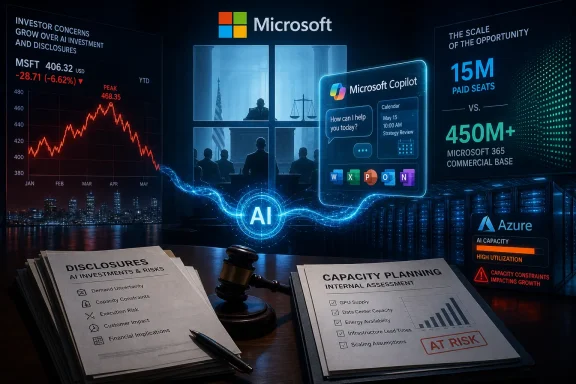
The market reaction showed the difference. Microsoft shares fell from $481.63 on January 28 to $433.50 on January 29, a $48.13 decline that the law firms characterize as roughly a 10 percent drop. The complaint treats that decline as the corrective moment: the point at which investors allegedly learned that Azure growth had slowed, AI spending remained enormous, and Microsoft 365 Copilot paid seats stood at 15 million.
The seat number is the heart of the dispute because it converts vision into arithmetic. Microsoft could point to strong year-over-year growth in paid seats and a much larger universe of free or included AI interactions. Plaintiffs and skeptical analysts could point to the denominator: more than 450 million Microsoft 365 commercial seats. Fifteen million paid Copilot seats can be presented as momentum, but it can also be presented as limited penetration after one of the most aggressive enterprise software pushes in Microsoft’s history.
That duality is why the lawsuit matters. It is not fighting over whether Copilot exists, whether Microsoft invested heavily, or whether Azure is a giant business. It is fighting over which interpretation of the same facts investors were entitled to hear sooner.
Copilot was the product that made the strategy legible. It could sit inside Word, Excel, PowerPoint, Outlook, Teams, Windows, GitHub, Edge, security consoles, and business applications. Microsoft did not have to persuade workers to discover a new app; it could put AI directly where work already happened.
That is why user frustration carries more strategic weight than ordinary software grumbling. Reports of confusing branding, inconsistent product boundaries, interoperability problems, and uneven usefulness are not just support headaches. They strike at the argument that Microsoft’s enterprise footprint would automatically translate into paid AI adoption.
Anyone who has watched Microsoft’s recent product naming knows the risk. Copilot has been a chatbot, a sidebar, a productivity assistant, a search experience, a developer tool, a Windows feature, a security layer, and an enterprise SKU. The name became a brand umbrella before many customers had a settled idea of what they were actually buying. In consumer software that might be messy; in enterprise procurement, it can slow deployment, confuse training, and make ROI harder to defend.
The lawsuit leans into that gap between ubiquity and adoption. Microsoft can surface Copilot everywhere, but a CIO still has to justify a paid seat. If the tool saves time in executive demos but stumbles on real-world permissions, latency, accuracy, or workflow integration, the math changes quickly.
The complaint, as summarized by plaintiff firms, alleges that Microsoft had to redirect or ration computing capacity and increase capital expenditures to support Copilot and AI research. That allegation, if tested in court, would go to a central investor concern: whether AI demand was expanding Azure’s opportunity faster than it was consuming Azure’s economics.
This is where the story becomes more complicated than “Copilot disappointed.” Microsoft has a profitable cloud franchise serving thousands of conventional workloads, from databases to enterprise applications to developer platforms. If the company must devote a significant share of scarce high-end compute to internal AI products, OpenAI-related obligations, or strategic model development, then investors need to understand how that allocation affects near-term Azure growth, margins, and backlog quality.
The earnings call context made that tension visible. Microsoft discussed massive capital expenditures and capacity constraints while also telling investors that AI demand was strong. Those statements can coexist. A company can be supply constrained because demand is real, and it can still disappoint investors if the incremental demand is expensive, delayed, or less profitable than expected.
The lawsuit’s broader claim is that investors were not given a complete picture of the trade-off. Microsoft’s defense, if it contests the allegations in the usual way, will likely emphasize that it disclosed risks, reported real numbers, and characterized Copilot and Azure growth in good faith. But the market’s reaction suggests investors wanted more than a growth slogan. They wanted clarity on how much AI was costing and how quickly it was converting into durable, paid usage.
But Microsoft is judged against Microsoft-sized expectations. The company’s installed base is so large that even impressive absolute numbers can look small as a percentage of the available market. That is the trap of being the incumbent: distribution creates upside, but it also creates a benchmark that makes early adoption look underwhelming.
Microsoft’s public framing emphasized growth. Paid seats were reportedly up more than 160 percent year over year, and the company highlighted large customers expanding their deployments. That is the language of momentum, and it is not meaningless. Enterprise software rollouts often begin with pilots, controlled deployments, security reviews, data-governance work, and staged licensing.
The plaintiffs’ framing emphasizes penetration. If 15 million paid seats sit against more than 450 million commercial Microsoft 365 seats, the question becomes whether Copilot is a mass-market productivity layer or an expensive add-on still searching for repeatable value. Those are not mutually exclusive descriptions, but they lead investors to different conclusions.
For WindowsForum readers, this distinction is familiar from every major Microsoft platform push. Redmond can ship something into the channel quickly, light it up across products, and generate enormous visibility. The harder part is getting administrators, compliance teams, help desks, finance departments, and skeptical users to treat it as essential.
A knowledge worker asking for a meeting summary is one use case. A regulated enterprise letting an AI assistant traverse mailboxes, SharePoint sites, Teams chats, files, calendars, customer records, and internal policy documents is another. The latter requires clean identity management, sensible permissions, disciplined data labeling, and a level of trust that many organizations still do not have in their own information architecture.
This is why Copilot’s business depends on more than model quality. It depends on tenant hygiene. If an organization has years of overshared SharePoint folders, stale groups, poorly classified documents, and inconsistent retention policies, Copilot can become a mirror held up to bad governance. That is not entirely Microsoft’s fault, but it becomes Microsoft’s problem when the company sells AI as a productivity accelerator rather than a governance audit.
Admins also care about supportability. When a user says Copilot gave a bad answer, the help desk needs to know whether the problem is permissions, grounding, indexing, model behavior, prompt design, licensing, latency, or user expectation. Traditional Office support is hard enough. AI support adds a layer of probabilistic behavior that many organizations are still learning how to operationalize.
That reality makes paid adoption slower than hype cycles suggest. A CFO may approve a pilot because the CEO wants an AI initiative. Renewing thousands of premium seats is a different decision. At that point, the product must survive contact with budget scrutiny.
That distinction matters because many of the allegations may be hard to prove. Public companies are allowed to be optimistic. They are allowed to describe products favorably, highlight strong customer examples, and frame risks in broad language. Securities fraud requires more than a product underperforming some analyst expectations.
Plaintiffs will need to connect the dots between internal knowledge, public statements, market expectations, and the stock drop. If Microsoft had internal data showing serious Copilot adoption or functionality problems while publicly suggesting broad, healthy momentum, that would help the plaintiffs’ theory. If Microsoft can show that its statements were accurate, qualified, and consistent with available data, the case becomes much harder.
The Wall Street Journal report cited in the announcement adds pressure because it put concrete language around product challenges shortly after the earnings shock. But journalism and litigation serve different functions. A reported article can identify market concerns; a court must decide whether those concerns map onto actionable misstatements.
The fairest reading is that the lawsuit formalizes a debate investors were already having. Microsoft’s AI strategy may be working, but it is also expensive, messy, and more dependent on actual workplace behavior than the early AI narrative admitted.
That ambition makes the investor case relevant beyond Wall Street. If Microsoft concludes that paid enterprise Copilot adoption is slower than expected, it has several possible responses. It can improve the product, simplify licensing, reduce friction, and let adoption grow organically. Or it can push harder through bundling, defaults, and deeper integration across the Microsoft stack.
Windows enthusiasts have already seen what the second path looks like. AI entry points appear in search, taskbars, context menus, browsers, Office apps, and cloud services. Some users welcome the convenience. Others see bloat, telemetry creep, and another layer of cloud dependency inserted into workflows that used to feel local and deterministic.
The lawsuit does not allege that Windows integration itself is unlawful. But the business pressure behind integration is relevant. When a company has spent heavily on AI infrastructure and promised investors a massive productivity market, every surface becomes distribution. Windows is not just an operating system in that model; it is a funnel.
That is why admins should watch the case even if they do not own Microsoft stock. Litigation can surface internal documents, adoption metrics, and product strategy details that ordinary earnings calls do not. Even before discovery produces anything public, the case signals that investors are now scrutinizing the same Copilot friction points IT departments have been living with.
Investors have to parse several overlapping businesses. Azure sells compute to AI companies and enterprises. Microsoft uses AI models inside its own products. Microsoft invests in and has commercial relationships with OpenAI. Copilot competes for user attention with ChatGPT, Gemini, Claude, and other tools that may also run on cloud infrastructure somewhere else. The result is a loop of strategy, dependency, and potential channel conflict.
That complexity creates room for misunderstanding. When Azure backlog grows because of AI commitments, investors want to know how profitable and durable those commitments are. When Copilot improves because of model access, investors want to know whether Microsoft controls enough of the product stack. When Microsoft spends tens of billions on infrastructure, investors want to know whether it is building for customer demand, partner demand, internal demand, or a defensive race it cannot afford to lose.
The securities case uses Copilot and Azure as the named battlegrounds, but the larger issue is the AI conglomerate Microsoft has become. It is selling shovels, digging for gold, financing miners, and building towns around the mine. That may be brilliant strategy. It is also hard to value cleanly.
Before the drop, investors could believe several comforting things at once. They could believe Copilot would monetize the Microsoft 365 base rapidly. They could believe Azure AI demand would remain capacity constrained in a good way. They could believe capital expenditures were a temporary bridge to high-margin revenue. They could believe Microsoft’s distribution advantage would overwhelm product rough edges.
After the January earnings report, those beliefs required more evidence. Fifteen million paid Copilot seats were evidence of adoption, but not enough to settle the penetration question. Slower Azure growth was not a disaster, but it weakened the idea that AI demand would make every cloud comparison easier. Heavy capital spending still looked strategic, but it also looked like a claim on future returns rather than proof of them.
That is the environment in which securities lawsuits thrive. They often arrive after a sharp stock move, when a once-clean narrative becomes disputed. The complaint’s allegations may ultimately survive, narrow, settle, or fail. But the market signal has already occurred: Microsoft’s AI story now has to clear a higher bar.
The company can also point to the breadth of Copilot usage beyond paid Microsoft 365 seats. Free, included, or bundled experiences may create habits before they create direct subscription revenue. GitHub Copilot, security Copilots, Dynamics integrations, Windows features, and consumer AI interactions all complicate any single adoption metric.
Microsoft’s strongest business defense is time. Enterprise AI is still early. Many organizations are experimenting, cleaning up data estates, waiting for better admin controls, testing ROI, and figuring out where generative AI actually saves money. A slow first phase does not prove the product is doomed.
But time cuts both ways. The longer Copilot remains more promise than necessity, the harder it becomes to justify the market’s most aggressive assumptions. Microsoft does not need Copilot to be perfect in 2026, but it does need customers to believe the product is improving faster than procurement skepticism is hardening.
That is why the lawsuit lands at an awkward moment. Microsoft wants investors to view AI spending as infrastructure for the next decade. Plaintiffs want a court to examine whether the company was candid enough about the current decade’s friction.
Still, the discovery risk is nontrivial if the case advances. Internal emails, adoption dashboards, customer escalations, product-health metrics, capacity planning documents, and executive briefings could become central to the dispute. For a company whose AI narrative depends heavily on confidence, even selective disclosure of internal concern could be uncomfortable.
The court venue also matters. The case is pending in the U.S. District Court for the Western District of Washington, Microsoft’s home turf in practical terms but not necessarily a soft venue. The lead plaintiff deadline of August 11, 2026, is a procedural milestone, not a verdict on the merits. It determines who may seek to steer the litigation on behalf of the proposed investor class.
For readers outside the investor world, the procedural language can sound like boilerplate. But leadership of a securities class action affects strategy: which law firm leads, which allegations are emphasized, and how aggressively plaintiffs pursue discovery. The June 29 investor announcement is part legal notice, part client recruitment, and part public pressure campaign.
That does not make it irrelevant. It means it should be read for what it is: an adversarial document summarizing allegations designed to attract shareholders and frame a narrative before Microsoft’s legal response fully develops.
Microsoft is still extraordinarily well positioned. It owns the productivity suite, the identity layer, the developer ecosystem, the endpoint footprint, the security stack, and one of the world’s most important clouds. If any company can turn AI into a recurring enterprise utility, Microsoft remains near the top of the list.
But the burden of proof has changed. Investors want paid seats, not just active users. Admins want controls, not just demos. Developers want stable APIs and useful models, not just brand consolidation. Users want tools that reduce work, not tools that create a new chore called “checking the AI.”
The complaint captures that shift because it attacks the connective tissue between Microsoft’s product claims and its valuation. Copilot is not merely another assistant competing for attention. It is the product Microsoft used to explain why AI spending would become software revenue. If that bridge is weaker than advertised, the entire model deserves closer scrutiny.
 The AI Premium Has Become a Legal Target
For the past two years, Microsoft has sold investors a relatively simple story. Azure would absorb the world’s demand for AI compute, Microsoft 365 would turn generative AI into a paid productivity layer, and Copilot would bind the two together in a way rivals could not easily copy. That story helped make Microsoft one of the defining companies of the AI trade.The class action tries to puncture that narrative at its most valuable seam. According to the complaint described by BFA and other plaintiff firms, Microsoft allegedly overstated or failed to fully disclose problems with Copilot adoption, product quality, interoperability, branding, capacity allocation, and the degree to which Azure growth depended on expensive AI infrastructure. The proposed class period reportedly runs from May 1, 2025, through January 28, 2026.
That timing matters. The case is not merely about whether Copilot annoyed some users or whether Azure growth slowed by a point. It is about whether Microsoft’s public AI optimism gave investors a misleading picture of the company’s real conversion rate from installed Office users to paid AI subscribers — and whether the capital demands of the AI build-out were properly understood before the stock sold off.
The legal phrasing is securities fraud. The business question is more interesting: did Microsoft convince the market that Copilot was already becoming the next Office, when it may still have been fighting to become the next Teams?
January 28 Was the Day the Story Became Measurable
Microsoft’s fiscal second-quarter 2026 earnings were not a collapse by ordinary corporate standards. The company reported $81.3 billion in revenue for the quarter ended December 31, 2025, up 17 percent year over year, with operating income and profit still moving at a pace most companies would envy. By any conventional measure, Microsoft remained a growth machine.But Microsoft is no longer priced like a conventional growth machine. It is priced as one of the central toll collectors of the AI economy. That means investors were not only asking whether the company was growing; they were asking whether the growth curve justified vast AI capital spending, OpenAI-linked obligations, and the expectation that Copilot would become a high-margin subscription layer across the enterprise estate.
The market reaction showed the difference. Microsoft shares fell from $481.63 on January 28 to $433.50 on January 29, a $48.13 decline that the law firms characterize as roughly a 10 percent drop. The complaint treats that decline as the corrective moment: the point at which investors allegedly learned that Azure growth had slowed, AI spending remained enormous, and Microsoft 365 Copilot paid seats stood at 15 million.
The seat number is the heart of the dispute because it converts vision into arithmetic. Microsoft could point to strong year-over-year growth in paid seats and a much larger universe of free or included AI interactions. Plaintiffs and skeptical analysts could point to the denominator: more than 450 million Microsoft 365 commercial seats. Fifteen million paid Copilot seats can be presented as momentum, but it can also be presented as limited penetration after one of the most aggressive enterprise software pushes in Microsoft’s history.
That duality is why the lawsuit matters. It is not fighting over whether Copilot exists, whether Microsoft invested heavily, or whether Azure is a giant business. It is fighting over which interpretation of the same facts investors were entitled to hear sooner.
Copilot Was Supposed to Be the Easy Part
Microsoft’s AI strategy always had two halves. The first was infrastructure: data centers, GPUs, networking, Azure capacity, and relationships with model providers. The second was distribution: embedding AI into the software people already use every day. The infrastructure side was expensive and technically difficult, but the distribution side looked like Microsoft’s natural advantage.Copilot was the product that made the strategy legible. It could sit inside Word, Excel, PowerPoint, Outlook, Teams, Windows, GitHub, Edge, security consoles, and business applications. Microsoft did not have to persuade workers to discover a new app; it could put AI directly where work already happened.
That is why user frustration carries more strategic weight than ordinary software grumbling. Reports of confusing branding, inconsistent product boundaries, interoperability problems, and uneven usefulness are not just support headaches. They strike at the argument that Microsoft’s enterprise footprint would automatically translate into paid AI adoption.
Anyone who has watched Microsoft’s recent product naming knows the risk. Copilot has been a chatbot, a sidebar, a productivity assistant, a search experience, a developer tool, a Windows feature, a security layer, and an enterprise SKU. The name became a brand umbrella before many customers had a settled idea of what they were actually buying. In consumer software that might be messy; in enterprise procurement, it can slow deployment, confuse training, and make ROI harder to defend.
The lawsuit leans into that gap between ubiquity and adoption. Microsoft can surface Copilot everywhere, but a CIO still has to justify a paid seat. If the tool saves time in executive demos but stumbles on real-world permissions, latency, accuracy, or workflow integration, the math changes quickly.
Azure’s AI Boom Came With a Capacity Bill
The Azure portion of the case is just as important as Copilot, even if it sounds less dramatic. Microsoft’s cloud business has been the company’s growth engine for years, and AI demand added a new accelerant. But AI infrastructure is not free cloud revenue falling from the sky. It requires expensive chips, power, land, networking, cooling, and long-term capacity planning.The complaint, as summarized by plaintiff firms, alleges that Microsoft had to redirect or ration computing capacity and increase capital expenditures to support Copilot and AI research. That allegation, if tested in court, would go to a central investor concern: whether AI demand was expanding Azure’s opportunity faster than it was consuming Azure’s economics.
This is where the story becomes more complicated than “Copilot disappointed.” Microsoft has a profitable cloud franchise serving thousands of conventional workloads, from databases to enterprise applications to developer platforms. If the company must devote a significant share of scarce high-end compute to internal AI products, OpenAI-related obligations, or strategic model development, then investors need to understand how that allocation affects near-term Azure growth, margins, and backlog quality.
The earnings call context made that tension visible. Microsoft discussed massive capital expenditures and capacity constraints while also telling investors that AI demand was strong. Those statements can coexist. A company can be supply constrained because demand is real, and it can still disappoint investors if the incremental demand is expensive, delayed, or less profitable than expected.
The lawsuit’s broader claim is that investors were not given a complete picture of the trade-off. Microsoft’s defense, if it contests the allegations in the usual way, will likely emphasize that it disclosed risks, reported real numbers, and characterized Copilot and Azure growth in good faith. But the market’s reaction suggests investors wanted more than a growth slogan. They wanted clarity on how much AI was costing and how quickly it was converting into durable, paid usage.
The 15 Million Seat Number Cuts Both Ways
A paid base of 15 million Microsoft 365 Copilot seats is not a failure in isolation. Many software companies would celebrate that scale. It represents a large commercial product in its own right, particularly if attached to enterprise contracts and layered onto existing Microsoft 365 relationships.But Microsoft is judged against Microsoft-sized expectations. The company’s installed base is so large that even impressive absolute numbers can look small as a percentage of the available market. That is the trap of being the incumbent: distribution creates upside, but it also creates a benchmark that makes early adoption look underwhelming.
Microsoft’s public framing emphasized growth. Paid seats were reportedly up more than 160 percent year over year, and the company highlighted large customers expanding their deployments. That is the language of momentum, and it is not meaningless. Enterprise software rollouts often begin with pilots, controlled deployments, security reviews, data-governance work, and staged licensing.
The plaintiffs’ framing emphasizes penetration. If 15 million paid seats sit against more than 450 million commercial Microsoft 365 seats, the question becomes whether Copilot is a mass-market productivity layer or an expensive add-on still searching for repeatable value. Those are not mutually exclusive descriptions, but they lead investors to different conclusions.
For WindowsForum readers, this distinction is familiar from every major Microsoft platform push. Redmond can ship something into the channel quickly, light it up across products, and generate enormous visibility. The harder part is getting administrators, compliance teams, help desks, finance departments, and skeptical users to treat it as essential.
Enterprise IT Does Not Buy Magic; It Buys Predictability
Generative AI demos beautifully. Enterprise IT deploys painfully. That gap may be the defining obstacle for Copilot.A knowledge worker asking for a meeting summary is one use case. A regulated enterprise letting an AI assistant traverse mailboxes, SharePoint sites, Teams chats, files, calendars, customer records, and internal policy documents is another. The latter requires clean identity management, sensible permissions, disciplined data labeling, and a level of trust that many organizations still do not have in their own information architecture.
This is why Copilot’s business depends on more than model quality. It depends on tenant hygiene. If an organization has years of overshared SharePoint folders, stale groups, poorly classified documents, and inconsistent retention policies, Copilot can become a mirror held up to bad governance. That is not entirely Microsoft’s fault, but it becomes Microsoft’s problem when the company sells AI as a productivity accelerator rather than a governance audit.
Admins also care about supportability. When a user says Copilot gave a bad answer, the help desk needs to know whether the problem is permissions, grounding, indexing, model behavior, prompt design, licensing, latency, or user expectation. Traditional Office support is hard enough. AI support adds a layer of probabilistic behavior that many organizations are still learning how to operationalize.
That reality makes paid adoption slower than hype cycles suggest. A CFO may approve a pilot because the CEO wants an AI initiative. Renewing thousands of premium seats is a different decision. At that point, the product must survive contact with budget scrutiny.
The Lawsuit Is About Disclosure, Not Whether Copilot Is Useful
It is important not to confuse the legal case with a product review. A securities class action does not ask whether Copilot is good, bad, annoying, promising, or overbranded in the abstract. It asks whether Microsoft and named executives made materially misleading statements or omitted material facts during the class period, and whether investors were harmed when the truth allegedly emerged.That distinction matters because many of the allegations may be hard to prove. Public companies are allowed to be optimistic. They are allowed to describe products favorably, highlight strong customer examples, and frame risks in broad language. Securities fraud requires more than a product underperforming some analyst expectations.
Plaintiffs will need to connect the dots between internal knowledge, public statements, market expectations, and the stock drop. If Microsoft had internal data showing serious Copilot adoption or functionality problems while publicly suggesting broad, healthy momentum, that would help the plaintiffs’ theory. If Microsoft can show that its statements were accurate, qualified, and consistent with available data, the case becomes much harder.
The Wall Street Journal report cited in the announcement adds pressure because it put concrete language around product challenges shortly after the earnings shock. But journalism and litigation serve different functions. A reported article can identify market concerns; a court must decide whether those concerns map onto actionable misstatements.
The fairest reading is that the lawsuit formalizes a debate investors were already having. Microsoft’s AI strategy may be working, but it is also expensive, messy, and more dependent on actual workplace behavior than the early AI narrative admitted.
Microsoft’s AI Problem Is Also a Windows Problem
For Windows users, Copilot has always been more than an enterprise SKU. Microsoft has pushed AI into Windows 11, Edge, Bing, Microsoft 365, and developer workflows with a persistence that has sometimes exceeded user demand. The company clearly wants Copilot to become a system-level companion rather than an optional app.That ambition makes the investor case relevant beyond Wall Street. If Microsoft concludes that paid enterprise Copilot adoption is slower than expected, it has several possible responses. It can improve the product, simplify licensing, reduce friction, and let adoption grow organically. Or it can push harder through bundling, defaults, and deeper integration across the Microsoft stack.
Windows enthusiasts have already seen what the second path looks like. AI entry points appear in search, taskbars, context menus, browsers, Office apps, and cloud services. Some users welcome the convenience. Others see bloat, telemetry creep, and another layer of cloud dependency inserted into workflows that used to feel local and deterministic.
The lawsuit does not allege that Windows integration itself is unlawful. But the business pressure behind integration is relevant. When a company has spent heavily on AI infrastructure and promised investors a massive productivity market, every surface becomes distribution. Windows is not just an operating system in that model; it is a funnel.
That is why admins should watch the case even if they do not own Microsoft stock. Litigation can surface internal documents, adoption metrics, and product strategy details that ordinary earnings calls do not. Even before discovery produces anything public, the case signals that investors are now scrutinizing the same Copilot friction points IT departments have been living with.
The OpenAI Shadow Makes the Story Harder to Price
Microsoft’s AI position is unusual because it is both a platform owner and a dependent partner. Its relationship with OpenAI gave Microsoft early access to frontier-model momentum and a powerful story for Azure. It also made the company’s financial narrative more complex.Investors have to parse several overlapping businesses. Azure sells compute to AI companies and enterprises. Microsoft uses AI models inside its own products. Microsoft invests in and has commercial relationships with OpenAI. Copilot competes for user attention with ChatGPT, Gemini, Claude, and other tools that may also run on cloud infrastructure somewhere else. The result is a loop of strategy, dependency, and potential channel conflict.
That complexity creates room for misunderstanding. When Azure backlog grows because of AI commitments, investors want to know how profitable and durable those commitments are. When Copilot improves because of model access, investors want to know whether Microsoft controls enough of the product stack. When Microsoft spends tens of billions on infrastructure, investors want to know whether it is building for customer demand, partner demand, internal demand, or a defensive race it cannot afford to lose.
The securities case uses Copilot and Azure as the named battlegrounds, but the larger issue is the AI conglomerate Microsoft has become. It is selling shovels, digging for gold, financing miners, and building towns around the mine. That may be brilliant strategy. It is also hard to value cleanly.
The Stock Drop Was a Repricing of Certainty
A 10 percent one-day decline in a company of Microsoft’s size is not just a bad trading session. It is a repricing of assumptions. The market did not suddenly discover that Microsoft was unprofitable or that Azure was irrelevant. It questioned the certainty of the AI acceleration curve.Before the drop, investors could believe several comforting things at once. They could believe Copilot would monetize the Microsoft 365 base rapidly. They could believe Azure AI demand would remain capacity constrained in a good way. They could believe capital expenditures were a temporary bridge to high-margin revenue. They could believe Microsoft’s distribution advantage would overwhelm product rough edges.
After the January earnings report, those beliefs required more evidence. Fifteen million paid Copilot seats were evidence of adoption, but not enough to settle the penetration question. Slower Azure growth was not a disaster, but it weakened the idea that AI demand would make every cloud comparison easier. Heavy capital spending still looked strategic, but it also looked like a claim on future returns rather than proof of them.
That is the environment in which securities lawsuits thrive. They often arrive after a sharp stock move, when a once-clean narrative becomes disputed. The complaint’s allegations may ultimately survive, narrow, settle, or fail. But the market signal has already occurred: Microsoft’s AI story now has to clear a higher bar.
Redmond’s Defense Will Lean on Scale, Risk Warnings, and Time
Microsoft has several obvious arguments available. It can say it disclosed financial results accurately, warned investors about risks, and reported real Copilot momentum. It can emphasize that early enterprise adoption often looks small compared with the eventual addressable base. It can argue that analyst expectations are not company promises.The company can also point to the breadth of Copilot usage beyond paid Microsoft 365 seats. Free, included, or bundled experiences may create habits before they create direct subscription revenue. GitHub Copilot, security Copilots, Dynamics integrations, Windows features, and consumer AI interactions all complicate any single adoption metric.
Microsoft’s strongest business defense is time. Enterprise AI is still early. Many organizations are experimenting, cleaning up data estates, waiting for better admin controls, testing ROI, and figuring out where generative AI actually saves money. A slow first phase does not prove the product is doomed.
But time cuts both ways. The longer Copilot remains more promise than necessity, the harder it becomes to justify the market’s most aggressive assumptions. Microsoft does not need Copilot to be perfect in 2026, but it does need customers to believe the product is improving faster than procurement skepticism is hardening.
That is why the lawsuit lands at an awkward moment. Microsoft wants investors to view AI spending as infrastructure for the next decade. Plaintiffs want a court to examine whether the company was candid enough about the current decade’s friction.
The Case May Settle, but the Discovery Risk Is Real
Most securities class actions do not end in cinematic trials. They are narrowed, dismissed, mediated, or settled, often without an admission of wrongdoing. Investors should be careful not to treat the filing of a complaint as a finding of fact.Still, the discovery risk is nontrivial if the case advances. Internal emails, adoption dashboards, customer escalations, product-health metrics, capacity planning documents, and executive briefings could become central to the dispute. For a company whose AI narrative depends heavily on confidence, even selective disclosure of internal concern could be uncomfortable.
The court venue also matters. The case is pending in the U.S. District Court for the Western District of Washington, Microsoft’s home turf in practical terms but not necessarily a soft venue. The lead plaintiff deadline of August 11, 2026, is a procedural milestone, not a verdict on the merits. It determines who may seek to steer the litigation on behalf of the proposed investor class.
For readers outside the investor world, the procedural language can sound like boilerplate. But leadership of a securities class action affects strategy: which law firm leads, which allegations are emphasized, and how aggressively plaintiffs pursue discovery. The June 29 investor announcement is part legal notice, part client recruitment, and part public pressure campaign.
That does not make it irrelevant. It means it should be read for what it is: an adversarial document summarizing allegations designed to attract shareholders and frame a narrative before Microsoft’s legal response fully develops.
The Copilot Reckoning Is Bigger Than One Complaint
The most concrete lesson from the Microsoft case is not that Copilot has failed. It is that the AI era has entered its accountability phase. Vendors can no longer rely on ambient excitement around generative AI to carry every metric, every product name, and every capital budget.Microsoft is still extraordinarily well positioned. It owns the productivity suite, the identity layer, the developer ecosystem, the endpoint footprint, the security stack, and one of the world’s most important clouds. If any company can turn AI into a recurring enterprise utility, Microsoft remains near the top of the list.
But the burden of proof has changed. Investors want paid seats, not just active users. Admins want controls, not just demos. Developers want stable APIs and useful models, not just brand consolidation. Users want tools that reduce work, not tools that create a new chore called “checking the AI.”
The complaint captures that shift because it attacks the connective tissue between Microsoft’s product claims and its valuation. Copilot is not merely another assistant competing for attention. It is the product Microsoft used to explain why AI spending would become software revenue. If that bridge is weaker than advertised, the entire model deserves closer scrutiny.
The Numbers Redmond Now Has to Make Boring
The practical stakes are clearer than the legal ones. Microsoft must make Copilot adoption, Azure AI capacity, and AI capital spending feel routine rather than mysterious. That does not mean slowing its AI push. It means giving customers and investors enough detail that the story no longer depends on faith.- Microsoft’s reported 15 million paid Microsoft 365 Copilot seats can be read as rapid growth or limited penetration, depending on whether the denominator is the prior year or the full commercial Microsoft 365 base.
- The January 29 stock drop reflected investor concern about AI monetization, Azure growth, and capital spending rather than a collapse in Microsoft’s overall financial performance.
- The securities case alleges misleading statements and omissions, but those allegations remain unproven unless admitted, settled, or established in court.
- Copilot’s enterprise challenge is not just model intelligence; it is governance, permissions, interoperability, user trust, licensing clarity, and measurable return on investment.
- Windows users and administrators should expect Microsoft to keep expanding AI integration because Copilot’s business case depends on distribution across the Microsoft ecosystem.
- The most important future disclosures will be the ones that separate paid adoption, bundled usage, Azure capacity constraints, AI-driven revenue, and infrastructure spending into numbers that can be tested.
References
- Primary source: GlobeNewswire
Published: 2026-06-29T10:07:23.948647
Loading…
www.globenewswire.com - Official source: microsoft.com
FY26 Q2 - Press Releases - Investor Relations - Microsoft
FY26 Q2 - Press Releases - Investor Relations - Microsoftwww.microsoft.com
- Related coverage: marketbeat.com
Microsoft Q2 Earnings Call Highlights | MarketBeat
Microsoft (NASDAQ:MSFT) executives used the company’s fiscal 2026 second-quarter earnings call to highlight accelerating demand for cloud and artificial intelligence products, while also addressing investor questions about the pace of capital spending and the path from infrastructure investment to rwww.marketbeat.com
- Related coverage: gigazine.net
Microsoft's AI chatbot 'Copilot' is facing growing user dissatisfaction due to confusing branding and interoperability issues, and the percentage of users who support it is declining. - GIGAZINE
Microsoft offers its own chatbot, Copilot, but as it works more closely with OpenAI, it's finding it harder to compete with OpenAI's ChatGPT, the Wall Street Journal reports. Microsoft's Pivotal AI Product Is Running Into Big Problems - WSJ...gigazine.net - Related coverage: 11th.com
11th.com | Investor Funds Recovery
$8.7 billion was paid to investors last year through class actions - but over 75% of investors missed their fair share. We're changing that. 11th.com
- Related coverage: kmllp.com
Microsoft Corporation | Kirby McInerney LLP
Kirby McInerney LLP is a leading plaintiff's law firm specializing in securities fraud, antitrust, commodities, and whistleblower litigation with nearly a century of experience.www.kmllp.com
- Related coverage: zlk.com
- Related coverage: openclassactions.com
Microsoft AI Class Action Lawsuit: Azure and Copilot Claims
Microsoft investors filed a class action alleging the company concealed Azure growth, Copilot problems and rising AI costs. The lead plaintiff deadline is August 11, 2026. openclassactions.com
- Related coverage: windowscentral.com
Only 3.3% of Microsoft 365 users pay for Copilot | Windows Central
A new report suggests that only a fraction of the Microsoft 365 and Office 365 users who interact with Copilot Chat actually pay for it.www.windowscentral.com - Related coverage: fool.com
Microsoft (MSFT) Q2 2026 Earnings Call Transcript | The Motley Fool
Microsoft (MSFT) Q2 2026 Earnings Call Transcriptwww.fool.com - Related coverage: techradar.com
Microsoft's AI spending spree is now facing a shareholder revolt after billions were poured into Copilot and cloud infrastructure | TechRadar
Microsoft's biggest AI bet yet has landed in courtwww.techradar.com - Related coverage: itpro.com
Microsoft sued over performance of Azure business | IT Pro
A class action lawsuit filed by a Michigan pension fund claims that the company failed to tell investors the full story about the costs of its AI expansionwww.itpro.com - Related coverage: gamesradar.com
Xbox CEO confirms it's "winding down" Microsoft Copilot on mobile and ending it on console | GamesRadar+
Xbox originally announced Copilot for console in Marchwww.gamesradar.com - Related coverage: tomsguide.com
Microsoft earnings — 'You can think of agents as the new apps,' CEO Satya Nadella | Tom's Guide
Will we finally learn whether Microsoft’s big bet on AI has paid off?www.tomsguide.com
