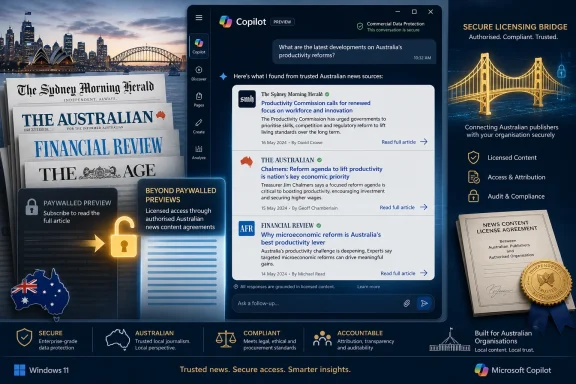
Nine Entertainment Co and Microsoft announced on July 3, 2026, in Australia, a content agreement allowing Microsoft Copilot to reference Nine masthead journalism, including text beyond paywalled previews, so AI search answers can show snippets, headlines, summaries, attribution, and links to full stories. The companies are selling the deal as an Australian first, but its importance is larger than geography. It is another sign that AI search is moving from a messy scrape-and-summarize frontier into a negotiated market where trusted content becomes infrastructure. For Windows users, Microsoft 365 customers, and publishers watching their traffic decay into answer boxes, the deal says the future of search may be less open web than licensed supply chain.
The headline version is simple: Copilot gets access to more of Nine’s journalism, and Nine gets attribution, traffic pathways, and a new commercial relationship with one of the world’s most important AI distributors. But that tidy framing understates the shift. Microsoft is not merely linking to news; it is incorporating professional reporting into the grounding layer that helps an AI system decide what to say.
That distinction matters. In traditional search, the publisher’s page is the destination and the search engine is the map. In AI search, the answer increasingly becomes the destination, while the publisher is pushed into a supporting role as evidence, citation, or expandable footnote.
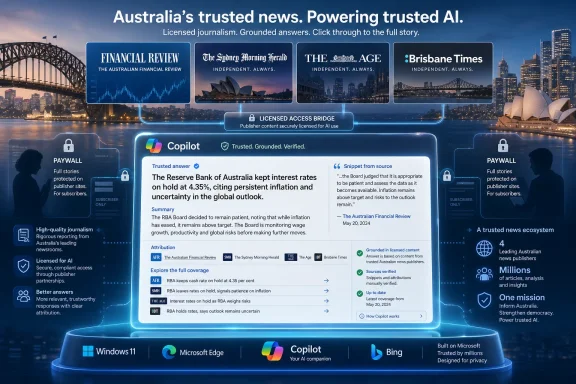
The Nine agreement is Microsoft’s attempt to make that inversion look less predatory and more contractual. Copilot will be able to reference text from Nine’s mastheads beyond the limited previews normally exposed around paywalled articles, then display snippets, headlines, and summaries with a path back to the full story. The named mastheads include The Australian Financial Review, The Sydney Morning Herald, The Age, and Brisbane Times.
That is a consequential collection of Australian journalism. It spans business reporting, politics, culture, local news, and state-level public interest coverage. If Copilot is going to answer current-affairs questions for Australian users, Nine’s archive and live reporting give Microsoft something the open web does not always supply: edited, time-sensitive, reputation-bearing material.
Microsoft’s public language leans on “trusted sources,” “verified facts,” and “confidence.” That is not accidental. The company is trying to solve two problems at once: AI systems need better grounding, and publishers need a reason not to treat AI answer engines as traffic-stripping copyright machines.
Nine’s deal with Microsoft sits firmly in the “license and integrate” camp. It does not resolve the broader copyright fight over AI training, and the announcement is careful to focus on Copilot outputs during AI searches rather than model training. Still, it puts a price, however undisclosed, on access to journalism that Copilot would otherwise have to reach through conventional crawling, snippets, public previews, or third-party summaries.
That is a big practical difference for paywalled news. A paywall tells the open web, and by extension search crawlers, that the full article is not freely available. If an AI assistant can produce a useful answer from only the public preview, the answer may be shallow or wrong. If it can access the full text through a commercial agreement, the answer can be more useful — but the publisher has surrendered part of the old bargain in exchange for money and attribution.
This is why the deal has to be read as both a media story and a platform story. Microsoft is building a permissions layer around parts of Copilot’s knowledge supply. The question is not just what Copilot knows; it is which institutions are allowed to feed it, on what terms, and with what visibility to users.
For Nine, the upside is obvious enough. If users increasingly ask Copilot for summaries of the news rather than visiting a homepage or typing a query into a conventional search box, Nine wants its reporting inside that interaction. The alternative is to be absent from the answer or, worse, paraphrased by an AI system that draws on competitors, wire copy, social posts, or low-quality pages.
That earlier fight was mostly about links, previews, search results, and social distribution. AI changes the mechanics but not the underlying power imbalance. Instead of asking whether a platform should pay to display or distribute news, publishers are asking whether an AI system should pay to understand, summarize, and repackage it.
Nine has been publicly concerned about this shift. The company has argued that AI-powered services threaten to further weaken the economics of journalism if they extract value from reporting without compensation. Its Microsoft deal is therefore not just opportunistic; it is a commercial answer to a regulatory anxiety.
The irony is that Australia’s earlier platform regulation may have made deals like this easier to imagine. Once the local media industry and government accept that bargaining power matters, the jump from search snippets to AI grounding is not very far. Microsoft can present itself as the cooperative platform: not waiting for Canberra to force its hand, not treating publishers as obstacles, but proactively signing deals.
That posture is good politics. It is also good product strategy. Microsoft is racing Google, OpenAI, Perplexity, Anthropic, and others to make AI answers feel current and trustworthy. In a country where news publishers are alert to platform leverage, a licensing deal is not just a supply agreement; it is reputation management.
Microsoft’s Copilot ecosystem already leans heavily on the idea of grounding. In broad terms, grounding means the AI system uses retrieved information — from the web, Microsoft Graph, enterprise data, or approved sources — to anchor its generated response. The promise is that the answer is not merely a probabilistic memory of the internet, but a response informed by relevant material available at query time.
The Nine agreement gives Microsoft a stronger claim for Australian news queries. If Copilot can draw on current reporting from major mastheads, it can in theory offer answers that are fresher and more reliable than a model responding from stale training data. It can also show references, snippets, and links that make the output feel auditable.
But “grounded” is not the same as “correct.” A grounded AI system can still choose the wrong source, misread an article, overstate a claim, or combine several accurate fragments into a misleading synthesis. Licensing improves the input layer; it does not magically solve the interpretation layer.
That distinction will matter to readers. A Copilot answer that cites The Australian Financial Review may inherit some of the masthead’s authority in the user’s mind, even if the wording and framing are Microsoft’s. Publishers will have to decide how much reputational risk they are willing to absorb when their reporting becomes raw material for someone else’s conversational interface.
Under the Nine-Microsoft deal, Copilot can reference text beyond paywalled previews. That does not mean Copilot users get free access to complete articles. Microsoft says Copilot will display snippets, headlines, and summaries, then direct audiences back to Nine mastheads for the complete story. The wall remains; the AI is allowed to peer over it under license.
This arrangement could be beneficial if it sends qualified readers back to Nine. A user who receives a concise Copilot answer may click through for details, context, or the full reporting. That is the optimistic version: AI becomes a discovery layer that restores some of the referral value search once provided.
The pessimistic version is equally plausible. If Copilot’s summary satisfies the user’s immediate need, the click never happens. The publisher gets licensing revenue and attribution, but loses the direct reader relationship that advertising, subscriptions, newsletters, and habit formation depend on.
That trade-off is not unique to Nine. It is the central bargain facing publishers in the AI era. Refuse licensing and risk invisibility or uncompensated substitution; accept licensing and risk teaching users that the AI answer is enough.
That breadth gives Microsoft a distribution advantage. It also gives publishers a reason to make deals even when they have reservations. A licensing relationship with Microsoft is not just a relationship with a chatbot; it is a potential entry point into the daily work habits of office workers, executives, students, policy staffers, and IT departments.
The company’s language around attribution is therefore strategic. Microsoft wants to present Copilot as a more publisher-friendly interface than generic answer engines that scrape, summarize, and move on. If Copilot can offer branded references and click-through paths, Microsoft can argue that it is preserving an information ecosystem rather than consuming it.
There is a competitive edge here. Google’s AI Overviews and Gemini integrations have intensified publisher fears about search traffic. OpenAI has cut major licensing deals while also facing copyright litigation alongside Microsoft. Perplexity has pitched revenue-sharing and publisher programs while attracting criticism over crawling and attribution. Microsoft’s deal with Nine lets it say: we can do AI search with permission.
Whether that becomes a durable advantage depends on implementation. Attribution buried below a generated answer is not the same as meaningful referral. A headline displayed in a Copilot response is not the same as a reader landing on a masthead’s site. The details of UI design — citation placement, source prominence, summary length, and click friction — will determine whether the arrangement feels like partnership or extraction.
That means content licensing has product consequences. If Copilot is the answer interface inside Edge, Bing, Windows, and Microsoft 365 experiences, the sources it can access shape the information users see before they ever open a browser tab. The news supply chain becomes part of the operating environment.
Administrators should pay attention to that shift. In enterprise settings, Copilot’s value proposition is not just that it can write emails or summarize meetings. It is that it can combine organizational data, web information, and approved knowledge sources into answers that workers treat as operationally useful.
The Nine agreement is consumer-facing in its announced form, but it points toward the same broader architecture. Microsoft wants AI answers grounded in sources with known provenance. That logic applies to newsrooms, corporate SharePoint libraries, legal databases, security documentation, customer records, and vertical industry content.
The lesson for IT is that source governance is becoming a first-order AI control. It will not be enough to ask whether a model is powerful. Organizations will need to ask what it can retrieve, whose data it trusts, what it cites, what it summarizes, and how users can verify the result.
The tougher reading is that the deal solves the easiest part of the problem: payment. It does not fully solve accountability. If Copilot summarizes a sensitive investigation poorly, who is responsible? If it omits crucial caveats from a financial story, does the user blame Microsoft, Nine, or the invisible mechanics of retrieval and generation? If a summary competes with the article itself, how much compensation is enough?
These are not abstract questions. News is not a static database of facts. It includes judgment, sequencing, uncertainty, sourcing, corrections, and editorial framing. A generated answer can carry the facts while losing the caution that made the original reporting responsible.
That problem becomes more acute with breaking news. Real-time reporting changes rapidly, and early accounts are often incomplete. A human news site can update a story, add corrections, change a headline, or publish follow-up analysis. An AI answer can compress a developing situation into a false sense of closure.
Microsoft’s answer is grounding and references. That helps, but it also shifts burden to the user. The user must notice the references, understand that the answer is a summary, and click through when the subject demands more than a capsule version. Many will not.
AI search disrupts that model by reducing the need to click. It is not merely another distribution channel. It is a substitution layer. For many everyday queries — “what happened,” “what does this mean,” “summarize the latest,” “compare the arguments” — the assistant can produce enough of an answer to satisfy casual interest.
That is why AI licensing deals are both attractive and dangerous. They create revenue where traffic may be declining, but they may also accelerate the habit change that caused the decline. The publisher becomes less a destination and more a data provider with a brand badge.
Large publishers are better positioned to survive this shift than small ones. Nine has scale, recognizable mastheads, political relevance, and negotiating leverage. Smaller outlets may not get similar terms, especially if AI companies focus on marquee brands that improve answer quality and public legitimacy.
This could produce a two-tier information economy. Major publishers become licensed grounding partners. Everyone else remains part of the open web, accessible through crawling if technically permitted, ignored if not, and compensated rarely if ever. The result may be better answers for popular topics but a weaker long tail of local, specialist, and independent reporting.
In the United States, the fight has been defined by giant lawsuits, marquee OpenAI deals, and a fragmented publisher landscape. In Europe, copyright directives and regulatory scrutiny create different leverage points. In Australia, the memory of the bargaining code gives media companies a language and precedent for demanding compensation.
Microsoft will likely prefer voluntary deals to mandatory rules. Voluntary deals let the company choose partners, manage costs, experiment with product formats, and avoid a one-size-fits-all regulatory regime. Publishers, meanwhile, will take voluntary money where they can get it while continuing to push governments for stronger bargaining tools.
That dynamic is familiar from the last platform war. Big technology companies often move fastest when regulation becomes plausible. The threat of compulsion can make private agreements look like enlightened cooperation.
Nine’s deal should be read in that context. It is not only a commercial arrangement between two companies. It is also a signal to regulators, competitors, and other publishers that Microsoft is willing to bargain — at least with media companies large enough to matter.
Small interface decisions carry economic consequences. How much of the story can Copilot summarize? Does it quote or paraphrase? Are links visible without expansion? Does the answer name the masthead in the body text, or only in a citation panel? Does Copilot treat Nine as the primary source when Nine broke the story, or as one source among many?
The wording “snippets, headlines and summaries” gives Microsoft room to maneuver. A snippet can be a teaser. A summary can be a substitute. The line between the two will be contested, quietly and constantly, in product meetings and analytics dashboards.
Nine will be watching click-through rates, subscriber conversions, and whether Copilot users become recognizable audiences rather than anonymous answer consumers. Microsoft will be watching answer satisfaction, user retention, and legal risk. Those incentives overlap, but they are not identical.
If the implementation is generous to publishers, it may become a model. If it is stingy, the deal could become another example of platforms paying just enough to secure supply while continuing to own the user relationship.
Nine is now part of that stack for Microsoft Copilot. Its journalism becomes not only content to be read, but context to be processed. That is a subtle but profound change in the role of news organizations online.
For IT professionals, this should sound familiar. Enterprises already worry about data classification, permissions, retention, search relevance, and audit trails. AI turns those concerns outward. The public information supply chain now has similar issues: source authority, licensing rights, freshness, attribution, and user verification.
Microsoft’s enterprise customers should also see the analogy. If a company would not let an AI assistant freely summarize confidential SharePoint content without permissions and auditability, why should society be relaxed about AI assistants summarizing public-interest reporting without provenance and commercial terms? The details differ, but the governance principle rhymes.
This is where Microsoft has a chance to differentiate. Its strongest pitch in enterprise AI is not that it has the flashiest chatbot; it is that it can wrap AI around identity, permissions, compliance, and productivity software. Applying a comparable discipline to news content could make Copilot feel less like an internet blender and more like an accountable information tool.
But high-value journalism increasingly sits behind paywalls, registration walls, app experiences, newsletters, and legal restrictions. The open web is still vast, but it is uneven. It includes official sources and excellent reporting, but also spam, rewrites, SEO sludge, partisan farms, and AI-generated filler.
AI search makes that unevenness more dangerous because it compresses sources into a single answer. In a conventional results page, the user can compare sources and judge credibility, at least in theory. In an AI answer, the system performs much of that judgment before the user sees anything.
That gives licensed premium content a new strategic role. It is not only valuable because people want to read it. It is valuable because it can improve the confidence and perceived legitimacy of AI answers.
This is the uncomfortable future for publishers: their reporting may be worth more to platforms as answer-grounding material than as pages with ads. That may bring money, but it also redefines journalism’s place in the digital economy.
The announcement also gives Microsoft a template. Start with major mastheads. Emphasize attribution and trusted information. Avoid overpromising on traffic. Present the deal as innovation rather than damage control. Then repeat in other markets where media companies have enough leverage to negotiate.
For users, the near-term change may look modest. A Copilot answer about an Australian business, political development, or breaking news event may cite Nine more often and provide a cleaner path to a full article. That is useful, but it is not revolutionary at the interface level.
The deeper change is institutional. Microsoft is building a world in which AI answers depend on a blend of public web material, private enterprise data, and licensed publisher content. That makes Copilot less like a chatbot sitting on top of the internet and more like a broker among information rights holders.
That future will be more orderly than the free-for-all that defined early generative AI. It may also be more closed. The best sources will be negotiated, metered, and bundled into platforms whose business incentives are not the same as those of readers, publishers, or the public.
The next phase will be harder. Publishers will need to measure whether AI attribution produces real audiences or merely polite extraction. Microsoft will need to prove that “grounded” answers are not just better-packaged summaries but genuinely accountable information experiences. And users — especially those living inside Windows, Edge, Bing, and Microsoft 365 — will need to learn that an AI answer with a trusted masthead attached is still an answer mediated by a platform, not the story itself.
 Microsoft Is Turning Journalism Into Copilot Fuel
The headline version is simple: Copilot gets access to more of Nine’s journalism, and Nine gets attribution, traffic pathways, and a new commercial relationship with one of the world’s most important AI distributors. But that tidy framing understates the shift. Microsoft is not merely linking to news; it is incorporating professional reporting into the grounding layer that helps an AI system decide what to say.That distinction matters. In traditional search, the publisher’s page is the destination and the search engine is the map. In AI search, the answer increasingly becomes the destination, while the publisher is pushed into a supporting role as evidence, citation, or expandable footnote.
The Nine agreement is Microsoft’s attempt to make that inversion look less predatory and more contractual. Copilot will be able to reference text from Nine’s mastheads beyond the limited previews normally exposed around paywalled articles, then display snippets, headlines, and summaries with a path back to the full story. The named mastheads include The Australian Financial Review, The Sydney Morning Herald, The Age, and Brisbane Times.
That is a consequential collection of Australian journalism. It spans business reporting, politics, culture, local news, and state-level public interest coverage. If Copilot is going to answer current-affairs questions for Australian users, Nine’s archive and live reporting give Microsoft something the open web does not always supply: edited, time-sensitive, reputation-bearing material.
Microsoft’s public language leans on “trusted sources,” “verified facts,” and “confidence.” That is not accidental. The company is trying to solve two problems at once: AI systems need better grounding, and publishers need a reason not to treat AI answer engines as traffic-stripping copyright machines.
The Real Product Is Not the Snippet, It Is the Permission
The most important word in the announcement is not “Copilot.” It is “agreement.” AI companies have spent the past several years insisting, implicitly or explicitly, that large-scale ingestion of online text is either lawful, technically necessary, or competitively unavoidable. Publishers have responded with a mixture of lawsuits, licensing deals, robots.txt changes, and political pressure.Nine’s deal with Microsoft sits firmly in the “license and integrate” camp. It does not resolve the broader copyright fight over AI training, and the announcement is careful to focus on Copilot outputs during AI searches rather than model training. Still, it puts a price, however undisclosed, on access to journalism that Copilot would otherwise have to reach through conventional crawling, snippets, public previews, or third-party summaries.
That is a big practical difference for paywalled news. A paywall tells the open web, and by extension search crawlers, that the full article is not freely available. If an AI assistant can produce a useful answer from only the public preview, the answer may be shallow or wrong. If it can access the full text through a commercial agreement, the answer can be more useful — but the publisher has surrendered part of the old bargain in exchange for money and attribution.
This is why the deal has to be read as both a media story and a platform story. Microsoft is building a permissions layer around parts of Copilot’s knowledge supply. The question is not just what Copilot knows; it is which institutions are allowed to feed it, on what terms, and with what visibility to users.
For Nine, the upside is obvious enough. If users increasingly ask Copilot for summaries of the news rather than visiting a homepage or typing a query into a conventional search box, Nine wants its reporting inside that interaction. The alternative is to be absent from the answer or, worse, paraphrased by an AI system that draws on competitors, wire copy, social posts, or low-quality pages.
Australia’s Platform Wars Never Really Ended
Australia is not a random venue for this deal. It has been one of the most aggressive democracies in forcing the question of whether digital platforms should compensate news publishers. The News Media Bargaining Code was built around the power imbalance between media companies and platforms such as Google and Facebook, and it helped establish the idea that large technology companies should pay when they benefit commercially from news content.That earlier fight was mostly about links, previews, search results, and social distribution. AI changes the mechanics but not the underlying power imbalance. Instead of asking whether a platform should pay to display or distribute news, publishers are asking whether an AI system should pay to understand, summarize, and repackage it.
Nine has been publicly concerned about this shift. The company has argued that AI-powered services threaten to further weaken the economics of journalism if they extract value from reporting without compensation. Its Microsoft deal is therefore not just opportunistic; it is a commercial answer to a regulatory anxiety.
The irony is that Australia’s earlier platform regulation may have made deals like this easier to imagine. Once the local media industry and government accept that bargaining power matters, the jump from search snippets to AI grounding is not very far. Microsoft can present itself as the cooperative platform: not waiting for Canberra to force its hand, not treating publishers as obstacles, but proactively signing deals.
That posture is good politics. It is also good product strategy. Microsoft is racing Google, OpenAI, Perplexity, Anthropic, and others to make AI answers feel current and trustworthy. In a country where news publishers are alert to platform leverage, a licensing deal is not just a supply agreement; it is reputation management.
Copilot’s Trust Problem Needs More Than Better Models
AI assistants have a credibility problem that cannot be solved by model size alone. The best large language models can still hallucinate, blur chronology, flatten nuance, or cite sources that do not actually support the answer. News content makes those risks sharper because timeliness and attribution are not decorative; they are the product.Microsoft’s Copilot ecosystem already leans heavily on the idea of grounding. In broad terms, grounding means the AI system uses retrieved information — from the web, Microsoft Graph, enterprise data, or approved sources — to anchor its generated response. The promise is that the answer is not merely a probabilistic memory of the internet, but a response informed by relevant material available at query time.
The Nine agreement gives Microsoft a stronger claim for Australian news queries. If Copilot can draw on current reporting from major mastheads, it can in theory offer answers that are fresher and more reliable than a model responding from stale training data. It can also show references, snippets, and links that make the output feel auditable.
But “grounded” is not the same as “correct.” A grounded AI system can still choose the wrong source, misread an article, overstate a claim, or combine several accurate fragments into a misleading synthesis. Licensing improves the input layer; it does not magically solve the interpretation layer.
That distinction will matter to readers. A Copilot answer that cites The Australian Financial Review may inherit some of the masthead’s authority in the user’s mind, even if the wording and framing are Microsoft’s. Publishers will have to decide how much reputational risk they are willing to absorb when their reporting becomes raw material for someone else’s conversational interface.
The Paywall Becomes a Negotiating Surface
For two decades, publishers have treated paywalls as defenses against the economics of free distribution. They are imperfect defenses, but they at least make a clear statement: full access requires a subscription, a registration, or a commercial arrangement. AI search makes that boundary more complicated.Under the Nine-Microsoft deal, Copilot can reference text beyond paywalled previews. That does not mean Copilot users get free access to complete articles. Microsoft says Copilot will display snippets, headlines, and summaries, then direct audiences back to Nine mastheads for the complete story. The wall remains; the AI is allowed to peer over it under license.
This arrangement could be beneficial if it sends qualified readers back to Nine. A user who receives a concise Copilot answer may click through for details, context, or the full reporting. That is the optimistic version: AI becomes a discovery layer that restores some of the referral value search once provided.
The pessimistic version is equally plausible. If Copilot’s summary satisfies the user’s immediate need, the click never happens. The publisher gets licensing revenue and attribution, but loses the direct reader relationship that advertising, subscriptions, newsletters, and habit formation depend on.
That trade-off is not unique to Nine. It is the central bargain facing publishers in the AI era. Refuse licensing and risk invisibility or uncompensated substitution; accept licensing and risk teaching users that the AI answer is enough.
Microsoft Wants to Be the Respectable Middleman
Microsoft’s position in the AI-news economy is unusual. It is not simply a model developer, not simply a search engine, not simply an enterprise software vendor, and not simply a consumer assistant provider. Copilot is threaded through Bing, Edge, Windows, Microsoft 365, GitHub, security products, and business workflows.That breadth gives Microsoft a distribution advantage. It also gives publishers a reason to make deals even when they have reservations. A licensing relationship with Microsoft is not just a relationship with a chatbot; it is a potential entry point into the daily work habits of office workers, executives, students, policy staffers, and IT departments.
The company’s language around attribution is therefore strategic. Microsoft wants to present Copilot as a more publisher-friendly interface than generic answer engines that scrape, summarize, and move on. If Copilot can offer branded references and click-through paths, Microsoft can argue that it is preserving an information ecosystem rather than consuming it.
There is a competitive edge here. Google’s AI Overviews and Gemini integrations have intensified publisher fears about search traffic. OpenAI has cut major licensing deals while also facing copyright litigation alongside Microsoft. Perplexity has pitched revenue-sharing and publisher programs while attracting criticism over crawling and attribution. Microsoft’s deal with Nine lets it say: we can do AI search with permission.
Whether that becomes a durable advantage depends on implementation. Attribution buried below a generated answer is not the same as meaningful referral. A headline displayed in a Copilot response is not the same as a reader landing on a masthead’s site. The details of UI design — citation placement, source prominence, summary length, and click friction — will determine whether the arrangement feels like partnership or extraction.
The Windows Angle Is Distribution, Not Desktop Wallpaper
For WindowsForum readers, this story is not just about Australian media policy. Copilot is now part of the Windows and Microsoft 365 environment that many users and administrators encounter every day. The company has spent the past few years treating AI as a platform layer, not a standalone app.That means content licensing has product consequences. If Copilot is the answer interface inside Edge, Bing, Windows, and Microsoft 365 experiences, the sources it can access shape the information users see before they ever open a browser tab. The news supply chain becomes part of the operating environment.
Administrators should pay attention to that shift. In enterprise settings, Copilot’s value proposition is not just that it can write emails or summarize meetings. It is that it can combine organizational data, web information, and approved knowledge sources into answers that workers treat as operationally useful.
The Nine agreement is consumer-facing in its announced form, but it points toward the same broader architecture. Microsoft wants AI answers grounded in sources with known provenance. That logic applies to newsrooms, corporate SharePoint libraries, legal databases, security documentation, customer records, and vertical industry content.
The lesson for IT is that source governance is becoming a first-order AI control. It will not be enough to ask whether a model is powerful. Organizations will need to ask what it can retrieve, whose data it trusts, what it cites, what it summarizes, and how users can verify the result.
The Deal Solves Compensation Better Than It Solves Accountability
The most generous reading of the Nine-Microsoft agreement is that it creates a healthier bargain. Microsoft gets reliable journalism. Nine gets revenue and attribution. Users get AI answers grounded in better reporting and links to the full story. Everyone moves a step away from the lawless scrape-and-pray phase of generative AI.The tougher reading is that the deal solves the easiest part of the problem: payment. It does not fully solve accountability. If Copilot summarizes a sensitive investigation poorly, who is responsible? If it omits crucial caveats from a financial story, does the user blame Microsoft, Nine, or the invisible mechanics of retrieval and generation? If a summary competes with the article itself, how much compensation is enough?
These are not abstract questions. News is not a static database of facts. It includes judgment, sequencing, uncertainty, sourcing, corrections, and editorial framing. A generated answer can carry the facts while losing the caution that made the original reporting responsible.
That problem becomes more acute with breaking news. Real-time reporting changes rapidly, and early accounts are often incomplete. A human news site can update a story, add corrections, change a headline, or publish follow-up analysis. An AI answer can compress a developing situation into a false sense of closure.
Microsoft’s answer is grounding and references. That helps, but it also shifts burden to the user. The user must notice the references, understand that the answer is a summary, and click through when the subject demands more than a capsule version. Many will not.
Publishers Are Choosing Between Bad Old Bargains and Unproven New Ones
The traditional platform bargain was brutal but legible. Search engines and social networks sent traffic. Publishers optimized for visibility, complained about dependency, and tried to convert a fraction of that traffic into money. The platforms captured much of the advertising market, but at least the referral path was visible.AI search disrupts that model by reducing the need to click. It is not merely another distribution channel. It is a substitution layer. For many everyday queries — “what happened,” “what does this mean,” “summarize the latest,” “compare the arguments” — the assistant can produce enough of an answer to satisfy casual interest.
That is why AI licensing deals are both attractive and dangerous. They create revenue where traffic may be declining, but they may also accelerate the habit change that caused the decline. The publisher becomes less a destination and more a data provider with a brand badge.
Large publishers are better positioned to survive this shift than small ones. Nine has scale, recognizable mastheads, political relevance, and negotiating leverage. Smaller outlets may not get similar terms, especially if AI companies focus on marquee brands that improve answer quality and public legitimacy.
This could produce a two-tier information economy. Major publishers become licensed grounding partners. Everyone else remains part of the open web, accessible through crawling if technically permitted, ignored if not, and compensated rarely if ever. The result may be better answers for popular topics but a weaker long tail of local, specialist, and independent reporting.
Australia Gets the Pilot Episode for a Global Fight
Nine says the agreement is the first of its kind for Microsoft in Australia, and the company’s publishing leadership describes it as Microsoft’s first such deal in the Asia-Pacific region. That regional framing matters because AI licensing is not settling into one global template. It is being shaped country by country through copyright law, media regulation, market power, and political pressure.In the United States, the fight has been defined by giant lawsuits, marquee OpenAI deals, and a fragmented publisher landscape. In Europe, copyright directives and regulatory scrutiny create different leverage points. In Australia, the memory of the bargaining code gives media companies a language and precedent for demanding compensation.
Microsoft will likely prefer voluntary deals to mandatory rules. Voluntary deals let the company choose partners, manage costs, experiment with product formats, and avoid a one-size-fits-all regulatory regime. Publishers, meanwhile, will take voluntary money where they can get it while continuing to push governments for stronger bargaining tools.
That dynamic is familiar from the last platform war. Big technology companies often move fastest when regulation becomes plausible. The threat of compulsion can make private agreements look like enlightened cooperation.
Nine’s deal should be read in that context. It is not only a commercial arrangement between two companies. It is also a signal to regulators, competitors, and other publishers that Microsoft is willing to bargain — at least with media companies large enough to matter.
The User Experience Will Decide Whether This Is a Partnership or a Tollbooth
The announcement promises that Copilot will direct audiences to Nine’s mastheads for the complete story. That promise sounds straightforward until you ask how users actually behave in AI interfaces. If the generated summary is prominent and the source link is secondary, the practical effect is substitution. If the summary is restrained and the source path is clear, the effect can look more like referral.Small interface decisions carry economic consequences. How much of the story can Copilot summarize? Does it quote or paraphrase? Are links visible without expansion? Does the answer name the masthead in the body text, or only in a citation panel? Does Copilot treat Nine as the primary source when Nine broke the story, or as one source among many?
The wording “snippets, headlines and summaries” gives Microsoft room to maneuver. A snippet can be a teaser. A summary can be a substitute. The line between the two will be contested, quietly and constantly, in product meetings and analytics dashboards.
Nine will be watching click-through rates, subscriber conversions, and whether Copilot users become recognizable audiences rather than anonymous answer consumers. Microsoft will be watching answer satisfaction, user retention, and legal risk. Those incentives overlap, but they are not identical.
If the implementation is generous to publishers, it may become a model. If it is stingy, the deal could become another example of platforms paying just enough to secure supply while continuing to own the user relationship.
The New Search Stack Has a Supply Chain
The old mental model of search was an index. The new model is a stack. At the bottom are crawlers, licensed feeds, enterprise connectors, APIs, and databases. Above that are retrieval systems deciding what context to pull. Above that are models generating answers. At the top is an interface that decides what the user sees, trusts, and clicks.Nine is now part of that stack for Microsoft Copilot. Its journalism becomes not only content to be read, but context to be processed. That is a subtle but profound change in the role of news organizations online.
For IT professionals, this should sound familiar. Enterprises already worry about data classification, permissions, retention, search relevance, and audit trails. AI turns those concerns outward. The public information supply chain now has similar issues: source authority, licensing rights, freshness, attribution, and user verification.
Microsoft’s enterprise customers should also see the analogy. If a company would not let an AI assistant freely summarize confidential SharePoint content without permissions and auditability, why should society be relaxed about AI assistants summarizing public-interest reporting without provenance and commercial terms? The details differ, but the governance principle rhymes.
This is where Microsoft has a chance to differentiate. Its strongest pitch in enterprise AI is not that it has the flashiest chatbot; it is that it can wrap AI around identity, permissions, compliance, and productivity software. Applying a comparable discipline to news content could make Copilot feel less like an internet blender and more like an accountable information tool.
The Part Microsoft Is Not Saying Out Loud
The deal also reveals something Microsoft would rather frame positively: open web grounding is not enough. If it were, there would be no need to license text beyond paywalled previews from Nine. Copilot could simply crawl, rank, summarize, and cite whatever the public web exposed.But high-value journalism increasingly sits behind paywalls, registration walls, app experiences, newsletters, and legal restrictions. The open web is still vast, but it is uneven. It includes official sources and excellent reporting, but also spam, rewrites, SEO sludge, partisan farms, and AI-generated filler.
AI search makes that unevenness more dangerous because it compresses sources into a single answer. In a conventional results page, the user can compare sources and judge credibility, at least in theory. In an AI answer, the system performs much of that judgment before the user sees anything.
That gives licensed premium content a new strategic role. It is not only valuable because people want to read it. It is valuable because it can improve the confidence and perceived legitimacy of AI answers.
This is the uncomfortable future for publishers: their reporting may be worth more to platforms as answer-grounding material than as pages with ads. That may bring money, but it also redefines journalism’s place in the digital economy.
The First Australian Deal Will Not Be the Last
Nine’s agreement creates pressure on rivals. Other Australian publishers will ask whether they should seek similar arrangements, hold out for better terms, or push government to mandate bargaining with AI platforms. Microsoft’s competitors will have to decide whether to match the deal, ignore it, or rely on other sources.The announcement also gives Microsoft a template. Start with major mastheads. Emphasize attribution and trusted information. Avoid overpromising on traffic. Present the deal as innovation rather than damage control. Then repeat in other markets where media companies have enough leverage to negotiate.
For users, the near-term change may look modest. A Copilot answer about an Australian business, political development, or breaking news event may cite Nine more often and provide a cleaner path to a full article. That is useful, but it is not revolutionary at the interface level.
The deeper change is institutional. Microsoft is building a world in which AI answers depend on a blend of public web material, private enterprise data, and licensed publisher content. That makes Copilot less like a chatbot sitting on top of the internet and more like a broker among information rights holders.
That future will be more orderly than the free-for-all that defined early generative AI. It may also be more closed. The best sources will be negotiated, metered, and bundled into platforms whose business incentives are not the same as those of readers, publishers, or the public.
The Copilot-Nine Bargain in Plain View
The agreement is easiest to understand as a practical settlement between two industries that need each other but do not fully trust each other. Microsoft needs fresh, reputable information to make Copilot useful. Nine needs compensation and visibility as AI interfaces absorb more of the attention once captured by search and social feeds.- Microsoft Copilot will be able to reference Nine masthead text beyond ordinary paywalled previews during AI search experiences.
- Copilot is expected to show snippets, headlines, summaries, attribution, and links that send users to Nine properties for full articles.
- The agreement covers major Nine mastheads including The Australian Financial Review, The Sydney Morning Herald, The Age, and Brisbane Times.
- The deal is being presented as Microsoft’s first arrangement of this kind with a major Australian news media company and, according to Nine’s publishing leadership, its first in the Asia-Pacific region.
- The arrangement improves Microsoft’s access to trusted Australian reporting, but it does not eliminate the risks of AI summaries replacing clicks or flattening editorial nuance.
- The deal signals that AI search is becoming a licensed content market, not just a technical feature layered on top of the open web.
The next phase will be harder. Publishers will need to measure whether AI attribution produces real audiences or merely polite extraction. Microsoft will need to prove that “grounded” answers are not just better-packaged summaries but genuinely accountable information experiences. And users — especially those living inside Windows, Edge, Bing, and Microsoft 365 — will need to learn that an AI answer with a trusted masthead attached is still an answer mediated by a platform, not the story itself.
References
- Primary source: Microsoft Source
Published: Thu, 02 Jul 2026 19:07:30 GMT
- Official source: support.microsoft.com
What information does Copilot use to answer my prompt? | Microsoft Support
Learn what information Copilot uses to answer your prompts.support.microsoft.com - Related coverage: theguardian.com
Nine urges Albanese to force tech companies to compensate media in face of AI threat | Nine Entertainment | The Guardian
Long-awaited news bargaining code with Google, Meta and TikTok at risk of further delay, chief executive sayswww.theguardian.com - Related coverage: techcrunch.com
People Inc. forges AI licensing deal with Microsoft as Google traffic drops | TechCrunch
People Inc. signs an AI licensing deal with Microsoft, which will use its media content in Copilot.techcrunch.com - Official source: learn.microsoft.com
Manage Microsoft 365 Copilot Search | Microsoft Learn
Information on how to manage Microsoft 365 Copilot Search.learn.microsoft.com - Related coverage: windowscentral.com
Microsoft's Publisher Content Marketplace will pay AI creators | Windows Central
In a pro-business move, Microsoft designs its marketplace to compensate for revenue made from AI-generated content.www.windowscentral.com

- Related coverage: searchenginejournal.com
Microsoft Clarity Now Shows Grounding Queries Behind AI Citations
Clarity shows which grounding queries pull your content into Copilot. The patterns surface insights worth acting on, even for non-Bing SEOs.www.searchenginejournal.com - Related coverage: axios.com
News Corp., WSJ owner, announces deal with OpenAI
The Wall Street Journal's owner will put lots of its current and archived material into ChatGPT.www.axios.com
- Official source: microsoft.com

Copilot Search | Microsoft Bing
Discover Copilot Search—an AI-powered way to get smarter, more contextual answers, explore topics, and follow your research in a connected flow, all within Bing and Edge.
www.microsoft.com
- Related coverage: towcenter.columbia.edu
- Related coverage: mediajustice.org