

Every major technological wave inside government starts with the same tension: relief for the overworked, anxiety for the cautious, and a scramble by institutions to catch up with what their people are already doing. The latest DVIDS opinion piece on Microsoft Copilot Chat lands squarely in that familiar moment, arguing that AI is not a job-killer in the Army but a force multiplier for a workforce buried in repetitive administration. It is also a timely reminder that the Pentagon’s AI debate is no longer abstract; it is now being fought in inboxes, meeting rooms, and daily battle rhythm. The bigger question is not whether AI will arrive, but how quickly the Army can turn it into disciplined advantage without losing human judgment.
The DVIDS commentary arrives at a moment when the defense enterprise is under pressure from both sides of the same equation: fewer people and more work. The author frames the day-to-day burden vividly, describing endless email chains, executive summaries, and PowerPoint tasks that consume time better spent on mission-critical duties. That complaint will feel instantly familiar to anyone inside a large bureaucracy, but it carries extra weight in uniformed and civilian defense organizations where staffing shortages and readiness demands leave little slack.
What makes the piece notable is not merely that it praises AI, but that it does so from inside the Army civilian workforce after participation in a Microsoft Copilot Chat pilot. That makes the argument less theoretical than the usual productivity hype cycle. It is not an outside vendor promising transformation; it is an internal user describing what changed after a couple of weeks of hands-on use. The article’s core thesis is simple: AI is already useful enough to matter, but not complete enough to replace the professional.
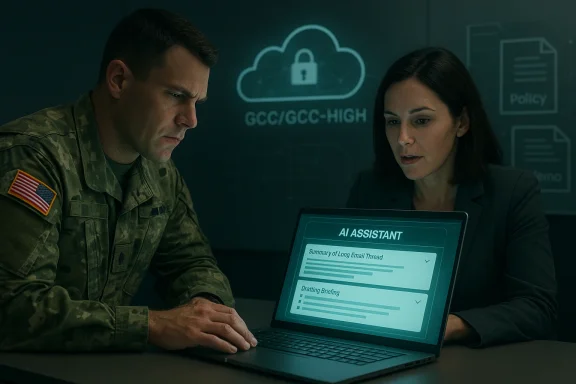
This framing also reflects a larger policy shift across the U.S. government and defense community. Microsoft has spent the last several years rolling Copilot and Copilot Chat into government cloud environments, including GCC, GCC-High, and DoD-aligned scenarios, with explicit attention to security and compliance boundaries. Microsoft’s public-sector guidance now presents Copilot Chat as available across government clouds and emphasizes that organizations can manage access, web grounding, and data controls differently depending on the environment. That matters because the Army’s AI adoption is not happening in a vacuum; it is unfolding inside a compliance architecture that shapes how useful the tools can be.
There is also a political and organizational backdrop. Recent Defense Department messaging has become more forceful about AI as a tool for output, efficiency, and adversary overmatch. The DVIDS author cites a memo attributed to Secretary of War Pete Hegseth, who is quoted saying AI should be part of the workforce’s daily rhythm and treated as a teammate. Defense reporting from the Department itself similarly describes Hegseth directing civilian workforce realignment and emphasizing a leaner, more mission-focused structure. Whether one views that as modernization or pressure, the message is unmistakable: AI is now part of the management conversation, not just the innovation conversation.
The article also fits a broader historical pattern. New office technologies rarely eliminate bureaucracy on contact; they usually change where the friction sits. Computers did not end paperwork, email did not end meetings, and spreadsheets did not end bad decisions. What those tools did do was accelerate the flow of information and make new forms of oversight possible. AI appears to be following the same path, except faster and with more explicit concern about trust, correctness, and human replacement.
The article’s tone also reveals something important about adoption inside government: skepticism is not a barrier so much as a filter. Many public servants will not become AI enthusiasts, but they do not need to. They need enough confidence to use the tool on narrow tasks, verify the output, and decide when the human must take over.
The author’s point is not that administration is pointless. In a large institution, documentation is how continuity survives turnover and how decisions are tracked. The issue is proportionality. When administrative effort grows until it crowds out operational judgment, the organization starts optimizing for paperwork rather than outcomes.
That makes AI more attractive to managers than to technologists. Leaders often do not care whether the algorithm is elegant; they care whether the process gets shorter, the summary gets cleaner, and the decision packet arrives on time. In that sense, the Army’s interest in Copilot is not a novelty experiment. It is a response to the same pressure every bureaucracy faces when resources tighten.
AI can help by drafting, structuring, and organizing. But the more important observation is that the Army has a lot of information bottlenecks that are not really knowledge problems. They are synthesis problems. Copilot’s value lies in smoothing those bottlenecks, even if only to give users a better starting point.
Microsoft’s public-sector guidance supports that reading. The company has positioned Copilot Chat for government clouds as a natural extension of workplace software, with controls tailored to cloud boundary and tenant type. Microsoft also says Copilot Chat can work across emails, documents, and meetings, which is exactly the kind of ambient workflow support the Army author describes.
The article also makes a subtle but important trust claim: the data fed into the tool stays within the user’s account rather than disappearing into some undefined ether. That language may be informal, but the underlying point is central to adoption in defense circles. If a tool feels like a data leak, people will avoid it. If it feels like a governed workspace assistant, they will try it.
This is why the article’s praise of seamlessness is more than a convenience note. It suggests that the Army’s AI adoption strategy may succeed best where it enhances familiar tools rather than demanding new ones. That is especially true for offices where people are already creating recurring products such as leader updates, agenda packs, and situation summaries.
That cloud distinction also affects how the Army thinks about scale. A pilot is useful, but operational value only emerges when the tool can move from isolated experimentation to routine staff use. The article strongly implies that the Army is reaching the stage where practical usage, not novelty, is the benchmark.
The examples are concrete. Copilot can summarize long email threads, pull key points from policy documents, organize rough notes into Excel, and turn scattered thoughts into talking points. Those are exactly the kinds of tasks where AI can deliver immediate value because the user already knows the shape of the answer. The AI is not replacing expertise; it is reducing the drag of assembly.
The article also notes that AI helps with brainstorming. That is less about automation and more about cognitive leverage. A model can generate alternate framings, checklists, or scenario-based questions that help a user escape tunnel vision. Even when the output is imperfect, it can provoke better thinking.
The article wisely argues that AI cannot replace strategic judgment. That caveat matters because a polished draft can create false confidence if the user does not interrogate it. In defense settings, a convincing but shallow answer can be worse than no answer at all.
This has broader implications for Army communication, emergency coordination, and internal reporting. Speed matters, but so does consistency. A machine that helps standardize the first pass can improve operational tempo without undermining the human chain of command.
This is why the author insists on checking source material. AI can accelerate research, but it does not relieve the user of responsibility. The model may know the shape of an answer, but the human must confirm whether that answer is legally, procedurally, and contextually valid.
This is especially important because military users often work across domains. A staffer may need to understand legal rules, communication norms, procurement constraints, or operational policy all at once. AI can help bridge those domains, but it can also blur them if the user is inattentive.
That means the best AI implementation is layered. Let the model do the recall, formatting, and synthesis. Let the human decide tone, substance, and appropriateness. That division of labor is not a limitation. It is the whole point.
In a defense context, that temptation has to be resisted. A tool that can sometimes be wrong in a confident voice demands disciplined habits, not casual adoption. The author understands this, which is one reason the piece lands with more credibility than a typical AI cheerleading column.
The article repeatedly returns to what AI cannot do. It cannot build relationships with community leaders, conduct sensitive interviews, or read the emotional temperature of a crisis room. Those are not side tasks; they are central to public affairs, command support, and organizational leadership.
This is why AI is best understood as a support layer. It can reduce the noise around the human decision-maker, but it cannot be the decision-maker. That distinction is especially important in the Army, where decisions often carry operational, legal, and reputational consequences.
That is a useful corrective to the current overstatement surrounding generative AI. Organizations often imagine they are buying productivity, when in reality they are buying a partial substitute for boring work. That is still valuable, but it is not the same as replacing the human professional.
That mindset will likely determine whether the Army’s AI push becomes genuinely transformative or merely fashionable. Tool adoption is easy; habit change is hard. The institutions that figure out the habit change first will gain the most.
Microsoft’s government-cloud positioning gives the company a strong opening in this space, especially as its Copilot ecosystem matures. The broader rollout of Copilot Chat in government environments means the Army is not experimenting with a fringe product; it is leaning into a platform that is already being normalized across public-sector workflows. That creates momentum that competitors will have to answer with equally secure, equally integrated, and equally usable tools.
The Army use case is also different from a private-sector office. A consumer might ask AI to help write an email. A defense professional may ask it to help interpret policy, produce a briefing, or summarize a chain of responsibility. The stakes are higher, and the acceptable error rate is lower.
That is why training matters as much as access. Microsoft’s public-sector roadshows, prompt-a-thons, and guidance materials suggest a recognition that adoption requires user education, not just licenses. The DVIDS article aligns with that broader reality: tools alone do not create value, people do.
The DVIDS piece suggests that the cultural argument is already being won in some parts of the force. The remaining challenge is operationalizing that acceptance without turning every user into an AI expert. The Army does not need everyone to become a technologist. It needs them to become disciplined consumers of AI output.
A mature adoption model will probably look boring from the outside, which is usually a sign of success. The best tools disappear into the workflow and make good habits faster. If the Army gets this right, AI will not be a spectacle; it will be infrastructure.
Source: DVIDS Opinion: How AI augments, not replaces the Army professional
 Background
The DVIDS commentary arrives at a moment when the defense enterprise is under pressure from both sides of the same equation: fewer people and more work. The author frames the day-to-day burden vividly, describing endless email chains, executive summaries, and PowerPoint tasks that consume time better spent on mission-critical duties. That complaint will feel instantly familiar to anyone inside a large bureaucracy, but it carries extra weight in uniformed and civilian defense organizations where staffing shortages and readiness demands leave little slack.What makes the piece notable is not merely that it praises AI, but that it does so from inside the Army civilian workforce after participation in a Microsoft Copilot Chat pilot. That makes the argument less theoretical than the usual productivity hype cycle. It is not an outside vendor promising transformation; it is an internal user describing what changed after a couple of weeks of hands-on use. The article’s core thesis is simple: AI is already useful enough to matter, but not complete enough to replace the professional.
This framing also reflects a larger policy shift across the U.S. government and defense community. Microsoft has spent the last several years rolling Copilot and Copilot Chat into government cloud environments, including GCC, GCC-High, and DoD-aligned scenarios, with explicit attention to security and compliance boundaries. Microsoft’s public-sector guidance now presents Copilot Chat as available across government clouds and emphasizes that organizations can manage access, web grounding, and data controls differently depending on the environment. That matters because the Army’s AI adoption is not happening in a vacuum; it is unfolding inside a compliance architecture that shapes how useful the tools can be.
There is also a political and organizational backdrop. Recent Defense Department messaging has become more forceful about AI as a tool for output, efficiency, and adversary overmatch. The DVIDS author cites a memo attributed to Secretary of War Pete Hegseth, who is quoted saying AI should be part of the workforce’s daily rhythm and treated as a teammate. Defense reporting from the Department itself similarly describes Hegseth directing civilian workforce realignment and emphasizing a leaner, more mission-focused structure. Whether one views that as modernization or pressure, the message is unmistakable: AI is now part of the management conversation, not just the innovation conversation.
The article also fits a broader historical pattern. New office technologies rarely eliminate bureaucracy on contact; they usually change where the friction sits. Computers did not end paperwork, email did not end meetings, and spreadsheets did not end bad decisions. What those tools did do was accelerate the flow of information and make new forms of oversight possible. AI appears to be following the same path, except faster and with more explicit concern about trust, correctness, and human replacement.
Why this moment matters
The real significance of the piece is that it treats AI as a workplace instrument rather than a science-fiction event. That is a useful correction to the way AI is often discussed in public, where debate tends to swing between utopian productivity and apocalyptic displacement. In practice, defense users care about whether a system can summarize a long thread, draft a memo, or surface a missing policy citation before a meeting starts.The article’s tone also reveals something important about adoption inside government: skepticism is not a barrier so much as a filter. Many public servants will not become AI enthusiasts, but they do not need to. They need enough confidence to use the tool on narrow tasks, verify the output, and decide when the human must take over.
- The piece is grounded in a real Army pilot, not hypothetical use.
- It treats AI as a productivity layer, not a replacement strategy.
- It highlights the tension between speed and accuracy.
- It reflects a broader government cloud AI rollout already underway. (dvidshub.net)
The Army’s Administrative Burden
The opening argument is a familiar one: too much time is spent on low-value administrative work. The author points to emails, summaries, and slide decks as drains on time and focus. That is not a complaint unique to the Army, but it becomes more consequential in a mission environment where every hour spent polishing a status update is an hour not spent on planning, coordination, or leadership.The author’s point is not that administration is pointless. In a large institution, documentation is how continuity survives turnover and how decisions are tracked. The issue is proportionality. When administrative effort grows until it crowds out operational judgment, the organization starts optimizing for paperwork rather than outcomes.
Time as the real scarce resource
The article does a good job of identifying the true constraint: time, not just labor. That distinction matters in defense settings because manpower shortages can sometimes be offset with better tooling, but time lost to repetitive work is harder to recover. AI does not create more hours in the day, but it can compress the amount of effort needed to produce a decent first pass.That makes AI more attractive to managers than to technologists. Leaders often do not care whether the algorithm is elegant; they care whether the process gets shorter, the summary gets cleaner, and the decision packet arrives on time. In that sense, the Army’s interest in Copilot is not a novelty experiment. It is a response to the same pressure every bureaucracy faces when resources tighten.
- Administrative overload is a capacity problem, not just a morale problem.
- AI’s main promise is time compression.
- The Army’s use case is strongest where work is repetitive and text-heavy.
- The operational payoff is larger when staff can redirect effort to mission judgment.
The bureaucracy behind the bureaucracy
The article also hints at something deeper than document fatigue: the hidden labor of moving information across layers. A memo is rarely just a memo; it is a translation of policy, intent, risk, and tone for different audiences. That translation is where a good deal of staff time disappears.AI can help by drafting, structuring, and organizing. But the more important observation is that the Army has a lot of information bottlenecks that are not really knowledge problems. They are synthesis problems. Copilot’s value lies in smoothing those bottlenecks, even if only to give users a better starting point.
Why Copilot Chat Fits Government Work
The DVIDS author emphasizes the integration of Copilot Chat into the Microsoft 365 ecosystem as a major advantage. That is a critical detail, because government workers already live in Outlook, Teams, Word, Excel, and SharePoint-like workflows. Tools that require a separate mental model or a separate data environment usually die from friction before they can prove value.Microsoft’s public-sector guidance supports that reading. The company has positioned Copilot Chat for government clouds as a natural extension of workplace software, with controls tailored to cloud boundary and tenant type. Microsoft also says Copilot Chat can work across emails, documents, and meetings, which is exactly the kind of ambient workflow support the Army author describes.
The article also makes a subtle but important trust claim: the data fed into the tool stays within the user’s account rather than disappearing into some undefined ether. That language may be informal, but the underlying point is central to adoption in defense circles. If a tool feels like a data leak, people will avoid it. If it feels like a governed workspace assistant, they will try it.
Integration beats novelty
In government, the winning software is often not the flashiest one. It is the one that fits into existing routines without forcing the user to rebuild their habits. Copilot Chat benefits from being inside the same ecosystem where the work already happens, which lowers training cost and increases repeat use.This is why the article’s praise of seamlessness is more than a convenience note. It suggests that the Army’s AI adoption strategy may succeed best where it enhances familiar tools rather than demanding new ones. That is especially true for offices where people are already creating recurring products such as leader updates, agenda packs, and situation summaries.
- Microsoft 365 integration lowers adoption friction.
- Government users value tools that fit existing mail, chat, and document flows.
- Data handling and tenant boundaries are part of the trust equation.
- Familiar interfaces make AI feel less like a toy and more like a utility.
The government cloud angle
The federal and defense versions of Copilot matter because they are not just commercial repackaging. Microsoft has been rolling capabilities into GCC and GCC-High, with DoD-aligned availability and compliance considerations. That expansion has made AI usable in places where many commercial tools simply cannot be deployed safely or at scale.That cloud distinction also affects how the Army thinks about scale. A pilot is useful, but operational value only emerges when the tool can move from isolated experimentation to routine staff use. The article strongly implies that the Army is reaching the stage where practical usage, not novelty, is the benchmark.
What AI Actually Does Well
One of the strongest parts of the commentary is its realism. The author does not sell AI as omniscient. Instead, he describes it as a well-structured first draft and a tireless digital teammate. That is probably the most accurate way to think about current generative AI in government work.The examples are concrete. Copilot can summarize long email threads, pull key points from policy documents, organize rough notes into Excel, and turn scattered thoughts into talking points. Those are exactly the kinds of tasks where AI can deliver immediate value because the user already knows the shape of the answer. The AI is not replacing expertise; it is reducing the drag of assembly.
Drafting, sorting, and structuring
This is where Copilot’s utility becomes obvious. It can take messy source material and shape it into a draft that is faster to edit than to create from scratch. For staff officers, public affairs personnel, analysts, and administrators, that can be the difference between meeting a deadline and missing one.The article also notes that AI helps with brainstorming. That is less about automation and more about cognitive leverage. A model can generate alternate framings, checklists, or scenario-based questions that help a user escape tunnel vision. Even when the output is imperfect, it can provoke better thinking.
- Summarizing long threads saves triage time.
- Drafting memos saves blank-page effort.
- Converting notes into structured products saves formatting labor.
- Brainstorming outputs can reveal options users had not considered.
The value of a first draft
A useful first draft is often enough to change workflow habits. Once a worker sees that a memo can begin with a decent outline, the burden shifts from invention to revision. That is a major psychological shift, especially in environments where the hardest part of writing is getting started.The article wisely argues that AI cannot replace strategic judgment. That caveat matters because a polished draft can create false confidence if the user does not interrogate it. In defense settings, a convincing but shallow answer can be worse than no answer at all.
Crisis tempo and speed
The author’s public-relations example is especially compelling. In a crisis, there is rarely enough time to produce a custom artifact from zero. AI can help merge existing templates with current facts, leaving the human to verify and refine. That is exactly where AI shines: not in deciding policy, but in accelerating response.This has broader implications for Army communication, emergency coordination, and internal reporting. Speed matters, but so does consistency. A machine that helps standardize the first pass can improve operational tempo without undermining the human chain of command.
Where AI Still Fails
The article is most persuasive when it admits the limits. The author warns that Copilot sometimes cites the wrong regulation, law, or policy, and can even fabricate references. That is not a minor footnote. In military and federal work, a wrong citation is not just an inconvenience; it can become a compliance or decision-making problem.This is why the author insists on checking source material. AI can accelerate research, but it does not relieve the user of responsibility. The model may know the shape of an answer, but the human must confirm whether that answer is legally, procedurally, and contextually valid.
Hallucination remains a real risk
The commentary correctly treats hallucination as part of the current state of the technology. Even in a strong system, there is no guarantee that every cited regulation or policy is correct. That is why the Army, like any serious organization, has to build verification into the process rather than assuming the tool is self-correcting.This is especially important because military users often work across domains. A staffer may need to understand legal rules, communication norms, procurement constraints, or operational policy all at once. AI can help bridge those domains, but it can also blur them if the user is inattentive.
- Wrong citations are a high-stakes failure mode.
- AI output should be treated as draft material, not final authority.
- Verification is not optional in federal or defense work.
- Cross-domain tasks are where AI is useful and risky at the same time.
Human judgment is the control layer
The author’s insistence on human review is not a hedge; it is the core design principle. AI is fast, but speed without context is dangerous. The Army professional brings institutional memory, interpersonal awareness, and strategic intuition that no current model can reproduce.That means the best AI implementation is layered. Let the model do the recall, formatting, and synthesis. Let the human decide tone, substance, and appropriateness. That division of labor is not a limitation. It is the whole point.
The danger of overtrust
One subtle risk in the article’s optimism is that users may begin to trust the tool more than they should because it often sounds right. That is a common failure mode with generative AI. The better the prose, the easier it is to stop checking.In a defense context, that temptation has to be resisted. A tool that can sometimes be wrong in a confident voice demands disciplined habits, not casual adoption. The author understands this, which is one reason the piece lands with more credibility than a typical AI cheerleading column.
AI as a Teammate, Not a Threat
The central editorial claim is that AI augments the Army professional instead of replacing them. That phrase is not just comforting language. It reflects the current division of labor between machine speed and human responsibility. Current AI systems can help write, sort, and summarize, but they cannot substitute for leadership, trust, or accountability.The article repeatedly returns to what AI cannot do. It cannot build relationships with community leaders, conduct sensitive interviews, or read the emotional temperature of a crisis room. Those are not side tasks; they are central to public affairs, command support, and organizational leadership.
The human edge
What the piece calls wisdom is really a mix of experience, intuition, and institutional context. That kind of judgment develops slowly through service and repetition. It is not something a model can synthesize from text alone, no matter how fluent it sounds.This is why AI is best understood as a support layer. It can reduce the noise around the human decision-maker, but it cannot be the decision-maker. That distinction is especially important in the Army, where decisions often carry operational, legal, and reputational consequences.
- AI can improve throughput.
- Humans provide judgment.
- AI can draft content.
- Humans supply accountability.
Relationships still matter
The article’s mention of community leaders and crisis communication is important because it draws a line between information work and trust work. Many government tasks are transactional, but the most consequential ones are relational. A model can help you prepare for a meeting; it cannot build the relationship that makes the meeting matter.That is a useful corrective to the current overstatement surrounding generative AI. Organizations often imagine they are buying productivity, when in reality they are buying a partial substitute for boring work. That is still valuable, but it is not the same as replacing the human professional.
Confidence without complacency
The best possible outcome is not a workforce that worships AI, but one that uses it confidently and critically. The article argues for exactly that posture. Learn the tool, integrate it, and let it remove friction, but do not confuse acceleration with authority.That mindset will likely determine whether the Army’s AI push becomes genuinely transformative or merely fashionable. Tool adoption is easy; habit change is hard. The institutions that figure out the habit change first will gain the most.
Competitive and Strategic Implications
The article also functions as a quiet warning to rivals and internal skeptics alike. If the Army can reclaim hours from repetitive work, even modest gains in staff efficiency compound across the enterprise. That could improve planning cycles, document turnaround, and the responsiveness of command support teams. In a defense environment where every advantage is measured against adversaries doing the same math, those minutes matter.Microsoft’s government-cloud positioning gives the company a strong opening in this space, especially as its Copilot ecosystem matures. The broader rollout of Copilot Chat in government environments means the Army is not experimenting with a fringe product; it is leaning into a platform that is already being normalized across public-sector workflows. That creates momentum that competitors will have to answer with equally secure, equally integrated, and equally usable tools.
Enterprise and consumer are not the same game
It is tempting to assume that because consumers use generative AI casually, the enterprise version is simply a safer replica. That is wrong. Government AI has to deal with data boundaries, auditability, retention, policy compliance, and mission specificity. Those constraints make the technology less whimsical and more consequential.The Army use case is also different from a private-sector office. A consumer might ask AI to help write an email. A defense professional may ask it to help interpret policy, produce a briefing, or summarize a chain of responsibility. The stakes are higher, and the acceptable error rate is lower.
- Defense AI must meet security and compliance needs.
- Enterprise value depends on repeatable workflows.
- Consumer familiarity helps adoption, but not governance.
- The Army’s use case demands verification and traceability.
The real productivity race
The strategic race is not about who has AI first. It is about who learns to use it without degrading quality. An organization can adopt AI and still waste time if users generate sloppy drafts and spend all day cleaning them up. The advantage comes from better input, better prompting, and better review discipline.That is why training matters as much as access. Microsoft’s public-sector roadshows, prompt-a-thons, and guidance materials suggest a recognition that adoption requires user education, not just licenses. The DVIDS article aligns with that broader reality: tools alone do not create value, people do.
Strengths and Opportunities
The most valuable part of the Army argument is that it focuses on concrete work rather than abstract promise. It identifies clear places where AI can help immediately and where human oversight still matters. That makes the case stronger, more believable, and more transferable to other defense offices.- Reduces repetitive administrative burden and frees time for higher-value work.
- Speeds up drafting for memos, updates, agendas, and briefings.
- Helps with synthesis across long emails, policy documents, and chats.
- Supports brainstorming and scenario planning without replacing judgment.
- Fits existing Microsoft 365 workflows, which lowers friction.
- Improves first-draft quality while preserving human editorial control.
- Can enhance crisis response tempo when time is tight.
Risks and Concerns
The article’s caution is equally important, because AI tools can become liabilities if users mistake fluency for correctness. In defense work, a wrong citation or misleading summary can cause confusion fast. The promise of speed must therefore be balanced against the discipline of verification.- Hallucinated citations can mislead users and damage trust.
- Overreliance on drafts may weaken writing and analytical habits.
- Confident but wrong outputs can look authoritative in a briefing context.
- Data handling concerns can slow adoption if boundaries are unclear.
- Uneven user skill may produce inconsistent results across teams.
- Cultural resistance may limit uptake among skeptical professionals.
- Governance gaps could create compliance and accountability problems.
Looking Ahead
The next phase of Army AI adoption will likely be less about whether tools like Copilot work and more about how well they are embedded into routine practice. That means better training, clearer usage rules, and stronger examples of approved mission use. It also means separating safe productivity gains from areas where AI should stay out of the loop.The DVIDS piece suggests that the cultural argument is already being won in some parts of the force. The remaining challenge is operationalizing that acceptance without turning every user into an AI expert. The Army does not need everyone to become a technologist. It needs them to become disciplined consumers of AI output.
A mature adoption model will probably look boring from the outside, which is usually a sign of success. The best tools disappear into the workflow and make good habits faster. If the Army gets this right, AI will not be a spectacle; it will be infrastructure.
- Expand task-level training for common Army workflows.
- Clarify citation and verification standards for AI-assisted products.
- Strengthen data governance and tenant-specific usage guidance.
- Measure gains in time saved, not just adoption counts.
- Prioritize use cases that are repetitive, document-heavy, and low-risk.
- Preserve human review for policy, legal, and crisis communication outputs.
Source: DVIDS Opinion: How AI augments, not replaces the Army professional
Last edited:
