

Microsoft is making a sweeping bet that enterprise AI has moved beyond chat, and the latest Copilot wave is its clearest proof yet. With Copilot Cowork, Agent 365, Work IQ, and the new Microsoft 365 E7 Frontier Suite, the company is reframing AI as an execution layer for work rather than a sidecar for drafting and summarizing. That is more than a product refresh; it is a strategic attempt to define the next operating model for knowledge work. (microsoft.com)
Microsoft’s Copilot story began as a familiar productivity tale: put a conversational assistant into the apps people already use, then gradually expand from simple text generation into analysis, search, and workflow support. Over the past several years, that vision has widened from an in-app helper into a broader platform thesis about how people and software should collaborate. The company now describes the destination as a Frontier Firm world, where organizations become human-led and agent-operated rather than merely AI-assisted. (microsoft.com)
That shift has not happened in one leap. Microsoft first layered copilots into Word, Excel, PowerPoint, Outlook, Teams, and Copilot Chat, then introduced more structured automation through Agent Mode and app-specific agents. The next step was governance: if agents are going to act across email, documents, spreadsheets, and business applications, enterprises need inventory, control, auditability, and policy enforcement. That is the problem Agent 365 is designed to solve. (microsoft.com)
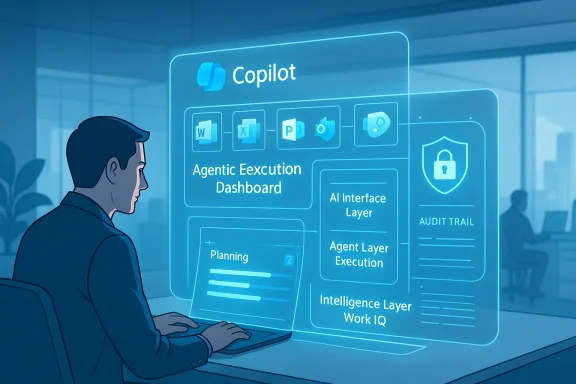
What makes the March 2026 announcements notable is not just the new capabilities, but the architecture underneath them. Microsoft is now describing three layers working together: the AI interface layer where users interact with Copilot, the agent layer where tasks are executed across apps, and the intelligence layer that ties together work data, memory, and inference. In Microsoft’s telling, this is how AI moves from suggestion to action while still remaining bounded by enterprise controls.
The competitive context matters, too. Microsoft is no longer behaving like a company that simply adds features to Office. It is positioning Microsoft 365 as the place where enterprise AI is operationalized, licensed, governed, and audited. That is a direct challenge to point solutions from startups and to rival productivity suites that still treat AI as a helpful overlay rather than a deeply managed runtime. (blogs.microsoft.com)
Microsoft also introduced Microsoft 365 E7, a higher-tier suite that bundles Microsoft 365 E5, Copilot, Agent 365, Entra Suite, and advanced Defender, Intune, and Purview capabilities. The pricing and bundling are strategically important because they turn AI adoption into a broader platform decision rather than a point purchase. In other words, Microsoft is selling not just intelligence, but the trust and control stack needed to deploy it broadly. (microsoft.com)
Finally, the company expanded model choice and app-native agents, including Anthropic models in Copilot surfaces and agent mode inside Office apps. That matters because it suggests Microsoft is no longer forcing enterprises to think in a single-model frame. Instead, the company is presenting itself as a neutral orchestrator that can route the right model to the right job. (microsoft.com)
At the top sits the AI interface layer, which is the familiar Copilot experience most users see. This is where people ask questions, draft content, summarize meetings, or invoke app-specific tasks. The significance is that Microsoft still wants Copilot to feel conversational and low-friction, because adoption usually starts with the interface people already understand.
The deepest layer is Work IQ, Microsoft’s intelligence layer for work context. Microsoft says it draws on emails, files, meetings, chats, memory, and organizational relationships to infer the next best action and to ground custom agents in enterprise permissions and policy. The implication is clear: context is the real moat, not raw model access. (microsoft.com)
It also creates a platform story that is harder for rivals to copy quickly. A competitor can launch a smart assistant, but it is far harder to replicate the combination of productivity apps, identity infrastructure, security tooling, and data governance already embedded in Microsoft’s commercial estate. That integrated base is a major advantage, even if the user experience still needs refinement. (microsoft.com)
The last part of the story is psychological: Microsoft is teaching buyers to think in systems, not features. That is a very Microsoft move. If successful, it makes AI adoption feel less like a tool purchase and more like an operating-model decision. (blogs.microsoft.com)
Microsoft is careful to frame that autonomy as permissioned and controllable. The company says work is observable, actions are transparent, progress can be reviewed or stopped, and everything runs inside Microsoft’s security, identity, and governance framework. That language is doing a lot of work: it reassures IT leaders that autonomy does not mean chaos.
Microsoft’s choice to collaborate with Anthropic is also telling. It suggests the company is willing to borrow the best agentic ideas from outside its own model ecosystem if they better fit the work model it wants to deliver. That is a pragmatic move, and it reflects a larger industry transition toward model pluralism rather than one-vendor loyalty.
There is another subtle implication: enterprise software increasingly needs to present progress, not just outputs. That sounds small, but it changes how teams supervise work. When an employee can inspect, redirect, or stop the agent midstream, AI becomes more like a junior operator than a black box.
The platform’s core promise is visibility. Organizations need to know which agents exist, what they can access, who created them, and whether they are acting within policy. Agent 365 addresses that by creating a unified inventory for both Microsoft-built and partner-built agents, including those registered through APIs. (microsoft.com)
The security framing is equally important. Microsoft says Agent 365 supports least privilege, sensitive data protection, threat detection, vulnerability management, audit trails, and security workflows in Defender and Purview. That means the company is attempting to extend its identity and security moat from users to agents. (microsoft.com)
Still, Microsoft’s advantage is obvious: it already sits inside the workflows it wants to govern. That is a powerful distribution edge, and it explains why the company is pushing the idea that AI management should live where identities, content, and collaboration already live. In enterprise software, proximity often wins. (microsoft.com)
That pricing is not accidental. Microsoft is positioning E7 as a simpler and more cost-effective way to deploy enterprise AI than buying the capabilities separately. In business terms, the company is collapsing the purchase decision from multiple products into one strategic commitment. That should improve attach rates and reduce procurement friction, especially in large organizations. (blogs.microsoft.com)
Microsoft also has a classic platform motive here: bundling protects the customer relationship. If organizations adopt E7 as the core AI and security stack, they are less likely to cherry-pick third-party copilots, standalone agent platforms, or independent governance tools. That is how bundles become ecosystems. (blogs.microsoft.com)
That prioritization makes sense. Enterprise customers pay for security, management, and breadth. Consumer users pay for convenience. Microsoft is trying to turn the former into a premium frontier suite and let the latter benefit from the trickle-down of that investment. (blogs.microsoft.com)
The idea is powerful because it transforms organizational memory into operational leverage. When the assistant understands who you collaborate with, what files matter, how your team works, and which patterns recur in your role, it can do more than answer questions. It can actively recommend actions and route requests to the right agent. (microsoft.com)
The business impact is substantial for custom agents as well. Microsoft says Work IQ can be used to ground agents securely in existing permissions, sensitivity labels, compliance controls, audit, logging, monitoring, and policy enforcement. That makes it much easier for enterprises to imagine creating agents that are both helpful and controlled. (microsoft.com)
There is also a product-design challenge. If Work IQ is too hidden, customers may not understand what it is doing. If it is too visible, it may feel intrusive. Microsoft will need to strike a balance between magic and explainability, because enterprise trust often depends on being able to see the logic behind automation. (microsoft.com)
This approach gives Microsoft strategic flexibility. It reduces dependence on a single vendor, broadens the technical range of the platform, and lets the company route workloads based on capability rather than allegiance. It also helps Microsoft present itself as the company that makes model diversity enterprise-safe. (microsoft.com)
The move also mirrors a broader enterprise trend: customers want optionality. Many organizations no longer want to bet all their AI workflows on one model family, one inference style, or one vendor roadmap. Microsoft is leaning into that reality rather than fighting it. (microsoft.com)
At the same time, model pluralism increases complexity. The more vendors and model paths a platform supports, the more security, compliance, and consistency work the customer must manage. Microsoft is trying to absorb that complexity on the customer’s behalf, but the long-term success of that promise remains to be proven. (microsoft.com)
Another concern is that Microsoft’s generosity toward model choice could introduce uneven behavior across apps and tasks. If one model excels at spreadsheets and another at slide generation, organizations may experience inconsistent outputs or governance expectations. The enterprise will want one control model even if it accepts many underlying models. (microsoft.com)
A second test will be adoption behavior. If CIOs and business leaders treat E7 as the default path for scaling AI, Microsoft’s strategy will accelerate quickly. If they prefer piecemeal deployments, third-party governance, or specialized agents, the company may still win the platform battle but lose some of the pricing power it is trying to establish. (blogs.microsoft.com)
Source: Cloud Wars Microsoft’s Frontier Transformation Strategy: How Copilot and AI Agents Will Redefine Enterprise Work
 Background
Microsoft’s Copilot story began as a familiar productivity tale: put a conversational assistant into the apps people already use, then gradually expand from simple text generation into analysis, search, and workflow support. Over the past several years, that vision has widened from an in-app helper into a broader platform thesis about how people and software should collaborate. The company now describes the destination as a Frontier Firm world, where organizations become human-led and agent-operated rather than merely AI-assisted. (microsoft.com)That shift has not happened in one leap. Microsoft first layered copilots into Word, Excel, PowerPoint, Outlook, Teams, and Copilot Chat, then introduced more structured automation through Agent Mode and app-specific agents. The next step was governance: if agents are going to act across email, documents, spreadsheets, and business applications, enterprises need inventory, control, auditability, and policy enforcement. That is the problem Agent 365 is designed to solve. (microsoft.com)
What makes the March 2026 announcements notable is not just the new capabilities, but the architecture underneath them. Microsoft is now describing three layers working together: the AI interface layer where users interact with Copilot, the agent layer where tasks are executed across apps, and the intelligence layer that ties together work data, memory, and inference. In Microsoft’s telling, this is how AI moves from suggestion to action while still remaining bounded by enterprise controls.
The competitive context matters, too. Microsoft is no longer behaving like a company that simply adds features to Office. It is positioning Microsoft 365 as the place where enterprise AI is operationalized, licensed, governed, and audited. That is a direct challenge to point solutions from startups and to rival productivity suites that still treat AI as a helpful overlay rather than a deeply managed runtime. (blogs.microsoft.com)
What changed in March 2026
The key announcement was the unveiling of Copilot Cowork, a multi-step, long-running agent experience built in close collaboration with Anthropic. Microsoft says it can break complex requests into steps, reason across tools and files, and carry work forward with visible progress and opportunities for the user to steer or stop it. That makes it qualitatively different from the one-shot prompt generation that defined the first generation of enterprise assistants.Microsoft also introduced Microsoft 365 E7, a higher-tier suite that bundles Microsoft 365 E5, Copilot, Agent 365, Entra Suite, and advanced Defender, Intune, and Purview capabilities. The pricing and bundling are strategically important because they turn AI adoption into a broader platform decision rather than a point purchase. In other words, Microsoft is selling not just intelligence, but the trust and control stack needed to deploy it broadly. (microsoft.com)
Finally, the company expanded model choice and app-native agents, including Anthropic models in Copilot surfaces and agent mode inside Office apps. That matters because it suggests Microsoft is no longer forcing enterprises to think in a single-model frame. Instead, the company is presenting itself as a neutral orchestrator that can route the right model to the right job. (microsoft.com)
The Three-Layer Frontier Stack
Microsoft’s framework is more than marketing language; it is an attempt to explain why its platform can support enterprise AI at scale. The company is effectively saying that enterprise work needs a stack where the interface, the execution layer, and the knowledge layer all reinforce one another. That is a useful framing because it shifts the debate from “Which model is best?” to “Which platform can safely run work end to end?”At the top sits the AI interface layer, which is the familiar Copilot experience most users see. This is where people ask questions, draft content, summarize meetings, or invoke app-specific tasks. The significance is that Microsoft still wants Copilot to feel conversational and low-friction, because adoption usually starts with the interface people already understand.
Interface is only the entry point
Below that is the agent layer, where the system stops merely answering and starts acting. This is the part that can coordinate actions across apps, follow a workflow, and keep working for minutes or hours. That is a material shift for enterprise software because it introduces a new expectation: software should not just produce artifacts, it should drive processes.The deepest layer is Work IQ, Microsoft’s intelligence layer for work context. Microsoft says it draws on emails, files, meetings, chats, memory, and organizational relationships to infer the next best action and to ground custom agents in enterprise permissions and policy. The implication is clear: context is the real moat, not raw model access. (microsoft.com)
- Interface handles the human conversation.
- Agents execute the process.
- Work IQ supplies the context and memory.
- Governance keeps the whole thing safe and observable.
- Licensing turns the stack into a sellable enterprise package. (microsoft.com)
Why the layering matters strategically
This architecture helps Microsoft defend against a common criticism of AI products: they are impressive in demos but weak in production. By making agent behavior observable and by connecting it to identity, data protection, and compliance layers, Microsoft is trying to reduce the adoption gap between experimentation and deployment. That is especially important in regulated industries, where trust is often the gating factor. (microsoft.com)It also creates a platform story that is harder for rivals to copy quickly. A competitor can launch a smart assistant, but it is far harder to replicate the combination of productivity apps, identity infrastructure, security tooling, and data governance already embedded in Microsoft’s commercial estate. That integrated base is a major advantage, even if the user experience still needs refinement. (microsoft.com)
The last part of the story is psychological: Microsoft is teaching buyers to think in systems, not features. That is a very Microsoft move. If successful, it makes AI adoption feel less like a tool purchase and more like an operating-model decision. (blogs.microsoft.com)
Copilot Cowork as the New Execution Engine
Copilot Cowork is the headline feature because it changes the meaning of Copilot itself. Instead of staying in the lane of “help me write this,” Microsoft is defining a system that can plan, execute, and return finished work across multiple apps. That makes Copilot feel less like a chat interface and more like an intelligent workbench with autonomy.Microsoft is careful to frame that autonomy as permissioned and controllable. The company says work is observable, actions are transparent, progress can be reviewed or stopped, and everything runs inside Microsoft’s security, identity, and governance framework. That language is doing a lot of work: it reassures IT leaders that autonomy does not mean chaos.
From drafting to doing
The practical significance is that Copilot Cowork can now be evaluated on workflow completion rather than content quality alone. That raises the bar. Enterprises will want to know whether the agent can reliably assemble a report, prepare a deck, reconcile source documents, or coordinate a task chain without introducing errors.Microsoft’s choice to collaborate with Anthropic is also telling. It suggests the company is willing to borrow the best agentic ideas from outside its own model ecosystem if they better fit the work model it wants to deliver. That is a pragmatic move, and it reflects a larger industry transition toward model pluralism rather than one-vendor loyalty.
- Long-running tasks matter more than single-turn prompts.
- User-visible progress improves trust and steerability.
- Multi-app orchestration is the real productivity unlock.
- Enterprise controls are essential if the agent can act on data.
- Anthropic partnership gives Microsoft a second engine for agentic work.
Why this is more than a product feature
Copilot Cowork is also a signal about where Microsoft thinks the value pool is moving. If AI can reliably execute business tasks, the winner will not just own the prompt box; it will own the workflow boundary, the security boundary, and the audit boundary. That is why Microsoft is pairing the agent with management and control rather than shipping it as a standalone novelty. (microsoft.com)There is another subtle implication: enterprise software increasingly needs to present progress, not just outputs. That sounds small, but it changes how teams supervise work. When an employee can inspect, redirect, or stop the agent midstream, AI becomes more like a junior operator than a black box.
Agent 365 and the Governance Problem
If Copilot Cowork is the flashy front end, Agent 365 is the bureaucratic backbone that makes the strategy viable. Microsoft describes it as the control plane for agents, with discovery, lifecycle management, logging, reporting, security controls, and IT-defined guardrails. That is a strong signal that Microsoft understands how quickly agent sprawl can become a security and compliance nightmare. (microsoft.com)The platform’s core promise is visibility. Organizations need to know which agents exist, what they can access, who created them, and whether they are acting within policy. Agent 365 addresses that by creating a unified inventory for both Microsoft-built and partner-built agents, including those registered through APIs. (microsoft.com)
Governance is now productized
That matters because most enterprises will not adopt agentic AI at scale until it can be governed like any other digital workforce. The old model of letting teams spin up automation in isolated tools is not sufficient when an agent can reach into mailboxes, documents, meetings, and business systems. Microsoft is turning governance into a product rather than leaving it as an integration headache. (microsoft.com)The security framing is equally important. Microsoft says Agent 365 supports least privilege, sensitive data protection, threat detection, vulnerability management, audit trails, and security workflows in Defender and Purview. That means the company is attempting to extend its identity and security moat from users to agents. (microsoft.com)
- Unified agent inventory
- Lifecycle management
- Audit trails and logging
- Least-privilege access
- Security-team visibility in existing workflows
- Governance for partner and Microsoft agents (microsoft.com)
The real enterprise question
The big question is whether Agent 365 becomes the default control layer for agentic work or just another Microsoft SKU. If it becomes the standard, Microsoft gains a crucial position in the emerging AI governance market. If not, enterprises may prefer third-party orchestration and observability stacks that sit above multiple AI vendors. (microsoft.com)Still, Microsoft’s advantage is obvious: it already sits inside the workflows it wants to govern. That is a powerful distribution edge, and it explains why the company is pushing the idea that AI management should live where identities, content, and collaboration already live. In enterprise software, proximity often wins. (microsoft.com)
Microsoft 365 E7 and the Commercial Logic
The introduction of Microsoft 365 E7 is the clearest sign that Microsoft believes frontier AI must be sold as a platform bundle, not as a list of optional add-ons. The suite packages Microsoft 365 E5, Copilot, Agent 365, Entra Suite, and advanced security capabilities into a single offer. Microsoft says it will be available for purchase on May 1, 2026 at $99 per user per month. (microsoft.com)That pricing is not accidental. Microsoft is positioning E7 as a simpler and more cost-effective way to deploy enterprise AI than buying the capabilities separately. In business terms, the company is collapsing the purchase decision from multiple products into one strategic commitment. That should improve attach rates and reduce procurement friction, especially in large organizations. (blogs.microsoft.com)
Bundling changes the buying conversation
For CIOs, the E7 bundle may feel attractive because it reduces stitching and integration burden. For CFOs, it may be harder because it shifts AI from an experimental spend to a larger recurring subscription commitment. That tension is likely to define many purchasing discussions over the next year. (blogs.microsoft.com)Microsoft also has a classic platform motive here: bundling protects the customer relationship. If organizations adopt E7 as the core AI and security stack, they are less likely to cherry-pick third-party copilots, standalone agent platforms, or independent governance tools. That is how bundles become ecosystems. (blogs.microsoft.com)
- Simplified procurement
- Broader platform lock-in
- Better economics than à la carte buying
- Easier upsell from E5
- Stronger tie between AI and security budgets
- More predictable enterprise adoption path (blogs.microsoft.com)
Enterprise vs. consumer implications
The enterprise impact is obvious: E7 is designed for organizations that need governance, compliance, and broad-scale deployment. Consumer users, by contrast, will mostly experience the indirect effects: better model quality, more agentic features in apps, and a broader AI brand identity for Microsoft 365. The company is clearly prioritizing the enterprise monetization path first. (microsoft.com)That prioritization makes sense. Enterprise customers pay for security, management, and breadth. Consumer users pay for convenience. Microsoft is trying to turn the former into a premium frontier suite and let the latter benefit from the trickle-down of that investment. (blogs.microsoft.com)
Work IQ and the Intelligence Layer
If Agent 365 is the control plane, Work IQ is the cognitive substrate. Microsoft says it combines work data, memory, and inference so Copilot can understand the user, the job, and the company. That means the platform is not merely retrieving documents; it is trying to infer patterns and next-best actions from how work actually happens. (microsoft.com)The idea is powerful because it transforms organizational memory into operational leverage. When the assistant understands who you collaborate with, what files matter, how your team works, and which patterns recur in your role, it can do more than answer questions. It can actively recommend actions and route requests to the right agent. (microsoft.com)
Context is the new moat
This is where Microsoft has a genuine strategic advantage. Its platform already sits in email, documents, calendars, chats, and identity systems. That means the company can build a richer work graph than point-product competitors that only see fragments of the enterprise. In AI, context is often more valuable than model size. (microsoft.com)The business impact is substantial for custom agents as well. Microsoft says Work IQ can be used to ground agents securely in existing permissions, sensitivity labels, compliance controls, audit, logging, monitoring, and policy enforcement. That makes it much easier for enterprises to imagine creating agents that are both helpful and controlled. (microsoft.com)
- Work data becomes machine-usable context.
- Memory captures user habits and preferences.
- Inference turns context into action.
- Custom agents inherit enterprise controls.
- The platform gets smarter the more it is used. (microsoft.com)
The risk of overreach
Still, Work IQ also raises privacy and governance questions. The more context a system absorbs, the more sensitive it becomes. Enterprises will need confidence that memory, inference, and permissions are operating exactly as promised, especially when agents are allowed to act on behalf of users. (microsoft.com)There is also a product-design challenge. If Work IQ is too hidden, customers may not understand what it is doing. If it is too visible, it may feel intrusive. Microsoft will need to strike a balance between magic and explainability, because enterprise trust often depends on being able to see the logic behind automation. (microsoft.com)
Model Pluralism and Microsoft’s Partnership Strategy
One of the most interesting aspects of the new Copilot wave is Microsoft’s willingness to embrace multiple model families, including Anthropic’s. That is a break from the older assumption that one flagship model relationship would dominate the platform. Instead, Microsoft is moving toward a best-model-for-the-task posture, which is more realistic in enterprise AI. (microsoft.com)This approach gives Microsoft strategic flexibility. It reduces dependence on a single vendor, broadens the technical range of the platform, and lets the company route workloads based on capability rather than allegiance. It also helps Microsoft present itself as the company that makes model diversity enterprise-safe. (microsoft.com)
Why Anthropic matters
Anthropic is not just a symbolic partner here. Microsoft says Copilot Cowork is built in close collaboration with Anthropic and that Claude models are now available in mainline Copilot Chat via the Frontier program. That means Anthropic’s technology is helping shape Microsoft’s most important agentic experiences, not just sitting in a side channel.The move also mirrors a broader enterprise trend: customers want optionality. Many organizations no longer want to bet all their AI workflows on one model family, one inference style, or one vendor roadmap. Microsoft is leaning into that reality rather than fighting it. (microsoft.com)
- Better task-specific model selection
- Less single-vendor risk
- Stronger enterprise appeal
- More competitive positioning vs. rival suites
- Higher perceived innovation velocity
- More complex governance requirements (microsoft.com)
Competitive implications for rivals
This is a problem for competitors because Microsoft can package model choice inside a familiar enterprise contract. Rivals may offer good models, but fewer can bundle them with identity, productivity apps, security, and governance in one commercial motion. That makes Microsoft’s platform unusually sticky. (blogs.microsoft.com)At the same time, model pluralism increases complexity. The more vendors and model paths a platform supports, the more security, compliance, and consistency work the customer must manage. Microsoft is trying to absorb that complexity on the customer’s behalf, but the long-term success of that promise remains to be proven. (microsoft.com)
Strengths and Opportunities
Microsoft’s Frontier strategy is strong because it is cohesive. The company is not shipping isolated demos; it is building a connected enterprise AI operating model where interface, workflow execution, data grounding, and governance reinforce each other. That gives customers a clearer path from pilot to production, which is where most AI initiatives either stall or succeed. (microsoft.com)- Clear platform story that links Copilot, agents, governance, and security.
- Enterprise-grade controls that address auditability and compliance from day one.
- Strong distribution through Microsoft 365, the most natural home for workplace AI.
- Model flexibility that reduces single-vendor dependence.
- Licensing leverage via E7 bundling and upsell paths.
- Context advantage through Work IQ and Microsoft’s deep work graph.
- Workflow automation depth that can cut across multiple Office and business apps. (blogs.microsoft.com)
Risks and Concerns
The biggest risk is that Microsoft is promising autonomy faster than enterprises are ready to trust it. Even with guardrails, agentic systems create concerns around hallucinations, permissions creep, mistaken actions, and invisible process drift. In a world where agents can run for hours, small errors can compound quickly. (microsoft.com)- Governance complexity may overwhelm smaller IT teams.
- Privacy concerns could rise as Work IQ absorbs more contextual data.
- Compliance friction may be significant in regulated industries.
- Pricing pressure could make E7 feel expensive for some buyers.
- Model diversity adds operational complexity if not managed carefully.
- User trust may lag behind product capability.
- Vendor concentration remains a concern when one company controls the workflow, identity, and security stack. (blogs.microsoft.com)
Another concern is that Microsoft’s generosity toward model choice could introduce uneven behavior across apps and tasks. If one model excels at spreadsheets and another at slide generation, organizations may experience inconsistent outputs or governance expectations. The enterprise will want one control model even if it accepts many underlying models. (microsoft.com)
Looking Ahead
The next phase will be about proof, not promise. Microsoft has already defined the architecture and the commercial package; now it has to demonstrate that Copilot Cowork, Agent 365, and Work IQ can deliver reliable gains in day-to-day enterprise operations. The most important test will be whether organizations see measurable productivity and governance benefits without creating new layers of operational risk. (microsoft.com)A second test will be adoption behavior. If CIOs and business leaders treat E7 as the default path for scaling AI, Microsoft’s strategy will accelerate quickly. If they prefer piecemeal deployments, third-party governance, or specialized agents, the company may still win the platform battle but lose some of the pricing power it is trying to establish. (blogs.microsoft.com)
What to watch next
- Whether Agent 365 becomes the de facto standard for enterprise agent governance.
- Whether Copilot Cowork proves reliable across long-running, multi-step tasks.
- Whether Work IQ generates meaningful context without triggering privacy backlash.
- Whether customers embrace Microsoft 365 E7 as a bundle or resist the price jump.
- Whether Anthropic-powered experiences become a durable competitive advantage inside Copilot. (microsoft.com)
Source: Cloud Wars Microsoft’s Frontier Transformation Strategy: How Copilot and AI Agents Will Redefine Enterprise Work
