
Microsoft made Copilot Cowork generally available worldwide on June 16, 2026, bringing its long-running, multi-tool workplace agent to Microsoft 365 Copilot customers with usage-based billing, admin-controlled rollout, Anthropic model support, and new cost-management controls after a three-month Frontier preview program. The launch is less a new chatbot than a boundary shift: Microsoft now wants organizations to delegate chunks of office work to software that can plan, act, and keep running. That is powerful, but it also drags AI governance out of the demo room and into budgets, audit logs, data boundaries, and help desk queues. Cowork’s arrival makes one thing plain: the next Microsoft 365 fight is not whether AI can write a paragraph, but whether enterprises will trust it to finish the work.
The original Copilot pitch was familiar enough: summarize this meeting, draft this email, turn this document into slides, explain this spreadsheet. Cowork is a more consequential proposition because it is framed around delegation rather than assistance. The user defines an outcome, and the agent is supposed to work across files, apps, context, models, and tools until it can return something closer to a completed deliverable.
That distinction matters. A chatbot answer is usually ephemeral, easy to discard, and cheap enough to hide inside a subscription. A long-running agentic task is different: it touches more data, consumes more compute, and creates artifacts that may become part of a business process. The more useful it becomes, the more it starts to resemble a junior employee with API access.
Microsoft’s own examples are chosen to make that point. Cowork is being positioned for batch-editing spreadsheets, comparing thousands of files across product versions, ranking stalled sales opportunities, generating flow charts, and handling repeatable work patterns that would previously have required human coordination. Those are not parlor tricks. They are the administrative glue that makes large organizations slow, expensive, and hard to automate cleanly.
The risk is that this is precisely where enterprise software failures become messy. If a model drafts a bad paragraph, someone rolls their eyes. If an agent misreads a spreadsheet, applies the wrong policy, or updates the wrong document set, IT needs logs, rollback, ownership, and a very clear answer to who authorized what. Cowork’s general availability is therefore not just a product milestone; it is Microsoft asking customers to accept a new operational category inside Microsoft 365.
That default-off posture is also a recognition that enterprise AI has entered its cost-and-control phase. The early Copilot conversation was dominated by productivity claims and license math. Cowork adds a metered layer on top of the Microsoft 365 Copilot subscription, with usage denominated in Copilot Credits and pay-as-you-go pricing at one cent per credit. For larger deployments, Microsoft is also offering prepaid capacity plans in exchange for discounting.
This is the part sysadmins and IT finance teams will immediately understand. A predictable per-user subscription is annoying but manageable. A long-running agent that can use models, retrieve context, call tools, and run for extended periods introduces a different kind of spend behavior. The cost is no longer just “How many users have Copilot?” but “What kind of work are those users delegating, and how much compute does that work burn?”
Microsoft is trying to head off the obvious objection with spending limits, scoped billing policies, usage reporting, alerts, and user-level task pricing. Those controls are necessary, but they also reveal the shape of the problem. Cowork is not free-floating magic in the cloud; it is a metered execution environment, and every automated workflow now has a cost profile.
This is where the product becomes culturally awkward. Microsoft 365 users are accustomed to thinking of Word, Excel, Outlook, and Teams as tools they use, not infrastructure they consume. Cowork asks organizations to treat knowledge work more like a cloud workload, where a “simple” request can hide expensive retrieval, reasoning, and orchestration behind the scenes.
For IT departments, this creates a new FinOps surface. A sales manager asking Cowork to analyze a pipeline might be doing valuable work, or might be generating an expensive pile of plausible but low-value analysis. A technical worker comparing thousands of files could save weeks, or accidentally normalize a habit of burning credits on tasks that still require heavy human validation. The admin console can show consumption; it cannot automatically decide whether the work was worth doing.
That is why Microsoft’s claim that Cowork can be cheaper than comparable Claude-based workflows should be treated as vendor positioning, not a universal truth. The comparison depends on task mix, model choice, connector behavior, runtime efficiency, and how carefully organizations shape usage. Some tasks will almost certainly be worth the spend. Others will be AI expense disguised as productivity experimentation.
The practical advice for enterprises is boring but unavoidable: pilot Cowork by role, not by enthusiasm. Legal operations, finance, engineering program management, sales operations, and support organizations may each have repeatable workflows where the savings are tangible. A broad, loosely governed rollout is more likely to produce a bill, a backlog of support questions, and a familiar round of “Copilot didn’t do what I meant” complaints.
That does not mean OpenAI has been displaced in Microsoft’s AI stack. It does mean Microsoft is increasingly presenting Copilot as a broker of models rather than a single-model product. In the abstract, that is good enterprise architecture. Different workloads have different cost, latency, reasoning, and compliance requirements, and a mature AI platform should be able to route work accordingly.
But model choice is also a hedge. It lets Microsoft compete on cost when frontier models are too expensive, lean on stronger reasoning models when tasks demand it, and eventually introduce its own lower-cost Cowork-specific model for everyday work. The promised Cowork 1 model is clearly aimed at making agentic work less financially exotic.
For customers, the model picker is useful only if it becomes governable. Enterprises do not merely want a drop-down menu of models; they want policy. They want to know which models can touch which data classes, which tasks can run on lower-cost models, which workflows require human approval, and how model changes affect reproducibility. If the same prompt can produce materially different results under different models, administrators need more than a marketing phrase about “frontier intelligence.”
The Anthropic integration also complicates Microsoft’s public story in a productive way. It acknowledges that no single AI vendor owns every capability customers need. For Windows and Microsoft 365 shops, that could be a healthy evolution: Copilot as a governed enterprise shell around multiple model providers. The danger is that the abstraction becomes too smooth, hiding important differences in behavior, reliability, and cost until something breaks.
That makes Scout the more provocative product, even if Cowork is the one now generally available. Scout belongs to Microsoft’s new “Autopilot” category, a class of agents that operate with their own identity, persist over time, and act under policies set by the user and organization. The pitch is that work no longer waits for a prompt. The agent notices coordination gaps, prepares materials, manages time, and flags risks before a human asks.
This is the old dream of personal productivity software made newly plausible by large language models and enterprise context. It is also the old nightmare of over-automated office software made newly consequential by access to calendars, files, chats, browsers, and commands. Windows users have lived through enough “helpful” background services to know that autonomy is only attractive when the user remains firmly in control.
Microsoft is trying to answer that with Entra identity, scoped credentials, Purview controls, sensitivity labels, auditability, and human approval for sensitive actions. Those are the right nouns. The question is whether they behave clearly enough for real administrators under real pressure. Nobody wants to learn how an always-on agent interprets policy during an incident response call.
The Cowork and Scout pairing shows Microsoft’s direction of travel. Chat is becoming the interface layer, but the product ambition is execution. The company is building toward a world where Windows, Edge, Microsoft 365, Graph, Entra, Purview, and Copilot form the substrate for agentic work. That is a larger platform play than adding AI buttons to Office.
The idea is straightforward: agents need live business context, not just stale document search. A procurement workflow might need information from an internal vendor system. A support workflow might need case data. A finance workflow might need line-of-business records that never belonged in SharePoint in the first place. Federated connectors are Microsoft’s answer to the enterprise reality that the truth is scattered.
They are also a new security boundary to manage. Every connector increases the blast radius of a misunderstood prompt, a badly scoped permission, or a poorly governed workflow. The more agentic Copilot becomes, the more connector design starts to look like application security rather than search configuration.
For admins, the right mental model is not “connect all the things.” It is “connect only what the agent has a legitimate need to reason over, and prove the access path.” That means testing with realistic user permissions, understanding what data is retrieved at query time, and watching how generated artifacts preserve or transform sensitivity labels. The convenience of unified context should not be allowed to outrun the discipline of data governance.
This is especially important in Microsoft 365 environments that already suffer from permission sprawl. If users have access to too much data, Copilot can make that overexposure more visible and more useful. Cowork adds a further twist: it may not merely surface sensitive information but incorporate it into completed work products.
From Microsoft’s perspective, this simplifies the commercial story. Copilot in the Office apps, Work IQ, prebuilt agents, custom agents, and now Cowork sit inside a more coherent paid stack. From a customer perspective, “simplifies” may feel like “paywalls.” Organizations that were experimenting at the edges now face a clearer decision: buy into the Copilot platform, or accept a more limited experience.
That shift is not surprising. Microsoft has spent enormous sums building and operating AI infrastructure, and the early era of broad subsidized access was never going to last indefinitely. What is changing is that the company is now forcing customers to separate casual AI curiosity from committed deployment.
The upside is administrative clarity. Procurement, licensing, and governance teams can align around a defined product tier. The downside is that Copilot’s most interesting features increasingly sit behind both per-user licensing and usage-based meters. For some organizations, that will make the business case sharper. For others, it will slow adoption because the cost model looks less like Office and more like Azure.
This is where Microsoft must be careful. The company’s greatest enterprise advantage is trust built through boring predictability: licenses, admin centers, support contracts, compliance controls, and a vast partner ecosystem. Agentic AI threatens that predictability with variable cost and probabilistic behavior. If Microsoft can tame both, Cowork becomes a credible enterprise platform. If it cannot, customers will treat it as another expensive feature to disable until someone proves the ROI.
Microsoft appears to understand this, which is why Cowork’s GA feature set emphasizes cost management, audit logs, eDiscovery, retention, sensitivity labels, insider risk management, and policy alignment. Those capabilities are not ornamental. They are the difference between “AI assistant” and “enterprise software.”
Still, availability is not the same as maturity. Admins will need to test how Cowork behaves when permissions are messy, files are mislabeled, connectors return partial data, browser use encounters blocked sites, or a task runs longer than expected. The important failures will not always be dramatic. They will be subtle: a plausible summary based on incomplete context, an overconfident recommendation, an artifact that looks polished but embeds the wrong assumption.
This is the uncomfortable truth of agentic systems. The better they are at producing finished-looking work, the more dangerous their mistakes become. A rough draft invites scrutiny. A formatted deliverable invites forwarding.
For WindowsForum’s IT pro readership, the operational playbook should begin with containment. Enable Cowork for a small group. Define allowed workflows. Set low spending caps at first. Require users to document where Cowork saved time and where it required correction. Treat the first month less like a productivity rollout and more like a controlled systems test.
The worst deployment pattern is familiar from every enterprise technology wave: open the floodgates, celebrate adoption metrics, discover hidden costs, then clamp down after a few ugly incidents. Cowork’s admin controls exist so customers do not have to repeat that cycle. The question is whether organizations will use them before the bill and the risk arrive.
A sensible early deployment would separate experimentation from production. Let a small group test exploratory uses, but designate only a few workflows as approved business processes. Tie those workflows to expected task cost, expected human review, data classes involved, and success criteria. If Cowork saves four hours but requires three hours of validation, the organization should know that before it scales the pattern.
Users also need training that goes beyond prompt tips. They need to understand that Cowork is not a person, not a system of record, and not a substitute for authorization. It is an execution layer that can be useful when bounded and risky when anthropomorphized. The language of “coworker” is clever marketing, but the governance model should remain stubbornly mechanical.
Microsoft’s challenge is that its product story pushes toward autonomy while its enterprise customers need accountability. The two can coexist, but only if every agentic action remains inspectable, attributable, reversible where possible, and financially visible.
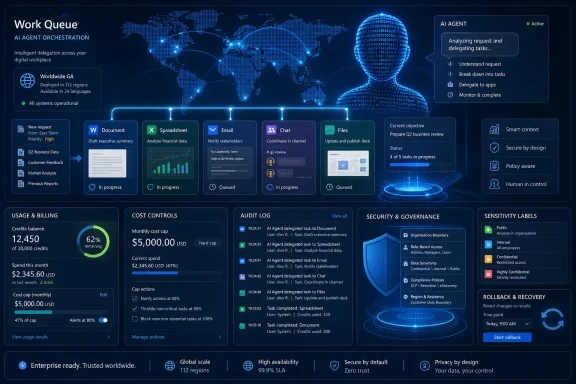 Microsoft Moves Copilot From Suggestion Box to Work Queue
The original Copilot pitch was familiar enough: summarize this meeting, draft this email, turn this document into slides, explain this spreadsheet. Cowork is a more consequential proposition because it is framed around delegation rather than assistance. The user defines an outcome, and the agent is supposed to work across files, apps, context, models, and tools until it can return something closer to a completed deliverable.That distinction matters. A chatbot answer is usually ephemeral, easy to discard, and cheap enough to hide inside a subscription. A long-running agentic task is different: it touches more data, consumes more compute, and creates artifacts that may become part of a business process. The more useful it becomes, the more it starts to resemble a junior employee with API access.
Microsoft’s own examples are chosen to make that point. Cowork is being positioned for batch-editing spreadsheets, comparing thousands of files across product versions, ranking stalled sales opportunities, generating flow charts, and handling repeatable work patterns that would previously have required human coordination. Those are not parlor tricks. They are the administrative glue that makes large organizations slow, expensive, and hard to automate cleanly.
The risk is that this is precisely where enterprise software failures become messy. If a model drafts a bad paragraph, someone rolls their eyes. If an agent misreads a spreadsheet, applies the wrong policy, or updates the wrong document set, IT needs logs, rollback, ownership, and a very clear answer to who authorized what. Cowork’s general availability is therefore not just a product milestone; it is Microsoft asking customers to accept a new operational category inside Microsoft 365.
The Off Switch Is Microsoft’s Quiet Admission of Risk
Cowork ships off by default, and that may be the most important administrative detail in the launch. Microsoft has spent the last several years embedding Copilot surfaces wherever knowledge workers already live, but an agent that executes multi-step work cannot be treated like another sidebar. It needs a tenant-level decision, not just user enthusiasm.That default-off posture is also a recognition that enterprise AI has entered its cost-and-control phase. The early Copilot conversation was dominated by productivity claims and license math. Cowork adds a metered layer on top of the Microsoft 365 Copilot subscription, with usage denominated in Copilot Credits and pay-as-you-go pricing at one cent per credit. For larger deployments, Microsoft is also offering prepaid capacity plans in exchange for discounting.
This is the part sysadmins and IT finance teams will immediately understand. A predictable per-user subscription is annoying but manageable. A long-running agent that can use models, retrieve context, call tools, and run for extended periods introduces a different kind of spend behavior. The cost is no longer just “How many users have Copilot?” but “What kind of work are those users delegating, and how much compute does that work burn?”
Microsoft is trying to head off the obvious objection with spending limits, scoped billing policies, usage reporting, alerts, and user-level task pricing. Those controls are necessary, but they also reveal the shape of the problem. Cowork is not free-floating magic in the cloud; it is a metered execution environment, and every automated workflow now has a cost profile.
Usage-Based AI Turns Productivity Into a Metered Utility
The most striking thing about Cowork’s pricing model is not the one-cent credit price. It is the way Microsoft describes the inputs: model use, context retrieval, tool calls, and runtime. That is cloud billing logic applied to office work.This is where the product becomes culturally awkward. Microsoft 365 users are accustomed to thinking of Word, Excel, Outlook, and Teams as tools they use, not infrastructure they consume. Cowork asks organizations to treat knowledge work more like a cloud workload, where a “simple” request can hide expensive retrieval, reasoning, and orchestration behind the scenes.
For IT departments, this creates a new FinOps surface. A sales manager asking Cowork to analyze a pipeline might be doing valuable work, or might be generating an expensive pile of plausible but low-value analysis. A technical worker comparing thousands of files could save weeks, or accidentally normalize a habit of burning credits on tasks that still require heavy human validation. The admin console can show consumption; it cannot automatically decide whether the work was worth doing.
That is why Microsoft’s claim that Cowork can be cheaper than comparable Claude-based workflows should be treated as vendor positioning, not a universal truth. The comparison depends on task mix, model choice, connector behavior, runtime efficiency, and how carefully organizations shape usage. Some tasks will almost certainly be worth the spend. Others will be AI expense disguised as productivity experimentation.
The practical advice for enterprises is boring but unavoidable: pilot Cowork by role, not by enthusiasm. Legal operations, finance, engineering program management, sales operations, and support organizations may each have repeatable workflows where the savings are tangible. A broad, loosely governed rollout is more likely to produce a bill, a backlog of support questions, and a familiar round of “Copilot didn’t do what I meant” complaints.
Anthropic Inside Microsoft 365 Is the Real Model-Choice Story
Cowork’s general availability also underlines a strategic shift that would have sounded strange earlier in the Copilot era: Microsoft is openly leaning on Anthropic models inside a flagship Microsoft 365 agent. At launch, Cowork runs on Anthropic models including Opus 4.8 and Sonnet 4.6, while additional model options are being tested through Microsoft’s Frontier channel.That does not mean OpenAI has been displaced in Microsoft’s AI stack. It does mean Microsoft is increasingly presenting Copilot as a broker of models rather than a single-model product. In the abstract, that is good enterprise architecture. Different workloads have different cost, latency, reasoning, and compliance requirements, and a mature AI platform should be able to route work accordingly.
But model choice is also a hedge. It lets Microsoft compete on cost when frontier models are too expensive, lean on stronger reasoning models when tasks demand it, and eventually introduce its own lower-cost Cowork-specific model for everyday work. The promised Cowork 1 model is clearly aimed at making agentic work less financially exotic.
For customers, the model picker is useful only if it becomes governable. Enterprises do not merely want a drop-down menu of models; they want policy. They want to know which models can touch which data classes, which tasks can run on lower-cost models, which workflows require human approval, and how model changes affect reproducibility. If the same prompt can produce materially different results under different models, administrators need more than a marketing phrase about “frontier intelligence.”
The Anthropic integration also complicates Microsoft’s public story in a productive way. It acknowledges that no single AI vendor owns every capability customers need. For Windows and Microsoft 365 shops, that could be a healthy evolution: Copilot as a governed enterprise shell around multiple model providers. The danger is that the abstraction becomes too smooth, hiding important differences in behavior, reliability, and cost until something breaks.
Scout Shows Where Microsoft Wants This to Go Next
Cowork is not launching in isolation. Microsoft’s Build 2026 messaging placed it alongside Scout, an always-on personal agent that works across cloud, desktop, web, Microsoft 365 apps, local resources, browsers, and model context protocol servers. If Cowork is the agent you deliberately assign a work package, Scout is the agent Microsoft wants humming in the background.That makes Scout the more provocative product, even if Cowork is the one now generally available. Scout belongs to Microsoft’s new “Autopilot” category, a class of agents that operate with their own identity, persist over time, and act under policies set by the user and organization. The pitch is that work no longer waits for a prompt. The agent notices coordination gaps, prepares materials, manages time, and flags risks before a human asks.
This is the old dream of personal productivity software made newly plausible by large language models and enterprise context. It is also the old nightmare of over-automated office software made newly consequential by access to calendars, files, chats, browsers, and commands. Windows users have lived through enough “helpful” background services to know that autonomy is only attractive when the user remains firmly in control.
Microsoft is trying to answer that with Entra identity, scoped credentials, Purview controls, sensitivity labels, auditability, and human approval for sensitive actions. Those are the right nouns. The question is whether they behave clearly enough for real administrators under real pressure. Nobody wants to learn how an always-on agent interprets policy during an incident response call.
The Cowork and Scout pairing shows Microsoft’s direction of travel. Chat is becoming the interface layer, but the product ambition is execution. The company is building toward a world where Windows, Edge, Microsoft 365, Graph, Entra, Purview, and Copilot form the substrate for agentic work. That is a larger platform play than adding AI buttons to Office.
Federated Connectors Pull the Enterprise Data Problem Into the Open
Agentic AI only becomes useful when it can see the right context. That is why federated connectors matter more than their dry name suggests. They allow organizations to connect Copilot to custom and third-party data sources without relying solely on pre-indexed content inside Microsoft Graph.The idea is straightforward: agents need live business context, not just stale document search. A procurement workflow might need information from an internal vendor system. A support workflow might need case data. A finance workflow might need line-of-business records that never belonged in SharePoint in the first place. Federated connectors are Microsoft’s answer to the enterprise reality that the truth is scattered.
They are also a new security boundary to manage. Every connector increases the blast radius of a misunderstood prompt, a badly scoped permission, or a poorly governed workflow. The more agentic Copilot becomes, the more connector design starts to look like application security rather than search configuration.
For admins, the right mental model is not “connect all the things.” It is “connect only what the agent has a legitimate need to reason over, and prove the access path.” That means testing with realistic user permissions, understanding what data is retrieved at query time, and watching how generated artifacts preserve or transform sensitivity labels. The convenience of unified context should not be allowed to outrun the discipline of data governance.
This is especially important in Microsoft 365 environments that already suffer from permission sprawl. If users have access to too much data, Copilot can make that overexposure more visible and more useful. Cowork adds a further twist: it may not merely surface sensitive information but incorporate it into completed work products.
Office Copilot Becomes a Paid Boundary, Not a Free Preview
Microsoft’s licensing changes around Copilot in Office apps fit the same pattern. Copilot features in Word, Excel, PowerPoint, and OneNote are being tied more tightly to the Microsoft 365 Copilot license, reducing the gray zone where some users with eligible business subscriptions could access pieces of the experience through Copilot Chat without the full paid add-on.From Microsoft’s perspective, this simplifies the commercial story. Copilot in the Office apps, Work IQ, prebuilt agents, custom agents, and now Cowork sit inside a more coherent paid stack. From a customer perspective, “simplifies” may feel like “paywalls.” Organizations that were experimenting at the edges now face a clearer decision: buy into the Copilot platform, or accept a more limited experience.
That shift is not surprising. Microsoft has spent enormous sums building and operating AI infrastructure, and the early era of broad subsidized access was never going to last indefinitely. What is changing is that the company is now forcing customers to separate casual AI curiosity from committed deployment.
The upside is administrative clarity. Procurement, licensing, and governance teams can align around a defined product tier. The downside is that Copilot’s most interesting features increasingly sit behind both per-user licensing and usage-based meters. For some organizations, that will make the business case sharper. For others, it will slow adoption because the cost model looks less like Office and more like Azure.
This is where Microsoft must be careful. The company’s greatest enterprise advantage is trust built through boring predictability: licenses, admin centers, support contracts, compliance controls, and a vast partner ecosystem. Agentic AI threatens that predictability with variable cost and probabilistic behavior. If Microsoft can tame both, Cowork becomes a credible enterprise platform. If it cannot, customers will treat it as another expensive feature to disable until someone proves the ROI.
Admins Will Judge Cowork by Logs, Caps, and Failure Modes
The audience most likely to determine Cowork’s fate is not the keynote crowd. It is the administrators, security teams, records managers, and department-level technology leads who will have to answer practical questions after the novelty wears off. What did Cowork access? Why did it choose that file? How much did that task cost? Did it inherit the right label? Can we reproduce the result? Can we stop users from running heavy tasks against the wrong data?Microsoft appears to understand this, which is why Cowork’s GA feature set emphasizes cost management, audit logs, eDiscovery, retention, sensitivity labels, insider risk management, and policy alignment. Those capabilities are not ornamental. They are the difference between “AI assistant” and “enterprise software.”
Still, availability is not the same as maturity. Admins will need to test how Cowork behaves when permissions are messy, files are mislabeled, connectors return partial data, browser use encounters blocked sites, or a task runs longer than expected. The important failures will not always be dramatic. They will be subtle: a plausible summary based on incomplete context, an overconfident recommendation, an artifact that looks polished but embeds the wrong assumption.
This is the uncomfortable truth of agentic systems. The better they are at producing finished-looking work, the more dangerous their mistakes become. A rough draft invites scrutiny. A formatted deliverable invites forwarding.
For WindowsForum’s IT pro readership, the operational playbook should begin with containment. Enable Cowork for a small group. Define allowed workflows. Set low spending caps at first. Require users to document where Cowork saved time and where it required correction. Treat the first month less like a productivity rollout and more like a controlled systems test.
The First Cowork Rollouts Should Be Narrow, Measured, and Slightly Paranoid
The organizations that get the most from Cowork will probably be those that resist the urge to turn it into a generic miracle worker. Agentic AI performs best when the work has structure, the inputs are discoverable, the output can be evaluated, and the cost of review is lower than the cost of doing everything manually. That narrows the early use cases, but it also makes success measurable.The worst deployment pattern is familiar from every enterprise technology wave: open the floodgates, celebrate adoption metrics, discover hidden costs, then clamp down after a few ugly incidents. Cowork’s admin controls exist so customers do not have to repeat that cycle. The question is whether organizations will use them before the bill and the risk arrive.
A sensible early deployment would separate experimentation from production. Let a small group test exploratory uses, but designate only a few workflows as approved business processes. Tie those workflows to expected task cost, expected human review, data classes involved, and success criteria. If Cowork saves four hours but requires three hours of validation, the organization should know that before it scales the pattern.
Users also need training that goes beyond prompt tips. They need to understand that Cowork is not a person, not a system of record, and not a substitute for authorization. It is an execution layer that can be useful when bounded and risky when anthropomorphized. The language of “coworker” is clever marketing, but the governance model should remain stubbornly mechanical.
Microsoft’s challenge is that its product story pushes toward autonomy while its enterprise customers need accountability. The two can coexist, but only if every agentic action remains inspectable, attributable, reversible where possible, and financially visible.
The Cowork Era Arrives With a Bill Attached
Cowork’s launch gives Microsoft 365 customers a concrete glimpse of where productivity software is heading, and it is neither pure hype nor pure horror. It is a capable but costly new layer of automation that deserves deliberate rollout rather than reflexive adoption.- Copilot Cowork is generally available worldwide for Microsoft 365 Copilot customers, but administrators must enable it before users can begin using it.
- The product is designed for long-running, multi-tool tasks that return completed work rather than simple chat responses or drafts.
- Cowork requires a Microsoft 365 Copilot license and adds usage-based billing through Copilot Credits, making cost governance central to deployment.
- Anthropic models power the general availability release, while Microsoft is positioning Cowork as a multi-model system with more cost-optimized options to come.
- Scout, federated connectors, and Office licensing changes show that Microsoft is turning Copilot from a feature set into a broader enterprise agent platform.
- The safest early deployments will be narrow, role-based, capped, audited, and measured against concrete workflow savings.
References
- Primary source: iNews Zoombangla
Published: 2026-06-26T18:48:08.583999
Microsoft Copilot Cowork General Availability Enterprise AI
Microsoft launches Copilot Cowork GA with agentic AI for multi-app workflows and integrates Claude AI as option.inews.zoombangla.com - Related coverage: itpro.com
Copilot Cowork is now generally available: Everything you need to know, including pricing, usage limits, and new features | IT Pro
Microsoft has announced that Copilot Cowork is now generally available for users globally, following a beta period via the tech giant’s Frontier program.www.itpro.com - Official source: microsoft.com
Copilot Cowork is now generally available | Microsoft 365 Blog
Copilot Cowork is now generally available worldwide, bringing secure, AI-powered automation for complex enterprise tasks in Microsoft 365.www.microsoft.com - Official source: news.microsoft.com
Copilot Cowork ya está disponible de forma general - Source EMEA
 news.microsoft.com
- Official source: learn.microsoft.com
Federated connectors overview - Microsoft 365 Copilot connectors | Microsoft Learn
Get an overview of MCP-based Microsoft 365 Copilot federated connectors.learn.microsoft.com - Official source: techcommunity.microsoft.com
Federated Copilot connectors - bringing real-time enterprise data within Microsoft 365 Copilot | Microsoft Community Hub
Announcing federated Copilot connectors. Bring real-time data within Copilot via connectors from partners like Moody's, HubSpot, LSEG (London Stock Exchange... techcommunity.microsoft.com
- Related coverage: softwareone.com
- Related coverage: aguidetocloud.com
What's New in Microsoft 365 Copilot: June 2026
June 2026 brought Build: Microsoft Scout, Copilot Cowork GA, Claude in Copilot Chat, Federated Connectors GA and Word edits by default — in plain English.www.aguidetocloud.com - Official source: directionsonmicrosoft.com
Microsoft’s Copilot Cowork Gets Model Choice Plus Usage-Based Billing - Directions on Microsoft
Microsoft’s Copilot 365’s Cowork feature, which is generally available worldwide as of June 16, will offer customers a choice of models and won’t be solely Anthropic-based as it is currently. Microsoft also is adding usage-based...www.directionsonmicrosoft.com - Related coverage: ad-hoc-news.de
Copilot Cowork: Microsoft startet KI-Agenten weltweit am 16. Juni
Microsoft startet Copilot Cowork und Planner Agent weltweit. Die neuen KI-Tools automatisieren komplexe Prozesse in Microsoft 365.www.ad-hoc-news.de - Related coverage: businesstechnavigator.com
Microsoft Copilot Cowork GA M365 2026: What IT Leaders Need to Know | Business Tech Navigator By Vatsal Shah
Microsoft Copilot Cowork reached GA on June 16, 2026. Autonomous multi-step workflows across Word, Excel, Teams, Outlook, and SharePoint are now live — but IT leaders face a governance gap that won't close until Q4 2026.businesstechnavigator.com - Related coverage: techradar.com
Microsoft makes Copilot Cowork open to everyone, and wants to help you tackle even the trickiest work tasks | TechRadar
Copilot Cowork gets an upgrade as it opens to all userswww.techradar.com - Related coverage: windowscentral.com
This is Microsoft's new "Copilot Cowork": An experiment with Anthropic's Claude AI models that plans and delegates your work | Windows Central
Microsoft ships Copilot Cowork to its Frontier program.www.windowscentral.com - Related coverage: axios.com
Microsoft explores DeepSeek for Copilot Cowork
Microsoft will also shift to usage-based pricing for the enterprise agent.www.axios.com
- Related coverage: tomsguide.com
Biggest Microsoft Build 2026 announcements — agentic AI, RTX Spark Dev Box, GitHub Copilot app, new MAI models, and more | Tom's Guide
All the big news from Microsoft's AI-focused eventwww.tomsguide.com - Related coverage: techxplore.com