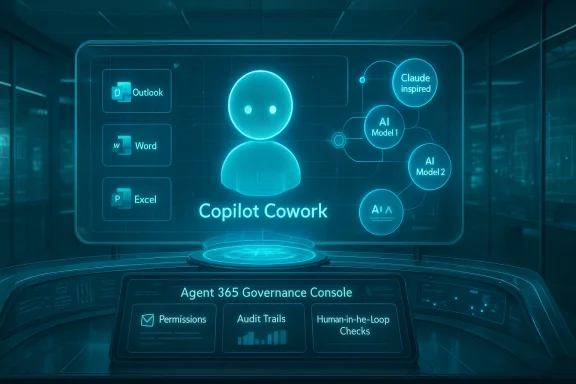
Microsoft’s pivot toward Anthropic — folding the Claude family and the company’s Cowork agent technology into the heart of Microsoft 365 Copilot — is neither a quiet product tweak nor a harmless branding exercise; it is a strategic reset with technical, commercial and governance implications that will reverberate across enterprise IT budgets, cloud contracts and the competitive map for years to come.
For the past three years Microsoft’s narrative around Copilot and the broader AI story has been dominated by a single partner: OpenAI. That partnership produced some of the flashiest consumer moments for Microsoft — from GPT-powered experiences in Bing to the integration of ChatGPT-derived models into Microsoft 365 — and it underpinned billions of dollars of cloud commitments and internal product engineering. But the landscape that produced those early wins has changed: Microsoft is now deliberately converting Copilot from a single‑vendor showcase into a multi‑model orchestration platform, and the marquee evidence of that conversion is Copilot Cowork — a Claude-powered, agentic assistant designed to plan, execute and return ford, Excel, PowerPoint, Outlook and Teams.
What changed practically overnight is twofold. First, Microsoft added Anthropic’s Claude models as selectable backends inside Microsoft 365 Copilot and Copilot Studio, allowing organizations to route specific tasks to the model best suited to them rather than being locked into a single provider. Second, Microsoft and Anthropic have layered an agentic capability — Cowork — into Copilot that moves the experience from “help me write” to “do it for me,” with long‑running, permissioned agents that can act across apps and return finished outputs. Both moves were framed by Microsoft as giviel choice and better governance; critics and wary IT leaders see them as a defensive pivot aimed at arresting Copilot’s market momentum problem.
In short: Microsoft has traded an increasingly brittle single‑vendor model for a more flexible, multi‑partner strategy that better matches how enterprises buy and operate software. Whether that strategy succeeds will depend on engineering follow‑through (safe agents, transparent governance), persuasive ROI narratives, and the economics of Azure capacity consumption. The next 12 months — early adopter case studies, Azure utilization trajectories and regulatory reactions — will determine whether this pivot is a masterstroke of strategic foresight or a costly hedging exercise in a high‑stakes industry pivot.
Conclusion: Copilot Cowork changes the conversation from “which assistant?” to “which workforce‑grade automation can we safely trust?” Microsoft has bought itself options and room to maneuver with Anthropic; now it must deliver the controls, telemetry and demonstrable business outcomes that turn those options into sustainable enterprise value.
Source: channelnews.com.au Microsoft Pivots to Anthropic as “Struggling” Copilot Fails to Dent ChatGPT Dominance - channelnews
 Background / Overview
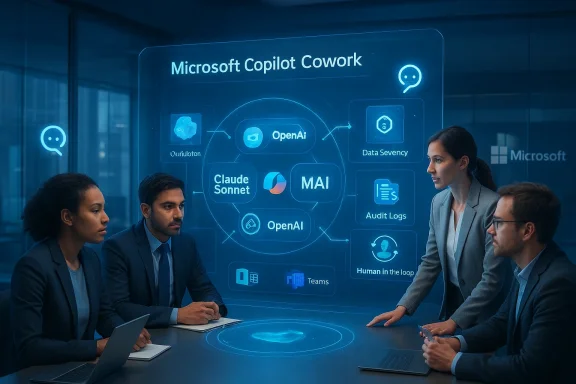
For the past three years Microsoft’s narrative around Copilot and the broader AI story has been dominated by a single partner: OpenAI. That partnership produced some of the flashiest consumer moments for Microsoft — from GPT-powered experiences in Bing to the integration of ChatGPT-derived models into Microsoft 365 — and it underpinned billions of dollars of cloud commitments and internal product engineering. But the landscape that produced those early wins has changed: Microsoft is now deliberately converting Copilot from a single‑vendor showcase into a multi‑model orchestration platform, and the marquee evidence of that conversion is Copilot Cowork — a Claude-powered, agentic assistant designed to plan, execute and return ford, Excel, PowerPoint, Outlook and Teams.What changed practically overnight is twofold. First, Microsoft added Anthropic’s Claude models as selectable backends inside Microsoft 365 Copilot and Copilot Studio, allowing organizations to route specific tasks to the model best suited to them rather than being locked into a single provider. Second, Microsoft and Anthropic have layered an agentic capability — Cowork — into Copilot that moves the experience from “help me write” to “do it for me,” with long‑running, permissioned agents that can act across apps and return finished outputs. Both moves were framed by Microsoft as giviel choice and better governance; critics and wary IT leaders see them as a defensive pivot aimed at arresting Copilot’s market momentum problem.
What Microsoft announced — the facts, verified
- Microsoft publicly announced the integration of Anthropic’s Claudet 365 Copilot and the rollout of Copilot Cowork as a research preview for select enterprise customers. This integration gives enterprises the ability to choose Claude Sonnet/Opus family models for selected workloads within the Copilot surface.
- As part of a separate but related set of commercial arrangements disclosed last year, Microsoft committed to invest up to $5 billion in Anthropic and Anthropic committed to purchase a very large amount of Azure compute capacity — widely reported at about $30 billion — as part of a broader strategic alliance that includes Nvidia participation. Both the Microsoft corporate blog and multiple industry outlets documented the investment and the compute commitment. These are company-level commitments that reshape where Anthropic will run major parts of its stack.
- Microsoft’s financial and strategic exposure to OpenAI was clarified in OpenAI’s October 2025 restructuring: after recapitalization Microsoft emerged with a roughly 27% stake in OpenAI’s newly formed for‑profit entity on an “as‑converted” basis, and had invested in the low‑to‑mid‑double‑digit billions into OpenAI over the lifetime of the partnership. Public reporting places Microsoft’s cumulative investment in OpenAI at roughly $13–14 billion, though roundings and the accounting basis used in various stories vary. Those numbers are drawn from company disclosures and multiple independent press reports.
- Parallel to Microsoft’s Anthropic move, OpenAI has broadened its commercial relationships and added significant cloud capacity deals with other hyperscalers; reporting shows OpenAI has struck large capacity commitments with AWS and announced multi‑dimensional commercial arrangements that increase the number of cloud partners it can call on. Microsoft’s reliance on OpenAI as the exclusive model supplier for Copilot is therefore demonstrably reduced.
Why this matters: strategic, product and competitive consequences
A deliberate move from vendor lock‑in to model choice
Microsoft’s Copilot has historically been synonymous with OpenAI-derived models. Turning Copilot into an orchestration layer that can host or route to models from Anthropic, OpenAI and Microsoft’s own MAI family (and, potentially, other vendors) is a strategic attempt to convert product lock‑in into an enterprise feature — model choice — that IT, compliance and procurement teams can use to tune cost, latency, performance or safety for different workloads. For large customers, the ability to route high‑risk, high‑sensitivity tasks to a model with stronger guardrails could be a persuasive argument for enterprise Copilot adoption.A commercial hedging strategy as much as a product bet
The Anthropic tie-up — including the reported $5 billion Microsoft stake and the multi‑billion‑dollar Azure commitment from Anthropic — reads like a hedge. Microsoft retains commercial options with OpenAI, but by betting on Anthropic and expanding its in-house model program (MAI), the company reduces single‑partner exposure to supply, pricing and IP risk. That matters in a market where hyperscalers and AI labs switch commercial partners and where model vendors are actively courting multiple cloud hosts. The compute and investment commitments also lock incremental revenue and capacity demand into Azure at a time when hyperscale cloud providers are competing for long‑term commitments.Product shift: from assistant to coworker
Copilot Cowork is not a ChatGPT plugin; it’s an agentic work engine that can orchestses, coordinate calendars, draft documents and assemble final deliverables autonomously within policy and permission boundaries. If it works as advertised, Copilot Cowork is a step change in the product proposition — moving the value proposition from “faster drafting” to “delegation at scale.” But the technical bar for safe, reliable agentic automation is much higher; it requires deterministic data access controls, rigorous provenance, and operational observability to prevent small errors cascading into business‑critical failures. Early rollouts are therefore appropriately cautious.Strengths of Microsoft’s new approach
- Enterprise alignment: Making model choice a first‑class feature and adding governance controls maps closely to how large customers actually buy and operate software. IT teams prize predictable SLAs, audit trails and the ability to enforce policies — all areas where Microsoft can add value on top of raw model capability.
- Cloud monetization: Anthropic’s multi‑billion‑dollar Azure commitment (if sustained) guarantees future demand for Azure compute, helping Microsoft amortize an enormous capital build‑out and reinforcing its incentives to co‑develop platform integration features. This creates a circular commercial logic for Redmond.
- Risk diversification: By adding Anthropic and expanding MAI, Microsoft reduces operational dependency on any single external model provnterparty risk and gives product teams more levers (cost, latency, safety) to match model choice to workloads.
- Agentic differentiation: Copilot Cowork’s promise — persistent, permissioned agents that complete real business work — addresses a real gap in current productivity tooling and could unlock measurable productivity gains if it proves reliable. This is a defensible, product‑level innovation that is hard for smaller vendors to replicate at scale.
Key risks and unresolved questions
1) Integration complexity and governance exposure
Adding multiple model backends to a single product surface dramatically increases the surface area for governance mistakes. Enterprises will demand clear provenance (which model handled what), data residency guarantees, and strong role‑based controls to prevent agent overreach. Microsoft’s ability to deliver safe agent governance across heterogeneous models will be the decisive factor in enterprise adoption. Early previews and Microsoft’s admonitions for permissioning are prudent, but the engineering and compliance work needed is nontrivial.2) Commercial and political tension inside the OpenAI relationship
Microsoft’s multi‑billion investment in OpenAI followed by the October 2025 recapitalization that left Microsoft with an as‑converted ~27% stake altered the practical contours of that relationship: Microsoft is both a major cloud provider and a significant equity holder in OpenAI. Broadening Copilot’s model set to include Anthropic signals a pragmatic rebalancing; it may also complicate governance of joint IP, commercial exclusivity and co‑development roadmaps with OpenAI. Those commercial frictions are manageable but politically sensitive.3) Financial optics and investor patience
Microsoft’s stock faced substantial volatility in early 2026 after investors reacted to surging AI‑driven capital expenditures and concerns about how quickly that spending converts to profit. Headlines noted double‑digit percentage declines year‑to‑date at various points this year, centering discussions on whether hyperscale AI spending will produce sufficiently rapid returns. Microsoft’s Anthropic bet increases short‑term capital allocation risk even while promising multi‑year monetization through Azure and seat‑licenses for Copilot E7. The market will watch adoption metrics closely.4) Security, update churn and IT friction
Microsoft’s frequent MS 365 security and feature updates have already frustrated some administrators, and the added complexity of agentic automation expands attack surface and raises concerns around inadvertent data exfiltration, privilege escalation or erroneous record changes. Real‑world enterprise deployments will surface edge cases quickly: Copilot agents operating with elevated privileges could make costly mistakes at scale. Microsoft must demonstrate robust runtime isolation and rollback capabilities. Evidence of administrator pain from earlier Copilot and update rollouts is already present in independent forum reporting and regulatory complaints.5) Adoption and user preference
Public reporting and independent usage studies have suggested that, despite deep integration into Windows and Microsoft 365, many users and organizations retain a preference for OpenAI’s ChatGPT interface for consumer‑grade conversational AI. Copilot’s conversion of that latent interest into paid adoption requires clear ROI, manageable pricing, and demonstrable improvements in day‑to‑day work outcomes. Microsoft’s strategy to bundle Copilot, Agent 365 and a new Microsoft 365 E7 tier is a sensible commercialization path, but adoption will require more than product announcements.Implementation realities: what IT leaders should evaluate now
Microsoft’s Copilot Cowork preview will reach a limited set of customers initially, but IT teams should begin evaluating architecture, governance and procurement questions now.- Inventory and mapping: catalog the workflows you want to automate and classify them by sensitivity (PHI/PII, financial close, legal outcomes). Not every workflow should be agentified.
- Model selection policy: define criteria for when a task should be routed to which model (cost, safety profile, latency, auditability). Copilot’s multi‑model capability only helps when the organization has policies that produce deterministic routing.
- Data handling and isolation: insist on model-level data residency, in‑flight encryption and documented data retention and deletion practices. Agents with access to mailboxes and files must be sandboxed and auditable.
- Fail‑safe and rollback: ensure agents operate with clearly defined human‑in‑the‑loop checkpoints and transaction boundaries; require automatic rollbacks for high‑risk changes.
- Cost governance: model choice and agent runtime carry variable compute costs. Centralize cost reporting and allocate chargebacks for agent usage.
Business model and pricing dynamics: the revenue puzzle
Microsoft’s Copilot monetization strategy is now more complex. The company is packaging agentic capabilities into a higher‑tier Microsoft 365 E7 bundle aimed at enterprises that want agent orchestration and governance. This bundling — combined with Anthropic’s Azure commitment — points to a dual monetization path:- Seat licensing and enterprise SKUs (recurring revenue from Microsoft 365 seat upgrades and add‑ons).
- Cloud consumption (large long‑term Azure commitments from Anthropic and higher inference/training consumption by customers routed through Azure).
Competitive landscape: how this reshuffles the board
- OpenAI remains the consumer and enterprise exemplar for general‑purpose conversational AI, and its cross‑cloud arrangements (including large capacity commitments with AWS) reduce single‑provider risk for the lab. Microsoft’s concession to multi‑model orchestration acknowledges that dynamic.
- Anthropic gains a distribution and enterprise governance moat: embedding Claude into Copilot and Windows surfaces gives Anthropic a massive enterprise endpoint presence that would be hard to replicate quickly, especially with the backing of a major cloud host.
- Hyperscalers and cloud providers will keep negotiating both compute and equity relationships with frontier model builders; these commercial entanglements create cyclic incentives that shape which models run where and at what margins. Microsoft’s bet on Anthropic is therefore both a product and an infrastructure play.
- Other productivity vendors (Google Workspace with Gemini, Amazon with Bedrock/AgentCore) will continue to push their own integrations. For enterprises the deciding factor will increasingly be the combination of model capability, governance, cloud economics and organizational risk tolerance.
What to watch next (short list)
- Adoption metrics: Microsoft must publish customer seat upgrades, Copilot E7 conversion rates and measurable time‑savings in early case studies. These will be leading indicators of whether Copilot Cowork converts trials into revenue.
- Provable safety wins: pilot customers must demonstrate that agentic workflows can be audited, reversed and monitored. Any high‑profile misrun will slow enterprise uptake.
- Cloud consumption realization: Anthropic’s Azure purchase commitments are meaningful only if capacity is actually consumed; watch Azure utilization and forward bookings disclosures.
- OpenAI commercial posture: OpenAI’s increasing multi‑cloud posture or further strategic ties with AWS will continue to shape Microsoft’s bargaining leverage.
- Regulatory and antitrust scrutiny: large cross‑ownership stakes, multi‑billion capacity commitments, and bundling of agentic features into core productivity suites increase the chances of regulatory attention in multiple jurisdictions.
Final assessment: pragmatic pivot, not a silver bullet
Microsoft’s move to integrate Anthropic and ship Copilot Cowork is a pragmatic, defensible pivot. It acknowledges market realities — the rise of multi‑model demand, the need for stronger governance, and the cloud economics of long‑term compute contracts. The partnership protects Microsoft on the infrastructure side and gives its product teams richer model options to serve enterprise needs. That said, the announcement is not a guaranteed fix for the deeper issues the company faces: converting product signals into durable paid adoption; ensuring agents operate safely at scale; and convincing investors that massive AI capex will yield attractive returns.In short: Microsoft has traded an increasingly brittle single‑vendor model for a more flexible, multi‑partner strategy that better matches how enterprises buy and operate software. Whether that strategy succeeds will depend on engineering follow‑through (safe agents, transparent governance), persuasive ROI narratives, and the economics of Azure capacity consumption. The next 12 months — early adopter case studies, Azure utilization trajectories and regulatory reactions — will determine whether this pivot is a masterstroke of strategic foresight or a costly hedging exercise in a high‑stakes industry pivot.
Quick checklist for IT decision makers evaluating Copilot Cowork today
- Confirm the model routing and audit logs you will need for compliance.
- Run a closed pilot with clearly defined rollback criteria for agent‑driven changes.
- Establish a cost allocation model for per‑user agent consumption.
- Insist on explicit data residency and deletion guarantees for model backends.
- Prepare governance playbooks that define human‑in‑the‑loop thresholds and escalation paths.
Conclusion: Copilot Cowork changes the conversation from “which assistant?” to “which workforce‑grade automation can we safely trust?” Microsoft has bought itself options and room to maneuver with Anthropic; now it must deliver the controls, telemetry and demonstrable business outcomes that turn those options into sustainable enterprise value.
Source: channelnews.com.au Microsoft Pivots to Anthropic as “Struggling” Copilot Fails to Dent ChatGPT Dominance - channelnews