

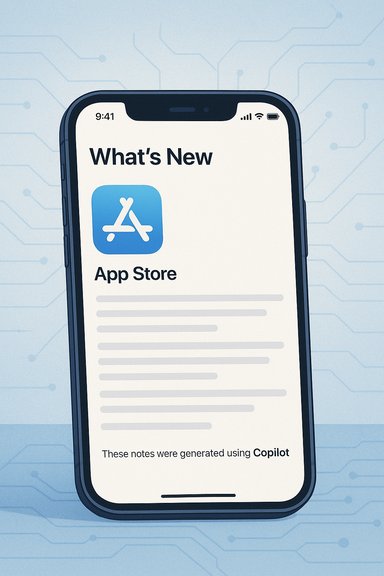
Microsoft quietly began stuffing a one-line Copilot credit into the What’s New / release-notes field of several iOS App Store listings, a low-friction visibility play that puts the Copilot brand in front of iPhone users without buying ads or changing app UI.
Microsoft has been aggressively pushing Copilot across product lines—integrating it into Windows, Edge, Office apps, and even TV platforms—and the company has for months been experimenting with putting Copilot-generated copy and AI-driven experiences into product touchpoints. Microsoft’s own Copilot release notes and product blogs show the company both publicizing Copilot features and using the assistant internally as part of its content workflow. What changed in December is not a technical feature but a marketing placement: several Microsoft iOS app listings now end their store changelog entries with a line such as “These notes were generated using Copilot,” a brief disclosure that doubles as a brand mention and — critically — appears on update cards that many users read when deciding whether to update an app. This was reported by multiple technology outlets after a reader or researcher noticed the line in Apple App Store listings for Microsoft apps.
The episode also exposes friction points in platform governance: Apple’s metadata rules already caution against misleading or promotional “What’s New” text, but their practical enforcement against factual AI disclosures is currently uneven. Meanwhile, the parallel controversy over Copilot appearing on TVs — sometimes with limited uninstall options — reminds us that distribution choices matter as much as messaging. Regulators, platform owners, and developer teams will need clearer standards for AI disclosure, installation controls, and the line between transparency and marketing in metadata.
Practical next steps for all parties are straightforward: users should verify and document unwanted installs; developers should use designated promotional fields where appropriate and clarify AI use; and Apple should publish clearer guidance on permissible AI‑generated metadata to avoid ad hoc outcomes. The Copilot line in the App Store is small, but it points to a much bigger conversation about how AI products are introduced to consumers — and who gets to decide where those introductions appear.
Source: Windows Report Microsoft Sneaks Copilot Promotions Into iOS App Store Release Notes
 Background
Microsoft has been aggressively pushing Copilot across product lines—integrating it into Windows, Edge, Office apps, and even TV platforms—and the company has for months been experimenting with putting Copilot-generated copy and AI-driven experiences into product touchpoints. Microsoft’s own Copilot release notes and product blogs show the company both publicizing Copilot features and using the assistant internally as part of its content workflow. What changed in December is not a technical feature but a marketing placement: several Microsoft iOS app listings now end their store changelog entries with a line such as “These notes were generated using Copilot,” a brief disclosure that doubles as a brand mention and — critically — appears on update cards that many users read when deciding whether to update an app. This was reported by multiple technology outlets after a reader or researcher noticed the line in Apple App Store listings for Microsoft apps. What exactly Microsoft did — a quick explainer
- Microsoft appended a short Copilot credit to the bottom of the App Store “What’s New” / version history text for some iOS apps.
- The line reads like a disclosure but functions as a subtle promotion: it signals that Microsoft uses Copilot and normalizes the name in a high-visibility place many users glance at when updating apps.
- Reports indicate the change has been present in some changelogs since mid‑May, suggesting it’s not a one-off experiment but a repeated practice for at least part of 2025.
Context: Microsoft’s recent Copilot marketing moves
Microsoft’s Copilot campaign has moved beyond in-app prompts and splash screens to platform-level placements and forced installs in some cases. Two notable threads give context to the App Store move:- Microsoft has been promoting Copilot features aggressively inside its apps and via the Microsoft 365 Copilot product channels, with numerous feature announcements, agent rollouts, and release notes that highlight Copilot capabilities.
- In parallel, user reports and forum threads show that Copilot has been added to some smart TV ecosystems (notably Samsung and reports for LG) as part of OEM partnerships. Several owners reported that a firmware update placed a Copilot tile or app on their LG TVs and that the item lacked a normal uninstall option — it could be hidden but not removed via the standard UI. Those reports, surfaced on community forums and independent technology blogs, sparked questions about preinstalled software, vendor control, and consumer choice.
Why the App Store placement matters
The App Store’s “What’s New” area is a unique user surface:- It appears every time a user checks an update or taps a version history entry, so it reaches active users at a moment of attention.
- It’s editable by developers without a new binary submission (in many cases), so placing a small line there is cheap and immediate.
- Apple’s store metadata is perceived as authoritative by many users; a mention there carries an implied legitimacy.
Are Microsoft’s App Store notes a disclosure or stealth marketing?
On its face the line is a disclosure — it states that the text was generated with Copilot — but the placement and consistency convert it into a brand signal. There are three ways to read it:- As a pure transparency move: telling users the copy was AI‑generated.
- As an internal operational note: documenting that teams used Copilot to save time.
- As a deliberate marketing nudge: using a neutral-feeling disclosure to advertise Copilot to a broad iOS audience.
Apple’s rules and the “What’s New” field — what the guidelines actually say
Apple enforces metadata accuracy and has specifically called out the “What’s New” text as a place that must accurately describe changes. The App Store Review Guidelines require that the “What’s New” field inform users about what changed in the update; generic or misleading text can trigger rejections under the guideline for Accurate Metadata (2.3.12). Apple has previously flagged developers for nondescriptive or promotional content in the “What’s New” area. Developer-facing documentation and historic review notes show that Apple expects the release-note text to describe app changes and not to be a marketing billboard. This is important because the Windows Report item asserted Apple’s rules don’t restrict such messaging; the record is not that black-and-white. Apple’s rules emphasize accurate and descriptive update notes and have historically rejected content that misuses that field. Whether a brief factual disclosure — “These notes were generated using Copilot” — violates that rule depends on Apple’s interpretation and enforcement choices. For now, Apple appears not to have forced removals of the line.Legal, ethical, and user-experience implications
Transparency vs. normalizing AI
Putting “generated using Copilot” in release notes reads as transparent on one level: it tells users an AI tool wrote the changelog copy. But transparency can also function as a brand nudge: repeated mentions normalize the product name and encourage users to try it. That dual nature raises tension between genuine disclosure and covert promotion.Platform policy and enforcement uncertainty
Apple’s metadata rules provide cover for developers who want to write accurate release notes. But the policy also bans using “What’s New” as pure marketing. The Copilot credit sits in a gray area: it is informational but also promotional. Enforcement discretion (or the lack of it) will determine whether other developers follow Microsoft’s lead and whether Apple reinterprets its rules.The bigger privacy and autonomy debate
The related reports of Copilot arriving on LG TVs — sometimes updated onto devices in a way users say left no uninstall option — underscore a larger consumer worry: when platform partners push AI assistants into device surfaces, users lose control over which software runs on their devices. Community investigations and forum reports documented that some LG webOS updates added Copilot tiles and that the standard uninstall option was missing, leaving owners to hide rather than remove the app. Those findings are sourced to user reports and community threads; the exact packaging (system app vs. removable app) was not always vendor-confirmed at publication, so the technical permanence of those installs required additional vendor or forensic confirmation.Regulatory risk
Repeated, platform‑level pushes to preinstall or make an assistant difficult to remove could draw regulator attention in consumer‑protection and competition reviews. Regulators in multiple jurisdictions have scrutinized preinstalled services and bundling in the past; adding an AI assistant to a device without a clear removal path could amplify those concerns.Why Microsoft might favor this approach
- Scalability: Editing store metadata is trivially scalable across apps and regions.
- Legitimacy: A disclosure inside App Store metadata implicitly benefits from Apple’s platform credibility.
- Low cost: The approach requires no ad budget or complex UX changes.
- Normalization: Repetition turns the Copilot name into a familiar product even among users who haven’t sought it out.
What Microsoft’s move reveals about corporate AI marketing
- AI brand building is moving into monotone, everyday text surfaces.
- Companies will use operational artefacts (release notes, changelog copy) as marketing channels when the overhead is low.
- The distinction between disclosure and promotion is blurring: a factual statement about AI usage doubles as brand placement.
Reactions and community signals
- Some users and journalists called the tactic clever and efficient; others described it as a “cheap” or cynical marketing trick that coopts a metadata field meant for practical change notes. Coverage by specialist sites noticed the pattern and questioned whether Apple would act.
- Community pushback around the TV installs has been stronger and more visceral: owners posted screenshots and complaints on Reddit and tech forums; independent blogs reported the inability to uninstall in practice, even if vendor confirmation about packaging details was not always available. That episode heightened skepticism about vendor‑pushed AI on consumer hardware.
Practical guidance for stakeholders
For users
- Read the “What’s New” text critically: a line stating AI generated the copy is informative but not indicative of deeper product changes.
- If a device or app receives software preloads (e.g., Copilot on a TV) and you don’t want them, check support forums and the vendor support site for removal/disable instructions, and document communications for potential complaints if the vendor declines to provide an uninstall path. Community posts have been useful for troubleshooting in real cases.
For developers and product teams
- Don’t treat the “What’s New” field as a marketing billboard. Apple’s metadata rules expect accurate descriptions of the update. Use the App Store’s Promotional Text field for marketing copy when appropriate; that field is designed for short promotional blurbs and has its own review expectations.
- If you use AI to generate release notes, consider adding context (e.g., “Notes generated using Copilot; edited by [team]”) to signal human oversight and guard against content errors.
For Apple and platform owners
- Clarify policy language around metadata marketing vs. disclosure. If Apple wants to allow factual AI‑use disclosures but prevent promotional abuse, guidance and enforcement examples would reduce ambiguity.
- Consider a standardized disclosure pattern for AI‑generated metadata — consistent phrasing and placement would help both users and reviewers.
Risks and unanswered questions
- Enforcement: Will Apple permit or restrict such disclosures at scale? The “What’s New” guideline exists to prevent misleading metadata, but its application to factual AI‑use disclosures is ambiguous.
- Intent: It’s impossible to fully prove whether Microsoft’s goal was primarily promotional; public evidence supports both transparency and brand‑building interpretations. That ambiguity invites scrutiny.
- Precedent: If other major developers adopt the same tactic, the Copilot credit could become a standard, further normalizing AI-generated copy and reducing the signal’s informational utility.
- Device-level installs: Reports that Copilot arrived as a non-removable TV component are strong on user testimony but lacked uniform vendor confirmations at the time of reporting. Independent technical verification (firmware analysis) would be required to categorically demonstrate that the install is system-level and cannot be removed. Reported behaviors are consistent across multiple threads, but they remain community-documented rather than universally vendor-certified.
Larger implications for AI disclosure and consumer trust
The Copilot-in-release-notes case sits at the crossroads of three trends:- Organizations using AI to create large volumes of product copy and content.
- Companies pushing AI assistants into previously non-AI device surfaces.
- Rising consumer sensitivity to preinstalled software and undisclosed data flows.
Conclusion
Microsoft’s insertion of a short Copilot credit into App Store release notes is a small tactical change with outsized signaling power: it’s cheap to deploy, visible to many iPhone users, and effective at naming and normalizing the Copilot brand. The move is defensible as transparency, contestable as stealth marketing, and emblematic of a larger AI-era contest over how and where AI is announced, promoted, and embedded.The episode also exposes friction points in platform governance: Apple’s metadata rules already caution against misleading or promotional “What’s New” text, but their practical enforcement against factual AI disclosures is currently uneven. Meanwhile, the parallel controversy over Copilot appearing on TVs — sometimes with limited uninstall options — reminds us that distribution choices matter as much as messaging. Regulators, platform owners, and developer teams will need clearer standards for AI disclosure, installation controls, and the line between transparency and marketing in metadata.
Practical next steps for all parties are straightforward: users should verify and document unwanted installs; developers should use designated promotional fields where appropriate and clarify AI use; and Apple should publish clearer guidance on permissible AI‑generated metadata to avoid ad hoc outcomes. The Copilot line in the App Store is small, but it points to a much bigger conversation about how AI products are introduced to consumers — and who gets to decide where those introductions appear.
Source: Windows Report Microsoft Sneaks Copilot Promotions Into iOS App Store Release Notes
