

Microsoft’s Copilot Critique feature is less a flashy add-on than a strategic signal: Microsoft is betting that the next phase of AI value will come from verification, not just generation. The uploaded Bitget article frames the move as a multi-model workflow in which one model drafts and another reviews for accuracy, sourcing, and completeness, while also tying it to broader enterprise adoption goals and a claimed benchmark lift. That framing is directionally plausible, but it also mixes product strategy, speculative architecture, and performance claims in a way that demands caution. The bigger story is not whether Microsoft has invented critique in AI; it is whether the company can turn trust, governance, and model orchestration into a durable workplace advantage.
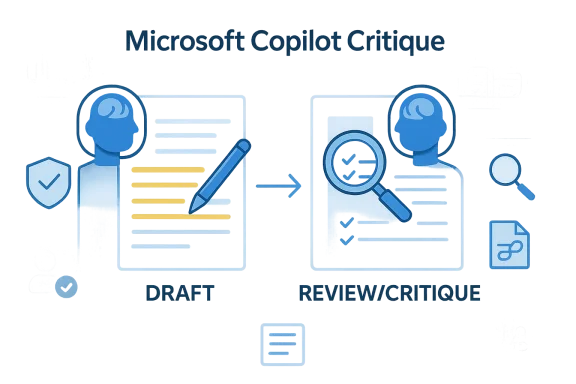
Microsoft’s Copilot strategy has clearly evolved beyond simple chat. The article in the uploaded file describes Critique as an infrastructure layer that uses one model to draft and another to review, with the long-term ambition of letting models critique each other in a closed loop. That is a meaningful shift from the old chatbot pitch, because it acknowledges the central flaw in generative AI for knowledge work: speed is easy, but confidence is hard.
That framing also fits Microsoft’s recent platform direction. The Copilot story in the file set repeatedly emphasizes multi-model orchestration, agent governance, and a push to make AI native to Microsoft 365 rather than a bolt-on assistant. In that context, Critique is not just a feature; it is a proof point for Microsoft’s broader effort to make Copilot the default surface for AI-enabled work inside the Microsoft ecosystem.
At the same time, the article’s tone is unmistakably promotional. It claims a 13.8% improvement on the DRACO benchmark, portrays Microsoft as ahead of rivals, and suggests a near-linear path from better critique systems to widespread adoption. Those claims may be useful as a thesis, but they should be treated as assertions, not settled facts, because the uploaded material does not independently verify the benchmark context, the comparison set, or the testing methodology.
That matters because Microsoft’s Copilot narrative has been running into real-world friction. The same file set repeatedly notes concern about adoption, reliability, privacy, and the gap between polished AI output and dependable enterprise utility. In other words, the company may be right that critique improves trust, but it still has to prove that trust at scale.
This approach created two simultaneous pressures. On one hand, Microsoft needed scale, because a platform strategy only works if AI feels native and unavoidable. On the other hand, the more Copilot was inserted into existing workflows, the more users and administrators pushed back against intrusiveness, confusion, and friction. The file set repeatedly reflects that tension, especially around whether Microsoft is adding useful capability or merely adding another AI surface.
That is why the move toward model diversity and agent governance is important. Rather than relying on a single model to do everything, Microsoft appears to be positioning Copilot as a managed orchestration layer that can combine models, review outputs, and route tasks to the best tool for the job. The uploaded materials describe Anthropic’s Claude being used in key Copilot surfaces and Microsoft introducing more structured control planes for enterprise agent use.
The critique concept also fits a broader industry pattern. As AI systems become more capable, the bottleneck shifts from raw generation to quality assurance. Enterprises do not just need text; they need evidence, traceability, and a way to reduce hallucinations without slowing work to a crawl. Microsoft is trying to solve that problem by turning verification into a product feature rather than a manual afterthought.
Finally, the file set suggests Microsoft is trying to transform Copilot from a helper into a workflow platform. References to “Copilot Cowork,” long-running tasks, and permissioned execution point to a much larger ambition: AI that can not only answer questions, but also manage processes, move through applications, and return finished work. Critique is a natural companion to that vision because the more autonomous the system becomes, the more important independent review becomes.
This is not merely a technical flourish. In knowledge work, the cost of a bad draft is usually not the draft itself; it is the time spent cleaning up, fact-checking, and rebuilding trust in the tool. If Critique reduces that cleanup burden, Microsoft can claim a genuine productivity gain rather than just a novelty feature.
Critique is meant to close that gap by making checking part of the workflow. But that also creates a subtle paradox: if a review model is just another probabilistic system, then it can also miss things, misread context, or reinforce errors from the first model. The benefit is real, but it is not magical. A second pass is better than no second pass, yet it is not the same as independent human judgment.
Still, sourcing is only as good as the underlying retrieval and the integrity of the source material. If the system cites weak, duplicated, or contaminated material, then the output may appear more rigorous than it really is. That is why enterprises will need to treat citations as a starting point for review, not proof of correctness.
Strategically, this is smart. If different models excel at drafting, reasoning, summarizing, or evaluating, then Microsoft can position itself as the router and governance layer that manages those strengths. In that world, Microsoft does not need to “own” the best frontier model in every category; it needs to own the workflow that chooses among them.
It also changes the competitive terrain. Rivals such as OpenAI, Google, Perplexity, and Anthropic can claim model excellence, but Microsoft can claim orchestration, distribution, and embedded enterprise reach. That combination is harder to copy than a single benchmark win. Platform gravity, not just model quality, becomes the battleground.
Microsoft’s challenge is to make the complexity invisible to the user. If the workflow feels seamless, the model stack underneath can be sophisticated. If the stack leaks through in the form of delays, odd outputs, or confusing policy boundaries, then the platform story weakens quickly.
That caution is important because AI benchmarks often reward narrow optimization more than real-world usefulness. A system can look better on paper while still failing on messy enterprise tasks, where source material is incomplete, terminology is inconsistent, and the goal changes midstream. In that environment, benchmark wins may predict direction, but they do not guarantee adoption.
That distinction matters because Microsoft’s Copilot business ultimately lives or dies on usage, not conference-slide performance. If Critique makes reports better but slows work enough to annoy users, the practical value may be lower than the benchmark implies. If it speeds confidence without adding friction, then the story becomes much stronger.
A more defensible conclusion is that Microsoft is trying to build a system-level advantage rather than a one-off feature advantage. In AI, that may be the only durable kind of edge: the company that can combine models, policy, distribution, and admin controls often wins more than the company with the flashiest demo.
But enterprise buyers will also notice the governance implications immediately. The file set repeatedly points to concerns about access control, permission sprawl, auditability, and the risk that autonomous or semi-autonomous systems will do the wrong thing with the right data. The more Copilot moves toward critique plus action, the more it inherits classic enterprise risk-management problems.
The consumer risk, however, is psychological. When a feature is marketed as a second set of eyes, users may assume it is more trustworthy than it really is. That illusion of safety can be dangerous, because people may stop checking the underlying facts just when they most need to.
It could also make Copilot feel more adult as a product. Instead of acting like a confident autocomplete engine, it would begin to resemble a research assistant that knows it needs supervision. That is a much healthier mental model for most users.
That is why education matters. Users need to understand that AI critique is a quality aid, not a guarantee. The product can reduce risk, but it cannot eliminate the obligation to think.
That distribution advantage changes the economics of competition. Rivals have to win attention, while Microsoft can win by default placement and workflow proximity. If Critique works well enough, it could become one more reason to stay inside the Microsoft stack rather than experimenting elsewhere.
Microsoft’s challenge is to avoid making Copilot feel like an enterprise committee product. If the feature stack becomes too complex, rivals can market simplicity. If it becomes too intrusive, rivals can market restraint. Microsoft needs the sweet spot where capability feels powerful but not noisy.
The file set also documents why skepticism is healthy. It references prior Copilot failures, concerns about benchmark validity, and examples where AI-generated work actually created extra cleanup for humans. Those are reminders that AI progress is rarely linear, and that product rhetoric often outruns operational reality.
That is why the most responsible reading of Critique is balanced. It is probably a genuine advancement in the sense that it addresses a real pain point. It is not yet proof that Microsoft has solved AI trust, or that multi-model orchestration automatically delivers superior real-world outcomes.
It will also matter whether Microsoft can keep balancing ambition and restraint. The file set suggests the company is simultaneously scaling toward agentic workflows while pulling back from overly intrusive AI placement in Windows. That is a healthy sign if it means Microsoft is learning where AI belongs, but it will only count if the product experience becomes cleaner rather than more confusing.
Source: Bitget Microsoft’s Copilot Critique Function: Genuine Advancement or Just AI Research Hype? | Bitget News
 Overview
Microsoft’s Copilot strategy has clearly evolved beyond simple chat. The article in the uploaded file describes Critique as an infrastructure layer that uses one model to draft and another to review, with the long-term ambition of letting models critique each other in a closed loop. That is a meaningful shift from the old chatbot pitch, because it acknowledges the central flaw in generative AI for knowledge work: speed is easy, but confidence is hard.That framing also fits Microsoft’s recent platform direction. The Copilot story in the file set repeatedly emphasizes multi-model orchestration, agent governance, and a push to make AI native to Microsoft 365 rather than a bolt-on assistant. In that context, Critique is not just a feature; it is a proof point for Microsoft’s broader effort to make Copilot the default surface for AI-enabled work inside the Microsoft ecosystem.
At the same time, the article’s tone is unmistakably promotional. It claims a 13.8% improvement on the DRACO benchmark, portrays Microsoft as ahead of rivals, and suggests a near-linear path from better critique systems to widespread adoption. Those claims may be useful as a thesis, but they should be treated as assertions, not settled facts, because the uploaded material does not independently verify the benchmark context, the comparison set, or the testing methodology.
That matters because Microsoft’s Copilot narrative has been running into real-world friction. The same file set repeatedly notes concern about adoption, reliability, privacy, and the gap between polished AI output and dependable enterprise utility. In other words, the company may be right that critique improves trust, but it still has to prove that trust at scale.
Background
To understand why Critique matters, it helps to remember what Microsoft has been trying to build since Copilot first emerged. The core idea has always been to embed generative AI into the tools people already use every day: Word, Excel, Outlook, Teams, Windows, and the broader Microsoft 365 estate. That makes Copilot less like a separate app and more like an operating layer for office work.This approach created two simultaneous pressures. On one hand, Microsoft needed scale, because a platform strategy only works if AI feels native and unavoidable. On the other hand, the more Copilot was inserted into existing workflows, the more users and administrators pushed back against intrusiveness, confusion, and friction. The file set repeatedly reflects that tension, especially around whether Microsoft is adding useful capability or merely adding another AI surface.
That is why the move toward model diversity and agent governance is important. Rather than relying on a single model to do everything, Microsoft appears to be positioning Copilot as a managed orchestration layer that can combine models, review outputs, and route tasks to the best tool for the job. The uploaded materials describe Anthropic’s Claude being used in key Copilot surfaces and Microsoft introducing more structured control planes for enterprise agent use.
The critique concept also fits a broader industry pattern. As AI systems become more capable, the bottleneck shifts from raw generation to quality assurance. Enterprises do not just need text; they need evidence, traceability, and a way to reduce hallucinations without slowing work to a crawl. Microsoft is trying to solve that problem by turning verification into a product feature rather than a manual afterthought.
Finally, the file set suggests Microsoft is trying to transform Copilot from a helper into a workflow platform. References to “Copilot Cowork,” long-running tasks, and permissioned execution point to a much larger ambition: AI that can not only answer questions, but also manage processes, move through applications, and return finished work. Critique is a natural companion to that vision because the more autonomous the system becomes, the more important independent review becomes.
Why this shift happened
- Generation alone is no longer a differentiator.
- Trust has become the real product moat.
- Enterprise buyers care about verification, not hype.
- Microsoft needs a reason to justify Copilot pricing.
- Multi-model systems offer flexibility single-model assistants lack.
What the Critique Feature Is Trying to Solve
The simplest reading of Critique is that Microsoft wants to create an AI review layer that makes Copilot outputs more reliable. The uploaded article says one model generates the draft while another model checks for accuracy, thoroughness, and sourcing. That is a practical answer to a very old AI problem: models can sound authoritative while still being wrong.This is not merely a technical flourish. In knowledge work, the cost of a bad draft is usually not the draft itself; it is the time spent cleaning up, fact-checking, and rebuilding trust in the tool. If Critique reduces that cleanup burden, Microsoft can claim a genuine productivity gain rather than just a novelty feature.
The trust gap in AI writing
There is a huge difference between “looks good” and “is correct.” The file set repeatedly warns that polished output can create overconfidence, especially when users stop checking source material. That is the hidden risk in all enterprise AI: the better the prose, the easier it is to assume the substance is right.Critique is meant to close that gap by making checking part of the workflow. But that also creates a subtle paradox: if a review model is just another probabilistic system, then it can also miss things, misread context, or reinforce errors from the first model. The benefit is real, but it is not magical. A second pass is better than no second pass, yet it is not the same as independent human judgment.
Why sourcing matters
One of the strongest claims in the article is that Critique will improve not only accuracy but also sourcing. That is important because enterprise users do not just want a final answer; they want a defensible answer. The ability to point to evidence, cite sources, or explain reasoning makes AI output easier to audit and easier to trust.Still, sourcing is only as good as the underlying retrieval and the integrity of the source material. If the system cites weak, duplicated, or contaminated material, then the output may appear more rigorous than it really is. That is why enterprises will need to treat citations as a starting point for review, not proof of correctness.
Multi-Model Orchestration as Strategy
The most interesting part of Microsoft’s direction is not the Critique idea alone, but the broader embrace of multi-model orchestration. The file set indicates that Microsoft has been opening Copilot surfaces to external models, especially Anthropic’s Claude family, and packaging the result as a more flexible enterprise platform. That is a major shift away from the old one-model-one-assistant model.Strategically, this is smart. If different models excel at drafting, reasoning, summarizing, or evaluating, then Microsoft can position itself as the router and governance layer that manages those strengths. In that world, Microsoft does not need to “own” the best frontier model in every category; it needs to own the workflow that chooses among them.
Why this is more than vendor flexibility
Multi-model support is not only about choice. It also gives Microsoft a way to reduce lock-in fears and blunt the argument that Copilot is merely a wrapper around a single provider. That is a meaningful competitive move because enterprise buyers increasingly ask whether AI platforms are durable or whether they depend too heavily on one vendor’s roadmap.It also changes the competitive terrain. Rivals such as OpenAI, Google, Perplexity, and Anthropic can claim model excellence, but Microsoft can claim orchestration, distribution, and embedded enterprise reach. That combination is harder to copy than a single benchmark win. Platform gravity, not just model quality, becomes the battleground.
The hidden trade-off
Of course, orchestration adds complexity. The more models and layers are involved, the more opportunities there are for latency, cost inflation, permission errors, and inconsistent behavior. Enterprises may love flexibility in theory, but they still want predictable performance in production.Microsoft’s challenge is to make the complexity invisible to the user. If the workflow feels seamless, the model stack underneath can be sophisticated. If the stack leaks through in the form of delays, odd outputs, or confusing policy boundaries, then the platform story weakens quickly.
The Benchmark Problem
The article leans heavily on a 13.8% DRACO benchmark improvement to argue that Critique is a material leap. That number is interesting, but any benchmark claim should be read with skepticism unless the benchmark’s design, dataset, and test conditions are transparent. The file set itself repeatedly warns about benchmark validity and the dangers of measuring AI on solved, published cases.That caution is important because AI benchmarks often reward narrow optimization more than real-world usefulness. A system can look better on paper while still failing on messy enterprise tasks, where source material is incomplete, terminology is inconsistent, and the goal changes midstream. In that environment, benchmark wins may predict direction, but they do not guarantee adoption.
What benchmark gains can and cannot tell us
A benchmark gain can show that a method works under controlled conditions. It can demonstrate that a new pipeline improves some measurable aspect of output quality. It cannot, by itself, prove that users will save time, reduce errors, or trust the tool more in day-to-day work.That distinction matters because Microsoft’s Copilot business ultimately lives or dies on usage, not conference-slide performance. If Critique makes reports better but slows work enough to annoy users, the practical value may be lower than the benchmark implies. If it speeds confidence without adding friction, then the story becomes much stronger.
Why the article may be overstating the edge
The Bitget piece implies that Microsoft is already ahead of major competitors because of this feature. That may be too aggressive. Competitors are also improving reasoning, retrieval, and agent workflows, and the field remains fluid enough that single-feature comparisons can age quickly.A more defensible conclusion is that Microsoft is trying to build a system-level advantage rather than a one-off feature advantage. In AI, that may be the only durable kind of edge: the company that can combine models, policy, distribution, and admin controls often wins more than the company with the flashiest demo.
Enterprise Impact
For enterprises, Critique could be genuinely useful if it reduces the amount of manual verification required for routine research tasks. That is especially relevant for analysts, consultants, legal teams, marketing teams, and internal comms staff who spend much of their day drafting, refining, and validating material. In those settings, a trustworthy first draft can save real time.But enterprise buyers will also notice the governance implications immediately. The file set repeatedly points to concerns about access control, permission sprawl, auditability, and the risk that autonomous or semi-autonomous systems will do the wrong thing with the right data. The more Copilot moves toward critique plus action, the more it inherits classic enterprise risk-management problems.
What IT teams will care about
- Who can enable Critique and where.
- What data the drafting model can access.
- What the review model is allowed to see.
- How outputs are logged, traced, and audited.
- Whether citations are reproducible and inspectable.
Consumer and Knowledge-Worker Impact
For individual users, the promise is easier to understand. Copilot that critiques itself sounds like Copilot that wastes less of your time. It could help with research briefs, email composition, meeting summaries, and document drafts where confidence matters more than creativity.The consumer risk, however, is psychological. When a feature is marketed as a second set of eyes, users may assume it is more trustworthy than it really is. That illusion of safety can be dangerous, because people may stop checking the underlying facts just when they most need to.
The practical upside
The upside is easy to see. If Critique reliably catches obvious errors, users can move faster and spend less time bouncing between the AI output and their own verification process. That is especially appealing in workplace settings where most tasks are not fully novel, but repetitive enough that small quality improvements compound.It could also make Copilot feel more adult as a product. Instead of acting like a confident autocomplete engine, it would begin to resemble a research assistant that knows it needs supervision. That is a much healthier mental model for most users.
The practical downside
The downside is that consumers may not distinguish critique from correctness. A polished answer with a “reviewed” feel can be more persuasive than a plain, imperfect answer. If Microsoft is not careful, the feature could increase confidence faster than it increases actual reliability.That is why education matters. Users need to understand that AI critique is a quality aid, not a guarantee. The product can reduce risk, but it cannot eliminate the obligation to think.
Competitive Implications
Microsoft’s real competitive advantage may be its distribution, not just its models. The file set emphasizes that Copilot sits inside Microsoft 365, where the work already happens. That gives Microsoft a built-in channel that standalone AI assistants do not have, and it makes adoption easier than forcing users to switch tools.That distribution advantage changes the economics of competition. Rivals have to win attention, while Microsoft can win by default placement and workflow proximity. If Critique works well enough, it could become one more reason to stay inside the Microsoft stack rather than experimenting elsewhere.
How rivals may respond
Competitors are unlikely to stand still. They may focus on simpler interfaces, stronger specialization, or faster single-model experiences that avoid orchestration overhead. They may also differentiate on transparency, speed, or more flexible consumer-facing experiences.Microsoft’s challenge is to avoid making Copilot feel like an enterprise committee product. If the feature stack becomes too complex, rivals can market simplicity. If it becomes too intrusive, rivals can market restraint. Microsoft needs the sweet spot where capability feels powerful but not noisy.
The Hype Problem
The uploaded article is strongest when it argues that Microsoft is aiming at the infrastructure layer of AI adoption. It is weakest when it slides into winner-takes-all language and treats a single feature as proof of broad platform superiority. That leap is exactly where AI coverage often becomes hype.The file set also documents why skepticism is healthy. It references prior Copilot failures, concerns about benchmark validity, and examples where AI-generated work actually created extra cleanup for humans. Those are reminders that AI progress is rarely linear, and that product rhetoric often outruns operational reality.
Why hype persists
Hype persists because the direction of travel is real even when individual claims are shaky. Microsoft is clearly building toward a more agentic, more plural, more governed Copilot stack. But the existence of a direction does not mean every announced milestone is equally important or equally proven. The difference between strategy and evidence still matters.That is why the most responsible reading of Critique is balanced. It is probably a genuine advancement in the sense that it addresses a real pain point. It is not yet proof that Microsoft has solved AI trust, or that multi-model orchestration automatically delivers superior real-world outcomes.
Strengths and Opportunities
Microsoft’s best opportunity is that Critique aligns neatly with what buyers actually want from workplace AI: less nonsense, more confidence, and less cleanup. If the feature is implemented well, it could make Copilot feel less like a novelty and more like a dependable part of everyday productivity. That would strengthen Microsoft’s pitch to both enterprises and individuals.- Better trust in AI outputs.
- Stronger enterprise differentiation.
- More defensible citation and review workflows.
- A practical answer to hallucination risk.
- A clear value story for knowledge workers.
- A route to deeper Microsoft 365 lock-in.
- A foundation for future agentic workflows.
Risks and Concerns
The risks are just as real. If Critique is marketed as a fix rather than a mitigation, Microsoft could deepen user overconfidence and create a false sense of security. The feature also adds complexity to an already crowded product story, and complexity often becomes the enemy of adoption.- Users may trust outputs too much.
- Benchmarks may not reflect real-world work.
- Multi-model routing can add latency and cost.
- Enterprise governance may lag product ambition.
- Security and permission boundaries may get messy.
- A polished system can still produce subtle errors.
- The feature could become hype without measurable ROI.
What to Watch Next
The next phase will be about proof, not promise. Watch for whether Microsoft expands Critique beyond a narrow preview into a broadly usable workflow and whether the company provides more detail on how model review, citations, and governance actually function. The most important signal will be whether enterprises report lower verification burden and faster completion times.It will also matter whether Microsoft can keep balancing ambition and restraint. The file set suggests the company is simultaneously scaling toward agentic workflows while pulling back from overly intrusive AI placement in Windows. That is a healthy sign if it means Microsoft is learning where AI belongs, but it will only count if the product experience becomes cleaner rather than more confusing.
- Whether Critique becomes a mainstream Copilot surface.
- Whether Microsoft discloses more on benchmark methodology.
- Whether enterprises measure real productivity gains.
- Whether multi-model workflows remain seamless.
- Whether user trust rises without complacency.
Source: Bitget Microsoft’s Copilot Critique Function: Genuine Advancement or Just AI Research Hype? | Bitget News
