

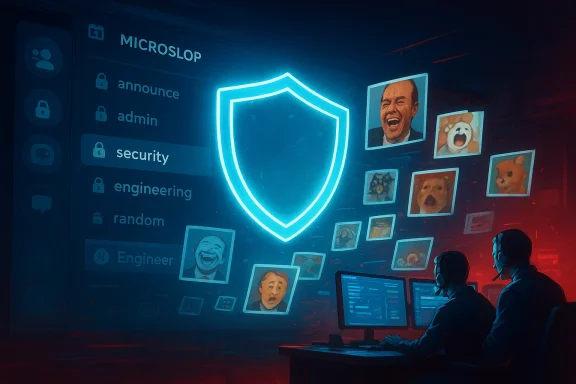
Microsoft’s attempt to silence a single meme word inside its official Copilot Discord erupted into a short, sharp PR crisis this week — a keyword filter that blocked the nickname “Microslop” prompted users to test, evade, and then flood the server, forcing moderators to restrict channels, hide message history, and temporarily lock the community while broader protections were deployed.
The word at the center of this incident — a portmanteau combining Microsoft and the pejorative slop — crystallized months of frustration among some users who feel the company has pushed AI features into Windows 11 and other products too aggressively. What began as a mocking nickname on social platforms migrated into the official Copilot Discord, where community members gather for product updates, troubleshooting, and discussion with Microsoft engineers and moderators.
Discord servers run by brands commonly use automated moderation to protect focused communities from spam, harassment, and off-topic content. In this case, moderators added Microslop to an automated keyword block. The block prevented messages containing that exact string from appearing publicly and presented the sender with an automated moderation notice instead. Once the presence of the filter was publicized, users began posting slightly altered forms of the nickname (for example replacing the letter “o” with a zero), and the activity quickly escalated into coordinated posting that overwhelmed server channels.
Microsoft’s team responded by tightening restrictions: posting permissions were disabled for many members, some channels were locked and message history was hidden, and the server was put into what moderators described internally as a containment mode while staff worked to restore normal service and implement more robust safeguards.
That explanation is plausible — automated bots and vegetable‑soup AI spam are genuine problems for public communities — but this event still exposed a credibility gap. When a corporation’s defensive measures coincide with suppression of a widely used pejorative, the optics are poor. Even if the intent was to stem harmful spam, the result read to many observers as thin-skinned censorship.
The lesson is simple: even defensible moderation choices require transparent explanation and visible proportionality if they are to be credible.
Key patterns in the reaction:
The takeaway for community operators is clear: defensive moderation must be smart, layered, and transparent. For product teams, the lesson is equally stark: the social context around feature rollouts matters. When users believe a company is imposing unwelcome changes, even small moderation choices can become large reputational flashpoints.
If companies want productive conversations in their official channels, they must earn them — through careful moderation design, timely explanations, and a willingness to take substantive product criticism on the merits rather than treating it as noise. Only by combining technical safeguards with genuine community engagement can brands protect spaces from disruption without amplifying the very dissent they hope to contain.
Source: Mezha Microsoft closes Discord chats due to spam and memes about Windows 11
 Background
The word at the center of this incident — a portmanteau combining Microsoft and the pejorative slop — crystallized months of frustration among some users who feel the company has pushed AI features into Windows 11 and other products too aggressively. What began as a mocking nickname on social platforms migrated into the official Copilot Discord, where community members gather for product updates, troubleshooting, and discussion with Microsoft engineers and moderators.Discord servers run by brands commonly use automated moderation to protect focused communities from spam, harassment, and off-topic content. In this case, moderators added Microslop to an automated keyword block. The block prevented messages containing that exact string from appearing publicly and presented the sender with an automated moderation notice instead. Once the presence of the filter was publicized, users began posting slightly altered forms of the nickname (for example replacing the letter “o” with a zero), and the activity quickly escalated into coordinated posting that overwhelmed server channels.
Microsoft’s team responded by tightening restrictions: posting permissions were disabled for many members, some channels were locked and message history was hidden, and the server was put into what moderators described internally as a containment mode while staff worked to restore normal service and implement more robust safeguards.
What actually happened — a short timeline
- Early March 2026: Moderators on the official Copilot Discord add a keyword filter that blocks the exact string Microslop.
- Within hours: Community members test the filter, post evaded variants (e.g., Microsl0p), and amplify the term across channels, intentionally and satirically.
- Soon after: Moderation escalates — posting is restricted for multiple users, recent message history is made invisible, and sections of the server are locked to slow the flood.
- Microsoft issues a statement to reporters characterizing the action as a temporary defensive measure against disruptive spam while stronger safeguards are implemented.
- Within a short window, posting restrictions were relaxed as the team adjusted defenses; the episode remains a visible flashpoint in broader conversations about Microsoft’s AI strategy and community governance.
Why a single blocked word spiraled into a crisis
The Streisand effect, memetics, and platform dynamics
Blocking a widely shared insult in a public forum is almost guaranteed to trigger interest. When a brand filters a term that mocks its products, two predictable dynamics emerge:- People test and intentionally evade filters. Simple keyword-based blocking is trivial to bypass using substitutions, homoglyphs, or minor edits. When users discover this, they quickly iterate.
- Attention spreads outside the community. Reporting or screenshotting the moderation action amplifies the joke. Once the broader internet knows an official channel is banning a term, the social value of posting it — for irony or protest — increases.
Keyword-only moderation is brittle
The incident highlights a core technical truth: simplistic keyword blacklists work until they don’t. Moderation systems that rely entirely on exact-string matching are:- Easy to circumvent with character substitutions.
- Prone to false positives and collateral damage when the keyword appears in legitimate contexts.
- Likely to trigger escalations rather than solutions if users perceive the rule as heavy-handed.
Microsoft’s public rationale and the credibility problem
Microsoft’s moderation team framed their actions as defensive: the Copilot Discord was being targeted by spammers and coordinated posts that degraded the community experience, so temporary filters and a short lockdown were necessary to protect users and the productive space.That explanation is plausible — automated bots and vegetable‑soup AI spam are genuine problems for public communities — but this event still exposed a credibility gap. When a corporation’s defensive measures coincide with suppression of a widely used pejorative, the optics are poor. Even if the intent was to stem harmful spam, the result read to many observers as thin-skinned censorship.
The lesson is simple: even defensible moderation choices require transparent explanation and visible proportionality if they are to be credible.
Community reaction: humor, anger, and cultural friction
User reaction was immediate and theatrical. Many members treated the filter as a challenge, deliberately posting variants to mock the measure. Others framed the move as emblematic of a broader corporate tone-deafness — evidence that product teams and community moderators were out of step with legitimate criticism about forced AI features in the OS.Key patterns in the reaction:
- Rapid creation of evasion variants and parody alternatives.
- Public discussion across other social platforms, increasing visibility.
- A mix of serious criticism (about product direction and opt-out controls) and light-hearted trolling.
Brand and PR analysis — why this matters for Microsoft and other tech companies
The Copilot Discord episode is not a product failure; it’s a reputational one. For a company actively positioning itself around AI integration, community sentiment and trust are strategic assets. Several risks emerge from this event:- Trust erosion. Perceived suppression of critical speech — even in a company-run channel — feeds narratives about corporate overreach, especially where users already resent intrusive product changes.
- Amplification of criticism. Heavy-handed moderation creates news cycles and memes that persist longer than the original complaint might have.
- Community alienation. Users who participate in product communities want to be heard. If they believe criticism is being filtered rather than addressed, they disengage or move to adversarial public channels.
Security and operational risks exposed by the incident
Beyond reputational implications, this event surfaces several real operational threats that community operators must plan for:- Automated, AI-generated spam: Mass-produced, contextually plausible messages can drown moderation queues and trigger manual interventions.
- Coordinated raids: Whether organic or organized, rapid surges of similar messages can exhaust rate limits and cause data-loss or moderation mistakes.
- Evasion techniques: Simple obfuscation (homoglyphs, substitution, insertion of punctuation) is a known, low-effort technique that defeats naive filters.
- Collateral damage: Keyword filters can hide legitimate conversation (for example, a user seeking help quoting the term), undermining community support objectives.
Practical recommendations for brand-run communities
If you run or advise a corporate community — especially one tied to a major product — adopt a layered, transparent approach to moderation. The following recommendations are pragmatic and implementable:- Use multi-factor defenses:
- Rate limits and temporary posting cooldowns for new or low-reputation accounts.
- Bot- and spam-detection models trained on behavioral signals, not just keywords.
- CAPTCHA challenges on suspicious activity spikes.
- Prefer contextual moderation over blunt keyword bans:
- Pattern detection (flooding behavior) is more robust than single-word blocking.
- Allow human reviewer oversight for borderline cases before broad enforcement.
- Maintain visible, clear rules and rationale:
- Post a short, accessible moderation policy in the server’s pinned channels explaining why temporary restrictions happen.
- When action is taken, provide a concise public rationale that focuses on safety and user experience, not legalese or marketing spin.
- Keep logs and an appeals process:
- Preserve audit trails of why accounts were restricted.
- Offer users a way to appeal moderation decisions and receive a timely explanation.
- Build community-native responses:
- Empower trusted community members with graduated moderation tools (trusted flags, slow-modes) so defenders are peers, not only corporate staff.
- Test filters in staging:
- Before applying heavy-handed filters in a public channel, trial them in a smaller test group to see how the community reacts.
What this says about Microsoft’s broader AI and Windows 11 strategy
This Discord incident is a symptom, not the disease. It highlights several longer-term questions about product strategy, user agency, and trust:- Perception of pushiness. Many users feel AI features have been pushed into Windows without sufficient opt-out or transparency. That perception creates fertile ground for ridicule and skepticism.
- Telemetry and performance concerns. Criticism of AI in operating systems often centers on resource use and background processing. A moderation flap compounds technical anxieties with cultural ones.
- Corporate communication gap. Users expect direct, plain-language responses to concerns. Technical fixes are necessary, but so is narrative repair.
Legal and ethical considerations
Running a private community does not equate to arbitrary speech suppression, but there are ethical constraints:- Corporate-run channels should balance rights to enforce community rules with obligations to avoid disproportionate suppression of dissenting voices.
- When moderation is defensive against genuine spam or abuse, companies must be able to demonstrate proportionality and non-discriminatory application.
- Transparency and appeal mechanisms reduce legal and reputational risk by showing a company acted for safety, not censorship.
How other brands can learn from this: a short blueprint
- Prepare: Establish layered moderation before crises emerge.
- Test: Simulate attacks in a closed environment to refine automated responses.
- Communicate: When action is taken, explain the what, why, and expected duration in plain language.
- Restore: Reopen community with a post-mortem and any promised remediation (e.g., enhanced anti‑spam filters, new moderator staffing).
- Learn: Publish a short, anonymized summary of lessons learned to regain trust.
The human element: moderators, engineers, and community managers
Behind every moderation decision are humans balancing competing priorities: community health, product perception, and operational capacity. This episode underlines the importance of:- Training moderators in escalation and de‑escalation techniques.
- Giving moderators rapid, technical support from engineers during an incident.
- Ensuring that moderation rules reflect product goals and community norms rather than short-term PR impulses.
Broader implications for online moderation and AI-era communities
The Copilot Discord incident sits at the intersection of two accelerating trends:- The democratization and weaponization of AI-generated content, which increases noise and lowers the cost of mass posting.
- The cultural sensitivity around AI deployments in core consumer products, which makes brand communities more likely to erupt when users feel ignored.
Conclusion
A blocked word and a few keystrokes escalated into a visible test of how a major technology company manages criticism, community safety, and reputation in the AI era. The immediate operational justification — stemming from spam and disruptive posting — is credible. But the episode also reveals how easily defensive moderation can be misread as censorship when the target is a mocking nickname tied to broader product anxieties.The takeaway for community operators is clear: defensive moderation must be smart, layered, and transparent. For product teams, the lesson is equally stark: the social context around feature rollouts matters. When users believe a company is imposing unwelcome changes, even small moderation choices can become large reputational flashpoints.
If companies want productive conversations in their official channels, they must earn them — through careful moderation design, timely explanations, and a willingness to take substantive product criticism on the merits rather than treating it as noise. Only by combining technical safeguards with genuine community engagement can brands protect spaces from disruption without amplifying the very dissent they hope to contain.
Source: Mezha Microsoft closes Discord chats due to spam and memes about Windows 11
