

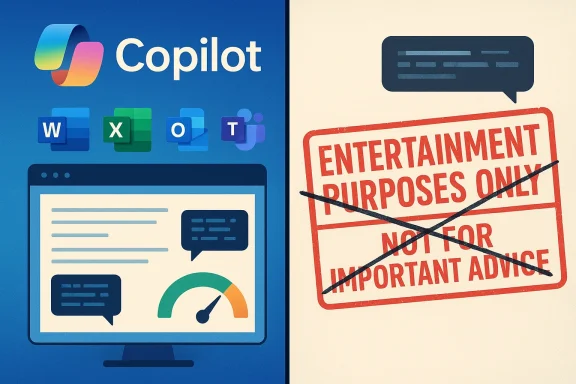
Microsoft’s latest Copilot disclaimer has landed with the kind of tone-deaf thud that only a company fully committed to AI can produce. After spending years telling users that Copilot belongs at the center of modern work, Microsoft’s own terms now say the consumer Copilot experience is for “entertainment purposes only” and should not be relied on for important advice. The result is a messaging collision: the product is being sold as a productivity layer inside Windows and Microsoft 365, while the legal language says, in effect, use it at your own risk.
That contradiction is more than a PR headache. It reveals how quickly the AI industry has moved from hype to liability management, and how companies are now trying to keep the upside of generative AI while insulating themselves from its failures. Microsoft did not suddenly discover that AI can be wrong; it has spent years warning that AI systems are probabilistic and fallible. What changed is that the disclaimer is now sitting right beside a product that Microsoft also promotes as a work tool across Word, Excel, Outlook, Teams, and business workflows.
Copilot did not appear in a vacuum. Microsoft has been building toward this moment since the early days of its partnership with OpenAI, first by embedding generative AI into Bing and Edge, then by expanding it into Microsoft 365, Windows, and enterprise services. In 2023, Microsoft framed Microsoft 365 Copilot as something that would “unlock productivity” inside the applications millions of people use every day, explicitly naming Word, Excel, Outlook, PowerPoint, and Teams as the places where AI would live.
That pitch was never subtle. Microsoft’s marketing has consistently positioned Copilot as an AI assistant for work, not a toy. Microsoft Learn today still describes Microsoft 365 Copilot as being paired with the productivity apps people use daily and grounded in organizational data and Microsoft Graph permissions. The company also markets Copilot Chat to business and enterprise customers as a tool that supports work content, web information, file uploads, IT controls, and enterprise-grade privacy and security.
At the same time, Microsoft has always wrapped its AI products in caution tape. Its support and transparency materials stress that AI-driven services are fallible and probabilistic, that users should not rely on outputs for regulated or high-stakes decisions, and that human judgment remains essential. The problem is not that Microsoft lacks cautionary language. The problem is that the cautionary language has now become impossible to ignore precisely because Copilot has been woven into so many places where users reasonably expect serious utility.
The new tension is therefore not technical; it is cultural and commercial. Microsoft wants Copilot to be ubiquitous, but ubiquity creates trust pressure. When a feature is built into everyday apps, users infer a degree of reliability that a standalone chatbot can more easily avoid promising. That is why a disclaimer that might seem routine in the context of a novelty app feels jarring inside Office, Outlook, and enterprise workflows.
That distinction matters because generative AI products have become part utility, part liability magnet. The more they touch finance, health, law, or workplace decisions, the more companies need disclaimers that say: we are not your advisor. Microsoft’s language is consistent with that trend, even if the optics are awkward. The awkwardness comes from the fact that Microsoft has also been the loudest voice insisting Copilot belongs inside serious work.
That wording is not unique to Microsoft. AI vendors routinely limit responsibility for output quality, and most try to avoid becoming de facto professional advisors. But Microsoft’s legal posture is unusually visible because Copilot is not merely an app people choose to open; it is often a persistent feature in products they already use for work. That makes the disclaimer feel less like a warning label on the box and more like a clause inserted after the product was already installed in the house.
That split is important. Microsoft appears to be separating a broad consumer AI companion from enterprise-grade Microsoft 365 Copilot, where the company can point to permissions, admin controls, and organizational guardrails. In practical terms, though, the line is not always intuitive for users, especially when the same Copilot branding spans both consumer and business contexts. The brand consistency is good for marketing, but bad for clarity.
That is not the language of entertainment. It is the language of a core workplace utility. So when the consumer terms say not to rely on Copilot for important advice, the obvious response is: then why is it in the middle of important work? The answer is that Microsoft is selling usefulness while disclaiming authority. That is a rational business move, but it is not a clean user experience.
For enterprise customers, this is manageable because organizations can train users, define workflows, and impose review steps. For consumers, it is harder. A home user asking Copilot to help with a budget, a school assignment, or a personal email may not be thinking in terms of model uncertainty. They are thinking in terms of convenience. That is exactly where disclaimer language becomes both necessary and, to many users, insulting.
That framework gives IT departments something to work with. They can deploy Copilot with policy controls, train staff, and define when human review is mandatory. In enterprise settings, AI is often treated as a drafting and summarization layer, not an autonomous decision-maker. That makes the disclaimer less inflammatory because it aligns with how mature organizations already think about risk.
This is also where platform power matters. A browser addon or optional chatbot can be ignored. A preinstalled assistant inside operating system and productivity software is harder to avoid. That means Microsoft has more responsibility, not less, to make the boundaries legible. The company can disclaim legal liability, but it cannot disclaim the UX consequences of making Copilot feel omnipresent.
The backlash is not really about whether disclaimers are reasonable. Most people understand that AI can hallucinate and that no company wants to be sued because a chatbot gave bad advice. The backlash is about the mismatch between promotion and protection. Users are being asked to accept the upside of AI integration while also absorbing a warning that implies they should mentally downgrade the system the moment it speaks.
There is also a broader fatigue around AI hype. After years of bold promises about transformation, users are becoming more sensitive to the gap between demos and dependable reality. When a company uses a tool to suggest automation and augmentation, but then adds a disclaimer that effectively says “we made no promises,” it invites skepticism about the entire category. That skepticism is now a market force.
Competitively, the move could cut both ways. On one hand, it reduces Microsoft’s legal risk and makes the product easier to ship broadly. On the other, it gives rivals an opening to claim they offer more trustworthy, better-scoped, or more task-specific AI experiences. In a crowded market, trust is a differentiator, especially when the underlying model quality is converging and the UX story becomes the battlefield.
This is also where model vendors, platform vendors, and app vendors diverge. A pure model vendor can argue it supplies infrastructure. A platform vendor like Microsoft is responsible for the user journey, the integration, and the defaults. Once AI becomes part of the operating system or productivity suite, trust is no longer only about model accuracy. It is about how the company frames the relationship between software and judgment.
There is a practical element here as well. If Copilot is embedded in Windows or Office, then even cautious users may still encounter it accidentally or in moments when they need fast help. That means the product can influence behavior before the warning is mentally activated. In other words, the software can shape the decision path before the legal disclaimer is ever read.
That tension becomes even sharper in productivity software, where users expect speed, context awareness, and reliability. If a tool is helping draft a report or summarize a meeting, people will naturally ask whether the response is good enough to use. Microsoft’s answer appears to be: yes, but only if you remain responsible for all the consequences. That is honest, but it is not reassuring.
The company may also be forced to make the user experience more self-explanatory. That could mean stronger prompts around verification, more visible boundaries around sensitive use cases, and better distinctions between drafting help and authoritative guidance. The long-term challenge is not merely legal compliance; it is making the product feel honest without making it feel useless. That balance is hard, but it is now central to AI product design.
Source: Digital Trends Microsoft spent years pushing Copilot, but now it says don’t rely on it
That contradiction is more than a PR headache. It reveals how quickly the AI industry has moved from hype to liability management, and how companies are now trying to keep the upside of generative AI while insulating themselves from its failures. Microsoft did not suddenly discover that AI can be wrong; it has spent years warning that AI systems are probabilistic and fallible. What changed is that the disclaimer is now sitting right beside a product that Microsoft also promotes as a work tool across Word, Excel, Outlook, Teams, and business workflows.
 Overview
Copilot did not appear in a vacuum. Microsoft has been building toward this moment since the early days of its partnership with OpenAI, first by embedding generative AI into Bing and Edge, then by expanding it into Microsoft 365, Windows, and enterprise services. In 2023, Microsoft framed Microsoft 365 Copilot as something that would “unlock productivity” inside the applications millions of people use every day, explicitly naming Word, Excel, Outlook, PowerPoint, and Teams as the places where AI would live.That pitch was never subtle. Microsoft’s marketing has consistently positioned Copilot as an AI assistant for work, not a toy. Microsoft Learn today still describes Microsoft 365 Copilot as being paired with the productivity apps people use daily and grounded in organizational data and Microsoft Graph permissions. The company also markets Copilot Chat to business and enterprise customers as a tool that supports work content, web information, file uploads, IT controls, and enterprise-grade privacy and security.
At the same time, Microsoft has always wrapped its AI products in caution tape. Its support and transparency materials stress that AI-driven services are fallible and probabilistic, that users should not rely on outputs for regulated or high-stakes decisions, and that human judgment remains essential. The problem is not that Microsoft lacks cautionary language. The problem is that the cautionary language has now become impossible to ignore precisely because Copilot has been woven into so many places where users reasonably expect serious utility.
The new tension is therefore not technical; it is cultural and commercial. Microsoft wants Copilot to be ubiquitous, but ubiquity creates trust pressure. When a feature is built into everyday apps, users infer a degree of reliability that a standalone chatbot can more easily avoid promising. That is why a disclaimer that might seem routine in the context of a novelty app feels jarring inside Office, Outlook, and enterprise workflows.
Why the disclaimer matters
The phrase “entertainment purposes only” is not just a legal hedge. It signals that Microsoft is deliberately narrowing the expectations around consumer Copilot, even while it expands the product’s footprint. For ordinary users, that may sound absurd when Copilot is summarizing email threads, suggesting spreadsheet formulas, or drafting documents. For lawyers, it is the kind of language that can reduce exposure when a system produces a bad answer and a user acts on it.That distinction matters because generative AI products have become part utility, part liability magnet. The more they touch finance, health, law, or workplace decisions, the more companies need disclaimers that say: we are not your advisor. Microsoft’s language is consistent with that trend, even if the optics are awkward. The awkwardness comes from the fact that Microsoft has also been the loudest voice insisting Copilot belongs inside serious work.
The Legal Fine Print
The strongest evidence that Microsoft is trying to draw a bright line appears in the Copilot Terms of Use themselves. In the current consumer terms, Microsoft says Copilot is for entertainment purposes only, can make mistakes, may not work as intended, and should not be relied on for important advice. The language also notes that users are responsible when they ask Copilot to take actions on their behalf.That wording is not unique to Microsoft. AI vendors routinely limit responsibility for output quality, and most try to avoid becoming de facto professional advisors. But Microsoft’s legal posture is unusually visible because Copilot is not merely an app people choose to open; it is often a persistent feature in products they already use for work. That makes the disclaimer feel less like a warning label on the box and more like a clause inserted after the product was already installed in the house.
Consumer Copilot versus work Copilot
The confusion also comes from the fact that Microsoft does not market every Copilot experience the same way. The consumer-facing Copilot terms read one way, while Microsoft 365 Copilot documentation and product pages speak in the language of productivity, business value, and organizational data. Microsoft even says Microsoft 365 Copilot can help with tasks such as summarizing meetings, drafting documents, and analyzing data in Word, Excel, Outlook, and Teams.That split is important. Microsoft appears to be separating a broad consumer AI companion from enterprise-grade Microsoft 365 Copilot, where the company can point to permissions, admin controls, and organizational guardrails. In practical terms, though, the line is not always intuitive for users, especially when the same Copilot branding spans both consumer and business contexts. The brand consistency is good for marketing, but bad for clarity.
A familiar strategy in the AI era
Microsoft is not alone in using disclaimers to manage the mismatch between capability claims and legal exposure. What makes this case stand out is the scale of the integration. A standalone chatbot can be dismissed as a curiosity; a chatbot embedded in Office becomes part of the digital workplace fabric. The disclaimer therefore reads less like a general caution and more like a reminder that Microsoft wants the benefits of AI adoption without promising perfection.- Microsoft’s legal language says Copilot is not a source of important advice.
- The same brand is used across consumer and enterprise offerings.
- The company continues to market Copilot as a productivity tool.
- The mismatch is partly a branding issue and partly a liability strategy.
- Users interpret embedded software differently from optional apps.
Product Positioning Versus Reality
Microsoft’s public messaging still leans heavily toward Copilot as a work accelerator. The Microsoft 365 learning center says users can learn how to use Copilot in Word, Excel, PowerPoint, OneDrive, Outlook, OneNote, and Designer. Microsoft Learn says Copilot in Word can generate, summarize, and edit documents, in Excel it can analyze data and create visualizations, and in Outlook it can manage email and calendar work more effectively.That is not the language of entertainment. It is the language of a core workplace utility. So when the consumer terms say not to rely on Copilot for important advice, the obvious response is: then why is it in the middle of important work? The answer is that Microsoft is selling usefulness while disclaiming authority. That is a rational business move, but it is not a clean user experience.
The trust gap
The trust gap grows when users see Copilot promoted as a time saver, then encounter it making obvious mistakes or overconfident suggestions. Microsoft’s own transparency materials acknowledge that AI outputs can be wrong and that even carefully tuned systems remain probabilistic. That admission is honest, but it also undercuts the premium aura surrounding the product.For enterprise customers, this is manageable because organizations can train users, define workflows, and impose review steps. For consumers, it is harder. A home user asking Copilot to help with a budget, a school assignment, or a personal email may not be thinking in terms of model uncertainty. They are thinking in terms of convenience. That is exactly where disclaimer language becomes both necessary and, to many users, insulting.
Why the word “entertainment” is explosive
The word “entertainment” is the real flashpoint. If Microsoft had said Copilot is “for informational purposes only” or “not a substitute for professional advice,” the reaction might have been muted. Calling it entertainment, however, suggests a lower tier of seriousness that sits uneasily beside the product’s real-world use cases. It also invites mockery because it sounds like a lawyer wrote it to survive a worst-case scenario, not a marketer to inspire confidence.- Productivity positioning depends on user trust.
- Legal disclaimers depend on limiting that trust.
- The two goals are now colliding in public.
- The word choice makes the message feel smaller than the product.
- Users can tolerate warnings; they resist being told their work tool is “just entertainment.”
Enterprise Versus Consumer Impact
The enterprise side of the story is more stable because Microsoft has spent years building governance narratives around Copilot for Microsoft 365. The company says Copilot Chat provides IT controls and enterprise-grade privacy and security, and that work content is grounded in permissions users already have. Microsoft also says business and enterprise customers can use Copilot in ways that inherit existing security and compliance requirements.That framework gives IT departments something to work with. They can deploy Copilot with policy controls, train staff, and define when human review is mandatory. In enterprise settings, AI is often treated as a drafting and summarization layer, not an autonomous decision-maker. That makes the disclaimer less inflammatory because it aligns with how mature organizations already think about risk.
Consumer expectations are different
Consumer expectations are more emotional and less procedural. If Copilot appears inside Windows, Edge, or a Microsoft account experience, many people interpret that as a default part of the platform, not a separate experimental tool. When Microsoft then says not to rely on it, the result is cognitive dissonance: the software is built into the workflow, but trust is suddenly being withdrawn at the exact moment of use.This is also where platform power matters. A browser addon or optional chatbot can be ignored. A preinstalled assistant inside operating system and productivity software is harder to avoid. That means Microsoft has more responsibility, not less, to make the boundaries legible. The company can disclaim legal liability, but it cannot disclaim the UX consequences of making Copilot feel omnipresent.
Risk segmentation
Microsoft is effectively trying to segment risk by audience. Enterprise customers get a story about governance, permissions, and value creation. Consumers get a story about convenience, creativity, and casual assistance, but with sharp warnings about relying on the output. That is a sensible business split, yet it also exposes the challenge of maintaining one brand across two very different trust models.- Enterprise users can absorb process-based safeguards.
- Consumers often expect product-level reliability.
- Copilot’s branding now spans both worlds.
- The disclaimer is easier to defend in enterprise than in consumer contexts.
- Microsoft is trying to scale AI adoption while keeping the legal blast radius small.
The Public Backlash
The online reaction was predictable because the contradiction is so easy to summarize in one sentence: Microsoft puts Copilot into everything, then tells users not to rely on it. That framing practically writes its own meme. And because Microsoft has invested so heavily in Copilot as the face of its AI strategy, any perceived retreat on trust becomes a reputational issue, not just a legal one.The backlash is not really about whether disclaimers are reasonable. Most people understand that AI can hallucinate and that no company wants to be sued because a chatbot gave bad advice. The backlash is about the mismatch between promotion and protection. Users are being asked to accept the upside of AI integration while also absorbing a warning that implies they should mentally downgrade the system the moment it speaks.
Why the ridicule sticks
Ridicule sticks because the criticism is fair. Microsoft has spent years encouraging people to use Copilot at work, to adopt it in Office, and to think of it as the next layer of productivity software. Then the fine print says not to rely on it for anything important. The disconnect is so sharp that even people who are not anti-AI can see the irony immediately.There is also a broader fatigue around AI hype. After years of bold promises about transformation, users are becoming more sensitive to the gap between demos and dependable reality. When a company uses a tool to suggest automation and augmentation, but then adds a disclaimer that effectively says “we made no promises,” it invites skepticism about the entire category. That skepticism is now a market force.
The messaging problem
Microsoft may think it is being transparent, but transparency can read like contradiction when the product surface is already saturated with marketing. The consumer Copilot experience is visually and strategically linked to Microsoft’s broader AI story, which means the disclaimer does not sit in isolation. It lands on top of a product narrative that has been loudly insisting on usefulness and permanence.- Users dislike being sold certainty and then handed uncertainty.
- The internet is especially unforgiving when a slogan sounds self-contradictory.
- Copilot’s visibility makes every disclaimer feel more dramatic.
- Microsoft’s marketing is doing one job while the legal text does another.
- The result is a trust wobble that rivals can exploit.
What This Means for the AI Market
Microsoft’s wording matters beyond Microsoft. If the largest software platform vendor in the market is telling users that its AI assistant is not dependable for important advice, that strengthens the case for stronger disclaimers across the industry. It also reinforces the idea that generative AI is still best understood as a co-pilot, not an autonomous expert. That may be obvious to engineers, but it is still being absorbed by mainstream users.Competitively, the move could cut both ways. On one hand, it reduces Microsoft’s legal risk and makes the product easier to ship broadly. On the other, it gives rivals an opening to claim they offer more trustworthy, better-scoped, or more task-specific AI experiences. In a crowded market, trust is a differentiator, especially when the underlying model quality is converging and the UX story becomes the battlefield.
The race to be “safe enough”
The AI market is increasingly a race to be safe enough for enterprise use and useful enough for consumers. Microsoft is trying to occupy both segments simultaneously. That is ambitious, but ambition comes with branding friction when the company needs one part of the market to see Copilot as indispensable and another part to see it as legally modest.This is also where model vendors, platform vendors, and app vendors diverge. A pure model vendor can argue it supplies infrastructure. A platform vendor like Microsoft is responsible for the user journey, the integration, and the defaults. Once AI becomes part of the operating system or productivity suite, trust is no longer only about model accuracy. It is about how the company frames the relationship between software and judgment.
Competitive implications
Rivals can now position themselves in one of two ways. They can either lean into stronger domain-specific guarantees, or they can use the same disclaimer-heavy language and hope users accept the tradeoff. The more Microsoft normalizes cautionary language, the more the industry may converge on a common reality: AI assistants are helpful, but they are never the authority.- Microsoft’s disclaimer may become an industry template.
- Trust, not just features, is a competitive moat.
- Platform vendors face more scrutiny than standalone AI apps.
- The safest messaging may be the least inspiring.
- Market leaders are discovering that ubiquity and caution do not always coexist gracefully.
The User Experience Problem
From a user-experience standpoint, the real issue is not the disclaimer itself. It is the fact that the disclaimer arrives after Microsoft has already normalized Copilot as part of the workflow. A warning label on a product you chose to buy feels different from a warning label on a feature you did not necessarily opt into. That difference matters because trust is partly built on consent.There is a practical element here as well. If Copilot is embedded in Windows or Office, then even cautious users may still encounter it accidentally or in moments when they need fast help. That means the product can influence behavior before the warning is mentally activated. In other words, the software can shape the decision path before the legal disclaimer is ever read.
Opt-in versus always-there AI
Optional tools are easier to forgive when they fail because users can treat them like experiments. Always-there tools are judged like infrastructure. Copilot has moved decisively toward the latter category, which is why Microsoft’s “entertainment” framing sounds so discordant. The product is behaving like infrastructure, while the contract is pretending it is a novelty.That tension becomes even sharper in productivity software, where users expect speed, context awareness, and reliability. If a tool is helping draft a report or summarize a meeting, people will naturally ask whether the response is good enough to use. Microsoft’s answer appears to be: yes, but only if you remain responsible for all the consequences. That is honest, but it is not reassuring.
The cost of ambiguity
Ambiguity has a cost. It slows adoption among cautious users and breeds overconfidence among less cautious ones. The most mature AI deployments will likely be the ones that make the line between assistance and authority painfully clear. Microsoft’s current Copilot branding does not always do that well, and the backlash suggests users are noticing.- Users want AI that is helpful, not hidden behind legalese.
- Embedded features create stronger expectations than standalone apps.
- The more frictionless the tool, the more consequential its mistakes.
- Ambiguity damages adoption as much as failure does.
- AI trust is now part of the interface design problem.
Strengths and Opportunities
Microsoft still has real advantages here, and the disclaimer should not obscure them. The company owns the platform, the productivity suite, and a massive installed base of users who already live in Microsoft’s ecosystem. If Microsoft can align the messaging more cleanly with product boundaries, Copilot could remain a major strategic asset rather than a recurring punchline.- Massive distribution across Windows, Microsoft 365, and enterprise services.
- Strong brand recognition that makes Copilot instantly discoverable.
- Deep workflow integration that rivals struggle to match.
- Enterprise permissions and security controls that support governed deployment.
- A growing library of training, transparency, and support material.
- Potential to turn AI from a chatbot into a workflow layer.
- A chance to define the market standard for responsible AI messaging.
Risks and Concerns
The downside is that Microsoft’s current positioning invites distrust from multiple directions at once. Skeptics see the disclaimer as proof that Copilot is not ready. Enthusiasts see it as legal cowardice. Enterprises see a branding issue. Consumers see a product that keeps showing up even after being told not to trust it.- The disclaimer may undermine product confidence.
- Users could misread the warning as proof of poor quality.
- Overly broad legal language may fuel public ridicule.
- Branding confusion can spill from consumer Copilot into Microsoft 365.
- Copilot’s ubiquity increases the consequences of a bad response.
- The company risks appearing to want the revenue of AI adoption without the accountability.
- Competitors can frame themselves as either more reliable or more specialized.
Looking Ahead
The next phase of this story is likely to be about refinement, not reversal. Microsoft is unlikely to remove Copilot from its products, and it is equally unlikely to abandon cautionary language. The more probable outcome is sharper segmentation: clearer consumer terms, tighter enterprise framing, and more explicit guidance about where Copilot fits into actual decision-making.The company may also be forced to make the user experience more self-explanatory. That could mean stronger prompts around verification, more visible boundaries around sensitive use cases, and better distinctions between drafting help and authoritative guidance. The long-term challenge is not merely legal compliance; it is making the product feel honest without making it feel useless. That balance is hard, but it is now central to AI product design.
Watch these developments
- Whether Microsoft revises the consumer Copilot wording in future terms updates.
- Whether Microsoft 365 Copilot gets more explicit trust indicators in-app.
- Whether enterprise messaging becomes even more separated from consumer branding.
- Whether rivals respond with more specific promises or the same disclaimers.
- Whether users begin treating Copilot more as a drafting aid than a decision tool.
Source: Digital Trends Microsoft spent years pushing Copilot, but now it says don’t rely on it
Last edited:
