

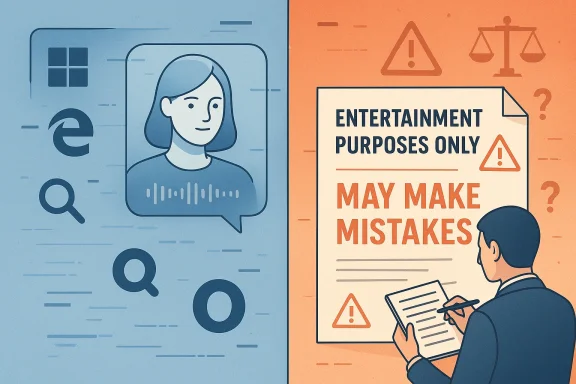
Microsoft’s latest Copilot terms are a jarring reminder that the company’s consumer AI push still sits somewhere between product promise and legal caution. In the current wording, Microsoft says Copilot is for entertainment purposes only, may make mistakes, and should not be relied on for important advice or decisions. That is a striking disclaimer for a tool the company has spent years marketing as an everyday AI companion across Windows, Bing, Edge, and Microsoft 365. (microsoft.com)
The tension is easy to see. Microsoft has invested heavily in making Copilot feel central to modern computing, from the early Bing Chat era to the unified Copilot brand that now spans consumer and enterprise experiences. Yet its current consumer terms still lean on language that sounds more like a warning label than a product slogan. That contrast matters because AI assistants are no longer novelty toys; they are increasingly used for work, shopping, research, and decision support. (blogs.microsoft.com)
This is not just a semantic issue. The legal framing reveals how Microsoft is managing risk while expanding the product’s scope. The company says Copilot may include advertising, may involve human review of data, makes no guarantees about performance, and should not be treated as a dependable source for important advice. In other words, Microsoft is asking users to enjoy the tool while also accepting that it is not a substitute for judgment, expertise, or verification. (microsoft.com)
The timing also adds intrigue. Root-Nation’s reporting points to an October 24, 2025 terms update that sharpened the disclaimer, while Microsoft’s broader product messaging has continued to describe Copilot as a helpful assistant and action-taking layer across consumer and business products. That divergence between marketing and legal language is not unusual in tech, but here it is unusually explicit. It suggests the company is still calibrating where Copilot belongs: as a productivity engine, a search companion, a creative toy, or some combination of all three.
What makes the story more interesting is that Microsoft’s own transparency materials are more nuanced than the headline disclaimer. In its support documentation, the company says users should review Copilot content before making decisions because AI can make mistakes, and it notes that generative systems are fallible and probabilistic. That is a more conventional AI safety position. The “entertainment purposes” wording, by contrast, feels intentionally blunt, almost overcorrective in tone. (support.microsoft.com)
That history matters because it explains the legal residue. If a service starts as a search experience with creative extras, the user expectation is fundamentally different from a medical advisor, legal assistant, or financial planner. Even as Copilot expanded into Windows, Edge, mobile apps, and Microsoft 365, the company never completely escaped the original “chatbot plus search” identity. The old framing still echoes through the current terms. (blogs.microsoft.com)
Microsoft has been careful to market Copilot as both ambitious and safe. The company says the assistant combines web context, work data, and device context, and it has repeatedly emphasized privacy and security alongside productivity. At the same time, its support materials warn that responses can be wrong and that AI systems are inherently probabilistic. This is the standard posture of a platform vendor trying to balance innovation with liability control. (blogs.microsoft.com)
There is also a competitive backdrop. Since late 2023, every major tech company has tried to turn its AI assistant into a daily habit. Microsoft’s own rollout of Copilot in Windows and Microsoft 365 put it in direct competition with OpenAI’s ChatGPT, Google’s Gemini ecosystem, and a growing list of task-specific copilots from Salesforce, Adobe, and others. In that environment, a cautious disclaimer can look like an awkward contradiction, but it can also be read as a defensive necessity. (blogs.microsoft.com)
That broader positioning creates a bigger trust problem. The more a product is presented as a companion, the more users may lean on it for decisions that feel routine but are actually consequential. Microsoft’s legal language appears designed to narrow that expectation before it becomes a liability headache. In that sense, the disclaimer is not a retreat from AI; it is an attempt to keep the company from overpromising. (microsoft.com)
That is where public perception becomes fragile. If Microsoft wants Copilot to help people plan launches, analyze documents, and act across workflows, the company cannot sound as if it believes the product belongs in the same category as a parlor trick. The mismatch may be temporary, but it is not trivial. It affects how users think about correctness, accountability, and whether Copilot can be trusted at all. (blogs.microsoft.com)
Microsoft’s transparency note softens that stance somewhat by focusing on practical caution instead of legal theater. It encourages users to review content before acting on it, and it reminds them that AI-driven services are fallible and probabilistic. That is the kind of wording one expects from a company trying to educate users about model limitations, not from one describing its own product as entertainment. (support.microsoft.com)
Still, the legal framing matters because consumers increasingly rely on assistants for tasks that feel low-risk but may have hidden costs. Planning travel, drafting workplace messages, summarizing policies, or making purchase comparisons may seem harmless, yet even small errors can cascade. Microsoft seems to know that, which is why the terms push responsibility back to the user. (microsoft.com)
That warning has enterprise implications as well as consumer ones. Businesses may welcome AI support for drafting and summarization, but many will balk if the legal and data-processing model is too opaque. Microsoft’s stance suggests it wants Copilot to be flexible enough for broad consumer use while still keeping enough guardrails to satisfy compliance-minded organizations. (microsoft.com)
Consumer users may shrug off the language as lawyerly overkill, especially if they mainly use Copilot for brainstorming or casual tasks. Enterprise buyers, however, will read it through a compliance lens. If Microsoft says not to rely on Copilot for important advice in consumer terms, CIOs and legal teams will want to know what the equivalent confidence level is in business workflows. (microsoft.com)
Microsoft has already moved in that direction by emphasizing commercial data protection, file access controls, and Microsoft 365 integration. Those are not marketing flourishes; they are the kinds of assurances enterprise buyers need. But a broad disclaimer in the consumer terms can still spill over into perception, especially when the same brand covers both product lines.
At the same time, blunt honesty may build trust in a different way. Users may appreciate a company that says, in effect, “This is powerful, but it is not gospel.” That kind of candor can be more credible than inflated confidence. Microsoft may be betting that some skepticism is better than overpromising and getting blamed later. (support.microsoft.com)
That tension is especially pronounced in search. Microsoft spent years trying to reshape search into a conversational experience, and Copilot Search in Bing reflects that ambition. But search engines are supposed to retrieve and organize information, not authoritatively decide matters on behalf of the user. The disclaimer is a reminder that Microsoft still does not want responsibility for the final judgment.
Of course, the reality is more complicated. All major AI systems make mistakes, and all of them rely on extensive legal disclaimers. But perception matters, especially in consumer software. A single phrase like “entertainment purposes only” can become a shorthand for the entire trust debate, whether or not it reflects the full engineering picture. (microsoft.com)
This is why the disclaimer feels so symbolically loaded. It hints at a deeper product ambiguity: if Copilot can explain, summarize, create, and act, what is the acceptable standard for reliability? Microsoft appears to be answering that question conservatively in legal text, even while pushing the product into more ambitious territory elsewhere. (microsoft.com)
That risk is magnified when Copilot is asked to help with high-stakes tasks. Users may try it for health, finance, legal, or employment-related questions simply because it is convenient and fluent. Microsoft’s warning language is therefore not just defensive; it is a liability shield against exactly this kind of overconfidence. (microsoft.com)
This is where public education becomes critical. If users understand that Copilot is a drafting and discovery tool, not a final authority, the system can be valuable without becoming dangerous. But if marketing and experience design blur that line too much, the burden shifts onto users to detect errors they may not know how to spot. (microsoft.com)
That is the underlying tension in this story. Microsoft wants Copilot to be ubiquitous, but ubiquity demands trust. The harsher the warning label, the more the company must prove in practice that the tool deserves to sit close to users’ daily decisions. (microsoft.com)
That can be useful from a courtroom perspective and embarrassing from a branding perspective. The line may protect Microsoft from claims that users treated Copilot as an oracle, yet it also invites the obvious question: if the tool is serious enough to reshape productivity, why does the terms page sound like a carnival disclaimer? (microsoft.com)
If so, the issue becomes one of modernization rather than intent. Microsoft may simply need to update its language so it matches current product usage. But even an outdated phrase can shape public perception if it remains visible in a high-profile legal document.
That balance is especially important because Copilot is now part of a much larger ecosystem. It appears in consumer apps, enterprise workflows, and browser contexts, each with different risk profiles. One blanket phrase may no longer be enough to describe all of them well. (blogs.microsoft.com)
What will matter more than the wording itself is whether Microsoft can close the gap between confidence and caution. If Copilot continues to grow into a more capable assistant while maintaining strong safety, privacy, and governance messaging, the disclaimer will fade into the background. If not, the warning will keep reappearing as shorthand for the broader problem of AI trust. (support.microsoft.com)
Source: Root-Nation.com https://root-nation.com/en/news-en/...ft-advises-against-relying-on-its-ai-copilot/
 Overview
The tension is easy to see. Microsoft has invested heavily in making Copilot feel central to modern computing, from the early Bing Chat era to the unified Copilot brand that now spans consumer and enterprise experiences. Yet its current consumer terms still lean on language that sounds more like a warning label than a product slogan. That contrast matters because AI assistants are no longer novelty toys; they are increasingly used for work, shopping, research, and decision support. (blogs.microsoft.com)This is not just a semantic issue. The legal framing reveals how Microsoft is managing risk while expanding the product’s scope. The company says Copilot may include advertising, may involve human review of data, makes no guarantees about performance, and should not be treated as a dependable source for important advice. In other words, Microsoft is asking users to enjoy the tool while also accepting that it is not a substitute for judgment, expertise, or verification. (microsoft.com)
The timing also adds intrigue. Root-Nation’s reporting points to an October 24, 2025 terms update that sharpened the disclaimer, while Microsoft’s broader product messaging has continued to describe Copilot as a helpful assistant and action-taking layer across consumer and business products. That divergence between marketing and legal language is not unusual in tech, but here it is unusually explicit. It suggests the company is still calibrating where Copilot belongs: as a productivity engine, a search companion, a creative toy, or some combination of all three.
What makes the story more interesting is that Microsoft’s own transparency materials are more nuanced than the headline disclaimer. In its support documentation, the company says users should review Copilot content before making decisions because AI can make mistakes, and it notes that generative systems are fallible and probabilistic. That is a more conventional AI safety position. The “entertainment purposes” wording, by contrast, feels intentionally blunt, almost overcorrective in tone. (support.microsoft.com)
Background
Copilot did not arrive as a fully formed personal assistant. It evolved out of Microsoft’s Bing Chat effort, which launched in 2023 as an AI-enhanced search experience. Microsoft later unified Bing Chat, Bing Chat Enterprise, and related consumer AI experiences under the Copilot brand, turning what began as a search adjunct into a broader interface for answering questions, generating content, and taking actions.That history matters because it explains the legal residue. If a service starts as a search experience with creative extras, the user expectation is fundamentally different from a medical advisor, legal assistant, or financial planner. Even as Copilot expanded into Windows, Edge, mobile apps, and Microsoft 365, the company never completely escaped the original “chatbot plus search” identity. The old framing still echoes through the current terms. (blogs.microsoft.com)
Microsoft has been careful to market Copilot as both ambitious and safe. The company says the assistant combines web context, work data, and device context, and it has repeatedly emphasized privacy and security alongside productivity. At the same time, its support materials warn that responses can be wrong and that AI systems are inherently probabilistic. This is the standard posture of a platform vendor trying to balance innovation with liability control. (blogs.microsoft.com)
There is also a competitive backdrop. Since late 2023, every major tech company has tried to turn its AI assistant into a daily habit. Microsoft’s own rollout of Copilot in Windows and Microsoft 365 put it in direct competition with OpenAI’s ChatGPT, Google’s Gemini ecosystem, and a growing list of task-specific copilots from Salesforce, Adobe, and others. In that environment, a cautious disclaimer can look like an awkward contradiction, but it can also be read as a defensive necessity. (blogs.microsoft.com)
From Bing Chat to Copilot
The transition from Bing Chat to Copilot was more than a rename. It was a strategic attempt to remove the idea that Microsoft’s AI was only a search sidebar and instead present it as an ambient layer across devices and workflows. Microsoft said Copilot would work in Windows 11, Microsoft 365, Edge, and Bing, and that it would use the context of the web and the user’s current activity to provide more relevant help. (blogs.microsoft.com)That broader positioning creates a bigger trust problem. The more a product is presented as a companion, the more users may lean on it for decisions that feel routine but are actually consequential. Microsoft’s legal language appears designed to narrow that expectation before it becomes a liability headache. In that sense, the disclaimer is not a retreat from AI; it is an attempt to keep the company from overpromising. (microsoft.com)
Why the disclaimer landed hard
The wording hits harder than usual because it uses plain language. “For entertainment purposes only” evokes astrology apps, novelty fortune-tellers, and other low-stakes amusements. Applying that phrase to a mainstream AI product invites ridicule, even if the legal intent is simply to reduce reliance and manage disclaimers. The phrase reads as if Microsoft were telling users not to mistake fluency for authority. (microsoft.com)That is where public perception becomes fragile. If Microsoft wants Copilot to help people plan launches, analyze documents, and act across workflows, the company cannot sound as if it believes the product belongs in the same category as a parlor trick. The mismatch may be temporary, but it is not trivial. It affects how users think about correctness, accountability, and whether Copilot can be trusted at all. (blogs.microsoft.com)
What Microsoft Actually Says
The key sentence in the current consumer terms is brutally direct: Copilot is for entertainment purposes only, it can make mistakes, and users should not rely on it for important advice. The document goes further and says Microsoft makes no warranty or representation about Copilot, while also warning that the company can change or remove features at any time. That is not unusual in legal terms, but it is unusually stark in a consumer-facing AI product. (microsoft.com)Microsoft’s transparency note softens that stance somewhat by focusing on practical caution instead of legal theater. It encourages users to review content before acting on it, and it reminds them that AI-driven services are fallible and probabilistic. That is the kind of wording one expects from a company trying to educate users about model limitations, not from one describing its own product as entertainment. (support.microsoft.com)
Legal caution versus product promise
The disconnect is partly explainable. Legal text is written to minimize exposure, while product copy is written to maximize usefulness. Those two goals rarely align neatly, especially when a system can generate plausible but wrong responses at scale. Microsoft’s terms therefore reflect the worst-case posture, not the marketing pitch. (microsoft.com)Still, the legal framing matters because consumers increasingly rely on assistants for tasks that feel low-risk but may have hidden costs. Planning travel, drafting workplace messages, summarizing policies, or making purchase comparisons may seem harmless, yet even small errors can cascade. Microsoft seems to know that, which is why the terms push responsibility back to the user. (microsoft.com)
The human-review problem
One especially important disclosure is that Copilot may involve both automated and manual human processing of data. That is not a surprise to anyone familiar with AI services, but it is a reminder that “AI” does not always mean fully autonomous or fully private. The company explicitly says users should not share anything they do not want reviewed. (microsoft.com)That warning has enterprise implications as well as consumer ones. Businesses may welcome AI support for drafting and summarization, but many will balk if the legal and data-processing model is too opaque. Microsoft’s stance suggests it wants Copilot to be flexible enough for broad consumer use while still keeping enough guardrails to satisfy compliance-minded organizations. (microsoft.com)
The Business and Consumer Split
Microsoft’s Copilot story is really two stories. For consumers, it is a general-purpose assistant that can chat, create, and search. For enterprises, it is a productivity layer woven into Microsoft 365, with access to work data, governance controls, and a higher expectation of reliability. The disclaimer therefore lands differently depending on who is reading it. (blogs.microsoft.com)Consumer users may shrug off the language as lawyerly overkill, especially if they mainly use Copilot for brainstorming or casual tasks. Enterprise buyers, however, will read it through a compliance lens. If Microsoft says not to rely on Copilot for important advice in consumer terms, CIOs and legal teams will want to know what the equivalent confidence level is in business workflows. (microsoft.com)
Why enterprises will read this differently
Businesses do not buy “entertainment purposes.” They buy productivity, governance, and risk reduction. That means Microsoft has to prove that Copilot is more than a clever interface; it must behave consistently enough to fit inside regulated processes and operational decision chains. The stronger the consumer disclaimer, the more pressure on Microsoft to show that enterprise Copilot is meaningfully different. (microsoft.com)Microsoft has already moved in that direction by emphasizing commercial data protection, file access controls, and Microsoft 365 integration. Those are not marketing flourishes; they are the kinds of assurances enterprise buyers need. But a broad disclaimer in the consumer terms can still spill over into perception, especially when the same brand covers both product lines.
Consumers, confidence, and habit formation
The consumer challenge is more subtle. Copilot’s value depends on habit formation. If people reach for it frequently, it becomes useful; if they treat it as a curiosity, it becomes just another app icon. A disclaimer that paints the tool as non-serious risks slowing that habit loop, even if the underlying technology keeps improving. (blogs.microsoft.com)At the same time, blunt honesty may build trust in a different way. Users may appreciate a company that says, in effect, “This is powerful, but it is not gospel.” That kind of candor can be more credible than inflated confidence. Microsoft may be betting that some skepticism is better than overpromising and getting blamed later. (support.microsoft.com)
The Competitive Context
Microsoft is not alone in struggling to define how much confidence users should place in AI outputs. Every major vendor is walking the same line between usefulness and caution. The more capable these assistants become, the more users expect them to act like advisors, and the more the companies behind them insist they are only assistants. (blogs.microsoft.com)That tension is especially pronounced in search. Microsoft spent years trying to reshape search into a conversational experience, and Copilot Search in Bing reflects that ambition. But search engines are supposed to retrieve and organize information, not authoritatively decide matters on behalf of the user. The disclaimer is a reminder that Microsoft still does not want responsibility for the final judgment.
How rivals may benefit
Competitors can use this moment to reinforce their own trust narratives. Google, OpenAI, and other AI vendors can position their tools as more transparent, more cited, or better suited for specific workflows. If Microsoft’s branding sounds casual while its terms sound wary, rivals can argue that they take accuracy and accountability more seriously. (microsoft.com)Of course, the reality is more complicated. All major AI systems make mistakes, and all of them rely on extensive legal disclaimers. But perception matters, especially in consumer software. A single phrase like “entertainment purposes only” can become a shorthand for the entire trust debate, whether or not it reflects the full engineering picture. (microsoft.com)
The search-assistant identity crisis
Copilot still lives at the intersection of search and assistant behavior. Microsoft’s own history shows that the product began as a way to make search more conversational, then expanded into image generation, productivity, and action-taking. That lineage makes it harder to define what kind of truth users should expect. Search expects sourcing; assistants often prioritize fluency.This is why the disclaimer feels so symbolically loaded. It hints at a deeper product ambiguity: if Copilot can explain, summarize, create, and act, what is the acceptable standard for reliability? Microsoft appears to be answering that question conservatively in legal text, even while pushing the product into more ambitious territory elsewhere. (microsoft.com)
The Risk of Overpromising AI Authority
The biggest danger for Microsoft is not that users will read the terms too carefully. It is that they will ignore the disclaimer whenever Copilot sounds confident. Generative AI is persuasive by design, and that makes it easy for users to overestimate correctness. The company knows this, which is why the terms and support materials keep returning to the idea of mistakes and probability. (microsoft.com)That risk is magnified when Copilot is asked to help with high-stakes tasks. Users may try it for health, finance, legal, or employment-related questions simply because it is convenient and fluent. Microsoft’s warning language is therefore not just defensive; it is a liability shield against exactly this kind of overconfidence. (microsoft.com)
Why fluency can mislead
A polished answer often feels more authoritative than it is. That is a core problem with large language models: they can produce text that sounds reasoned even when the underlying facts are incomplete or wrong. Microsoft’s own transparency note acknowledges this by emphasizing that users should review content before acting on it. (support.microsoft.com)This is where public education becomes critical. If users understand that Copilot is a drafting and discovery tool, not a final authority, the system can be valuable without becoming dangerous. But if marketing and experience design blur that line too much, the burden shifts onto users to detect errors they may not know how to spot. (microsoft.com)
The legal shield is not the same as trust
Microsoft can protect itself with terms of use, but it cannot legislate user confidence. Trust is earned through consistency, accuracy, and visible correction when errors happen. A product that feels contradictory may become harder to trust even when it improves technically. (microsoft.com)That is the underlying tension in this story. Microsoft wants Copilot to be ubiquitous, but ubiquity demands trust. The harsher the warning label, the more the company must prove in practice that the tool deserves to sit close to users’ daily decisions. (microsoft.com)
Why the “Entertainment Purposes” Line Matters
The phrase itself has become the headline because it is so out of step with how people now think about AI. “Entertainment” suggests a game, a novelty, or a light diversion, not a system integrated into workplace software and browser workflows. The legal purpose may be to limit reliance, but the rhetorical effect is to minimize the product. (microsoft.com)That can be useful from a courtroom perspective and embarrassing from a branding perspective. The line may protect Microsoft from claims that users treated Copilot as an oracle, yet it also invites the obvious question: if the tool is serious enough to reshape productivity, why does the terms page sound like a carnival disclaimer? (microsoft.com)
A reminder of AI’s early era
There is also a historical echo here. Early consumer AI and novelty services often carried “for entertainment only” labels because they were clearly not meant for consequential decisions. Microsoft’s alleged explanation to PCMag, as relayed by Root-Nation, suggests the company sees the phrase as a legacy holdover from Copilot’s early Bing-centric identity. That would make the wording more of an artifact than a philosophical statement.If so, the issue becomes one of modernization rather than intent. Microsoft may simply need to update its language so it matches current product usage. But even an outdated phrase can shape public perception if it remains visible in a high-profile legal document.
Public relations versus legal precision
Microsoft may not be able to replace blunt caution with sweeping confidence, and perhaps it should not. Yet it can likely do a better job of aligning product language with actual use cases. The best AI disclosures are the ones that are honest without sounding absurd. (microsoft.com)That balance is especially important because Copilot is now part of a much larger ecosystem. It appears in consumer apps, enterprise workflows, and browser contexts, each with different risk profiles. One blanket phrase may no longer be enough to describe all of them well. (blogs.microsoft.com)
Strengths and Opportunities
Microsoft still has a strong hand here because Copilot is embedded across familiar products, supported by a huge distribution footprint, and backed by a company that can iterate quickly. If the disclaimer is cleaned up, the product can keep growing without the baggage of sounding unserious. The broader opportunity is to turn honesty about limitations into a trust advantage.- Massive distribution through Windows, Edge, Bing, and Microsoft 365 gives Copilot instant reach. (blogs.microsoft.com)
- Clearer safety language can help users understand what Copilot is and is not. (support.microsoft.com)
- Enterprise segmentation lets Microsoft maintain different trust standards for consumer and business users.
- Ongoing product evolution means the legal wording can be revised as Copilot’s role matures. (microsoft.com)
- Search grounding and web context remain a major differentiator versus simple chatbots.
- Responsible AI positioning gives Microsoft a framework to justify careful disclosures. (support.microsoft.com)
Risks and Concerns
The biggest concern is not legal language alone, but what the language signals about product confidence. If users conclude that Microsoft does not trust Copilot for important advice, they may hesitate to use it for anything beyond casual experimentation. That could slow adoption, especially in consumer scenarios where habit is everything.- Trust erosion if users interpret the wording as an admission of low reliability. (microsoft.com)
- Brand confusion because the same Copilot name spans entertainment, productivity, and enterprise use. (blogs.microsoft.com)
- Overreliance risks when users ignore the disclaimer and treat fluent answers as facts. (support.microsoft.com)
- Compliance concerns for organizations that need clearer data-processing assurances. (microsoft.com)
- Competitor messaging that frames Microsoft as less serious about accuracy or accountability.
- User backlash if the phrasing is seen as dismissive or outdated.
Looking Ahead
Microsoft is likely to refine this language rather than leave it untouched. The company already appears to acknowledge, at least implicitly, that the “entertainment purposes” phrasing does not fully reflect how Copilot is used today. If so, the next version of the terms may be more precise, less theatrical, and better aligned with Copilot’s role as a productivity and search companion.What will matter more than the wording itself is whether Microsoft can close the gap between confidence and caution. If Copilot continues to grow into a more capable assistant while maintaining strong safety, privacy, and governance messaging, the disclaimer will fade into the background. If not, the warning will keep reappearing as shorthand for the broader problem of AI trust. (support.microsoft.com)
- Watch for terms updates that replace or soften the “entertainment purposes” line. (microsoft.com)
- Watch for enterprise messaging that distinguishes business-grade Copilot from consumer Copilot.
- Watch for new transparency notes that explain model limitations in plainer, less awkward language. (support.microsoft.com)
- Watch for product design changes that make confidence cues more aligned with actual reliability.
- Watch competitor reactions as rival AI assistants lean into trust and sourcing narratives.
Source: Root-Nation.com https://root-nation.com/en/news-en/...ft-advises-against-relying-on-its-ai-copilot/
