

Microsoft’s updated Copilot terms have sparked a predictable but still important debate: is the company quietly downgrading its own AI assistant from productivity tool to glorified novelty? The short answer is no, but the longer answer is more interesting. Microsoft’s consumer Copilot terms now say the service is “for entertainment purposes only” and warn that it can make mistakes, while Microsoft’s work-focused Copilot products remain positioned very differently for commercial use.
The uproar makes more sense when you remember how aggressively Microsoft has been repositioning Copilot over the last two years. What began as a broad AI brand spanning consumer chat, Windows integration, and Microsoft 365 productivity has gradually split into distinct experiences with different promises, different safeguards, and different legal framing. That distinction matters because users often talk about “Copilot” as if it is one thing, when Microsoft now treats it as a family of products with separate rules.
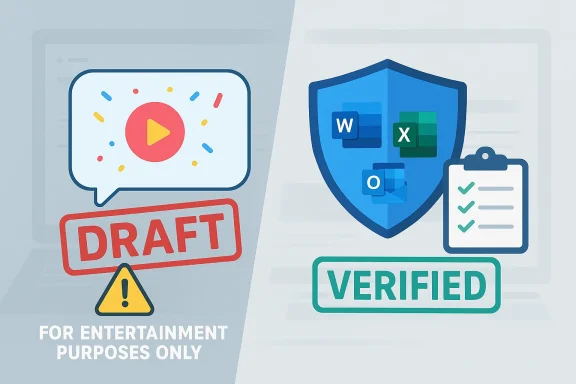
The consumer-facing Copilot terms were updated on October 24, 2025, and the current wording explicitly says Copilot is for entertainment purposes only, that it may not work as intended, and that users should not rely on it for important advice. Microsoft also clarifies that these terms do not apply to Microsoft 365 Copilot apps or services unless a particular app or service says they do. In other words, the company is drawing a legal and product boundary between casual consumer AI and the work product embedded in Microsoft 365.
That boundary is easy to miss because Microsoft has also spent the past year making Copilot more central to everyday work. In Microsoft 365 Personal and Family, the company brought Copilot into consumer productivity apps such as Word, Excel, PowerPoint, Outlook, OneNote, and the Microsoft 365 app, but it still framed those changes as a consumer subscription update rather than the enterprise-grade Microsoft 365 Copilot business offering. Meanwhile, Microsoft continues to market Microsoft 365 Copilot as the AI assistant for work, connected to organizational data and workplace workflows.
The timing also matters because Microsoft is simultaneously expanding more advanced, agent-like Copilot features in business settings. The company recently introduced Copilot Cowork in the Frontier program, describing it as a tool for long-running, multi-step work in Microsoft 365. Microsoft says it uses a multi-model approach and integrates skills from Claude and Microsoft-built capabilities, reinforcing the idea that the company is not retreating from work AI at all. If anything, it is becoming more explicit about which Copilot experiences are experimental, which are consumer-oriented, and which are intended for enterprise deployment.
That sounds harsh, but it is actually consistent with how Microsoft describes the service in its own disclosures. The terms say Copilot may include ads, may involve human review, and may not operate as intended. The company is signaling that the consumer product is a probabilistic AI assistant, not a regulated reference source or professional advisor. That is a meaningful distinction in an era when many users are treating chatbots as if they were search engines with personalities.
There is also a product design reason for the wording. Consumer AI assistants are intentionally broad, conversational, and open-ended, which means they can be useful for brainstorming, drafting, planning, and light research while still being unreliable on factual edge cases. Microsoft’s own transparency note says generative models can make mistakes despite mitigations. That is a practical warning, but it also exposes the tension between convenience and authority.
The confusion comes from branding. Many users see “Copilot” in Windows, in Edge, in Bing, in the Microsoft 365 app, and in the Microsoft 365 Copilot suite, then assume the legal framing must be uniform. It is not. Microsoft now presents consumer Copilot as a general-purpose assistant for personal tasks and Microsoft 365 Copilot as a workplace system grounded in organizational data and enterprise controls.
By contrast, Microsoft 365 Copilot is designed around work content, enterprise security, and organizational permissioning. Microsoft’s own marketing says it is the AI assistant across Microsoft 365 applications, and the product inherits the compliance expectations of the Microsoft 365 service boundary. That makes it closer to an enterprise workflow layer than a casual chatbot.
Many users want AI to behave like a deterministic assistant, especially when the tool is embedded in a desktop operating system and a productivity suite. But large language models are probabilistic systems, and Microsoft’s own transparency materials acknowledge the risk of incorrect or harmful responses. So the “shockwave” is less a revelation than a collision between consumer appetite and technical reality.
That does not mean the tool is unhelpful. It means the burden of verification remains essential, especially for factual, financial, legal, medical, or operational decisions. The more polished the interface becomes, the more dangerous false confidence can be, because users may not notice the difference between a fluent answer and a correct one.
The important detail is that Microsoft is now comfortable talking about multiple models in the same product story. The company says Copilot Cowork uses a multi-model advantage and that its newer Researcher and related features can compare or combine output from different model vendors. That suggests Microsoft is trying to reduce error not by pretending models are perfect, but by orchestrating them against each other.
It also signals a product design philosophy that is more cautious than some competitors’ “one model does everything” messaging. By layering critique and comparison into workflow agents, Microsoft is effectively saying that reliability comes from process, not from blind trust in a single generative engine. That is a smart move for enterprise adoption, even if it complicates the consumer message.
What enterprises should care about most is governance. A company that uses Copilot in work settings needs clear rules about what can be prompted, which accounts are approved, how outputs are validated, and which scenarios require human review. The better Microsoft gets at embedding Copilot in daily workflows, the more important those controls become.
The practical enterprise question is not whether Copilot can be used at work. It is whether businesses have the maturity to use it well. That means training staff to distinguish consumer and enterprise experiences, not pasting confidential data into the wrong interface, and treating AI-generated content as a draft unless formally validated.
This matters because consumers often overestimate the authority of a polished assistant. If someone uses Copilot to compare options, write an email, plan a trip, or sketch a household budget, the risk is moderate; if they use it to interpret a medical issue, legal concern, or financial obligation, the risk rises sharply. Microsoft’s terms are really an attempt to make that distinction impossible to ignore.
Users should also be more careful about where they type. Microsoft’s own guidance says not to enter sensitive work data into consumer Copilot, and its terms warn that data may be reviewed. Those are not obscure legal footnotes; they are operating instructions for anyone who expects to use AI in daily life without creating avoidable risk.
The company is also leaning into “Frontier” as a way to separate experimental capabilities from mainstream product promises. That helps Microsoft protect itself legally while giving enthusiasts and enterprises early access to emerging features. It is a pragmatic compromise, though one that still leaves the consumer brand vulnerable when users collapse every Copilot variant into one mental bucket.
That may be the real lesson here. Microsoft is not backing away from AI; it is learning how to frame AI more carefully in a market that is waking up to reliability problems. The company knows that long-term adoption depends less on hype than on users feeling that they understand what the system can and cannot do.
What to watch is not only the wording of the terms, but the behavior of the products. Better citations, clearer provenance, stronger task boundaries, and more obvious model selection cues could all help users understand when to trust Copilot and when to treat it as a draft generator. That is where the real competition will be won: not by the flashiest demo, but by the AI assistant people can safely use every day.
Source: NewsBricks Microsoft Copilot's AI new terms have sent users shockwaves
 Background
The uproar makes more sense when you remember how aggressively Microsoft has been repositioning Copilot over the last two years. What began as a broad AI brand spanning consumer chat, Windows integration, and Microsoft 365 productivity has gradually split into distinct experiences with different promises, different safeguards, and different legal framing. That distinction matters because users often talk about “Copilot” as if it is one thing, when Microsoft now treats it as a family of products with separate rules.The consumer-facing Copilot terms were updated on October 24, 2025, and the current wording explicitly says Copilot is for entertainment purposes only, that it may not work as intended, and that users should not rely on it for important advice. Microsoft also clarifies that these terms do not apply to Microsoft 365 Copilot apps or services unless a particular app or service says they do. In other words, the company is drawing a legal and product boundary between casual consumer AI and the work product embedded in Microsoft 365.
That boundary is easy to miss because Microsoft has also spent the past year making Copilot more central to everyday work. In Microsoft 365 Personal and Family, the company brought Copilot into consumer productivity apps such as Word, Excel, PowerPoint, Outlook, OneNote, and the Microsoft 365 app, but it still framed those changes as a consumer subscription update rather than the enterprise-grade Microsoft 365 Copilot business offering. Meanwhile, Microsoft continues to market Microsoft 365 Copilot as the AI assistant for work, connected to organizational data and workplace workflows.
The timing also matters because Microsoft is simultaneously expanding more advanced, agent-like Copilot features in business settings. The company recently introduced Copilot Cowork in the Frontier program, describing it as a tool for long-running, multi-step work in Microsoft 365. Microsoft says it uses a multi-model approach and integrates skills from Claude and Microsoft-built capabilities, reinforcing the idea that the company is not retreating from work AI at all. If anything, it is becoming more explicit about which Copilot experiences are experimental, which are consumer-oriented, and which are intended for enterprise deployment.
What Microsoft Actually Changed
The core issue is not that Microsoft suddenly decided Copilot cannot be used for work. The change is that Microsoft’s consumer terms now emphasize that the online service is not a guarantee engine, and the company is shifting responsibility for how users interpret outputs more squarely onto the user. The legal language says Copilot can make mistakes, may generate incorrect information, and should not be treated as a source of important advice.That sounds harsh, but it is actually consistent with how Microsoft describes the service in its own disclosures. The terms say Copilot may include ads, may involve human review, and may not operate as intended. The company is signaling that the consumer product is a probabilistic AI assistant, not a regulated reference source or professional advisor. That is a meaningful distinction in an era when many users are treating chatbots as if they were search engines with personalities.
Why “Entertainment Purposes” Matters
The phrase “for entertainment purposes only” is what drew the loudest reaction, because it sounds dismissive and legally defensive. Yet the wording is not unique to Microsoft; it reflects a broader strategy used across generative AI products to reduce liability when users over-trust machine-generated text. The company is not saying the tool is useless. It is saying the user remains responsible for judgment, verification, and consequences.There is also a product design reason for the wording. Consumer AI assistants are intentionally broad, conversational, and open-ended, which means they can be useful for brainstorming, drafting, planning, and light research while still being unreliable on factual edge cases. Microsoft’s own transparency note says generative models can make mistakes despite mitigations. That is a practical warning, but it also exposes the tension between convenience and authority.
- Microsoft’s consumer Copilot terms now say the service is for entertainment purposes only.
- The terms warn that Copilot can produce incorrect information.
- The wording is meant to limit overreliance, not ban ordinary use.
- Microsoft 365 Copilot is governed by a different work-oriented framing.
Can Copilot Still Be Used for Work?
Yes, but the answer depends on which Copilot you mean. Microsoft’s work product, Microsoft 365 Copilot, is explicitly marketed as an AI assistant for organizations with eligible Microsoft 365 or Office 365 licenses, and Microsoft says it helps users draft documents, analyze data, summarize meetings, and manage email. That is a very different proposition from the consumer Copilot terms, which are aimed at general users and personal tasks.The confusion comes from branding. Many users see “Copilot” in Windows, in Edge, in Bing, in the Microsoft 365 app, and in the Microsoft 365 Copilot suite, then assume the legal framing must be uniform. It is not. Microsoft now presents consumer Copilot as a general-purpose assistant for personal tasks and Microsoft 365 Copilot as a workplace system grounded in organizational data and enterprise controls.
Consumer Tasks Versus Workplace Tasks
Microsoft’s own Learn guidance now tells users that the consumer version of Microsoft Copilot is for personal tasks and should be used cautiously for nonsensitive work tasks. The company specifically warns people not to add sensitive or proprietary work information in consumer prompts. That is a strong signal that the consumer tool can assist with work-adjacent activities, but it is not the approved home for business-critical data.By contrast, Microsoft 365 Copilot is designed around work content, enterprise security, and organizational permissioning. Microsoft’s own marketing says it is the AI assistant across Microsoft 365 applications, and the product inherits the compliance expectations of the Microsoft 365 service boundary. That makes it closer to an enterprise workflow layer than a casual chatbot.
- Consumer Copilot can assist with personal and light work tasks.
- Sensitive or proprietary information should not be entered into consumer prompts.
- Microsoft 365 Copilot is intended for work and organizational use.
- Enterprise deployments can rely on different data, compliance, and admin controls.
Why the Backlash Feels So Strong
The backlash is not only about legal phrasing. It is about expectation management. Microsoft has spent years telling consumers and businesses that Copilot is a productivity multiplier, then the legal terms remind everyone that the system is still fallible and should not be trusted as an authority. That gap between marketing and caution is where a lot of user frustration lives.Many users want AI to behave like a deterministic assistant, especially when the tool is embedded in a desktop operating system and a productivity suite. But large language models are probabilistic systems, and Microsoft’s own transparency materials acknowledge the risk of incorrect or harmful responses. So the “shockwave” is less a revelation than a collision between consumer appetite and technical reality.
The Hallucination Problem
The problem of hallucination has been discussed for years, but it becomes much more visible when an AI is packaged as a mainstream assistant rather than a niche research demo. A system can generate polished text that sounds authoritative even when it is wrong, and that can mislead users who are in a hurry or who assume the product has stronger validation than it actually does. Microsoft’s revised terms are a blunt acknowledgment of that risk.That does not mean the tool is unhelpful. It means the burden of verification remains essential, especially for factual, financial, legal, medical, or operational decisions. The more polished the interface becomes, the more dangerous false confidence can be, because users may not notice the difference between a fluent answer and a correct one.
- Hallucinations can make inaccurate outputs seem credible.
- Users may trust an answer because of tone, not accuracy.
- Microsoft’s updated terms shift emphasis toward user verification.
- This is a broader industry issue, not a Microsoft-only flaw.
What Copilot Cowork Signals About Microsoft’s Direction
If the terms update sounds defensive, the Copilot Cowork rollout sounds aggressively ambitious. Microsoft has introduced Copilot Cowork through the Frontier program as a system for long-running, multi-step work in Microsoft 365, and it describes the capability as one that can reason across tools and files while maintaining visible progress. That is not a retreat from AI utility; it is a deepening of it.The important detail is that Microsoft is now comfortable talking about multiple models in the same product story. The company says Copilot Cowork uses a multi-model advantage and that its newer Researcher and related features can compare or combine output from different model vendors. That suggests Microsoft is trying to reduce error not by pretending models are perfect, but by orchestrating them against each other.
Multi-Model Is a Strategic Hedge
This multi-model approach is significant because it shows Microsoft no longer wants to be seen as depending on a single model family for all Copilot experiences. The company has been explicit that Anthropic models are now part of Copilot Studio and the Frontier ecosystem, alongside OpenAI models. In practical terms, that gives Microsoft flexibility, bargaining power, and the ability to route around weaknesses in any one model.It also signals a product design philosophy that is more cautious than some competitors’ “one model does everything” messaging. By layering critique and comparison into workflow agents, Microsoft is effectively saying that reliability comes from process, not from blind trust in a single generative engine. That is a smart move for enterprise adoption, even if it complicates the consumer message.
- Microsoft is expanding Copilot with multi-model orchestration.
- Copilot Cowork is designed for long-running, multi-step work.
- The Frontier program provides early access to experimental features.
- Microsoft is hedging reliability by comparing model outputs, not just generating them.
Enterprise Implications
For enterprises, the takeaway is simple: this controversy should not be read as a sign that Microsoft 365 Copilot is suddenly being downgraded. Microsoft still positions the work product as a business tool with commercial data protection, tenant grounding, and administrative controls. The consumer terms are a warning about the broader Copilot family, not a repudiation of the enterprise line.What enterprises should care about most is governance. A company that uses Copilot in work settings needs clear rules about what can be prompted, which accounts are approved, how outputs are validated, and which scenarios require human review. The better Microsoft gets at embedding Copilot in daily workflows, the more important those controls become.
Policy, Compliance, and Data Boundaries
Microsoft says work prompts and responses remain within the Microsoft 365 service boundary when used in the appropriate work context, and it has repeatedly emphasized commercial data protection and compliance commitments. That should reassure IT departments more than the consumer “entertainment” label alarms them. Still, no compliance promise removes the need for internal policy.The practical enterprise question is not whether Copilot can be used at work. It is whether businesses have the maturity to use it well. That means training staff to distinguish consumer and enterprise experiences, not pasting confidential data into the wrong interface, and treating AI-generated content as a draft unless formally validated.
- Enterprises should distinguish consumer Copilot from Microsoft 365 Copilot.
- Work data should stay in approved, governed environments.
- Human review remains essential for important decisions.
- Admin policies matter more as agents become more autonomous.
Consumer Implications
For consumers, the updated wording is more of a reality check than a blocker. Microsoft still wants Copilot to be used widely for brainstorming, drafting, summarizing, and general assistance, and its consumer products remain available in the Microsoft 365 Personal and Family ecosystem. The catch is that users should treat it as a helper, not a judge.This matters because consumers often overestimate the authority of a polished assistant. If someone uses Copilot to compare options, write an email, plan a trip, or sketch a household budget, the risk is moderate; if they use it to interpret a medical issue, legal concern, or financial obligation, the risk rises sharply. Microsoft’s terms are really an attempt to make that distinction impossible to ignore.
What Users Should Do Differently
The best response is not to abandon Copilot. It is to adopt a verification habit. Cross-check factual claims, inspect citations when available, and avoid treating AI-generated text as ground truth unless you have independently verified it. That discipline is tedious, but it is far cheaper than learning the hard way that a confident answer was wrong.Users should also be more careful about where they type. Microsoft’s own guidance says not to enter sensitive work data into consumer Copilot, and its terms warn that data may be reviewed. Those are not obscure legal footnotes; they are operating instructions for anyone who expects to use AI in daily life without creating avoidable risk.
- Use Copilot for drafting and ideation, not final authority.
- Verify factual, financial, and legal claims independently.
- Keep sensitive information out of consumer prompts.
- Distinguish between personal Copilot and work Copilot experiences.
How Microsoft Is Trying to Repair Trust
Microsoft’s broader response to the trust problem is not to promise perfection, but to add layers of control, comparison, and context. The company’s recent work on Researcher, Analyst, and Copilot Cowork shows a pattern: instead of one-shot answers, Microsoft is pushing users toward guided, multi-step, visible workflows. That is an important shift because process transparency can be more credible than a single opaque response.The company is also leaning into “Frontier” as a way to separate experimental capabilities from mainstream product promises. That helps Microsoft protect itself legally while giving enthusiasts and enterprises early access to emerging features. It is a pragmatic compromise, though one that still leaves the consumer brand vulnerable when users collapse every Copilot variant into one mental bucket.
A Product Story Built on Caution
At first glance, this seems like an odd turn for a company that wants AI to feel inevitable. But the caution is strategic. If Microsoft can make users believe its work agents are trustworthy because they are bounded, auditable, and connected to enterprise data, then the consumer disclaimers stop looking like weakness and start looking like clear product segmentation.That may be the real lesson here. Microsoft is not backing away from AI; it is learning how to frame AI more carefully in a market that is waking up to reliability problems. The company knows that long-term adoption depends less on hype than on users feeling that they understand what the system can and cannot do.
- Microsoft is adding more structure to AI workflows.
- Experimental features are being isolated in Frontier.
- The company is using multi-model orchestration to improve quality.
- Trust is being built through controls, not promises of infallibility.
Strengths and Opportunities
The controversy also highlights why Copilot still has meaningful momentum. Microsoft controls the operating system, the productivity suite, the enterprise identity layer, and a growing agent ecosystem, which gives it a distribution advantage few rivals can match. If Microsoft can keep separating consumer convenience from enterprise trust, it has an opportunity to make Copilot the default AI layer for both personal and professional computing.- Massive installed base across Windows and Microsoft 365.
- Clear enterprise positioning for work scenarios.
- Stronger governance potential through Microsoft 365 controls.
- Multi-model support may improve reliability over time.
- Frontier lets Microsoft test ambitious features without overpromising.
- Copilot Cowork could expand from assistance to workflow automation.
Risks and Concerns
The biggest risk is brand confusion. If users cannot quickly tell consumer Copilot from Microsoft 365 Copilot, the legal disclaimers will continue to look like contradictions rather than product-specific guardrails. A second risk is overreliance: the more useful Copilot becomes, the more damaging a confident mistake can be.- Brand overlap can blur consumer and enterprise expectations.
- Hallucinations can still produce costly errors.
- Users may ignore the need for human verification.
- Experimental features can confuse mainstream users.
- Legal wording may fuel backlash even when the underlying product is unchanged.
- Multi-model complexity may improve capability but reduce clarity.
Looking Ahead
The next few months will show whether Microsoft can sustain a two-track Copilot strategy without alienating casual users. If the company keeps refining work-grade agents while making consumer Copilot more obviously a general assistant, the backlash may fade into a footnote. If not, the “entertainment purposes” language will keep resurfacing every time Copilot is mentioned in the context of productivity or decision-making.What to watch is not only the wording of the terms, but the behavior of the products. Better citations, clearer provenance, stronger task boundaries, and more obvious model selection cues could all help users understand when to trust Copilot and when to treat it as a draft generator. That is where the real competition will be won: not by the flashiest demo, but by the AI assistant people can safely use every day.
- Whether Microsoft revises the consumer messaging again.
- How quickly Copilot Cowork expands beyond Frontier.
- Whether Microsoft 365 Copilot gets stronger provenance and validation tools.
- How well Microsoft reduces confusion between consumer and work versions.
Source: NewsBricks Microsoft Copilot's AI new terms have sent users shockwaves
