

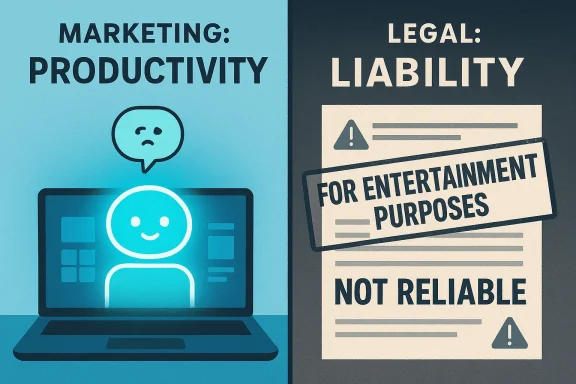
Microsoft’s Copilot legal language has become a punchline because it exposes a real tension at the heart of the company’s AI strategy: Copilot is marketed as a productivity engine, but its consumer-facing terms still read like a broad liability shield. The phrase “for entertainment purposes” sounds absurd when placed beside Microsoft’s years-long campaign to position Copilot as a work tool for Windows, Microsoft 365, Edge, and business users. That mismatch is exactly why the language is drawing attention now.
The reaction to Copilot’s terms is not really about one sentence in isolation. It is about the gap between marketing ambition and legal caution, a gap that has widened as Microsoft has pushed Copilot deeper into daily workflows. The company has spent the last two years presenting Copilot as a transformational layer across productivity apps, Windows, and enterprise services, while its standard consumer terms continue to insist that the service may be inaccurate, should not be relied on, and is for entertainment purposes only.
That kind of disclaimer is common in consumer software, especially for generative AI tools that can hallucinate, misquote sources, or produce defective output. But Microsoft is not just any consumer app vendor in this story. It is the company that has spent enormous resources persuading businesses that AI is now a core part of modern work, with Microsoft 365 Copilot positioned as an “AI assistant for work” and promoted in official materials as a tool for drafting, summarizing, and automating repetitive tasks.
The legal language therefore reads less like a surprise and more like a reminder that consumer Copilot and enterprise Copilot are not the same promise. Microsoft can tell businesses that Copilot is designed to drive efficiency and unlock productivity gains, while simultaneously telling users of the consumer service not to trust it for advice and to use it at their own risk. That distinction matters because many readers and casual users do not differentiate between the brand umbrella and the product tier beneath it. (microsoft.com)
There is also a broader industry context. Every major AI vendor is balancing enthusiasm with caution, because the legal exposure around generated content, privacy, reliability, and intellectual property is still evolving. What makes Microsoft’s wording stand out is not that it is uniquely conservative, but that it sits inside a branding machine that has made Copilot the centerpiece of the company’s AI narrative. In that environment, a sentence about “entertainment” lands with unusual force. (microsoft.com)
That sounds stark, but the wording is doing a specific legal job. Microsoft is trying to avoid any implication that a consumer chatbot is a trusted advisor, a source of professional guidance, or a warranty-backed information service. In other words, it is framing Copilot as a probabilistic tool, not an authoritative one. That legal posture is especially important for a system that can produce convincing but wrong output at scale. (microsoft.com)
This is where the disconnect becomes visible. A legal disclaimer is not a product strategy, but it can reveal where a company believes risk begins. Microsoft’s lawyers appear to be drawing a hard line: consumer users are not supposed to assume reliability, while enterprise customers are expected to engage through separate contracts, controls, and service terms. That is sensible legally, but it also makes the consumer-facing brand feel less coherent than the marketing suggests. (microsoft.com)
That combination is important because it shows the company is not merely disclaiming performance. It is also managing content risk, privacy risk, and misuse risk. For a company deploying AI across consumer and enterprise surfaces, those are not side issues; they are the central legal and operational challenges. The entertainment phrase is the headline, but the rest of the clause is the real risk-management architecture. (microsoft.com)
That makes the entertainment disclaimer look like a contradiction, but it is really a split between product positioning and legal classification. Microsoft can market the experience as useful and disruptive while still reserving the right to say that the consumer version is not a dependable source of advice. The company is trying to harvest enthusiasm without accepting the legal burdens that would come with sounding like a professional services provider. (microsoft.com)
So why the legal hedging? Because the same company knows generative AI remains statistically fallible, and those failures matter more in the real world than in keynote decks. In that sense, Microsoft’s wording is a reminder that the AI hype cycle and the legal risk cycle are not synchronized. The marketing team sells acceleration; the legal team writes caution. (microsoft.com)
That is the critical nuance. Microsoft can say one thing about the consumer service and another about enterprise offerings because they are not governed the same way. The practical result, however, is that the Copilot brand can appear internally inconsistent to everyday users who just see one logo and one promise. That’s especially true when Copilot surfaces in Windows, Edge, and Microsoft 365 side by side. (microsoft.com)
That difference matters because businesses are not buying a joke chatbot; they are buying a productivity stack. Microsoft’s own materials say organizations use Copilot to automate repetitive work, speed drafting, and surface information faster. Those claims are supported by case studies and product pages that focus on measurable operational benefit rather than entertainment value.
That means the real question for businesses is not whether Copilot says “entertainment.” The question is whether the organization has built a policy framework that matches the tool’s volatility. If not, the legal disclaimers become a preview of future problems rather than a harmless footnote. That is where CIOs, legal teams, and security officers should focus attention. (microsoft.com)
This distinction also explains why Microsoft can push Copilot into Windows and Office while preserving strong caveats. For personal productivity, ambiguity is often acceptable; for business-critical decisions, it is not. The more Copilot moves from ideation to execution, the more the tension between promise and disclaimer will intensify. That tension is likely to define the next phase of the product’s reputation.
That distinction matters for perception. If a tool is presented as a research preview or a creative assistant, disclaimer language feels ordinary. If the tool is presented as a ubiquitous workplace layer, the same language feels like a reversal. Microsoft’s challenge is that it wants Copilot to feel indispensable while also preserving enough legal distance to avoid being treated like a guarantor of truth.
What differentiates Microsoft is scale. When a company embeds AI across Windows, Office, Edge, cloud services, and business tools, every disclaimer takes on greater significance because the product is no longer niche. It becomes infrastructure-adjacent. And infrastructure-adjacent products are judged less by what the fine print says and more by how safely they are used in practice.
In practical terms, the company should expect critics to keep pointing out this contradiction whenever Copilot makes visible mistakes. A single sentence in the terms is easy to quote because it is memorable, funny, and damning all at once. That makes it excellent clickbait and a persistent branding problem. (microsoft.com)
That creates a behavioral problem. Users may develop expectations from the Windows or browser experience and then carry them into Office documents, email drafting, or spreadsheet analysis. But the legal disclaimers are telling them that the system remains fallible regardless of where it appears. In other words, the interface may feel integrated, but the trust model still demands caution. (microsoft.com)
From Microsoft’s perspective, the OS integration is strategic because it increases engagement and normalizes AI usage. From the user’s perspective, however, persistent integration raises the stakes of bad output. A joke in the terms may be harmless until the model offers a wrong instruction or a misleading summary in a context where the user assumes confidence. (microsoft.com)
That is not hypocrisy so much as segmentation, but segmentation is invisible to many users. A marketing message about productivity can bleed into assumptions about accuracy. The safest interpretation is that Microsoft wants Copilot to accelerate work while humans retain responsibility for verification, approvals, and final judgment. That is a sensible model, but it requires much clearer communication than a single branded umbrella currently provides.
That means the phrase is not really a confession; it is an allocation of risk. Microsoft is telling users that the tool is experimental enough that they should not treat it as authoritative. The problem is not that the company is legally wrong. The problem is that the brand promise and the disclaimer are packaged together in a way that encourages ridicule. (microsoft.com)
That may be legally efficient, but it is not user-friendly. And in the AI market, user trust is part of the product. If a phrase becomes a meme, it can overshadow months of careful product positioning. That is the price of launching a mass-market AI assistant under a name that suggests guidance, collaboration, and reliability. (microsoft.com)
The truth is that the more Microsoft wants Copilot to feel indispensable, the more it has to manage expectations carefully. If the company overpromises, the disclaimers look cynical. If it underpromises, the product looks less revolutionary. That tension may be unavoidable in AI, but Microsoft has made it unusually public. That is why this tiny legal phrase has become such a large conversation. (microsoft.com)
The company also has an opening to become the AI vendor most associated with responsible deployment rather than just raw capability. That would require clearer product segmentation, stronger disclosure, and a more disciplined public narrative. In an AI market increasingly crowded with similar model performance, trust could become the real moat.
There is also the reputational issue. In the AI era, a brand can be damaged less by a single catastrophic failure than by a steady pattern of overpromising and underdelivering. Microsoft’s Copilot strategy remains powerful, but it now carries the burden of proving that the experience is more than a marketing wrapper around a probabilistic engine.
The biggest strategic question is whether Microsoft can make Copilot feel dependable without making it sound like a warranty-backed oracle. That balance is difficult, but it is where the market is heading. The winners in enterprise AI will be the vendors who can combine useful automation with transparent boundaries and credible safeguards.
Source: digit.in Microsoft Copilot terms are legal ‘LOL’ for every business using it
 Overview
The reaction to Copilot’s terms is not really about one sentence in isolation. It is about the gap between marketing ambition and legal caution, a gap that has widened as Microsoft has pushed Copilot deeper into daily workflows. The company has spent the last two years presenting Copilot as a transformational layer across productivity apps, Windows, and enterprise services, while its standard consumer terms continue to insist that the service may be inaccurate, should not be relied on, and is for entertainment purposes only.That kind of disclaimer is common in consumer software, especially for generative AI tools that can hallucinate, misquote sources, or produce defective output. But Microsoft is not just any consumer app vendor in this story. It is the company that has spent enormous resources persuading businesses that AI is now a core part of modern work, with Microsoft 365 Copilot positioned as an “AI assistant for work” and promoted in official materials as a tool for drafting, summarizing, and automating repetitive tasks.
The legal language therefore reads less like a surprise and more like a reminder that consumer Copilot and enterprise Copilot are not the same promise. Microsoft can tell businesses that Copilot is designed to drive efficiency and unlock productivity gains, while simultaneously telling users of the consumer service not to trust it for advice and to use it at their own risk. That distinction matters because many readers and casual users do not differentiate between the brand umbrella and the product tier beneath it. (microsoft.com)
There is also a broader industry context. Every major AI vendor is balancing enthusiasm with caution, because the legal exposure around generated content, privacy, reliability, and intellectual property is still evolving. What makes Microsoft’s wording stand out is not that it is uniquely conservative, but that it sits inside a branding machine that has made Copilot the centerpiece of the company’s AI narrative. In that environment, a sentence about “entertainment” lands with unusual force. (microsoft.com)
What Microsoft Actually Says
The key phrase comes from Microsoft’s Copilot terms archive, where the company states that the online services are “for entertainment purposes” and are “not error-free”, may not work as expected, and may generate incorrect information. The same section says users should not rely on the service and should not use it for advice of any kind. Microsoft also says use is at the user’s own risk. (microsoft.com)That sounds stark, but the wording is doing a specific legal job. Microsoft is trying to avoid any implication that a consumer chatbot is a trusted advisor, a source of professional guidance, or a warranty-backed information service. In other words, it is framing Copilot as a probabilistic tool, not an authoritative one. That legal posture is especially important for a system that can produce convincing but wrong output at scale. (microsoft.com)
Why the phrase is so jarring
The phrase feels jarring because “entertainment” is not how Microsoft sells Copilot in public. In official Microsoft materials, Copilot is described as a workplace assistant, an enterprise AI layer, and a productivity tool designed to help teams manage repetitive tasks, summarize information, and speed up routine work. That is a completely different rhetorical lane from entertainment.This is where the disconnect becomes visible. A legal disclaimer is not a product strategy, but it can reveal where a company believes risk begins. Microsoft’s lawyers appear to be drawing a hard line: consumer users are not supposed to assume reliability, while enterprise customers are expected to engage through separate contracts, controls, and service terms. That is sensible legally, but it also makes the consumer-facing brand feel less coherent than the marketing suggests. (microsoft.com)
- Consumer Copilot terms emphasize caution, non-reliability, and user risk.
- Microsoft’s marketing emphasizes productivity, transformation, and workplace value.
- The mismatch is what makes the legal language look almost satirical.
- The disclaimer is best read as a liability boundary, not a product feature.
- Still, the wording matters because it shapes public perception of trust.
The broader disclaimer structure
The entertainment line is only one piece of a much larger legal package. Microsoft also warns that outputs may be non-unique, that identical or similar results may be shown to other users, and that content you submit can be used in ways tied to the operation of Microsoft’s businesses. In addition, users are told not to upload content they would not want reviewed and not to use the service for biometric or privacy-infringing purposes. (microsoft.com)That combination is important because it shows the company is not merely disclaiming performance. It is also managing content risk, privacy risk, and misuse risk. For a company deploying AI across consumer and enterprise surfaces, those are not side issues; they are the central legal and operational challenges. The entertainment phrase is the headline, but the rest of the clause is the real risk-management architecture. (microsoft.com)
Why Microsoft Says One Thing and Sells Another
Microsoft’s public messaging around Copilot has been unambiguous: this is a major strategic platform, not a toy. The company has repeatedly described Copilot as an AI assistant for work, highlighted adoption among large enterprises, and framed the product family as part of the broader shift toward AI transformation. In official Microsoft commentary, Copilot is linked to business efficiency, automation, and measurable productivity gains.That makes the entertainment disclaimer look like a contradiction, but it is really a split between product positioning and legal classification. Microsoft can market the experience as useful and disruptive while still reserving the right to say that the consumer version is not a dependable source of advice. The company is trying to harvest enthusiasm without accepting the legal burdens that would come with sounding like a professional services provider. (microsoft.com)
The Satya Nadella effect
Satya Nadella has repeatedly framed AI as fundamental to how people work, and Microsoft has long pitched Copilot as central to modern productivity. In Microsoft’s own corporate messaging, Copilot is presented as something businesses can use to reimagine processes, support employees, and create operating leverage. That is a very strong promise, especially when coupled with adoption claims across Fortune 500 customers.So why the legal hedging? Because the same company knows generative AI remains statistically fallible, and those failures matter more in the real world than in keynote decks. In that sense, Microsoft’s wording is a reminder that the AI hype cycle and the legal risk cycle are not synchronized. The marketing team sells acceleration; the legal team writes caution. (microsoft.com)
- Microsoft’s leadership has consistently pushed Copilot as a workplace transformation tool.
- The legal language is trying to prevent overreliance and reduce exposure.
- The two messages can coexist, but they do not feel emotionally consistent.
- For users, that inconsistency can weaken trust even if the underlying legal logic is sound.
- This is a classic case of brand ambition outrunning risk messaging.
Why “enterprise ready” does not erase disclaimers
Enterprise buyers often assume that if a product is sold to business customers, it must be reliable enough for professional use. Microsoft’s own materials reinforce that impression by describing enterprise-grade privacy, security controls, usage analytics, and role-based deployment options for Microsoft 365 Copilot. But “enterprise-ready” does not mean “free from disclaimer language.” It means there are administrative controls, data boundaries, and contractual protections layered on top of the product.That is the critical nuance. Microsoft can say one thing about the consumer service and another about enterprise offerings because they are not governed the same way. The practical result, however, is that the Copilot brand can appear internally inconsistent to everyday users who just see one logo and one promise. That’s especially true when Copilot surfaces in Windows, Edge, and Microsoft 365 side by side. (microsoft.com)
Consumer Versus Business: A Real Divide
The best way to understand this controversy is to separate consumer Copilot from Microsoft 365 Copilot and other business-grade services. Microsoft’s consumer-facing terms are broad, cautionary, and built around usage boundaries and liability shields. By contrast, Microsoft 365 Copilot is sold with enterprise controls, reporting, and privacy/security language intended for organizational deployment. (microsoft.com)That difference matters because businesses are not buying a joke chatbot; they are buying a productivity stack. Microsoft’s own materials say organizations use Copilot to automate repetitive work, speed drafting, and surface information faster. Those claims are supported by case studies and product pages that focus on measurable operational benefit rather than entertainment value.
What businesses should infer
For businesses, the legal disclaimer should not be read as “Copilot is useless.” It should be read as “Copilot is not a substitute for governance.” Enterprises that adopt AI successfully tend to define approved use cases, validate outputs, train staff, and decide where human review is mandatory. Microsoft’s terms are a warning that the burden of safe deployment is shared, not outsourced. (microsoft.com)That means the real question for businesses is not whether Copilot says “entertainment.” The question is whether the organization has built a policy framework that matches the tool’s volatility. If not, the legal disclaimers become a preview of future problems rather than a harmless footnote. That is where CIOs, legal teams, and security officers should focus attention. (microsoft.com)
- Consumer Copilot should be treated as a convenience tool, not a source of authority.
- Enterprise Copilot should be deployed with governance and human oversight.
- The same brand name does not mean the same legal or operational expectations.
- Organizations need policies for validation, retention, and sensitive data handling.
- The disclaimer is a signal to formalize AI usage, not to ignore it.
Personal productivity is not professional liability
Many individuals use Copilot for drafts, brainstorming, rewrites, and quick answers. That is reasonable, provided the user understands the limitations. But the moment a user treats Copilot output as medical advice, legal advice, financial guidance, or compliance-grade information, the risk profile changes dramatically. Microsoft’s terms are effectively warning against that leap. (microsoft.com)This distinction also explains why Microsoft can push Copilot into Windows and Office while preserving strong caveats. For personal productivity, ambiguity is often acceptable; for business-critical decisions, it is not. The more Copilot moves from ideation to execution, the more the tension between promise and disclaimer will intensify. That tension is likely to define the next phase of the product’s reputation.
How Microsoft Compares With Rivals
The criticism that Microsoft is being uniquely disingenuous does not fully hold up under scrutiny. Other major AI providers also use broad limitations, warn against reliance, and disclaim accuracy. The difference is that rival brands often market their systems in more explicitly experimental or assistive terms, whereas Microsoft has heavily tied Copilot to mainstream productivity and operating-system integration. (microsoft.com)That distinction matters for perception. If a tool is presented as a research preview or a creative assistant, disclaimer language feels ordinary. If the tool is presented as a ubiquitous workplace layer, the same language feels like a reversal. Microsoft’s challenge is that it wants Copilot to feel indispensable while also preserving enough legal distance to avoid being treated like a guarantor of truth.
The trust gap in generative AI
The broader generative AI market is still wrestling with a trust deficit. Hallucinations, bias, content provenance, and privacy concerns remain unresolved enough that vendors have to keep their disclaimers broad. Microsoft’s “entertainment” phrasing may be more blunt than competitors’ wording, but the underlying logic is similar: do not assume perfection, and do not outsource judgment entirely to the model. (microsoft.com)What differentiates Microsoft is scale. When a company embeds AI across Windows, Office, Edge, cloud services, and business tools, every disclaimer takes on greater significance because the product is no longer niche. It becomes infrastructure-adjacent. And infrastructure-adjacent products are judged less by what the fine print says and more by how safely they are used in practice.
- Rivals also protect themselves with broad legal language.
- Microsoft’s brand is more exposed because Copilot is everywhere.
- The more embedded the tool, the less forgiving users become about caveats.
- Trust is now a competitive differentiator in AI, not just raw capability.
- Legal wording alone cannot repair weak user confidence.
Brand coherence matters more than ever
AI users are learning to read between the lines. When a vendor says “assistant,” “co-pilot,” and “enterprise-grade,” consumers infer a certain level of reliability. If the same vendor’s terms say “entertainment purposes,” that cognitive dissonance can reduce confidence, even if the disclaimer is technically appropriate. This is where Microsoft may need to think less like a software licensor and more like a trust platform. (microsoft.com)In practical terms, the company should expect critics to keep pointing out this contradiction whenever Copilot makes visible mistakes. A single sentence in the terms is easy to quote because it is memorable, funny, and damning all at once. That makes it excellent clickbait and a persistent branding problem. (microsoft.com)
What the Terms Mean for Windows and Microsoft 365
The Copilot story cannot be separated from Windows and Microsoft 365, because those are the environments where the brand’s reach is most visible. Microsoft has made Copilot a recurring interface element in Windows 11, a central feature in Office apps, and a headline capability across business subscriptions. The result is that users encounter the same branding in contexts that feel both casual and mission-critical.That creates a behavioral problem. Users may develop expectations from the Windows or browser experience and then carry them into Office documents, email drafting, or spreadsheet analysis. But the legal disclaimers are telling them that the system remains fallible regardless of where it appears. In other words, the interface may feel integrated, but the trust model still demands caution. (microsoft.com)
Windows users will feel this first
For Windows users, Copilot is increasingly part of the ambient computing experience rather than a separate app. That makes it harder to mentally classify it as “just for fun.” If the service is constantly present in the OS, the entertainment clause can feel like a mismatch between platform positioning and legal reality. That is especially true for users who expect operating-system features to be dependable.From Microsoft’s perspective, the OS integration is strategic because it increases engagement and normalizes AI usage. From the user’s perspective, however, persistent integration raises the stakes of bad output. A joke in the terms may be harmless until the model offers a wrong instruction or a misleading summary in a context where the user assumes confidence. (microsoft.com)
- OS-level integration makes Copilot feel more authoritative than it legally is.
- Repetition across apps increases user trust by familiarity, not by proof.
- The more integrated the system, the more important error handling becomes.
- Microsoft will need to educate users about verification habits.
- The user experience and the legal disclaimer currently pull in opposite directions.
Microsoft 365 raises the stakes
In Microsoft 365, the issue becomes even more serious because business users often work with documents, communications, and data that have real operational consequences. Microsoft’s enterprise materials emphasize data protection, reporting, and control, which is exactly what enterprise customers want. But the consumer-style disclaimer still highlights that outputs can be wrong and should not be trusted blindly.That is not hypocrisy so much as segmentation, but segmentation is invisible to many users. A marketing message about productivity can bleed into assumptions about accuracy. The safest interpretation is that Microsoft wants Copilot to accelerate work while humans retain responsibility for verification, approvals, and final judgment. That is a sensible model, but it requires much clearer communication than a single branded umbrella currently provides.
The Legal Logic Behind the Humor
The line is funny because it sounds like Microsoft is disowning its own flagship AI. But in legal terms, the wording is a standard defensive move. AI services can produce misleading, defamatory, infringing, or harmful outputs, and companies want to avoid language that could be used to imply warranties, fitness for purpose, or professional reliance. (microsoft.com)That means the phrase is not really a confession; it is an allocation of risk. Microsoft is telling users that the tool is experimental enough that they should not treat it as authoritative. The problem is not that the company is legally wrong. The problem is that the brand promise and the disclaimer are packaged together in a way that encourages ridicule. (microsoft.com)
Why lawyers write this way
Lawyers prefer broad, durable disclaimers because AI behavior changes quickly and unpredictably. If a product update improves output quality in one area but introduces new failure modes in another, the disclaimer should still hold. The phrase “entertainment purposes” is likely intended to be sweeping rather than literal, a catch-all buffer against claims of dependence or professional misuse. (microsoft.com)That may be legally efficient, but it is not user-friendly. And in the AI market, user trust is part of the product. If a phrase becomes a meme, it can overshadow months of careful product positioning. That is the price of launching a mass-market AI assistant under a name that suggests guidance, collaboration, and reliability. (microsoft.com)
- Broad disclaimers are common in AI because behavior changes constantly.
- The phrase is likely broader than it sounds in ordinary language.
- Legal efficiency does not equal marketing clarity.
- If users stop trusting the wording, the product narrative suffers.
- Memes can outlast formal corrections.
A warning Microsoft cannot easily escape
Microsoft could rewrite the terms to sound less provocative, but that would not remove the underlying risk. Any generative AI system that can produce wrong answers still needs strong disclaimers. So the issue is not whether Microsoft should disclaim risk; it is whether the current wording undercuts the brand more than necessary. That is an unusually visible tradeoff for a company of Microsoft’s size. (microsoft.com)The truth is that the more Microsoft wants Copilot to feel indispensable, the more it has to manage expectations carefully. If the company overpromises, the disclaimers look cynical. If it underpromises, the product looks less revolutionary. That tension may be unavoidable in AI, but Microsoft has made it unusually public. That is why this tiny legal phrase has become such a large conversation. (microsoft.com)
Strengths and Opportunities
Microsoft still has a strong strategic hand here, even if the wording is awkward. The company owns the operating system, the productivity suite, the cloud stack, and a massive enterprise channel, which gives Copilot distribution advantages most rivals cannot match. The legal disclaimer is a branding headache, but it does not erase the underlying commercial opportunity. Microsoft can still turn Copilot into a default workflow layer if it continues to improve quality and trust.- Massive built-in distribution across Windows, Microsoft 365, Edge, and Azure.
- Strong enterprise sales channels and existing customer relationships.
- Clear monetization paths through subscriptions, add-ons, and usage tiers.
- Potential to improve through tighter model integration and better grounding.
- Opportunity to educate users on safe AI usage and verification habits.
- Room to separate consumer and enterprise messaging more cleanly.
- Ability to leverage telemetry and feedback to reduce failure modes.
Where Microsoft can still win
If Microsoft keeps sharpening enterprise controls and reduces visible mistakes, the “entertainment” joke may fade into a footnote. Businesses care less about courtroom phrasing than about whether a system saves time, reduces drudgery, and stays within guardrails. That means product quality and governance will do more for Copilot’s reputation than any revised disclaimer ever could.The company also has an opening to become the AI vendor most associated with responsible deployment rather than just raw capability. That would require clearer product segmentation, stronger disclosure, and a more disciplined public narrative. In an AI market increasingly crowded with similar model performance, trust could become the real moat.
Risks and Concerns
The biggest risk is that Microsoft’s legal caution becomes a credibility problem. If users keep seeing Copilot fail in obvious ways while the company keeps calling it a transformative productivity layer, the brand can start to feel overstated. Once that happens, every mistake becomes evidence that the promise is larger than the reality.- Users may confuse consumer Copilot with enterprise Copilot and overtrust outputs.
- The “entertainment purposes” line can undermine serious-product positioning.
- Public ridicule can distort perception of the whole Copilot ecosystem.
- Bad outputs in high-stakes contexts can create legal and reputational damage.
- Overreliance by employees could produce compliance and decision-making errors.
- Inconsistent messaging may slow adoption in cautious enterprise environments.
- Competitors can use the mismatch to attack Microsoft’s trust story.
The compliance problem
Enterprises are likely to care less about the joke and more about the operational implications. A broadly deployed assistant that is used without verification can introduce errors into reports, emails, summaries, and decisions. Microsoft’s terms place responsibility squarely on the user, but that does not eliminate the possibility of downstream liability or workflow breakage. (microsoft.com)There is also the reputational issue. In the AI era, a brand can be damaged less by a single catastrophic failure than by a steady pattern of overpromising and underdelivering. Microsoft’s Copilot strategy remains powerful, but it now carries the burden of proving that the experience is more than a marketing wrapper around a probabilistic engine.
Looking Ahead
The next phase of this story is likely to be about refinement, not reinvention. Microsoft will probably keep tightening Copilot’s enterprise controls, expanding model capabilities, and separating consumer and business narratives more carefully. At the same time, the company will need to keep reminding users that AI assistance is not the same thing as AI authority.The biggest strategic question is whether Microsoft can make Copilot feel dependable without making it sound like a warranty-backed oracle. That balance is difficult, but it is where the market is heading. The winners in enterprise AI will be the vendors who can combine useful automation with transparent boundaries and credible safeguards.
What to watch next
- Whether Microsoft revises the Copilot consumer wording again.
- How clearly Microsoft separates consumer and enterprise Copilot branding.
- Whether enterprise adoption grows despite the legal disclaimer controversy.
- Whether rival AI vendors emphasize trust and accuracy as differentiators.
- Whether Microsoft’s new models and product updates reduce visible errors.
- Whether regulators or enterprise buyers push for clearer AI usage disclosures.
- Whether the joke phrase fades or becomes a lasting symbol of AI hype fatigue.
Source: digit.in Microsoft Copilot terms are legal ‘LOL’ for every business using it
