

Microsoft's three-day online AI boot camp and the expanding Copilot agent lineup mark the company's most concerted push yet to move Copilot beyond a set of point features and into day‑to‑day enterprise workflows — and the timing matters: organizations that treat these announcements as tactical upgrades risk missing the strategic shift toward agent‑driven business process automation now underway.
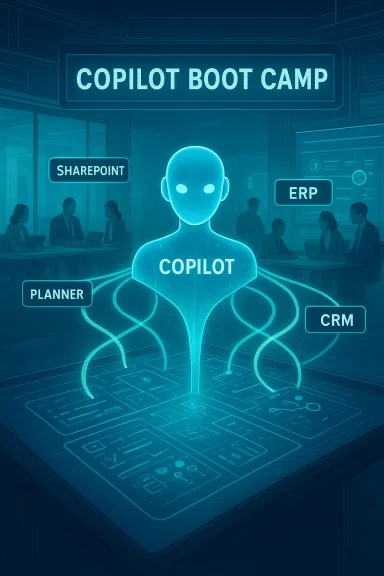
Microsoft has spent the last two years reshaping Office and Microsoft 365 around generative AI experiences under the Copilot brand. What began as conversational helpers inside Word, Excel, Outlook, and Teams has evolved into an ecosystem: Copilot Studio (the authoring toolset), the Microsoft Agent Framework, identity tooling for agents, and product integrations that connect agents to Planner, SharePoint, Dynamics/CRM, and ERP systems.
That evolution aims to move companies from manual, repeatable tasks to agentic automation — autonomous or semi‑autonomous software entities that can act inside organizational systems, orchestrate tasks, and continuously refine output. Recent roadmap and product communications show Microsoft layering specialized, role‑focused agents on top of Copilot, while also opening tools and templates that let customers build bespoke agents without deep LLM engineering. The new boot camp is Microsoft’s response to a common enterprise problem: lots of capability, but not enough structured guidance on how to harness it for real business outcomes.
Why it matters:
The boot camp is a useful accelerant because it pairs hands‑on learning with prescriptive playbooks; the summit offers a community and partner ecosystem for scaling those pilots. For firms that take a disciplined, metrics‑first approach, agents can convert repetitive human effort into reliable, auditable automation. For the rest, the risk is a messy sprawl of partial automations, runaway consumption bills, and governance blind spots.
In short: Copilot and agents move the needle from “AI as a feature” to “AI as operational infrastructure.” That change requires attention to people, process, and platform — not just prompts. Organizations that prepare accordingly will capture disproportionate value; those that don’t will pay for the experiment in unexpected ways.
Source: Cloud Wars Microsoft Launches AI Boot Camp to Accelerate Copilot Adoption
 Background
Microsoft has spent the last two years reshaping Office and Microsoft 365 around generative AI experiences under the Copilot brand. What began as conversational helpers inside Word, Excel, Outlook, and Teams has evolved into an ecosystem: Copilot Studio (the authoring toolset), the Microsoft Agent Framework, identity tooling for agents, and product integrations that connect agents to Planner, SharePoint, Dynamics/CRM, and ERP systems.That evolution aims to move companies from manual, repeatable tasks to agentic automation — autonomous or semi‑autonomous software entities that can act inside organizational systems, orchestrate tasks, and continuously refine output. Recent roadmap and product communications show Microsoft layering specialized, role‑focused agents on top of Copilot, while also opening tools and templates that let customers build bespoke agents without deep LLM engineering. The new boot camp is Microsoft’s response to a common enterprise problem: lots of capability, but not enough structured guidance on how to harness it for real business outcomes.
What Microsoft announced (the essentials)
The boot camp: a three‑day, practical primer for Copilot adoption
Microsoft has launched a three‑day online boot camp designed to accelerate Copilot adoption across organizations. The curriculum begins with a session titled “Copilots and Agents: What’s New and What’s Next?” and continues through hands‑on clinics and scenario workshops meant for business‑process owners, architects, and citizen developers.Why it matters:
- The format is focused on execution — translating Copilot features into measurable process improvements.
- It targets both technical and non‑technical roles, signaling Microsoft expects cross‑functional teams to drive deployments.
- Practical tracks aim to reduce the learning curve for Copilot Studio, agent templates, and integration with Fabric, Dataverse, and common line‑of‑business systems.
New and expanding agent lineup
Microsoft is broadening its collection of first‑party agents and agent templates — not just for chat, but as background services and workflow participants. Announcements and roadmap items over the last several months show this feature set coalescing into a recognizable portfolio:- Project Manager Agent — embedded in Planner and Teams, able to generate project plans, create tasks, update status, and produce status reports from plan progress. The agent can act on behalf of a plan to execute tasks or assign work, and it integrates Loop Pages for in‑task collaboration.
- Knowledge Agent (SharePoint) — designed to run in the background to improve content quality: fixing broken links, generating page summaries and FAQs, and tagging content with metadata to make knowledge more discoverable.
- Personalized Learning Agent — creates micro‑learning plans and delivers targeted learning nudges, tied to Viva and internal learning resources.
- Sales Agent — pulls CRM data into Outlook and Teams workflows, helping sellers craft targeted messages, prepare call notes, and automate routine pipeline hygiene.
- Service Agent — supports frontline and customer support teams by surfacing relevant knowledge, drafting replies, and routing escalations.
- Finance Agent — integrates ERP and financial datasets into Excel and Outlook, accelerating analysis, reconciliation, and report drafting.
Copilot Studio / Agent Builder enhancements
Microsoft’s authoring experiences — Copilot Studio (full) and the lighter Agent Builder features baked into the Microsoft 365 admin and authoring surfaces — are receiving iterative improvements intended to speed development:- Simplified agent creation workflows to move faster from idea to preview.
- The ability to copy agents between the “lite” and full Copilot Studio experiences, easing authoring handoffs.
- Predefined templates for common business scenarios to reduce the amount of design work needed.
- Admin center and reporting improvements to measure agent adoption and compliance signals.
Events and community: AI Agent & Copilot Summit
To support adoption, the AI Agent & Copilot Summit is scheduled for March 17–19, 2026 in San Diego. The summit packages product briefings, industry use‑case sessions, and masterclasses aimed at mapping Copilot/agent strategy to measurable outcomes. Microsoft executives and partner speakers will present real deployments and governance patterns, making the event a practical complement to the boot camp.Why this is more consequential than another product update
There are three powerful dynamics behind these moves:- From features to workflows. Early Copilot releases were about content generation and conversational assistance inside apps. The agent strategy ties the assistant directly into workflow systems — Planner, SharePoint, Teams, ERP, CRM — which enables automation that either augments or replaces multi‑step human processes.
- Commoditization of agent creation. By shipping templates, prebuilt role agents, and simplified authoring flows, Microsoft lowers the bar for organizations to build agents. That shifts the competitive advantage from raw LLM expertise to process design, data hygiene, and governance.
- Platform lock‑in through orchestration. Agents that read and write to OneLake, Dataverse, Outlook, and SharePoint deepen Microsoft 365’s value proposition. The more processes an organization routes through these agents, the higher the switching cost to alternative stacks.
Use cases that matter now
1. Project management at scale
The Project Manager agent turns plan generation and execution into a conversation. In practice it can:- Generate a plan from a single sentence goal.
- Populate tasks and assign them to people or agents.
- Regenerate tasks after team feedback and update Loop pages automatically.
For companies that struggle with repeatable project templates, this can cut weeks of planning friction.
2. Knowledge base remediation and discovery
The Knowledge Agent’s background scanning — identifying broken links, consolidating redundant pages, auto‑tagging content with metadata — removes low‑value editorial work. That lifts the signal‑to‑noise ratio for knowledge workers and improves Copilot grounding when agents answer questions from enterprise content.3. Sales and service enablement
Sales and Service agents that surface CRM context directly into Outlook/Teams workflows shorten response windows and standardize message quality. They also provide a practical on‑ramp for frontline teams to use AI without leaving their core productivity surfaces.4. Finance automation inside Excel
Finance teams live in spreadsheets. Agents that can reason over ERP‑connected data in Excel, create reconciliations, and draft narrative explanations for variance analysis accelerate month‑end and ad‑hoc reporting.Adoption roadmap: how organizations should approach Copilot and agents
Adopting agentic AI isn’t a big‑bang migration; it’s iterative. Here’s a pragmatic roll‑out sequence organizations should follow:- Inventory and prioritize processes. Map repetitive, high‑value, cross‑system processes that are good candidates for automation (e.g., invoice triage, contract drafting, project initiation).
- Select pilot scenarios. Start with one or two scenarios with clear success metrics (time saved, cycle time reduction, error reduction).
- Choose the right agent surface. Use first‑party agents where available; extend with Copilot Studio for unique workflows.
- Prepare your data. Ensure knowledge stores, SharePoint libraries, and CRM/ERP connectors are clean and have appropriate access controls.
- Measure and iterate. Track adoption, assisted hours, user satisfaction, and error rates. Use these metrics to refine prompts, agent tempering, or retraining.
- Scale with governance. Once pilots show value, roll out with guardrails: entitlements, logging, content approval workflows, and audit trails.
Governance, compliance, and security: the non‑negotiables
Microsoft’s agent story relies on deep access to enterprise data, so governance and security are core risks to manage:- Data residency and sensitivity. Agents that read from ERP, CRM, and internal docs must respect data residency, encryption, and least privilege. Organizations must map which agents can access what datasets and enforce Entra/Azure AD identity controls.
- Prompt injection and hallucination risk. Agents that act (e.g., assign tasks, modify plans, send emails) must include deterministic verification points — human approvals for high‑impact changes and audit trails for automated actions.
- Supply chain and integration risk. Agents often call external connectors or APIs. Validate third‑party integrations and perform threat modeling for potential supply‑chain compromise.
- Licensing and cost governance. Copilot usage may be billed via seat licenses and consumption‑based credits. Track consumption patterns and set budgets for Copilot Credits to avoid unexpected invoices.
- Change management and accountability. Define ownership for agents (who supports and updates them), and ensure teams have training on when to rely on agent output and when to escalate.
The economics: licensing, credits, and cost drivers
The Copilot pricing model has multiple dimensions that affect total cost of ownership:- Seat licenses. Microsoft 365 Copilot (per‑user) remains the baseline for many built‑in agent experiences.
- Consumption (Copilot Credits). Custom agents and Copilot Studio artifacts often use a metered credit model for model invocations or “messages.” High‑frequency agents (e.g., triage bots, sales assistants) can drive substantial consumption.
- Capacity and prepurchase options. Microsoft offers capacity packs or prepurchase options to smooth costs and provide discounts for committed usage.
- Hidden integration costs. Building agents that integrate with ERP/CRM often requires engineering effort, middleware, or third‑party connectors that carry additional fees.
Technical considerations: data, models, and runtime
- Grounding and retrieval (RAG). Agents are only as good as their retrieval pipelines. Using OneLake or well‑curated semantic indexes significantly improves accuracy and reduces hallucination.
- Model selection and tuning. For domain‑specific outputs (legal language, financial reports), model tuning and instruction engineering matter. Microsoft’s product extensions (brand kits, global instructions) are aimed at making outputs more consistent with organizational voice.
- Runtime orchestration (MARS/Multi‑Agent Runtime). Multi‑agent orchestration enables specialized subagents (e.g., a fact‑checker, a summarizer, an action executor) to collaborate. Building with these runtimes reduces the complexity of writing custom orchestration code.
- Observability and debugging. Ensure logging, replayability, and test harnesses are in place so agent behavior can be tested and audited.
Strengths: what Microsoft gets right
- End‑to‑end integration. Microsoft’s advantage is its control of productivity surfaces — Outlook, Teams, Word, Excel — plus enterprise data platforms like OneLake and Dataverse. That tight integration reduces friction when agents need to act on business data.
- Prebuilt role agents. Shipping first‑party, role‑specific agents for Project Management, Knowledge, and Finance accelerates adoption in departments that are hungry for productivity gains but wary of heavy engineering projects.
- Authoring and templates. Copilot Studio’s authoring flows and templates lower the barrier for citizen builders and accelerate safe experimentation.
- Ecosystem and events. The boot camp and the AI Agent & Copilot Summit create structured learning pathways and community knowledge‑sharing that enterprises often lack when trying to operationalize AI.
Risks and open questions
- Lock‑in vs portability. The more business processes depend on Microsoft’s agent primitives and OneLake‑backed data, the higher the vendor lock‑in. Organizations should balance immediate productivity gains against long‑term architectural flexibility.
- Measurement and validation. Many Copilot outcomes are qualitative (draft quality, helpfulness). Firms must develop quantitative measures to avoid chasing illusionary productivity improvements.
- Cost unpredictability. Consumption models can balloon if agents are misconfigured or misused. Rigorous cost controls and monitoring are essential.
- Governance maturity. Microsoft provides tools, but successfully governing agents requires new organizational processes — role definitions, approval workflows, and incident response plans for agent failures.
- Skill gaps. Building effective agents requires a blend of prompt engineering, data engineering, and domain SMEs. Many organizations lack that hybrid skillset today.
Practical checklist for IT and business leaders
- Before you pilot
- Identify 1–2 high‑value processes with measurable KPIs.
- Clean and classify source data; apply access controls.
- Confirm licensing and budget for consumption.
- During pilot
- Use first‑party agents where possible; lean on templates in Copilot Studio.
- Instrument agent usage with logging and user feedback.
- Require human approval gates for any automated outbound actions.
- After pilot
- Publish measurable outcomes and ROI to secure funding for scale.
- Create an Agent Governance Board with security, legal, and business representation.
- Train frontline users on how to work with agents and flag issues.
What to watch next
- Template and tuning rollouts. Microsoft has signalled brand‑kit and template capabilities that make Copilot output more consistent with corporate voice. Organizations should test these features for regulated content and external‑facing documents.
- Agent licensing clarifications. The distinction between seat licenses and consumption will evolve; track Microsoft’s pricing and capacity options closely to avoid surprises.
- Evolving security guidance. Watch for deeper Purview and Defender integrations that will be necessary to run agentic workloads in regulated industries.
- Marketplace and third‑party agents. Expect partners and ISVs to package vertical agents (legal, healthcare, manufacturing) as managed offerings that reduce internal engineering demands.
Critical takeaways
Microsoft’s boot camp and the expanded Copilot/agent portfolio signal a pragmatic shift from isolated AI features to workflow‑native agents designed to deliver measurable business outcomes. The opportunity is substantial: faster planning cycles, cleaner knowledge systems, sales and support acceleration, and finance automation. But the path is not frictionless. Organizations must treat agent adoption like any core systems change — with governance, measurable pilots, careful data hygiene, and cost controls.The boot camp is a useful accelerant because it pairs hands‑on learning with prescriptive playbooks; the summit offers a community and partner ecosystem for scaling those pilots. For firms that take a disciplined, metrics‑first approach, agents can convert repetitive human effort into reliable, auditable automation. For the rest, the risk is a messy sprawl of partial automations, runaway consumption bills, and governance blind spots.
In short: Copilot and agents move the needle from “AI as a feature” to “AI as operational infrastructure.” That change requires attention to people, process, and platform — not just prompts. Organizations that prepare accordingly will capture disproportionate value; those that don’t will pay for the experiment in unexpected ways.
Conclusion
Microsoft’s three‑day AI boot camp and the steady stream of agentic capabilities are an invitation: build responsibly or be built around. The next 12 months will decide whether Copilot becomes a utility that quietly lifts productivity across routine workflows or a costly, fragmented collection of half‑worked automations. Strategic pilots, strong governance, and a focus on measurable outcomes are the shortest path to turning Microsoft’s agent promises into sustainable business advantage.Source: Cloud Wars Microsoft Launches AI Boot Camp to Accelerate Copilot Adoption
