

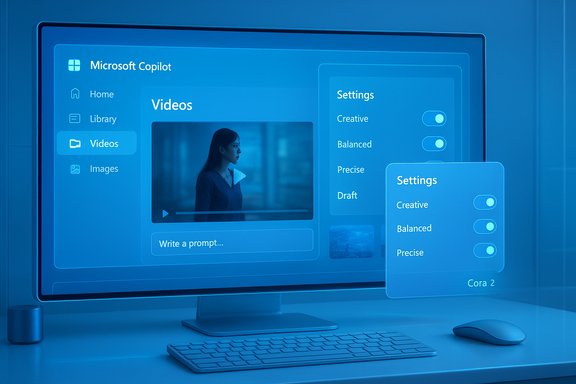
Microsoft is preparing to add short-form video generation to Copilot by wiring in OpenAI’s next‑generation video model Sora 2, together with a new Videos tab and a refreshed settings modal — an expansion that would move Copilot from a multimodal assistant that “sees and writes” toward a full creative workspace where users can ideate, store, and (potentially) publish short AI‑generated clips directly from the assistant interface.
Microsoft has been steadily embedding generative AI across Bing, Office, Windows, and Azure, and the addition of video generation into Copilot is a natural — if consequential — next step. Short, on‑demand video generation closes the loop between idea and output inside the same assistant flow users already reach for when they need research, images, or writing help. That creates productivity gains for creators, students, marketers, and enterprise teams while concentrating significant technical, governance and moderation responsibilities in one product surface.
The broader infrastructure that makes this practical is already in place. Microsoft’s Bing Video Creator now exposes Sora‑powered generation to consumers, and Azure AI Foundry lists Sora‑2 as a production‑oriented model option for enterprises — meaning Microsoft can route consumer, Copilot, and developer video workloads to the same underlying model family while layering in enterprise controls and billing.
The net effect could be transformative for productivity and content creation on Windows and across Microsoft’s ecosystem — but it elevates the need for robust governance. Provenance, moderation, copyright, likeness consent, and cost controls are the operational problems that will determine whether this feature empowers creative teams or creates a new, hard‑to‑manage vector of risk.
For individuals and teams, the prudent path is clear: experiment, but do so inside a controlled pilot; insist on evidence that provenance survives export and that human review and takedown pathways are fast and reliable; and budget for the per‑second economics of video. Microsoft’s technical architecture makes these mitigations possible, but the policy and product details will determine how safe and practical this capability becomes at scale.
The introduction of Sora‑2 video generation into Copilot will be one of the more consequential shifts in how mainstream users produce media: it moves short‑form video from a standalone creative task into the same assistant surface people use for writing, research, and planning. That concentration of capability is a productivity win, but it must be matched by durable provenance, robust moderation, clear quota policies, and enterprise guardrails before it can be safely adopted by organizations at scale.
Source: testingcatalog.com Microsoft prepares Copilot to get Sora 2 video generation
 Background: why this matters now
Microsoft has been steadily embedding generative AI across Bing, Office, Windows, and Azure, and the addition of video generation into Copilot is a natural — if consequential — next step. Short, on‑demand video generation closes the loop between idea and output inside the same assistant flow users already reach for when they need research, images, or writing help. That creates productivity gains for creators, students, marketers, and enterprise teams while concentrating significant technical, governance and moderation responsibilities in one product surface.The broader infrastructure that makes this practical is already in place. Microsoft’s Bing Video Creator now exposes Sora‑powered generation to consumers, and Azure AI Foundry lists Sora‑2 as a production‑oriented model option for enterprises — meaning Microsoft can route consumer, Copilot, and developer video workloads to the same underlying model family while layering in enterprise controls and billing.
What TestingCatalog and telemetry are reporting
- A new “Videos” tab has been spotted inside the Copilot web app’s Library section, intended to collect and organize user‑generated videos the same way Copilot stores images today. This suggests Microsoft will keep generated clips discoverable and reusable from within Copilot’s Library.
- The Imagine page — Copilot’s current image‑generation gallery — may soon show videos alongside images, indicating a unified media experience for image and video assets.
- There are UI changes in testing: Copilot settings are being moved to a modern pop‑up modal for faster access and a cleaner workflow. That UI refresh is consistent with recent Copilot fall release updates and often precedes functional rollouts.
- Early testing signals point to Sora 2 as the underlying model for Copilot video generation and to quota controls for free users (a likely “one video per day” restriction reported in field tests), although Microsoft has not published formal limits for Copilot video generation. Treat that one‑per‑day number as provisional until Microsoft publishes official quotas.
The technical foundation: Sora 2, Bing Video Creator, and Azure AI Foundry
What Sora 2 brings to the table
Sora 2 is a second‑generation text‑to‑video model engineered for short‑form, synchronized audio/video outputs, improved physical plausibility, and higher steerability than earlier era models. It supports:- text‑to‑video and image‑to‑video generation,
- synchronized audio (dialogue and effects) across supported languages,
- fine control over camera moves, lighting, and staging,
- remix and edit modes for iterative workflows.
Bing Video Creator: the consumer preview that proves feasibility
Microsoft rolled Sora into the Bing mobile app as Bing Video Creator, which lets logged‑in Microsoft account holders generate short, vertical videos from text prompts. The official product documentation and blog explain the launch behavior:- Videos are short (Bing initially offered 5‑second outputs with 9:16 vertical format; Microsoft noted 16:9 support was coming soon).
- The feature follows a freemium/quotas design: a limited number of “Fast” instant generations, and an unlimited but slower “Standard” generation tier; additional instant runs can be paid for with Microsoft Rewards points or other credits.
- Creations are stored temporarily (Bing’s blog said creations are kept for up to 90 days for download or sharing).
How Copilot’s UI changes hint at workflow integration
The visible test artifacts indicate Microsoft is designing for a low‑friction creative flow inside Copilot:- A dedicated Videos tab in the Copilot Library means generated clips will be centrally accessible, retrievable, and presumably attachable to other outputs such as documents, emails, or social posts. That mirrors how Copilot already organizes images and aligns with the “one workspace” approach.
- The Imagine gallery showing videos beside images would unify media types and improve iteration cycles for creative projects, allowing users to switch quickly between stills and motion for storyboarding or social media use.
- Replacing a full settings page with a pop‑up modal is a small but meaningful usability change: it reduces context switching and signals that Microsoft expects users to toggle generation settings frequently during creative sessions.
Policy, safety, and provenance: unresolved but front‑of‑mind
Text‑to‑video introduces a steeper set of moderation challenges than text or images. Sora 2’s improved realism — especially synchronized audio and lifelike motion — increases the risk and potential impact of misuse. There are a few important mitigations already in play across the ecosystem, and several gaps to watch:- Provenance and watermarking: OpenAI designed Sora with visible watermarks and C2PA‑style metadata for traceability, and Bing/Azure surfaces inherit provenance tooling; however, metadata can be stripped and watermarks cropped, so provenance is only a partial defense unless downstream platforms honor those signals.
- Consent and likeness controls: OpenAI’s “Cameo” concept for controlled likeness use shows one path toward consented identity generation; Microsoft’s enterprise posture on likeness rights in Copilot remains to be detailed and will be an important legal and technical consideration for organizations.
- Moderation scale: video requires both automated filters and human review at higher effort and cost per artifact than images. Microsoft’s use of model filters and human pipelines can mitigate many issues, but throughput and false positives are ongoing challenges.
- Unverifiable claims and provisional limits: reports of a “one video per day” free user quota inside Copilot come from field testing and are not yet confirmed by Microsoft; treat those numbers as provisional until formal documentation is published.
Business and product implications for Microsoft
Embedding video into Copilot has strategic logic across three axes:- Productivity: Users can generate illustrative, explainer, and social media clips without leaving the assistant, potentially reducing time to publish and lowering the barrier for non‑specialists to create video content.
- Commerce: Copilot’s sidebar experiments with a Shopping tab and merchant integrations suggest Microsoft wants to link content creation and commerce — imagine generating a product demo video and instantly publishing it to a product page or ad unit. That conflation of creation and commerce can open monetization pathways but also raises new warranty and return‑policy complexities.
- Platform consolidation: By routing consumer (Bing), assistant (Copilot), and developer (Azure Foundry) video generation through the same model family, Microsoft can unify moderation, billing, and enterprise controls — a competitive advantage over fragmented tooling stacks.
Practical guidance for Windows users, content teams, and IT leaders
For casual users and creators- Treat Copilot’s video generation as an ideation and prototyping tool, especially early on. Use low‑resolution drafts or watermarked proofs for review and keep brand‑sensitive assets off generated drafts until a human approval step is complete.
- Expect rate limits. Field reports indicate quota controls for free users; plan your creative calendar around test quotas or evaluate paid Pro/enterprise options for heavier workloads.
- Run a controlled pilot: designate a small project for rapid iteration and track seconds consumed, renders, and revision cycles.
- Establish an approvals pipeline: generate a low‑res draft for review, then authorize a final render after legal and brand sign‑off.
- Tag assets in a CMS with provenance metadata and retention flags so you can track generated content across distribution channels.
- Test governance controls in Azure Foundry first where possible: Foundry’s environment gives you logging, policy controls, and region selection to evaluate moderation and retention guarantees.
- Define policy for likeness and cameo usage: maintain opt‑in logs for any employee or influencer likeness use, require contractual rights for public personas, and create a takedown playbook for contested content.
- Budget for operational cost: per‑second preview pricing on Foundry and per‑generation compute that Microsoft uses on consumer surfaces mean video can grow expensive quickly if left unchecked. Use low‑res proofs and only trigger final renders post‑approval.
Strengths worth highlighting
- Unified workflow: Having text, images, audio, and now video within a single assistant reduces friction for multi‑format projects and shortens iteration loops.
- Enterprise controls in Azure Foundry: Sora‑2’s availability in Foundry gives organizations the tools to sandbox, monitor, and audit generated video before production use.
- Freemium access seeds adoption: Bing Video Creator’s mix of quick free runs and paid fast runs is a proven pattern for driving user experimentation and seeding a creator base that may migrate to Copilot workflows.
Risks and unresolved questions
- Provenance fragility: metadata and watermarks are necessary but not sufficient; they are only effective if the entire distribution chain preserves or respects those signals. That remains a systemic problem.
- Moderation capacity: video multiplies the moderation burden and increases the potential impact of a single harmful clip. False negatives and delayed human review could cause rapid spread before enforcement acts.
- Legal exposure on likeness and IP: cameo or likeness systems can help, but contractual and jurisdictional complexities for celebrity or third‑party likeness uses remain thorny for businesses that repurpose Copilot outputs externally.
- Pricing and operational costs: enterprise per‑second pricing (preview figures were published in early Foundry notes) mean that high‑volume usage without explicit quotas will quickly increase cloud spend. Plan guardrails and budgets accordingly.
- Quota ambiguity: reports of “one video per day” for free Copilot users are provisional test observations, not official policy. Rely on Microsoft’s published documentation and account admin portals for final quota and pricing information.
Checklist: what to confirm before adopting Copilot video generation in production
- Confirm official quota and pricing for Copilot video generation across account tiers.
- Validate retention windows and export controls for generated content (where is the file stored? for how long? who has access?.
- Verify that provenance metadata (C2PA or equivalent) is preserved through your chosen distribution channels.
- Define an approval pipeline and human‑in‑the‑loop moderation SLA for any public‑facing videos.
- Run a 30–90 day pilot in Azure Foundry (if possible) to measure cost per final minute/second, moderation accuracy, and integration complexity.
Final analysis and outlook
Bringing Sora 2 video generation into Copilot is a logical and powerful move: it gives users a single assistant that can go from a written brief to a shareable short video without switching tools, and Microsoft’s Azure Foundry provides enterprise plumbing to manage risk. Reports of a Videos tab, Imagine gallery changes, and a refreshed settings modal are consistent with a staged rollout that prioritizes discoverability and quick iteration.The net effect could be transformative for productivity and content creation on Windows and across Microsoft’s ecosystem — but it elevates the need for robust governance. Provenance, moderation, copyright, likeness consent, and cost controls are the operational problems that will determine whether this feature empowers creative teams or creates a new, hard‑to‑manage vector of risk.
For individuals and teams, the prudent path is clear: experiment, but do so inside a controlled pilot; insist on evidence that provenance survives export and that human review and takedown pathways are fast and reliable; and budget for the per‑second economics of video. Microsoft’s technical architecture makes these mitigations possible, but the policy and product details will determine how safe and practical this capability becomes at scale.
The introduction of Sora‑2 video generation into Copilot will be one of the more consequential shifts in how mainstream users produce media: it moves short‑form video from a standalone creative task into the same assistant surface people use for writing, research, and planning. That concentration of capability is a productivity win, but it must be matched by durable provenance, robust moderation, clear quota policies, and enterprise guardrails before it can be safely adopted by organizations at scale.
Source: testingcatalog.com Microsoft prepares Copilot to get Sora 2 video generation
