

Microsoft’s product roadmap at Ignite has quietly but unmistakably moved the enterprise conversation from “what a chatbot can answer” to “what an autonomous worker can do.” The new battleground is not a better prompt or a faster LLM; it is a model-and-policy stack that treats AI agents as identity-bound, auditable members of the corporate workforce — discoverable on the taskbar, registered in an agent registry, and governed by the same controls that protect human users. This is Microsoft’s strategic pivot: turn Copilot from a passive assistant into a platform for hundreds — potentially thousands — of autonomous agents that plan, act, and close loops inside business systems.
Microsoft’s announcements knit together four technical pillars into a single strategic narrative: Copilot Studio (authoring and low-code agent creation), Dynamics 365 pre-built agents (out-of-the-box utility), Agent 365 / Entra Agent ID (the governance and identity plane), and Azure AI Foundry / model routing (multi-model runtime and choice). The pitch is straightforward — democratize creation, productize utility, and govern scale — but the implications are wide-ranging for IT, procurement, security, and compliance teams. These are not incremental UX updates; they are architectural shifts that change how organizations think about automation, identity, and auditability.
Microsoft’s pivot is a high-stakes, high-reward wager: build the operating system for the agent era and let customers decide whether they want fleets of digital workers. The company has supplied the factory; the rest of the enterprise must decide whether to hire and train the foremen, install the safety rails, and run the quality checks that separate durable automation from seductive demos.
Microsoft’s agent story is not a finished product; it is an invitation to rethink how enterprise work is modeled, measured, and managed. The technical building blocks are in place, but the next chapter will be written in implementation logs, governance playbooks, and audited ROI — not in keynote slides.
Source: WebProNews The Great Agent Pivot: Microsoft Bets the Enterprise on Autonomous AI
 Background
Microsoft’s announcements knit together four technical pillars into a single strategic narrative: Copilot Studio (authoring and low-code agent creation), Dynamics 365 pre-built agents (out-of-the-box utility), Agent 365 / Entra Agent ID (the governance and identity plane), and Azure AI Foundry / model routing (multi-model runtime and choice). The pitch is straightforward — democratize creation, productize utility, and govern scale — but the implications are wide-ranging for IT, procurement, security, and compliance teams. These are not incremental UX updates; they are architectural shifts that change how organizations think about automation, identity, and auditability. The Agent Pivot: From Sidekick to Supervisor
What Microsoft announced — the product map
- Copilot Studio: A low-code/no-code environment where business users and “citizen developers” can build agents using natural language, drag-and-drop logic blocks, and pre-built connectors to Microsoft Graph, Dataverse, and enterprise systems. Microsoft positions Copilot Studio as the central hub for agent creation and publishing.
- Dynamics 365 autonomous agents: Ten pre-built agents for sales, service, finance, and supply chain teams — examples include a Sales Qualification Agent and a Supplier Communications Agent — designed to deliver immediate value without extensive custom engineering. Microsoft showcased customer pilots (McKinsey, Thomson Reuters and other early adopters) that show large reductions in process cycle times in controlled scenarios.
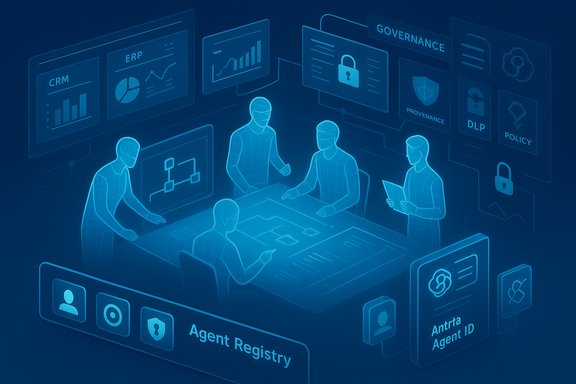
- Agent 365 and Entra Agent ID: A control plane and identity model that registers agents, assigns them identities, and enables lifecycle management (discovery, audit, deprovisioning). The goal is to let IT treat agents as first-class workloads with conditional access, monitoring and policy enforcement similar to human users.
- Azure AI Foundry and model routing: Multi-model choice and runtime routing that lets organizations pick models (OpenAI, Anthropic, Microsoft, or private models), route tasks by sensitivity and cost, and optimize for performance and compliance.
Why this is different
The key technical distinction is agency: agents are designed to act — to open tickets, send outbound messages, update CRM records, and reconcile invoices — not merely to summarize or suggest. That introduces new classes of risk (actions that have legal, financial, or reputational consequences) and new operational requirements (identity, least privilege, audit trails, human-in-the-loop thresholds). Microsoft’s messaging acknowledges this by emphasizing identity and lifecycle controls, not just model accuracy.Democratization of Development — Promise and Practical Limits
The low-code dream
Copilot Studio is deliberately framed as a “lego set” for business users: natural language instructions, pre-built “skills,” and connectors that promise to make agent creation accessible outside engineering teams. This is the next iteration of the citizen-developer movement: make automation easy enough that domain experts — marketers, procurement leads, sales ops — can create and tune agents for their workflows. Microsoft also couples this with marketplaces and agent catalogs to accelerate reuse.The friction beneath the demos
Real-world enterprise systems are rarely neat. Effective agents need clean grounding (accurate, accessible data), predictable connectors to legacy ERPs and CRMs, and robust guardrails against hallucination and unsafe actions. Low-code tooling hides complexity, but it doesn’t remove the need for careful design: connector scoping, sensitivity labeling, error handling, provenance logging, and lifecycle management still require IT governance and sometimes engineering work. If the time-to-value for a meaningful agent exceeds the time it takes to do the job manually, adoption stalls — a risk Microsoft implicitly accepts by offering pre-built Dynamics 365 agents.Workforce appetite and the “maker fatigue” problem
The big assumption underlying democratization is demand: that large numbers of employees want to become accidental developers. History shows many low-code initiatives end up as shelfware when business users lack time, incentives, or skills to maintain created artifacts. For agent programs to scale, organizations must invest in training, QA workflows, and maker support roles (agent ops, prompt engineers) and bake approval processes into the authoring pipeline. Without that, “agent sprawl” becomes just a more dangerous version of shadow IT.The Benioff–Nadella Proxy War: Horizontal vs. Vertical Intelligence
Salesforce’s Marc Benioff has been vocal in criticizing Microsoft’s Copilot, calling it “Clippy 2.0” and arguing that agents must live inside the system of record — the CRM — to deliver real value. Microsoft counters with a horizontal layer that sits above applications and orchestrates across them. This is more than marketing theater: it’s a strategic bet on who controls the interface of work.- Microsoft’s argument: a universal, platform-level agent ecosystem gives enterprises flexibility and scale by integrating across Office, Teams, Dynamics, and third-party apps.
- Salesforce’s argument: vertical, domain-specific agents embedded in a CRM will have deeper data fidelity and better business outcomes than a general-purpose orchestrator.
Shadow AI, Rogue Agents, and the Governance Nightmare
Agent sprawl is the new Shadow IT
Allowing thousands of user-created agents with privileges to access email, files, and transactional systems multiplies the attack surface. An incorrectly scoped agent could leak sensitive documents, trigger unauthorized transfers, or violate data residency rules. Microsoft’s response: treat agents as identities, enforce DLP, and build agent registries to detect and manage shadow agents. But the volume and autonomy of agents create monitoring challenges most IT teams are not yet staffed to handle.Microsoft’s controls — necessary but not sufficient
Microsoft has introduced several governance primitives — Agent 365 registries, Entra Agent ID identity, Purview integrations, Global Secure Access for agents and runtime controls — designed to make agents discoverable, scoped, and auditable. These are important technical steps that reduce risk when implemented correctly. However, tooling alone cannot solve organizational design problems: owner assignment, lifecycle reviews, consumption caps, naming conventions and legal agreements around external model routing are critical. Many enterprise teams will need new operational roles and adjusted incident playbooks to manage agent risk effectively.Real-world attack classes to plan for
- Prompt injection and tool abuse (agents using connectors improperly).
- Credential or identity misuse (misconfigured Entra policies or long-lived tokens).
- Chain-of-actions errors (multi-step agents producing cascading mistakes).
- Cost runaway (agents continuously executing expensive model calls).
- Compliance drift (unintended use of non-compliant models or cross-border data flows).
Dynamics 365 Agents and the Lock-In Question
Microsoft’s simultaneous release of ten pre-built agents in Dynamics 365 is a pragmatic move: give customers immediate, measurable utility rather than asking them to build everything from scratch. These agents aim to automate common workflows — sales qualification, supplier communications, knowledge management — and Microsoft cites early pilot results that promise large efficiency gains. The commercial implication is stickiness. Agents embedded in Dynamics 365 and reliant on Microsoft Graph, Dataverse, and Agent 365 controls create high switching costs. If critical processes are automated by Microsoft-bound agents, migrating to an alternate stack becomes not just an integration exercise but a reassembly of identity, connectors, and operational workflows. Enterprises must therefore weigh the near-term productivity gains against longer-term vendor concentration risks.The ROI Question and Market Fatigue
Why agents are pitched as the ROI solution
After a year of generative-AI pilots with limited transitions to production, agents are pitched as a clearer path to cost savings: automate end-to-end processes rather than produce isolated outputs. Microsoft’s narrative is operational metrics — reduced cycle times, fewer manual handoffs, and lower headcount for repetitive tasks. Early customer anecdotes show impressive percentages in controlled pilots, and Microsoft has emphasized those stories in sales motions.Why CIOs are skeptical
- Pilot fatigue: Many GenAI projects have stalled before production, eroding trust and making CFOs cautious.
- Integration complexity: The gap between demo and production — connecting multiple legacy systems, dealing with data quality, and designing robust exception handling — remains significant.
- Metering risk: Usage-based pricing for agents and model routing can create unpredictable bills if consumption isn’t tightly controlled.
- Governance overhead: If agents require heavy supervision or frequent manual intervention, the projected labor savings vanish.
Practical Playbook: How Enterprises Should Pilot Agents
- Define the business outcome first (e.g., reduce lead-to-opportunity time by X%, cut invoice reconciliation time by Y days).
- Start with low-risk, high-frequency workflows (read-only knowledge agents, internal reporting, HR FAQ triage).
- Enforce identity and least privilege: require Entra Agent ID registration and owner assignment for every agent.
- Implement a staged approval pipeline in Copilot Studio with automated QA checks and human-in-the-loop gates.
- Instrument everything: consumption dashboards, provenance logs, and SIEM integration for agent actions.
- Set financial caps and alerting on model consumption; treat agent spend as a first-class cost center.
- Run A/B tests with controls to measure real business impact before scaling.
- Publish a decommissioning policy: every agent must have an expiry, owner, and documented rollback plan.
Risks, Uncertainties, and Open Questions
- Provenance and explainability: Multi-step agent actions that touch multiple systems need tamper-resistant logs and clear chains of custody to support audits and legal reviews. Current tooling is improving but not yet mature for highly regulated industries.
- Market projections vs. reality: Microsoft and IDC projections (e.g., large forecasts of agent counts) are useful directional signals, but vendor-sponsored estimates should not substitute for organization-specific capacity planning. Treat these numbers as planning inputs, not guarantees.
- Regulatory and legal implications: Cross-border data flows, the EU AI Act, sector-specific rules for finance and health, and evolving model liability frameworks remain unsettled and will materially affect how agents operate in regulated contexts.
- Vendor consolidation: The convenience of a single integrated stack increases operational speed but also strategic dependence. Organizations must decide whether to accept this trade-off or design for portability using open protocols (Model Context Protocol, Agent-to-Agent standards) where feasible.
- Workforce impacts: Agents will change job composition. Planning for reskilling, role redefinition, and transparent workforce transition strategies is both an ethical imperative and a practical necessity.
Final Assessment: Revolution or Hype Cycle?
Microsoft has built a credible, end-to-end factory for agentic automation: authoring (Copilot Studio), runtime and model choice (Foundry/model router), identity and governance (Entra Agent ID, Agent 365), and packaged utility (Dynamics 365 agents). The technical scaffolding answers many of the obvious enterprise objections — identity, DLP, and lifecycle management — in ways that earlier GenAI efforts did not. For organizations already invested in Microsoft’s ecosystem, that integration advantage is substantial. Yet the road from platform capability to mass adoption runs through operational discipline. The winner won’t be the vendor that promises the most agents; it will be the organization that treats agents like production services: instrumented, costed, governed, and continuously audited. Without that discipline, agent sprawl, runaway costs, and compliance incidents will drown the promise of productivity.Microsoft’s pivot is a high-stakes, high-reward wager: build the operating system for the agent era and let customers decide whether they want fleets of digital workers. The company has supplied the factory; the rest of the enterprise must decide whether to hire and train the foremen, install the safety rails, and run the quality checks that separate durable automation from seductive demos.
Microsoft’s agent story is not a finished product; it is an invitation to rethink how enterprise work is modeled, measured, and managed. The technical building blocks are in place, but the next chapter will be written in implementation logs, governance playbooks, and audited ROI — not in keynote slides.
Source: WebProNews The Great Agent Pivot: Microsoft Bets the Enterprise on Autonomous AI
