

Microsoft’s latest update to Copilot in the Microsoft Advertising Platform turns static images into motion, opens generative APIs for enterprise-scale creative production, and folds advanced performance-comparison tools into the same conversational workflow advertisers are already using — a practical, holiday-season-ready push that marries creative scale with faster decision-making.
Microsoft announced three headline updates to Copilot in Microsoft Advertising Platform on November 17, 2025: Image Animation, expanded generative AI API access (Background, Display, Video, Brand Kit), and Performance Comparison analytics. Image Animation converts still images into short video assets that can run across Microsoft Advertising Network video placements; the API expansion lets advertisers bake generative capabilities directly into their own creative pipelines; and Performance Comparison brings conversational, period-over-period benchmarking and A/B monitoring into the Copilot interface. These product moves arrive amid a fast-shifting creative landscape where short-form and programmatic video inventory command rising shares of ad budgets. Microsoft cited broader market data — that Americans average hours-a-day watching digital video — as context for Image Animation, while case studies from Priceline and agency Carat US illustrate how the company is positioning Copilot as both a creative engine and an analytics accelerator.
Priceline’s rollout is the canonical example used by Microsoft: they embedded Copilot into their ad-production flow to generate hundreds of thousands of localized creative assets — a use case that’s nearly impossible for manual teams to match economically. Priceline reported a measurable lift in ad performance after the integration, which underscores the commercial argument for API-enabled scale.
Microsoft’s move also accelerates what’s already an industry-wide shift: image-to-video and generative creative are now fundamental ad production tools, not fringe experiments. Amazon, Google, and Meta have released comparable toolsets, and the winner in the medium term will be whichever vendor combines creative fidelity, measurement transparency, and robust governance into a single, developer-friendly stack. For marketers preparing for the holidays, the immediate action is simple: pilot with guardrails, measure with randomized tests, and keep humans in the loop. The technology is ready to scale; the policies and measurement frameworks are the work that remains.
Microsoft’s announcement on November 17, 2025, is both a practical upgrade for advertisers and a reminder that creative production and campaign measurement are converging under the banner of generative AI — a shift that offers real gains for those who pair automation with rigorous controls.
Source: PPC Land Microsoft adds image animation and performance tracking to Copilot AI tools
 Background
Microsoft announced three headline updates to Copilot in Microsoft Advertising Platform on November 17, 2025: Image Animation, expanded generative AI API access (Background, Display, Video, Brand Kit), and Performance Comparison analytics. Image Animation converts still images into short video assets that can run across Microsoft Advertising Network video placements; the API expansion lets advertisers bake generative capabilities directly into their own creative pipelines; and Performance Comparison brings conversational, period-over-period benchmarking and A/B monitoring into the Copilot interface. These product moves arrive amid a fast-shifting creative landscape where short-form and programmatic video inventory command rising shares of ad budgets. Microsoft cited broader market data — that Americans average hours-a-day watching digital video — as context for Image Animation, while case studies from Priceline and agency Carat US illustrate how the company is positioning Copilot as both a creative engine and an analytics accelerator. What Microsoft shipped and why it matters
Image Animation — turning images into video at scale
Image Animation is a pilot feature available through Ads Studio’s video templates that transforms existing still images into motion-rich video assets suitable for video placements across Microsoft’s inventory (global, except mainland China). The feature is explicitly aimed at reducing the production friction and cost that prevented many advertisers — especially smaller brands — from participating in video-first ad formats. Microsoft frames Image Animation as a way to “extend the shelf life” of top-performing image assets and scale creative coverage into long-tail markets without manual video production. Why this matters now:- Video consumption has continued to rise and advertisers are under seasonal pressure to produce motion creative quickly.
- Image-to-video tools let brands test motion variants of proven static assets without large creative budgets.
- By integrating the capability inside Ads Studio, Microsoft reduces handoffs and friction for agencies and in-house teams.
API expansion — generative capabilities become part of production pipelines
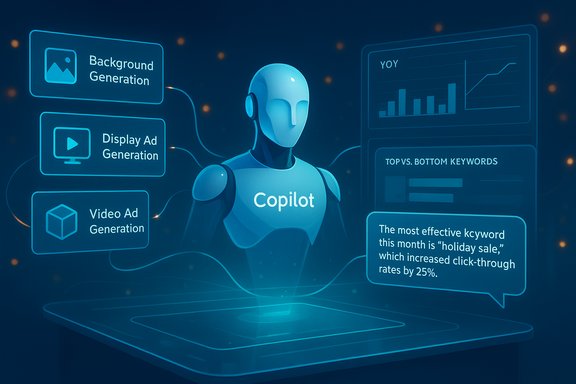
Microsoft expanded global API access (again, excluding mainland China) for Background generation, Display ad generation, Video ad generation, and Brand Kit functionality. The core value is operational: enterprises can integrate Copilot’s generative outputs into proprietary ad-build systems, creative management platforms, and programmatic workflows.Priceline’s rollout is the canonical example used by Microsoft: they embedded Copilot into their ad-production flow to generate hundreds of thousands of localized creative assets — a use case that’s nearly impossible for manual teams to match economically. Priceline reported a measurable lift in ad performance after the integration, which underscores the commercial argument for API-enabled scale.
Performance Comparison — conversational analytics for faster decisions
Performance Comparison is the newest analytics surface inside Copilot’s performance toolset, enabling advertisers to benchmark campaign performance across:- Year-over-year, quarter-over-quarter, month-over-month, week-over-week, day-over-day
- A/B test progress (test vs. control)
- Multi-month campaign recaps
- Top/lowest performing keywords, ads, ad groups, and campaigns
How this fits in the competitive landscape
Microsoft is not alone in bringing image-to-video and AI-driven creative tools to advertisers. The update needs to be read alongside parallel moves from Amazon, Google, and Meta:- Amazon Ads expanded Video Generator capabilities to all U.S. advertisers earlier in 2025 and markets image-to-video and multi-scene generation features intended to make rapid video creative broadly accessible. Those tools already produce multiple video options per request and emphasize product motion and multi-scene layouts.
- Google has been consolidating creative tooling under Asset Studio and integrating advanced image models (including Imagen family models) to let advertisers generate and edit imagery and short video assets within Google Ads. Google’s broader creative canvas aims at seamless ad production and previewing across channels.
- Meta has repeatedly rolled out video-editing and image-animation capabilities for Facebook/Instagram, and has invested in models that support short-form generation and editing; Meta’s tools have shown strong performance on Reels and short video placements.
Fact-checking key claims and verifiable numbers
- Microsoft’s product announcement and product details for Image Animation and Performance Comparison were published directly by Microsoft Advertising on November 17, 2025, confirming the timing and scope of the rollout.
- Microsoft’s advertising business showed substantial growth in 2025: public earnings statements and company financial summaries indicate search and news advertising revenue increased roughly 21% in a recent reporting period, supporting the view that Microsoft’s ad business is commercially robust.
- Microsoft Advertising’s own research — published in August 2025 — reports that Copilot-driven placements generated 73% higher click-through rates and 16% stronger conversion rates versus traditional search, with customer journeys 33% shorter (data window: Nov 2024–May 2025). This is first-party data and is publicly shared on Microsoft’s advertising blog. Advertisers should treat first-party platform studies as directional and validate against their own metrics.
- Amazon’s wider roll-out of enhanced Video Generator tools to U.S. advertisers was announced in June 2025 and shows Amazon is pursuing image-to-video capabilities aggressively, generating multiple creative options per request. Independent reporting corroborates the capability availability.
- Google and Meta have comparable offerings: Google’s Asset Studio and Meta’s Movie Gen / video-editing tools establish that image-to-video is now a cross-platform arms race.
- Microsoft’s blog post references an eMarketer forecast that Americans spend “4 hours and 14 minutes per day” consuming digital video. The Microsoft announcement cites that forecast for context, but the original eMarketer release with the precise number could not be located via public search at the time of reporting; advertisers should treat that figure as quoted by Microsoft rather than a direct, independently-verified eMarketer citation in this article. Exercise caution when relying on aggregated third-party forecasts that platforms quote in marketing materials.
Strengths — where Copilot’s updates earn their keep
- Operational scale for creative: The API expansion is the clearest enterprise-level win. Brands with large catalogs, many locales, or complex inventory can automate asset generation and serve long-tail demand that manual teams cannot cover economically. Priceline’s case shows how creative automation can unlock volume and personalization without linear headcount growth.
- Reduced time-to-insight: Performance Comparison’s conversational analytics addresses a real pain point — turning raw campaign data into actionable recommendations faster. For time-pressured seasonal campaigns, that speed can materially improve optimization cycles and budget allocation.
- Lowered creative barriers: Image Animation helps advertisers who lack in-house production resources produce motion creative for video inventory, increasing access to high-value placements and reducing dependency on external agencies or studios.
- Ecosystem integration: Because these features live inside Microsoft Advertising’s platform and API, they reduce handoff friction between planning, creative production, and media activation — a practical advantage for teams that want end-to-end automation.
Risks, limitations, and unanswered questions
1. Measurement and survivorship bias
Microsoft’s performance claims derive from first-party analysis. While the reported lifts (73% CTR, 16% conversion uplift) are eye-catching, platform-provided lift studies can reflect selection effects: early adopters, specific verticals, and placement differences could skew results. Advertisers should replicate testing on their own KPIs, using randomized controlled experiments where possible.2. Creative quality vs. volume trade-offs
Automated image-to-video workflows excel at scale, but quality is not uniform. Rapidly generated video variants can produce generic or repetitive motion, off-brand visual artifacts, or inconsistent audio/voice choices. Human review and quality gates remain essential for brand safety and creative coherence.3. Brand consistency and identity risk
Generative tools can inadvertently alter logos, trademarks, or product context in ways that confuse audiences or violate brand guidelines. A robust Brand Kit and explicit style constraints are necessary to ensure fidelity — and audits must be in place to detect accidental misuse.4. Transparency and ad labeling
Microsoft emphasizes “Ad Voice” and conversational separation between organic and sponsored content, but integrating ads directly into conversational AI responses raises transparency questions. Users must clearly understand what is paid and why it’s shown; regulatory scrutiny on native advertising and algorithmic transparency is increasing globally.5. Safety, deepfakes, and legal exposure
Video generation competent enough to mimic people, locations, or copyrighted content carries legal and reputational risk. Advertisers should implement policy layers restricting generation of public figures, copyrighted works, or sensitive content without clear rights and controls.6. Privacy and data flows
Embedding generative functions within an ad workflow that scrapes landing pages, ingests brand materials, and interacts with user session data raises potential data governance and compliance challenges. Enterprises must map data flows, ensure GDPR/CCPA compliance, and confirm where inference runs (on-device vs. cloud), especially for regulated verticals.7. Platform concentration and supply quality
Scaling automated creative into programmatic and publisher inventories depends on the underlying supply quality. Video placements across “premium” publishers may vary in performance; advertisers need to measure viewability and placement quality separately from creative effectiveness.Practical recommendations for advertisers
Quick checklist for holiday-ready Copilot adoption
- Define guardrails:
- Create a Brand Kit (logos, color palettes, tone rules).
- Prohibit generation of public figures, copyrighted content, and sensitive content.
- Pilot with a controlled cohort:
- Start with a single market or a low-risk product line.
- Run test vs. control A/B tests using the Performance Comparison features to validate lifts on your metrics.
- Measure holistically:
- Track CTR, CVR, post-click engagement, viewability, and conversion latency.
- Measure “quick-backs” or short dwell return rates as a proxy for landing page relevance.
- Implement human-in-the-loop:
- Auto-generate asset variants but route them through a brand reviewer before scale deployment.
- Log and audit:
- Record prompts, inputs, and generated outputs to support content provenance and dispute resolution.
- Check billing and API costs:
- Understand API unit economics — per-generation costs, storage, and downstream editing fees — before mass generation.
- Run legal clearance:
- Legal teams should approve the policy for generated content and confirm licensing for background imagery and music.
How to use Performance Comparison effectively
- Use conversational queries to surface quick hypotheses (e.g., “Compare keyword performance for the last 14 days vs. previous 14 days”).
- Schedule daily snapshot checks for high-traffic campaigns and weekly recaps for longer-funnel programs.
- Leverage the A/B monitoring to detect divergence early and pivot budget toward top-performing creative variants.
Implementation patterns and sample workflows
Small brand, fast-turn holiday push
- Step 1: Upload top-performing static images to Ads Studio.
- Step 2: Use Image Animation to generate 3 motion variants per asset.
- Step 3: Run a 50/50 traffic split for 48–72 hours using Performance Comparison to monitor CTR and conversion latency.
- Step 4: Promote winners across high-viewability video placements and use brand-safe blocklists.
Enterprise catalog automation (example pattern used by Priceline)
- Crawl product pages for brand tone and canonical images.
- Use Brand Kit to enforce brand voice and visual fidelity.
- Generate localized videos for long-tail destinations via the Video API.
- Feed outputs into the company’s ad supply-side platform for campaign activation.
- Hold weekly measurement and optimization meetings using Copilot conversational reports to surface underperformers.
Governance and procurement considerations
- Contracting: Negotiate API-level SLAs around availability, request throughput, and support during high-volume holiday periods.
- Data residency and processing: Confirm where inferencing occurs and which legal entity controls data; consider EU/data-region constraints.
- Model provenance and update cadence: Ask vendors for clear change-management notices when core models change, to avoid sudden creative drift.
- Auditability: Ensure logs for prompt inputs and outputs are retained for regulatory and legal review.
Where this will likely move next
- Tightening of safety controls and industry standards for AI-generated creative, including watermarking or provenance metadata that travels with assets.
- More robust on-device inference options for low-latency creative generation on certified hardware, reducing cloud costs and improving privacy.
- Increased demand for cross-platform creative management systems that normalize outputs across Google, Meta, Amazon, and Microsoft to prevent creative fragmentation.
- Growth of standardized AB/causal-measurement frameworks that let advertisers compare first-party platform claims with independent lift studies.
Final analysis: opportunity vs. responsibility
Microsoft’s announcement of Image Animation, expanded generative APIs, and Performance Comparison is a pragmatic, execution-focused set of features that solve three persistent advertiser problems: creative bottlenecks, scale for long-tail markets, and slow analytics. The updates lower the bar for producing video creative and raise the stakes on measurement and governance. For advertisers, the immediate upside is faster iteration and the ability to reach video inventory without a commensurate production budget. On the other hand, reliance on first-party platform research, automated creative, and conversational ad placements requires new controls. Advertisers should treat platform performance claims as hypotheses to be validated within their own accounts. Invest in brand-safe prompts, human review stages, audit logs, and A/B frameworks. Those steps balance the power of generative scale with the responsibility of brand stewardship.Microsoft’s move also accelerates what’s already an industry-wide shift: image-to-video and generative creative are now fundamental ad production tools, not fringe experiments. Amazon, Google, and Meta have released comparable toolsets, and the winner in the medium term will be whichever vendor combines creative fidelity, measurement transparency, and robust governance into a single, developer-friendly stack. For marketers preparing for the holidays, the immediate action is simple: pilot with guardrails, measure with randomized tests, and keep humans in the loop. The technology is ready to scale; the policies and measurement frameworks are the work that remains.
Microsoft’s announcement on November 17, 2025, is both a practical upgrade for advertisers and a reminder that creative production and campaign measurement are converging under the banner of generative AI — a shift that offers real gains for those who pair automation with rigorous controls.
Source: PPC Land Microsoft adds image animation and performance tracking to Copilot AI tools
