

Microsoft’s Copilot rollout — the centerpiece of a multi‑billion‑dollar push to make generative AI the default productivity layer for knowledge work — is bumping hard against the realities of enterprise IT, procurement, and everyday user behavior.
Microsoft framed Copilot as a simple value proposition: embed advanced language models across Microsoft 365, Windows, GitHub and Azure to automate repetitive tasks, summarize content, draft documents, and surface insights — then monetize that value both via seat subscriptions and increased Azure consumption. The company backed the vision with heavy capital spending, partnerships with leading model providers, and a broad family of “Copilot” branded experiences.
The optics of the strategy are powerful: Microsoft has reported millions of Copilot seats sold and highlighted large aggregate usage metrics across consumer and commercial surfaces. Yet those headline numbers mask an uneven reality: paid penetration in commercial Microsoft 365 seats remains modest, active usage and conversion lag expectations, and independent measurements suggest many users still prefer consumer chat assistants for ad‑hoc tasks.
Key practical failures reported by enterprises:
Hidden total cost of ownership (TCO) factors enterprises report:
If Microsoft executes the unglamorous work of reliability, simplifies pricing, and tightens governance primitives, Copilot can still fulfill much of its original promise. If those investments lag, however, Copilot risks becoming a cautionary example: a technically impressive product that failed to translate early hype into consistent enterprise value.
Source: WebProNews Microsoft’s Copilot Ambitions Collide With Reality as Enterprise Adoption Stalls
 Background
Microsoft framed Copilot as a simple value proposition: embed advanced language models across Microsoft 365, Windows, GitHub and Azure to automate repetitive tasks, summarize content, draft documents, and surface insights — then monetize that value both via seat subscriptions and increased Azure consumption. The company backed the vision with heavy capital spending, partnerships with leading model providers, and a broad family of “Copilot” branded experiences.The optics of the strategy are powerful: Microsoft has reported millions of Copilot seats sold and highlighted large aggregate usage metrics across consumer and commercial surfaces. Yet those headline numbers mask an uneven reality: paid penetration in commercial Microsoft 365 seats remains modest, active usage and conversion lag expectations, and independent measurements suggest many users still prefer consumer chat assistants for ad‑hoc tasks.
The promise vs. the practice: where the productivity gains went missing
Microsoft’s marketing promised that Copilot would deliver dramatic time savings — drafting emails in seconds, automatically summarizing meetings, generating polished slide decks, and surfacing correct spreadsheet insights. In controlled demos those moments frequently land. In production, many organizations report a different pattern: usefulness that’s intermittent, outputs that require careful editing, and long tail costs in verification and governance.Key practical failures reported by enterprises:
- Inconsistent output quality — helpful answers appear next to hallucinated or context‑blind responses that require human correction.
- High prompting overhead — many employees must craft careful prompts and iterate with the assistant, eroding the time saved.
- Domain specificity gaps — Copilot, trained on broad corpora, can lack the precise institutional or regulatory knowledge necessary for legal, finance, or healthcare workflows.
The Productivity Paradox: why pilots don’t become platforms
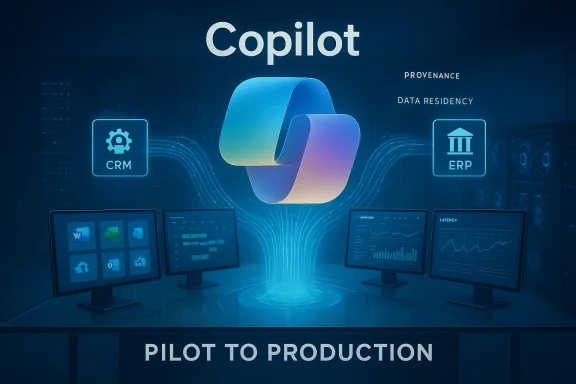
Enterprise AI projects have a well‑known transition problem: they look impressive in sandbox pilots but often fail to scale. For Copilot, that pilot‑to‑production gap shows up across three linked areas.1) Reliability and engineering maturity
Copilot’s integration model requires dependable, low‑latency access to models while maintaining strong security and compliance. Synchronous, in‑app assistants introduce different engineering constraints than stand‑alone chatbots, and Microsoft has experienced operational incidents and autoscaling pressure that directly affected customers. Those outages and degraded responses undermine trust for teams that expect continuous availability.2) Integration and data plumbing
Real enterprise value comes from connecting AI to live CRM, ERP, document stores, and custom systems. Building and maintaining those connectors — with the audits, logging, and role‑based access controls required by compliance teams — is nontrivial. The cost and time to build enterprise‑grade connectors often eclipse the initial pilot budget.3) Measurement and ROI uncertainty
CIOs and CFOs need auditable productivity metrics. Traditional time‑and‑motion gains are hard to capture for cognitive work, and many organizations find the quantitative uplift insufficient to justify seat‑by‑seat licensing at scale. The result: procurement delays, partial rollouts, and under‑utilized licenses.Economics: the cost structure complicates adoption
Microsoft’s per‑seat pricing tiers and consumption billing combine to make procurement calculus complicated. Commonly cited list prices (for certain Copilot tiers) near $30 per user per month scale quickly in large organizations and require clear, repeatable benefits to pay off. For a 10,000‑user deployment, the subscription line item alone can represent multi‑million‑dollar annual spend — before accounting for the internal costs of change management, training, governance tooling, and integration work.Hidden total cost of ownership (TCO) factors enterprises report:
- Training and enablement programs to teach employees how to prompt and verify AI outputs.
- Engineering time to develop and secure connectors to internal systems.
- Governance, monitoring and legal review to mitigate data‑use and compliance risk.
- Overhead from under‑utilized or misallocated seats. Independent surveys and internal telemetry show cases where only a fraction of purchased seats are actively used.
Technical debt, infrastructure strain, and the limits of agentic AI
Microsoft’s Copilot ambition required enormous investments in GPU capacity, data center footprint, and model hosting. Those investments were necessary but expensive, and customers realistically expect those costs to translate into reliable, enterprise‑grade performance. The problem: running large models at synchronous, global scale with strict SLAs is technically difficult.- Autoscaling and latency: Several incidents tied to unexpected spikes in traffic have produced timeouts and truncated answers inside Office apps, adding friction to workflows that rely on immediate responses.
- Costly chain of model calls for agents: Agentic workflows — sequences of model calls that execute multi‑step tasks — can be brittle and costly. Academic benchmarking and independent tests show many agents complete only a fraction of realistic, multi‑step office tasks reliably, and per‑task inference costs can run multiple dollars in controlled experiments. That makes broad, agentic automation expensive at scale and operationally fragile.
- Dependency on hardware supply chain: Azure’s economics for Copilot are tied to third‑party GPU hardware cycles, which constrains margin and time‑to‑scale, and leaves Microsoft partly dependent on suppliers for capacity growth.
Data privacy, governance, and the Recall controversy
Enterprises are rightly cautious about data used to prompt and train models. Copilot’s promise of contextual assistance depends on accessing corporate content, but that same capability creates real risks for data leakage, training telemetry exposure, and regulatory non‑compliance.- Microsoft has implemented tenant isolation and enterprise controls, yet legal and compliance teams still perform lengthy reviews before greenlighting deployments in regulated industries.
- High‑visibility controversies around features like Windows Recall — an indexed timeline of on‑screen content — sharpened risk perceptions. Even after Microsoft shifted to opt‑in defaults and added gating, the episode left enterprise security teams more skeptical and slowed adoption in conservative sectors.
Strategic implications for Microsoft
Microsoft’s Copilot program is more than a product bet — it’s a strategic thesis linking feature monetization to Azure consumption. The current adoption friction has several cascading consequences:- Investor expectations and revenue timing: Heavy capex to scale GPU capacity makes the timing of monetization material to investor narratives. If Copilot monetization lags, Microsoft may face pressure to reframe growth expectations or accelerate other Azure revenue streams.
- Pricing power erosion: Fragmented product messaging and visible competition from consumer assistants weaken premium pricing. Enterprises comparing alternatives can force discounts or seek hybrid, open‑source approaches.
- Brand fragmentation risk: “Copilot” is many things — GitHub Copilot for developers, Microsoft 365 Copilot for productivity, verticalized copilots, and platform tools for building agents. That fragmentation blurs the customer decision pathway and increases procurement friction.
Competition and the larger market context
Copilot’s struggle is not unique: the enterprise AI market is fragmenting rapidly. Google’s Gemini, OpenAI’s consumer offerings, and an increasing number of specialized vendors and open‑source stacks offer alternatives that appeal to different segments:- Consumer and ad‑hoc users often default to lightweight chat apps (ChatGPT, Gemini) because of accessibility and simplicity. That behavior erodes first‑choice preference for embedded assistants unless the enterprise product demonstrably beats them on workflow performance.
- Startups and cloud rivals emphasize customization and pricing flexibility, which can be attractive to enterprises unwilling to pay seat‑by‑seat licensing for uncertain returns.
Practical recommendations for CIOs, procurement teams, and IT leaders
Enterprises deciding whether to deploy Copilot (or any comparable assistant) should temper enthusiasm with disciplined risk management and measurement.- Start with measurable, high‑value use cases. Prioritize scenarios where outputs can be validated and ROI is quantifiable (e.g., templated report generation, inbox triage for specific teams, or standardized data extraction).
- Treat pilot success as a necessary but not sufficient signal. Require a production runbook that includes SLA targets, error budgets, and staffing plans for maintenance.
- Enforce non‑training enterprise tiers in contracts for regulated data, and insist on clear data residency and deletion clauses.
- Build an observability and auditing layer that logs prompts, responses, and downstream actions for compliance and debugging.
- Provide targeted training: don’t assume employees know how to prompt or verify model outputs; invest in practical, role‑specific enablement.
- Implement a multi‑assistant strategy as a hedge: allow users to access consumer tools for creative work while formalizing Copilot for official, auditable workflows.
What Microsoft must do next to convert pilots into durable adoption
To turn product promise into enterprise reality, Microsoft needs a three‑pronged focus:- Hardening reliability and observability: invest in the engineering work that reduces outages, improves latency at scale, and provides enterprise‑grade error handling and replay logs. Enterprises buy reliability, not demos.
- Simplify commercial packaging: reduce friction in purchasing by offering clearer bundles, predictable TCO models, and usage analytics that connect seat purchases to observable outcomes.
- Narrow and clarify product messaging: make it simple for buyers to understand which Copilot solves which problem, and offer migration paths between consumer and enterprise tiers. Product fragmentation is an adoption tax.
Industry lessons and the road ahead
Microsoft’s Copilot experience is a high‑visibility case study in how technical capability differs from product maturity. The enterprise AI transition will be iterative: vendors must earn trust through predictable behavior, clear governance, and demonstrable ROI. For buyers, the imperative is the same: approach AI as an operations and integration problem, not merely a license acquisition.If Microsoft executes the unglamorous work of reliability, simplifies pricing, and tightens governance primitives, Copilot can still fulfill much of its original promise. If those investments lag, however, Copilot risks becoming a cautionary example: a technically impressive product that failed to translate early hype into consistent enterprise value.
Conclusion
The story of Copilot today is not binary success or failure — it’s a course correction. The company built the right headline thesis: AI will be central to the next era of productivity. The harder truth now emerging is that the path from model capability to enterprise utility runs through reliability, integration, governance, and clear economics. Microsoft’s scale and resources give it a genuine shot at bridging that gap, but the timetable is longer and the engineering and commercial work more exacting than early rhetoric suggested. For enterprises, the prudent posture is to pilot strategically, require auditable value, and build governance up front. For Microsoft and the broader vendor ecosystem, the lesson is equally stark: momentum and marketing cannot substitute for trustworthy, repeatable outcomes.Source: WebProNews Microsoft’s Copilot Ambitions Collide With Reality as Enterprise Adoption Stalls
