

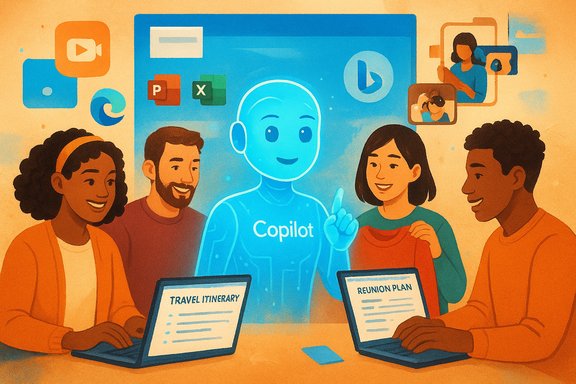
Microsoft’s decision to hire mainstream social media creators to model everyday use of Copilot marks a decisive turn: consumer marketing for an enterprise-rooted AI is moving from product briefs to short-form feeds, and the results will hinge less on impressions than on whether trial converts to habit.
Background / Overview
Microsoft’s Copilot family is now being pitched not only as an enterprise productivity layer but as a consumer-facing assistant that can live in Windows, Edge, Bing and standalone mobile apps. The company’s recent investor communications report that the first‑party Copilot family surpassed 150 million monthly active users, and that Microsoft sees roughly 900 million monthly active users of AI features across its product portfolio. These headline figures reflect rapid platform rollouts and deep integration across Microsoft 365, Windows and developer tools — but they also mix very different product types and usage contexts.By contrast, the two most visible consumer challengers in public perception are OpenAI’s ChatGPT, which company leadership has said reaches roughly 800 million weekly active users, and Google’s Gemini, which Google reports has around 650 million monthly active users. Those numbers have become shorthand in press coverage for the competitive pecking order, yet they are measured and reported in different ways (weekly vs monthly, consumer‑app installs vs enterprise integrations), which makes simple head‑to‑head comparisons misleading.
The new push is tactical: Microsoft has engaged lifestyle and short‑form creators — names reported publicly include Alix Earle and twin creators Brigette and Danielle Pheloung — to create candid demos showing how Copilot helps with chores, planning and creative tasks. Clips that present Copilot as a companion rather than a developer tool have already drawn tens of millions of views on major platforms. Microsoft has not publicly disclosed the financial terms of these creator deals or a systematic lift study tying creator posts to sustained installs or retention, leaving analysts and marketers asking whether reach will translate into durable consumer adoption.
Why this matters now
- Consumer mindshare shapes the next generation of AI habits. Conversational assistants win when opening them becomes a reflex for users seeking quick answers, ideas or creative starts.
- Microsoft occupies a unique distribution advantage. Copilot is embedded in software people already use daily — Outlook, Word, Excel, Windows — which can reduce onboarding friction if first trials land well.
- Marketing has to carry product experience. Viral impressions produce awareness; product reliability produces retention. The two together determine whether creator buzz becomes a growth lever or a costly experiment.
What Microsoft is actually promoting
The “Copilot family” is an umbrella term
Microsoft’s Copilot brand now spans:- Microsoft 365 Copilot (embedded in Office apps for information work)
- GitHub Copilot (coding assistant)
- Copilot consumer app(s) and Copilot integrations in Windows and Edge
- Domain‑specific copilots in security, healthcare and other verticals
Creators are showing practical, low‑friction use cases
Creator content typically focuses on bounded scenarios that nontechnical viewers can instantly understand:- Planning a reunion using Copilot Groups
- Styling or fashion prompts
- Quick travel itineraries and packing lists
- Light wellness or “life‑coach” style prompts (framed playfully)
Strengths of the influencer approach
- Scale where discovery happens: Short‑form video platforms are primary discovery engines for Gen Z and millennials. Demonstrations that fit native formats are more likely to drive initial curiosity than traditional banner ads.
- Built‑in distribution hooks: Copilot shows up inside products many users already have; a creator may spark an install but Microsoft’s product flows can reinforce activation inside an existing OS or Office install.
- Humanized storytelling: Lifestyle creators turn abstract AI claims into human moments — a friend‑like demo can normalize the idea of “asking an assistant” for routine decisions.
- Creative variety: Working across niches (beauty, fashion, travel, comedy) lets Microsoft seed multiple micro‑moments that collectively raise familiarity faster than one mass campaign.
Key risks and blind spots
1. Metric mixing and misleading comparisons
Vendor‑reported user numbers use different definitions and time frames. Microsoft’s 150M is a monthly aggregate across enterprise and consumer products. ChatGPT’s 800M figure is reported as weekly active users. Gemini’s 650M is a monthly active user number. Comparing WAU to MAU or aggregating disparate product types creates a distorted view of brand parity. Treat vendor milestones as directional, not apples‑to‑apples.2. Reach vs. retention (vanity metrics)
Influencer content is optimized for engagement, not retention. Views and likes do not equal installs, and installs do not equal sustained usage. Without public lift studies showing improvements in 7‑day or 30‑day retention tied to creator exposure, reach remains a top‑of‑funnel metric.3. Overpromising and hallucinations
Creators often dramatize an assistant’s fluency; viewers may assume outputs are authoritative. Generative systems still hallucinate and make factual errors. If creators present Copilot as an infallible adviser and real users encounter mistakes, brand trust and retention may suffer.4. Disclosure and regulatory exposure
Paid partnerships require clear labeling. Influencers who obscure sponsored content risk regulatory scrutiny and public backlash. Messaging must also avoid overstating privacy guarantees and data handling.5. Privacy and permission complexity
Consumer Copilot features increasingly require connectors — calendars, drives and mailboxes — to perform useful tasks. Creators showing frictionless integrations risk normalizing permissive data sharing without explaining what is stored, for how long, and how users can revoke access.6. Brand confusion
Multiple Copilot products with overlapping names can create confusion. Internal reports and employee commentary indicate some unease about consumers misinterpreting which Copilot lives where. Excessive brand stretch can dilute trust if product roles are unclear.Measured verification of the key commercial claims
- Microsoft publicly reported the Copilot family figure as part of its quarterly corporate statements. That number is an aggregate monthly active user figure across first‑party Copilot products and enterprise features.
- OpenAI leadership publicly stated ChatGPT’s user milestone as a weekly active user count; treating it like a weekly metric versus Microsoft’s monthly aggregate meaningfully changes the scale and interpretation.
- Google reported the Gemini app reaching hundreds of millions of monthly active users in the course of its earnings commentary, with the public figure commonly cited at roughly 650 million monthly active users.
Tactical recommendations for Microsoft (and brands trying the same play)
- Publish transparent lift studies
- Commit to randomized market tests or holdouts that measure creator exposure against key downstream metrics: install → activation → 7‑day retention → 30‑day successful session rate (SSR).
- Tighten creator guidance and disclosure
- Require clear sponsorship labeling and short safety captions that explain what permissions the app requests.
- Link creative hooks to product onboarding
- Pair each creator post with tailored onboarding flows and in‑app tips that set realistic expectations and reduce the likelihood of immediate churn.
- Make privacy and permission experiences explicit
- Give creators short scripts or cards to show how to revoke connectors and where memory is stored.
- Build a rapid response and correction playbook
- If a viral clip surfaces a product failure, respond transparently with corrective content rather than deleting or obfuscating.
- Align product and marketing KPIs
- Give product teams a direct signal from creator analytics to prioritize critical fixes highlighted by creators’ demos.
How to measure creator ROI in a complex AI product funnel
- Instrument UTM‑tagged creator links and use robust attribution platforms that combine:
- Click‑through and install attribution
- In‑app activation tracing (first chat, connector enabled)
- Event‑based retention (return sessions, task completion)
- Run randomized holdout markets to isolate creator lift from contemporaneous product updates, paid search, or other organic trends.
- Prioritize long‑term SSR as the core health metric rather than raw installs; SSR measures the proportion of sessions that accomplish a useful outcome.
- Use cohort analysis and A/B tests to see whether users acquired via creators progress to premium subscriptions, enterprise trials or other monetizable outcomes.
What this means for users and enterprise IT
- For consumers: creator demonstrations are useful to understand everyday possibilities, but outputs should be treated as starting points — verify critical facts and don’t hand over sensitive account permissions without reading the permission prompt.
- For IT leaders: an influencer‑driven consumer surge could increase requests to deploy Copilot‑enabled devices or subscriptions. Governance plans should include connector controls, data retention policies and a migration path to enterprise‑grade settings where available.
- For privacy advocates: monitor how creators frame data sharing. Promotional content should make clear whether the assistant has access to personal calendars, email or files, and how memory is controlled.
Will influencer marketing close the gap with ChatGPT and Gemini?
The short answer: unlikely on its own. Influencer campaigns are effective at generating trial and shaping perception among younger audiences, but closing a lead built on frequent, habitual usage requires product behavior that consistently delivers value.- ChatGPT’s user milestones reflect repeated day‑to‑day consumer engagement across a broad range of tasks; many users have built workflows and habits around opening the ChatGPT app or web interface.
- Google’s Gemini growth has been driven in part by viral features and browser integrations that created hooks inside an already‑ubiquitous product (search and Chrome).
- Microsoft’s strength is integration at the OS and productivity level — an advantage for converting trial into habitual workplace usage — but the consumer mindshare that translates into independent app habit still lags.
- Reliable outputs and low hallucination rates for common tasks
- Seamless permission and privacy controls that reassure users
- Strong product onboarding that turns curiosity into repeat behaviour
Strategic opportunities beyond vanity metrics
- Use creators as product researchers: creators surface real user pain points in the wild; Microsoft can turn those moments into prioritized product tickets that materially raise SSR.
- Leverage cross‑product funnels: a creator‑driven install that leads to enabling Copilot inside Windows or Office is far more valuable than a standalone app install. Design the post‑install flow to encourage activation where Microsoft’s ecosystem advantage is strongest.
- Open up measurable, limited experiments with creators where payment is tied to downstream outcomes (e.g., verified activations), not only views.
Final assessment
Microsoft’s influencer push is a logical and necessary experiment in consumerization. It acknowledges the reality that cultural relevance — not just enterprise contracts — will determine which assistant becomes part of daily life. The campaign’s early view counts demonstrate that creators can make Copilot feel approachable to audiences that do not live inside Office slide decks.However, several constraints temper enthusiasm:
- Public user‑count milestones from Microsoft, OpenAI and Google are real but non‑uniform; comparing them without normalizing the metrics is misleading.
- Viral creator content is not a substitute for product reliability; mismatches between promoted use cases and actual model behavior risk rapid churn.
- Regulatory and privacy obligations require clear, consistent disclosure, especially when creators demonstrate permissioned connectors or group memory features.
Source: Tech in Asia https://www.techinasia.com/news/microsofts-copilot-taps-influencers-to-rival-chatgpt-gemini/
