

Microsoft’s Copilot monetization story is starting to look less like a speculative AI option and more like a packaging and pricing engine for the entire productivity stack. That is the core message investors are reacting to after TD Cowen’s Derrick Wood reiterated a Buy on Microsoft with a $540 price target, arguing that stronger Copilot uptake, new bundles, and a more favorable Office 365 commercial mix support a stronger growth outlook. The thesis is not simply that AI is popular; it is that Microsoft is increasingly turning AI into a paid layer across enterprise workflows, security, and collaboration.
For much of the past two years, Microsoft’s AI narrative has been defined by anticipation. Investors wanted proof that Copilot could move beyond demos, pilots, and executive enthusiasm into sustained seat growth, real monetization, and durable average revenue per user expansion. That question is now shifting from “if” to “how fast,” because Microsoft has started to align product packaging, licensing, and infrastructure allocation around a more explicit paid adoption strategy.
The latest catalyst is a broader enterprise software cycle in which Microsoft is no longer selling only apps, but also an operating model for AI-assisted work. Copilot now sits at the center of Microsoft 365’s value proposition, while adjacent products such as security, identity, and agent management are being bundled more tightly into higher-priced suites. That matters because enterprise software seldom scales on enthusiasm alone; it scales when procurement logic, compliance needs, and security concerns all point in the same direction.
TD Cowen’s view, as summarized in the TipRanks report, is rooted in survey evidence and product timing. Wood’s read is that decision-makers are increasingly willing to upgrade suites and adopt AI agents, that many already see tangible ROI, and that Microsoft’s forthcoming bundles can increase paid Copilot penetration over time. In other words, the bull case is not centered on a single feature. It is built on a systematic re-rating of Microsoft’s commercial cloud economics.
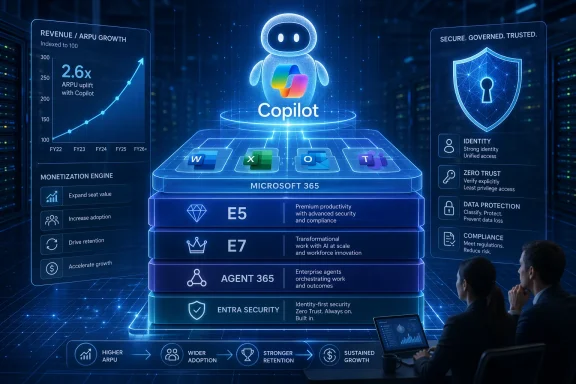
Microsoft’s own disclosures reinforce that framing. In its FY26 Q2 productivity and business processes report, the company said Microsoft 365 Commercial cloud revenue grew 17%, with revenue per user helped by Microsoft 365 E5 and Microsoft 365 Copilot. Microsoft also publicly positioned its new Microsoft 365 E7 bundle as a way to combine Copilot, Agent 365, and the Entra security stack into one premium package, with availability beginning May 1 at $99 per user per month. That combination signals a deliberate attempt to make AI monetization feel less experimental and more standard.
Copilot is the next step in that evolution, but it is also a test of whether Microsoft can commercialize generative AI at scale. The original promise was compelling: let users draft, summarize, search, analyze, and automate inside the apps they already use every day. The challenge was always adoption. Enterprises wanted evidence that the feature would justify its premium price, while Microsoft had to ensure the product did not cannibalize other revenue or create an expensive support burden.
That tension explains why Copilot’s rollout has been carefully staged. Microsoft first trained the market to think about AI as a productivity booster, then shifted toward enterprise-grade controls, then expanded to bundled offerings, and now is leaning into agentic workflows and suite packaging. The progression matters because each stage addresses a different buyer objection: usefulness, security, governance, and budget justification.
The backdrop to the TD Cowen call is also important. Microsoft is still spending aggressively on AI infrastructure, including GPUs and data center capacity, so monetization needs to keep pace with capital intensity. The company cannot afford a narrative in which it is the de facto supplier of enterprise AI infrastructure while rivals or customers capture most of the upside. That is why the move toward paid Copilot, premium bundles, and higher ARPU is so strategically important. It is not merely a product upgrade; it is a margin defense mechanism.
The company’s own messaging now emphasizes both user-facing productivity and enterprise control. Microsoft says Copilot is available as an add-on to Microsoft 365, and it continues to frame the product as a secure AI assistant grounded in work data and organizational context. In the enterprise, that positioning matters because the buying committee is not just looking for novelty; it is looking for a safe path to productivity gains.
What TD Cowen appears to be arguing is that adoption is crossing from curiosity into repeat behavior. If decision-makers are already seeing ROI and reporting high satisfaction, then the next phase becomes less about trial and more about standardization. That tends to improve gross retention, renewals, and bundle attach rates over time.
The broader significance is that Copilot can act as a force multiplier for existing Microsoft 365 monetization. If customers upgrade from mid-tier plans to E5-like bundles, or if they migrate from limited usage to broader licensed deployment, Microsoft benefits in several ways at once. It raises seat value, supports premium pricing, and gives the company a larger base for follow-on AI services.
This is more than a SKU launch. It is a signal that Microsoft wants to reframe the enterprise conversation around outcomes instead of line items. Rather than asking whether Copilot alone is worth $30 per user per month, Microsoft is asking whether the full suite of AI, security, identity, and governance capabilities is worth a premium as a unit. That is a very different sale.
The economics are attractive because a broader bundle can lift ARPU without requiring every customer to become a heavy AI user immediately. If the suite includes capabilities that procurement already values, then Copilot can ride along as part of a more expensive platform decision. That is a classic enterprise software tactic, and Microsoft is unusually good at it.
The other key point is timing. Microsoft is simultaneously planning broader commercial pricing updates for Microsoft 365 suite subscriptions effective July 1, 2026. That means the company is not merely adding value; it is also recalibrating price across the stack, which should support revenue growth even before usage reaches full maturity.
The survey angle also helps explain why Microsoft’s AI story can look different from consumer sentiment data. Consumer AI usage can be high while enterprise deployment remains limited, and enterprise deployment can be highly valuable even if only a subset of employees actively use the product. The buying center is the key variable, not the total number of casual users.
The market likely reads this as incremental evidence that Microsoft is winning mindshare in the right place. If purchasing decision-makers are increasingly open to Copilot and AI agents, then Microsoft’s sales force has a stronger story to tell in renewals, upsells, and new deployments. That can lift forward estimates even if current usage remains uneven.
GPU allocation is ultimately a capital allocation decision disguised as a technical one. If Microsoft gives preferential treatment to services that directly increase revenue per user, it improves the odds that AI spending produces visible financial returns. That is especially important for investors who worry that large-scale AI capex could outrun monetization for too long.
The broader implication is that Microsoft is attempting to control the value chain more tightly. Instead of merely hosting models or enabling third-party use cases, it is trying to channel compute into products it owns end-to-end. That can improve margin visibility and customer lock-in, but it also raises expectations. If the company is favoring its own services, then those services need to keep scaling.
Still, the competitive landscape is not static. Google, Adobe, SAP, and OpenAI all shape how buyers think about AI productivity and workflow automation. Microsoft must convince customers that its platform is not only integrated but also worth paying for repeatedly. In enterprise software, good enough plus ubiquitous often beats best-in-class plus isolated.
This is why the E7 bundle matters competitively. It gives Microsoft a way to answer the question of whether Copilot is a premium feature or a platform capability. If the market accepts the latter framing, Microsoft’s moat gets wider, not just deeper.
Consumer AI is important for brand familiarity and ecosystem reach, but enterprise AI is what can materially shift revenue. That is why Microsoft’s public emphasis is increasingly on commercial cloud, seat upgrades, and paid assistants rather than only on broad usage.
If TD Cowen is correct that Copilot penetration accelerates, then Microsoft can raise its long-term Office 365 Commercial Cloud revenue assumptions without needing explosive seat growth. That is the subtle but important point. A platform with enormous existing distribution does not need huge unit expansion to create meaningful revenue if it can increase monetization per customer.
There is also a second-order effect. As AI features become more integral to premium suites, Microsoft may gain pricing power in adjacent categories such as security, identity, and administration. That is especially true if customers come to see governance as inseparable from AI usage.
That means buyers will need to be more disciplined about evaluating use cases. If the business is purchasing Copilot primarily because it is bundled into E7 or because the renewal cycle makes it easy, it should still measure actual productivity gains, user engagement, and governance impact. Otherwise, the organization may end up paying for a premium suite whose value is only partially realized.
This is where Microsoft’s enterprise strengths become a double-edged sword. The same packaging power that makes its business model so durable can also make budgets creep upward without a proportional increase in adoption. Buyers need to treat AI not as a generic software upgrade, but as a managed investment.
The most important thing to watch is whether Microsoft can maintain momentum while keeping customer trust intact. Enterprise buyers will tolerate higher prices if they feel the platform saves time, reduces risk, and simplifies governance. They will not tolerate paying more for a vague AI story that never matures into measurable value. That is why the coming quarters matter so much.
Source: TipRanks Accelerating Copilot Adoption and New Office 365 Bundles Support Stronger Growth Outlook for Microsoft - TipRanks.com
 Overview
For much of the past two years, Microsoft’s AI narrative has been defined by anticipation. Investors wanted proof that Copilot could move beyond demos, pilots, and executive enthusiasm into sustained seat growth, real monetization, and durable average revenue per user expansion. That question is now shifting from “if” to “how fast,” because Microsoft has started to align product packaging, licensing, and infrastructure allocation around a more explicit paid adoption strategy.The latest catalyst is a broader enterprise software cycle in which Microsoft is no longer selling only apps, but also an operating model for AI-assisted work. Copilot now sits at the center of Microsoft 365’s value proposition, while adjacent products such as security, identity, and agent management are being bundled more tightly into higher-priced suites. That matters because enterprise software seldom scales on enthusiasm alone; it scales when procurement logic, compliance needs, and security concerns all point in the same direction.
TD Cowen’s view, as summarized in the TipRanks report, is rooted in survey evidence and product timing. Wood’s read is that decision-makers are increasingly willing to upgrade suites and adopt AI agents, that many already see tangible ROI, and that Microsoft’s forthcoming bundles can increase paid Copilot penetration over time. In other words, the bull case is not centered on a single feature. It is built on a systematic re-rating of Microsoft’s commercial cloud economics.
Microsoft’s own disclosures reinforce that framing. In its FY26 Q2 productivity and business processes report, the company said Microsoft 365 Commercial cloud revenue grew 17%, with revenue per user helped by Microsoft 365 E5 and Microsoft 365 Copilot. Microsoft also publicly positioned its new Microsoft 365 E7 bundle as a way to combine Copilot, Agent 365, and the Entra security stack into one premium package, with availability beginning May 1 at $99 per user per month. That combination signals a deliberate attempt to make AI monetization feel less experimental and more standard.
Background
Microsoft’s productivity franchise has always been its quiet superpower. Office evolved into Microsoft 365, then into a cloud subscription model that reduced license churn, improved predictability, and gave the company recurring revenue from what had once been a one-time purchase. The addition of Teams, security, compliance, and device management turned the suite into an enterprise operating platform rather than a set of office apps.Copilot is the next step in that evolution, but it is also a test of whether Microsoft can commercialize generative AI at scale. The original promise was compelling: let users draft, summarize, search, analyze, and automate inside the apps they already use every day. The challenge was always adoption. Enterprises wanted evidence that the feature would justify its premium price, while Microsoft had to ensure the product did not cannibalize other revenue or create an expensive support burden.
That tension explains why Copilot’s rollout has been carefully staged. Microsoft first trained the market to think about AI as a productivity booster, then shifted toward enterprise-grade controls, then expanded to bundled offerings, and now is leaning into agentic workflows and suite packaging. The progression matters because each stage addresses a different buyer objection: usefulness, security, governance, and budget justification.
The backdrop to the TD Cowen call is also important. Microsoft is still spending aggressively on AI infrastructure, including GPUs and data center capacity, so monetization needs to keep pace with capital intensity. The company cannot afford a narrative in which it is the de facto supplier of enterprise AI infrastructure while rivals or customers capture most of the upside. That is why the move toward paid Copilot, premium bundles, and higher ARPU is so strategically important. It is not merely a product upgrade; it is a margin defense mechanism.
Why the Packaging Shift Matters
The move from standalone AI add-ons toward broader suite bundles is often more important than the feature list itself. Enterprise buyers usually prefer predictability, security, and procurement simplicity over a cheaper but fragmented toolchain. Microsoft understands this better than most software vendors, and its current strategy reflects that advantage.- Bundles reduce friction in procurement.
- Bundles raise switching costs.
- Bundles make upsell easier for Microsoft sales teams.
- Bundles let Microsoft monetize governance, not just usage.
- Bundles turn AI into part of the baseline enterprise stack.
Copilot as the Growth Engine
The heart of the bullish thesis is that Copilot adoption is becoming a revenue driver, not just a product story. Microsoft has the rare advantage of embedding AI into the apps where workers already spend time, including Word, Excel, Outlook, PowerPoint, and Teams. That makes the product easier to understand at the executive level and easier to justify when measured against employee time savings.The company’s own messaging now emphasizes both user-facing productivity and enterprise control. Microsoft says Copilot is available as an add-on to Microsoft 365, and it continues to frame the product as a secure AI assistant grounded in work data and organizational context. In the enterprise, that positioning matters because the buying committee is not just looking for novelty; it is looking for a safe path to productivity gains.
What TD Cowen appears to be arguing is that adoption is crossing from curiosity into repeat behavior. If decision-makers are already seeing ROI and reporting high satisfaction, then the next phase becomes less about trial and more about standardization. That tends to improve gross retention, renewals, and bundle attach rates over time.
The broader significance is that Copilot can act as a force multiplier for existing Microsoft 365 monetization. If customers upgrade from mid-tier plans to E5-like bundles, or if they migrate from limited usage to broader licensed deployment, Microsoft benefits in several ways at once. It raises seat value, supports premium pricing, and gives the company a larger base for follow-on AI services.
Enterprise Adoption Signals
The strongest signal for Microsoft is not social buzz but purchasing behavior. When enterprises move from pilots to budgeted seats, that is when AI starts affecting the income statement.- Higher intent to upgrade suites.
- Rising willingness to pay for AI assistants.
- Positive ROI language from decision-makers.
- Better retention for enterprise subscriptions.
- More structured demand for governance and admin controls.
New Bundles and the Pricing Cycle
Microsoft’s bundling strategy is where the story becomes especially interesting. The company’s Microsoft 365 E7 plan, announced in March and set for availability on May 1, combines Microsoft 365 E5, Copilot, Agent 365, and the Entra Suite into a single premium package. Microsoft describes it as a frontier suite built to secure users and govern agents across the enterprise stack.This is more than a SKU launch. It is a signal that Microsoft wants to reframe the enterprise conversation around outcomes instead of line items. Rather than asking whether Copilot alone is worth $30 per user per month, Microsoft is asking whether the full suite of AI, security, identity, and governance capabilities is worth a premium as a unit. That is a very different sale.
E7 and the Premium Stack
E7 effectively turns Copilot into part of a wider enterprise control plane. That matters because many organizations hesitate to buy AI tools in isolation, but they are willing to spend on a more complete stack if it simplifies compliance and management. Microsoft’s own positioning suggests it expects exactly that behavior.The economics are attractive because a broader bundle can lift ARPU without requiring every customer to become a heavy AI user immediately. If the suite includes capabilities that procurement already values, then Copilot can ride along as part of a more expensive platform decision. That is a classic enterprise software tactic, and Microsoft is unusually good at it.
The other key point is timing. Microsoft is simultaneously planning broader commercial pricing updates for Microsoft 365 suite subscriptions effective July 1, 2026. That means the company is not merely adding value; it is also recalibrating price across the stack, which should support revenue growth even before usage reaches full maturity.
What Bundling Changes
Bundling changes the sales conversation, the user perception, and the financial model. It gives Microsoft more flexibility in how it frames ROI, and it makes Copilot less vulnerable to criticism that it is “too expensive” as a standalone license.- It improves attach rates across security and identity products.
- It makes procurement easier for large enterprises.
- It allows Microsoft to defend pricing with broader value.
- It can accelerate conversion from pilot to standard deployment.
- It creates a cleaner narrative for investors watching ARPU.
Survey Evidence and Market Read-Through
TD Cowen’s report appears to rely on a sizable survey of U.S. decision-makers, and that is important because enterprise AI adoption is often misunderstood through consumer-style usage metrics. In business software, the question is not how many people have heard of a tool. The question is who has budget authority, what problem is being solved, and whether deployment is broad enough to matter financially.The survey angle also helps explain why Microsoft’s AI story can look different from consumer sentiment data. Consumer AI usage can be high while enterprise deployment remains limited, and enterprise deployment can be highly valuable even if only a subset of employees actively use the product. The buying center is the key variable, not the total number of casual users.
The market likely reads this as incremental evidence that Microsoft is winning mindshare in the right place. If purchasing decision-makers are increasingly open to Copilot and AI agents, then Microsoft’s sales force has a stronger story to tell in renewals, upsells, and new deployments. That can lift forward estimates even if current usage remains uneven.
From Interest to Purchase
There is a critical distinction between enthusiasm and monetization. Survey respondents can say they like the product, but the outcome that matters is whether those impressions survive budget season.- Decision-makers control licensing.
- ROI language can unlock approvals.
- Security and governance reduce resistance.
- Suite upgrades can mask standalone AI price sensitivity.
- Adoption tends to deepen after organizational buy-in.
GPU Allocation and Monetization Discipline
One of the more revealing parts of the current Microsoft narrative is the idea that the company is reallocating GPU capacity toward first-party Copilot services. That suggests management is not just chasing broad AI growth; it is prioritizing workloads with clearer monetization paths. In a constrained infrastructure environment, this is a rational and telling choice.GPU allocation is ultimately a capital allocation decision disguised as a technical one. If Microsoft gives preferential treatment to services that directly increase revenue per user, it improves the odds that AI spending produces visible financial returns. That is especially important for investors who worry that large-scale AI capex could outrun monetization for too long.
The broader implication is that Microsoft is attempting to control the value chain more tightly. Instead of merely hosting models or enabling third-party use cases, it is trying to channel compute into products it owns end-to-end. That can improve margin visibility and customer lock-in, but it also raises expectations. If the company is favoring its own services, then those services need to keep scaling.
Why Compute Prioritization Matters
The strategic logic is clear: compute is scarce, expensive, and increasingly tied to measurable revenue. By pushing capacity toward paid Copilot experiences, Microsoft is effectively saying it wants the highest-return workloads first.- It aligns capex with monetization.
- It reduces dependence on speculative usage.
- It improves the economics of premium SKUs.
- It supports faster product iteration where demand is proven.
- It may limit the pace of experimentation elsewhere.
Competition and Market Positioning
Microsoft’s strongest competitive advantage is distribution. It can place Copilot in front of hundreds of millions of commercial users through a suite they already know, use, and trust. That is a far stronger position than a standalone AI vendor can claim, and it is one reason the company has been able to build a credible AI monetization path so quickly.Still, the competitive landscape is not static. Google, Adobe, SAP, and OpenAI all shape how buyers think about AI productivity and workflow automation. Microsoft must convince customers that its platform is not only integrated but also worth paying for repeatedly. In enterprise software, good enough plus ubiquitous often beats best-in-class plus isolated.
This is why the E7 bundle matters competitively. It gives Microsoft a way to answer the question of whether Copilot is a premium feature or a platform capability. If the market accepts the latter framing, Microsoft’s moat gets wider, not just deeper.
Enterprise Versus Consumer Dynamics
Enterprise adoption and consumer adoption are very different businesses, even when the same brand appears on both sides. Consumers tend to respond to convenience and novelty, while enterprises respond to control, compliance, and measurable productivity. Microsoft’s current strategy is built for the enterprise side of that equation.Consumer AI is important for brand familiarity and ecosystem reach, but enterprise AI is what can materially shift revenue. That is why Microsoft’s public emphasis is increasingly on commercial cloud, seat upgrades, and paid assistants rather than only on broad usage.
- Consumer users help awareness.
- Enterprise buyers drive revenue durability.
- Security and compliance drive willingness to pay.
- Workflow integration drives retention.
- Governance drives the premium tier.
Financial Implications
The financial consequence of Copilot adoption is likely to show up first in revenue per user, then in bundle mix, and eventually in margin structure. Microsoft’s FY26 Q2 disclosures already show that commercial cloud growth is benefiting from both E5 and Copilot. That is exactly the kind of mix shift investors want to see because it suggests the company is not relying purely on volume.If TD Cowen is correct that Copilot penetration accelerates, then Microsoft can raise its long-term Office 365 Commercial Cloud revenue assumptions without needing explosive seat growth. That is the subtle but important point. A platform with enormous existing distribution does not need huge unit expansion to create meaningful revenue if it can increase monetization per customer.
There is also a second-order effect. As AI features become more integral to premium suites, Microsoft may gain pricing power in adjacent categories such as security, identity, and administration. That is especially true if customers come to see governance as inseparable from AI usage.
Revenue Levers at Work
Microsoft now has several levers working at once, which is why the outlook appears stronger than a simple Copilot seat count would suggest.- Higher ARPU from premium bundle migration.
- Better revenue mix from commercial cloud expansion.
- More paid Copilot penetration over time.
- Upsell opportunities tied to security and governance.
- Potential price increases in future commercial cycles.
What This Means for IT Buyers
For enterprise IT teams, Microsoft’s strategy creates both opportunity and complexity. On the one hand, the company is offering a more integrated path to AI, security, and workflow automation. On the other hand, the pricing structure may make it harder to separate genuine AI value from bundle-driven upsell pressure.That means buyers will need to be more disciplined about evaluating use cases. If the business is purchasing Copilot primarily because it is bundled into E7 or because the renewal cycle makes it easy, it should still measure actual productivity gains, user engagement, and governance impact. Otherwise, the organization may end up paying for a premium suite whose value is only partially realized.
This is where Microsoft’s enterprise strengths become a double-edged sword. The same packaging power that makes its business model so durable can also make budgets creep upward without a proportional increase in adoption. Buyers need to treat AI not as a generic software upgrade, but as a managed investment.
Practical Questions for Buyers
A responsible rollout should answer a few straightforward questions before broad deployment.- Which teams actually benefit from Copilot today?
- What tasks are being accelerated in measurable terms?
- Does the bundle include features the organization already planned to buy?
- Are security and compliance controls sufficient for expanded use?
- Is the organization tracking usage, satisfaction, and ROI over time?
Strengths and Opportunities
Microsoft’s current setup has several clear advantages. The company is pairing product leadership with platform scale, and that combination is hard for competitors to replicate quickly. Just as important, it is monetizing AI in places where customers already have budgets and governance expectations.- Massive installed base creates a built-in upgrade path.
- Copilot integration makes AI feel native, not bolted on.
- E7 bundling can lift ARPU without relying on pure seat growth.
- Security and identity adjacency strengthens the value proposition.
- Commercial cloud growth already shows Copilot contributing to mix improvement.
- Pricing discipline suggests Microsoft is serious about paid adoption.
- Governance positioning may reduce enterprise hesitation around AI rollout.
Risks and Concerns
The bullish case is real, but it is not risk-free. Microsoft still has to prove that AI enthusiasm translates into broad, sustained spending rather than selective adoption in a few departments. If customers see Copilot as optional or overhyped, the monetization ramp could be slower than bulls expect.- Adoption may remain uneven across industries and job functions.
- Standalone Copilot pricing could create resistance at renewal time.
- AI capex intensity may pressure margins before monetization catches up.
- Competition from Google, Adobe, SAP, and OpenAI remains intense.
- Usage does not always equal value, especially in enterprise pilots.
- Bundle complexity could obscure ROI for procurement teams.
- Overpromising on AI risks a backlash if outcomes disappoint.
Looking Ahead
The next phase of this story will be determined by execution, not narrative. Microsoft must show that Copilot’s paid penetration rises meaningfully, that E7 converts at a healthy pace, and that commercial cloud growth remains resilient even as pricing changes roll through the base. If those things happen together, the company’s AI story will look less like a market theme and more like a durable operating lever.The most important thing to watch is whether Microsoft can maintain momentum while keeping customer trust intact. Enterprise buyers will tolerate higher prices if they feel the platform saves time, reduces risk, and simplifies governance. They will not tolerate paying more for a vague AI story that never matures into measurable value. That is why the coming quarters matter so much.
- Watch Copilot seat growth and renewal behavior.
- Track E7 adoption after the May 1 launch.
- Monitor commercial cloud revenue per user.
- Look for signs of higher paid AI attach rates.
- Pay attention to margin effects from AI infrastructure spending.
Source: TipRanks Accelerating Copilot Adoption and New Office 365 Bundles Support Stronger Growth Outlook for Microsoft - TipRanks.com
