

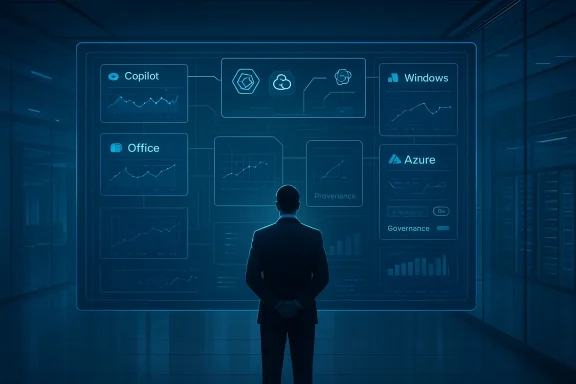
Microsoft’s AI playbook has moved from headline demos to CEO-led product pressure: Satya Nadella is personally orchestrating a faster, more pragmatic push to harden Copilot across Windows, Microsoft 365 and Azure while simultaneously hedging bets with multiple model partners — most notably OpenAI and Anthropic — and keeping an eye on open‑source agent tooling. The result is a high‑stakes, multi‑front strategy that ties product reliability, enterprise governance and massive cloud consumption into a single corporate mission: turn Copilot from a promise into repeatable, auditable value for businesses at scale.
Background
Microsoft’s Copilot is now the visible center of a much larger strategic wager. The company has recast Copilot as an orchestration layer that can route tasks across different model backends, embed agents in productivity surfaces, and monetize through a mix of seat subscriptions and metered Azure inference consumption. That commercial architecture is what makes the business case for intensive capital spending on GPUs and datacenter capacity.At the same time, Microsoft’s partnerships have deepened and diversified. OpenAI remains a key strategic partner through multi‑year commercial arrangements and preferential model access, but Microsoft is increasingly integrating Anthropic’s Claude family into production surfaces and even piloting Anthropic’s coding agent internally. Microsoft engineers are being asked to run Claude Code alongside GitHub Copilot to compare outcomes, signaling a pragmatic multi‑model approach rather than exclusive reliance on a single supplier.
That posture has real financial consequences: Microsoft’s reported cloud and Copilot metrics — and the multi‑year Azure commitments tied to model providers — create both revenue visibility and operational obligations that will play out over several fiscal years. These commitments are now central to analysts’ models and Microsoft’s datacenter plans.
What Nadella is actually doing: hands‑on product stewardship
From sponsor to steward
Multiple internal reports show Nadella shifting from high‑level sponsor to an active product steward: he’s convening weekly technical sessions, participating in engineer‑led demonstrations, and using internal Teams channels where product teams share prototypes and telemetry. That change in cadence is deliberate — senior leadership wants to reduce filtering, accelerate feedback loops, and expose thorny product problems earlier in the cycle.This isn’t typical CEO theatre. Nadella’s involvement is operational: top‑level intervention on model choices, integration priorities, and timelines. When your revenue thesis depends on enterprise customers trusting Copilot in regulated workflows, the CEO’s near‑term involvement signals urgency and shifts internal incentives.
Speed vs. stability: the new mandate
The pragmatic goal is straightforward: close the gap between marketing claims and production reliability. Internal signals cited in reporting point to persistent integration and reliability issues across email, calendar, and multi‑step agent flows — the very experiences that determine whether enterprises buy thousands of seats. Nadella’s response prioritizes measurable fixes: reduce hallucinations, tighten provenance, improve latency, and harden connectors to corporate data.That mandate reframes Copilot’s success criteria: instead of model‑size headlines, the company is measuring end‑to‑end KPIs such as error rates, response latency in Office flows, governance hooks, and demonstrable time‑saved metrics for business processes.
The multi‑model reality: OpenAI, Anthropic, and the pragmatism of choice
A polyamorous model strategy
Microsoft’s architecture increasingly treats models as interchangeable building blocks behind orchestration layers. Copilot Studio and Researcher are being instrumented to allow tenant admins to select different model backends — including OpenAI and Anthropic — depending on workload, governance needs, or cost targets. This design choice converts model competition into a product advantage: enterprises can choose the right tool for the job without ripping out Copilot.That model‑choice approach aligns with the “systems over models” thesis Nadella has been advocating: reliability and productization require orchestration, memory, entitlement enforcement, and audit trails — not just larger models. By decoupling the UI and orchestration plane from model backends, Microsoft reduces vendor lock‑in for customers while preserving a monetizable control point.
Why Anthropic matters (and why Microsoft uses it)
Anthropic’s Claude family — especially Claude Code and the Opus/Sonnet variants — has shown particular strength in coding and agentic workflows. Microsoft has integrated Anthropic endpoints into Azure Foundry and is using Anthropic models in internal pilots, including powering features that resemble competitor tools like Anthropic’s own Cowork. In short: Microsoft is both a partner and a competitor.Pragmatically, Anthropic offers Microsoft different tradeoffs: performance for certain agentic tasks, element‑level robustness in workflows, and an additional source of commercial buying (Anthropic itself has committed large Azure purchases). Microsoft’s willingness to run Anthropic models in production surfaces reflects a move away from monolithic vendor dependence.
The competitive flashpoints: Cowork, Moltbot, and agentic automation
Anthropic Cowork as a competitive signal
Anthropic’s Cowork — an agentic tool that can operate across apps and automate multi‑step tasks (for example, extracting receipts to create Excel spreadsheets or assembling a presentation from local files and web research) — crystallized an urgent product comparison inside Microsoft. Internal product leads flagged Cowork as a feature‑level competitor to 365 Copilot, prompting immediate engineering countermeasures and prototype builds that mirror Cowork’s horizontal, cross‑app capabilities.The practical lesson for Microsoft is that horizontal agents — those that can orchestrate actions across third‑party apps with minimal user effort — create new expectations for productivity AI. Microsoft’s advantage is deep, native integrations with Office and Windows, but the competitive challenge is real: users value a single tool that acts like a human across multiple silos.
Open‑source pressure: Moltbot (formerly Clawdbot) and developer innovation
Open‑source projects such as Moltbot (previously Clawdbot) are accelerating grassroots innovation. Nadella has publicly encouraged staff to experiment with these projects, and internal channels show senior executives testing open‑source agents themselves. That top‑down endorsement speeds adoption inside Microsoft and reveals another dimension of the competition: not just between hyperscalers and startups, but between corporate product roadmaps and community‑driven tooling that can be quickly assembled and deployed.Open‑source agents create both opportunity and risk. They expand the ecosystem of useful agent patterns Microsoft can learn from, but they also lower the bar for startups and integrators to build exactly the horizontal automation that threatens to unseat incumbent product flows. Microsoft’s response is therefore twofold: incorporate useful patterns, and accelerate productization so that enterprise customers prefer the governance and support that comes with Microsoft’s offerings.
Money and mechanics: how the cloud economics tie everything together
The Azure consumption thesis
Microsoft’s AI strategy is not only product engineering; it’s a cloud‑consumption play. Large multi‑year commitments from model partners (most prominently a multi‑year Azure purchase commitment widely cited in recent reporting) create a revenue backlog that smooths analyst models and justifies the massive capital outlays for GPUs and datacenters. Analysts now treat Copilot as both a seat revenue generator and a consumption engine tied to Azure, delivering two complementary monetization levers.The arithmetic matters: seat revenue (Copilot SKUs) provides predictable recurring license revenue, while inference and fine‑tuning consumption on Azure scales quickly as deployments expand — producing high‑margin, usage‑based revenue. That dual pathway is precisely what underpins Microsoft’s willingness to absorb heavy capex in the near term.
Revenue visibility and operational obligations
Long‑term cloud purchase commitments improve revenue visibility but also create operational obligations. Microsoft must deliver capacity, uptime, and latency at scale, and that requires sustained investment in specialized hardware and global sites. Those commitments reduce Microsoft’s flexibility in capacity planning and enforce a multiyear execution timetable. Analysts and customers will watch two sets of metrics closely: (1) how quickly bookings convert into recognized revenue, and (2) whether Microsoft maintains operational quality as workloads scale.Strengths: where Microsoft has real advantages
- Distribution and entrenchment: Microsoft owns identity (Entra/Azure AD), productivity (Microsoft 365), developer tooling (GitHub), and the cloud (Azure). That end‑to‑end surface is uniquely monetizeable and hard to replicate.
- Engineering and balance‑sheet capacity: Microsoft can fund large datacenter and GPU investments to secure capacity and preferential pricing, which supports its long‑term inference needs.
- Governance and enterprise controls: Copilot’s emphasis on tenant controls, opt‑in model choice, and auditability aligns with enterprise procurement and compliance demands. These features are increasingly central to adoption decisions.
- Product orchestration: By building Copilot as an orchestration layer rather than a single model interface, Microsoft can route workloads to the most appropriate backend and add value through connectors and entitlements.
Risks and unknowns: where the strategy could falter
- Reliability vs. hype: If Copilot continues to exhibit brittle behavior in real enterprise workflows (hallucinations, broken multi‑step flows, privacy leaks), seat adoption and renewals will stall. Internal reports indicate this is an ongoing concern and the impetus for Nadella’s hands‑on approach.
- Vendor complexity and legal friction: Running third‑party model endpoints (Anthropic, OpenAI) inside enterprise products raises data residency, contractual and IP complexity. Tenants must opt in and admins need fine‑grained controls — any misstep risks legal and regulatory backlash.
- Open‑source and startup agility: Horizontal agents from startups and open‑source projects can move faster and iterate directly on user feedback. Microsoft must close the features reliability gap faster than these nimble competitors can capture developer and early‑adopter mindshare.
- Capital intensity: The consumption model relies on sustained enterprise scale. If Azure capacity constraints, pricing pressure, or slower than expected Copilot seat adoption appear, Microsoft could face a longer and more expensive ramp to break‑even on its GPU investments.
- Perception and trust: CEO‑level attention helps, but leaked internal critiques and public demos that fail can damage enterprise trust. Microsoft must translate internal fixes into transparent, measureable improvements that customers and regulators can audit.
What this means for IT teams and Windows administrators
- Prioritize governance: Turn on tenant‑level controls, opt into model choice deliberately, and build clear provenance workflows for critical processes. Treat Copilot as a platform requiring ongoing policy management.
- Pilot with metrics: Run tightly scoped pilots that measure hallucination rates, time‑saved, and rework reduction. Use those metrics to justify seat rollouts rather than marketing claims.
- Plan for portability: Design automation and connectors so that outputs can be exported and validated outside a single Copilot instance. This reduces lock‑in risk if your organization chooses to switch models or vendors later.
- Watch vendor contracts: Negotiate clarity on data handling, retention, and liability when third‑party models are used inside Copilot workflows. Ensure SLAs reflect the criticality of agentic tasks.
Verdict: practical optimism tempered by execution risk
Microsoft’s strategic pivot — CEO involvement, multi‑model orchestration, and a cloud‑consumption monetization plan — is intellectually coherent and commercially plausible. The company’s unique distribution, enterprise controls and balance‑sheet strength give it a credible path to convert Copilot from promise to predictable revenue stream. Nadella’s top‑down push matters because it aligns incentives and accelerates resource allocation where the product most needs it.But the march from pilot to scale is treacherous. The biggest threat is not a single competitor but the combined pressure of startup agility, open‑source innovation, and the realities of enterprise governance. Microsoft can win if it executes systems engineering with measurable results — reduced hallucinations, tight audit trails, acceptable latency — and if it preserves the integration advantages of Office and Windows without creating brittle, opaque agentic behaviors.
What to watch next
- Product telemetry and KPIs Microsoft publishes or discloses for Copilot: look for measurable reductions in hallucination rates, improved latency, and enterprise adoption curves that show seats converting into daily active users.
- Model‑choice rollouts and governance features Tenant admin controls and opt‑in mechanics will be early indicators of how robust the platform is for regulated customers.
- Anthropic and open‑source integrations How Microsoft surfaces Anthropic and community agent patterns inside Copilot will reveal whether the company is successfully turning external innovation into product advantages.
- Azure capacity and bookings conversion Watch how multi‑year purchase commitments translate into recognized revenue and whether Azure keeps up with the demand profile for inference workloads.
Microsoft’s AI chapter is now a test of execution: convert orchestration and platform theory into predictable, auditable outcomes for business customers without losing the innovation edge that comes from external model partners and open‑source creativity. Nadella’s involvement makes the stakes clear: this is no longer a long‑range experiment — it’s a product and operational sprint whose results will shape how enterprises adopt AI in everyday workflows. For Windows users, IT leaders and developers, the immediate prescription is practical: pilot carefully, require provenance, and insist on metrics. The technology will continue to accelerate — the critical question is whether the product and governance engineering can keep pace.
Source: AI: Reset to Zero AI: Microsoft CEO proactive on Copilot AI Challengers. RTZ #981
