

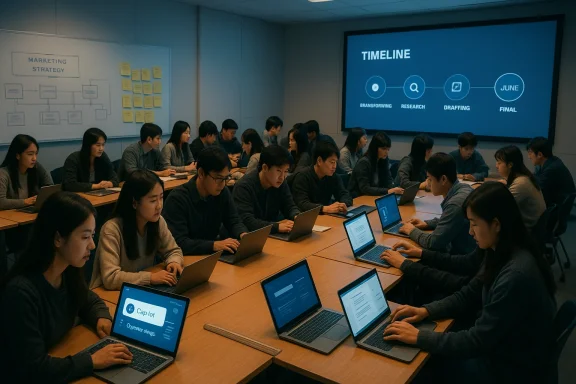
Korea Microsoft’s new capstone project with Sookmyung Women’s University and Samsung Electronics is more than a campus pilot. It is a deliberate attempt to measure how Microsoft Copilot changes the way students plan, research, and present work inside a real business context. By folding the project into a formal course for 50 business administration students, the partners are turning AI adoption into a structured experiment rather than a loose demonstration. The bigger story is that Copilot+ PCs, Windows, and Microsoft 365 are being positioned not just as productivity tools, but as the operating system for a new academic workflow.
The Digital Today report describes a corporate-linked capstone design course created through cooperation between Korea Microsoft and Sookmyung Women’s University, with Samsung Electronics tied to the final business scenarios and marketing strategy review. The class will run in the first semester of the 2026 academic year, and the project will conclude with a final presentation and certificate ceremony on June 12. That timeline matters because it gives the initiative enough runway to capture the full arc of student behavior, from early brainstorming to final deliverables. It is not a one-day hackathon or a marketing showcase. It is a semester-long test of how AI assistance affects academic output.
What makes the arrangement notable is the way it blends education, enterprise, and platform strategy. Microsoft is not simply offering students a chatbot; it is embedding Copilot into a workflow that includes Windows, Copilot+ PC experiences, and business-facing use cases. Microsoft’s own education messaging has increasingly emphasized that AI tools should be integrated directly into learning environments, and its Copilot-in-education positioning explicitly frames the product as an AI assistant for teaching and learning. That lines up with this project almost perfectly.
The timing also fits Microsoft’s broader Korea strategy. Just days before this report, Microsoft highlighted Korea as a key AI market and showcased local adoption stories during AI Tour Seoul, including fresh Copilot updates and broader organizational transformation cases. In other words, this capstone is not an isolated academic partnership; it is part of a wider push to normalize AI across Korean institutions and industries. The campus becomes a proving ground, and the university becomes a reference account.
There is also a strong consumer education angle hidden inside the enterprise narrative. Microsoft has spent the past year promoting Copilot+ PCs to students, calling out battery life, performance, and AI-powered productivity tools as reasons to study smarter. By placing university students on Copilot-enabled workflows, Microsoft can observe where the product genuinely helps and where the pitch still needs work. That is valuable feedback for product teams, but it is also useful market signaling. If students embrace the tools, the company can argue that the next generation already expects AI-native computing.
The project also gives Microsoft a chance to measure how AI tools affect student workflow, not just output quality. That distinction matters. A strong final deck may hide the fact that the student team spent more time validating answers or correcting AI-generated assumptions than they would have in a traditional class. A weaker deck may still reflect a healthier process if students learn better problem definition and iteration discipline.
From a journalism perspective, that is why this initiative is worth watching. It is not only about whether Copilot can write better copy or make prettier slides. It is about whether AI-assisted education can improve decision-making, collaboration, and speed without eroding the judgment that business schools are supposed to build.
For students, that may mean faster note-taking, quicker drafting, and easier task switching. For Microsoft, it means a chance to prove that AI productivity gains are not abstract. They are supposed to appear in the ordinary, messy reality of campus life: deadlines, team projects, presentations, and endless revision cycles. Those are the use cases that matter if Microsoft wants to convince universities and enterprises that Copilot is a durable platform shift rather than a temporary trend.
The enterprise signal is obvious: if students can use Copilot to accelerate early-stage planning without losing strategic rigor, businesses will be more willing to trust AI in the first drafts of work. That would be meaningful because many firms still hesitate to let generative AI touch outward-facing content. A university pilot with a major corporate partner helps normalize the idea that AI can contribute to strategy formation, not just clerical work.
But there is also a subtler message to Samsung’s competitors. By participating in a Microsoft-led education project, Samsung is helping validate the broader AI productivity ecosystem around Windows and Microsoft 365. That does not mean Samsung is conceding anything. It does mean the company sees value in being associated with the workflows that future white-collar workers will use. In a market where ecosystem control matters, that is a strategically practical choice.
But the risk is dependency. If students lean too hard on AI-generated summaries or canned recommendations, the project could reward speed over substance. That is where faculty oversight becomes essential. A well-designed capstone should force students to show their thinking, not just their final answer. Output quality is only useful if it is backed by decision quality.
The ideal outcome is a hybrid model where AI handles the repetitive work and students own the interpretation. That would give the cohort a realistic preview of the modern workplace, where AI is increasingly a collaborator but not a replacement for human judgment. It also mirrors the way Microsoft wants Copilot to be perceived: as a productivity multiplier, not an autonomous substitute.
Sookmyung Women’s University’s participation suggests the institution is willing to engage with that challenge rather than avoid it. That is important because many schools are still debating whether AI should be restricted, tolerated, or integrated into coursework. A capstone tied to an actual company task takes a more constructive path: it asks how AI can be governed in a way that supports learning outcomes.
The broader implication is that AI literacy is quickly becoming a core employability skill. Students entering business, marketing, and strategy roles will almost certainly work alongside AI tools. A project like this gives them a controlled environment to learn when to trust the tool, when to challenge it, and when to discard its output entirely. That may be the most valuable lesson of all.
That matters in a market like Korea, where technology adoption can move quickly but expectations are also high. To win credibility, Microsoft has to show that Copilot delivers measurable value in real settings, not just in promotional slides. University partnerships are useful because they create visible, human-scale stories about change. They also help the company build goodwill with future professionals who may later carry Microsoft tools into their employers.
The competitive angle is equally interesting. Rivals in productivity software and device ecosystems will be watching to see whether Microsoft can convert education partnerships into durable preference. If students learn with Copilot and later use it at work, that would strengthen Microsoft’s long-term enterprise moat. The company knows that platform habits formed early can echo for years.
For students, that continuity can be a real benefit. It can reduce onboarding friction and make the transition from academic projects to corporate assignments feel less abrupt. Yet it also raises a pedagogical question: are universities teaching students to use a tool, or teaching them how to think in a world where tools increasingly generate first drafts? The answer should be both, but the balance matters. Tool fluency should never replace thinking fluency.
That distinction is especially relevant in business education. Strategy, marketing, and customer analysis all involve judgment under uncertainty. Copilot can accelerate the mechanics, but it cannot fully replace the human job of deciding which opportunity matters, which tradeoff is acceptable, or which insight is actually actionable. Those are precisely the kinds of decisions a capstone should teach.
The certificate element is also worth noting. It gives students a formal credential tied to AI-capable teamwork, which may help them in future job searches. Employers increasingly want evidence that candidates can use AI responsibly and effectively. A certificate from a respected university-industry collaboration may become a meaningful signal in that environment.
Still, the finale should not be treated as proof of broad success. A strong showcase can obscure uneven participation, overreliance on AI, or faculty scaffolding that did most of the heavy lifting. The real test is whether the project changes the way students work after the event ends. That is the harder, more interesting question.
It will also be worth watching how the university describes the students’ role. If the language emphasizes originality, verification, and critical thinking, the project could become a useful example of responsible AI adoption. If the framing is mostly promotional, its impact will be more limited. In the AI era, the difference between learning with tools and being sold a tool is becoming harder to ignore.
Source: 디지털투데이 Korea Microsoft to launch Copilot capstone project with Sookmyung Women's University
 Overview
The Digital Today report describes a corporate-linked capstone design course created through cooperation between Korea Microsoft and Sookmyung Women’s University, with Samsung Electronics tied to the final business scenarios and marketing strategy review. The class will run in the first semester of the 2026 academic year, and the project will conclude with a final presentation and certificate ceremony on June 12. That timeline matters because it gives the initiative enough runway to capture the full arc of student behavior, from early brainstorming to final deliverables. It is not a one-day hackathon or a marketing showcase. It is a semester-long test of how AI assistance affects academic output.What makes the arrangement notable is the way it blends education, enterprise, and platform strategy. Microsoft is not simply offering students a chatbot; it is embedding Copilot into a workflow that includes Windows, Copilot+ PC experiences, and business-facing use cases. Microsoft’s own education messaging has increasingly emphasized that AI tools should be integrated directly into learning environments, and its Copilot-in-education positioning explicitly frames the product as an AI assistant for teaching and learning. That lines up with this project almost perfectly.
The timing also fits Microsoft’s broader Korea strategy. Just days before this report, Microsoft highlighted Korea as a key AI market and showcased local adoption stories during AI Tour Seoul, including fresh Copilot updates and broader organizational transformation cases. In other words, this capstone is not an isolated academic partnership; it is part of a wider push to normalize AI across Korean institutions and industries. The campus becomes a proving ground, and the university becomes a reference account.
There is also a strong consumer education angle hidden inside the enterprise narrative. Microsoft has spent the past year promoting Copilot+ PCs to students, calling out battery life, performance, and AI-powered productivity tools as reasons to study smarter. By placing university students on Copilot-enabled workflows, Microsoft can observe where the product genuinely helps and where the pitch still needs work. That is valuable feedback for product teams, but it is also useful market signaling. If students embrace the tools, the company can argue that the next generation already expects AI-native computing.
Why this partnership matters
At first glance, the project sounds like a standard industry-academia collaboration. But the specific partners and task design make it more strategic than that. Sookmyung Women’s University brings a structured student cohort, Samsung Electronics provides real business relevance, and Korea Microsoft supplies the AI platform and productivity layer. That combination lets each party test a different part of the value chain. Microsoft tests product utility, Samsung tests marketing and customer-scenario ideation, and the university tests educational relevance.A semester-long laboratory
A semester-long capstone is a better test bed than a short workshop because it reveals habits, not just reactions. Students can use Copilot at multiple stages: framing a problem, organizing notes, drafting strategy options, refining language, and preparing presentations. Those are precisely the kinds of tasks where generative AI can either improve efficiency or flatten original thinking, so the real outcome depends on how the course is designed and assessed.The project also gives Microsoft a chance to measure how AI tools affect student workflow, not just output quality. That distinction matters. A strong final deck may hide the fact that the student team spent more time validating answers or correcting AI-generated assumptions than they would have in a traditional class. A weaker deck may still reflect a healthier process if students learn better problem definition and iteration discipline.
From a journalism perspective, that is why this initiative is worth watching. It is not only about whether Copilot can write better copy or make prettier slides. It is about whether AI-assisted education can improve decision-making, collaboration, and speed without eroding the judgment that business schools are supposed to build.
- It tests AI as a workflow partner, not a novelty.
- It ties classroom work to real business scenarios.
- It creates measurable student behavior across a full semester.
- It gives Microsoft practical feedback on product adoption.
- It lets Samsung observe how young users frame market problems.
The Copilot and Copilot+ PC angle
The most important detail in the report may be the mention of Microsoft Copilot integrated across the Windows environment and the latest Copilot+ PC experience. That signals that Microsoft wants this pilot to showcase not only cloud AI, but also the newer device category built around on-device intelligence. Microsoft introduced Copilot+ PCs in 2024 as a new class of Windows machines designed for AI workflows, with performance and battery-life benefits positioned as part of the appeal. Since then, the company has continued to frame Copilot+ as a core part of the future of Windows computing.Windows as the AI surface
The Windows angle is especially important because it changes Copilot from an app into a system-level experience. Instead of treating AI as a separate site or chatbot, Microsoft wants Copilot to live inside the operating system, close to documents, apps, and user context. That makes the student workflow more frictionless, but it also makes the platform more sticky. The better the experience feels inside Windows, the harder it becomes for users to switch away later.For students, that may mean faster note-taking, quicker drafting, and easier task switching. For Microsoft, it means a chance to prove that AI productivity gains are not abstract. They are supposed to appear in the ordinary, messy reality of campus life: deadlines, team projects, presentations, and endless revision cycles. Those are the use cases that matter if Microsoft wants to convince universities and enterprises that Copilot is a durable platform shift rather than a temporary trend.
Device strategy meets education
The device strategy is also a hedge against commoditization. If AI chat tools become interchangeable, Microsoft’s advantage comes from owning the environment where the work happens. Copilot+ PC gives the company a hardware story, a software story, and a learning story all at once. That is a much stronger position than simply competing on chatbot features.- Copilot becomes a built-in workflow layer.
- Copilot+ PCs add a hardware differentiator.
- Windows provides context and persistence.
- Students experience AI in everyday tasks.
- Microsoft gains a more complete ecosystem pitch.
Samsung’s role and the enterprise signal
Samsung Electronics’ involvement gives the project a more practical edge. The report says the customer scenarios and marketing strategy guidelines produced by students will be reviewed in connection with Samsung’s real business tasks. That means the capstone is not just about academic polish; it is about testing whether AI-assisted student teams can contribute ideas that resemble actual corporate thinking. It is a smart way to bridge classroom creativity and enterprise usefulness.From classroom ideas to corporate tasks
This kind of linkage matters because it changes what counts as success. In a typical university project, the goal is often conceptual clarity or presentation quality. Here, the student output needs to be valuable enough that a global electronics company can see how it maps onto market planning, customer insight, or campaign framing. That is a much higher bar, and it makes the project feel closer to a hiring pipeline or innovation lab than a standard class assignment.The enterprise signal is obvious: if students can use Copilot to accelerate early-stage planning without losing strategic rigor, businesses will be more willing to trust AI in the first drafts of work. That would be meaningful because many firms still hesitate to let generative AI touch outward-facing content. A university pilot with a major corporate partner helps normalize the idea that AI can contribute to strategy formation, not just clerical work.
But there is also a subtler message to Samsung’s competitors. By participating in a Microsoft-led education project, Samsung is helping validate the broader AI productivity ecosystem around Windows and Microsoft 365. That does not mean Samsung is conceding anything. It does mean the company sees value in being associated with the workflows that future white-collar workers will use. In a market where ecosystem control matters, that is a strategically practical choice.
What students are likely to learn
The most important lesson may not be how to use a specific AI feature. It may be how to ask better questions of an AI system. Students who are guided properly will learn to treat Copilot as a drafting assistant, research accelerator, and brainstorming tool, not as an oracle. That distinction is critical because the value of generative AI depends heavily on prompt quality, verification habits, and editorial judgment.Productivity versus dependency
There is a real productivity upside to Copilot in a course like this. Students can move faster from raw notes to structured plans, and they may spend less time on repetitive formatting and more on analysis. That should, in theory, give them more room to think critically about customer behavior, messaging, and market fit. Microsoft has been making exactly this case in its student-facing product messaging.But the risk is dependency. If students lean too hard on AI-generated summaries or canned recommendations, the project could reward speed over substance. That is where faculty oversight becomes essential. A well-designed capstone should force students to show their thinking, not just their final answer. Output quality is only useful if it is backed by decision quality.
The ideal outcome is a hybrid model where AI handles the repetitive work and students own the interpretation. That would give the cohort a realistic preview of the modern workplace, where AI is increasingly a collaborator but not a replacement for human judgment. It also mirrors the way Microsoft wants Copilot to be perceived: as a productivity multiplier, not an autonomous substitute.
- Students gain faster drafting and organizing workflows.
- Faculty can observe real AI literacy in action.
- Teams may improve presentation and storytelling speed.
- The course can surface verification habits and gaps.
- The project may reveal where AI support stops helping.
The academic innovation story
Higher education is under pressure to show that it can prepare students for an AI-saturated workplace. That has pushed universities to rethink capstones, internships, and lab-based collaboration. Microsoft has clearly understood this trend and has been building education-oriented materials around Copilot+ PCs, Windows 11, and AI-enabled learning experiences. This project fits neatly into that broader institutional shift.Capstone design as a testbed
Capstone projects are especially useful because they sit at the intersection of theory and practice. They let students demonstrate not just knowledge, but synthesis. When AI enters that environment, it challenges educators to define what the student contribution actually is: idea generation, verification, synthesis, narrative construction, or final presentation polish. That question is becoming central across universities, not just in Korea.Sookmyung Women’s University’s participation suggests the institution is willing to engage with that challenge rather than avoid it. That is important because many schools are still debating whether AI should be restricted, tolerated, or integrated into coursework. A capstone tied to an actual company task takes a more constructive path: it asks how AI can be governed in a way that supports learning outcomes.
The broader implication is that AI literacy is quickly becoming a core employability skill. Students entering business, marketing, and strategy roles will almost certainly work alongside AI tools. A project like this gives them a controlled environment to learn when to trust the tool, when to challenge it, and when to discard its output entirely. That may be the most valuable lesson of all.
Korea as a strategic AI market
Microsoft’s involvement in this capstone should also be read through the lens of its recent Korea messaging. The company has described Korea as a place where AI adoption is already high and where it wants to deepen partnerships across sectors. It has highlighted enterprise transformation, workforce skilling, and AI infrastructure as part of a broader national opportunity. This university project sits inside that larger strategy.Beyond one-off pilots
A common weakness in corporate AI initiatives is that they stay trapped in pilot mode. They generate nice headlines, but they never become repeatable models. Microsoft appears to be trying to avoid that by linking product demos, education programs, and enterprise use cases into a more coherent Korean story. If this capstone works, it can be cited alongside other local examples as evidence that Microsoft’s AI stack is adaptable across institutions.That matters in a market like Korea, where technology adoption can move quickly but expectations are also high. To win credibility, Microsoft has to show that Copilot delivers measurable value in real settings, not just in promotional slides. University partnerships are useful because they create visible, human-scale stories about change. They also help the company build goodwill with future professionals who may later carry Microsoft tools into their employers.
The competitive angle is equally interesting. Rivals in productivity software and device ecosystems will be watching to see whether Microsoft can convert education partnerships into durable preference. If students learn with Copilot and later use it at work, that would strengthen Microsoft’s long-term enterprise moat. The company knows that platform habits formed early can echo for years.
AI in the classroom versus AI in the office
One reason this story stands out is that it blurs the line between educational and workplace AI. The same Copilot environment that helps students draft a business plan is also designed for office productivity, document creation, and enterprise collaboration. That continuity is attractive to Microsoft because it reduces the gap between learning and working. It also means the classroom can double as a training ground for enterprise software adoption.Continuity of tools, continuity of habits
When the same ecosystem follows a user from college into their first job, the habits become sticky. They do not have to relearn a new workflow, and the employer gets a worker who already understands the productivity stack. That is a major commercial advantage for Microsoft, especially as AI competition increasingly centers on who owns the daily operating layer rather than the flashiest standalone model.For students, that continuity can be a real benefit. It can reduce onboarding friction and make the transition from academic projects to corporate assignments feel less abrupt. Yet it also raises a pedagogical question: are universities teaching students to use a tool, or teaching them how to think in a world where tools increasingly generate first drafts? The answer should be both, but the balance matters. Tool fluency should never replace thinking fluency.
That distinction is especially relevant in business education. Strategy, marketing, and customer analysis all involve judgment under uncertainty. Copilot can accelerate the mechanics, but it cannot fully replace the human job of deciding which opportunity matters, which tradeoff is acceptable, or which insight is actually actionable. Those are precisely the kinds of decisions a capstone should teach.
Why the June 12 finale matters
The planned final presentation and certificate-awarding ceremony on June 12 is more than a ceremonial endpoint. It creates a public milestone that can be used to evaluate the project’s legitimacy. If the outputs are strong, Microsoft and the university will have a concrete success story. If the work feels derivative, the event still provides useful feedback about the limits of AI-assisted student projects.The value of visible outcomes
Public presentations matter because they force clarity. Students have to explain not only what they produced, but how they used Copilot and what value it added. That transparency is crucial in a moment when many AI claims are vague or inflated. It is one thing to say AI improved productivity; it is another to show the before-and-after process in front of faculty, company partners, and peers.The certificate element is also worth noting. It gives students a formal credential tied to AI-capable teamwork, which may help them in future job searches. Employers increasingly want evidence that candidates can use AI responsibly and effectively. A certificate from a respected university-industry collaboration may become a meaningful signal in that environment.
Still, the finale should not be treated as proof of broad success. A strong showcase can obscure uneven participation, overreliance on AI, or faculty scaffolding that did most of the heavy lifting. The real test is whether the project changes the way students work after the event ends. That is the harder, more interesting question.
Strengths and Opportunities
This partnership has several obvious strengths, but the biggest opportunity is that it creates a repeatable model for how universities, software vendors, and corporate sponsors can collaborate around AI literacy. If executed well, it could become a template for future courses in business, communications, and design. It also gives Microsoft and Samsung a shared narrative around practical innovation rather than abstract AI hype.- Builds real-world relevance into academic work.
- Gives Microsoft a live test of Copilot adoption in education.
- Helps Samsung observe student thinking on market and customer scenarios.
- Strengthens Sookmyung Women’s University’s industry-facing profile.
- Encourages AI literacy and responsible workflow habits.
- Creates a visible bridge between campus learning and enterprise practice.
- May produce a reusable model for other universities and partners.
Risks and Concerns
The downside is that any AI-heavy classroom experiment can slide into superficiality if the tools are treated as shortcuts instead of collaborators. There is also the risk of overpromising what Copilot can do in strategic work, especially if students produce polished but shallow deliverables. Finally, universities must be careful about data handling, transparency, and the fairness of assessing work that may be partially AI-assisted.- Students may become overly dependent on AI-generated drafts.
- Final outputs may look strong while reasoning remains weak.
- Faculty assessment standards may not fully match AI workflows.
- Corporate partners may expect more business value than students can realistically deliver.
- Privacy and data-governance questions may arise in project work.
- The project could be interpreted as marketing if outcomes are not transparent.
- Some students may benefit more from the tools than others, widening gaps.
Looking Ahead
The next few months will show whether this capstone becomes a meaningful case study or just a polished proof of concept. The most important metrics will be how students actually work, how the faculty evaluates that work, and whether Samsung and Microsoft see outputs worth extending into new projects. If the project produces clear evidence of better planning, faster iteration, and stronger presentations, it will bolster Microsoft’s argument that Copilot belongs at the center of modern academic and enterprise workflows.It will also be worth watching how the university describes the students’ role. If the language emphasizes originality, verification, and critical thinking, the project could become a useful example of responsible AI adoption. If the framing is mostly promotional, its impact will be more limited. In the AI era, the difference between learning with tools and being sold a tool is becoming harder to ignore.
- Whether students use Copilot for brainstorming, drafting, or final refinement.
- Whether the final presentations show stronger strategic reasoning.
- Whether Samsung identifies usable insights from the student outputs.
- Whether Microsoft expands the model to other Korean universities.
- Whether the project becomes a recurring education-and-enterprise template.
Source: 디지털투데이 Korea Microsoft to launch Copilot capstone project with Sookmyung Women's University
