

Microsoft is pushing deeper into enterprise AI research with two new capabilities for Researcher, its Copilot-based research agent: Critique and Council. The timing matters. Microsoft has spent the past year turning Copilot from a chat assistant into an increasingly modular agent platform, and these additions are aimed at one of the hardest problems in enterprise AI: making generated research not just fluent, but reliable. In a market where every vendor is promising deeper reasoning, Microsoft is betting that transparency, multi-model workflows, and internal evaluation loops will become the differentiators that enterprises care about most.
Microsoft’s Copilot strategy has evolved quickly from productivity assistant to enterprise agent ecosystem. When Researcher and Analyst became generally available in Microsoft 365 Copilot in June 2025, Microsoft positioned them as “reasoning agents” built for work, with Researcher focused on multi-step research and Analyst on data analysis. Microsoft said Researcher combined OpenAI’s deep research model with Copilot orchestration and deep search, and it highlighted early uses such as tariff analysis, vendor negotiations, and client preparation. (microsoft.com)
That launch was important because it established a new baseline: Microsoft was no longer just surfacing generative AI inside Office apps, but packaging specialized workflows as named agents. The company also tied Researcher to the Frontier program, its early-access channel for experimental capabilities. By the time Researcher became broadly available, Microsoft had already signaled that the feature was meant to be more than a simple summarization tool; it was designed for deep work, with licensing, governance, and usage limits layered around it. (microsoft.com)
The newer Critique and Council features appear to be the next stage of that evolution. Microsoft’s broader messaging in March 2026 stressed a model-diverse, enterprise-controlled future for Copilot, including multiple model families and more explicit governance. Microsoft also said Copilot is now being built as an open, heterogeneous system rather than a single-model product, and that enterprise trust is becoming as important as raw capability. (blogs.microsoft.com)
This matters because enterprise users rarely need AI to be merely creative. They need it to be auditably useful. Research agents that hallucinate sources, miss counterarguments, or fail to expose uncertainty are hard to trust in procurement, finance, legal, strategy, and operations. Microsoft’s new features are therefore best understood as a direct answer to the enterprise fear that AI can sound right while still being wrong.
The broader competitive context is equally important. OpenAI, Anthropic, Google, and others have all been moving toward “deep research” and multi-step reasoning tools. Microsoft’s advantage is that it can combine model access, enterprise data, security layers, and workflow integration in one product stack. If Critique and Council work as advertised, they could help Microsoft claim not just that Copilot can do research, but that it can do it in a way enterprises are more willing to act on.
Council takes a different approach. Rather than asking one model to do all the work, it runs models from Anthropic and OpenAI in parallel, with each producing a full independent report. A separate judge model then compares the outputs and summarizes areas of agreement, divergence, and noteworthy differences. That gives users a side-by-side view of how different systems reason about the same problem, which is a meaningful step toward transparency by comparison.
These capabilities fit neatly into Microsoft’s current framing of AI for work. The company has repeatedly emphasized that Copilot is becoming more model-diverse, more governed, and more deeply integrated into enterprise systems. In Microsoft’s own language, it is trying to deliver “Intelligence + Trust” as a product philosophy, not just a marketing slogan. (blogs.microsoft.com)
It also reflects the industry’s broader shift from chatbot UX to agent architecture. The more autonomous the system becomes, the more important it is to add internal checks, model diversity, and clear provenance. In that sense, Microsoft’s new features are less about novelty and more about operational hardening.
The practical implication is that Researcher can now be more than a generator of plausible prose. It becomes a workflow with an internal reviewer, which is much closer to how analysts, consultants, or researchers actually work. That may sound modest, but process design is often the difference between a toy and a tool in enterprise software.
This architecture also mirrors a pattern increasingly common in advanced AI systems: generate, inspect, revise. The interesting part is that Microsoft is surfacing the workflow as a product feature, not leaving it hidden inside the model stack. That is important for trust because enterprise buyers often care less about the exact model name than about the structure of the process producing the result.
That said, accuracy in enterprise research is not a single metric. It depends on source quality, retrieval quality, prompt quality, and the system’s willingness to admit uncertainty. Critique does not magically solve all of those problems, but it does create a second chance for failure detection, which is already a meaningful advantage.
The design is clever because it acknowledges a basic truth about frontier AI: different models often expose different strengths. One may produce stronger structure, another stronger retrieval behavior, another more cautious reasoning. By placing them side by side, Microsoft gives users a chance to inspect those differences rather than pretending that one model’s answer is authoritative by default.
It also introduces a more mature research workflow. Human analysts routinely compare sources, seek corroboration, and note disputes before making recommendations. Council brings that habit into the AI layer by turning model diversity into a visible part of the output.
It also helps Microsoft position Copilot as a coordination layer above models, not merely a wrapper around one model family. That is a strategically useful posture in a market where model quality changes quickly and enterprise buyers want flexibility without rebuilding their workflows every six months.
That matters because enterprise adoption of AI tools often depends on governance as much as performance. Microsoft has recently talked about a broader control plane for AI agents, and it has framed trust as a prerequisite for scaling autonomy. In that environment, a feature like Council is not just a UX enhancement; it is a governance-friendly way to show how AI arrives at an answer. (blogs.microsoft.com)
Critique, meanwhile, creates an internal review step that is easy to explain to buyers. You can say, in plain English, that one model drafts and another checks. That kind of description is much easier for compliance teams, procurement leaders, and IT decision-makers to assess than abstract claims about “better reasoning.”
That flexibility is becoming a strategic asset. If one model family is better at one task and another is better at a different task, Microsoft can route work accordingly. Council effectively productizes that idea by showing the user the output of different model families and then summarizing the delta. That is a clever way to turn model diversity into a product feature rather than an internal plumbing detail.
That could become a real moat if Microsoft can combine model choice with identity, permissions, document access, auditing, and app integration. In that case, the user is not buying a model; the user is buying an operating layer for work.
This is part of a larger shift in AI product development. Benchmarks still matter, but in enterprise deployment, companies care about downstream usefulness: Did the model miss a key caveat? Did it cite the right sources? Did it confuse the issue by overexplaining? Was the output structured enough to use in a meeting or memo? Those are the real metrics that determine adoption.
Critique is therefore not just a capability; it is a statement about how Microsoft wants to measure success. The company is saying that AI should be judged against output quality and analytical rigor, not merely response speed.
Still, that risk may be preferable to blind single-model generation. In enterprise AI, imperfect visibility is often better than none at all.
That has practical implications for everyday knowledge work. A strategist, analyst, or manager can use Researcher to produce an initial report, then rely on Critique to improve the structure and completeness of the output. Or they can use Council when they want to see whether different model families are converging on the same conclusion.
They also fit well with how enterprise users already work. Many professionals do not want a final answer; they want a first draft, a challenge to assumptions, and a way to check whether the logic holds up. That makes these features feel closer to a research workflow than a chat gimmick.
For strategy and corporate development teams, Council could help compare perspectives on markets, competitors, and macroeconomic shifts. For procurement and supply-chain teams, Critique may help sharpen vendor analyses and make sourcing reports more defensible. For sales and customer success, the features could help users produce better account intelligence and meeting prep.
It also strengthens Microsoft’s pitch that Copilot is not just an assistant but an enterprise research layer. That is a meaningful distinction in crowded knowledge-work software markets.
Microsoft will also need to prove that these features are practical at scale. That means showing that the extra reasoning steps do not make the product too slow, too expensive, or too abstract for everyday users. If the company gets the balance right, it can strengthen Copilot’s reputation as the enterprise AI platform that is not only powerful, but careful.
Source: AI Business Microsoft Brings New AI Capabilities to Copilot Researcher
 Background
Microsoft’s Copilot strategy has evolved quickly from productivity assistant to enterprise agent ecosystem. When Researcher and Analyst became generally available in Microsoft 365 Copilot in June 2025, Microsoft positioned them as “reasoning agents” built for work, with Researcher focused on multi-step research and Analyst on data analysis. Microsoft said Researcher combined OpenAI’s deep research model with Copilot orchestration and deep search, and it highlighted early uses such as tariff analysis, vendor negotiations, and client preparation. (microsoft.com)That launch was important because it established a new baseline: Microsoft was no longer just surfacing generative AI inside Office apps, but packaging specialized workflows as named agents. The company also tied Researcher to the Frontier program, its early-access channel for experimental capabilities. By the time Researcher became broadly available, Microsoft had already signaled that the feature was meant to be more than a simple summarization tool; it was designed for deep work, with licensing, governance, and usage limits layered around it. (microsoft.com)
The newer Critique and Council features appear to be the next stage of that evolution. Microsoft’s broader messaging in March 2026 stressed a model-diverse, enterprise-controlled future for Copilot, including multiple model families and more explicit governance. Microsoft also said Copilot is now being built as an open, heterogeneous system rather than a single-model product, and that enterprise trust is becoming as important as raw capability. (blogs.microsoft.com)
This matters because enterprise users rarely need AI to be merely creative. They need it to be auditably useful. Research agents that hallucinate sources, miss counterarguments, or fail to expose uncertainty are hard to trust in procurement, finance, legal, strategy, and operations. Microsoft’s new features are therefore best understood as a direct answer to the enterprise fear that AI can sound right while still being wrong.
The broader competitive context is equally important. OpenAI, Anthropic, Google, and others have all been moving toward “deep research” and multi-step reasoning tools. Microsoft’s advantage is that it can combine model access, enterprise data, security layers, and workflow integration in one product stack. If Critique and Council work as advertised, they could help Microsoft claim not just that Copilot can do research, but that it can do it in a way enterprises are more willing to act on.
Overview
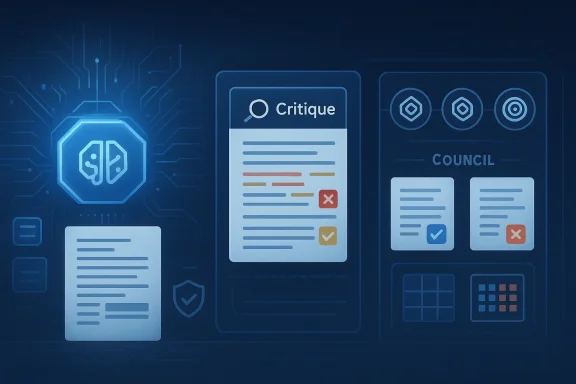
At a high level, Critique is Microsoft’s answer to the problem of self-checking. According to the launch description, it splits the research workflow between two AI models: one model plans, retrieves information, and drafts the report, while a second model reviews the output for accuracy, argument quality, completeness, and clarity. The point is not simply to make the answer longer; it is to introduce an internal adversarial layer that can identify missing angles and coverage gaps.Council takes a different approach. Rather than asking one model to do all the work, it runs models from Anthropic and OpenAI in parallel, with each producing a full independent report. A separate judge model then compares the outputs and summarizes areas of agreement, divergence, and noteworthy differences. That gives users a side-by-side view of how different systems reason about the same problem, which is a meaningful step toward transparency by comparison.
These capabilities fit neatly into Microsoft’s current framing of AI for work. The company has repeatedly emphasized that Copilot is becoming more model-diverse, more governed, and more deeply integrated into enterprise systems. In Microsoft’s own language, it is trying to deliver “Intelligence + Trust” as a product philosophy, not just a marketing slogan. (blogs.microsoft.com)
Why the timing matters
The timing suggests Microsoft is responding to a second-wave enterprise question: not “Can AI help?” but “Can we trust it enough to use it in decision-making?” That question is surfacing just as companies begin moving beyond pilots and into scaled AI deployments. Microsoft has said Copilot paid seats and usage have grown sharply, which makes reliability improvements strategically more valuable than flashy new demos. (blogs.microsoft.com)It also reflects the industry’s broader shift from chatbot UX to agent architecture. The more autonomous the system becomes, the more important it is to add internal checks, model diversity, and clear provenance. In that sense, Microsoft’s new features are less about novelty and more about operational hardening.
- Critique adds a second-pass review loop.
- Council adds cross-model comparison.
- Both aim to reduce single-model blind spots.
- Both are meant to improve enterprise confidence.
- Both reinforce Microsoft’s model-agnostic positioning.
What Critique Actually Changes
Critique is the more subtly important of the two additions because it changes the internal mechanics of how a report is assembled. Instead of relying on one model to reason, search, draft, and polish in a single pass, Microsoft is separating those responsibilities. That division creates a built-in opportunity for error detection and correction before the final output reaches the user.The practical implication is that Researcher can now be more than a generator of plausible prose. It becomes a workflow with an internal reviewer, which is much closer to how analysts, consultants, or researchers actually work. That may sound modest, but process design is often the difference between a toy and a tool in enterprise software.
A two-model workflow
Microsoft says one model handles planning, retrieval, and drafting, while the second evaluates the result, strengthens arguments, and refines the report. In other words, the system is not just optimizing for fluency; it is optimizing for coverage and argumentation. That can be especially useful when research questions require synthesis across many sources or when the user needs balanced analysis rather than a quick answer.This architecture also mirrors a pattern increasingly common in advanced AI systems: generate, inspect, revise. The interesting part is that Microsoft is surfacing the workflow as a product feature, not leaving it hidden inside the model stack. That is important for trust because enterprise buyers often care less about the exact model name than about the structure of the process producing the result.
- Planning and retrieval are separated from critique.
- Drafting is no longer the final step.
- The second model is effectively an internal editor.
- The workflow is designed to expose weak arguments.
- Output quality is measured against multiple dimensions.
Why this matters for accuracy
Microsoft says Critique improved accuracy, analytical breadth, and presentation quality in its assessments. That claim should be read carefully, but the direction is compelling. If the second model can challenge the first model’s assumptions, it may catch gaps that would otherwise be buried in a polished but incomplete report.That said, accuracy in enterprise research is not a single metric. It depends on source quality, retrieval quality, prompt quality, and the system’s willingness to admit uncertainty. Critique does not magically solve all of those problems, but it does create a second chance for failure detection, which is already a meaningful advantage.
How Council Differs From Critique
Where Critique is about internal correction, Council is about comparison. Microsoft says the feature runs Anthropic and OpenAI models in parallel, then asks a judge model to compare the reports and summarize where they agree, where they diverge, and what stands out. That makes Council less of a drafting assistant and more of a multi-perspective research layer.The design is clever because it acknowledges a basic truth about frontier AI: different models often expose different strengths. One may produce stronger structure, another stronger retrieval behavior, another more cautious reasoning. By placing them side by side, Microsoft gives users a chance to inspect those differences rather than pretending that one model’s answer is authoritative by default.
The value of disagreement
For enterprise users, disagreement is not a bug; it can be a feature. If two models converge, confidence increases. If they diverge, the user gets a signal that the issue deserves more scrutiny. That is a much better mental model for research than simply assuming the first polished answer is correct.It also introduces a more mature research workflow. Human analysts routinely compare sources, seek corroboration, and note disputes before making recommendations. Council brings that habit into the AI layer by turning model diversity into a visible part of the output.
- Parallel outputs create an immediate comparison point.
- The judge model highlights consensus and disagreement.
- Users can spot uncertainty faster.
- The feature supports transparent triangulation.
- Council is well suited to high-stakes exploratory work.
Enterprise implications
Council may be especially attractive to enterprises that already worry about model lock-in. Microsoft has recently emphasized that Copilot is model diverse by design, and Council is a concrete manifestation of that philosophy. It tells customers that Microsoft is willing to use the best available models for the task, rather than forcing everything through one supplier’s stack. (blogs.microsoft.com)It also helps Microsoft position Copilot as a coordination layer above models, not merely a wrapper around one model family. That is a strategically useful posture in a market where model quality changes quickly and enterprise buyers want flexibility without rebuilding their workflows every six months.
Frontier, Governance, and Enterprise Trust
Microsoft’s Frontier program is the distribution mechanism that makes these experiments possible. The company has used Frontier to stage early access to new Copilot capabilities, and Researcher itself initially rolled out through that channel before broad availability. By placing Critique and Council inside Frontier, Microsoft is signaling that these are still maturing capabilities, not finished consumer features. (microsoft.com)That matters because enterprise adoption of AI tools often depends on governance as much as performance. Microsoft has recently talked about a broader control plane for AI agents, and it has framed trust as a prerequisite for scaling autonomy. In that environment, a feature like Council is not just a UX enhancement; it is a governance-friendly way to show how AI arrives at an answer. (blogs.microsoft.com)
Why transparency is strategic
Transparency is becoming a competitive lever in enterprise AI. Vendors increasingly know that “trust us” is not enough when the output might influence business decisions. Council offers a practical form of explainability by showing the relationship between model outputs rather than hiding the process behind a single response.Critique, meanwhile, creates an internal review step that is easy to explain to buyers. You can say, in plain English, that one model drafts and another checks. That kind of description is much easier for compliance teams, procurement leaders, and IT decision-makers to assess than abstract claims about “better reasoning.”
The enterprise vs consumer split
For enterprises, the appeal is obvious: more confidence, clearer evaluation, and better alignment with research workflows. For consumers, the value is less immediate because most people do not need a two-model research audit for everyday queries. But the enterprise improvements may still spill over into the broader Copilot ecosystem over time, especially if Microsoft decides the reliability gains are worth the extra compute cost.- Enterprises care about accountability.
- Consumers care more about speed and convenience.
- Frontier lets Microsoft test without overpromising.
- Governance can become a selling point.
- Reliability is a stronger story than raw novelty.
Competitive Positioning Against Other AI Platforms
Microsoft’s move lands in a crowded and fast-moving market. OpenAI, Anthropic, Google, and others are all racing to build agentic research experiences that can handle multi-step tasks, synthesize sources, and support more complex knowledge work. Microsoft’s advantage is not that it owns all the best models, but that it can integrate multiple model providers into a single enterprise environment. (blogs.microsoft.com)That flexibility is becoming a strategic asset. If one model family is better at one task and another is better at a different task, Microsoft can route work accordingly. Council effectively productizes that idea by showing the user the output of different model families and then summarizing the delta. That is a clever way to turn model diversity into a product feature rather than an internal plumbing detail.
Multi-model systems as a moat
The more the AI market matures, the more enterprises will want optionality. They will not want to rebuild their copilots every time a model provider changes pricing, performance, or policy. Microsoft is trying to make Copilot the layer that stays steady even as the model ecosystem underneath it evolves. (blogs.microsoft.com)That could become a real moat if Microsoft can combine model choice with identity, permissions, document access, auditing, and app integration. In that case, the user is not buying a model; the user is buying an operating layer for work.
What rivals will likely do
Rivals are unlikely to stand still. If Microsoft’s customers begin to value side-by-side model comparison and built-in critique, others will almost certainly respond with similar multi-agent and multi-model research workflows. The more the market converges on this design pattern, the more the battleground shifts from “Which model is best?” to “Which platform best orchestrates the models?”- Model routing becomes a platform advantage.
- Governance becomes a selling feature.
- Research quality becomes a workflow issue.
- Multi-model comparison can reduce vendor lock-in fears.
- Enterprise trust may matter more than benchmark wins.
Reliability, Evals, and the New AI Product Metric
The language Microsoft uses around Critique is revealing. It references academic and professional research evaluation patterns, and it frames the feature as an attempt to improve breadth, depth, and presentation quality. That suggests Microsoft understands that enterprise AI will increasingly be judged by quality control, not just by demo appeal.This is part of a larger shift in AI product development. Benchmarks still matter, but in enterprise deployment, companies care about downstream usefulness: Did the model miss a key caveat? Did it cite the right sources? Did it confuse the issue by overexplaining? Was the output structured enough to use in a meeting or memo? Those are the real metrics that determine adoption.
Evals become product features
Microsoft’s recent messaging has repeatedly emphasized evals, cost, and enterprise usefulness. That is no accident. If a company can show that its agentic system performs better in structured evaluations, it can make a stronger case that the product is worth paying for, governing, and scaling.Critique is therefore not just a capability; it is a statement about how Microsoft wants to measure success. The company is saying that AI should be judged against output quality and analytical rigor, not merely response speed.
Why this is hard
The challenge is that evaluation itself can become another layer of complexity. More models, more judge logic, and more comparison steps can create latency, cost, and failure modes of their own. If the review model misjudges the draft, or if the judge model oversimplifies two nuanced outputs, the user can end up with an overly confident synthesis of a flawed process.Still, that risk may be preferable to blind single-model generation. In enterprise AI, imperfect visibility is often better than none at all.
- Evaluation can improve trust.
- Evaluation also adds overhead.
- Output quality is more important than speed for some tasks.
- Latency tradeoffs will matter.
- The best systems will balance rigor and responsiveness.
User Experience and Practical Workflow Impact
From a user perspective, these features should make Researcher feel less like a one-shot chatbot and more like a structured research assistant. The user no longer has to assume that a single answer represents the system’s best effort. Instead, the product is moving toward an environment where the AI can inspect its own work or compare itself against another model.That has practical implications for everyday knowledge work. A strategist, analyst, or manager can use Researcher to produce an initial report, then rely on Critique to improve the structure and completeness of the output. Or they can use Council when they want to see whether different model families are converging on the same conclusion.
When users will feel the difference
The difference will be most visible on complex prompts. Simple factual queries do not need two-model critique or model comparison. But open-ended requests about market dynamics, legal/regulatory implications, competitor analysis, or internal planning are exactly where missing nuance can hurt. That is where these features could pay off.They also fit well with how enterprise users already work. Many professionals do not want a final answer; they want a first draft, a challenge to assumptions, and a way to check whether the logic holds up. That makes these features feel closer to a research workflow than a chat gimmick.
Adoption friction
Of course, the user experience will only be strong if the added complexity remains manageable. Too much visible machinery can make AI feel slow or cumbersome. Microsoft will need to ensure that users experience confidence rather than friction.- Complex tasks benefit most.
- Simple tasks may not need multi-model overhead.
- Draft-plus-review mirrors human work habits.
- Comparison can surface uncertainty quickly.
- UX clarity will determine whether users embrace the feature.
Enterprise Impact by Function
The strongest near-term impact is likely to vary by business function. Research-heavy teams will see the most obvious value, but the broader enterprise could benefit if Microsoft proves that Critique and Council consistently improve reliability. That is especially true in organizations where output must withstand scrutiny from leadership, regulators, auditors, or customers.For strategy and corporate development teams, Council could help compare perspectives on markets, competitors, and macroeconomic shifts. For procurement and supply-chain teams, Critique may help sharpen vendor analyses and make sourcing reports more defensible. For sales and customer success, the features could help users produce better account intelligence and meeting prep.
High-value use cases
The feature set appears particularly well suited to research tasks that depend on synthesis rather than recall. In those cases, a second model’s review can expose missing categories, weak support, or incoherent structure before the output goes to stakeholders. That could save time and prevent rework.It also strengthens Microsoft’s pitch that Copilot is not just an assistant but an enterprise research layer. That is a meaningful distinction in crowded knowledge-work software markets.
- Strategy teams need comparative analysis.
- Procurement teams need source confidence.
- Sales teams need concise, accurate prep.
- Compliance teams need traceable reasoning.
- Operations teams need structured summaries.
Consumer relevance remains secondary
For consumer users, the value proposition is more subtle. Most people will not notice or care whether a report was generated by one model or by two. But consumer perceptions still matter because enterprise confidence often follows visible product maturity. If Microsoft can make Copilot feel more dependable in visible enterprise scenarios, that can improve the platform’s overall reputation.Strengths and Opportunities
Microsoft’s latest move has several clear strengths. It aligns with enterprise demand for trustworthy AI, leverages model diversity as a feature, and builds on the company’s growing Copilot ecosystem rather than treating research capabilities as an isolated add-on. It also gives Microsoft a way to differentiate on process quality, which may be more durable than competing on raw model excitement alone. (blogs.microsoft.com)- Stronger reliability through internal critique loops.
- Better transparency via side-by-side model comparison.
- Enterprise-friendly governance thanks to Frontier staging.
- Model diversity without forcing customers into one stack.
- More defensible outputs for high-stakes work.
- Better alignment with human research workflows.
- Potential product moat around orchestration and trust.
- Scalable differentiation if Microsoft expands these patterns across Copilot.
Risks and Concerns
The upside is real, but so are the risks. Multi-model systems increase complexity, raise compute costs, and can introduce new failure modes if the critique or judge models misinterpret the situation. There is also the risk that users will over-trust the appearance of rigor, assuming that a comparative workflow guarantees correctness when it only improves the odds.- Higher latency from multi-step processing.
- Greater compute cost than single-model generation.
- False confidence if users treat comparison as proof.
- Judge-model bias if the evaluator is imperfect.
- Workflow complexity that may frustrate casual users.
- Feature confusion if the value is not well explained.
- Uneven performance across different research tasks.
- Potential dependency on third-party model availability.
Looking Ahead
The key question now is whether Microsoft will keep these features confined to Frontier or eventually weave them into mainstream Copilot experiences. If the company sees consistent gains in accuracy and user satisfaction, the next logical step would be broader rollout, perhaps first in enterprise tiers where customers value governance and source quality most. The same is true of whether Council becomes a general pattern for model comparison across other Copilot features.Microsoft will also need to prove that these features are practical at scale. That means showing that the extra reasoning steps do not make the product too slow, too expensive, or too abstract for everyday users. If the company gets the balance right, it can strengthen Copilot’s reputation as the enterprise AI platform that is not only powerful, but careful.
- Watch for wider Frontier availability.
- Watch for performance benchmarks and user feedback.
- Watch for expansion into other Copilot agents.
- Watch for whether Council becomes a standard review mode.
- Watch for competitor responses from OpenAI, Anthropic, and Google.
Source: AI Business Microsoft Brings New AI Capabilities to Copilot Researcher
