

Microsoft shares rose on Tuesday, July 7, 2026, after Investing.com and Bloomberg reported that the company has begun routing some Copilot prompts in Excel and Outlook through Microsoft’s own MAI models instead of relying entirely on OpenAI and Anthropic. The stock move is the easy headline, but the more important story is architectural: Microsoft is trying to turn Copilot from an expensive wrapper around other companies’ models into a margin-controlled platform. For Windows users, Microsoft 365 admins, and developers living inside the company’s ecosystem, that shift may matter more than any single model benchmark.
For the first phase of the generative AI boom, Microsoft’s advantage was access. It had the OpenAI partnership, Azure infrastructure, the Office estate, GitHub, Windows, and the enterprise relationships needed to put AI buttons in front of hundreds of millions of users. That was enough to make Copilot feel less like an experiment and more like the next layer of Microsoft software.
The second phase is less glamorous and more consequential. Once AI is embedded into Excel, Outlook, Teams, GitHub, Windows, and Azure workflows, every prompt becomes a cost event. A summary, a formula suggestion, a code review, a meeting recap, an image edit, and an email draft all consume compute, tokens, orchestration, storage, monitoring, and compliance overhead.
That is why the Bloomberg-reported routing of some Excel and Outlook prompts to Microsoft’s in-house MAI models matters. It suggests Microsoft is no longer content to be the best distributor of someone else’s intelligence. It wants to own enough of the model layer to decide when a premium frontier model is worth the money and when a cheaper, specialized internal model is good enough.
Investing.com framed the market reaction as Microsoft edging higher while investors digested the potential cost savings. That is fair as far as it goes. But for the WindowsForum audience, the larger point is that Microsoft is beginning to treat AI inference the way it treats cloud capacity, identity, endpoint management, and productivity licensing: as a system to be optimized, governed, bundled, and monetized over time.
The user-facing question gets most of the attention. People argue about whether Copilot in Outlook writes better emails, whether Excel’s AI features understand messy spreadsheets, whether Teams summaries are worth the license, and whether Windows Copilot feels integrated or bolted on. Those debates matter, because unused AI is just an expensive icon.
But Microsoft’s internal economics may be the sharper constraint. A conventional Office feature can be developed once and used millions of times with relatively predictable maintenance costs. A generative AI feature keeps spending money every time it runs. The better Microsoft gets at making Copilot visible across its product suite, the more urgent it becomes to reduce the unit cost of each interaction.
That is where in-house models become strategically useful even if they are not always the best models in the world. A tuned model that handles a narrow Excel or Outlook task cheaply can be more valuable than a frontier model answering everything expensively. Microsoft does not need every Copilot response to be a moonshot; it needs enough responses to be reliable, fast, compliant, and affordable.
This is the quiet pivot from AI as wow factor to AI as industrial plumbing. The first sells demos. The second determines whether Copilot becomes a durable business.
That distinction is important. The industry spent the last several years treating model quality as a single leaderboard race. But enterprise software rarely works that way. The right model for turning a rambling email thread into three action items is not necessarily the right model for complex legal drafting, code generation, image editing, or multi-step data analysis.
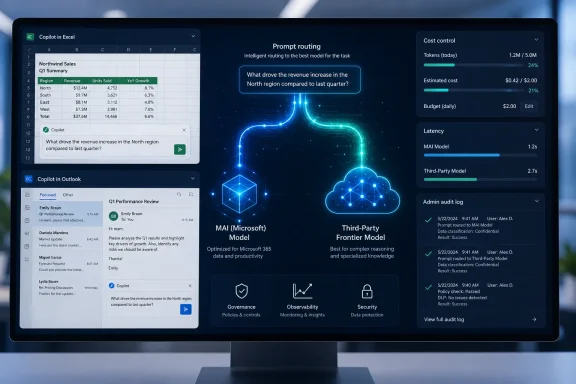
Bloomberg’s report, amplified by Investing.com, says Microsoft has already deployed internal MAI models into Excel and Outlook for a slice of real-world prompt traffic. That does not mean OpenAI or Anthropic have been kicked out of Copilot. It means Microsoft is moving toward a brokered model strategy, where the system can choose among models based on task, cost, latency, policy, and likely quality.
That is a very Microsoft move. The company has rarely been shy about abstracting complexity behind a platform layer. Windows abstracts hardware, Microsoft 365 abstracts collaboration, Azure abstracts infrastructure, and now Copilot may increasingly abstract the model marketplace.
The user may see one Copilot button. Underneath it, Microsoft wants the freedom to swap engines.
But strategic dependence is different from strategic partnership. Microsoft’s early AI lead was strengthened by its access to OpenAI’s models. Over time, however, the same relationship created an obvious business tension: if Copilot’s growth depends on paying outside labs for high-volume inference, Microsoft’s margins and roadmap are constrained by other companies’ costs, priorities, and bargaining power.
Anthropic’s presence in Copilot also underscores the point. Microsoft has been moving toward a multi-model posture for some time, not a single-provider religion. The arrival of MAI inside production Office workloads is less a rejection of outside models than a bid to make them compete for their place in the stack.
That matters for customers because model diversity can improve resilience and choice, but it can also make governance harder. If a tenant’s Copilot experience can route prompts across different model families, admins will want clearer visibility into what model handled which task, where data flowed, and how Microsoft enforces contractual and regulatory boundaries.
The question for enterprise IT is not whether Microsoft uses OpenAI, Anthropic, or MAI. The question is whether Microsoft can make model routing auditable enough for organizations that cannot treat AI as a black box.
Those workloads are not trivial, but many are bounded. A specialized model can be tuned around the actual shape of Office tasks, the conventions of business documents, and Microsoft Graph context. It may not need to be the most general model available if the job is narrow enough and the orchestration layer is strong enough.
Excel is especially revealing. Spreadsheet work mixes natural language, structured data, formulas, charts, and business context. A poor AI answer in Excel can be worse than useless if it quietly produces a wrong calculation or misleading interpretation. Microsoft therefore has an incentive to route only the tasks that MAI can handle reliably, while reserving heavier models for cases that require broader reasoning.
Outlook is a different kind of test. Email is abundant, repetitive, and expensive to process at scale if every small request hits a premium model. If Microsoft can use MAI to handle routine summaries, drafts, and triage without degrading perceived quality, the cost savings could be meaningful.
The operative word is perceived. Users do not care which model answered them until the answer gets worse, slower, or less trustworthy. Microsoft’s gamble is that most customers will accept invisible model substitution if the Copilot button keeps producing acceptable work.
Microsoft’s market valuation already assumes AI will reinforce the company’s cloud and productivity franchises. That creates pressure. If Copilot adoption grows but margins disappoint, the AI story becomes more complicated. If Copilot adoption grows and Microsoft can lower inference costs with internal models, the story becomes much cleaner.
That explains why a modest operational report can move sentiment. Microsoft is not merely adding an AI feature; it is showing the market that it has levers. It can tune models, route workloads, negotiate with suppliers, deploy internal alternatives, and gradually bend cost curves.
This is also why the company’s MAI work should be viewed alongside its custom silicon efforts, Azure capacity investments, and packaging changes across Microsoft 365. AI economics are not solved by any one model. They are solved, if they are solved at all, by a stack: chips, datacenters, orchestration, model selection, caching, product design, licensing, and telemetry.
In that stack, in-house models are a control surface. They give Microsoft another way to decide what Copilot costs to run.
Windows has already become a distribution surface for Copilot, Recall-style features, local AI ambitions, and device-level neural processing unit marketing. The more Microsoft learns how to divide work among cloud models, smaller specialized models, and local hardware, the more that logic will shape Windows itself.
A future Windows AI feature may not simply ask “Can this model answer the question?” It may ask whether the task should run locally, in Microsoft’s cloud, on a cheap internal model, on a premium frontier model, or not at all because policy forbids it. That routing layer will be invisible when it works and infuriating when it does not.
The risk is that users experience this as inconsistency. One Copilot answer may be excellent, another strangely shallow. One tenant may have access to a capability that another lacks. One device may run a feature locally while another sends it to the cloud. Microsoft will need to explain enough of the system to preserve trust without overwhelming people with model menus.
The Windows ecosystem has lived through this before in another form. Hardware abstraction made PCs flexible, but also created driver hell. AI abstraction could make Copilot flexible, but it could also create a new kind of troubleshooting fog: which model, which policy, which license, which endpoint, which region, which data boundary?
If Copilot in Excel or Outlook changes the model behind a feature, Microsoft will argue that the product contract, security boundary, and compliance commitments remain the meaningful layer. In many cases, that may be true. Enterprises buy Microsoft 365 as a governed service, not as a direct relationship with every model vendor underneath it.
Still, model provenance matters. Some regulated customers will ask whether prompts are processed by Microsoft-operated models, OpenAI-hosted models, Anthropic models, or Azure-hosted variants under Microsoft controls. They will ask whether data is retained, whether prompts can train models, whether logs are available, and whether model routing can be restricted by policy.
Microsoft’s answer cannot be hand-waving about innovation. The more Copilot becomes embedded in business workflows, the more it becomes part of the control environment. AI features that summarize board emails, inspect spreadsheets, draft customer communications, or interact with code repositories are not toys.
The company has an opportunity here. If it gives admins clear reporting and policy controls for model families, data residency, and feature-level AI behavior, it can turn its multi-model strategy into an enterprise advantage. If it hides the machinery too aggressively, it will invite suspicion from the same customers it wants to upsell.
Coding agents can be expensive because they do not merely answer a question. They inspect repositories, generate diffs, run tools, review changes, iterate, and sometimes consume long context windows. If every agentic coding task uses a top-tier model from an external provider, the economics can become ugly quickly.
A cheaper internal coding model changes the equation. It may be good enough for autocomplete-like interactions, small refactors, simple explanations, or routine agent steps, while larger models are reserved for harder reasoning. The developer sees a faster or cheaper Copilot experience; Microsoft sees fewer expensive tokens flowing to third parties.
This will also affect the competitive landscape for developer tools. Cursor, JetBrains, Google, Amazon, Anthropic, OpenAI, and smaller coding startups all compete partly on model access and partly on workflow integration. Microsoft’s strongest card is not merely having a good model. It is having GitHub, VS Code, Visual Studio, Azure, Windows, and enterprise identity in the same orbit.
That integration becomes more powerful if Microsoft can lower its own cost base. A company with distribution and cheap inference can afford to bundle aggressively.
This is not a theoretical concern. AI systems are difficult to evaluate from the outside, especially when vendors can change models behind the scenes. A user may not know whether a worse answer came from a weaker model, a shorter context window, a policy filter, a retrieval failure, or a transient service issue.
Microsoft therefore has to manage the trust problem carefully. If it wants customers to accept dynamic model routing, it should be willing to publish meaningful quality claims, expose admin controls where appropriate, and avoid pretending all models are interchangeable. They are not.
The best version of Copilot is not the cheapest model answering every prompt. It is an intelligent hierarchy that spends heavily only when heavy spending produces better outcomes. That requires restraint, measurement, and honesty about which tasks need frontier intelligence and which do not.
Microsoft’s long history makes this both plausible and worrying. The company is very good at platform optimization. It is also very good at bundling complexity until customers feel they have no practical alternative.
As Microsoft adds internal models and more metered AI surfaces, the economics may become more nuanced. A fixed seat license is only one layer. Behind it sits a growing set of consumption patterns, model choices, agent actions, and workload-specific costs. The more Microsoft optimizes inference, the more room it has to experiment with packaging.
This could help customers if lower costs produce broader access, better performance, or more generous quotas. It could hurt customers if Microsoft uses efficiency gains to preserve its own margin while continuing to raise effective AI spend through bundles, add-ons, or premium tiers.
The pattern to watch is not one Tuesday stock move. It is whether Microsoft’s internal cost savings translate into customer-visible value. Do Copilot features become cheaper, more available, faster, or more reliable? Or does the same monthly bill simply become more profitable for Microsoft?
Enterprise buyers should assume Microsoft’s first responsibility is to its own platform economics. That is not scandalous; it is capitalism. But it means procurement and IT teams need to ask sharper questions than “Does Copilot use AI?” The better question is: what exactly are we buying, and how will Microsoft prove it is worth renewing?
The first wave of generative AI rewarded companies that could get access to the best models quickly. The next wave rewards companies that can operate a portfolio of models efficiently. That means routing, governance, observability, and cost control become as important as raw benchmark performance.
For Microsoft, this is especially urgent because Copilot is not one product. It is a brand stretched across Windows, Microsoft 365, GitHub, Security, Azure, Dynamics, Power Platform, Edge, and consumer services. A single-model strategy would be too expensive, too brittle, and too dependent on outside roadmaps.
The MAI push is therefore not merely defensive. It is the foundation for Microsoft’s preferred future: Copilot as a universal interface, Azure as the AI control plane, Microsoft 365 as the work graph, GitHub as the developer loop, and Windows as the client surface. In that future, models are components. The platform is the product.
That is why investors liked the report. It makes Microsoft’s AI story look less like a reseller arrangement and more like an operating system for model-driven work.
 Microsoft’s AI Story Is Moving From Access to Control
For the first phase of the generative AI boom, Microsoft’s advantage was access. It had the OpenAI partnership, Azure infrastructure, the Office estate, GitHub, Windows, and the enterprise relationships needed to put AI buttons in front of hundreds of millions of users. That was enough to make Copilot feel less like an experiment and more like the next layer of Microsoft software.The second phase is less glamorous and more consequential. Once AI is embedded into Excel, Outlook, Teams, GitHub, Windows, and Azure workflows, every prompt becomes a cost event. A summary, a formula suggestion, a code review, a meeting recap, an image edit, and an email draft all consume compute, tokens, orchestration, storage, monitoring, and compliance overhead.
That is why the Bloomberg-reported routing of some Excel and Outlook prompts to Microsoft’s in-house MAI models matters. It suggests Microsoft is no longer content to be the best distributor of someone else’s intelligence. It wants to own enough of the model layer to decide when a premium frontier model is worth the money and when a cheaper, specialized internal model is good enough.
Investing.com framed the market reaction as Microsoft edging higher while investors digested the potential cost savings. That is fair as far as it goes. But for the WindowsForum audience, the larger point is that Microsoft is beginning to treat AI inference the way it treats cloud capacity, identity, endpoint management, and productivity licensing: as a system to be optimized, governed, bundled, and monetized over time.
Copilot’s Problem Was Never Just Whether Users Liked It
Copilot has always carried two questions at once. The first is whether users find it useful enough to change daily habits. The second is whether Microsoft can deliver that usefulness at a gross margin that looks like software rather than infrastructure-heavy services.The user-facing question gets most of the attention. People argue about whether Copilot in Outlook writes better emails, whether Excel’s AI features understand messy spreadsheets, whether Teams summaries are worth the license, and whether Windows Copilot feels integrated or bolted on. Those debates matter, because unused AI is just an expensive icon.
But Microsoft’s internal economics may be the sharper constraint. A conventional Office feature can be developed once and used millions of times with relatively predictable maintenance costs. A generative AI feature keeps spending money every time it runs. The better Microsoft gets at making Copilot visible across its product suite, the more urgent it becomes to reduce the unit cost of each interaction.
That is where in-house models become strategically useful even if they are not always the best models in the world. A tuned model that handles a narrow Excel or Outlook task cheaply can be more valuable than a frontier model answering everything expensively. Microsoft does not need every Copilot response to be a moonshot; it needs enough responses to be reliable, fast, compliant, and affordable.
This is the quiet pivot from AI as wow factor to AI as industrial plumbing. The first sells demos. The second determines whether Copilot becomes a durable business.
The MAI Rollout Is a Cost Story Wearing a Product Story’s Clothes
Microsoft has been preparing the ground for this move. At Build 2026, the company announced a family of in-house MAI models, including MAI-Thinking-1 for reasoning and MAI-Code-1-Flash for coding workloads. Microsoft’s own messaging emphasized efficiency, lower token costs, and fit-for-purpose models rather than simply claiming it had beaten every frontier competitor across the board.That distinction is important. The industry spent the last several years treating model quality as a single leaderboard race. But enterprise software rarely works that way. The right model for turning a rambling email thread into three action items is not necessarily the right model for complex legal drafting, code generation, image editing, or multi-step data analysis.
Bloomberg’s report, amplified by Investing.com, says Microsoft has already deployed internal MAI models into Excel and Outlook for a slice of real-world prompt traffic. That does not mean OpenAI or Anthropic have been kicked out of Copilot. It means Microsoft is moving toward a brokered model strategy, where the system can choose among models based on task, cost, latency, policy, and likely quality.
That is a very Microsoft move. The company has rarely been shy about abstracting complexity behind a platform layer. Windows abstracts hardware, Microsoft 365 abstracts collaboration, Azure abstracts infrastructure, and now Copilot may increasingly abstract the model marketplace.
The user may see one Copilot button. Underneath it, Microsoft wants the freedom to swap engines.
OpenAI Remains Central, but Dependence Is No Longer the Goal
The temptation is to cast this as a Microsoft-versus-OpenAI divorce story. That is too simple. OpenAI remains deeply important to Microsoft’s AI product strategy, Azure positioning, and developer ecosystem. The most capable frontier models are still valuable for hard problems, premium workflows, and brand credibility.But strategic dependence is different from strategic partnership. Microsoft’s early AI lead was strengthened by its access to OpenAI’s models. Over time, however, the same relationship created an obvious business tension: if Copilot’s growth depends on paying outside labs for high-volume inference, Microsoft’s margins and roadmap are constrained by other companies’ costs, priorities, and bargaining power.
Anthropic’s presence in Copilot also underscores the point. Microsoft has been moving toward a multi-model posture for some time, not a single-provider religion. The arrival of MAI inside production Office workloads is less a rejection of outside models than a bid to make them compete for their place in the stack.
That matters for customers because model diversity can improve resilience and choice, but it can also make governance harder. If a tenant’s Copilot experience can route prompts across different model families, admins will want clearer visibility into what model handled which task, where data flowed, and how Microsoft enforces contractual and regulatory boundaries.
The question for enterprise IT is not whether Microsoft uses OpenAI, Anthropic, or MAI. The question is whether Microsoft can make model routing auditable enough for organizations that cannot treat AI as a black box.
Excel and Outlook Are the Right Test Beds Because They Are Boring
Excel and Outlook are not flashy AI canvases. That is precisely why they are the right places to test Microsoft’s model economics. These apps generate repetitive, high-volume, enterprise-shaped tasks: summarize this thread, draft this reply, classify this inbox, explain this formula, find an anomaly, generate a chart, clean this table.Those workloads are not trivial, but many are bounded. A specialized model can be tuned around the actual shape of Office tasks, the conventions of business documents, and Microsoft Graph context. It may not need to be the most general model available if the job is narrow enough and the orchestration layer is strong enough.
Excel is especially revealing. Spreadsheet work mixes natural language, structured data, formulas, charts, and business context. A poor AI answer in Excel can be worse than useless if it quietly produces a wrong calculation or misleading interpretation. Microsoft therefore has an incentive to route only the tasks that MAI can handle reliably, while reserving heavier models for cases that require broader reasoning.
Outlook is a different kind of test. Email is abundant, repetitive, and expensive to process at scale if every small request hits a premium model. If Microsoft can use MAI to handle routine summaries, drafts, and triage without degrading perceived quality, the cost savings could be meaningful.
The operative word is perceived. Users do not care which model answered them until the answer gets worse, slower, or less trustworthy. Microsoft’s gamble is that most customers will accept invisible model substitution if the Copilot button keeps producing acceptable work.
The Market Is Rewarding a Margin Thesis, Not a Breakthrough
Investors did not need a new philosophical argument about artificial intelligence on Tuesday. They needed evidence that Microsoft has a path to make AI less ruinously expensive. The reported share move reflected that very specific hope.Microsoft’s market valuation already assumes AI will reinforce the company’s cloud and productivity franchises. That creates pressure. If Copilot adoption grows but margins disappoint, the AI story becomes more complicated. If Copilot adoption grows and Microsoft can lower inference costs with internal models, the story becomes much cleaner.
That explains why a modest operational report can move sentiment. Microsoft is not merely adding an AI feature; it is showing the market that it has levers. It can tune models, route workloads, negotiate with suppliers, deploy internal alternatives, and gradually bend cost curves.
This is also why the company’s MAI work should be viewed alongside its custom silicon efforts, Azure capacity investments, and packaging changes across Microsoft 365. AI economics are not solved by any one model. They are solved, if they are solved at all, by a stack: chips, datacenters, orchestration, model selection, caching, product design, licensing, and telemetry.
In that stack, in-house models are a control surface. They give Microsoft another way to decide what Copilot costs to run.
Windows Users Will Feel the Strategy Before They See the Architecture
For ordinary Windows users, this may sound remote. Model routing inside Excel and Outlook feels like something that happens deep in Microsoft’s cloud, far away from the Start menu, File Explorer, or the Windows desktop. But Microsoft’s AI strategy does not stay neatly inside product boxes.Windows has already become a distribution surface for Copilot, Recall-style features, local AI ambitions, and device-level neural processing unit marketing. The more Microsoft learns how to divide work among cloud models, smaller specialized models, and local hardware, the more that logic will shape Windows itself.
A future Windows AI feature may not simply ask “Can this model answer the question?” It may ask whether the task should run locally, in Microsoft’s cloud, on a cheap internal model, on a premium frontier model, or not at all because policy forbids it. That routing layer will be invisible when it works and infuriating when it does not.
The risk is that users experience this as inconsistency. One Copilot answer may be excellent, another strangely shallow. One tenant may have access to a capability that another lacks. One device may run a feature locally while another sends it to the cloud. Microsoft will need to explain enough of the system to preserve trust without overwhelming people with model menus.
The Windows ecosystem has lived through this before in another form. Hardware abstraction made PCs flexible, but also created driver hell. AI abstraction could make Copilot flexible, but it could also create a new kind of troubleshooting fog: which model, which policy, which license, which endpoint, which region, which data boundary?
Administrators Need Transparency More Than Model Names
Enterprise admins do not necessarily need to know every parameter count or benchmark score. They do need to know whether a feature changes data handling, auditability, compliance posture, latency, and cost. That is where Microsoft’s model-switching strategy will face its hardest audience.If Copilot in Excel or Outlook changes the model behind a feature, Microsoft will argue that the product contract, security boundary, and compliance commitments remain the meaningful layer. In many cases, that may be true. Enterprises buy Microsoft 365 as a governed service, not as a direct relationship with every model vendor underneath it.
Still, model provenance matters. Some regulated customers will ask whether prompts are processed by Microsoft-operated models, OpenAI-hosted models, Anthropic models, or Azure-hosted variants under Microsoft controls. They will ask whether data is retained, whether prompts can train models, whether logs are available, and whether model routing can be restricted by policy.
Microsoft’s answer cannot be hand-waving about innovation. The more Copilot becomes embedded in business workflows, the more it becomes part of the control environment. AI features that summarize board emails, inspect spreadsheets, draft customer communications, or interact with code repositories are not toys.
The company has an opportunity here. If it gives admins clear reporting and policy controls for model families, data residency, and feature-level AI behavior, it can turn its multi-model strategy into an enterprise advantage. If it hides the machinery too aggressively, it will invite suspicion from the same customers it wants to upsell.
Developers Are Watching the Same Economics From the Other Side
GitHub Copilot gives developers a parallel view of the same shift. Microsoft has already positioned MAI-Code-1-Flash as a smaller, purpose-built coding model available across more Copilot surfaces, with business and enterprise access expanding over time. That is not just a developer convenience; it is another example of Microsoft matching model size and cost to workload.Coding agents can be expensive because they do not merely answer a question. They inspect repositories, generate diffs, run tools, review changes, iterate, and sometimes consume long context windows. If every agentic coding task uses a top-tier model from an external provider, the economics can become ugly quickly.
A cheaper internal coding model changes the equation. It may be good enough for autocomplete-like interactions, small refactors, simple explanations, or routine agent steps, while larger models are reserved for harder reasoning. The developer sees a faster or cheaper Copilot experience; Microsoft sees fewer expensive tokens flowing to third parties.
This will also affect the competitive landscape for developer tools. Cursor, JetBrains, Google, Amazon, Anthropic, OpenAI, and smaller coding startups all compete partly on model access and partly on workflow integration. Microsoft’s strongest card is not merely having a good model. It is having GitHub, VS Code, Visual Studio, Azure, Windows, and enterprise identity in the same orbit.
That integration becomes more powerful if Microsoft can lower its own cost base. A company with distribution and cheap inference can afford to bundle aggressively.
The Danger Is That Cost Optimization Becomes Product Degradation
There is a darker version of this story. Microsoft could use cheaper internal models not to improve Copilot’s economics while preserving quality, but to quietly reduce quality in the name of margin. Users would experience that as the familiar enterprise software pattern: prices go up, features get rebranded, and the thing that once felt novel becomes less reliable.This is not a theoretical concern. AI systems are difficult to evaluate from the outside, especially when vendors can change models behind the scenes. A user may not know whether a worse answer came from a weaker model, a shorter context window, a policy filter, a retrieval failure, or a transient service issue.
Microsoft therefore has to manage the trust problem carefully. If it wants customers to accept dynamic model routing, it should be willing to publish meaningful quality claims, expose admin controls where appropriate, and avoid pretending all models are interchangeable. They are not.
The best version of Copilot is not the cheapest model answering every prompt. It is an intelligent hierarchy that spends heavily only when heavy spending produces better outcomes. That requires restraint, measurement, and honesty about which tasks need frontier intelligence and which do not.
Microsoft’s long history makes this both plausible and worrying. The company is very good at platform optimization. It is also very good at bundling complexity until customers feel they have no practical alternative.
The Copilot Business Case Is Being Rewritten in Real Time
For many organizations, the original Copilot business case was blunt: pay a per-user premium and hope productivity gains justify the spend. That was always an awkward calculation because productivity is hard to measure and AI usage varies wildly by role. Some workers use Copilot daily; others barely touch it.As Microsoft adds internal models and more metered AI surfaces, the economics may become more nuanced. A fixed seat license is only one layer. Behind it sits a growing set of consumption patterns, model choices, agent actions, and workload-specific costs. The more Microsoft optimizes inference, the more room it has to experiment with packaging.
This could help customers if lower costs produce broader access, better performance, or more generous quotas. It could hurt customers if Microsoft uses efficiency gains to preserve its own margin while continuing to raise effective AI spend through bundles, add-ons, or premium tiers.
The pattern to watch is not one Tuesday stock move. It is whether Microsoft’s internal cost savings translate into customer-visible value. Do Copilot features become cheaper, more available, faster, or more reliable? Or does the same monthly bill simply become more profitable for Microsoft?
Enterprise buyers should assume Microsoft’s first responsibility is to its own platform economics. That is not scandalous; it is capitalism. But it means procurement and IT teams need to ask sharper questions than “Does Copilot use AI?” The better question is: what exactly are we buying, and how will Microsoft prove it is worth renewing?
AI Independence Is Becoming a Cloud Platform Requirement
Microsoft is not alone in this. Every major cloud and software platform is trying to reduce dependence on any single frontier model provider. Amazon has its own models and partnerships. Google has Gemini and its cloud stack. Meta has open-weight ambitions. Apple is mixing local models, private cloud compute, and partner integrations. The direction of travel is clear.The first wave of generative AI rewarded companies that could get access to the best models quickly. The next wave rewards companies that can operate a portfolio of models efficiently. That means routing, governance, observability, and cost control become as important as raw benchmark performance.
For Microsoft, this is especially urgent because Copilot is not one product. It is a brand stretched across Windows, Microsoft 365, GitHub, Security, Azure, Dynamics, Power Platform, Edge, and consumer services. A single-model strategy would be too expensive, too brittle, and too dependent on outside roadmaps.
The MAI push is therefore not merely defensive. It is the foundation for Microsoft’s preferred future: Copilot as a universal interface, Azure as the AI control plane, Microsoft 365 as the work graph, GitHub as the developer loop, and Windows as the client surface. In that future, models are components. The platform is the product.
That is why investors liked the report. It makes Microsoft’s AI story look less like a reseller arrangement and more like an operating system for model-driven work.
Redmond’s New AI Math Has Consequences
The concrete lesson from the Investing.com and Bloomberg reports is not that Microsoft has suddenly replaced OpenAI. It has not. The lesson is that Microsoft is beginning to operationalize a more self-sufficient AI stack inside the productivity apps where the cost pressure is most obvious.- Microsoft has reportedly started using its own MAI models for some Copilot prompts in Excel and Outlook, signaling that Office AI workloads are now part of a broader cost-optimization campaign.
- OpenAI and Anthropic remain important to Copilot, but Microsoft is moving toward a model-routing strategy rather than a single-provider dependency.
- The biggest near-term benefit for Microsoft is likely margin control, because high-volume Copilot usage can become expensive when every prompt relies on premium external models.
- Enterprise customers should press Microsoft for clearer visibility into model routing, data handling, audit logs, and tenant-level controls as Copilot becomes more deeply embedded in business workflows.
- Windows and developer tools will eventually reflect the same architecture, with AI tasks split among local models, Microsoft-hosted models, third-party frontier models, and policy-driven restrictions.
References
- Primary source: investing.com
Published: Tue, 07 Jul 2026 16:30:00 GMT
Microsoft edges higher as in-house AI push takes aim at copilot costs By Investing.com
Microsoft edges higher as in-house AI push takes aim at copilot costswww.investing.com - Related coverage: techcrunch.com
Microsoft joins AI cost-cutting trend by relying more on its own models | TechCrunch
Microsoft is the latest Silicon Valley giant to cut back on its AI spending.techcrunch.com - Related coverage: gizmodo.com
Claude and ChatGPT Are Getting Too Expensive, Even for Microsoft
The tech giant is reportedly using its own AI models for some AI prompts in its Excel and Outlook software. gizmodo.com
- Related coverage: thetechportal.com
Microsoft begins replacing OpenAI, Anthropic models with in-house MAI AI across key products: Report - The Tech Portal
Microsoft has reportedly begun deploying its own AI models across some of its most widely used productivity applications. Instead of thetechportal.com
- Related coverage: au.finance.yahoo.com
Microsoft edges higher as in-house AI push takes aim at copilot costs
Investing.com -- Microsoft (NASDAQ:MSFT) shares ticked up 1.75% on Tuesday, outperforming a sluggish Nasdaq following reports that the tech giant is beginning to ditch pricey third-party AI models in favor of its own homegrown technology. According to Bloomberg, Microsoft has quietly deployed...au.finance.yahoo.com - Related coverage: axios.com
Microsoft debuts Scout agent, homegrown reasoning model
Microsoft is seeking to show it is a serious player in AI.www.axios.com
- Related coverage: cnbc.com
Microsoft starts testing AI model that could escalate competition with OpenAI
Microsoft wants to depend more on its own internally built artificial intelligence models for Copilot, which is available in Bing and Windows 11.www.cnbc.com - Related coverage: windowscentral.com
Microsoft 365 is paywalling most of Copilot in its Office apps | Windows Central
Commercial customers will soon need a Microsoft 365 Copilot license to use Copilot Chat in Word, Excel, PowerPoint, and OneNote.www.windowscentral.com - Related coverage: bloomberg.com
- Related coverage: preferreddata.com
Microsoft 365 Copilot SMB Pricing: NC July 1 Deadline | Preferred Data Blog
M365 Business Copilot becomes permanent on July 1, 2026 at $23.50-$32/seat. NC SMB Copilot rollout plan + MAI models. Call (336) 886-3282.www.preferreddata.com - Related coverage: endpointweekly.com
Microsoft 365 Copilot SMB Pricing Changes July 1, 2026:… — EndpointWeekly
From July 1, Microsoft 365 Business Standard with Copilot and Business Premium with Copilot become permanent SKUs with updated list prices. If you manage…endpointweekly.com - Related coverage: thenextweb.com
Microsoft swaps in its own AI over OpenAI in some apps
Microsoft is routing some app features to its in-house MAI models instead of OpenAI and Anthropic, chipping away at its reliance on partners.thenextweb.com - Related coverage: tipranks.com
- Related coverage: geekwire.com
Microsoft unveils seven homegrown AI models in new bid for 'long term self-sufficiency' – GeekWire
Microsoft used its Build conference to unveil seven in-house AI models, including a reasoning model it says draws even with Anthropic's Claude Sonnet 4.6 — part of a push to depend less on the AI partners it has invested billions in.www.geekwire.com - Official source: microsoft.com
</rdf:Alt> </dc:title> <dc:description> <rdf:Alt> <rdf:li xml:lang="x-default"/> </rdf:Alt> </dc:description> <dc:creator> <rdf:Seq> <rdf:li>Lukas V
</rdf:Alt> </dc:description> <dc:creator> <rdf:Seq> <rdf:li>Lukas Velushwww.microsoft.com
- Related coverage: troutman.com
When E5 and Copilot Aren’t Enough, Microsoft’s Latest E7 SKU Is on the AI ‘Frontier’
PDF documentwww.troutman.com
- Related coverage: github.blog
MAI-Code-1-Flash available on more Copilot surfaces - GitHub Changelog
MAI‑Code‑1‑Flash, Microsoft’s purpose‑built small coding model, is now available across additional GitHub Copilot surfaces. MAI‑Code‑1‑Flash can now be used in: Copilot CLI Copilot cloud agent GitHub Copilot app Copilot Chat…github.blog
- Official source: blogs.microsoft.com
Microsoft Build 2026: Be yourself at work - The Official Microsoft Blog
Platforms shift when developers build. We explore, choose tools, dream, create. This platform shift comes with more information than ever, ready at your fingertips. This shift, it’s about building fast AND THEN: it’s about building, operating, optimizing and observing. Securing your...blogs.microsoft.com - Official source: news.microsoft.com
Microsoft Foundry (国际版) 推出全新 MAI 模型 - Source Asia
 news.microsoft.com
- Official source: developer.microsoft.com
Microsoft Build 2026 recap: vision, launches, and top sessions - Microsoft for Developers
Catch up on Microsoft Build 2026 with the vision lead-off, top developer announcements, and must-watch sessions across the Microsoft developer ecosystem.developer.microsoft.com - Official source: techcommunity.microsoft.com
- Official source: devblogs.microsoft.com
What's new in Microsoft Foundry | Build Edition | Microsoft Foundry Blog
Microsoft Build 2026 brings a major set of Microsoft Foundry updates for developers building agents: hosted runtimes, Toolboxes, memory, Voice Live, Foundry IQ, new models, managed compute, and trust, evaluation, and observability tools.devblogs.microsoft.com - Official source: cdn-dynmedia-1.microsoft.com
- Official source: download.microsoft.com