

Microsoft is reshaping the economics of Copilot by making a deceptively simple wager: the best AI experience does not always require the biggest, most expensive frontier model. Instead, the company is increasingly routing everyday work to specialized in-house MAI models, while reserving top-tier systems from OpenAI and Anthropic for tasks that genuinely demand them.
That strategy could prove more consequential than another headline-grabbing model benchmark. Microsoft serves AI across GitHub Copilot, Microsoft 365, Excel, Outlook, Windows-adjacent productivity workflows, Azure, and enterprise business applications. At that scale, a modest reduction in tokens, latency, or compute expenditure can become a major operational advantage. The question is no longer simply whether a model is the smartest available; it is whether it can complete a useful task accurately, quickly, safely, and at a sustainable cost.
Microsoft’s newest messaging makes clear that it sees the model layer as part of a larger system rather than the product itself. Its internal hill-climbing approach combines tailored data, product-specific evaluations, post-training, tools, user context, memory, and continuous feedback. In practical terms, the company wants Excel Copilot to become exceptionally effective at Excel work and GitHub Copilot to become exceptionally effective at coding work, without paying frontier-model prices for every routine prompt.
For Windows users and IT administrators, the immediate significance is not that a single AI model may replace another. It is that Copilot is evolving into an orchestration layer where the underlying AI can vary from task to task, often without the user needing to choose a model manually. That could improve speed and reliability—but it also raises hard questions about transparency, evaluation quality, model switching, enterprise controls, and the increasingly blurred boundary between software features and AI services.
Microsoft’s plan challenges a popular assumption in the generative AI market: that progress means deploying the largest general-purpose model everywhere. Frontier models remain extraordinarily capable, particularly for difficult reasoning, broad synthesis, unfamiliar domains, long multi-step workflows, and ambiguous requests. But their capabilities come with significant inference costs.
Every AI response consumes compute. The cost rises with model size, the amount of context supplied, the number of output tokens generated, the complexity of tool calls, and the degree of reasoning required. When an organization serves millions of users, even apparently small inefficiencies can create enormous infrastructure bills.
Microsoft’s answer is a model-routing strategy:
Likewise, an Excel assistant should be skilled at spreadsheet structures, formulas, tables, formatting, business data, workbook context, and the user’s requested outcome. A model trained and evaluated around these workflows can potentially outperform a larger generalist in practical use, even if it would score lower on broad academic-style tests.
That distinction may define the next phase of enterprise AI.
These are meaningful figures if they hold across broad real-world use. Code acceptance rate is particularly important because it measures more than whether a response appears plausible. It asks whether a developer actually accepts the proposed code. That is closer to a product outcome than a standalone code-generation benchmark.
The token reduction matters as well. Fewer tokens can mean:
A suggestion might be accepted because it saves a few keystrokes, not because it solves a difficult engineering problem. Conversely, developers may reject a high-quality suggestion simply because it does not fit their local conventions or because they have already begun implementing a different approach.
Microsoft’s approach is still compelling, however, because GitHub Copilot offers an unusually rich feedback environment. Developers accept, modify, ignore, test, and deploy code. Those interactions can produce a far more relevant optimization signal than a generic benchmark question with a single predetermined answer.
Excel work ranges from simple formula help to intricate financial modeling, forecasting, data validation, charting, reconciliation, and business reporting. The difference between a competent answer and a reliable one can matter enormously. A misplaced cell reference, a misunderstood date format, or an incorrect formula can ripple through an entire workbook.
The notable technical point is that Microsoft describes its Excel model as building from a coding-oriented foundation and then optimizing it against Excel-specific evaluations. That reflects a practical view of model development: begin with a capable base system, then shape it against a tightly defined environment where the tools, tasks, and success criteria are clearer.
For routine Excel Copilot tasks, this could be a significant breakthrough. If a smaller model can accurately create a formula, explain a table, restructure a worksheet, identify a trend, or generate a useful summary at lower cost, Microsoft can scale the experience more aggressively across Microsoft 365.
But “common tasks” is doing important work in that claim. The model may be highly competitive on everyday spreadsheet assistance while still needing a stronger fallback for more difficult logic, unfamiliar business rules, complex multi-sheet analysis, or requests that require broad external knowledge.
That is not a failure of the specialized approach. It is exactly why Microsoft is emphasizing orchestration rather than replacement.
Microsoft expects frontier systems from OpenAI and Anthropic to remain valuable for the most demanding requests. In a multi-model Copilot architecture, a powerful model can be reserved for difficult reasoning, advanced generation, unusual tasks, large-context analysis, or workflows where the specialized model lacks confidence.
This allows Microsoft to offer a more flexible AI stack:
For enterprise buyers, multi-model AI also reduces the risk of tying an entire productivity stack to a single supplier or a single model family. Microsoft gains greater leverage, more room to optimize costs, and a clearer path toward differentiation in products that might otherwise feel like interfaces built around someone else’s intelligence.
There is also a strategic subtext. The industry’s center of gravity may be shifting from raw model ownership to learning loops: the ability to observe product usage, define task-specific success, improve models quickly, and integrate those models into software that customers already use every day.
A generalized model may be broadly brilliant. But a company that owns the workflow, the telemetry, the evaluation harness, the deployment platform, and the customer relationship has powerful advantages of its own.
In Microsoft’s AI strategy, hill climbing is less about a single training technique and more about an end-to-end operating model. The process appears to combine:
This matters because traditional AI benchmarks have real limitations. Benchmarks are valuable for measuring broad capabilities, but they can be gamed, become stale, fail to reflect tool-using workflows, or overemphasize tasks that do not map cleanly to enterprise value.
An AI assistant may score brilliantly on a standardized reasoning test yet struggle with a user’s messy workbook, a company-specific codebase, or a request that requires operating within a complex software interface. Conversely, a smaller specialized model may excel in a narrowly defined setting even if it lacks the general fluency of a frontier model.
Microsoft’s argument is that task success is the benchmark that matters most.
That claim is persuasive, but it needs governance. Product-specific measurement is only as trustworthy as the task set, the definition of success, the safeguards against metric gaming, and the transparency around failures. An internal evaluation can reveal useful product performance, but it is not the same thing as an independent assessment.
A large model may be technically capable of handling a basic request such as:
Microsoft’s strategy seeks to improve the cost-to-quality ratio. If MAI models can preserve usefulness while lowering token usage and compute demand, the company can improve margins, reduce capacity pressure, and potentially support more inclusive AI features across its products.
This has implications well beyond Microsoft.
That does not mean demand for frontier models disappears. It means their role could become more selective and more valuable at the high end. Providers may increasingly compete on areas such as:
It could invest savings in better features, expand AI availability across more plans, improve response times, subsidize adoption, or offer organizations more predictable consumption models. It could also use the cost advantage defensively, protecting Copilot margins as customer usage grows.
For IT leaders, the more important outcome may be consistency. Enterprise AI pricing has often felt detached from the underlying usage patterns of employees. If model routing becomes more efficient, Microsoft may be better positioned to offer AI capacity that is easier to budget and less vulnerable to costly spikes.
That distinction is worth preserving. It is easy for a broad strategic announcement to become interpreted as a universal product switch, especially across a brand as sprawling as Copilot. Microsoft uses the Copilot name across consumer assistants, Microsoft 365, GitHub, security tools, business applications, developer services, and Windows experiences. The model mix, rollout status, controls, and capabilities can differ substantially across those products.
For customers, model transparency needs to improve as routing becomes more dynamic. Organizations should be able to understand, at an appropriate level:
The more invisible the routing layer becomes, the more important the policy layer becomes.
This is especially significant in Excel, where a result can look polished while containing subtle errors. Human review remains essential for financial, operational, regulatory, and high-stakes analysis.
A suggestion accepted today could create technical debt tomorrow. A quick spreadsheet action could overwrite a critical formula. A fast email draft could miss business context. The evaluation system must account for these downstream effects.
Microsoft will need to make the experience coherent even when several models are working behind the scenes.
The best model-routing system in the world is not enough if administrators cannot verify where data travels, how it is retained, and which safeguards govern tool actions.
Microsoft’s public claims about parity and better acceptance rates therefore set a high bar. The company will need to demonstrate that the user-facing quality remains strong as MAI adoption expands.
Windows increasingly acts as a gateway to Microsoft’s cloud-connected productivity and AI services. Whether a user is working in Visual Studio Code, Excel, Outlook, Edge, Teams, or a Copilot interface, the value of the experience will depend less on a single model name and more on how intelligently the system combines local context, cloud services, tools, permissions, and AI reasoning.
Over time, efficient model routing could also make more AI experiences practical across a wider range of hardware and service tiers. The most demanding requests will still benefit from cloud-scale frontier compute. But routine AI assistance may become faster, cheaper, and more ubiquitous when it can be handled by smaller models optimized for the job.
For Windows enthusiasts, developers, and IT professionals, the important shift is architectural. Copilot is becoming less like one assistant powered by one brain and more like a software control plane that selects from several AI capabilities.
That may be less marketable than declaring a single model to be the most powerful. It may also be much more useful.
Frontier models will continue to define the outer edge of AI capability. OpenAI and Anthropic remain critical to that landscape, and Microsoft still sees both as part of its overall orchestration system. But the center of enterprise value may increasingly sit in the layer above the model: the application, the workflow, the tools, the memory, the evaluation process, and the feedback loop.
Microsoft’s hill-climbing approach is therefore more than a cost-cutting exercise. It is an effort to turn Copilot into a continuously improving, product-aware AI system where model selection is invisible and task success is the ultimate measure.
If Microsoft can maintain quality while using fewer tokens and less expensive compute, it could strengthen Copilot’s economics and make AI features feel more responsive across everyday work. If it cannot provide transparency, dependable routing, and rigorous safeguards, the same strategy could make Copilot feel opaque and inconsistent.
The real test will not be whether MAI models can beat a rival in a narrow comparison. It will be whether users notice that Copilot is faster, more accurate, and more useful—without needing to know which model did the work.
That strategy could prove more consequential than another headline-grabbing model benchmark. Microsoft serves AI across GitHub Copilot, Microsoft 365, Excel, Outlook, Windows-adjacent productivity workflows, Azure, and enterprise business applications. At that scale, a modest reduction in tokens, latency, or compute expenditure can become a major operational advantage. The question is no longer simply whether a model is the smartest available; it is whether it can complete a useful task accurately, quickly, safely, and at a sustainable cost.
Microsoft’s newest messaging makes clear that it sees the model layer as part of a larger system rather than the product itself. Its internal hill-climbing approach combines tailored data, product-specific evaluations, post-training, tools, user context, memory, and continuous feedback. In practical terms, the company wants Excel Copilot to become exceptionally effective at Excel work and GitHub Copilot to become exceptionally effective at coding work, without paying frontier-model prices for every routine prompt.
For Windows users and IT administrators, the immediate significance is not that a single AI model may replace another. It is that Copilot is evolving into an orchestration layer where the underlying AI can vary from task to task, often without the user needing to choose a model manually. That could improve speed and reliability—but it also raises hard questions about transparency, evaluation quality, model switching, enterprise controls, and the increasingly blurred boundary between software features and AI services.
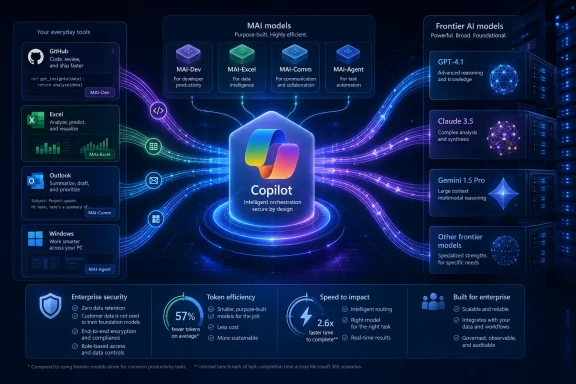 The Core Idea: Right Model, Right Task
Microsoft’s plan challenges a popular assumption in the generative AI market: that progress means deploying the largest general-purpose model everywhere. Frontier models remain extraordinarily capable, particularly for difficult reasoning, broad synthesis, unfamiliar domains, long multi-step workflows, and ambiguous requests. But their capabilities come with significant inference costs.Every AI response consumes compute. The cost rises with model size, the amount of context supplied, the number of output tokens generated, the complexity of tool calls, and the degree of reasoning required. When an organization serves millions of users, even apparently small inefficiencies can create enormous infrastructure bills.
Microsoft’s answer is a model-routing strategy:
- Use smaller, highly tuned MAI models for routine, high-volume tasks.
- Escalate complex requests to more powerful frontier models when needed.
- Evaluate success in the actual application rather than relying exclusively on general benchmarks.
- Continuously improve specialized models using feedback generated inside the product environment.
- Reduce the total number of tokens and the amount of expensive compute required per completed task.
Likewise, an Excel assistant should be skilled at spreadsheet structures, formulas, tables, formatting, business data, workbook context, and the user’s requested outcome. A model trained and evaluated around these workflows can potentially outperform a larger generalist in practical use, even if it would score lower on broad academic-style tests.
That distinction may define the next phase of enterprise AI.
MAI Models Move Into Copilot Workflows
Microsoft has already begun positioning its MAI family as a practical component of its commercial AI stack rather than a distant research initiative. The company’s latest examples focus on GitHub Copilot and Excel, two products where outcomes can be observed more directly than in a generic chat interface.GitHub Copilot and MAI-Code-1-Flash
Microsoft says MAI-Code-1-Flash has delivered an approximately 10% higher code acceptance rate than GPT-5.4 Mini and Claude Haiku 4.5 in its VS Code testing. It also reportedly used around 10% fewer median tokens.These are meaningful figures if they hold across broad real-world use. Code acceptance rate is particularly important because it measures more than whether a response appears plausible. It asks whether a developer actually accepts the proposed code. That is closer to a product outcome than a standalone code-generation benchmark.
The token reduction matters as well. Fewer tokens can mean:
- Lower model-serving costs.
- Faster responses, particularly under heavy load.
- More predictable enterprise operating expenses.
- Less wasted computation on routine completions.
- Greater capacity for a fixed amount of AI infrastructure.
A suggestion might be accepted because it saves a few keystrokes, not because it solves a difficult engineering problem. Conversely, developers may reject a high-quality suggestion simply because it does not fit their local conventions or because they have already begun implementing a different approach.
Microsoft’s approach is still compelling, however, because GitHub Copilot offers an unusually rich feedback environment. Developers accept, modify, ignore, test, and deploy code. Those interactions can produce a far more relevant optimization signal than a generic benchmark question with a single predetermined answer.
Excel as a Test of Cross-Domain Adaptation
Microsoft also reports that a specialized MAI model deployed in Excel is performing on par with GPT-5.6 for common tasks while operating more cost-efficiently. That is a bold statement, especially because spreadsheets are one of the most commercially valuable applications for workplace AI.Excel work ranges from simple formula help to intricate financial modeling, forecasting, data validation, charting, reconciliation, and business reporting. The difference between a competent answer and a reliable one can matter enormously. A misplaced cell reference, a misunderstood date format, or an incorrect formula can ripple through an entire workbook.
The notable technical point is that Microsoft describes its Excel model as building from a coding-oriented foundation and then optimizing it against Excel-specific evaluations. That reflects a practical view of model development: begin with a capable base system, then shape it against a tightly defined environment where the tools, tasks, and success criteria are clearer.
For routine Excel Copilot tasks, this could be a significant breakthrough. If a smaller model can accurately create a formula, explain a table, restructure a worksheet, identify a trend, or generate a useful summary at lower cost, Microsoft can scale the experience more aggressively across Microsoft 365.
But “common tasks” is doing important work in that claim. The model may be highly competitive on everyday spreadsheet assistance while still needing a stronger fallback for more difficult logic, unfamiliar business rules, complex multi-sheet analysis, or requests that require broad external knowledge.
That is not a failure of the specialized approach. It is exactly why Microsoft is emphasizing orchestration rather than replacement.
Frontier Models Are Still Part of the System
The headline is not that Microsoft is abandoning OpenAI or Anthropic. The more accurate reading is that the company is changing its dependency model.Microsoft expects frontier systems from OpenAI and Anthropic to remain valuable for the most demanding requests. In a multi-model Copilot architecture, a powerful model can be reserved for difficult reasoning, advanced generation, unusual tasks, large-context analysis, or workflows where the specialized model lacks confidence.
This allows Microsoft to offer a more flexible AI stack:
- Fast specialized models handle predictable, high-frequency tasks.
- General frontier models handle complex or novel problems.
- Application tools perform actions, retrieve information, edit files, query systems, or run code.
- Memory and context layers supply relevant user and organizational information.
- Policy and safety systems determine what data may be used and what actions are allowed.
For enterprise buyers, multi-model AI also reduces the risk of tying an entire productivity stack to a single supplier or a single model family. Microsoft gains greater leverage, more room to optimize costs, and a clearer path toward differentiation in products that might otherwise feel like interfaces built around someone else’s intelligence.
There is also a strategic subtext. The industry’s center of gravity may be shifting from raw model ownership to learning loops: the ability to observe product usage, define task-specific success, improve models quickly, and integrate those models into software that customers already use every day.
A generalized model may be broadly brilliant. But a company that owns the workflow, the telemetry, the evaluation harness, the deployment platform, and the customer relationship has powerful advantages of its own.
What Microsoft Means by “Hill Climbing”
Microsoft calls its continuous optimization process hill climbing. The name is borrowed from optimization methods in computing, where a system iteratively searches for improvements by moving toward better-performing states.In Microsoft’s AI strategy, hill climbing is less about a single training technique and more about an end-to-end operating model. The process appears to combine:
- Product-specific tasks and evaluations.
- Curated data from realistic workflows.
- Fine-tuning and post-training.
- Tool use and environment grounding.
- Feedback from production deployment.
- Repeated measurement against task-completion outcomes.
- Efficient infrastructure and deployment choices.
This matters because traditional AI benchmarks have real limitations. Benchmarks are valuable for measuring broad capabilities, but they can be gamed, become stale, fail to reflect tool-using workflows, or overemphasize tasks that do not map cleanly to enterprise value.
An AI assistant may score brilliantly on a standardized reasoning test yet struggle with a user’s messy workbook, a company-specific codebase, or a request that requires operating within a complex software interface. Conversely, a smaller specialized model may excel in a narrowly defined setting even if it lacks the general fluency of a frontier model.
Microsoft’s argument is that task success is the benchmark that matters most.
That claim is persuasive, but it needs governance. Product-specific measurement is only as trustworthy as the task set, the definition of success, the safeguards against metric gaming, and the transparency around failures. An internal evaluation can reveal useful product performance, but it is not the same thing as an independent assessment.
Why the Economics Matter So Much
The economics of AI inference are becoming as important as model quality. Training frontier models attracts the headlines, but serving billions of prompts over time can be just as financially consequential.A large model may be technically capable of handling a basic request such as:
- Rewriting a short email.
- Explaining a spreadsheet formula.
- Generating a boilerplate code block.
- Summarizing a meeting transcript.
- Reformatting a table.
- Suggesting a reply in Outlook.
Microsoft’s strategy seeks to improve the cost-to-quality ratio. If MAI models can preserve usefulness while lowering token usage and compute demand, the company can improve margins, reduce capacity pressure, and potentially support more inclusive AI features across its products.
This has implications well beyond Microsoft.
Pressure on AI Model Providers
OpenAI and Anthropic remain central players in the frontier-model market, especially for advanced reasoning and complex enterprise tasks. But every Copilot request shifted to an in-house MAI model is a request that does not require an external frontier system.That does not mean demand for frontier models disappears. It means their role could become more selective and more valuable at the high end. Providers may increasingly compete on areas such as:
- Difficult reasoning and planning.
- Long-context performance.
- Reliability in unfamiliar domains.
- Advanced tool use.
- Multimodal understanding.
- Safety controls and enterprise administration.
- The ability to act as a fallback for lower-cost specialized systems.
Better Margins Could Change Copilot Pricing
Microsoft has not announced that this model-routing strategy will directly alter Copilot prices. Still, lower operating costs could give the company more flexibility.It could invest savings in better features, expand AI availability across more plans, improve response times, subsidize adoption, or offer organizations more predictable consumption models. It could also use the cost advantage defensively, protecting Copilot margins as customer usage grows.
For IT leaders, the more important outcome may be consistency. Enterprise AI pricing has often felt detached from the underlying usage patterns of employees. If model routing becomes more efficient, Microsoft may be better positioned to offer AI capacity that is easier to budget and less vulnerable to costly spikes.
The Outlook Question and the Need for Clearer Transparency
Reports around Microsoft’s broader Copilot strategy have included references to Outlook, alongside Excel and GitHub Copilot. However, the clearest newly detailed technical examples center on GitHub Copilot and Excel.That distinction is worth preserving. It is easy for a broad strategic announcement to become interpreted as a universal product switch, especially across a brand as sprawling as Copilot. Microsoft uses the Copilot name across consumer assistants, Microsoft 365, GitHub, security tools, business applications, developer services, and Windows experiences. The model mix, rollout status, controls, and capabilities can differ substantially across those products.
For customers, model transparency needs to improve as routing becomes more dynamic. Organizations should be able to understand, at an appropriate level:
- Which product experiences may use Microsoft-developed models.
- When external frontier models may be invoked.
- What data is sent to which service boundary.
- How model routing is governed.
- Whether administrators can control model availability.
- What retention, logging, and compliance rules apply.
- How quality and safety regressions are detected.
The more invisible the routing layer becomes, the more important the policy layer becomes.
The Strengths of Microsoft’s Approach
Microsoft’s strategy has several genuine strengths.Product-Centered Evaluation
Measuring whether people complete real tasks is more useful than relying only on abstract benchmark scores. A model that helps a developer ship accepted code or helps a finance analyst create the right spreadsheet logic has demonstrated tangible value.Lower Latency for Common Work
Smaller optimized models can often respond faster. In productivity software, responsiveness is not cosmetic. A Copilot feature that appears instantly is more likely to become part of a daily workflow than one that requires users to pause and wait for every small request.More Sustainable AI Deployment
Serving every request with maximum compute is difficult to justify economically and environmentally. Efficiency gains can reduce unnecessary energy use while enabling more AI functionality across a much larger user base.Better Software Differentiation
A specialized model embedded deeply in Excel or GitHub Copilot can become more than a generic chatbot. It can understand the application’s tools, structures, conventions, and states. That creates a more coherent software experience and makes it harder for a rival model alone to displace the integrated product.Reduced Single-Vendor Dependency
Microsoft’s ability to mix MAI, OpenAI, Anthropic, and potentially other models gives it greater strategic flexibility. Customers may benefit if Microsoft uses that flexibility to optimize quality, resilience, and cost rather than locking organizations into a single opaque AI dependency.The Risks Microsoft Still Has to Solve
The strategy is promising, but it is not risk-free.Specialized Models Can Fail Outside Their Lane
A model trained for narrow workflows may excel until a user asks something unusual. The challenge is identifying those boundaries correctly. If routing systems fail to escalate a difficult request, users could receive a confident but inadequate answer from a lower-cost model.This is especially significant in Excel, where a result can look polished while containing subtle errors. Human review remains essential for financial, operational, regulatory, and high-stakes analysis.
Internal Metrics Can Create Blind Spots
Code acceptance rate and task-completion metrics are useful, but no single metric tells the entire story. Microsoft must guard against optimization that boosts one number while degrading other qualities such as security, maintainability, explainability, or user trust.A suggestion accepted today could create technical debt tomorrow. A quick spreadsheet action could overwrite a critical formula. A fast email draft could miss business context. The evaluation system must account for these downstream effects.
Model Switching Could Confuse Users
If Copilot behaves differently from one task to another because the underlying model has changed, users may perceive inconsistency. One request may be concise and fast; the next may be more reflective and detailed. Without careful product design, the orchestration layer could feel unpredictable.Microsoft will need to make the experience coherent even when several models are working behind the scenes.
Privacy and Data Governance Remain Central
Specialized models do not eliminate the core enterprise AI questions around sensitive data. Whether a request is processed by MAI, OpenAI, Anthropic, or a hybrid pipeline, organizations need confidence that their information is handled according to contractual, technical, and regulatory commitments.The best model-routing system in the world is not enough if administrators cannot verify where data travels, how it is retained, and which safeguards govern tool actions.
Cost Savings Must Not Become Quality Cuts
Customers will accept smarter routing if it improves their experience. They will be far less enthusiastic if “right model for the job” becomes a euphemism for sending too many requests to a weaker model in the name of margin improvement.Microsoft’s public claims about parity and better acceptance rates therefore set a high bar. The company will need to demonstrate that the user-facing quality remains strong as MAI adoption expands.
What This Means for Windows and the Broader Copilot Experience
There is no indication that this announcement represents a standalone new Windows feature or a wholesale redesign of Copilot in Windows. Still, the broader direction is highly relevant to the Windows ecosystem.Windows increasingly acts as a gateway to Microsoft’s cloud-connected productivity and AI services. Whether a user is working in Visual Studio Code, Excel, Outlook, Edge, Teams, or a Copilot interface, the value of the experience will depend less on a single model name and more on how intelligently the system combines local context, cloud services, tools, permissions, and AI reasoning.
Over time, efficient model routing could also make more AI experiences practical across a wider range of hardware and service tiers. The most demanding requests will still benefit from cloud-scale frontier compute. But routine AI assistance may become faster, cheaper, and more ubiquitous when it can be handled by smaller models optimized for the job.
For Windows enthusiasts, developers, and IT professionals, the important shift is architectural. Copilot is becoming less like one assistant powered by one brain and more like a software control plane that selects from several AI capabilities.
That may be less marketable than declaring a single model to be the most powerful. It may also be much more useful.
The Larger Strategic Shift
Microsoft’s MAI strategy suggests that the next enterprise AI battle will not be won solely by whoever trains the largest model. It will be won by whoever can deliver the most reliable outcome at the best combination of quality, speed, cost, security, and integration.Frontier models will continue to define the outer edge of AI capability. OpenAI and Anthropic remain critical to that landscape, and Microsoft still sees both as part of its overall orchestration system. But the center of enterprise value may increasingly sit in the layer above the model: the application, the workflow, the tools, the memory, the evaluation process, and the feedback loop.
Microsoft’s hill-climbing approach is therefore more than a cost-cutting exercise. It is an effort to turn Copilot into a continuously improving, product-aware AI system where model selection is invisible and task success is the ultimate measure.
If Microsoft can maintain quality while using fewer tokens and less expensive compute, it could strengthen Copilot’s economics and make AI features feel more responsive across everyday work. If it cannot provide transparency, dependable routing, and rigorous safeguards, the same strategy could make Copilot feel opaque and inconsistent.
The real test will not be whether MAI models can beat a rival in a narrow comparison. It will be whether users notice that Copilot is faster, more accurate, and more useful—without needing to know which model did the work.
References
- Primary source: WION
Published: 2026-07-24T05:43:12.630182
- Official source: microsoft.ai
