

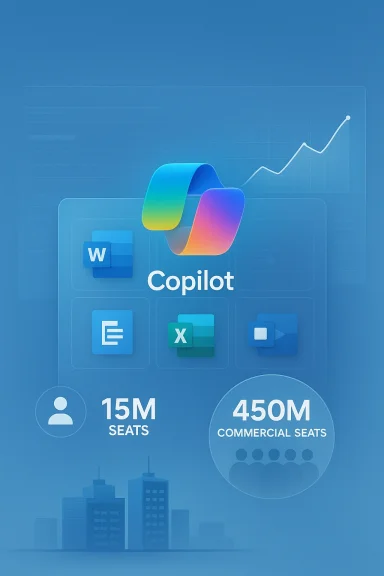
Microsoft’s Copilot problem is not that the product is dead on arrival. It is that investors have started treating it like a referendum on Microsoft’s entire AI future, even though the business case has always been broader, slower, and more layered than a single premium add-on. The company disclosed 15 million paid Microsoft 365 Copilot seats in its fiscal Q2 2026 earnings call, while also reiterating that Microsoft 365 commercial paid seats exceeded 450 million and that revenue growth in the segment was being driven by Microsoft 365 E5 and Microsoft 365 Copilot. Microsoft also said it was seeing larger commercial deployments, with some customers purchasing more than 35,000 seats, and Publicis alone buying nearly all of its employees access.
That matters because the debate around Copilot has become strangely detached from the scale of Microsoft’s broader platform. Copilot is important, but it does not need to become the dominant revenue engine for Microsoft’s stock to work. The real question is whether it improves retention, raises revenue per user, and deepens Microsoft’s already formidable enterprise moat. In other words, Copilot is less a standalone verdict on Microsoft than a test of whether the company can monetize AI as an embedded layer inside an already elite recurring-revenue business.
Microsoft’s Copilot story began as a bold attempt to make AI feel ambient across the company’s ecosystem, from Windows to Microsoft 365 to developer tools. The pitch was elegant: instead of forcing users to learn a new interface, Microsoft would place AI inside the software people already use every day. Over time, that idea turned into a sprawling portfolio of Copilot-branded experiences, each with different licensing rules, product surfaces, and customer expectations.
That expansion was strategically sensible, but it also created confusion. Copilot became a label attached to consumer chat, enterprise productivity, Windows entry points, and developer tools at once. For Microsoft, this helped establish AI as a platform identity. For users and investors, it made the product story harder to parse. A feature that appears everywhere can feel powerful; it can also feel diffuse, especially when the business model behind it is still evolving.
Microsoft’s commercial push has been particularly significant. The company has said that for commercial organizations it will prioritize future Copilot development in the Microsoft 365 app rather than in Copilot in Windows, which is a meaningful strategic signal. That doesn’t mean Microsoft is abandoning Windows AI; it means the company is drawing a line between where it wants the core monetization story to live and where it wants the assistant to be merely visible.
The timing is important as well. Microsoft has been pouring money into AI infrastructure, with executives describing rising investments in compute capacity and AI talent alongside continued data center expansion. That has fueled investor anxiety about capex, capacity constraints, and when the returns will show up in the financials. Copilot, naturally, has become the easiest target for that anxiety because it is the most visible AI product with a measurable seat count.
The problem is that markets often price narratives faster than businesses can mature. Copilot became a symbol of Microsoft’s AI future before it became a fully scaled revenue driver. That gap created a tension between valuation expectations and operating reality. When the seat number landed at 15 million, some investors heard momentum; others heard that adoption was meaningful but still nowhere near transformative relative to Microsoft’s scale.
But distribution alone is not the same as enthusiasm. Users can be handed a feature and still not make it part of their workflow. The distinction is critical. Microsoft can win by making Copilot useful enough to improve the economics of Microsoft 365 without necessarily turning it into a consumer sensation. That is a slower, less flashy model, but it is much more consistent with how Microsoft has historically created durable value.
At the same time, Microsoft’s own framing suggests Copilot is still one part of a much bigger commercial machine. Microsoft 365 commercial cloud revenue grew 17%, driven in part by revenue per user, and the company said commercial seats rose 6% with expansion across SMB and frontline worker offerings. That is a reminder that the base business is massive and still compounding on its own.
Microsoft also said it was seeing “accelerating seat growth quarter-over-quarter” and “larger commercial deployments,” including accounts with more than 35,000 seats. Those are the kinds of signals bulls wanted to hear because they imply the product may be moving beyond pilot-stage curiosity into broader enterprise adoption. Still, accelerating is not the same as dominant, and that distinction is where the market tends to get impatient.
The result is that Copilot now sits in the uncomfortable middle ground where it is too real to dismiss, but too early to crown. The market wants an instant payoff from a product that is still being integrated into workflows, expanded across customer segments, and fitted into Microsoft’s licensing stack. That is a recipe for disappointment if expectations get ahead of execution.
This is where the food-critic analogy in the uploaded article lands well. Copilot is being judged as if it were the main course when, in Microsoft’s business model, it is closer to a premium ingredient layered onto an already expensive and profitable meal. The company’s biggest AI value may come from increasing stickiness, raising average revenue per user, and strengthening the case for Azure and Microsoft 365 adoption.
A feature can be strategically powerful without being the headline revenue driver. If Copilot helps Microsoft retain customers, sell more premium licenses, and deepen switching costs, it will have done its job. The market, however, often wants a cleaner and faster answer. That mismatch is what makes the stock reaction feel larger than the underlying product data.
The irony is that Copilot can still be highly successful even if it never becomes the star of the story. Microsoft’s platform business has always rewarded products that quietly improve the value of the ecosystem rather than dominating headlines. Copilot may end up looking less like a blockbuster app and more like the glue that makes the Microsoft Cloud even harder to leave.
The company has also discussed increased AI capacity and major data center buildouts. In prior commentary, Microsoft said it expected to increase total AI capacity by more than 80% in FY26 and roughly double its data center footprint over two years. That kind of expansion is expensive, and it invites scrutiny about whether the revenue ramp will keep pace.
That concern is not irrational. AI infrastructure is front-loaded, while monetization can take longer to mature. Microsoft has enough financial strength to absorb that timing mismatch, but public markets can be impatient when the capex line rises faster than the revenue line. In that sense, Copilot has become a proxy for a broader debate about whether the AI buildout is prematurely expensive or simply early.
Still, management has to prove that the spending converts into usage and margin improvement. If Copilot adoption grows while Microsoft 365 revenue per user rises and Azure demand remains strong, the company can make the spend look prescient. If not, the capex overhang will keep weighing on sentiment, regardless of how many seats Copilot eventually sells.
That is a very Microsoft-like strategy. The company has repeatedly turned infrastructure and distribution into moat expansion. If Copilot helps make Microsoft 365 stickier, that stickiness can be monetized through higher tiers, broader seat expansion, and deeper cloud dependency. The upside is subtle, but it can be substantial.
At roughly $30 per user per month in the commercial lineup, Copilot can contribute real revenue if adoption broadens. But the bigger opportunity is that it can lift Microsoft 365’s perceived value, reducing churn risk and making upgrades easier to justify. In that sense, Copilot is less about replacing the core business than about making the core business harder to leave.
That is why the “one Copilot for everything” story eventually ran into friction. In consumer computing, users do not want to feel coerced. In enterprise, IT administrators do not want surprise features. Microsoft appears to be adjusting by separating presentation from capability, which is often the right move when product enthusiasm collides with operational reality.
That’s important because Microsoft is still an exceptional business even if the multiple doesn’t expand much. The company has unmatched scale in enterprise software, a broad distribution moat, and enough balance-sheet strength to keep spending through a noisy AI cycle. A stock can be expensive in theory and merely fairly valued in practice.
Analysts often look past quarter-to-quarter noise when the underlying platform remains strong. Microsoft’s revenue mix, cloud scale, and recurring enterprise relationships support that approach. The challenge is that sentiment can stay skeptical longer than the fundamentals stay disappointing, especially when a stock has already been rerated on AI optimism.
But a lower multiple does not automatically guarantee upside. It can also reflect uncertainty about the timing of returns on AI spending, the eventual scale of Copilot adoption, and the sustainability of current growth rates. Investors are effectively asking Microsoft to prove that its AI investments are not just strategically sound, but financially legible.
What has changed is that the market is now less willing to assume Microsoft automatically wins just because it is Microsoft. AI is more fluid than the software categories that came before it. Model access, infrastructure partnerships, and product bundling all matter, but none of them guarantee monopoly-like economics.
That said, Microsoft still enjoys an enviable position. Few companies can roll AI into an installed base of hundreds of millions of commercial seats while also controlling the cloud layer underneath. That is why Copilot’s real strategic value may be cumulative rather than explosive. Microsoft does not need a breakout consumer hit if it can keep tightening the enterprise loop.
Copilot may end up being less about creating a new category than about reinforcing Microsoft’s category dominance. If that happens, the product can be financially successful even while never becoming the sort of breakout consumer phenomenon that excites headlines. The value would show up in margins, renewals, and share of wallet, not necessarily in viral brand heat.
At the same time, the company’s strategic messaging is likely to become more nuanced. Microsoft appears to be moving toward a model where Copilot is less of a universal branding hammer and more of a targeted workflow layer, especially for commercial customers. That may disappoint the believers who wanted a faster, flashier monetization story, but it could also be exactly what a mature platform company needs to do to turn AI from headline into habit.
Source: Investing.com Microsoft’s Copilot Problem Isn’t What You Think | Investing.com
That matters because the debate around Copilot has become strangely detached from the scale of Microsoft’s broader platform. Copilot is important, but it does not need to become the dominant revenue engine for Microsoft’s stock to work. The real question is whether it improves retention, raises revenue per user, and deepens Microsoft’s already formidable enterprise moat. In other words, Copilot is less a standalone verdict on Microsoft than a test of whether the company can monetize AI as an embedded layer inside an already elite recurring-revenue business.
 Background
Microsoft’s Copilot story began as a bold attempt to make AI feel ambient across the company’s ecosystem, from Windows to Microsoft 365 to developer tools. The pitch was elegant: instead of forcing users to learn a new interface, Microsoft would place AI inside the software people already use every day. Over time, that idea turned into a sprawling portfolio of Copilot-branded experiences, each with different licensing rules, product surfaces, and customer expectations.That expansion was strategically sensible, but it also created confusion. Copilot became a label attached to consumer chat, enterprise productivity, Windows entry points, and developer tools at once. For Microsoft, this helped establish AI as a platform identity. For users and investors, it made the product story harder to parse. A feature that appears everywhere can feel powerful; it can also feel diffuse, especially when the business model behind it is still evolving.
Microsoft’s commercial push has been particularly significant. The company has said that for commercial organizations it will prioritize future Copilot development in the Microsoft 365 app rather than in Copilot in Windows, which is a meaningful strategic signal. That doesn’t mean Microsoft is abandoning Windows AI; it means the company is drawing a line between where it wants the core monetization story to live and where it wants the assistant to be merely visible.
The timing is important as well. Microsoft has been pouring money into AI infrastructure, with executives describing rising investments in compute capacity and AI talent alongside continued data center expansion. That has fueled investor anxiety about capex, capacity constraints, and when the returns will show up in the financials. Copilot, naturally, has become the easiest target for that anxiety because it is the most visible AI product with a measurable seat count.
Why the market fixated on Copilot
Investors love a clean story, and Copilot initially looked like one: AI inside Office, paid subscriptions, obvious monetization, easy upside. But Microsoft is not a single-product company, and Copilot is not the whole AI strategy. The company’s earnings report shows that Productivity and Business Processes, Intelligent Cloud, and the broader Microsoft Cloud are still doing the heavy lifting, while Copilot is one monetization layer among many.The problem is that markets often price narratives faster than businesses can mature. Copilot became a symbol of Microsoft’s AI future before it became a fully scaled revenue driver. That gap created a tension between valuation expectations and operating reality. When the seat number landed at 15 million, some investors heard momentum; others heard that adoption was meaningful but still nowhere near transformative relative to Microsoft’s scale.
The distribution advantage
Microsoft’s great strength has always been distribution. It does not need to invent demand from scratch; it can place new capabilities inside software already embedded in daily work. That is exactly why Copilot matters. A premium add-on layered onto Microsoft 365 can eventually become a high-margin monetization engine if it boosts usage, expands seat value, and keeps customers inside the ecosystem longer.But distribution alone is not the same as enthusiasm. Users can be handed a feature and still not make it part of their workflow. The distinction is critical. Microsoft can win by making Copilot useful enough to improve the economics of Microsoft 365 without necessarily turning it into a consumer sensation. That is a slower, less flashy model, but it is much more consistent with how Microsoft has historically created durable value.
What Microsoft Actually Reported
The first thing to note is that Microsoft finally quantified Copilot in a way investors could anchor to. The company said it had 15 million paid Microsoft 365 Copilot seats, a figure that was presented alongside broader commercial seat growth and AI-driven revenue per user gains in Microsoft 365. That is a meaningful disclosure because it turns an abstract AI strategy into something that can be tracked quarter by quarter.At the same time, Microsoft’s own framing suggests Copilot is still one part of a much bigger commercial machine. Microsoft 365 commercial cloud revenue grew 17%, driven in part by revenue per user, and the company said commercial seats rose 6% with expansion across SMB and frontline worker offerings. That is a reminder that the base business is massive and still compounding on its own.
The seat count is real, but context is everything
Fifteen million paid seats sound enormous in isolation. Against Microsoft’s 450 million-plus commercial paid seat base, however, the figure is still a relatively small penetration rate. That does not make Copilot weak; it makes it early. The difference matters because investors are often evaluating the product as if it should already be a mature growth pillar rather than a developing monetization layer.Microsoft also said it was seeing “accelerating seat growth quarter-over-quarter” and “larger commercial deployments,” including accounts with more than 35,000 seats. Those are the kinds of signals bulls wanted to hear because they imply the product may be moving beyond pilot-stage curiosity into broader enterprise adoption. Still, accelerating is not the same as dominant, and that distinction is where the market tends to get impatient.
Why the disclosure changed the conversation
Before Microsoft gave a paid-seat number, Copilot could be discussed mostly as a strategic promise. Once the number arrived, it became a business with a measurable adoption slope. That is good for transparency, but it also gives skeptics a hard baseline against which to compare Microsoft’s AI capex and platform ambition.The result is that Copilot now sits in the uncomfortable middle ground where it is too real to dismiss, but too early to crown. The market wants an instant payoff from a product that is still being integrated into workflows, expanded across customer segments, and fitted into Microsoft’s licensing stack. That is a recipe for disappointment if expectations get ahead of execution.
Why Investors Misread the Product
A lot of the Copilot debate comes down to framing. Investors have treated it like a referendum on Microsoft’s entire AI destiny, but Microsoft’s own disclosures suggest a more measured reality: Copilot is an add-on to a platform company that already generates enormous recurring revenue. That means Copilot can matter a great deal without needing to carry the whole valuation story.This is where the food-critic analogy in the uploaded article lands well. Copilot is being judged as if it were the main course when, in Microsoft’s business model, it is closer to a premium ingredient layered onto an already expensive and profitable meal. The company’s biggest AI value may come from increasing stickiness, raising average revenue per user, and strengthening the case for Azure and Microsoft 365 adoption.
A feature, not a franchise
That distinction is especially important in enterprise software. Enterprise buyers rarely adopt new tools because a demo is exciting; they adopt them because the tool changes the economics of the workflow. Microsoft appears to understand this, which is why it has continued embedding Copilot into Microsoft 365 rather than trying to sell it as a separate moonshot business.A feature can be strategically powerful without being the headline revenue driver. If Copilot helps Microsoft retain customers, sell more premium licenses, and deepen switching costs, it will have done its job. The market, however, often wants a cleaner and faster answer. That mismatch is what makes the stock reaction feel larger than the underlying product data.
The problem with narrative overload
Microsoft’s AI narrative has become so broad that Copilot sometimes gets asked to explain everything. It is expected to justify capex, defend valuation, and validate the company’s entire AI brand. That is too much pressure for one product line, especially one still scaling in a large enterprise base.The irony is that Copilot can still be highly successful even if it never becomes the star of the story. Microsoft’s platform business has always rewarded products that quietly improve the value of the ecosystem rather than dominating headlines. Copilot may end up looking less like a blockbuster app and more like the glue that makes the Microsoft Cloud even harder to leave.
Capex, Compute, and the Real Burden on the Stock
The more serious pressure on Microsoft’s shares may not be Copilot itself, but the cost of supporting the whole AI stack. Microsoft said operating expenses rose partly because of research and development investments in compute capacity and AI talent, while gross margin was affected by continued AI infrastructure spending and growing AI product usage. That is the kind of tradeoff investors are watching very closely in 2026.The company has also discussed increased AI capacity and major data center buildouts. In prior commentary, Microsoft said it expected to increase total AI capacity by more than 80% in FY26 and roughly double its data center footprint over two years. That kind of expansion is expensive, and it invites scrutiny about whether the revenue ramp will keep pace.
Infrastructure is the hidden story
This is why Copilot gets pulled into a larger argument about capital allocation. The product is visible, but the infrastructure behind it is where the real money is being spent. Investors are not merely asking whether users like Copilot; they are asking whether Microsoft’s AI spending will translate into enough durable revenue to justify the buildout.That concern is not irrational. AI infrastructure is front-loaded, while monetization can take longer to mature. Microsoft has enough financial strength to absorb that timing mismatch, but public markets can be impatient when the capex line rises faster than the revenue line. In that sense, Copilot has become a proxy for a broader debate about whether the AI buildout is prematurely expensive or simply early.
When investors confuse expense with failure
A big capex cycle does not automatically mean a bad strategy. Microsoft has historically used scale to outlast smaller rivals, and it is now doing the same in AI. The risk is that the market interprets every expensive quarter as evidence that the strategy is broken, rather than as the natural cost of building new platform capacity.Still, management has to prove that the spending converts into usage and margin improvement. If Copilot adoption grows while Microsoft 365 revenue per user rises and Azure demand remains strong, the company can make the spend look prescient. If not, the capex overhang will keep weighing on sentiment, regardless of how many seats Copilot eventually sells.
Copilot as Distribution, Not Destination
Microsoft’s smartest AI play may be to use Copilot as a distribution layer rather than a stand-alone destination. The company has already signaled that future development focus for commercial customers is moving toward the Microsoft 365 app, which suggests the long-term goal is to make AI a daily part of work rather than a separate product people consciously go open.That is a very Microsoft-like strategy. The company has repeatedly turned infrastructure and distribution into moat expansion. If Copilot helps make Microsoft 365 stickier, that stickiness can be monetized through higher tiers, broader seat expansion, and deeper cloud dependency. The upside is subtle, but it can be substantial.
Why “nice-to-have” may be enough
The uploaded article calls Copilot a “nice-to-have, albeit premium, add-on,” and that may actually be the right framing. In software economics, a product does not need to be indispensable to be profitable; it only needs to be meaningfully valuable to enough customers. Microsoft’s pricing structure and distribution base make that possible.At roughly $30 per user per month in the commercial lineup, Copilot can contribute real revenue if adoption broadens. But the bigger opportunity is that it can lift Microsoft 365’s perceived value, reducing churn risk and making upgrades easier to justify. In that sense, Copilot is less about replacing the core business than about making the core business harder to leave.
Enterprise and consumer behave differently
Consumer adoption is usually driven by novelty, convenience, and visible delight. Enterprise adoption is driven by governance, predictability, and measurable productivity. Microsoft has to satisfy both, but the monetization logic is stronger on the enterprise side because the company can sell in bulk, control deployment, and tie usage to recurring contracts.That is why the “one Copilot for everything” story eventually ran into friction. In consumer computing, users do not want to feel coerced. In enterprise, IT administrators do not want surprise features. Microsoft appears to be adjusting by separating presentation from capability, which is often the right move when product enthusiasm collides with operational reality.
Is Microsoft’s Stock Really That Cheap?
Valuation is where the debate gets concrete. The uploaded analysis says Microsoft was trading around 28x forward earnings in early April, only a bit above the S&P 500 average and well below the premium typically assigned to a company with Microsoft’s franchise strength. If that is accurate, the stock may not be pricing in a dramatic AI disappointment at all; it may simply be digesting a slower monetization curve than bulls once expected.That’s important because Microsoft is still an exceptional business even if the multiple doesn’t expand much. The company has unmatched scale in enterprise software, a broad distribution moat, and enough balance-sheet strength to keep spending through a noisy AI cycle. A stock can be expensive in theory and merely fairly valued in practice.
Why analysts remain bullish
The analyst community is still heavily supportive. The uploaded article cites a consensus price target of $588.97 and says 40 of 45 analysts rate the stock a Buy. Even allowing for differences in timing and methodology, that points to a market view that Microsoft’s fundamentals remain intact and that the selloff may have overcorrected relative to the company’s long-term earnings power.Analysts often look past quarter-to-quarter noise when the underlying platform remains strong. Microsoft’s revenue mix, cloud scale, and recurring enterprise relationships support that approach. The challenge is that sentiment can stay skeptical longer than the fundamentals stay disappointing, especially when a stock has already been rerated on AI optimism.
A premium business with a more ordinary multiple
What stands out is not that Microsoft has become cheap in the classic value sense. It is that the market is no longer assigning an obviously euphoric premium to the stock. For a company with Microsoft’s quality, that may itself be a bullish setup if the company can keep compounding while expectations reset.But a lower multiple does not automatically guarantee upside. It can also reflect uncertainty about the timing of returns on AI spending, the eventual scale of Copilot adoption, and the sustainability of current growth rates. Investors are effectively asking Microsoft to prove that its AI investments are not just strategically sound, but financially legible.
The Competitive Landscape Is Still Favorable
Microsoft is not operating in a vacuum, but it does remain one of the best-positioned companies in enterprise AI. It has the cloud, the productivity suite, the identity layer, the enterprise channel, and the developer ecosystem. That combination is hard to replicate, even for larger rivals with strong AI capabilities of their own.What has changed is that the market is now less willing to assume Microsoft automatically wins just because it is Microsoft. AI is more fluid than the software categories that came before it. Model access, infrastructure partnerships, and product bundling all matter, but none of them guarantee monopoly-like economics.
Why rivals matter less than execution
In the short term, the biggest competitor to Microsoft’s Copilot story may not be another product from a rival tech giant. It may be customer inertia. If users do not see enough value to change habits, then Microsoft cannot convert distribution into monetization quickly enough. The company must win the daily workflow, not merely the slide deck.That said, Microsoft still enjoys an enviable position. Few companies can roll AI into an installed base of hundreds of millions of commercial seats while also controlling the cloud layer underneath. That is why Copilot’s real strategic value may be cumulative rather than explosive. Microsoft does not need a breakout consumer hit if it can keep tightening the enterprise loop.
The platform advantage remains intact
The broader market should not confuse a slower-than-hoped monetization curve with strategic weakness. Microsoft is still shaping the environment in which a great deal of enterprise work happens. That is a structural advantage, not a temporary one.Copilot may end up being less about creating a new category than about reinforcing Microsoft’s category dominance. If that happens, the product can be financially successful even while never becoming the sort of breakout consumer phenomenon that excites headlines. The value would show up in margins, renewals, and share of wallet, not necessarily in viral brand heat.
Strengths and Opportunities
Microsoft’s AI strategy still has a long runway because it is built on distribution, recurring revenue, and enterprise trust rather than on novelty alone. The company can afford to be patient, and that may turn out to be a competitive advantage if the market has overestimated how quickly AI should monetize.- Massive installed base across Microsoft 365 and Windows creates low-friction distribution for AI features.
- Enterprise trust in security, identity, and compliance gives Microsoft an edge in managed deployments.
- Recurring revenue model makes even modest Copilot adoption financially meaningful over time.
- Pricing power can emerge if Copilot increases Microsoft 365’s perceived value.
- Azure and cloud integration give Microsoft control over both the front end and the compute layer.
- Workflow stickiness may prove more valuable than a standalone AI app.
- Potential for simplification could make Copilot feel more coherent and easier to sell.
Risks and Concerns
The risk is not that Microsoft is failing; it is that the market may be expecting a faster and cleaner AI payoff than the business can realistically deliver. That gap can keep sentiment weak even if operations remain strong.- High AI capex could continue to pressure margins and investor patience.
- Copilot adoption may remain too gradual to satisfy near-term growth expectations.
- Product fragmentation across Windows, Microsoft 365, and consumer surfaces can confuse users.
- Enterprise backlash is possible if AI feels forced rather than optional.
- Execution risk rises when infrastructure buildout, product integration, and branding all shift at once.
- Sentiment risk remains if investors keep measuring Copilot against an unrealistic blockbuster standard.
- Valuation compression could persist if the growth story fails to accelerate visibly.
Looking Ahead
The next few quarters will matter more for sentiment than for the long-term thesis. Investors will want to see whether Copilot seat growth continues to accelerate, whether Microsoft can widen deployment across larger enterprise accounts, and whether the company’s heavy AI spending starts to translate into clearer financial returns. Those are measurable questions, and Microsoft has now given the market enough information to keep score.At the same time, the company’s strategic messaging is likely to become more nuanced. Microsoft appears to be moving toward a model where Copilot is less of a universal branding hammer and more of a targeted workflow layer, especially for commercial customers. That may disappoint the believers who wanted a faster, flashier monetization story, but it could also be exactly what a mature platform company needs to do to turn AI from headline into habit.
What to watch next
- Quarterly Copilot seat growth and whether 15 million becomes a stepping stone or a plateau.
- Microsoft 365 revenue per user and whether Copilot continues to support pricing power.
- Azure capacity and capex guidance as the AI buildout continues.
- Enterprise deployment breadth, especially larger commercial rollouts.
- Product simplification efforts that reduce Copilot clutter and improve usability.
Source: Investing.com Microsoft’s Copilot Problem Isn’t What You Think | Investing.com
Last edited:
