

Microsoft’s Copilot has a new face: a deliberately non‑human, animated avatar called Mico that Microsoft unveiled as the visible anchor of a sweeping “Copilot Fall Release” aimed at turning reactive chat into a persistent, voice‑first collaborator — and the company is explicitly pitching it as what Clippy should have been, not what Clippy became.
Microsoft announced a major consumer push for Copilot in a staged fall rollout that bundles personality, long‑term memory, group collaboration, and agentic browser actions into a single release. The most public element is Mico — an expressive, shape‑shifting orb that appears primarily in Copilot’s voice mode and in learning and group workflows to provide nonverbal cues (listening, thinking, acknowledgement) while Copilot speaks. Microsoft frames Mico as optional, configurable, and intentionally non‑photoreal to reduce emotional over‑attachment. Beyond the avatar, the release includes:
If Microsoft follows through with transparent retention policies, auditable provenance, conservative defaults for vulnerable users, and strong enterprise controls, Mico can be a durable, helpful face for Copilot. If governance and metrics are deprioritized in favor of engagement, the industry risks relearning lessons about interruption, manipulation, and user backlash that Clippy once taught. The difference between a lovable assistant and an intrusive gimmick will be decided less by how Mico looks and more by how the invisible scaffolding of safety, privacy and auditability is built and enforced.
Source: keysnews.com Microsoft hopes Mico succeeds where Clippy failed as tech companies warily imbue AI with personality
 Background / Overview
Microsoft announced a major consumer push for Copilot in a staged fall rollout that bundles personality, long‑term memory, group collaboration, and agentic browser actions into a single release. The most public element is Mico — an expressive, shape‑shifting orb that appears primarily in Copilot’s voice mode and in learning and group workflows to provide nonverbal cues (listening, thinking, acknowledgement) while Copilot speaks. Microsoft frames Mico as optional, configurable, and intentionally non‑photoreal to reduce emotional over‑attachment. Beyond the avatar, the release includes:- Copilot Groups — shared sessions that let multiple people interact with a single Copilot instance for brainstorming, summaries and task assignment.
- Learn Live — a voice‑led, Socratic tutoring flow intended to scaffold learning rather than simply hand out answers.
- Real Talk — a conversational mode that can push back or challenge assumptions instead of reflexively agreeing.
- Memory & Connectors — opt‑in long‑term memory and permissioned connectors (Outlook, OneDrive, Gmail, Google Drive/Calendar).
- Edge Actions & Journeys — agentic, multi‑step web actions the assistant can perform after explicit confirmation.
What is Mico — design, intent and how it differs from Clippy
A deliberately non‑human persona
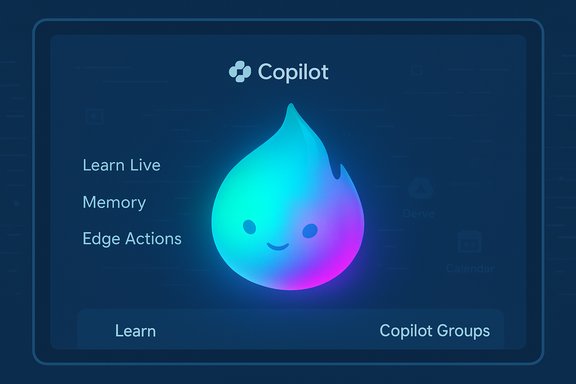
Mico is a small animated orb — a blob‑ or flame‑like shape — that changes color and expression to indicate conversational state. Crucially, the design team purposely avoided photorealism and humanoid faces to reduce the uncanny valley and the risk of emotional over‑attachment. Microsoft describes Mico as a visual layer on top of Copilot’s reasoning engine, not a distinct, separate personality or agent.Scoped activation and opt‑out controls
Where Clippy infamously popped up unsolicited and repeatedly, Mico is scoped to contexts where nonverbal cues materially help interaction: voice conversations, Learn Live tutoring flows, and collaborative Copilot Groups. Preview coverage and Microsoft’s messaging stress that Mico is optional and can be disabled — though early builds reportedly enable it by default in supported voice experiences in the U.S., making an accessible opt‑out vital.The Clippy wink
Hands‑on previews captured an Easter egg: tapping Mico repeatedly can briefly morph it into a small paperclip reminiscent of Clippy. Reporters treat that as a playful nod to Microsoft’s UX history rather than a resurrected behavior; Microsoft positions the easter egg as low‑stakes nostalgia. That detail is provisional and may change between preview and general availability.The functional context — why personality matters now
Voice and multimodal interactions remain awkward for many users. A visible avatar helps signal conversational state — when the assistant is listening, thinking, or ready — which reduces social friction and makes hands‑free usage more discoverable and comfortable. Microsoft frames Mico as a usability affordance that makes Copilot’s voice experiences feel natural rather than gimmicky. But the avatar is not the product: it’s the signal for a broader strategy that leans on memory, connectors, and the ability to act on users’ behalf in the browser and apps. This strategy has business logic: a friendly but useful persona can increase engagement and retention while making the assistant feel more approachable for non‑technical audiences, students, and mixed groups. On the flip side, personality also amplifies the psychological and regulatory stakes of AI assistants, which is why Microsoft stresses opt‑in controls and provenance.What’s actually new — feature breakdown
Mico: expressive avatar
- Appears in voice mode and Copilot home surface.
- Real‑time reactions to tone (color and expression changes).
- Tactile behaviors in preview (tap to animate).
- Optional and customizable; can be disabled.
Learn Live: Socratic tutoring
- Voice‑led, guided learning flows with visual whiteboarding and stepwise questioning.
- Designed to scaffold problem solving rather than hand out direct answers.
- Education‑focused design aims to reduce misuse (e.g., copying homework) by engaging learners in the reasoning process.
Copilot Groups: shared AI sessions
- Link‑based shared Copilot conversations intended for small teams, classes, or social groups.
- The preview participant cap varies across reports (roughly 30–32); treat the precise number as provisional until Microsoft’s documentation finalizes it.
Real Talk: calibrated disagreement
- An optional conversational mode that shows more of the assistant’s reasoning and can respectfully push back on false or risky assumptions, aiming to combat “yes‑man” behavior.
Memory and connectors
- Opt‑in long‑term memory primitives let Copilot retain project context, preferences and persistent facts across sessions.
- UI controls allow users to view, edit and delete remembered items.
- Connectors to consumer services (Outlook, OneDrive, Gmail, Google Drive/Calendar) enable natural‑language search across accounts after explicit permission.
Edge Actions & Journeys
- Edge gains “Actions” that enable multi‑step web tasks (hotel bookings, form fills) after explicit confirmation.
- “Journeys” group browsing into resumable project workspaces, turning research into persistent, resumable tasks. These agentic capabilities materially change Copilot from a query engine to a task performer.
Verification of key claims (cross‑checked)
Several load‑bearing claims were checked against independent reporting and Microsoft’s preview coverage:- Mico’s existence, expressive behavior, and default presence in voice mode were reported consistently by major outlets and previewers.
- Group chat functionality and shared Copilot sessions were demonstrated; several outlets reported participant caps (reports vary between ~30 and 32), so the exact number is provisional.
- Learn Live and the Socratic tutoring approach were demonstrated in preview and emphasized in Microsoft’s messaging as an alternative to simply providing answers.
- Memory primitives and user‑facing controls were central to the rollout and called out repeatedly; independent coverage verified UI controls to view, edit and delete memories. However, precise retention policies and back‑end storage locales were not disclosed in previews and remain to be confirmed in admin documentation.
Strengths — what Microsoft got right
- Purpose‑first personality: Mico is scoped to scenarios where nonverbal cues improve usability (voice, tutoring, groups) rather than being an ever‑present desktop sprite — a clear corrective to Clippy’s core failure.
- Opt‑in controls and memory management: The company foregrounded UI for memory review, editing and deletion, which is essential for consent and governance when assistants retain personal facts.
- Pedagogical design in Learn Live: A Socratic, scaffolded tutoring model addresses a major misuse vector in education by encouraging reasoning over copy‑and‑paste answers.
- Integrated productivity story: By combining persona, memory and agentic actions inside Windows, Edge and Microsoft 365, Copilot becomes a practical assistant with real workflows rather than a mere novelty. This breadth gives Mico immediate utility.
Risks and failure modes — what to watch closely
- Default matters: Enabling Mico by default in voice mode (as reported in early rollouts) shifts the burden to users to opt out. Defaults have outsized behavioral influence; an enabled‑by‑default expressive avatar risks creeping into workflows where it’s distracting or misleading.
- Emotional manipulation and attachment: Even abstract avatars can trigger emotional responses. Schools, caregivers and product teams must watch for dependency or misplaced trust, especially for minors or vulnerable users. Non‑human design reduces risk but does not eliminate it.
- Privacy & connectors: Linking email, drives and calendars across providers increases convenience but also increases the attack surface and governance complexity. Admins must verify connector scopes and audit logs; users must be able to revoke access easily. The preview materials do not fully disclose backend storage and retention semantics, creating an audit gap that must be closed in official documentation.
- Hallucination and liability: When Copilot is allowed to act (book, reserve, recommend), errors can have real costs. “Real Talk” and provenance displays help, but liability and redress mechanisms for mistaken automated actions remain an open design and legal question.
- Educational misuse: Learn Live’s design mitigates rote copying, but classroom deployment still requires guardrails (plagiarism detection, teacher oversight, and privacy protections for student data).
- Regulatory scrutiny: Anthropomorphic companions are attracting scrutiny globally — from consumer protection to child safety regulators. Companies may face new obligations if avatars are marketed toward children or vulnerable adults.
Practical guidance — for users, parents and IT administrators
- For consumers:
- Review Copilot settings and turn off Mico if you prefer text‑only or distraction‑free interactions.
- Audit Copilot Memory and delete entries you don’t want retained.
- Be cautious when enabling connectors — start small and verify what the assistant can access.
- For parents and educators:
- Pilot Learn Live in supervised settings first; require validation steps for assignments.
- Teach students that Copilot outputs are aids, not authoritative answers.
- Use institutional accounts with clear policies about data retention and consent.
- For IT administrators:
- Pilot group features with a test cohort to observe behavior and audit logs.
- Restrict or disable connectors and Actions until you can validate audit trails and confirmation flows.
- Require explicit consent for any Copilot features that access user data, and document opt‑out mechanics for compliance audits.
- For product and security teams:
- Demand transparent provenance (source citations for factual claims) and error reporting APIs.
- Instrument agentic Actions with transaction logs auditable by administrators.
- Define recovery and compensation procedures for bot‑triggered transactions that fail or cause loss.
Governance and standards — what Microsoft and the industry should do
- Publish clear, machine‑readable retention policies and server locales for memory and connector data.
- Expose auditable provenance metadata for each recommendation or action Copilot issues.
- Provide specialized safety modes for minors and vulnerable groups with hardened defaults (no agentic actions, limited memory).
- Offer enterprise policy controls that let admins set per‑user limits on connectors, memory, Actions and group session size.
- Commit to independent third‑party audits on safety, privacy and fairness metrics for persona‑driven features.
The bigger picture — what Mico signals for consumer AI
Mico is less an isolated UX choice and more a visible marker of a broader industry trend: companies are moving from faceless automation to social, persistent assistants that act on behalf of users. That shift increases product usefulness but multiplies risks: privacy exposure, emotional manipulation, regulatory attention, and legal liability when agents act. Microsoft’s approach — purpose‑first, opt‑in controls, and non‑human design — addresses many classic failure modes, but defaults, implementation details and governance will determine whether Mico becomes a constructive productivity aid or an annoying, risky novelty.Conclusion
Mico is Microsoft’s attempt to learn the right lessons from Clippy: give personality a clear purpose, make it optional, and bind it tightly to functional improvements that earn user trust. The initial rollout demonstrates thoughtful design tradeoffs — a non‑human visual layer, Learn Live’s pedagogical scaffolding, and memory controls — but it also surfaces critical questions about defaults, privacy, and agentic behavior that are not yet fully answered in preview documentation.If Microsoft follows through with transparent retention policies, auditable provenance, conservative defaults for vulnerable users, and strong enterprise controls, Mico can be a durable, helpful face for Copilot. If governance and metrics are deprioritized in favor of engagement, the industry risks relearning lessons about interruption, manipulation, and user backlash that Clippy once taught. The difference between a lovable assistant and an intrusive gimmick will be decided less by how Mico looks and more by how the invisible scaffolding of safety, privacy and auditability is built and enforced.
Source: keysnews.com Microsoft hopes Mico succeeds where Clippy failed as tech companies warily imbue AI with personality
