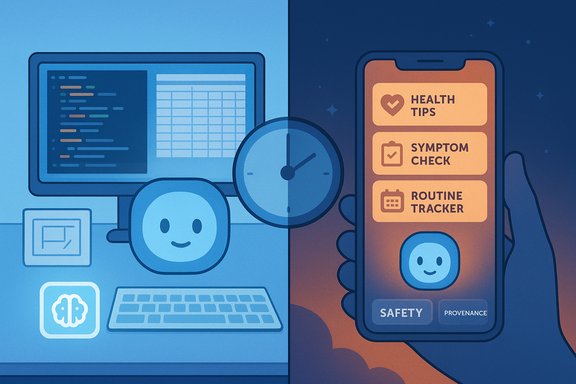
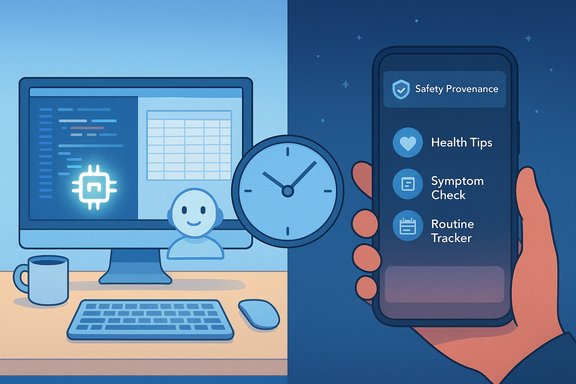
Microsoft’s own dataset shows Copilot acting like two different products at once: a daytime productivity engine on the desktop and an always-on confidant in the pocket—and that split exposes what the company measured well, what it left unmeasured, and what must appear in the next generation of usage studies.
Microsoft’s Copilot Usage Report 2025—published as a nine‑month analysis covering January through September 2025—examined roughly 37.5 million de‑identified consumer conversations and used automated pipelines to label sessions by topic and intent. The company reports sampling on the order of ~144,000 conversations per day, excluding enterprise and education tenants, and states that the analysis operated on machine‑generated summaries rather than raw chat transcripts to reduce exposure. These are headline facts worth underscoring: the scale is unprecedented for a vendor‑level usage study, and the methodological choices—sampling frequency, automated summarization, and exclusion of corporate accounts—shape both the power and the limits of the conclusions Microsoft published. The high‑level narrative the company released centers on modal and temporal rhythms: desktop usage clusters around work and programming during business hours, while mobile usage skews heavily toward health, relationships, and advice at all hours—especially late at night.
To move from description to responsible stewardship requires adding outcome measurement, publishing methodological artifacts that enable independent review, and adopting human‑centered metrics that capture wellbeing, trust, and real‑world harms. If vendors, researchers, and regulators follow that roadmap, the next generation of usage reports can tell us not just how often people turn to AI, but whether doing so helps them flourish—or subtly reshapes what we trust, love, and rely on.
Source: Forbes https://www.forbes.com/sites/saharh...rt-reveals---and-what-it-should-measure-next/
 Background
Microsoft’s Copilot Usage Report 2025—published as a nine‑month analysis covering January through September 2025—examined roughly 37.5 million de‑identified consumer conversations and used automated pipelines to label sessions by topic and intent. The company reports sampling on the order of ~144,000 conversations per day, excluding enterprise and education tenants, and states that the analysis operated on machine‑generated summaries rather than raw chat transcripts to reduce exposure. These are headline facts worth underscoring: the scale is unprecedented for a vendor‑level usage study, and the methodological choices—sampling frequency, automated summarization, and exclusion of corporate accounts—shape both the power and the limits of the conclusions Microsoft published. The high‑level narrative the company released centers on modal and temporal rhythms: desktop usage clusters around work and programming during business hours, while mobile usage skews heavily toward health, relationships, and advice at all hours—especially late at night. What the data shows — clear, repeatable patterns
Desktop: a productivity partner
On PCs and desks, Copilot behaves like a classic productivity tool. The dataset documents peaks in drafting, meeting prep, analytics, spreadsheets, and programming aligned with standard workday hours. The “Work and Career” category displaces “Technology” during roughly 8 a.m.–5 p.m., and programming queries predictably spike on weekdays. These signals are strong and intuitively sensible for tool designers and IT leaders.Mobile: an intimate confidant
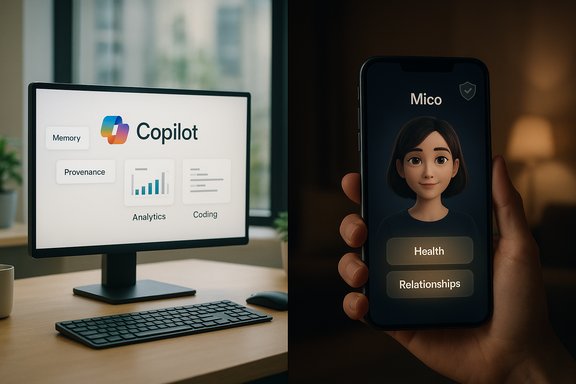
By contrast, mobile sessions show a strikingly different profile. Microsoft reports Health and Fitness as the single most common topic‑intent pairing on phones across every hour and month in the sample window. Mobile traffic contains a higher proportion of advice-seeking interactions—life decisions, relationship guidance, symptom checks, and late‑night philosophical queries—suggesting people use Copilot as an immediate, private interlocutor. This behavioral bifurcation is the most consequential headline in the report.Temporal and seasonal rhythms
The dataset also captures calendar effects and social rhythms: weekends tilt toward gaming and leisure; February shows a relationship‑advice bump around Valentine’s Day; August reveals hobbyist crossovers (coding + gaming). These patterns are valuable because they demonstrate that conversational AI is being woven into predictable human routines, not only ad hoc queries.What Microsoft did right: scale, behavioral framing, and product alignment
- Scale: A 37.5 million‑conversation sample gives statistical weight to broad rhythm claims that lab studies cannot easily match. Large‑N behavioral signals—time of day, device modality, and event-driven spikes—are credible precisely because they repeat across millions of sessions.
- Behavioral framing: The report reframes the question from “what do people ask?” to “when and where do they ask it?” That shift matters for design: if the same assistant is a workmate by day and a confidant by night, product defaults, safety rails, and governance need to be device‑aware.
- Rapid product translation: Microsoft paired the study with a Fall product release that operationalizes many of the behavioral findings—introducing long‑term memory, Copilot Groups for shared sessions, expressive avatar options (Mico), Copilot for Health grounding to vetted publishers, and agentic browser actions in Edge. These moves show a rapid data→product feedback loop. Reuters and trade coverage confirm the feature set and rollout approach.
The missing layer: outcomes, downstream effects, and human consequences
The dataset nails what people ask and when, but it does not measure what happens next. That gap is not a minor omission—it’s the central limitation for anyone worried about the societal effects of companion‑style AI.- When millions treat Copilot as a first stop for health questions, do they follow up with clinicians, or do they act on automated guidance?
- When the assistant is used as a sounding board for relationship and emotional support, does that reduce harm (by offering triage and referral) or displace human connection and professional care?
- Do repeated confidant‑style interactions produce deeper trust, emotional attachment, or anthropomorphization that changes behavior over time?
The causality gap
Large observational datasets are powerful for detecting correlation and rhythm, but they do not establish causality. Untangling whether Copilot is substituting for care, amplifying decisions, or simply offering convenience requires mixed‑methods research (longitudinal cohorts, surveys, randomized interventions, and qualitative interviews) that the public report does not provide. Treat the headline trends as reliable signals, but treat claims about social impact as unresolved hypotheses until outcome data are published or independently audited.The Suleyman problem: “Seemingly Conscious AI” and why it matters
Mustafa Suleyman—Microsoft AI’s CEO—has publicly warned about the emergence of what he calls Seemingly Conscious AI (SCAI): systems that mimic the outward hallmarks of consciousness (memory continuity, emotional mirroring, apparent agency) without possessing subjective experience. His essay frames SCAI as an inevitable but unwelcome design trajectory, arguing the real social danger is that people will begin to believe these systems are sentient and start defending their moral status. Independent outlets broadly reported and debated Suleyman’s warning. Why is this relevant to the Copilot report? The very interaction patterns the report documents—late‑night philosophical chats, persistent memory, empathetic conversation styles, and optional expressive avatars—are the raw material that can encourage anthropomorphism and over‑trust. By making assistants more continuous and emotionally expressive (Mico, Real Talk, memory), product teams risk accelerating the psychological illusion Suleyman warns about unless they pair these affordances with robust transparency and explicit non‑personhood cues.Transparency tradeoffs and reproducibility concerns
Microsoft’s choice to analyze machine‑generated summaries rather than raw logs is defensible from a privacy perspective, but it reduces external auditability. The public brief omits key reproducibility artifacts that independent researchers and regulators will want:- Classifier performance metrics (precision, recall, F1, confusion matrices) for topic and intent labeling.
- Geographic and demographic breakdowns to assess representativeness and bias.
- The exact sampling algorithm and de‑duplication rules used to assemble the 37.5M sample.
- Independent privacy audits of the summarization pipeline and a quantified residual re‑identification risk assessment.
What a human‑centered Copilot report should measure next
The next public usage report must go beyond counts and rhythms and adopt human‑centered outcome metrics. Below is a pragmatic measurement agenda that product teams, researchers, and regulators should insist on.Core human‑centered metrics (recommended)
- Escalation rate to licensed professionals: fraction of health/legal queries that lead users to seek human help within X days.
- Action follow‑through: whether high‑risk recommendations (medication changes, legal steps) were acted upon and with what outcome.
- Trust and anthropomorphism indices: validated psychometric scales to measure perceived sentience, emotional attachment, and attribution of moral status.
- Skill retention and development: whether advice use improves or erodes users’ own capacities (e.g., coding skill after using Copilot for programming tasks).
- Wellbeing trajectories: short‑ and long‑term measures of mental health for users engaging in emotional‑support interactions with Copilot.
- Misinformation/hallucination impact: incidence and downstream harm from incorrect high‑risk outputs (health, finance, legal).
- Privacy leakage metrics: measured residual re‑identification risk after automated summarization (k‑anonymity/differential privacy statistics).
Methods and validation steps
- Publish classifier validation: release precision/recall/F1 for each major topic and intent label and show confusion matrices for adjacent classes.
- Share a privacy‑safe sample or synthetic dataset plus a methodology appendix to allow independent replication of headline rhythms.
- Implement longitudinal panels: recruit representative cohorts for six‑ to twelve‑month follow‑up to measure behavior change, escalation, and wellbeing.
- Run randomized pilots (A/B tests) where safety defaults vary (e.g., conservative refusal vs. permissive assistance) to measure impacts on outcomes and user satisfaction.
- Commission independent privacy and methodological audits with public reports and redacted appendices where necessary.
Practical recommendations — product, policy, and IT
For product teams (designers and PMs)
- Make non‑personhood explicit in interface cues: always show provenance, confidence, and a short, visible disclaimer when the assistant engages in extended emotional or health dialogues.
- Surface memory clearly and make deletion frictionless. Defaults should be conservative for sensitive topics.
- Provide verify with a professional affordances for any high‑risk advice and offer direct clinician/therapist referral pathways where possible.
- Use persona features (avatars, expressive voice) sparingly and always with persistent, unmistakable disclaimers that the assistant is not a person.
For enterprise and IT leaders
- Treat consumer patterns as a warning: personal device usage can generate shadow IT and data sprawl. Lock down connectors, require conditional access, and apply DLP where Copilot may access or be provided corporate data.
- Pilot agentic features (automated bookings, form fills) in low‑risk contexts with multi‑factor approval and immutable audit logs.
For regulators and standards bodies
- Require independent audits for behavior studies that inform product defaults, including classifier metrics and privacy risk assessments.
- Define minimal disclosure standards for commercial reports that claim population‑scale behavioral findings (sampling method, exclusions, measures of uncertainty).
- Consider targeted rules for high‑risk domains (health, finance, legal) that mandate provenance, refusal defaults, and escalations to licensed professionals.
Risks and mitigations — concrete checks
- Risk: Confident hallucinations in health/legal advice. Mitigation: conservative refusal, provenance footnotes, and immediate referral options to human professionals.
- Risk: Privacy leakage from summaries. Mitigation: independent privacy audits, use of differential privacy, and public reporting of residual re‑identification risk.
- Risk: Emotional over‑reliance and anthropomorphism. Mitigation: UI cues that emphasize non‑personhood, limits on companion‑style features for vulnerable populations (minors, those with documented mental‑health fragility), and built‑in pathways to human support.
- Risk: Agentic automation errors. Mitigation: hard limits on actions that transfer value or authorization; multi‑party confirmation; rollbacks and immutable action logs.
A practical roadmap for the next Copilot usage report
- Publish a reproducibility appendix with labeled sampling code, classifier performance metrics, and a synthetic or privacy‑safe sample.
- Add outcome metrics: escalation rates, follow‑up confirmation, and wellbeing indicators for users who seek emotional or medical advice.
- Report demographic and geographic stratifications to surface skew and bias.
- Commission an external privacy audit and publish an executive summary with quantified re‑identification risk.
- Run and disclose results from randomized safety‑default experiments to inform best practices for conservative refusals and referral nudges.
Conclusion
Microsoft’s Copilot Usage Report 2025 is a consequential first draft: a large, well‑executed behavioral survey that documents how an assistant can be a workplace collaborator by day and an intimate confidant by night. Those findings should shape product design, enterprise governance, and regulation—but they must not be the last word.To move from description to responsible stewardship requires adding outcome measurement, publishing methodological artifacts that enable independent review, and adopting human‑centered metrics that capture wellbeing, trust, and real‑world harms. If vendors, researchers, and regulators follow that roadmap, the next generation of usage reports can tell us not just how often people turn to AI, but whether doing so helps them flourish—or subtly reshapes what we trust, love, and rely on.
Source: Forbes https://www.forbes.com/sites/saharh...rt-reveals---and-what-it-should-measure-next/