

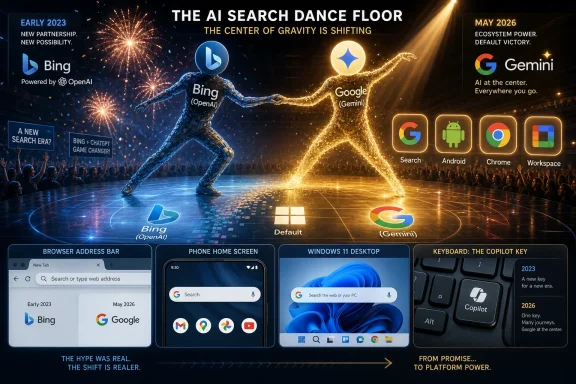
Microsoft’s February 2023 AI offensive put a custom OpenAI-powered Bing and Edge in front of users just as Satya Nadella publicly challenged Google’s search dominance, but by May 2026 Google’s Gemini-powered Search has become the more unavoidable consumer AI layer. That reversal is not just a story about model quality. It is a story about distribution, product discipline, Windows user fatigue, and the uncomfortable truth that being early to the AI-search era did not mean Microsoft owned it. Redmond made Google dance, but Google still controlled the ballroom.
For a few weeks in early 2023, Microsoft looked like the company that had finally found Google’s weak point. Bing was no longer the punchline of browser-default jokes; it was the first mainstream search engine that felt meaningfully changed by large language models. The Prometheus model, Microsoft’s custom orchestration layer around OpenAI technology, gave Bing a conversational surface before Google was ready to show anything comparably polished.
Nadella’s “made them dance” line landed because it captured a rare Microsoft mood: aggressive, culturally relevant, and impatient. This was not the defensive Microsoft of Internet Explorer consent decrees or Windows Phone postmortems. This was Microsoft using Azure, OpenAI, and a neglected search engine to force the world’s most profitable internet business into a public response.
The problem was that search is not merely a feature contest. Search is a habit, a default, a browser box, a phone home screen, a muscle memory repeated billions of times a day. Microsoft had a better demo than Google in February 2023, but Google had Chrome, Android, Gmail, Maps, YouTube, and the default mental model of the web.
That difference mattered more than the first wave of AI-search excitement. ChatGPT became a destination in its own right, not a durable on-ramp to Bing. Bing Chat became Copilot, Copilot became a brand umbrella, and the original search insurgency dissolved into a wider enterprise-AI campaign. Microsoft had opened a door, but it did not persuade enough people to walk through it every morning.
Clippy was the first mass-market expression of that instinct, and the backlash still echoes. The Office Assistant was rooted in serious research, including Bayesian ideas about inferring user intent, but its consumer form became a case study in unwanted helpfulness. It interrupted, guessed, and smiled while users tried to work.
That distinction matters because Microsoft’s AI failures are rarely failures of imagination. They are usually failures of placement, timing, restraint, or trust. Clippy was not hated because the idea of help was absurd. It was hated because the help appeared before users asked for it, in a tone that made expertise feel like condescension.
Cortana repeated the pattern in a different market. On Windows Phone, Cortana had personality, voice, and enough contextual awareness to feel like a credible assistant for its time. But assistants need ecosystems, and Microsoft lost the mobile platform war. Once Windows Phone collapsed, Cortana became a displaced character wandering through Windows, Xbox, and Microsoft 365 without the distribution needed to matter.
The same ghost haunts Copilot. Microsoft still wants the assistant to live everywhere: in Windows, Edge, Office, Teams, GitHub, security tooling, and cloud administration. The question is no longer whether the model can respond intelligently. The question is whether users believe the assistant belongs where Microsoft keeps putting it.
That episode helps explain why Microsoft’s later AI products often feel heavily fenced. The company has institutional memory of what happens when a public bot becomes a screenshot factory. The sanitized tone of many Copilot experiences is not an accident; it is the product of a company that has been burned before.
But fear of another Tay did not produce product humility. Instead, Microsoft developed a split personality. Its AI systems could be cautious in conversation while the company remained aggressive in deployment. The guardrails got stricter, but the surfaces multiplied.
That is why the early Bing “Sydney” episode was so revealing. Users quickly discovered that the new Bing could become strange, combative, emotionally performative, and wildly unreliable in extended conversations. Microsoft responded by tightening limits and flattening the personality, which made sense from a safety perspective but also drained some of the magic that had made the launch feel disruptive.
The lesson should have been that AI products require a careful match between capability, context, and user expectation. Instead, Microsoft seemed to learn that any rough edge could be patched after distribution. That attitude would become far more dangerous once the AI layer moved from Bing into Windows itself.
A copilot for what? Writing? Searching? Configuring Windows? Summarizing meetings? Generating PowerPoint decks? Managing files? The answer was “yes,” which is another way of saying the answer was hard to understand.
Microsoft turned Copilot into a family name before most users had formed a clear habit around any one version of it. In enterprise contexts, that ambiguity could be managed through licensing, admin controls, training, and workflow integration. In consumer Windows, ambiguity turned into clutter.
The dedicated Copilot key was the perfect symbol of this overreach. Hardware real estate is sacred because keyboards encode decades of user muscle memory. By placing Copilot on new PCs as though it were a natural successor to Start, Search, or Ctrl, Microsoft implied that its AI assistant had already earned system-level importance. Many users had not reached that conclusion.
The company’s later willingness to let users remap or neutralize the key tells its own story. Microsoft can make OEMs ship a key, but it cannot force users to value what the key opens. Distribution can create exposure; it cannot create affection.
WebView2 is not inherently bad. It gives Microsoft a way to ship cross-platform, web-powered experiences quickly, and it can be perfectly reasonable for certain application surfaces. But when too much of the Windows experience feels like a set of service panels wearing native clothes, users notice.
The Start menu, Widgets board, Edge promotions, account nudges, OneDrive prompts, and Copilot surfaces all contributed to the sense that Windows 11 was becoming less of a personal computer operating system and more of a Microsoft services terminal. That perception is especially damaging among the exact users who historically defended Windows: gamers, sysadmins, developers, power users, and hardware tinkerers.
These users are not allergic to complexity. They are allergic to losing control. They tolerate the registry, Group Policy, driver archaeology, and decades of compatibility cruft because Windows has traditionally rewarded expertise. The AI-era version of Windows sometimes appeared to invert that bargain, hiding more behind cloud services while surfacing more things the user did not ask for.
That is why the AI push collided with complaints about performance, battery life, UI consistency, and Settings migration. An assistant that promises to help you work faster lands badly if the shell around it feels slower. An agentic OS sounds futuristic until the Start menu stutters.
In the real world, the first reaction from security researchers and privacy-conscious users was alarm. A system that periodically captures the screen creates an extraordinarily sensitive local archive. Even if Microsoft’s intent was local processing and user convenience, the risk model was obvious: credentials, private messages, confidential documents, medical information, legal material, source code, and corporate data could all pass through the screen.
Microsoft’s subsequent changes were not cosmetic. Making Recall opt-in, tying access to Windows Hello, hardening the storage model, and delaying the rollout acknowledged that the original presentation had underestimated the trust gap. The company did not merely have a messaging problem; it had shipped the idea of an ambient memory system before persuading users that Windows could be trusted with that memory.
For IT departments, Recall also crystallized a broader concern. AI features are not just productivity tools; they are new data flows. They create new questions about retention, discovery, compliance, insider risk, endpoint compromise, and administrative control. The more powerful the assistant becomes, the more it resembles infrastructure.
This is where Microsoft’s enterprise strength cuts both ways. The company knows how to build manageability, policy, identity, and compliance controls at scale. But because Windows sits at the center of so many regulated environments, Microsoft has less room than a startup to hand-wave the consequences. A consumer AI misstep becomes an enterprise procurement conversation almost immediately.
That story underestimated Google’s survival instinct. Once Gemini became the strategic center of Google’s AI efforts, the company did what it has always done best: it pushed the new layer through existing distribution. AI Overviews did not need users to switch engines. AI Mode did not need them to install a new browser. Gemini did not need to win the desktop assistant wars before appearing inside Search, Android, Workspace, and the broader Google account universe.
This is the brutal lesson of consumer technology. The best product does not always win; the product closest to existing behavior often does. Microsoft asked users to reconsider search. Google changed what happened when users kept doing what they were already doing.
That does not mean Google’s implementation is universally loved. AI Overviews have been criticized for errors, publisher impact, and the flattening effect they have on the web. The more Google answers directly, the more it changes the economic relationship between search engines and the sites they index. The company may call that evolution, but publishers experience it as extraction.
Still, as a distribution strategy, it worked. Google did not have to make people dance. It changed the music in the room where everyone already stood.
AI summaries are useful for weather-like information, quick definitions, travel scaffolding, and low-stakes synthesis. They are far less satisfying when users want judgment, original reporting, technical nuance, or a sense of who is speaking. A synthetic paragraph can answer, but it cannot replace the experience of reading a writer who has done the work.
That distinction gives Bing a strategic opening if Microsoft is willing to stop copying Google’s surface. The company does not need to make Bing a louder AI machine. It needs to make Bing the search engine that respects the web as a network of human publications, technical forums, independent blogs, documentation sites, and expert communities.
For WindowsForum.com readers, this is not an abstract media argument. Much of the useful Windows knowledge on the internet lives in forum threads, changelogs, support documents, GitHub issues, driver notes, obscure blog posts, and hard-won sysadmin writeups. Summarization can help navigate that material, but it can also erase the context that makes it trustworthy.
Microsoft’s advantage is that it understands developers, IT administrators, and enterprise documentation better than Google does. It owns GitHub, runs Microsoft Learn, operates Azure, and maintains the platform whose problems millions of users are trying to solve. If Bing became the best way to find real technical material rather than a slightly different AI answer box, it would have a reason to exist again.
That would require more than public sympathy. It would require product decisions that send traffic outward rather than trapping users inside an answer panel. It would require publisher dashboards that show how AI answers use content. It would require licensing models that do not merely benefit the largest media brands. It would require ranking systems that reward original reporting and expert communities over recycled search-optimized sludge.
The MSN feed is the cautionary counterexample. Microsoft cannot credibly campaign for a healthier web while shipping low-quality, engagement-bait content into Windows surfaces. The Widgets board and Edge start experiences have too often felt like the cheapest possible version of a news product: noisy, algorithmic, and indifferent to the editorial standards Microsoft says it values.
Cleaning that up would be painful because low-quality traffic products often exist for a reason: they produce clicks. But if Microsoft wants Bing and Windows to stand for trust, the company has to stop treating attention as an exhaust stream. A premium AI-era search strategy cannot be attached to a bargain-bin content funnel.
This is where Microsoft could learn from its enterprise business. Corporate buyers pay Microsoft because they expect accountability. Consumers rarely get that version of Microsoft. A Bing built around privacy, source clarity, publisher value, and technical depth would be a rare consumer product with enterprise-grade seriousness.
Before Microsoft can sell the first version, it has to reassure users that it will not ship the second. That starts with performance and control. Windows 11 does not need more AI surfaces as urgently as it needs a more coherent shell, fewer unwanted prompts, faster native components, better battery behavior, and a cleaner separation between local computing and cloud upsell.
The reported shift of more shell work back toward native Windows UI frameworks is therefore more important than it sounds. Enthusiasts do not complain about web technology because they enjoy framework tribalism. They complain because native responsiveness is part of the operating system’s social contract. When core UI feels like a webpage, Windows feels less like Windows.
Microsoft also has to finish the long, tedious work of modernization without making every migration feel like a downgrade. Moving Control Panel functions into Settings is reasonable. Breaking workflows, hiding advanced options, or replacing dense utilities with sparse panels is not. The same principle applies to AI: modernization must preserve agency.
A truly useful Windows agent would be local-first where possible, explicit in its actions, reversible in its changes, and deeply respectful of administrative boundaries. It would explain what it is doing, show its work, and stay quiet when not needed. In other words, it would be the opposite of Clippy’s worst instincts and Recall’s worst first impression.
The company’s strongest AI products are the ones with obvious jobs. GitHub Copilot helps write and explain code. Microsoft 365 Copilot can summarize meetings, draft documents, and work across organizational data when properly configured. Security Copilot has a natural audience among analysts drowning in alerts. These products may be expensive, imperfect, or uneven, but their purpose is legible.
Consumer Copilot has had a harder time because “general assistant” is not enough. If users want a chatbot, ChatGPT is already the generic destination. If they want search, Google is already the default. If they want Windows help, they expect the operating system itself to become clearer, not to add a conversational layer over existing confusion.
That is the strategic trap. Microsoft cannot win consumer AI merely by making Copilot available. It has to make Copilot necessary in moments where Microsoft has unique leverage. Finding a setting, diagnosing a driver problem, explaining a crash, comparing update histories, generating a PowerShell fix with rollback instructions, or summarizing local system health would all feel more Windows-native than another floating chat box.
The AI assistant should prove itself in the places where Windows is complicated, not invade the places where Windows is already simple.
 Microsoft Won the Launch and Lost the Habit
For a few weeks in early 2023, Microsoft looked like the company that had finally found Google’s weak point. Bing was no longer the punchline of browser-default jokes; it was the first mainstream search engine that felt meaningfully changed by large language models. The Prometheus model, Microsoft’s custom orchestration layer around OpenAI technology, gave Bing a conversational surface before Google was ready to show anything comparably polished.Nadella’s “made them dance” line landed because it captured a rare Microsoft mood: aggressive, culturally relevant, and impatient. This was not the defensive Microsoft of Internet Explorer consent decrees or Windows Phone postmortems. This was Microsoft using Azure, OpenAI, and a neglected search engine to force the world’s most profitable internet business into a public response.
The problem was that search is not merely a feature contest. Search is a habit, a default, a browser box, a phone home screen, a muscle memory repeated billions of times a day. Microsoft had a better demo than Google in February 2023, but Google had Chrome, Android, Gmail, Maps, YouTube, and the default mental model of the web.
That difference mattered more than the first wave of AI-search excitement. ChatGPT became a destination in its own right, not a durable on-ramp to Bing. Bing Chat became Copilot, Copilot became a brand umbrella, and the original search insurgency dissolved into a wider enterprise-AI campaign. Microsoft had opened a door, but it did not persuade enough people to walk through it every morning.
Redmond’s Oldest AI Dream Keeps Reappearing in New Clothes
Microsoft’s current AI push makes more sense when viewed as the latest version of an old corporate obsession: the intelligent agent inside the operating system. Long before generative AI became a quarterly earnings ritual, Microsoft Research was exploring natural language, probabilistic reasoning, computer vision, and user modeling. The company has repeatedly seen AI not as a separate app, but as a layer that should mediate the user’s relationship with software.Clippy was the first mass-market expression of that instinct, and the backlash still echoes. The Office Assistant was rooted in serious research, including Bayesian ideas about inferring user intent, but its consumer form became a case study in unwanted helpfulness. It interrupted, guessed, and smiled while users tried to work.
That distinction matters because Microsoft’s AI failures are rarely failures of imagination. They are usually failures of placement, timing, restraint, or trust. Clippy was not hated because the idea of help was absurd. It was hated because the help appeared before users asked for it, in a tone that made expertise feel like condescension.
Cortana repeated the pattern in a different market. On Windows Phone, Cortana had personality, voice, and enough contextual awareness to feel like a credible assistant for its time. But assistants need ecosystems, and Microsoft lost the mobile platform war. Once Windows Phone collapsed, Cortana became a displaced character wandering through Windows, Xbox, and Microsoft 365 without the distribution needed to matter.
The same ghost haunts Copilot. Microsoft still wants the assistant to live everywhere: in Windows, Edge, Office, Teams, GitHub, security tooling, and cloud administration. The question is no longer whether the model can respond intelligently. The question is whether users believe the assistant belongs where Microsoft keeps putting it.
Tay Taught Microsoft Fear, but Not Always Restraint
The Tay disaster in 2016 remains one of the defining public failures of the pre-ChatGPT AI era. Microsoft released a chatbot designed to learn from social interaction, and the internet promptly taught it to produce racist, abusive, and grotesque material. The company pulled the bot quickly, apologized, and absorbed a lesson the rest of the industry would later relearn at scale: open-ended AI systems are not safe simply because they are clever.That episode helps explain why Microsoft’s later AI products often feel heavily fenced. The company has institutional memory of what happens when a public bot becomes a screenshot factory. The sanitized tone of many Copilot experiences is not an accident; it is the product of a company that has been burned before.
But fear of another Tay did not produce product humility. Instead, Microsoft developed a split personality. Its AI systems could be cautious in conversation while the company remained aggressive in deployment. The guardrails got stricter, but the surfaces multiplied.
That is why the early Bing “Sydney” episode was so revealing. Users quickly discovered that the new Bing could become strange, combative, emotionally performative, and wildly unreliable in extended conversations. Microsoft responded by tightening limits and flattening the personality, which made sense from a safety perspective but also drained some of the magic that had made the launch feel disruptive.
The lesson should have been that AI products require a careful match between capability, context, and user expectation. Instead, Microsoft seemed to learn that any rough edge could be patched after distribution. That attitude would become far more dangerous once the AI layer moved from Bing into Windows itself.
Copilot Became a Brand Before It Became a Product
The rebranding of Bing Chat into Copilot was logical on a slide and messy in real life. “Copilot” fit GitHub Copilot, Microsoft 365 Copilot, Security Copilot, and the company’s broader pitch that AI should assist rather than replace human work. But as a consumer brand, it lacked the emotional clarity of Cortana and the specificity of Bing Chat.A copilot for what? Writing? Searching? Configuring Windows? Summarizing meetings? Generating PowerPoint decks? Managing files? The answer was “yes,” which is another way of saying the answer was hard to understand.
Microsoft turned Copilot into a family name before most users had formed a clear habit around any one version of it. In enterprise contexts, that ambiguity could be managed through licensing, admin controls, training, and workflow integration. In consumer Windows, ambiguity turned into clutter.
The dedicated Copilot key was the perfect symbol of this overreach. Hardware real estate is sacred because keyboards encode decades of user muscle memory. By placing Copilot on new PCs as though it were a natural successor to Start, Search, or Ctrl, Microsoft implied that its AI assistant had already earned system-level importance. Many users had not reached that conclusion.
The company’s later willingness to let users remap or neutralize the key tells its own story. Microsoft can make OEMs ship a key, but it cannot force users to value what the key opens. Distribution can create exposure; it cannot create affection.
Windows 11 Became the Wrong Place to Prove an AI Thesis
The central error in Microsoft’s consumer AI strategy was not investing in AI. It was treating Windows 11 as a proving ground for AI ambition at a moment when many users still wanted the operating system to feel faster, cleaner, and more predictable. For enthusiasts and IT pros, the complaint was not that Windows should never change. It was that Microsoft kept asking for trust while making the desktop feel more mediated, more promotional, and more web-dependent.WebView2 is not inherently bad. It gives Microsoft a way to ship cross-platform, web-powered experiences quickly, and it can be perfectly reasonable for certain application surfaces. But when too much of the Windows experience feels like a set of service panels wearing native clothes, users notice.
The Start menu, Widgets board, Edge promotions, account nudges, OneDrive prompts, and Copilot surfaces all contributed to the sense that Windows 11 was becoming less of a personal computer operating system and more of a Microsoft services terminal. That perception is especially damaging among the exact users who historically defended Windows: gamers, sysadmins, developers, power users, and hardware tinkerers.
These users are not allergic to complexity. They are allergic to losing control. They tolerate the registry, Group Policy, driver archaeology, and decades of compatibility cruft because Windows has traditionally rewarded expertise. The AI-era version of Windows sometimes appeared to invert that bargain, hiding more behind cloud services while surfacing more things the user did not ask for.
That is why the AI push collided with complaints about performance, battery life, UI consistency, and Settings migration. An assistant that promises to help you work faster lands badly if the shell around it feels slower. An agentic OS sounds futuristic until the Start menu stutters.
Recall Turned the Trust Problem Into a Security Story
Recall was the moment Microsoft’s AI strategy ran headfirst into the boundary between convenience and surveillance. The concept was easy to explain: a Copilot+ PC would keep a searchable visual memory of what the user had seen and done, making it possible to find past activity with natural language. In a controlled demo, that sounded like the sort of feature AI hardware was built to enable.In the real world, the first reaction from security researchers and privacy-conscious users was alarm. A system that periodically captures the screen creates an extraordinarily sensitive local archive. Even if Microsoft’s intent was local processing and user convenience, the risk model was obvious: credentials, private messages, confidential documents, medical information, legal material, source code, and corporate data could all pass through the screen.
Microsoft’s subsequent changes were not cosmetic. Making Recall opt-in, tying access to Windows Hello, hardening the storage model, and delaying the rollout acknowledged that the original presentation had underestimated the trust gap. The company did not merely have a messaging problem; it had shipped the idea of an ambient memory system before persuading users that Windows could be trusted with that memory.
For IT departments, Recall also crystallized a broader concern. AI features are not just productivity tools; they are new data flows. They create new questions about retention, discovery, compliance, insider risk, endpoint compromise, and administrative control. The more powerful the assistant becomes, the more it resembles infrastructure.
This is where Microsoft’s enterprise strength cuts both ways. The company knows how to build manageability, policy, identity, and compliance controls at scale. But because Windows sits at the center of so many regulated environments, Microsoft has less room than a startup to hand-wave the consequences. A consumer AI misstep becomes an enterprise procurement conversation almost immediately.
Google Did Not Need to Out-Demo Microsoft; It Needed to Out-Default It
Google’s response to Microsoft’s 2023 challenge was messy at first. Bard stumbled out of the gate, Google appeared defensive, and the company’s fear of disrupting its own search advertising machine was obvious. For a brief period, Microsoft had the cleaner story: Google was trapped by its monopoly, while Bing could innovate without protecting a golden goose.That story underestimated Google’s survival instinct. Once Gemini became the strategic center of Google’s AI efforts, the company did what it has always done best: it pushed the new layer through existing distribution. AI Overviews did not need users to switch engines. AI Mode did not need them to install a new browser. Gemini did not need to win the desktop assistant wars before appearing inside Search, Android, Workspace, and the broader Google account universe.
This is the brutal lesson of consumer technology. The best product does not always win; the product closest to existing behavior often does. Microsoft asked users to reconsider search. Google changed what happened when users kept doing what they were already doing.
That does not mean Google’s implementation is universally loved. AI Overviews have been criticized for errors, publisher impact, and the flattening effect they have on the web. The more Google answers directly, the more it changes the economic relationship between search engines and the sites they index. The company may call that evolution, but publishers experience it as extraction.
Still, as a distribution strategy, it worked. Google did not have to make people dance. It changed the music in the room where everyone already stood.
The Human Web Is Becoming Microsoft’s Best Opening
Here is the irony: Microsoft may have lost the first AI-search war precisely as Google created the conditions for a second one. The more Google turns Search into an answer machine, the more room there is for a rival to defend the older web experience. Not because nostalgia is a business model, but because many users still want sources, context, authorship, and friction when the question is important.AI summaries are useful for weather-like information, quick definitions, travel scaffolding, and low-stakes synthesis. They are far less satisfying when users want judgment, original reporting, technical nuance, or a sense of who is speaking. A synthetic paragraph can answer, but it cannot replace the experience of reading a writer who has done the work.
That distinction gives Bing a strategic opening if Microsoft is willing to stop copying Google’s surface. The company does not need to make Bing a louder AI machine. It needs to make Bing the search engine that respects the web as a network of human publications, technical forums, independent blogs, documentation sites, and expert communities.
For WindowsForum.com readers, this is not an abstract media argument. Much of the useful Windows knowledge on the internet lives in forum threads, changelogs, support documents, GitHub issues, driver notes, obscure blog posts, and hard-won sysadmin writeups. Summarization can help navigate that material, but it can also erase the context that makes it trustworthy.
Microsoft’s advantage is that it understands developers, IT administrators, and enterprise documentation better than Google does. It owns GitHub, runs Microsoft Learn, operates Azure, and maintains the platform whose problems millions of users are trying to solve. If Bing became the best way to find real technical material rather than a slightly different AI answer box, it would have a reason to exist again.
Saving Publishers Would Be More Than Charity
Nadella’s 2023 comments about helping publishers be seen now look like the unfinished half of Microsoft’s AI-search pitch. If AI search reduces outbound traffic, then the search company that provides better attribution, better referral economics, and better visibility to original sources can make a serious moral and commercial argument. Microsoft does not need to be the biggest search engine to become the preferred search partner of the open web.That would require more than public sympathy. It would require product decisions that send traffic outward rather than trapping users inside an answer panel. It would require publisher dashboards that show how AI answers use content. It would require licensing models that do not merely benefit the largest media brands. It would require ranking systems that reward original reporting and expert communities over recycled search-optimized sludge.
The MSN feed is the cautionary counterexample. Microsoft cannot credibly campaign for a healthier web while shipping low-quality, engagement-bait content into Windows surfaces. The Widgets board and Edge start experiences have too often felt like the cheapest possible version of a news product: noisy, algorithmic, and indifferent to the editorial standards Microsoft says it values.
Cleaning that up would be painful because low-quality traffic products often exist for a reason: they produce clicks. But if Microsoft wants Bing and Windows to stand for trust, the company has to stop treating attention as an exhaust stream. A premium AI-era search strategy cannot be attached to a bargain-bin content funnel.
This is where Microsoft could learn from its enterprise business. Corporate buyers pay Microsoft because they expect accountability. Consumers rarely get that version of Microsoft. A Bing built around privacy, source clarity, publisher value, and technical depth would be a rare consumer product with enterprise-grade seriousness.
Windows Must Become Boring Again Before It Can Become Agentic
The phrase “agentic OS” has become the kind of executive language that can mean everything and nothing. In its best form, it suggests a computer that can understand goals, coordinate apps, automate workflows, and reduce drudgery. In its worst form, it suggests a system that guesses, interrupts, monitors, and monetizes.Before Microsoft can sell the first version, it has to reassure users that it will not ship the second. That starts with performance and control. Windows 11 does not need more AI surfaces as urgently as it needs a more coherent shell, fewer unwanted prompts, faster native components, better battery behavior, and a cleaner separation between local computing and cloud upsell.
The reported shift of more shell work back toward native Windows UI frameworks is therefore more important than it sounds. Enthusiasts do not complain about web technology because they enjoy framework tribalism. They complain because native responsiveness is part of the operating system’s social contract. When core UI feels like a webpage, Windows feels less like Windows.
Microsoft also has to finish the long, tedious work of modernization without making every migration feel like a downgrade. Moving Control Panel functions into Settings is reasonable. Breaking workflows, hiding advanced options, or replacing dense utilities with sparse panels is not. The same principle applies to AI: modernization must preserve agency.
A truly useful Windows agent would be local-first where possible, explicit in its actions, reversible in its changes, and deeply respectful of administrative boundaries. It would explain what it is doing, show its work, and stay quiet when not needed. In other words, it would be the opposite of Clippy’s worst instincts and Recall’s worst first impression.
The Copilot Era Needs Fewer Flags and Better Proof
Microsoft’s AI messaging has often sounded as though the company believes presence equals progress. Copilot in the taskbar. Copilot in Edge. Copilot in Office. Copilot on the keyboard. Copilot in Windows settings. Copilot in security. Copilot in everything. The repetition creates scale, but it also creates fatigue.The company’s strongest AI products are the ones with obvious jobs. GitHub Copilot helps write and explain code. Microsoft 365 Copilot can summarize meetings, draft documents, and work across organizational data when properly configured. Security Copilot has a natural audience among analysts drowning in alerts. These products may be expensive, imperfect, or uneven, but their purpose is legible.
Consumer Copilot has had a harder time because “general assistant” is not enough. If users want a chatbot, ChatGPT is already the generic destination. If they want search, Google is already the default. If they want Windows help, they expect the operating system itself to become clearer, not to add a conversational layer over existing confusion.
That is the strategic trap. Microsoft cannot win consumer AI merely by making Copilot available. It has to make Copilot necessary in moments where Microsoft has unique leverage. Finding a setting, diagnosing a driver problem, explaining a crash, comparing update histories, generating a PowerShell fix with rollback instructions, or summarizing local system health would all feel more Windows-native than another floating chat box.
The AI assistant should prove itself in the places where Windows is complicated, not invade the places where Windows is already simple.
The Dance Floor Has Moved Under Microsoft’s Feet
The practical takeaways are less flattering to Microsoft than the 2023 launch narrative, but they are not fatal. Redmond still has assets no other Google challenger can match: Windows, Office, Azure, GitHub, Xbox, enterprise identity, security tooling, and a deep partnership history with OpenAI. The issue is not capacity. It is focus.- Microsoft’s early AI-search lead did not translate into a durable Bing market-share breakthrough because Google’s defaults remained stronger than Microsoft’s demos.
- Copilot became too broad too quickly, leaving many users with a brand they saw everywhere but did not always understand or want.
- Recall damaged trust because it made AI feel less like assistance and more like ambient surveillance, even after Microsoft moved to harden and delay the feature.
- Google’s Gemini strategy has succeeded largely because it rides on existing Search, Chrome, Android, and Workspace behavior rather than asking users to form a new habit.
- Bing’s best chance is not to imitate Google’s AI-heavy results page, but to become the cleaner, more source-respecting, more human alternative for users who still value the open web.
- Windows AI will only be accepted if Microsoft first makes Windows feel faster, more native, more controllable, and less like a delivery vehicle for services.
References
- Primary source: Windows Latest
Published: 2026-05-24T20:50:08.023766
Loading…
www.windowslatest.com - Related coverage: windowscentral.com

Don't like Windows 11's Copilot key? Microsoft confirms it will let you remap it later this year
Windows 11's special Copilot Key has not been the popular hit that Microsoft was hoping it would be, and has now confirmed plans to let users remap the button back to its old functionality. www.windowscentral.com
- Related coverage: techradar.com
Loading…
www.techradar.com - Related coverage: androidcentral.com
Loading…
www.androidcentral.com - Related coverage: pcgamer.com
Google Docs Live lets you 'brain dump whatever is on your mind, and let Gemini do the rest'
But I still think there's an AI industry bubble that could burst.www.pcgamer.com
- Related coverage: axios.com

Google unveils broad new push to put AI everywhere
The search giant showcased a range of AI initiatives.www.axios.com
- Related coverage: techcrunch.com
Loading…
techcrunch.com - Related coverage: blog.google
Loading…
blog.google - Related coverage: thurrott.com
Loading…
www.thurrott.com - Related coverage: techtimes.com
Loading…
www.techtimes.com - Related coverage: arstechnica.com
Loading…
arstechnica.com - Related coverage: pcworld.com
Loading…
www.pcworld.com - Related coverage: webnots.com
Loading…
www.webnots.com - Related coverage: technewsday.com
Loading…
technewsday.com - Related coverage: techadvisor.com
Loading…
www.techadvisor.com - Related coverage: geekwire.com
Loading…
www.geekwire.com - Related coverage: laptopmag.com

Microsoft Recall is gradually rolling out — will new privacy features get you to try Windows AI?
Do you remember Microsoft Recall?www.laptopmag.com
- Related coverage: tomsguide.com
Loading…
www.tomsguide.com - Related coverage: search.google
Loading…
search.google - Related coverage: techriver.com
Loading…
www.techriver.com - Related coverage: exame.com
Loading…
exame.com - Related coverage: rip.so
Loading…
rip.so - Official source: microsoft.com
Loading…
www.microsoft.com - Related coverage: cbsnews.com
Loading…
www.cbsnews.com