

Microsoft removed a Windows Learning Center article in early May 2026 after Windows Latest reported that the page described 16GB of RAM as the baseline for Windows 11 gaming and 32GB as the “no worries” upgrade. The deletion matters less because of one vanished marketing page than because it exposed a contradiction Microsoft has spent years trying to paper over: Windows 11 is still sold as a 4GB-minimum operating system, while Microsoft’s own product strategy increasingly behaves as if 16GB is the floor and 32GB is the comfort zone.
That gap is where the outrage came from. Gamers did not need Microsoft to tell them that modern games, Discord, browsers, launchers, capture tools, RGB utilities, overlays, and update agents can turn 16GB into a cramped apartment. What irritated people was the suspicion that Microsoft was not merely describing reality but helping to create it.
The deleted document, according to Windows Latest, carried the title “Gaming features: What the best Windows PC gaming systems have in common.” It reportedly appeared in Microsoft’s consumer-facing Learning Center, the softer marketing-and-guidance layer that often ranks well in search and translates platform priorities into shopping advice.
On its face, the recommendation was not absurd. A Windows 11 gaming PC with 16GB of RAM can still be entirely usable, and a 32GB configuration is increasingly sensible if the machine is expected to run a heavyweight game while juggling Discord, a Chromium-based browser, streaming tools, launchers, voice chat, peripheral software, and background services. Many enthusiast builders have been telling friends exactly that for years.
The problem is that the advice did not arrive from a neutral system builder. It came from Microsoft, the company responsible for the platform overhead that users are already grumbling about, and it landed at a moment when the company is pushing AI features, Copilot+ hardware, WebView2 app experiences, and cloud-connected services across Windows.
That is why “32GB is the no-worries upgrade” sounded less like helpful purchasing advice and more like a confession. Microsoft was not saying Windows 11 requires 32GB. It was saying, in effect, that the modern Windows gaming experience is better when users buy enough memory to stop thinking about what Windows and its app ecosystem are doing in the background.
The distinction matters. Minimum requirements keep upgrade paths open, support documents tidy, and OEM conversations manageable. They do not tell a student whether a budget laptop will age gracefully, a gamer whether Alt-Tabbing will turn into a paging festival, or an IT department whether a fleet of 8GB devices will remain tolerable through another three years of feature updates.
This has been a Windows problem for decades, but Windows 11 makes the gap more visible. A fresh install may boot within the published requirements, yet a real PC is rarely just Windows. It is Teams, Edge, OneDrive, widgets, security agents, printer tools, GPU software, game launchers, browser tabs, password managers, update services, and whatever OEM utilities survived the first round of cleanup.
For gaming, the situation is even less forgiving. Games increasingly stream assets aggressively, reserve large memory pools, and assume the player has multiple companion apps running. Microsoft’s deleted guidance reportedly acknowledged that 16GB is the practical starting point and 32GB gives newer titles “more breathing room.” The phrasing was mild; the implication was not.
That spec tells us where Microsoft believes the modern Windows experience is going. Copilot+ is not just a premium sticker; it is a hardware baseline for the features Microsoft most wants to promote. Recall, local AI workloads, enhanced captions, image generation, semantic search, and other ambient computing features all presume a more capable machine than the Windows 11 minimum table suggests.
This creates a two-tier message. To run Windows 11, Microsoft says 4GB is enough. To participate in the future Microsoft is actually marketing, 16GB is the entry point. To game without thinking about multitasking pressure, the deleted Learning Center page reportedly nudged users toward 32GB.
That ladder is coherent from a product-strategy perspective, but it is awkward from a consumer-trust perspective. Microsoft wants Windows 11 to remain broadly compatible while also persuading buyers that the best Windows 11 experience lives on much beefier hardware. The deleted article merely made that tension too searchable.
RAM prices also matter. The memory market is volatile, and AI infrastructure demand has added new pressure to the supply chain. A 32GB recommendation lands differently when users feel that enterprise AI and hyperscale buying are helping make consumer memory more expensive.
Microsoft is not solely responsible for game memory demands, and it would be lazy to pretend otherwise. Developers target consoles and PCs with different constraints, engines have grown more ambitious, and the PC gaming ecosystem has normalized a swarm of always-on companion software. But Windows is the platform layer beneath much of that complexity, and Microsoft has spent the past several years adding more web-powered, account-connected, AI-adjacent experiences to that layer.
That is the context in which the deleted document became inflammatory. The words themselves were defensible. The messenger was the problem.
These technologies are not inherently evil. They let developers ship faster, reuse web code, maintain consistent interfaces, and avoid rebuilding native clients for every platform. Many users would rather have a cross-platform app that exists than a native app that never ships.
But the cost is visible in Task Manager. Users see multiple Edge WebView2 processes, Teams components, widgets, launchers, chat clients, storefronts, and helper processes. They may not understand the architecture, but they understand the feeling: a machine that once had headroom now feels busy before the game even launches.
Microsoft sits in an uncomfortable position here. It promotes WebView2 as a modern Windows development technology, uses web-backed experiences throughout its own software, and then must convince users that Windows is being optimized for performance. When a company simultaneously asks developers to use web containers and tells gamers to buy more RAM, people connect the dots whether or not the engineering picture is fair.
Instead, according to Windows Latest, Microsoft redirected the page to the Learning Center homepage and blocked web archives from surfacing the retracted document. That is the kind of cleanup operation that turns a questionable page into a case study in platform messaging.
The company may have had mundane reasons. The article may have been drafted poorly, published prematurely, generated by an internal content workflow that leaned too heavily on AI, or failed to pass the right policy review. It may also have been accurate but politically inconvenient. The public cannot know without Microsoft explaining it, and silence rarely favors the platform owner.
The suspected AI authorship is another irritant. Microsoft has every right to use AI in content production, but autogenerated or lightly edited guidance becomes dangerous when it strays into buying advice. A hallucinated historical fact is embarrassing. A sloppy hardware recommendation can influence purchases, OEM expectations, and search results.
Copilot+ PCs have accelerated the normalization of 16GB. Once Microsoft’s flagship AI category mandates that amount, OEMs have a powerful reason to treat it as the modern default for premium and upper-mainstream systems. Even when buyers do not care about AI features, the branding shifts expectations.
Gaming laptops and desktops are moving in a similar direction. Entry-level models may still use 16GB to keep sticker prices palatable, but the enthusiast recommendation has drifted toward 32GB because the cost of being wrong is irritating. A RAM-constrained gaming PC does not merely benchmark lower; it stutters, swaps, reloads, hesitates, and punishes multitasking.
That is why Microsoft’s deleted recommendation rang true even to some critics. The outrage was not rooted in the idea that 32GB is bad advice. It was rooted in the belief that Microsoft has not earned the right to deliver that advice without acknowledging its own contribution to the problem.
That focus is not happening in a vacuum. SteamOS and handheld gaming PCs have exposed a weakness in the traditional Windows model. On a desktop tower with 64GB of RAM and a high-end GPU, Windows overhead is annoying but survivable. On a handheld, every background process, update prompt, launcher, and overlay competes with battery life, thermals, and frame pacing.
The gaming PC is no longer just a beige box under a desk or a glass-sided tower full of RGB. It is also a handheld, a living-room device, a laptop, and sometimes a low-power machine that users expect to behave more like a console. Windows has to become less noisy if Microsoft wants to defend that territory.
A 32GB RAM recommendation points in the opposite emotional direction. It says the answer is more hardware. Gamers increasingly want Microsoft to prove the answer can also be less overhead.
The AI push makes that suspicion sharper. Copilot is not just another app; it is Microsoft’s organizing principle for the next phase of Windows, Office, Edge, and cloud services. Users who do not want AI woven through their operating system are already primed to see every hardware recommendation as part of that campaign.
To be fair, AI features do need local compute if Microsoft wants them to be faster, more private, and less dependent on the cloud. NPUs exist for a reason. More RAM can make local models and semantic features more practical. There is a technically coherent argument for the Copilot+ baseline.
But Microsoft’s challenge is not merely technical coherence. It is consent. Users are more willing to accept higher requirements when they believe the added resources serve their priorities. They are less forgiving when they suspect the resources are being consumed by features they did not ask for and cannot fully remove.
The current messaging forces users to reconcile incompatible signals. 4GB is the minimum. 8GB is still common in stores. 16GB is required for Copilot+. 32GB is reportedly the no-worries gaming upgrade. None of those statements is automatically false, but together they look evasive.
Microsoft could fix much of this by being explicit. A Windows 11 minimum spec should be labeled as a survival threshold. A recommended spec should describe a mainstream experience in 2026. A gaming spec should distinguish between esports titles, AAA games, streaming, and multitasking. An AI PC spec should explain what the extra hardware is for and what happens if users do not have it.
That clarity would not end arguments, but it would make them more honest. Enthusiasts can tolerate hard truths. What they dislike is marketing language pretending to be neutral guidance.
Windows 11 remains an operating system with a low official minimum, a heavier real-world footprint, and a future-facing feature strategy that assumes substantially better hardware. Microsoft wants to preserve the breadth of the Windows ecosystem while pushing users and OEMs toward a more capable AI PC baseline. That is a difficult balancing act, and the deleted article stepped directly onto the wire.
For IT pros, the lesson is familiar. Official minimums are procurement trivia, not lifecycle planning. A fleet designed around the lowest supported spec will age badly. A gaming PC built around today’s minimum comfort line may feel tight before the GPU is obsolete.
For Microsoft, the lesson should be more uncomfortable. If the company wants users to buy into a 16GB-and-up future, it has to show that Windows is becoming more disciplined, not simply more demanding.
But practical truth and official messaging are different things. Microsoft can benefit from a market that moves to higher memory configurations without wanting to be seen as the company that moved the goalposts. That is especially true when its own AI ambitions are part of the demand story.
The company’s silence also leaves room for an unflattering interpretation: Microsoft wants the performance headroom of richer hardware baselines without taking responsibility for why users need them. That may be unfair to individual Windows engineers doing real optimization work. It is not unfair to the overall product strategy users experience.
Windows is vast, old, commercially entangled, and expected to support everything from corporate endpoints to enthusiast rigs. Nobody should expect it to behave like a stripped-down console OS. But Microsoft cannot keep presenting Windows as both lightweight enough for a 4GB minimum and ambitious enough for always-on AI without explaining the tradeoff.
The cleaner takeaway is not “Microsoft lied” or “gamers overreacted.” It is that Microsoft let a plausible recommendation escape without the framing needed to make it trustworthy. The company told users what to buy before convincingly showing that it is doing its part to make Windows leaner.
Source: Windows Latest Microsoft quietly deletes Windows 11 doc pushing 32GB RAM for gaming after outrage
That gap is where the outrage came from. Gamers did not need Microsoft to tell them that modern games, Discord, browsers, launchers, capture tools, RGB utilities, overlays, and update agents can turn 16GB into a cramped apartment. What irritated people was the suspicion that Microsoft was not merely describing reality but helping to create it.
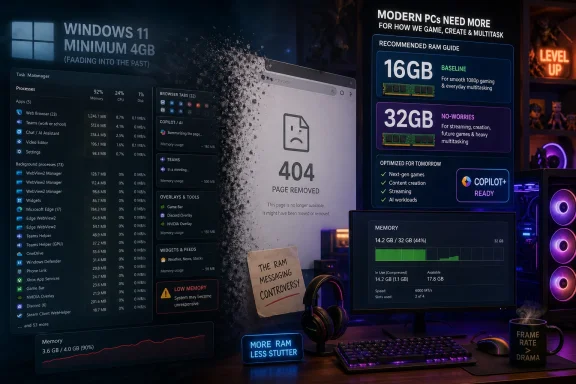 Microsoft Accidentally Said the Quiet Part Like a Buyer’s Guide
The deleted document, according to Windows Latest, carried the title “Gaming features: What the best Windows PC gaming systems have in common.” It reportedly appeared in Microsoft’s consumer-facing Learning Center, the softer marketing-and-guidance layer that often ranks well in search and translates platform priorities into shopping advice.On its face, the recommendation was not absurd. A Windows 11 gaming PC with 16GB of RAM can still be entirely usable, and a 32GB configuration is increasingly sensible if the machine is expected to run a heavyweight game while juggling Discord, a Chromium-based browser, streaming tools, launchers, voice chat, peripheral software, and background services. Many enthusiast builders have been telling friends exactly that for years.
The problem is that the advice did not arrive from a neutral system builder. It came from Microsoft, the company responsible for the platform overhead that users are already grumbling about, and it landed at a moment when the company is pushing AI features, Copilot+ hardware, WebView2 app experiences, and cloud-connected services across Windows.
That is why “32GB is the no-worries upgrade” sounded less like helpful purchasing advice and more like a confession. Microsoft was not saying Windows 11 requires 32GB. It was saying, in effect, that the modern Windows gaming experience is better when users buy enough memory to stop thinking about what Windows and its app ecosystem are doing in the background.
The 4GB Minimum Is Technically True and Practically Useless
Microsoft’s official Windows 11 system requirements still list 4GB of RAM as the minimum. That number has always been a political and compatibility statement as much as a performance recommendation. It defines the lowest rung of eligibility, not the point at which the operating system feels good.The distinction matters. Minimum requirements keep upgrade paths open, support documents tidy, and OEM conversations manageable. They do not tell a student whether a budget laptop will age gracefully, a gamer whether Alt-Tabbing will turn into a paging festival, or an IT department whether a fleet of 8GB devices will remain tolerable through another three years of feature updates.
This has been a Windows problem for decades, but Windows 11 makes the gap more visible. A fresh install may boot within the published requirements, yet a real PC is rarely just Windows. It is Teams, Edge, OneDrive, widgets, security agents, printer tools, GPU software, game launchers, browser tabs, password managers, update services, and whatever OEM utilities survived the first round of cleanup.
For gaming, the situation is even less forgiving. Games increasingly stream assets aggressively, reserve large memory pools, and assume the player has multiple companion apps running. Microsoft’s deleted guidance reportedly acknowledged that 16GB is the practical starting point and 32GB gives newer titles “more breathing room.” The phrasing was mild; the implication was not.
Copilot+ Turned 16GB Into Microsoft’s Real Floor
The more revealing comparison is not between 4GB and 32GB. It is between Windows 11’s official minimum and Copilot+ PC requirements. Microsoft’s AI-branded PC category requires, among other things, 16GB of RAM, 256GB of storage, and an NPU capable of at least 40 TOPS.That spec tells us where Microsoft believes the modern Windows experience is going. Copilot+ is not just a premium sticker; it is a hardware baseline for the features Microsoft most wants to promote. Recall, local AI workloads, enhanced captions, image generation, semantic search, and other ambient computing features all presume a more capable machine than the Windows 11 minimum table suggests.
This creates a two-tier message. To run Windows 11, Microsoft says 4GB is enough. To participate in the future Microsoft is actually marketing, 16GB is the entry point. To game without thinking about multitasking pressure, the deleted Learning Center page reportedly nudged users toward 32GB.
That ladder is coherent from a product-strategy perspective, but it is awkward from a consumer-trust perspective. Microsoft wants Windows 11 to remain broadly compatible while also persuading buyers that the best Windows 11 experience lives on much beefier hardware. The deleted article merely made that tension too searchable.
The Gaming Community Heard a Hardware Upsell
Gamers are unusually sensitive to this kind of messaging because they already live inside an expensive stack. A modern gaming PC is a negotiation among GPU pricing, CPU platform costs, motherboard generations, SSD capacity, monitor refresh rates, power supplies, cooling, and now memory capacity. When Microsoft appears to move the goalposts, even in a soft recommendation, the reaction is predictable.RAM prices also matter. The memory market is volatile, and AI infrastructure demand has added new pressure to the supply chain. A 32GB recommendation lands differently when users feel that enterprise AI and hyperscale buying are helping make consumer memory more expensive.
Microsoft is not solely responsible for game memory demands, and it would be lazy to pretend otherwise. Developers target consoles and PCs with different constraints, engines have grown more ambitious, and the PC gaming ecosystem has normalized a swarm of always-on companion software. But Windows is the platform layer beneath much of that complexity, and Microsoft has spent the past several years adding more web-powered, account-connected, AI-adjacent experiences to that layer.
That is the context in which the deleted document became inflammatory. The words themselves were defensible. The messenger was the problem.
WebView2 and Electron Became the Villains Because They Are Visible
Windows users often blame Electron and WebView2 for memory bloat, sometimes too broadly and sometimes with good reason. Electron apps bundle Chromium and Node.js to deliver cross-platform desktop software with web technologies. WebView2 lets developers embed Microsoft Edge’s rendering engine inside Windows applications.These technologies are not inherently evil. They let developers ship faster, reuse web code, maintain consistent interfaces, and avoid rebuilding native clients for every platform. Many users would rather have a cross-platform app that exists than a native app that never ships.
But the cost is visible in Task Manager. Users see multiple Edge WebView2 processes, Teams components, widgets, launchers, chat clients, storefronts, and helper processes. They may not understand the architecture, but they understand the feeling: a machine that once had headroom now feels busy before the game even launches.
Microsoft sits in an uncomfortable position here. It promotes WebView2 as a modern Windows development technology, uses web-backed experiences throughout its own software, and then must convince users that Windows is being optimized for performance. When a company simultaneously asks developers to use web containers and tells gamers to buy more RAM, people connect the dots whether or not the engineering picture is fair.
Deleting the Page Made the Story Bigger
The quiet removal of the Learning Center page was almost guaranteed to intensify suspicion. If Microsoft had left the article up and clarified that 32GB was a recommendation for multitasking-heavy gaming rather than a Windows requirement, the story might have remained a minor skirmish in the endless PC spec wars.Instead, according to Windows Latest, Microsoft redirected the page to the Learning Center homepage and blocked web archives from surfacing the retracted document. That is the kind of cleanup operation that turns a questionable page into a case study in platform messaging.
The company may have had mundane reasons. The article may have been drafted poorly, published prematurely, generated by an internal content workflow that leaned too heavily on AI, or failed to pass the right policy review. It may also have been accurate but politically inconvenient. The public cannot know without Microsoft explaining it, and silence rarely favors the platform owner.
The suspected AI authorship is another irritant. Microsoft has every right to use AI in content production, but autogenerated or lightly edited guidance becomes dangerous when it strays into buying advice. A hallucinated historical fact is embarrassing. A sloppy hardware recommendation can influence purchases, OEM expectations, and search results.
The OEM Channel Has Already Moved On
The consumer shelf has been telling a clearer story than Microsoft’s minimum requirements page. Many mainstream PCs still ship with 8GB of RAM, especially at the budget end, but that configuration is increasingly hard to recommend for anyone who expects longevity. For a Windows 11 machine bought in 2026, 8GB is a price-point compromise.Copilot+ PCs have accelerated the normalization of 16GB. Once Microsoft’s flagship AI category mandates that amount, OEMs have a powerful reason to treat it as the modern default for premium and upper-mainstream systems. Even when buyers do not care about AI features, the branding shifts expectations.
Gaming laptops and desktops are moving in a similar direction. Entry-level models may still use 16GB to keep sticker prices palatable, but the enthusiast recommendation has drifted toward 32GB because the cost of being wrong is irritating. A RAM-constrained gaming PC does not merely benchmark lower; it stutters, swaps, reloads, hesitates, and punishes multitasking.
That is why Microsoft’s deleted recommendation rang true even to some critics. The outrage was not rooted in the idea that 32GB is bad advice. It was rooted in the belief that Microsoft has not earned the right to deliver that advice without acknowledging its own contribution to the problem.
Windows Is Trying to Win Back Gamers While Carrying Its Own Baggage
Microsoft has been signaling that Windows gaming performance and reliability are back near the top of the priority list. Reporting in recent months has pointed to work around background workloads, power behavior, scheduling, graphics stack improvements, driver reliability, and more console-like gaming experiences.That focus is not happening in a vacuum. SteamOS and handheld gaming PCs have exposed a weakness in the traditional Windows model. On a desktop tower with 64GB of RAM and a high-end GPU, Windows overhead is annoying but survivable. On a handheld, every background process, update prompt, launcher, and overlay competes with battery life, thermals, and frame pacing.
The gaming PC is no longer just a beige box under a desk or a glass-sided tower full of RGB. It is also a handheld, a living-room device, a laptop, and sometimes a low-power machine that users expect to behave more like a console. Windows has to become less noisy if Microsoft wants to defend that territory.
A 32GB RAM recommendation points in the opposite emotional direction. It says the answer is more hardware. Gamers increasingly want Microsoft to prove the answer can also be less overhead.
The Real Fight Is Over Trust, Not DIMMs
There is an easy version of this story that says Microsoft recommended 32GB, gamers got mad, and Microsoft deleted the page. That version misses the deeper issue. The fight is about whether users believe Microsoft is optimizing Windows for them or normalizing heavier hardware requirements for Microsoft’s own strategic agenda.The AI push makes that suspicion sharper. Copilot is not just another app; it is Microsoft’s organizing principle for the next phase of Windows, Office, Edge, and cloud services. Users who do not want AI woven through their operating system are already primed to see every hardware recommendation as part of that campaign.
To be fair, AI features do need local compute if Microsoft wants them to be faster, more private, and less dependent on the cloud. NPUs exist for a reason. More RAM can make local models and semantic features more practical. There is a technically coherent argument for the Copilot+ baseline.
But Microsoft’s challenge is not merely technical coherence. It is consent. Users are more willing to accept higher requirements when they believe the added resources serve their priorities. They are less forgiving when they suspect the resources are being consumed by features they did not ask for and cannot fully remove.
Microsoft Needs Separate Advice for Minimum, Mainstream, and Ambitious PCs
One lesson from this flap is that a single RAM number cannot do all the work Microsoft wants it to do. The company needs clearer tiers that distinguish installation eligibility, everyday comfort, gaming comfort, creator workloads, enterprise management, and AI-forward experiences.The current messaging forces users to reconcile incompatible signals. 4GB is the minimum. 8GB is still common in stores. 16GB is required for Copilot+. 32GB is reportedly the no-worries gaming upgrade. None of those statements is automatically false, but together they look evasive.
Microsoft could fix much of this by being explicit. A Windows 11 minimum spec should be labeled as a survival threshold. A recommended spec should describe a mainstream experience in 2026. A gaming spec should distinguish between esports titles, AAA games, streaming, and multitasking. An AI PC spec should explain what the extra hardware is for and what happens if users do not have it.
That clarity would not end arguments, but it would make them more honest. Enthusiasts can tolerate hard truths. What they dislike is marketing language pretending to be neutral guidance.
The Vanished Page Leaves Microsoft With a Cleaner Site and a Messier Message
The deletion solves Microsoft’s immediate problem: one embarrassing page no longer sits in search results telling gamers that 32GB is the comfortable upgrade. It does not solve the underlying contradiction. If anything, it makes the contradiction easier to describe.Windows 11 remains an operating system with a low official minimum, a heavier real-world footprint, and a future-facing feature strategy that assumes substantially better hardware. Microsoft wants to preserve the breadth of the Windows ecosystem while pushing users and OEMs toward a more capable AI PC baseline. That is a difficult balancing act, and the deleted article stepped directly onto the wire.
For IT pros, the lesson is familiar. Official minimums are procurement trivia, not lifecycle planning. A fleet designed around the lowest supported spec will age badly. A gaming PC built around today’s minimum comfort line may feel tight before the GPU is obsolete.
For Microsoft, the lesson should be more uncomfortable. If the company wants users to buy into a 16GB-and-up future, it has to show that Windows is becoming more disciplined, not simply more demanding.
The RAM Recommendation Microsoft Could Not Keep Saying Out Loud
The practical guidance has not changed just because the page disappeared. A budget Windows 11 PC with 8GB of RAM is still a compromise. A general-purpose machine with 16GB is the safer mainstream buy. A gaming system intended to run modern titles while multitasking is better off with 32GB when the budget allows.But practical truth and official messaging are different things. Microsoft can benefit from a market that moves to higher memory configurations without wanting to be seen as the company that moved the goalposts. That is especially true when its own AI ambitions are part of the demand story.
The company’s silence also leaves room for an unflattering interpretation: Microsoft wants the performance headroom of richer hardware baselines without taking responsibility for why users need them. That may be unfair to individual Windows engineers doing real optimization work. It is not unfair to the overall product strategy users experience.
Windows is vast, old, commercially entangled, and expected to support everything from corporate endpoints to enthusiast rigs. Nobody should expect it to behave like a stripped-down console OS. But Microsoft cannot keep presenting Windows as both lightweight enough for a 4GB minimum and ambitious enough for always-on AI without explaining the tradeoff.
The Buying Advice Survives the Backlash
Here is the uncomfortable part for anyone hoping the deleted page was simply wrong: Microsoft’s reported recommendation was broadly reasonable if treated as gaming advice rather than a Windows requirement. The modern PC gaming environment is messy, and memory headroom is one of the cheapest ways to make that mess less visible.The cleaner takeaway is not “Microsoft lied” or “gamers overreacted.” It is that Microsoft let a plausible recommendation escape without the framing needed to make it trustworthy. The company told users what to buy before convincingly showing that it is doing its part to make Windows leaner.
- A Windows 11 minimum requirement is not a useful buying guide for a new PC in 2026.
- A 16GB Windows 11 system is now the practical baseline for mainstream users who want several years of comfortable service.
- A 32GB gaming PC is increasingly sensible for players who run modern games alongside browsers, Discord, streaming tools, launchers, and overlays.
- Copilot+ has effectively made 16GB Microsoft’s real entry point for its preferred future Windows experience.
- Microsoft’s deletion of the page reduced the immediate controversy but amplified doubts about whether its hardware guidance is marketing, engineering, or both.
Source: Windows Latest Microsoft quietly deletes Windows 11 doc pushing 32GB RAM for gaming after outrage
