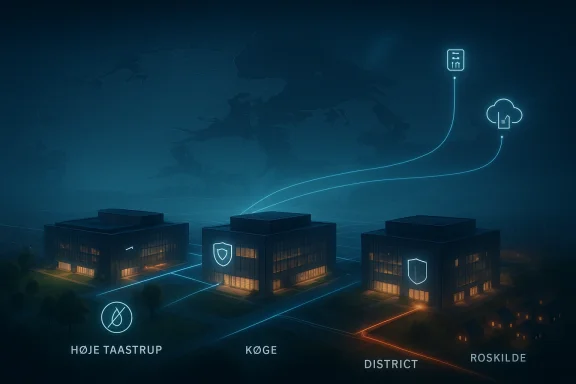
Microsoft’s official opening of the Denmark East datacenter region marks more than a local infrastructure milestone. It is a signal that Denmark has become a strategic node in Microsoft’s European cloud map, with implications for digital resilience, data sovereignty, AI readiness, and the country’s wider economic footprint. The move also arrives at a moment when governments and enterprises alike are demanding more control over where data lives, how cloud services are governed, and how critical digital services can be kept online under pressure. For Microsoft, the Danish launch is both a technical expansion and a political statement about the future of trusted cloud infrastructure in Europe.
The new region is centered across three sites in Høje Taastrup, Køge, and Roskilde on Zealand, and Microsoft says it is designed to deliver local, secure cloud infrastructure with sustainability embedded from the start. The company frames the launch as a way to give customers greater control, lower latency, and local data residency, while reinforcing European compliance and operational transparency. That framing matters because the cloud market has shifted from a conversation about raw scale to one about where control sits and who can assert it when law, regulation, or geopolitics get complicated.
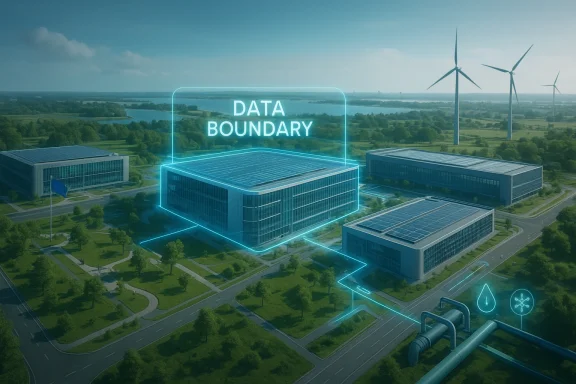
The timing is notable. In recent years, Microsoft has steadily expanded its European sovereignty posture through the EU Data Boundary, the European Digital Commitments, and a broader Sovereign Cloud strategy. Denmark East is one of the most concrete manifestations of that strategy in the Nordics, adding physical infrastructure to a policy architecture that already promises more localized processing, stronger controls, and clearer legal assurances. In other words, Microsoft is no longer just saying that European cloud data should be protected; it is building more of the stack inside Europe to make that promise more credible.
There is also a strong economic-development narrative attached to the launch. Microsoft and IDC are projecting billions of dollars in local spending and sizable ecosystem effects over the next several years, with much of the value expected to flow through Danish partners rather than only to Microsoft itself. That is a familiar cloud story, but it is still important: cloud regions do not just host workloads, they reorganize regional IT economies, create a gravity well for systems integrators, and change the bargaining power of local customers who want enterprise-grade infrastructure without sending their data and operations abroad.
Sustainability is another pillar of the announcement, and Microsoft is leaning hard on it. The Danish datacenters are described as zero-water cooling facilities, designed for LEED Gold certification, targeted for a PUE of 1.16, and engineered to recycle surplus heat into district heating systems. Those features do not just make the launch greener on paper; they reflect a broader industry effort to make hyperscale infrastructure more compatible with public expectations, scarce resources, and municipal planning. The Danish case is especially interesting because it tries to make a datacenter look less like a sealed industrial box and more like a civic utility with local benefits.
The country also sits inside a broader European debate about digital sovereignty. Governments and regulated sectors want cloud services that do not simply operate in Europe but are governed, supported, and architected with Europe’s legal and political expectations in mind. Denmark East addresses that demand by placing more infrastructure on Danish soil and tying it to the EU Data Boundary and Microsoft’s European commitments. That does not solve every sovereignty concern, but it narrows the gap between policy language and physical reality.
A few factors explain why the Danish market is attractive:
The evolution from announcement to operation also reflects a broader shift in Microsoft’s regional model. Earlier cloud-era projects often emphasized capacity expansion and global footprint. Today, the message is more nuanced: infrastructure is being positioned as a means to achieve sovereignty, resilience, sustainability, and economic localization all at once. That is a much more ambitious proposition, and it reflects how cloud has moved from an IT procurement issue to a strategic national asset.
Historically, cloud buyers could accept geographic abstraction. That is harder now. Enterprises, regulators, and public-sector buyers increasingly want to know:
For regulated industries, the most important factor is often not raw speed but certainty. If data can stay in Denmark, under European legal protection and within a well-defined governance model, that simplifies compliance and reduces the operational overhead of explaining where data lives. It also makes hybrid architectures easier to justify, especially when cloud systems must sit close to on-premises services or specialized industrial systems.
Microsoft’s own examples point to sectors such as:
Lower latency also has strategic implications for AI workloads. As organizations move from experimentation to production, responsiveness, locality, and governance all become more important. A regional cloud footprint lets companies build with more confidence, especially when data, identity, and application layers need to stay tightly coupled.
This is a meaningful market shift. Sovereignty used to be discussed mostly in government procurement circles. Now it is becoming a mainstream enterprise feature, especially for industries that are subject to strict regulation, data localization concerns, or geopolitical risk. Microsoft is clearly trying to position itself ahead of rivals by making sovereignty feel like a configurable cloud capability rather than a special-case exception.
In practical terms, that means customers can look for:
It also puts pressure on cloud buyers to rethink procurement criteria. If sovereignty, resilience, and EU legal framing are now part of the product value proposition, then “cheapest compute” stops being the default decision rule. That shifts market competition toward trust, governance, and ecosystem depth.
The environmental case is especially strong in Denmark because the region can integrate with local energy systems and district heating networks. Microsoft’s claim that surplus heat can warm thousands of homes turns the datacenter from an isolated consumer of energy into a contributor to local infrastructure. That is a powerful narrative, and it may help reduce the political friction that often accompanies large datacenter builds.
The broader significance is that sustainability is increasingly a matter of systems integration, not just efficiency metrics. A datacenter that is efficient and useful to the surrounding community has a better chance of winning social license. It can be seen less as an extractive asset and more as shared infrastructure.
The important point is that the sustainability story is no longer limited to the datacenter operator. It extends to customer behavior. If cloud migration leads to better utilization, fewer stranded servers, and more efficient cooling and energy sourcing, then the environmental gains can compound across the ecosystem. If customers simply replicate inefficient architectures in the cloud, however, the gains will be smaller.
This is why cloud regions matter regionally. They are not just supply-side investments; they create demand for local expertise. Once a region is live, customers need help migrating workloads, architecting security, complying with regulations, and building AI-enabled solutions. Those activities create jobs and keep more value inside the national economy.
The ecosystem can be summarized simply:
Small and medium-sized enterprises could benefit too, though often indirectly. SMEs tend not to build cloud regions themselves, but they do use the services, applications, and digital products that emerge around them. If Denmark East helps local software vendors and consultancies grow, those gains can spread well beyond Microsoft’s immediate customer base.
Datacenters can be controversial if they appear opaque, power-hungry, or disconnected from local life. Microsoft is trying to avoid that by presenting the region as part of a broader civic ecosystem. The message is that cloud infrastructure can coexist with public space, environmental stewardship, and local participation.
Municipal leaders can also use such projects to signal that their communities are ready for advanced investment. For local governments, hosting a datacenter is a way to demonstrate industrial relevance in a digital era. It says, in effect, that the municipality can support future-proof infrastructure rather than merely tolerate it.
The best-case scenario is a genuinely symbiotic relationship. The worst case is a polished narrative that masks an imbalanced exchange. The success of Denmark East will depend on whether local stakeholders continue to see real benefits after the publicity cycle fades.
The region’s success will also depend on how well Microsoft turns infrastructure into an ecosystem. That means training partners, enabling developers, supporting AI adoption, and maintaining credibility on sustainability and sovereignty. If those pieces hold together, Denmark East could become a model for the next generation of European cloud investment rather than merely another datacenter milestone.
Source: Microsoft Source Microsoft announces the opening of its new datacenter region in Denmark, strengthening digital resilience, innovation, and economic growth - Source EMEA
 Overview
The new region is centered across three sites in Høje Taastrup, Køge, and Roskilde on Zealand, and Microsoft says it is designed to deliver local, secure cloud infrastructure with sustainability embedded from the start. The company frames the launch as a way to give customers greater control, lower latency, and local data residency, while reinforcing European compliance and operational transparency. That framing matters because the cloud market has shifted from a conversation about raw scale to one about where control sits and who can assert it when law, regulation, or geopolitics get complicated.The timing is notable. In recent years, Microsoft has steadily expanded its European sovereignty posture through the EU Data Boundary, the European Digital Commitments, and a broader Sovereign Cloud strategy. Denmark East is one of the most concrete manifestations of that strategy in the Nordics, adding physical infrastructure to a policy architecture that already promises more localized processing, stronger controls, and clearer legal assurances. In other words, Microsoft is no longer just saying that European cloud data should be protected; it is building more of the stack inside Europe to make that promise more credible.
There is also a strong economic-development narrative attached to the launch. Microsoft and IDC are projecting billions of dollars in local spending and sizable ecosystem effects over the next several years, with much of the value expected to flow through Danish partners rather than only to Microsoft itself. That is a familiar cloud story, but it is still important: cloud regions do not just host workloads, they reorganize regional IT economies, create a gravity well for systems integrators, and change the bargaining power of local customers who want enterprise-grade infrastructure without sending their data and operations abroad.
Sustainability is another pillar of the announcement, and Microsoft is leaning hard on it. The Danish datacenters are described as zero-water cooling facilities, designed for LEED Gold certification, targeted for a PUE of 1.16, and engineered to recycle surplus heat into district heating systems. Those features do not just make the launch greener on paper; they reflect a broader industry effort to make hyperscale infrastructure more compatible with public expectations, scarce resources, and municipal planning. The Danish case is especially interesting because it tries to make a datacenter look less like a sealed industrial box and more like a civic utility with local benefits.
Why Denmark Matters in Microsoft’s European Strategy
Denmark is a small market in population terms, but strategically it punches above its weight because it combines high digital maturity, strong public-sector technology use, and a policy climate that values both innovation and sustainability. For Microsoft, that makes Denmark an ideal place to showcase the next version of cloud infrastructure: locally anchored, compliance-ready, and wrapped in a narrative that emphasizes partnership rather than extraction. The company is effectively using Denmark as a reference case for what a modern cloud region should look like in Europe.The country also sits inside a broader European debate about digital sovereignty. Governments and regulated sectors want cloud services that do not simply operate in Europe but are governed, supported, and architected with Europe’s legal and political expectations in mind. Denmark East addresses that demand by placing more infrastructure on Danish soil and tying it to the EU Data Boundary and Microsoft’s European commitments. That does not solve every sovereignty concern, but it narrows the gap between policy language and physical reality.
A Small Market With Outsized Signal Value
Denmark is often used by global vendors as a proving ground for how infrastructure, policy, and sustainability can be integrated. If a model works in Denmark, the argument goes, it can often be adapted elsewhere in Europe. That makes this launch more than a local event; it becomes a template Microsoft can point to when discussing future regional investments, regulated-industry migrations, and public-sector cloud adoption.A few factors explain why the Danish market is attractive:
- High trust in digital public services.
- Strong demand for low-latency, local cloud operations.
- A policy environment that rewards sustainability claims.
- Mature partner ecosystems capable of translating infrastructure into services.
- A public conversation about resilience that is increasingly practical, not abstract.
The Long Build-Up to Denmark East
This opening did not happen overnight. Microsoft first announced plans for a Danish datacenter region years ago, and the intervening period has been about permits, construction, partner mobilization, power strategy, and public-private alignment. In that sense, the launch is the culmination of a long industrial process rather than a simple ribbon-cutting moment. That matters because datacenter regions are among the few technology projects where patience is not just a virtue but a requirement.The evolution from announcement to operation also reflects a broader shift in Microsoft’s regional model. Earlier cloud-era projects often emphasized capacity expansion and global footprint. Today, the message is more nuanced: infrastructure is being positioned as a means to achieve sovereignty, resilience, sustainability, and economic localization all at once. That is a much more ambitious proposition, and it reflects how cloud has moved from an IT procurement issue to a strategic national asset.
From Capacity to Commitment
The Danish launch is especially interesting because Microsoft has layered several commitments on top of the physical region. Those include local residency assurances, broader EU data handling commitments, and sovereign-cloud options for customers with stricter control requirements. The company is trying to show that a datacenter region is no longer just a place where workloads run; it is a platform for legal, operational, and political assurances.Historically, cloud buyers could accept geographic abstraction. That is harder now. Enterprises, regulators, and public-sector buyers increasingly want to know:
- Where is the data stored?
- Where is it processed?
- Who can access it?
- What happens under legal pressure?
- What resilience exists if one site is disrupted?
What Customers Gain from Local Infrastructure
For customers, the headline benefits are straightforward: lower latency, local data residency, more control, and access to Microsoft’s cloud and AI services inside a Danish region. But the practical significance depends on workload type. A bank, a hospital, a municipality, and a manufacturer may all value the region, but they will value it for slightly different reasons.For regulated industries, the most important factor is often not raw speed but certainty. If data can stay in Denmark, under European legal protection and within a well-defined governance model, that simplifies compliance and reduces the operational overhead of explaining where data lives. It also makes hybrid architectures easier to justify, especially when cloud systems must sit close to on-premises services or specialized industrial systems.
Enterprise Use Cases vs Consumer Impact
The enterprise impact is immediate and easy to understand. Large organizations want cloud regions that fit audit requirements, improve disaster recovery planning, and reduce dependence on distant facilities. Consumers benefit more indirectly, through the services their banks, hospitals, retailers, and utilities deliver on top of that infrastructure.Microsoft’s own examples point to sectors such as:
- Healthcare.
- Finance.
- Manufacturing.
- Energy.
- Public services.
Why Latency Still Matters
Latency is often treated as a technical footnote, but for modern workloads it can shape user experience and system architecture. When cloud services sit closer to user populations and on-premises systems, developers can design faster applications and simpler integrations. That is especially valuable for hybrid environments, where the cloud is not a replacement for local systems but a companion to them.Lower latency also has strategic implications for AI workloads. As organizations move from experimentation to production, responsiveness, locality, and governance all become more important. A regional cloud footprint lets companies build with more confidence, especially when data, identity, and application layers need to stay tightly coupled.
Sovereignty Is Becoming a Product Feature
Microsoft is not just selling compute in Denmark East; it is selling a sovereignty story. The company says customers in Denmark are covered by the EU Data Boundary, and it has tied the launch to its European Digital Commitments and Microsoft Sovereign Cloud. That makes the region part of a broader commercial package in which legal assurances, governance structures, and technical architecture are all bundled together.This is a meaningful market shift. Sovereignty used to be discussed mostly in government procurement circles. Now it is becoming a mainstream enterprise feature, especially for industries that are subject to strict regulation, data localization concerns, or geopolitical risk. Microsoft is clearly trying to position itself ahead of rivals by making sovereignty feel like a configurable cloud capability rather than a special-case exception.
The New Language of Control
The phrase “digital sovereignty” is doing a lot of work in the current cloud market. It can mean different things to different customers, ranging from simple residency to more advanced operational autonomy. Microsoft’s position is that sovereignty is a continuum, not a binary. That framing is smart because it lets the company address a broad range of needs without forcing every customer into the same model.In practical terms, that means customers can look for:
- Controlled data residency.
- Greater operational transparency.
- Region-specific governance.
- Options for isolated or highly regulated workloads.
- Stronger contractual and technical assurances.
Competitive Implications
The competitive implications are substantial. Rivals in the hyperscale market are also pushing localized infrastructure and sovereignty-themed offerings, but Microsoft has a strong advantage in the combination of cloud, productivity software, enterprise trust, and public-sector depth. By tying Denmark East to broader sovereignty commitments, Microsoft is raising the bar for competitors that want to win the same workloads.It also puts pressure on cloud buyers to rethink procurement criteria. If sovereignty, resilience, and EU legal framing are now part of the product value proposition, then “cheapest compute” stops being the default decision rule. That shifts market competition toward trust, governance, and ecosystem depth.
Sustainability Is Not Just a Side Benefit
Microsoft is making a strong sustainability argument around Denmark East, and it is one of the more compelling parts of the announcement. The company says the region is designed with zero water use for cooling, LEED Gold ambitions, and a PUE of 1.16. It also says it uses renewable fuels such as HVO for backup power where available and has long-term renewable energy agreements in Denmark. These details matter because sustainability claims in datacenters are only credible when they are backed by engineering, not marketing.The environmental case is especially strong in Denmark because the region can integrate with local energy systems and district heating networks. Microsoft’s claim that surplus heat can warm thousands of homes turns the datacenter from an isolated consumer of energy into a contributor to local infrastructure. That is a powerful narrative, and it may help reduce the political friction that often accompanies large datacenter builds.
Heat Recovery as Local Infrastructure
Waste heat recovery is one of the most interesting features of the Danish project. Instead of letting excess heat dissipate, Microsoft says the Høje Taastrup site can feed local district heating, with future expansion planned for Køge. That creates a visible public benefit and helps explain why municipalities have embraced the project.The broader significance is that sustainability is increasingly a matter of systems integration, not just efficiency metrics. A datacenter that is efficient and useful to the surrounding community has a better chance of winning social license. It can be seen less as an extractive asset and more as shared infrastructure.
Carbon, Water, and the Cloud Transition
Microsoft also argues that moving from on-premises infrastructure to cloud services can reduce emissions significantly. IDC’s estimates, as cited by Microsoft, suggest substantial CO₂ reductions over the next four years if organizations shift workloads into cloud environments. That is plausible in many cases, though outcomes will vary depending on workload design, utilization rates, and how customers architect their environments.The important point is that the sustainability story is no longer limited to the datacenter operator. It extends to customer behavior. If cloud migration leads to better utilization, fewer stranded servers, and more efficient cooling and energy sourcing, then the environmental gains can compound across the ecosystem. If customers simply replicate inefficient architectures in the cloud, however, the gains will be smaller.
The Partner Ecosystem May Matter More Than the Region Itself
The launch’s economic case hinges on the ecosystem effect. Microsoft says that for every dollar of cloud revenue, multiple dollars are generated in the wider partner network, and that the Danish region should drive significant local spending over the next four years. That is consistent with how cloud ecosystems work in practice: the datacenter is the base layer, but the real value often appears in consulting, integration, security, software development, and managed services.This is why cloud regions matter regionally. They are not just supply-side investments; they create demand for local expertise. Once a region is live, customers need help migrating workloads, architecting security, complying with regulations, and building AI-enabled solutions. Those activities create jobs and keep more value inside the national economy.
A Flywheel for Local IT Services
The Danish partner story is critical because it shows how hyperscale infrastructure feeds the local services economy. Microsoft’s cloud is not a closed system. It depends on integrators, consultancies, security firms, and specialized software vendors to turn raw infrastructure into business outcomes. That is where much of the employment and revenue expansion comes from.The ecosystem can be summarized simply:
- Cloud region opens.
- Customers migrate workloads.
- Local partners guide adoption.
- New services and applications get built.
- Spending circulates through the domestic economy.
Public Sector and SME Effects
The public sector may be one of the biggest long-term beneficiaries. Municipalities, healthcare providers, and agencies often need robust cloud services but must balance compliance, procurement rules, and data sensitivity. A local region with strong legal and operational framing can reduce barriers to adoption.Small and medium-sized enterprises could benefit too, though often indirectly. SMEs tend not to build cloud regions themselves, but they do use the services, applications, and digital products that emerge around them. If Denmark East helps local software vendors and consultancies grow, those gains can spread well beyond Microsoft’s immediate customer base.
Municipal Politics and Community Design Matter More Than Ever
One of the most interesting aspects of the Danish launch is the amount of local civic framing around it. Microsoft is highlighting community partnerships, neighborhood engagement, biodiversity work, inclusion initiatives, and even a new public park near the Høje Taastrup site. That may sound like corporate polish, but it reflects a real lesson: infrastructure projects succeed more easily when nearby communities see tangible, local value.Datacenters can be controversial if they appear opaque, power-hungry, or disconnected from local life. Microsoft is trying to avoid that by presenting the region as part of a broader civic ecosystem. The message is that cloud infrastructure can coexist with public space, environmental stewardship, and local participation.
Why Local Trust Is a Strategic Asset
Trust is not just a nice-to-have in this context; it is a strategic asset. If municipalities believe the project contributes to heat networks, urban design, job creation, and skills development, then the political coalition around the datacenter becomes more durable. That matters when future expansions, zoning debates, or policy discussions arise.Municipal leaders can also use such projects to signal that their communities are ready for advanced investment. For local governments, hosting a datacenter is a way to demonstrate industrial relevance in a digital era. It says, in effect, that the municipality can support future-proof infrastructure rather than merely tolerate it.
A New Model of Corporate Presence
Microsoft’s community approach in Denmark reflects a broader shift in how technology firms present themselves in Europe. The company is not just a cloud provider; it is a local economic actor, an infrastructure partner, and a sustainability participant. That model is increasingly necessary because large-scale infrastructure now affects energy grids, district heating, land use, and municipal identity.The best-case scenario is a genuinely symbiotic relationship. The worst case is a polished narrative that masks an imbalanced exchange. The success of Denmark East will depend on whether local stakeholders continue to see real benefits after the publicity cycle fades.
Strengths and Opportunities
Microsoft’s Denmark East launch has several clear strengths. It aligns infrastructure, regulation, sustainability, and local economic development in a way that is rare even among top-tier cloud announcements. Just as important, it comes with concrete technical and civic commitments rather than vague promises.- Local data residency should reduce compliance friction for sensitive workloads.
- Lower latency can improve hybrid application performance and user experience.
- Sovereignty options give regulated sectors more confidence in cloud adoption.
- Waste heat recovery adds a visible community and environmental benefit.
- Renewable energy sourcing strengthens Microsoft’s sustainability credibility.
- Partner ecosystem growth could create long-term local jobs and revenue.
- Public-sector readiness may accelerate digital transformation across municipalities and agencies.
Risks and Concerns
The launch is promising, but it is not free of risk. The biggest challenge is that ambitious infrastructure messaging can create expectations that are difficult to sustain once customers begin using the region at scale. Transparency, uptime, and actual sovereignty mechanics will matter more than launch-day language.- Sovereignty claims may still leave questions about ultimate cloud control.
- Energy demand could become a political issue if growth outpaces grid planning.
- Heat recovery promises depend on practical integration with district systems.
- Community benefits must remain visible beyond the construction phase.
- Cost pressures could limit adoption if the region is priced above alternatives.
- Competition from other cloud providers may narrow Microsoft’s advantage.
- Complex compliance needs may require bespoke customer implementations.
Looking Ahead
The next phase will be about utilization, not inauguration. The real test of Denmark East begins when public institutions, enterprises, and software partners start moving production workloads into the region and measuring whether the promised gains show up in practice. If the region delivers lower latency, stronger compliance, and smoother operations, it could become one of Microsoft’s most persuasive European references.The region’s success will also depend on how well Microsoft turns infrastructure into an ecosystem. That means training partners, enabling developers, supporting AI adoption, and maintaining credibility on sustainability and sovereignty. If those pieces hold together, Denmark East could become a model for the next generation of European cloud investment rather than merely another datacenter milestone.
- Watch for customer migration announcements from public-sector and regulated-industry users.
- Watch for partner-led solution launches built specifically on Denmark East.
- Watch for sustainability metrics that show whether design targets hold in operation.
- Watch for district heating integration milestones and community reporting.
- Watch for follow-on investment that expands the region’s footprint or adjacent services.
Source: Microsoft Source Microsoft announces the opening of its new datacenter region in Denmark, strengthening digital resilience, innovation, and economic growth - Source EMEA