

Microsoft is formalizing something many large enterprises still treat as an ad hoc discipline: the governance layer that decides whether AI and analytics can scale safely, or stall in a thicket of fragmented data and competing priorities. In the company’s own telling, the Microsoft Digital Data Council is designed to unify ownership, standards, and accountability across domains so Microsoft can push toward AI-ready data without sacrificing trust, compliance, or speed. That framing matters because the strategy is not just about building a better data platform; it is about turning data governance into an operating advantage for the entire company. Microsoft’s article also makes clear that the council is being used as a Customer Zero mechanism, so internal lessons can shape product readiness before those patterns are pushed outward to customers.
For two decades, Microsoft describes its own data journey as a series of trade-offs between control and agility. The earliest model was highly decentralized: teams owned their own data assets, optimized locally, and moved quickly within their own lanes, but often at the cost of consistency and enterprise-wide visibility. That approach produced the familiar enterprise problem of data silos, where different parts of the business could not easily trust, reuse, or compare what they had.
The next phase swung the pendulum toward centralization. Microsoft says that centralized data platforms brought standardization, security, and scale, but also introduced distance between the people closest to the business problem and the people controlling the platform. In practice, this often weakens responsiveness and can blur accountability, because domain owners no longer feel fully responsible for the data they create or consume. Microsoft’s current answer is a more balanced model: federated ownership with common guardrails, often described as a data mesh.
That shift is important because it mirrors a broader enterprise realization: AI does not eliminate data governance, it makes governance more consequential. The company argues that if data is not discoverable, reliable, and responsibly managed, then AI systems will only scale confusion faster. In that sense, the council is not merely administrative; it is a response to the realities of modern AI, where poor metadata, unclear ownership, and inconsistent quality can undermine everything from analytics to agentic workflows.
Microsoft also places the council inside a larger enterprise maturity narrative, one tied to what it calls the Frontier Firm. That language signals a broader internal ambition: become an organization that can support interconnected analytics, AI at scale, and product-level learning loops across the enterprise. The council therefore sits at the intersection of platform engineering, compliance, employee enablement, and business strategy, which is exactly where the hardest data problems now live.
There is a second context worth noting. Microsoft is not talking about data governance in the abstract; it is describing a live operating environment where Microsoft Fabric, Microsoft Purview, Microsoft 365 Copilot, and other enterprise systems must work together under real-world constraints. That gives the story an unusually practical edge. Instead of positioning governance as a back-office control, Microsoft is presenting it as the substrate on which trusted AI depends.
The council is also explicitly cross-functional. Microsoft says it includes representation from Microsoft Digital, CELA, and Finance, which is a signal that it understands governance as more than a technical concern. The inclusion of legal and financial voices suggests the company sees AI readiness as a mixture of policy, risk management, spend discipline, and operational fit, not simply platform modernization.
In Microsoft’s model, the council is not simply reviewing policies after the fact. It is shaping the conditions under which AI can be deployed safely in the first place. That means the council sits upstream of both analytics and agentic systems, influencing how data is packaged, validated, and exposed for reuse.
The practical benefit is speed with confidence. When business and technical teams know that data products have clear ownership, quality standards, and policy controls, they can move faster without re-litigating the basics every time a new AI use case appears. In a large enterprise, that can be the difference between scaling a successful pilot and getting trapped in endless review cycles.
The council also reflects a subtle but important shift in enterprise operating models: the people closest to the data should help define its rules, while shared platforms should enforce those rules at scale. That balance is what makes the data mesh approach appealing. It preserves local context without reintroducing chaos, and it keeps central control from becoming a bottleneck.
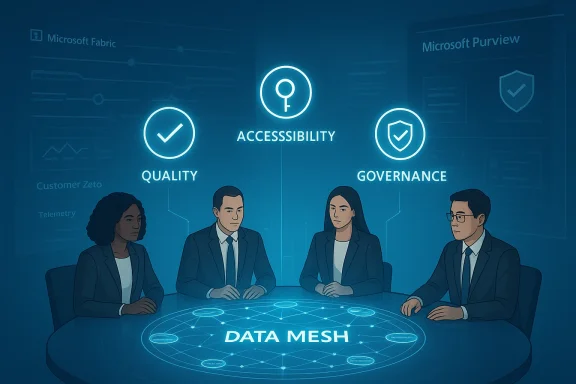
Quality means the data must be complete, accurate, and reliable enough for both humans and machines to use. Accessibility means employees can find and use the data they need without compromising security. Governance means the organization can enforce privacy, compliance, and ethical boundaries consistently across the enterprise. Together, these dimensions create the minimum viable foundation for AI at scale.
The company says Microsoft Purview helps oversee attributes and monitor fidelity, including standards for accuracy and completeness. That gives quality a measurable operational shape rather than leaving it to informal judgment. In enterprise AI, that kind of measurement is crucial because it turns “trust the data” into a visible, auditable practice.
This is where the article becomes especially relevant to real-world enterprise IT. The promise is not just that data is “available,” but that it is discoverable, secure, and connected across domains. That distinction matters because AI agents and analytics tools are only as useful as the systems they can search, query, and trust.
The result is a more nuanced definition of access. It is not open access, and it is not locked-down access. It is governed access, where employees can work confidently because policy and platform design already handle the risk in the background. That is much closer to how modern enterprises need to operate.
Purview’s role is to automate discovery, classification, and protection of sensitive data. In other words, the council is not relying on manual review and human memory to keep the enterprise safe. It is building a system in which controls are embedded into the workflow itself, which is the only realistic way to govern data at Microsoft scale.
That framing also reflects a broader industry lesson: the organizations that move fastest with AI are usually not the ones with the most data, but the ones with the best data operating model. A data mesh lets Microsoft preserve local knowledge while ensuring interoperability. That is especially useful when different business domains need different data shapes but still want shared governance and shared trust.
That approach reduces ambiguity. Instead of asking which team might know something about a table or report, consumers can look to the product owner, metadata, and governance signals. In an AI environment, that clarity matters because it lets agents validate freshness, schema, and eligibility before they act.
It also creates a healthier political economy inside the enterprise. When teams retain ownership, they are more likely to care about data quality, completeness, and lifecycle management. That is valuable because data quality problems usually persist when nobody feels personally responsible for fixing them.
That combination matters because architecture and governance have historically lived in separate conversations. Microsoft is trying to collapse that divide. The platform is not just where data resides; it is where policy, trust, and usability are operationalized.
That has obvious strategic benefits. A unified platform reduces duplication, lowers integration overhead, and makes it easier to support AI workloads that need consistent, governed access to enterprise data. It also makes the enterprise easier to observe, which is crucial when you are measuring reliability and readiness.
The important implication is that governance can scale only if it is built into the platform. Manual review cannot keep up with the speed of AI-enabled development, especially when new datasets and use cases appear constantly. Purview’s value is that it helps turn governance from an occasional event into a continuous process.
That idea matters because discovery is the point where governance becomes usable. A data policy that nobody can navigate is not a working policy. A catalog that exposes ownership, trust signals, schema, and freshness turns abstract standards into actionable behavior.
That dual-use design is especially important in the era of agentic AI. An agent cannot operate responsibly if it is blind to freshness, schema changes, or usage restrictions. The catalog becomes a necessary bridge between human intent and machine action.
That is why Microsoft’s framing is so compelling. It is not saying “catalogs are useful.” It is saying catalogs are the mechanism through which enterprise data becomes operationally visible to both people and AI. In a world of fragmented data estates, that is a significant advantage.
This is not simply about being an early adopter. It is about using the internal enterprise as a proving ground for platforms and policies. In a company as large as Microsoft, that can shape product direction in ways that are much more credible than abstract roadmap promises.
This is also a smart internal influence strategy. Rather than filing feature requests in isolation, the council can speak as a unified enterprise voice. That increases the odds that roadmap priorities reflect actual operational pain points rather than just feature enthusiasm.
This is especially important for large enterprises that need proof, not slogans. They want to know whether a data governance model survives real adoption, real policy friction, and real security constraints. The Customer Zero approach suggests Microsoft is aware that credibility must be earned operationally.
The article’s strongest cultural argument is that teams need to understand how data powers AI systems if they are going to use those systems responsibly. Training is therefore not a side activity. It is part of the operating model.
The company also references courses on data concepts and the extensibility of AI tools like Microsoft 365 Copilot, along with data products such as Purview and Fabric. That suggests the council is trying to create a common language across engineering, operations, and business functions. In a large enterprise, shared vocabulary is not trivial; it reduces friction and makes cross-functional collaboration much easier.
The company’s language about applying skills in real AI scenarios is particularly strong. It suggests Microsoft wants training to translate directly into outcomes, not remain a slide-deck exercise. That is a much healthier way to think about organizational AI readiness.
The deeper lesson is that data strategy must be treated as an organizational capability, not a project. Projects end. Capabilities compound. That distinction is why councils like this matter: they create persistent decision-making structures that can outlive one product cycle or one AI wave.
The article implies that the council’s leaders are not just approving work; they are championing it. That gives the initiative political durability, which is essential in a company where many teams can claim urgent priorities at once.
That matters because AI readiness is rarely blocked by a single issue. It is usually a chain of small unresolved questions about ownership, access, quality, compliance, and implementation. Cross-functional design shortens that chain.
This is where the story becomes broadly relevant to the market. Many organizations want AI outcomes without investing in the data plumbing that makes those outcomes sustainable. Microsoft’s internal example suggests that if the platform is fragmented, the governance model will be brittle no matter how good the policy looks on paper.
It is also smart about where the enterprise pain actually lives. The article does not pretend that AI failure starts and ends with model choice; it recognizes that poor metadata, weak ownership, and inconsistent controls can break enterprise AI before a user ever sees a result. That is a more mature view of the problem.
There is also a cultural risk. Councils can clarify accountability, but they can also become overly procedural if their processes are not kept light enough to support real work. The article argues against that outcome, but any organization of this size has to guard against governance turning into ceremony.
The next phase will likely hinge on execution details: whether quality metrics are consistently published, whether governance stays automated, whether the catalog remains genuinely useful, and whether employees see the council’s work as enabling rather than slowing their day-to-day tasks. If those pieces hold together, Microsoft will have built something many enterprises still only discuss in theory.
Source: Microsoft Harnessing AI: How a data council is powering our unified data strategy at Microsoft - Inside Track Blog
 Background
For two decades, Microsoft describes its own data journey as a series of trade-offs between control and agility. The earliest model was highly decentralized: teams owned their own data assets, optimized locally, and moved quickly within their own lanes, but often at the cost of consistency and enterprise-wide visibility. That approach produced the familiar enterprise problem of data silos, where different parts of the business could not easily trust, reuse, or compare what they had.The next phase swung the pendulum toward centralization. Microsoft says that centralized data platforms brought standardization, security, and scale, but also introduced distance between the people closest to the business problem and the people controlling the platform. In practice, this often weakens responsiveness and can blur accountability, because domain owners no longer feel fully responsible for the data they create or consume. Microsoft’s current answer is a more balanced model: federated ownership with common guardrails, often described as a data mesh.
That shift is important because it mirrors a broader enterprise realization: AI does not eliminate data governance, it makes governance more consequential. The company argues that if data is not discoverable, reliable, and responsibly managed, then AI systems will only scale confusion faster. In that sense, the council is not merely administrative; it is a response to the realities of modern AI, where poor metadata, unclear ownership, and inconsistent quality can undermine everything from analytics to agentic workflows.
Microsoft also places the council inside a larger enterprise maturity narrative, one tied to what it calls the Frontier Firm. That language signals a broader internal ambition: become an organization that can support interconnected analytics, AI at scale, and product-level learning loops across the enterprise. The council therefore sits at the intersection of platform engineering, compliance, employee enablement, and business strategy, which is exactly where the hardest data problems now live.
There is a second context worth noting. Microsoft is not talking about data governance in the abstract; it is describing a live operating environment where Microsoft Fabric, Microsoft Purview, Microsoft 365 Copilot, and other enterprise systems must work together under real-world constraints. That gives the story an unusually practical edge. Instead of positioning governance as a back-office control, Microsoft is presenting it as the substrate on which trusted AI depends.
Why the Data Council Exists
The council exists because the old model of “every team manages its own data” stops working once AI becomes central to decision-making. Microsoft says its goal is to establish a cohesive data strategy across Microsoft Digital, so analytics and AI can function as an enterprise capability rather than a collection of isolated projects. That matters because AI systems thrive on reusable, well-described, well-protected data products, not on scattered one-off datasets.The council is also explicitly cross-functional. Microsoft says it includes representation from Microsoft Digital, CELA, and Finance, which is a signal that it understands governance as more than a technical concern. The inclusion of legal and financial voices suggests the company sees AI readiness as a mixture of policy, risk management, spend discipline, and operational fit, not simply platform modernization.
Governance as a business capability
One of the strongest themes in the article is that governance is not a brake when it is embedded into the system correctly. Microsoft argues that the council helps transform enterprise data into a strategic capability by ensuring the organization can trust what it uses, understand where it came from, and enforce rules consistently. That is an important distinction because too many firms still treat governance as a gatekeeping function that slows innovation.In Microsoft’s model, the council is not simply reviewing policies after the fact. It is shaping the conditions under which AI can be deployed safely in the first place. That means the council sits upstream of both analytics and agentic systems, influencing how data is packaged, validated, and exposed for reuse.
The practical benefit is speed with confidence. When business and technical teams know that data products have clear ownership, quality standards, and policy controls, they can move faster without re-litigating the basics every time a new AI use case appears. In a large enterprise, that can be the difference between scaling a successful pilot and getting trapped in endless review cycles.
Why cross-functional representation matters
A data council without legal, finance, and engineering participation often becomes too narrow to be useful. Microsoft’s structure suggests it is trying to avoid that trap by making decisions in a forum that can actually resolve conflicts among compliance, cost, platform design, and business demand. That is especially important for AI, where the same dataset may raise performance, privacy, and budget questions at once.The council also reflects a subtle but important shift in enterprise operating models: the people closest to the data should help define its rules, while shared platforms should enforce those rules at scale. That balance is what makes the data mesh approach appealing. It preserves local context without reintroducing chaos, and it keeps central control from becoming a bottleneck.
The Three Pillars: Quality, Accessibility, and Governance
Microsoft structures the council’s work around three core dimensions: quality, accessibility, and governance. Those are not novel terms, but the article’s point is that AI makes them inseparable. If one of them fails, the others cannot carry the load alone.Quality means the data must be complete, accurate, and reliable enough for both humans and machines to use. Accessibility means employees can find and use the data they need without compromising security. Governance means the organization can enforce privacy, compliance, and ethical boundaries consistently across the enterprise. Together, these dimensions create the minimum viable foundation for AI at scale.
Why quality now matters more than ever
AI systems do not simply “consume data”; they amplify whatever assumptions the underlying data contains. If the data is stale, incomplete, or inconsistently labeled, the downstream model or agent may still produce a confident answer, but it will not necessarily be a correct one. That is why Microsoft’s emphasis on quality is so central: it is a recognition that model output quality cannot exceed input quality by much.The company says Microsoft Purview helps oversee attributes and monitor fidelity, including standards for accuracy and completeness. That gives quality a measurable operational shape rather than leaving it to informal judgment. In enterprise AI, that kind of measurement is crucial because it turns “trust the data” into a visible, auditable practice.
Accessibility without exposing the enterprise
Accessibility is where many organizations get stuck. Employees want fast access to data, but security teams want to avoid accidental exposure, uncontrolled duplication, and untracked use. Microsoft’s answer is to unify siloed data in a mesh-like structure with Microsoft Fabric while using Purview to democratize access responsibly.This is where the article becomes especially relevant to real-world enterprise IT. The promise is not just that data is “available,” but that it is discoverable, secure, and connected across domains. That distinction matters because AI agents and analytics tools are only as useful as the systems they can search, query, and trust.
The result is a more nuanced definition of access. It is not open access, and it is not locked-down access. It is governed access, where employees can work confidently because policy and platform design already handle the risk in the background. That is much closer to how modern enterprises need to operate.
Governance as an operating layer
Microsoft frames governance as a combination of policy, privacy, security, and ethical AI usage. It explicitly ties this to regulatory obligations such as GDPR and CDPA, which reinforces the point that enterprise AI now lives inside a demanding compliance environment. That means governance is no longer optional or symbolic; it is a prerequisite for scaled deployment.Purview’s role is to automate discovery, classification, and protection of sensitive data. In other words, the council is not relying on manual review and human memory to keep the enterprise safe. It is building a system in which controls are embedded into the workflow itself, which is the only realistic way to govern data at Microsoft scale.
Data Mesh and the Federalized Enterprise
Microsoft’s embrace of a data mesh mindset is one of the most interesting parts of the piece. The company is effectively arguing that neither rigid centralization nor free-for-all decentralization can satisfy the demands of AI-era enterprise data. The answer is a federated model where domains own products, but common standards keep the system coherent.That framing also reflects a broader industry lesson: the organizations that move fastest with AI are usually not the ones with the most data, but the ones with the best data operating model. A data mesh lets Microsoft preserve local knowledge while ensuring interoperability. That is especially useful when different business domains need different data shapes but still want shared governance and shared trust.
What “data products” really mean
Microsoft says domain teams publish data as well-defined, discoverable products. This is more than a branding exercise. It means each dataset should have clear ownership, documented semantics, and predictable interfaces so that both people and automated systems can use it safely.That approach reduces ambiguity. Instead of asking which team might know something about a table or report, consumers can look to the product owner, metadata, and governance signals. In an AI environment, that clarity matters because it lets agents validate freshness, schema, and eligibility before they act.
How the model changes accountability
The article’s implied critique of older central models is that they often remove ownership from the people who understand the data best. A data mesh corrects that by pushing responsibility back to the domain while preserving shared infrastructure. In theory, that yields both stronger accountability and better responsiveness.It also creates a healthier political economy inside the enterprise. When teams retain ownership, they are more likely to care about data quality, completeness, and lifecycle management. That is valuable because data quality problems usually persist when nobody feels personally responsible for fixing them.
The practical upside
- Faster response to business changes.
- Better alignment between data and the teams who know it best.
- Shared standards without suffocating local autonomy.
- Easier interoperability between AI and analytics systems.
- Stronger resilience against data sprawl and duplication.
The Role of Microsoft Fabric and Purview
Microsoft treats Fabric and Purview as the practical backbone of the strategy. Fabric provides the unified analytics and data integration environment, while Purview supplies governance, discovery, and protection. Together, they represent the company’s answer to the perennial question of how to make enterprise data usable without making it unsafe.That combination matters because architecture and governance have historically lived in separate conversations. Microsoft is trying to collapse that divide. The platform is not just where data resides; it is where policy, trust, and usability are operationalized.
Fabric as the unification layer
The article says Fabric allows Microsoft to unify siloed data in a single mesh that supports advanced analytics, data science, and visualization. This is significant because it suggests the company is using a modern analytics stack to tame the complexity created by years of organic growth. Instead of asking every team to build its own pipeline, Microsoft wants a shared environment that can scale across domains.That has obvious strategic benefits. A unified platform reduces duplication, lowers integration overhead, and makes it easier to support AI workloads that need consistent, governed access to enterprise data. It also makes the enterprise easier to observe, which is crucial when you are measuring reliability and readiness.
Purview as the control plane
Purview appears throughout the article as the mechanism that makes data usable without making it wild. Microsoft uses it to oversee quality attributes, enforce standards, and automate sensitive-data discovery and protection. That positions Purview less as a compliance checkbox and more as a control plane for the enterprise data estate.The important implication is that governance can scale only if it is built into the platform. Manual review cannot keep up with the speed of AI-enabled development, especially when new datasets and use cases appear constantly. Purview’s value is that it helps turn governance from an occasional event into a continuous process.
Discovery for Humans and AI
One of the most forward-looking sections of the article is the discussion of the data catalog as a common discovery layer. Microsoft says the catalog must serve both humans and AI systems, which is a subtle but important evolution in enterprise information architecture. The question is no longer just whether a person can find a dataset, but whether an AI agent can find, validate, and reason over it safely.That idea matters because discovery is the point where governance becomes usable. A data policy that nobody can navigate is not a working policy. A catalog that exposes ownership, trust signals, schema, and freshness turns abstract standards into actionable behavior.
What the catalog provides
For business users, the catalog offers intuitive search, ownership transparency, and trust indicators. That supports self-service analytics, which is still one of the main promises of modern data platforms. For AI agents, the same catalog exposes machine-readable metadata so they can programmatically identify canonical datasets and respect governance constraints.That dual-use design is especially important in the era of agentic AI. An agent cannot operate responsibly if it is blind to freshness, schema changes, or usage restrictions. The catalog becomes a necessary bridge between human intent and machine action.
Why discovery is now a competitive issue
Discovery used to be an internal usability problem. Now it is a competitive one. Organizations that can locate trustworthy data quickly will build better copilots, better analytics, and better internal automation. Those that cannot will spend more time arguing about definitions than extracting value.That is why Microsoft’s framing is so compelling. It is not saying “catalogs are useful.” It is saying catalogs are the mechanism through which enterprise data becomes operationally visible to both people and AI. In a world of fragmented data estates, that is a significant advantage.
Customer Zero and Enterprise Readiness
Microsoft’s Customer Zero model gives the story its most practical edge. The company says Microsoft Digital operates its own enterprise solutions under real-world conditions so customers do not have to absorb the same trial-and-error risk. That means Microsoft can generate telemetry, refine product readiness, and surface blockers before they reach external customers.This is not simply about being an early adopter. It is about using the internal enterprise as a proving ground for platforms and policies. In a company as large as Microsoft, that can shape product direction in ways that are much more credible than abstract roadmap promises.
Telemetry as product feedback
The article makes a strong point that engaging product teams with real telemetry turns theory into execution. That matters because enterprise readiness is often where promising AI systems fail: not in demos, but in the messy details of permissions, lineage, freshness, and compliance. Microsoft is using the council to bring those realities into product discussions earlier.This is also a smart internal influence strategy. Rather than filing feature requests in isolation, the council can speak as a unified enterprise voice. That increases the odds that roadmap priorities reflect actual operational pain points rather than just feature enthusiasm.
Why this matters to customers
For customers, the main takeaway is that Microsoft is trying to make its own house the reference architecture. If the company can show that Purview, Fabric, Copilot, and its governance model work together under pressure, that reduces buyer risk. It also gives Microsoft more credibility when it recommends the same stack to others.This is especially important for large enterprises that need proof, not slogans. They want to know whether a data governance model survives real adoption, real policy friction, and real security constraints. The Customer Zero approach suggests Microsoft is aware that credibility must be earned operationally.
- Product readiness improves when internal usage exposes flaws early.
- Real telemetry helps prioritize roadmap work.
- Enterprise voices can surface blockers faster than isolated teams.
- Shared patterns reduce duplication across business units.
- Customers benefit when Microsoft proves the stack on itself first.
Building Data Culture, Not Just Data Infrastructure
Microsoft is careful to say the council’s work is not limited to tools and policies. It also includes curriculum, certifications, and community programs designed to advance data literacy and AI capability across the organization. That is significant because infrastructure alone does not create good data culture; people do.The article’s strongest cultural argument is that teams need to understand how data powers AI systems if they are going to use those systems responsibly. Training is therefore not a side activity. It is part of the operating model.
From literacy to capability
Microsoft says it has evolved from teaching people about data to enabling them to apply data to build, operate, and govern intelligent solutions. That is a meaningful shift. Literacy is about comprehension, but capability is about execution, which is what enterprise AI really needs.The company also references courses on data concepts and the extensibility of AI tools like Microsoft 365 Copilot, along with data products such as Purview and Fabric. That suggests the council is trying to create a common language across engineering, operations, and business functions. In a large enterprise, shared vocabulary is not trivial; it reduces friction and makes cross-functional collaboration much easier.
Why culture is the hard part
Technology can be purchased. Culture has to be practiced. If employees do not understand why data quality matters, or if they do not trust the governance model, the best platform in the world will still underperform. Microsoft’s focus on certification and community engagement is an acknowledgment of that reality.The company’s language about applying skills in real AI scenarios is particularly strong. It suggests Microsoft wants training to translate directly into outcomes, not remain a slide-deck exercise. That is a much healthier way to think about organizational AI readiness.
Lessons Learned From the Council
Microsoft closes with a set of lessons that read like a playbook for any large enterprise thinking about AI governance. The first is that executive sponsorship matters. The second is that cross-functional collaboration accelerates impact. The third is that modern platforms make scalable productivity possible. None of that is surprising, but it is useful because it comes from a system operating at Microsoft scale.The deeper lesson is that data strategy must be treated as an organizational capability, not a project. Projects end. Capabilities compound. That distinction is why councils like this matter: they create persistent decision-making structures that can outlive one product cycle or one AI wave.
Executive sponsorship as a force multiplier
Microsoft says leadership provides support, reinforcement, and clarity around competing priorities. That sounds simple, but in practice it is often the difference between policy adoption and policy theater. Without sponsorship, governance efforts tend to lose momentum as soon as they encounter friction.The article implies that the council’s leaders are not just approving work; they are championing it. That gives the initiative political durability, which is essential in a company where many teams can claim urgent priorities at once.
Cross-functional collaboration as an accelerant
A council with diverse representation can see problems earlier and negotiate trade-offs more intelligently. That is especially useful where legal, finance, and engineering interests intersect. Microsoft’s description suggests the council functions as a coordination mechanism as much as a governance body.That matters because AI readiness is rarely blocked by a single issue. It is usually a chain of small unresolved questions about ownership, access, quality, compliance, and implementation. Cross-functional design shortens that chain.
Modern platforms as the enabler
Microsoft’s final lesson is that the architecture itself must support the strategy. Purview and Fabric are not optional add-ons; they are the systems that make governance, discovery, and analytics work at scale. Without them, the council would be forced back into manual control and endless exceptions.This is where the story becomes broadly relevant to the market. Many organizations want AI outcomes without investing in the data plumbing that makes those outcomes sustainable. Microsoft’s internal example suggests that if the platform is fragmented, the governance model will be brittle no matter how good the policy looks on paper.
Strengths and Opportunities
Microsoft’s approach has several notable strengths. It treats data governance as a strategic enabler, not a bureaucratic hurdle. It also aligns platform modernization, employee learning, and AI readiness into a single operating model. That coherence is one of the main reasons the council feels more substantial than a typical internal committee.It is also smart about where the enterprise pain actually lives. The article does not pretend that AI failure starts and ends with model choice; it recognizes that poor metadata, weak ownership, and inconsistent controls can break enterprise AI before a user ever sees a result. That is a more mature view of the problem.
- Clear enterprise ownership across business and technical domains.
- Automated governance that scales better than manual review.
- A federated model that balances autonomy and control.
- Better discovery for both people and AI agents.
- Stronger internal credibility through Customer Zero execution.
- Employee learning pathways that connect skills to real use cases.
- Improved product feedback loops from real-world telemetry.
Risks and Concerns
The biggest risk is that the model becomes too dependent on the platforms and processes Microsoft already prefers. If governance is too tightly coupled to a specific stack, flexibility can suffer and innovation may become constrained by platform assumptions. That is a familiar enterprise trade-off, and it is worth watching.There is also a cultural risk. Councils can clarify accountability, but they can also become overly procedural if their processes are not kept light enough to support real work. The article argues against that outcome, but any organization of this size has to guard against governance turning into ceremony.
- Platform lock-in if the strategy becomes too tightly bound to one ecosystem.
- Process sprawl if governance reviews multiply faster than business needs.
- Uneven adoption across teams with different maturity levels.
- Data quality blind spots if measurement is incomplete or lagging.
- Shadow AI usage if employees work around formal controls.
- False confidence if “governed” data is assumed to be automatically correct.
- Cultural fatigue if training and certification feel disconnected from daily work.
Looking Ahead
The most important question now is not whether Microsoft has the right vocabulary for modern data strategy. It clearly does. The question is whether the council can sustain operational discipline as AI usage expands deeper into business workflows, copilots, analytics, and agentic scenarios. That will determine whether this becomes a durable model or just a polished internal narrative.The next phase will likely hinge on execution details: whether quality metrics are consistently published, whether governance stays automated, whether the catalog remains genuinely useful, and whether employees see the council’s work as enabling rather than slowing their day-to-day tasks. If those pieces hold together, Microsoft will have built something many enterprises still only discuss in theory.
- Continued expansion of AI-ready data products.
- More visible use of enterprise-quality metrics.
- Deeper integration between governance and AI tooling.
- Broader employee certification and skills pathways.
- Stronger product feedback loops from Customer Zero telemetry.
Source: Microsoft Harnessing AI: How a data council is powering our unified data strategy at Microsoft - Inside Track Blog
