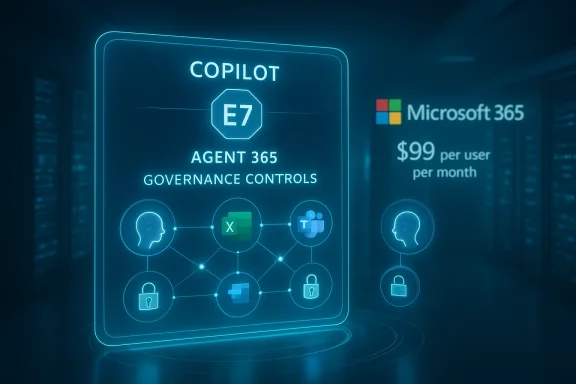
Microsoft’s internal deliberations over an “E7” Microsoft 365 bundle — a premium, AI-packed suite that could combine Microsoft Copilot, a forthcoming “Agent 365” hub, and other advanced services — have surfaced in multiple market reports this week, and the implications for enterprise IT, procurement, and the vendor landscape are large, immediate, and worth a careful read.
For years Microsoft has experimented with layering advanced security, compliance, and management features on top of its core Microsoft 365 suites. The rumored E7 package represents the next logical step: a high-end, AI-first SKU that would consolidate Copilot-level intelligence, lifecycle management for AI agents, and enterprise-grade control into a single, premium subscription. Contemporary reporting suggests Microsoft is again discussing this plan internally after shelving similar plans previously, and the price being discussed in the market is eye-catching — up to $99 per user per month in some scenarios. If true, that would place E7 well above current enterprise list pricing for Microsoft 365 E5 and the existing Copilot add-ons.
Multiple outlets have independently reported that the package under consideration would fold in Microsoft Copilot capabilities and a new agent management layer often described as Agent 365, alongside more traditional E5 capabilities. The news arrives in the context of Microsoft’s continuing effort to monetize enterprise AI, streamline Copilot packaging, and respond to competitive moves from other cloud and AI vendors.
At present, the E7 story should be treated as a credible market-level development but not as a confirmed product offering. The reported $99 per-user-per-month figure in market coverage is a powerful headline and should be handled cautiously — it is a planning number until Microsoft provides formal SKU and pricing documentation.
For organizations, the right posture is proactive but measured:
Source: TipRanks Microsoft weighs releasing AI-loaded software bundle for 365, BI says - TipRanks.com
 Background
For years Microsoft has experimented with layering advanced security, compliance, and management features on top of its core Microsoft 365 suites. The rumored E7 package represents the next logical step: a high-end, AI-first SKU that would consolidate Copilot-level intelligence, lifecycle management for AI agents, and enterprise-grade control into a single, premium subscription. Contemporary reporting suggests Microsoft is again discussing this plan internally after shelving similar plans previously, and the price being discussed in the market is eye-catching — up to $99 per user per month in some scenarios. If true, that would place E7 well above current enterprise list pricing for Microsoft 365 E5 and the existing Copilot add-ons.Multiple outlets have independently reported that the package under consideration would fold in Microsoft Copilot capabilities and a new agent management layer often described as Agent 365, alongside more traditional E5 capabilities. The news arrives in the context of Microsoft’s continuing effort to monetize enterprise AI, streamline Copilot packaging, and respond to competitive moves from other cloud and AI vendors.
Why this matters now
Microsoft’s moves here are not incremental; they aim at the center of how organizations buy productivity software. A premium E7 SKU would:- Reshape total cost of ownership for Microsoft environments that plan to adopt AI broadly.
- Change the calculus for third-party tools and specialized AI vendors.
- Force IT and procurement teams to re-evaluate license portfolios, renewals, and negotiation strategies.
- Raise urgent questions about governance, compliance, and operational controls for AI agents that act on enterprise data.
Overview of the rumor and what’s verified
- The central claim: Microsoft is weighing an “E7” Microsoft 365 bundle that would be a higher-priced, AI-heavy successor/companion to E5. The package being discussed reportedly includes Microsoft Copilot and an AI agent hub named Agent 365. These details come from multiple industry reports that cite people familiar with Microsoft’s strategy.
- Reported pricing: Up to $99 per user per month is being discussed in market reporting. That price point contrasts with recent list prices for enterprise suites and Copilot add-ons and would represent a meaningful premium.
- What is verified independently: Microsoft has been actively reorganizing and simplifying Copilot packaging, and it has rolled different Copilot specialties (Sales, Service, Finance) into consolidated Copilot offerings in recent product updates. Copilot business/enterprise pricing tiers already exist in the market. Microsoft has also been developing agent tooling — sometimes referred to in public reporting as Agent 365 or an “agent hub” — to manage programmable AI agents and the governance around them.
- What remains unverified or speculative: The final scope of E7, precise price points, the launch timetable, and how Microsoft will carve features between existing E3/E5 and any new E7 SKU. The $99 figure and the exact inclusion list should be treated as rumor-level reporting until Microsoft makes a formal announcement.
A short history: Microsoft’s AI packaging so far
Copilot, tiers, and recent pricing moves
Microsoft introduced Copilot capabilities as paid add-ons to Microsoft 365 and later launched dedicated Copilot tiers for small business and enterprise customers. In recent months, Microsoft consolidated several specialized Copilots (for Sales, Service, Finance) into more unified Copilot offerings, and revised how those capabilities are priced and bundled. There are multiple Copilot SKUs — from SMB-focused, more affordable offerings to full enterprise Copilot priced per user — and some price adjustments and bundling have been used to accelerate adoption.The agent story
The concept of AI agents — persistent, task-oriented automations that combine model-driven reasoning with connectors to enterprise systems — has been central to many vendors’ long-term plans. Microsoft’s agent tooling initiative aims to let organizations create, manage, and secure those agents within the Microsoft 365 ecosystem. Agent management is materially different from a point Copilot query: it involves lifecycle management, permissions, data access rules, observability, and audit trails.What E7 could include — educated reconstruction
While no official spec exists, the probable components of a premium E7 bundle, based on current Microsoft product architecture and reported aims, would include:- Microsoft 365 E5 baseline features — the existing security, compliance, and management stack that large enterprises value.
- Microsoft Copilot (enterprise tier) — full integration across Word, Excel, PowerPoint, Outlook, Teams, and enterprise data sources.
- Agent 365 / Agent management console — tools to create, deploy, monitor, and decommission AI agents, with permissions, data handling controls, and governance policies.
- Copilot Studio / developer and admin tooling — enhanced no-code and pro-code tools for building custom agents and workflows.
- Expanded governance and data loss prevention (DLP) for agents — enterprise controls to limit agent actions, data exfiltration, and API access.
- Expanded model options or model credits — hybrid pricing that might combine per-seat fees and usage-based “credits” for heavy model inference or specialized models (e.g., multimodal models or partner models).
- Priority enterprise support and SLA guarantees — faster incident response or higher availability SLAs for AI features.
Strategic analysis: Strengths of an E7 approach
- Simplicity for buyers
A single premium SKU that combines productivity apps, Copilot, and agent management reduces the need for multiple contracts and licensing lines, simplifying procurement for organizations wanting a turnkey AI solution. - Friction reduction for IT adoption
Pre-bundled governance and agent tooling can reduce friction for IT teams that previously had to stitch together disparate products, third-party tools, and custom automation. - Monetization aligned with value
If Microsoft can deliver materially higher productivity and automation value, a premium price is defensible. Enterprises that save thousands of staff hours via integrated AI could view per-seat premiums as a net benefit. - Centralized security model
When agent lifecycle, access control, and DLP are native to the platform, enterprises can gain stronger, centralized controls versus ad hoc integrations with external AI tools. - Competitive positioning
Bundling advanced AI widely into Microsoft 365 puts pressure on competing productivity and AI vendors. For customers already deeply invested in M365, the incremental lock-in is a strong retention lever.
Risks and downsides — what IT teams must consider
- Pricing shock and budget impact
A $99-per-user-per-month SKU would dramatically raise license bills. For organizations with thousands of licenses, the year-over-year bill increase is potentially enormous and could force difficult tradeoffs. - Potential for cannibalization and confusion
Microsoft already has multiple Copilot SKUs and standalone AI offerings. Introducing E7 could create packaging overlap, complicating renewals and making it harder for procurement to compare apples to apples. - Vendor lock-in escalation
The more functionality Microsoft bundles natively — especially agent orchestration tightly coupled to M365 data planes — the harder it becomes for organizations to adopt neutral or multi-cloud AI strategies. - Governance complexity and false security
Tooling labelled “governance” does not automatically imply safe behavior. Organizations still need mature processes, staff, and audits. Relying solely on vendor-provided governance layers risks complacency. - Operational and cost unpredictability (usage-based components)
If E7 pricing mixes per-seat fees with usage-based credits for model inference, finance teams will face variable costs that are hard to forecast. - Regulatory and data residency concerns
Enterprises in regulated industries will need to validate how agent actions, model training, and telemetry comply with laws (data protection, export controls, sector-specific regulation). Bundled AI may increase scrutiny from compliance teams. - Model provenance and multi-vendor models
Using third-party models (e.g., Anthropic, OpenAI) inside Copilot-style experiences raises questions about model updates, performance variability across tasks, and contractual SLAs tied to model vendors that Microsoft may or may not be able to control.
Likely business scenarios and their implications
Below are three plausible ways Microsoft might roll an E7 offering out, with implications for IT buyers.- Scenario A — Conservative: E7 as an add-on bundle for large enterprises
- Microsoft launches E7 as an optional add-on to E5 customers who want agent capabilities and premium Copilot features.
- Implication: Existing E5 customers have a path for staged adoption; procurement can opt in selectively. Less disruption, slower revenue upside for Microsoft.
- Scenario B — Aggressive: Reprice and reposition, pushing AI into the suite
- Microsoft repackages tiers, moving substantial capabilities into a new, higher-priced suite and nudging customers toward E7 for future AI features.
- Implication: Strong price pressure; many customers will renegotiate or consider third-party alternatives. Large enterprises could save money by carefully segmenting seats and using mixed licensing.
- Scenario C — Hybrid: Per-seat base plus usage credits for heavy agent workloads
- Microsoft introduces a two-part model: a guaranteed per-seat fee for baseline Copilot/agent features and usage credits for intensive agent orchestration or advanced multimodal models.
- Implication: Predictability for light users, open-ended costs for heavy automation use cases. Requires new chargeback and governance processes.
Practical steps IT leaders should take now
If you manage procurement, licensing, or AI governance for your organization, begin planning now:- Inventory your current Microsoft estate.
- Determine who has E3, E5, which Copilot SKUs, and where third-party integrations exist.
- Map sensitive data sources and workflows that could be exposed to agent activity.
- Create a license segmentation plan.
- Identify which users absolutely need full Copilot/agent capabilities and which users can remain on lower tiers.
- Use role-based segmentation to avoid paying per-seat premiums universally.
- Pilot governance controls.
- Build policies for agent approval, least-privilege access, logging, and audit trails.
- Consider a “safe list” of agent templates and a central approval board for production use.
- Prepare procurement strategies.
- Open dialogues with resellers and Microsoft account teams about staged rollouts, caps on usage-based costs, and volume discounts.
- Get renewal timelines in a calendar to avoid sticker-shock mid-term.
- Run legal and compliance checks.
- Ask vendors for model provenance, data handling descriptions, and SOC/ISO attestations that cover agent telemetry and model training.
- Start a TCO model for E7 scenarios.
- Build cost models that include seat counts, expected usage credits, Azure compute costs (if relevant), and estimated productivity gains.
- Run sensitivity analyses for various adoption levels.
Governance checklist for buying AI-first bundles
- Define permitted agent actions and data scopes before deployment.
- Require role-based access controls and approval workflows for agent creation.
- Enforce immutable audit logs for agent activity and data exfiltration attempts.
- Implement DLP and contextual data filtering tied to agent requests.
- Establish an incident response playbook specific to agent misbehavior (hallucinations, leaks, unauthorized actions).
- Require contractual obligations for model change notifications, performance regressions, and data retention rules.
- Run periodic red-team testing of agents and their connectors.
Impact on Microsoft's partner ecosystem and ISVs
A premium E7 SKU could benefit some partners and pressure others:- Managed Service Providers (MSPs) and Systems Integrators: Opportunity to offer migration, governance, and agent lifecycle services to customers adopting E7.
- Independent Software Vendors (ISVs) offering specialized automation: Risk of displacement if Microsoft provides built-in, high-quality agent templates and connectors.
- Security vendors: Opportunity to integrate richer telemetry and compliance tooling, but also pressure to interoperate deeply with Microsoft’s native governance APIs.
Financial markets and investor implications
Speculative reports of a premium E7 SKU are likely to influence investor sentiment in two ways:- Positive: If Microsoft can successfully monetize enterprise AI at higher price points without triggering churn, the revenue upside is substantial and strategically defensible.
- Negative: If customers react to high prices by delaying purchases, migrating to mixed providers, or demanding significant discounts, Microsoft could see margin pressure in sales and longer sales cycles.
Technical deep-dive: What Agent 365 (or similar) must deliver to be credible
To justify a premium and to be trusted inside enterprise environments, Agent 365-style tooling must deliver:- Fine-grained identity & access — agents should act as principals with specific, auditable permissions.
- Context-aware data access — agents must only access the minimal data required for their tasks; context isolation is crucial.
- Observable behavior — telemetry and explainability features that allow admins to replay actions and rationales.
- Runtime sandboxing — limit cross-tenant or cross-service lateral movement from agent executions.
- Governed model selection — ability to pin agents to specific, validated model versions; model change management tooling.
- Human-in-the-loop controls — for high-risk actions require signoff or approval workflows.
What to watch for next — signals that an E7 is coming
- Microsoft’s public product roadmap and Ignite announcements mentioning Agent 365, unified Copilot bundles, or new enterprise SKUs.
- Changes in Microsoft 365 commercial price lists or new SKU announcements tied to AI governance features.
- Partner communications and early-access programs that provide hands-on previews of agent management tooling.
- Microsoft documentation describing new governance, compliance, and DLP controls specifically for agents.
Final assessment
Microsoft’s deliberations over an E7 bundle reflect a strategic moment: the company is trying to convert the productivity promise of AI into a monetized, enterprise-ready platform. The strengths of such an approach are obvious: convenience, centralized governance, and a clear path for organizations that want to operationalize AI at scale. But the risks are just as concrete: material price increases, licensing complexity, potential lock-in, governance gaps, and unpredictable usage-based costs.At present, the E7 story should be treated as a credible market-level development but not as a confirmed product offering. The reported $99 per-user-per-month figure in market coverage is a powerful headline and should be handled cautiously — it is a planning number until Microsoft provides formal SKU and pricing documentation.
For organizations, the right posture is proactive but measured:
- Inventory, segment, and pilot before you buy.
- Strengthen governance and audit before you scale agent use.
- Treat E7-like offerings as part of an overall automation and vendor-lock strategy, not as an automatic upgrade path.
Source: TipRanks Microsoft weighs releasing AI-loaded software bundle for 365, BI says - TipRanks.com