

Edge Won the Argument Before Microsoft Entered the Room
The original insult was easy social-media bait. A Mac user sees Microsoft Edge’s download page for macOS, asks what sort of person would use it on Apple hardware, and waits for the usual derision to arrive. The expected script is familiar: Microsoft product, Apple audience, pile-on.
Instead, the replies turned into something more interesting. Mac users defended Edge not as a lifestyle choice, but as a tool. They talked about RAM consumption, Chromium compatibility, extension support, profile sync, enterprise policy, and the simple reality that many people already use Microsoft 365, Teams, Outlook, OneDrive, and VS Code on Macs every day.
That matters because Edge’s reputation still lags behind its product reality. The browser inherited decades of Internet Explorer baggage, then spent the early Windows 10 years as a half-finished Microsoft platform bet, then re-emerged in 2020 as a Chromium browser. The result is a product that is often technically competent, sometimes genuinely excellent, and almost always dragged down by the company’s compulsion to meddle with it.
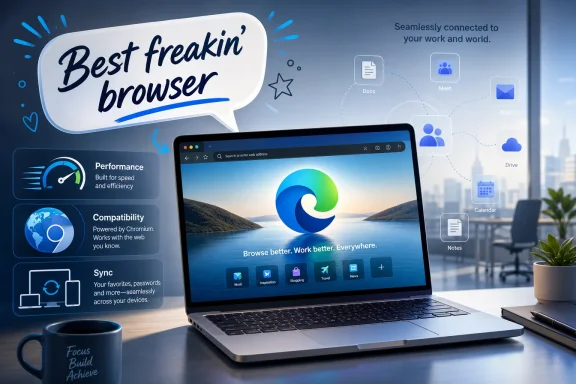
Microsoft’s “Best freakin’ browser” reply worked because it did not sound like a product manager’s slide. It sounded like a company briefly noticing that users had already made the case for it. For once, Microsoft did not have to tell people Edge was good; it merely had to point at the people saying it.
The Mac Is No Longer a Microsoft-Free Zone
The old Mac-versus-PC divide is a useful cultural fossil, but it does not describe how people actually work in 2026. A MacBook can be an Apple device, a Microsoft 365 endpoint, a GitHub and VS Code workstation, a Teams terminal, and a browser-based enterprise desktop all at once. The browser in that environment is not a badge of loyalty; it is infrastructure.
That is why Edge on Mac makes more sense than the mockery suggests. If a user signs into Outlook, edits documents in Word, joins meetings in Teams, authenticates through Entra ID, and lives inside SharePoint, Edge is not an alien object. It is the browser Microsoft’s ecosystem was built to recognize first.
This does not mean Safari is weak. Safari remains deeply integrated into macOS and, for many users, it is the most battery-friendly and Apple-native browser available. But Safari’s strengths are not universal. Corporate web apps, Chrome extensions, Microsoft identity flows, and admin policy expectations often push users toward Chromium-based browsers, and Edge is the Chromium browser Microsoft can manage most aggressively.
That is the part the viral joke missed. Edge on Mac is not primarily about personal affection for Microsoft. It is about the messy middle of modern computing, where users may prefer Apple hardware while their employer, school, or workflow still runs through Microsoft services.
Performance Is the Defense Users Actually Understand
The most persuasive replies were not philosophical. They were practical. Users said Edge felt fast, used less memory than Chrome, handled tabs well, and delivered Chromium compatibility without Chrome’s worst resource habits.
Some of that is subjective, and browser performance is notoriously dependent on extensions, workloads, battery state, websites, and device memory. But the theme is consistent enough to matter. Microsoft has spent years positioning Edge around performance features such as sleeping tabs, efficiency mode, startup boost, and memory-saving behavior. Those are not glamorous features, but on a MacBook with dozens of tabs, they are exactly the kind of features users notice.
Sleeping tabs, in particular, show why Edge has a real product story. The feature pauses inactive tabs to free system resources, giving Microsoft a simple pitch: keep your tabs, lose some of the memory pressure. Chrome and Safari have their own resource-management improvements, but Edge made tab discipline part of its public identity earlier and more loudly.
The irony is that this is precisely the sort of advantage Microsoft should have marketed with discipline. Instead, Edge’s public image is often dominated by Bing prompts, Windows nagging, Copilot sidebars, and default-browser drama. The browser earns goodwill in daily use, then spends it through the surrounding behavior of the company that ships it.
“Just a Reskinned Chromium” Is Too Easy and Not Quite True
The easiest way to dismiss Edge is to call it Chrome in a Microsoft jacket. There is enough truth in that line to make it stick. Edge is built on Chromium, uses the same broad web platform foundation as Chrome, and benefits from the compatibility work Google’s browser made unavoidable.
But “just a reskin” undersells what Chromium has become. Chromium is not a finished statue that browser vendors merely repaint; it is a giant open-source codebase shaped by many contributors, priorities, regressions, patches, experiments, and platform needs. Microsoft’s move to Chromium was not just surrender to Google’s engine. It was also a decision to put Microsoft engineers into the upstream web platform fight rather than maintaining a separate engine that developers increasingly ignored.
That trade-off still has consequences. The web became less diverse at the engine level when EdgeHTML died, and anyone who cares about browser competition should be uneasy about Chromium’s dominance. But the practical outcome for users was immediate: fewer broken sites, better extension compatibility, and faster parity with the browser most web developers target.
Microsoft has also used Edge to push features that are not simply Chrome clones. Vertical tabs, sleeping tabs, browser-based work profiles, enterprise controls, and Microsoft 365 integration gave Edge a distinct shape. Some users may dislike those choices, but they are choices, not merely a coat of paint.
The real critique is subtler. Edge is not “just Chromium,” but it is trapped inside Chromium’s gravitational field. Its differentiation comes from management, productivity, identity, and Microsoft services layered on top. That can make Edge genuinely useful, especially in organizations, while also making it feel like a browser constantly at risk of becoming a corporate dashboard.
Enterprise Mac Users Were Always the Quiet Edge Constituency
The loudest browser debates happen among consumers, enthusiasts, and platform loyalists. The browser decisions that actually shape fleets of machines often happen somewhere else: endpoint management consoles, compliance meetings, procurement reviews, and help-desk incident patterns. That is where Edge has a built-in advantage.
Microsoft Edge for Business can be managed across Windows and macOS through Microsoft Intune, with policies for configuration, security, data controls, and browser behavior. For an IT department already using Microsoft 365 and Intune, that is not a minor detail. It means Edge can be treated as part of the managed endpoint environment rather than another unmanaged consumer app.
That explains why some Mac users in the viral thread pointed to government and enterprise requirements. A browser can become mandatory not because it is beloved, but because certificate deployment, single sign-on, compliance settings, or internal app testing made it the path of least resistance. In that world, Edge is less a brand choice than an administrative standard.
This is also where Microsoft has a more credible story than it usually gets credit for. Chrome is deeply entrenched, Safari is native to macOS, and Firefox remains important for those who value engine diversity and privacy posture. But Edge is the browser that lets Microsoft tell CIOs: your Windows and Mac users can share a browser policy model, identity integration, and security posture.
The danger is that enterprise success can make Microsoft complacent. A browser that wins because it is manageable can still lose affection if users feel it is being used as a delivery mechanism for ads, prompts, AI panels, or default-app pressure. Administrators may tolerate that if the controls are good enough. Users remember it.
Microsoft’s Account Wall Is Finally Cracking
One of the more interesting details in the Edge-on-Mac discussion is not the joke, but the timing. Microsoft is preparing Google account sign-in support for Edge on Windows and macOS, with availability expected in July 2026. For years, Edge sync was tied to Microsoft accounts in a way that made sense for Microsoft’s ecosystem and much less sense for users who simply wanted a Chromium browser with their existing identity.
That change is bigger than it sounds. A Mac user who lives in Gmail, Google Calendar, YouTube, and Google Password Manager may have had little reason to sign into Edge with a Microsoft account. If Edge can sync using a Google account, Microsoft removes one of the most obvious psychological barriers to trying the browser.
It is also a rare example of Microsoft choosing adoption over account purity. The company has spent much of the Windows 11 era pushing Microsoft account sign-ins, OneDrive defaults, Microsoft 365 upsells, and Edge/Bing integrations. Letting users bring a Google identity into Edge is almost an admission that the browser cannot grow if every road leads first through Microsoft account conversion.
For Mac users, that matters even more. Many bought Apple hardware precisely to avoid the Windows account funnel. If Microsoft wants Edge to be judged on performance, compatibility, and features, lowering the identity tax is the right move.
The question is whether Microsoft can stop itself from replacing one wall with another. If Google sign-in becomes a clean bridge, Edge gains credibility. If it becomes another surface for prompts, account confusion, or “recommended” Microsoft services, users will treat it as the same old strategy with a more convenient front door.
The Best Browser Microsoft Can Build Is Still Surrounded by Microsoft
This is the central contradiction of Edge. The browser is good enough to win spontaneous defenders among Mac users, but the company around it keeps making decisions that validate the skeptics. Microsoft wants Edge to be judged as a product, while often behaving as if it is a distribution channel.
Feature churn is part of that frustration. Microsoft has promoted features such as Collections, Sidebar, and Drop, only to later remove or de-emphasize them as the browser is simplified and reshaped around Copilot-era priorities. Users who build workflows around browser features do not experience those removals as simplification. They experience them as a reminder that Microsoft’s roadmap can pivot underneath them.
The Copilot push intensifies that concern. There is a reasonable version of AI inside a browser: summarizing pages, organizing tabs, helping with research, improving accessibility, and assisting with repetitive tasks. There is also an unreasonable version, where the browser becomes a billboard for whatever strategic initiative Microsoft is currently trying to normalize.
Edge has flirted with both. AI tab organization and page tools can be useful. A browser increasingly styled around Copilot and Bing risks feeling less like an instrument and more like an agenda. Users can distinguish between a feature that solves a problem and a feature that exists because the quarterly strategy deck demanded more AI surfaces.
Then there is Windows itself. Microsoft’s history of pushing Edge through Windows prompts, default-browser friction, update behaviors, and Bing nudges has done enormous damage to Edge’s reputation. A good browser should not need coercion. Every time Windows behaves as if Edge must be forced into view, it undermines the case made by users who say Edge is worth choosing voluntarily.
Apple’s Platform Loyalty Cuts Both Ways
The Mac angle makes the story sharper because Apple users are often presumed to be Safari loyalists. In reality, Mac browser choice has always been more complicated. Developers often use Chrome because their tooling and testing targets demand it. Privacy-conscious users may prefer Firefox or niche browsers. Enterprise users install whatever their organization supports. Power users split workloads across multiple browsers and profiles.
Apple benefits from default status, tight platform integration, and a strong privacy narrative. Safari’s battery life and system integration remain hard to beat for many users. But Apple also leaves room for competitors when workflows move beyond the Apple garden.
Microsoft understands that opening. Edge on Mac does not need to beat Safari among all Mac users. It only needs to be the best answer for people who need Chromium compatibility, Microsoft 365 alignment, policy management, or a familiar browser across Windows and macOS. That is a smaller claim than “best browser,” but it is a much more defensible one.
The funny part is that Edge’s Mac adoption is a sign of Apple’s success as much as Microsoft’s. Macs are common enough in corporate and developer environments that Microsoft has to take them seriously. The old dream of keeping users inside one company’s stack has given way to a world where Apple sells the hardware, Microsoft manages the identity and productivity layer, Google shapes the web platform, and users stitch together whatever works.
That is why mocking Edge on a Mac feels increasingly dated. The real world is hybrid. The browser wars did not end; they dissolved into identity, sync, management, performance, and service ecosystems.
Marketing Is Still Edge’s Weirdest Bug
One point deserves to be underlined: Edge’s marketing problem is not that Microsoft lacks confidence. It is that Microsoft’s confidence often arrives in the wrong form. “Best freakin’ browser” is funny because it is unusually human. Much of Edge’s normal promotion is not.
For years, Microsoft has tried to convince users through prompts, comparative banners, reward schemes, and Windows-level interventions. Some of those tactics may move metrics in the short term. They also teach users to distrust the product. If a browser is excellent, why does it keep asking to be made default? If Bing is compelling, why does it need so many incentives? If Edge is faster, why not let that be the headline?
The answer is that Microsoft has rarely been patient with consumer trust. It can build strong software, especially when enterprise requirements impose discipline. But when the company sees a strategic opening, it tends to over-instrument the experience. Edge becomes not just a browser, but a growth surface for search, ads, Microsoft accounts, shopping tools, rewards, Copilot, and Microsoft 365.
That is how a technically strong product acquires a weak emotional brand. Users do not hate every Edge feature. Many like the browser despite Microsoft’s behavior around it. That distinction should terrify Redmond because it means the product team has done enough to earn interest, while the growth machinery keeps spending it.
The viral Mac thread inverted that dynamic. Microsoft did not have to interrupt anyone. It did not have to nag, plead, or hijack a default. Users made the argument in their own language, and Microsoft added a short punchline. That is the kind of marketing Edge needs more often: confidence rooted in observed utility, not forced exposure.
The Browser War Is Now a Trust War
The old browser war was fought over speed, standards, extensions, and market share. Those still matter, but the modern browser is also an identity vault, password manager, policy endpoint, AI interface, shopping assistant, PDF reader, sync engine, and security boundary. Choosing a browser now means choosing who gets to sit between you and nearly everything you do online.
That is why Edge’s Mac moment is important beyond the joke. Microsoft has a plausible browser for users who do not instinctively want a Microsoft browser. That is a hard thing to build. It requires performance good enough to overcome brand resistance, compatibility good enough to avoid punishment, and features useful enough to survive comparison with Chrome and Safari.
But trust is harder than performance. Chrome’s trust problem is Google’s advertising business. Safari’s trust problem is Apple’s control over its platform. Edge’s trust problem is Microsoft’s history of pushing too hard after finally building something people might choose freely.
For sysadmins, the calculus is different but related. Edge can simplify policy, identity, and security across mixed fleets. It can reduce the support burden of browser sprawl. It can give organizations a managed Chromium browser that fits into Microsoft’s stack. Yet administrators also need Microsoft to keep Edge predictable, configurable, and free of consumer-grade surprises in work environments.
For enthusiasts, Edge is a reminder that good software can come from a company whose tactics you dislike. That is uncomfortable, but useful. The serious evaluation is not whether Edge has a Microsoft logo. It is whether the browser respects the user’s choices after installation.
Redmond’s Mac Browser Has Earned a Narrower, Stronger Claim
Microsoft’s “best browser” line is too broad to be taken literally. There is no single best browser for everyone. Safari may be best for many Mac users who want native integration and battery life. Chrome may be best for those all-in on Google services and web development assumptions. Firefox may be best for users who value independence from Chromium’s dominance. Edge may be best for users who want Chromium compatibility with Microsoft integration and better tab/resource management than they experience elsewhere.
That narrower claim is still valuable. Edge does not need to win a theology contest. It needs to win enough daily decisions: the browser someone opens for work, the one that keeps a Windows and Mac profile in sync, the one an IT department can manage, the one that does not melt memory under a messy tab load.
The Mac defenders in the viral thread were not declaring allegiance to Microsoft. They were describing use cases. That distinction is exactly why the moment felt credible. Nobody had to pretend Edge was cool. They only had to explain why it was useful.
Microsoft should learn from that. The company’s best browser pitch is not swagger. It is restraint. Let Edge be fast. Let it be manageable. Let it sync cleanly. Let users bring the account they actually use. Let Copilot be helpful where it earns its place. Let the browser win without Windows leaning on the scale.
The Accidental Edge Defense Microsoft Should Not Waste
The practical lessons from this episode are less about one viral post than about the browser Microsoft now has and the reputation it still fights. Edge can be good on a Mac. That should no longer be surprising, but it is still revealing.
- Edge’s appeal on macOS is rooted in ordinary work needs, including Chromium compatibility, tab management, extension support, Microsoft 365 integration, and cross-device sync.
- Microsoft’s move toward Google account sign-in could make Edge easier to try for users who do not want another Microsoft account in their daily workflow.
- Enterprise support remains one of Edge’s strongest advantages because Intune and policy management make it easier to standardize across Windows and macOS fleets.
- The “reskinned Chromium” criticism misses the real issue, which is not whether Edge has unique engineering, but whether Microsoft can avoid burying it under service promotion.
- Feature removals and Copilot-first redesign choices risk alienating the same power users who have been willing to defend Edge on its merits.
- Microsoft’s best marketing for Edge may be less intervention, fewer prompts, and more confidence that the browser can survive direct comparison.
The most interesting thing about Microsoft Edge on the Mac is not that Apple users defended it, or that Microsoft found a rare social-media voice that did not sound laminated. It is that Edge has become a genuinely competitive browser while still carrying the habits of a company that does not fully trust users to choose it. If Microsoft can resist turning every Edge advantage into another funnel for accounts, AI, search, or defaults, the browser may keep gaining the kind of credibility no campaign can buy: users explaining, unprompted, why the supposed punchline is the thing they actually use.