

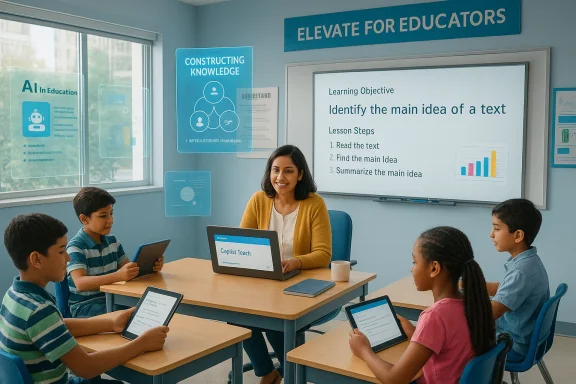
Microsoft’s Elevate for Educators rollout in New Delhi — announced at CM SHRI School, Pandara Road — signals a moment when classroom practice and large-scale corporate AI initiatives intersect: teachers there are already using Microsoft Copilot to build lesson plans, generate formative assessments, create posters and infographics, scaffold complex concepts, and design personalised supports that aim to make classrooms more inclusive and engaging. What began as a series of pilot workshops and teacher demonstrations at a small cluster of schools now reads like an early roadmap for how AI tools could be embedded across thousands of Indian government schools — but the promise comes with urgent questions about pedagogy, privacy, equity, and long-term sustainability.
The program announced in New Delhi — Microsoft Elevate for Educators — is positioned by Microsoft as a professional development and capacity-building initiative intended to train millions of educators and bring AI tools into mainstream school practice. Microsoft describes the initiative as aiming to skill two million teachers and reach 200,000 schools in India by 2030, and to do so via a mix of online credentials, in-person academies, AI productivity labs, and partnerships with local education systems. At the product level, the initiative leans on features in the Microsoft 365 Copilot ecosystem — notably the Teach module in the Microsoft 365 Copilot app and Copilot Chat capabilities designed for educational settings.
That combination — a programmatic, system-level rollout plus readily available AI features inside productivity apps used by teachers — is what makes this development noteworthy: it isn’t just a pilot of a single feature, it’s an attempt to align product capability, training pathways, and government school systems at scale.
What worked:
Public systems and vendors share a responsibility: vendors must provide transparent, auditable controls and respect institutional data practices; governments and schools must protect students, fund the fundamentals, and insist that pedagogy — not the algorithm — drive learning. When those pieces line up, AI can become a durable assistant in classrooms; when they don’t, the risk is merely replacing old problems with new complexity.
For education leaders, technologists, and classroom teachers considering Copilot-style tools, the practical path forward is clear: pilot with clear learning goals, couple every product feature with deep pedagogical support, make data and privacy protections non-negotiable, and measure impact openly. Only by doing so can the promise of AI — more personalised learning, stronger inclusion, and richer student agency — move from promising headlines to repeated, verifiable improvements in what matters most: learning.
Source: Education Times Teachers turn to Microsoft Copilot AI tool for designing lessons and making classrooms more inclusive - EducationTimes.com
 Background / Overview
The program announced in New Delhi — Microsoft Elevate for Educators — is positioned by Microsoft as a professional development and capacity-building initiative intended to train millions of educators and bring AI tools into mainstream school practice. Microsoft describes the initiative as aiming to skill two million teachers and reach 200,000 schools in India by 2030, and to do so via a mix of online credentials, in-person academies, AI productivity labs, and partnerships with local education systems. At the product level, the initiative leans on features in the Microsoft 365 Copilot ecosystem — notably the Teach module in the Microsoft 365 Copilot app and Copilot Chat capabilities designed for educational settings.That combination — a programmatic, system-level rollout plus readily available AI features inside productivity apps used by teachers — is what makes this development noteworthy: it isn’t just a pilot of a single feature, it’s an attempt to align product capability, training pathways, and government school systems at scale.
What teachers are doing with Copilot: practical classroom use cases
Teachers at participating CM SHRI schools described a range of everyday uses that convert abstract AI promises into instructional artifacts and classroom routines:- Creating visual learning materials — posters, infographics, and slide decks that simplify complex topics and reduce cognitive load for learners.
- Drafting scaffolded lesson sequences and learning intentions that shift emphasis away from rote recall toward analysis, synthesis, and critical thinking.
- Designing formative assessments and diagnostic quizzes that surface specific learning gaps so teachers can target remediation more precisely.
- Generating personalised teaching-learning materials (TLMs) and short activities tailored to individual students’ needs — including supports for learners with disabilities.
- Supporting student projects end-to-end — from storyboard and lighting cues for a classroom drama to prototype support when students explore computer vision and model-building tools.
Short, concrete examples reported by educators
- A biology teacher used Copilot to produce infographics and an aligned formative test that revealed targeted misconceptions; the resulting lesson moved students from memorisation to reasoning tasks.
- An English teacher incorporated Copilot-generated interactive lesson plans and TLMs, then organised a teacher-learning community to share uses and strategies.
- A primary teacher used Copilot prompts to design a “buddy” routine and motivational frames that supported social-emotional inclusion for an autistic child, producing small classroom changes that the teacher described as transformative for the child’s comfort and peer relationships.
Students as creators, not just consumers
One of the clearest early benefits was that students used the same AI ecosystem to conceive and build projects they otherwise would have found technically out of reach.- A school theatre troupe credited Copilot with practical design guidance — lighting, mood boards, costume ideas and sound cues — enabling them to stage a historical play without prior production experience.
- A small team of class VI students reportedly built an applied prototype named Parakh AI, using Azure Custom Vision and coding assistance to distinguish visually similar fruits by texture, with the aim of protecting farmers from mispricing.
Why Microsoft (and similar vendors) see education as core to AI adoption
There are strategic and civic reasons vendors pursue education:- Education is a scale multiplier: training teachers multiplies impact across cohorts of students, families, and communities.
- Schools are environments where responsible AI use, critical thinking about sources, and data literacy can be taught systematically.
- Embedding AI into mainstream productivity platforms (email, Word, Teams, PowerPoint) creates a low-friction path for adoption: teachers already use these tools daily.
- For vendors, education programs position their technologies as foundational infrastructure for long-term learning ecosystems and workforce readiness.
Verified program claims and product capabilities
Several product- and program-level claims are corroborated by official announcements and broad reporting from multiple outlets:- Microsoft has publicly articulated an educator-focused program and global commitments to upskill people in AI; Microsoft’s India launch framed India as the first country in Asia selected for Elevate for Educators, with targets for training millions of teachers and reaching hundreds of thousands of schools by 2030.
- The Microsoft 365 Copilot ecosystem includes education-specific capabilities such as the Teach module, tools for generating lesson plans, quizzes, standards alignment, and learning activities — features that Microsoft has documented and publicly demoed.
- Copilot availability for student use is constrained by age and administrative enablement: Microsoft has described Copilot Chat and Microsoft 365 Copilot availability for students aged 13 and older, subject to institutional controls and administrative configuration.
- Azure Custom Vision and other Azure AI services are widely available for research and prototyping, and have been used in classroom and hobbyist projects to build lightweight classification models.
Strengths: what makes this approach promising
- Teacher productivity and instructional time: By automating repetitive preparation tasks (formatting, scaffolding, quick assessments), teachers regain time for human-centered activities — conferencing with students, coaching, and curriculum adaptation.
- Differentiation at scale: AI can quickly generate multiple versions of activities at different reading levels, enabling more accessible learning pathways for diverse classrooms.
- Rapid prototyping and student agency: Low barriers to entry for ideas — students can translate creative concepts into prototypes using cloud-hosted toolkits and receive step-by-step guidance.
- Potential to mainstream inclusive practices: Small, evidence-backed interventions such as daily “buddy” routines or personalised motivational materials can be authored quickly and integrated into classroom routines.
- System-level capacity building: When approached as a coordinated initiative — with training pathways, credentials, and local partnerships — the program can build durable educator communities and institutional readiness rather than isolated pilot effects.
Risks and trade-offs: what can go wrong
Adopting AI at scale in public-school systems is attractive but risky. Major concerns include:- Data privacy and student protection: Integrating cloud AI into the classroom raises questions about student data residency, consent, retention policies, and whether sensitive information could be exposed or repurposed. Robust enterprise controls and privacy-by-design are essential.
- Over-reliance and skill erosion: If teachers depend on Copilot for core planning tasks without ongoing professional development in pedagogy, there’s a risk that instructional quality could flatten into algorithmically generated templates rather than deep, context-sensitive planning.
- Bias and representational harms: Model outputs can reflect biases in training data. For marginalized students, unexamined recommendations (reading levels, assessment phrasing, cultural references) can perpetuate misunderstandings.
- Equity of access: Hardware, connectivity, and classroom management resources vary widely. Rolling out AI without guaranteeing devices, robust internet, and maintenance support will deepen divides.
- Assessment integrity and academic honesty: Generative tools can enable novel forms of cheating or artifact manipulation. Assessment design and academic integrity policies must evolve alongside tool adoption.
- Vendor lock-in and sustainability: Deep reliance on a single vendor’s ecosystem risks future costs and reduces local customisation. Public systems must balance vendor partnerships with open standards and interoperability.
- Teacher workload paradox: Early pilots often show time-savings in content creation, but administrators may respond by increasing expectations (more output, more customisation), eroding the initial gains.
Governance and practical safeguards schools should demand
- Clear data governance: Contracts and deployments must specify what data is collected, how long it is retained, where it is stored, and how it may be used. Parents and guardians should be able to understand and consent where appropriate.
- Administrative controls and age gating: Institutions should keep central control over enabling Copilot features for student accounts, apply age restrictions, and configure mitigation settings (for example, limiting file uploads or external API calls).
- Transparency about model behavior: Teachers and students should be told when outputs are AI-generated and taught to interrogate and verify those outputs.
- Pedagogical training that foregrounds judgment: Professional development should prioritise curricular goals and instructional design so AI augments, rather than replaces, teacher judgment.
- Equity-first procurement: Any large-scale rollout must include an explicit plan for devices, connectivity, maintenance, and accessibility tools for students with disabilities.
- Assessment redesign: Replace high-stakes reliance on text-only, easily automated tasks with multimodal, process-oriented assessments that value reasoning and performance.
Technical considerations for IT and school systems
- Identity and licensing: Copilot features are tied to Microsoft 365 accounts and specific licensing models. District IT leaders must plan user provisioning, license management, and cost forecasting.
- Enterprise Data Protection (EDP): Use built-in EDP features to ensure institutional data is protected and not used to train external models beyond controlled scopes.
- Network & device readiness: Reliable bandwidth, device management tooling, and classroom peripherals (cameras, mics, interactive panels) are prerequisites for a smooth rollout.
- Local language and cultural adaptation: AI outputs require localization for regional languages and curricula. Off-the-shelf prompts may not align to local standards or cultural contexts without careful work.
- Edge & on-device features: Where connectivity is constrained, consider Copilot+ PC options and on-device intelligence features that operate with lower latency and reduced cloud dependency.
- Monitoring and analytics: Use telemetry responsibly to understand adoption, but not to surveil or penalise teachers. Metrics should inform support and professional development.
A practical implementation checklist for school leaders
- Convene stakeholders (teachers, IT, parents, student representatives) to set shared goals and red lines for AI use.
- Pilot in a small cluster of classrooms with explicit, observable learning objectives and evaluation metrics.
- Pair product training with pedagogy — show not only “how to” but “why” and “when” to use AI.
- Build local teacher communities (peer mentoring, micro-credentials) so adoption is driven by colleagues, not just by vendors.
- Require contract language that protects student data, limits secondary uses, and ensures transferability if vendor relationships change.
- Plan for devices, connectivity, and technical support before scaling.
- Redesign assessments to value process and demonstration over text-only outputs.
- Publicly publish impact metrics and experiences to enable external review and accountability.
Case study: what worked — and what needs scrutiny — in the CM SHRI pilots
The CM SHRI pilot showcases small-scale wins and open questions in equal measure.What worked:
- Practical outputs: Teachers produced more engaging TLMs and tests; students completed creative projects previously out of reach.
- Community-building: Teacher networks formed (for instance, teacher learning communities) that exchanged prompts, lesson formats, and classroom strategies.
- Inclusion-oriented innovations: Low-cost, teacher-authored interventions supported an autistic student’s classroom integration and social comfort.
- Verification of impact: Anecdotal reports are inspiring, but there is a need for systematic evaluation: pre/post measures of learning gains, retention, and socio-emotional outcomes.
- Sustainable resourcing: Scaling requires guarantees of hardware, connectivity, and long-term support budgets; without these, initial benefits may not be durable.
- Transparency of classroom data usage: Teachers and school leaders need clear documentation showing how student work or assessment results may (or may not) be used by cloud services.
Policy and system-level recommendations
- Ministries and district leaders should require vendor agreements to include strong data-protection clauses, onshore data residency options where appropriate, and transparent audit rights.
- Funding models must include total cost of ownership: devices, connectivity, teacher release time, and ongoing professional development.
- National or state-level curriculum bodies should collaborate with vendors to co-design localized prompts, content libraries, and curriculum-aligned templates rather than accepting global defaults.
- Create independent evaluation windows: require pilot projects to publish methodology, data summaries, and third-party reviews before broad procurement decisions are finalised.
Long-term horizon: what success looks like
If done correctly, AI in classrooms will be measured not by the number of AI-generated posters or the speed of lesson plan drafting, but by durable improvements in three domains:- Teacher agency and craft: Teachers use AI to free bandwidth for instruction, assessment interpretation, and relationship building, not as a shortcut for lesson planning alone.
- Learner outcomes and equity: AI-enhanced differentiation should reduce, not widen, achievement gaps — measured through longitudinal outcomes and representative assessments.
- Civic and digital literacy: Students graduating from AI-augmented schooling should show clearer judgment about source evaluation, model limitations, and responsible use — skills central to civic participation in an AI-enabled world.
Conclusion
The early work at CM SHRI schools and Microsoft’s Elevate for Educators launch in India captures both a hopeful and complicated moment. On one hand, AI tools like Microsoft Copilot are demonstrably useful for everyday classroom work: they make lesson design faster, help generate targeted formative assessments, and can empower student creativity. On the other hand, scaling these benefits across entire systems requires more than product demos — it requires robust data governance, sustained investment in devices and connectivity, teacher-centred professional learning, and careful attention to equity and pedagogy.Public systems and vendors share a responsibility: vendors must provide transparent, auditable controls and respect institutional data practices; governments and schools must protect students, fund the fundamentals, and insist that pedagogy — not the algorithm — drive learning. When those pieces line up, AI can become a durable assistant in classrooms; when they don’t, the risk is merely replacing old problems with new complexity.
For education leaders, technologists, and classroom teachers considering Copilot-style tools, the practical path forward is clear: pilot with clear learning goals, couple every product feature with deep pedagogical support, make data and privacy protections non-negotiable, and measure impact openly. Only by doing so can the promise of AI — more personalised learning, stronger inclusion, and richer student agency — move from promising headlines to repeated, verifiable improvements in what matters most: learning.
Source: Education Times Teachers turn to Microsoft Copilot AI tool for designing lessons and making classrooms more inclusive - EducationTimes.com
