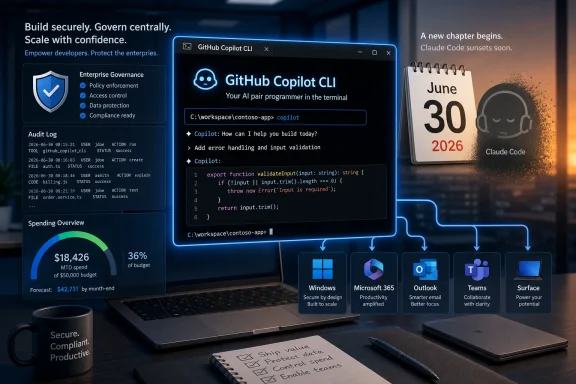
Microsoft is reportedly ending most Anthropic Claude Code licenses inside its Experiences and Devices division by June 30, 2026, and pushing engineers toward GitHub Copilot CLI while GitHub faces outages, a recent internal-repository breach, and post-CEO integration into Microsoft’s CoreAI organization. That is not just a procurement story. It is a stress test of Microsoft’s entire AI bargain: centralize the tools, own the platform, absorb the cost, and convince everyone else that the machine is reliable enough to build on. The problem is that the machine now includes GitHub, and GitHub is wobbling at precisely the moment Microsoft needs it to look inevitable.
The most revealing detail in the Claude Code pullback is not that Microsoft prefers its own tool. Of course it does. The revealing detail is that Microsoft’s internal AI coding usage has become expensive enough to force a policy change inside the division that builds Windows, Office, Teams, Outlook, and Surface.
That makes the episode less a betrayal of Anthropic than a preview of AI economics at enterprise scale. Coding agents are not traditional software seats with predictable marginal cost. They are metered compute funnels, and the more useful they become, the more aggressively developers use them. If the bill climbs in proportion to enthusiasm, adoption becomes a finance problem as much as a productivity story.
Microsoft’s answer is to bring its engineers back under the Copilot umbrella. GitHub Copilot CLI gives the company a controlled channel, a strategic product story, and presumably more room to manage model routing and internal cost allocation. It also lets Microsoft turn a messy internal marketplace of AI tools into something closer to a corporate standard.
But the move carries an obvious irony. Microsoft is steering engineers away from a third-party tool because token-based costs ran hot, just as GitHub is moving Copilot customers toward usage-based billing on June 1, 2026. The lesson for customers is hard to miss: the old subscription fantasy of “unlimited AI assistance” is giving way to a utility model, and even Microsoft is not immune to the meter.
Enterprises do not merely want better autocomplete. They want model choice, audit trails, budget controls, data residency, security posture, and some way to stop a handful of power users from turning a productivity pilot into a surprise cloud bill. Microsoft is positioning Copilot as the place where those constraints can be managed without making developers assemble their own toolchain from API keys and browser tabs.
That helps explain why Microsoft can both support multiple models through Azure and still push its own employees toward Copilot. The company does not need every internal prompt to run on a Microsoft model. It needs the workflow, billing, identity, and policy surface to belong to Microsoft.
The internal Claude Code cutoff therefore reads like the back-office version of the same message Microsoft is sending customers: bring AI usage into the platform where it can be measured. The open question is whether developers see that as helpful standardization or corporate narrowing. In engineering culture, the difference matters.
Independent outage tracking for the May 2025 to April 2026 period counted 257 GitHub incidents, including 48 major outages. February 2026 was especially ugly, with 37 interruptions. GitHub Actions, the automation backbone for countless CI/CD pipelines, was reportedly the most affected service, with 57 outages in that window.
Those numbers are not just status-page trivia. For a developer, GitHub is no longer a place where code merely rests. It is where tests run, releases ship, secrets rotate, packages publish, security scans trigger, and deployment gates open. When GitHub stalls, modern software factories stop moving.
That is why frustration has become louder and more reputationally dangerous. A social network can have an outage and inconvenience users. A developer platform outage can halt production releases, delay incident fixes, and strand teams that have built their delivery processes around GitHub Actions. The deeper GitHub embeds itself into the software supply chain, the less tolerance customers have for “try again later.”
Former GitHub CTO Vlad Fedorov previously talked about a tenfold capacity increase. Later reporting suggested that even that target was no longer sufficient, with GitHub needing closer to thirty times its current scale. Whether those exact multipliers prove durable or not, the direction is clear. GitHub’s infrastructure assumptions were built for a different product.
AI has changed the load profile. Copilot usage, agentic coding workflows, code search, Actions workloads, dependency scanning, package operations, and automated pull request generation all add pressure. Developers are not just pushing commits; machines are increasingly acting on repositories continuously.
That is the real strategic risk for Microsoft. GitHub is no longer merely a collaboration platform that happens to host Copilot. GitHub is becoming the execution environment for AI-assisted software development. If that environment is unreliable, Copilot’s promise begins to look like an overlay on shaky ground.
According to public reports, the incident began when a GitHub employee’s device was compromised through a poisoned Visual Studio Code extension. GitHub said the activity appeared limited to internal repositories, and public reporting has not established that customer repositories were accessed. Still, the symbolism is brutal: the company that hosts the world’s code was hit through the same extension ecosystem that developers use to accelerate their work.
This is the new supply-chain problem in miniature. Developers install extensions because they save time. AI coding tools, linters, build helpers, notebook integrations, formatters, cloud plug-ins, and language servers all demand trust. Each one becomes a possible path from convenience to compromise.
The breach also lands awkwardly beside Microsoft’s AI ambitions. Agentic tools ask for more permissions, more context, and more repository access than old autocomplete ever did. They are most useful when they can see the whole project and act across files. That makes identity, secrets management, extension review, sandboxing, and endpoint hygiene newly central to the developer experience.
Microsoft can plausibly argue that centralizing around Copilot helps reduce this sprawl. But the breach shows that the broader Microsoft developer ecosystem still has porous edges. If the future of coding is assistants, agents, and extensions all acting inside the IDE, then the IDE has become a high-value attack surface.
Thomas Dohmke announced in August 2025 that he would step down as GitHub CEO, and Microsoft opted not to appoint a direct replacement. GitHub’s leadership was folded more visibly into Microsoft’s CoreAI structure, ending another chapter of the platform’s semi-independent post-acquisition identity. Then Julia Liuson, the long-serving Microsoft developer chief who had taken on major GitHub oversight responsibilities, announced plans to retire at the end of June 2026.
None of this means GitHub is leaderless in the literal sense. Microsoft has deep benches and abundant executive machinery. But platforms with developer trust problems benefit from visible ownership. When outages mount, breaches occur, pricing changes land, and product direction shifts toward AI, customers want to know who is accountable.
The loss of a standalone GitHub CEO also changes the emotional contract. Microsoft spent years reassuring developers that GitHub would not simply become another Redmond product surface. Folding GitHub into CoreAI may make strategic sense, but it also confirms what skeptics feared: GitHub is now a core component of Microsoft’s AI platform strategy, not an independent developer commons that merely happens to be owned by Microsoft.
That distinction matters because developers are unusually sensitive to platform capture. They will use corporate tools when those tools are excellent. They will also flee quickly when the tools feel extractive, unreliable, or politically constrained.
Cursor, Windsurf, JetBrains AI, Sourcegraph Cody, OpenAI’s coding tools, Anthropic’s Claude Code, and a growing field of terminal-native agents are all fighting for the same daily developer loop. Their pitch is not always “we are cheaper.” Often it is “we are faster, more agentic, less bureaucratic, and built around how serious developers actually work.”
That is why the Claude Code licensing story cuts both ways. On one hand, Microsoft has every reason to standardize internally on Copilot. On the other, the fact that Claude Code became popular enough inside Microsoft to create a cost issue is itself a market signal. Developers are not blindly loyal to the corporate standard when another tool feels better.
The reported frustration from prominent developers about GitHub outages adds another opening for rivals. Developer platforms do not lose trust all at once. They lose it through repeated small failures: a failed Actions run, a delayed status update, a blocked release, a billing surprise, a confusing product shift, a breach that makes teams recheck their threat model.
Copilot can remain successful while GitHub loses some cultural shine. But if the next generation of AI coding work happens inside tools that treat GitHub as a backend rather than the center of gravity, Microsoft’s strategic leverage weakens.
For the quarter ended March 31, 2026, Microsoft reported revenue of $82.9 billion, up 18 percent year over year. Net income rose sharply, Azure and other cloud services grew 40 percent, and Microsoft said its AI business surpassed a $37 billion annual revenue run rate. Those numbers buy patience, engineering capacity, and investor forgiveness.
They also explain why Microsoft can spend at astonishing scale. Reported infrastructure plans around 2026 point to enormous capital expenditure, driven by AI data center demand, component costs, and the race to secure compute capacity. Microsoft’s cloud position gives it a structural advantage that most AI tooling companies cannot match.
But the financial strength does not erase the operational contradictions. In fact, it sharpens them. If Microsoft can spend hundreds of billions on AI infrastructure and still struggle to make GitHub feel consistently reliable, customers will reasonably ask whether the bottleneck is money, architecture, execution, or priorities.
Microsoft’s answer will likely be that the transition is already underway and that scale problems are the consequence of extraordinary demand. That may be true. It is also exactly what customers hear from every cloud platform during periods of strain.
Microsoft’s Experiences and Devices division is the bridge between internal AI tooling and the products hundreds of millions of people touch. If the engineers building Windows and Microsoft 365 are being pushed into Copilot-driven workflows, then those workflows will shape how Microsoft itself builds, tests, and ships the next generation of desktop AI features.
Windows 11 is already becoming a Copilot host. Microsoft has tested deeper taskbar integration, contextual actions, and interface-level AI features designed to turn the operating system into something more assistant-aware. Office is following the same trajectory, with Copilot moving from a novelty pane toward a persistent productivity layer.
That makes internal tooling discipline more than a procurement footnote. Microsoft is trying to industrialize AI-assisted software development inside the same organization that will industrialize AI-assisted computing for users. The habits, controls, and cost models it imposes on its own engineers are a preview of what customers will eventually experience.
The risk is that Windows becomes another place where Microsoft’s AI strategy outruns user trust. If Copilot is helpful, fast, transparent, and controllable, deeper integration will feel natural. If it is expensive, noisy, unreliable, or too tightly bound to Microsoft’s commercial priorities, users and admins will push back.
The center of gravity is control. Who can use the tool? Which repositories can it see? Where does the prompt data go? How are secrets protected? Can usage be capped? Can models be restricted by team? Can generated code be audited? What happens when the platform goes down during a release window?
Usage-based billing makes those questions sharper. A fixed-price Copilot seat was easy to approve as a productivity tool. A metered agent that can consume credits through long context windows, test generation, pull request reviews, and multi-step planning is a different procurement animal. Finance teams will want predictability, security teams will want policy enforcement, and engineering leaders will want enough flexibility not to strangle productivity.
Microsoft’s internal Claude Code decision is therefore a case study in the same governance problem its customers face. The company is effectively admitting that popular AI coding tools can become too costly without central controls. That admission may help sell Copilot to CIOs, but it also validates their anxiety.
That pluralism is commercially useful. It reassures enterprises that Microsoft is not forcing every workload through one model provider, and it positions Azure as the neutral-ish control plane for AI. But neutrality has limits when the workflow layer is Copilot and the billing relationship runs through Microsoft.
The Claude Code cutoff highlights that boundary. Microsoft can offer Anthropic models to customers while discouraging uncontrolled Anthropic tool usage internally. It can support a multi-model ecosystem while steering developers toward its own interface, identity, billing, and policy stack. That is not hypocrisy so much as platform strategy.
The question for customers is whether they are buying optionality or merely renting it inside Microsoft’s walls. If Copilot becomes the default interface for coding, Office work, Windows actions, and enterprise agents, model choice may matter less than platform dependence. The menu can be varied while the restaurant remains Microsoft’s.
Now the bargain is changing. GitHub is more tightly integrated into Microsoft. Copilot is moving toward usage billing. Outages have made reliability a boardroom issue for engineering organizations. A breach has reminded everyone that developer convenience can create supply-chain exposure. Internal Microsoft engineers are being pushed toward the very Copilot stack customers are being asked to trust.
That does not mean the bargain is broken. It means the grace period is over. GitHub is no longer judged as a beloved developer site with occasional growing pains. It is judged as Microsoft’s strategic AI development platform.
That standard is harsher, and it should be. If Microsoft wants GitHub to be the operating layer for software development in the AI era, GitHub has to meet infrastructure expectations closer to Azure than to a startup SaaS tool. The credibility of Copilot depends on it.
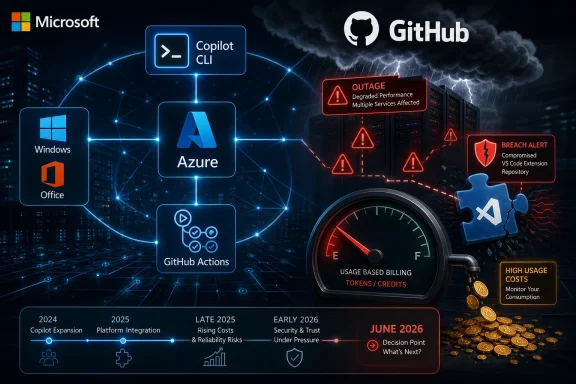 Microsoft’s AI Discipline Starts at Home
The most revealing detail in the Claude Code pullback is not that Microsoft prefers its own tool. Of course it does. The revealing detail is that Microsoft’s internal AI coding usage has become expensive enough to force a policy change inside the division that builds Windows, Office, Teams, Outlook, and Surface.That makes the episode less a betrayal of Anthropic than a preview of AI economics at enterprise scale. Coding agents are not traditional software seats with predictable marginal cost. They are metered compute funnels, and the more useful they become, the more aggressively developers use them. If the bill climbs in proportion to enthusiasm, adoption becomes a finance problem as much as a productivity story.
Microsoft’s answer is to bring its engineers back under the Copilot umbrella. GitHub Copilot CLI gives the company a controlled channel, a strategic product story, and presumably more room to manage model routing and internal cost allocation. It also lets Microsoft turn a messy internal marketplace of AI tools into something closer to a corporate standard.
But the move carries an obvious irony. Microsoft is steering engineers away from a third-party tool because token-based costs ran hot, just as GitHub is moving Copilot customers toward usage-based billing on June 1, 2026. The lesson for customers is hard to miss: the old subscription fantasy of “unlimited AI assistance” is giving way to a utility model, and even Microsoft is not immune to the meter.
Copilot Is Becoming a Cost-Control Layer, Not Just a Coding Assistant
Copilot began life as a marvel: type a comment, get a function; start a pattern, watch the model infer the rest. In 2026, that story is no longer enough. The real product is becoming governance.Enterprises do not merely want better autocomplete. They want model choice, audit trails, budget controls, data residency, security posture, and some way to stop a handful of power users from turning a productivity pilot into a surprise cloud bill. Microsoft is positioning Copilot as the place where those constraints can be managed without making developers assemble their own toolchain from API keys and browser tabs.
That helps explain why Microsoft can both support multiple models through Azure and still push its own employees toward Copilot. The company does not need every internal prompt to run on a Microsoft model. It needs the workflow, billing, identity, and policy surface to belong to Microsoft.
The internal Claude Code cutoff therefore reads like the back-office version of the same message Microsoft is sending customers: bring AI usage into the platform where it can be measured. The open question is whether developers see that as helpful standardization or corporate narrowing. In engineering culture, the difference matters.
GitHub’s Reliability Problem Has Become a Microsoft Problem
If Copilot is the designated landing zone, GitHub has to be boringly dependable. Instead, the platform has spent the past year reminding developers that centralization has a blast radius.Independent outage tracking for the May 2025 to April 2026 period counted 257 GitHub incidents, including 48 major outages. February 2026 was especially ugly, with 37 interruptions. GitHub Actions, the automation backbone for countless CI/CD pipelines, was reportedly the most affected service, with 57 outages in that window.
Those numbers are not just status-page trivia. For a developer, GitHub is no longer a place where code merely rests. It is where tests run, releases ship, secrets rotate, packages publish, security scans trigger, and deployment gates open. When GitHub stalls, modern software factories stop moving.
That is why frustration has become louder and more reputationally dangerous. A social network can have an outage and inconvenience users. A developer platform outage can halt production releases, delay incident fixes, and strand teams that have built their delivery processes around GitHub Actions. The deeper GitHub embeds itself into the software supply chain, the less tolerance customers have for “try again later.”
The Azure Migration Was Supposed to Be the Fix
The deeper story behind GitHub’s outages is capacity. GitHub has been moving deeper into Microsoft’s cloud orbit, but the transition away from older infrastructure has reportedly lagged the scale of demand. That is a familiar cloud-era problem with a very GitHub-specific sting: Microsoft owns one of the world’s largest cloud platforms, yet its developer crown jewel is still fighting scale constraints.Former GitHub CTO Vlad Fedorov previously talked about a tenfold capacity increase. Later reporting suggested that even that target was no longer sufficient, with GitHub needing closer to thirty times its current scale. Whether those exact multipliers prove durable or not, the direction is clear. GitHub’s infrastructure assumptions were built for a different product.
AI has changed the load profile. Copilot usage, agentic coding workflows, code search, Actions workloads, dependency scanning, package operations, and automated pull request generation all add pressure. Developers are not just pushing commits; machines are increasingly acting on repositories continuously.
That is the real strategic risk for Microsoft. GitHub is no longer merely a collaboration platform that happens to host Copilot. GitHub is becoming the execution environment for AI-assisted software development. If that environment is unreliable, Copilot’s promise begins to look like an overlay on shaky ground.
A Security Breach Turns Developer Convenience Into Supply-Chain Risk
Reliability is only one side of the trust equation. The recent breach involving roughly 3,800 internal GitHub repositories shows how fragile the developer tooling perimeter has become.According to public reports, the incident began when a GitHub employee’s device was compromised through a poisoned Visual Studio Code extension. GitHub said the activity appeared limited to internal repositories, and public reporting has not established that customer repositories were accessed. Still, the symbolism is brutal: the company that hosts the world’s code was hit through the same extension ecosystem that developers use to accelerate their work.
This is the new supply-chain problem in miniature. Developers install extensions because they save time. AI coding tools, linters, build helpers, notebook integrations, formatters, cloud plug-ins, and language servers all demand trust. Each one becomes a possible path from convenience to compromise.
The breach also lands awkwardly beside Microsoft’s AI ambitions. Agentic tools ask for more permissions, more context, and more repository access than old autocomplete ever did. They are most useful when they can see the whole project and act across files. That makes identity, secrets management, extension review, sandboxing, and endpoint hygiene newly central to the developer experience.
Microsoft can plausibly argue that centralizing around Copilot helps reduce this sprawl. But the breach shows that the broader Microsoft developer ecosystem still has porous edges. If the future of coding is assistants, agents, and extensions all acting inside the IDE, then the IDE has become a high-value attack surface.
GitHub’s Leadership Vacuum Arrives at the Worst Possible Time
The operational strain would be easier to digest if GitHub looked organizationally settled. It does not.Thomas Dohmke announced in August 2025 that he would step down as GitHub CEO, and Microsoft opted not to appoint a direct replacement. GitHub’s leadership was folded more visibly into Microsoft’s CoreAI structure, ending another chapter of the platform’s semi-independent post-acquisition identity. Then Julia Liuson, the long-serving Microsoft developer chief who had taken on major GitHub oversight responsibilities, announced plans to retire at the end of June 2026.
None of this means GitHub is leaderless in the literal sense. Microsoft has deep benches and abundant executive machinery. But platforms with developer trust problems benefit from visible ownership. When outages mount, breaches occur, pricing changes land, and product direction shifts toward AI, customers want to know who is accountable.
The loss of a standalone GitHub CEO also changes the emotional contract. Microsoft spent years reassuring developers that GitHub would not simply become another Redmond product surface. Folding GitHub into CoreAI may make strategic sense, but it also confirms what skeptics feared: GitHub is now a core component of Microsoft’s AI platform strategy, not an independent developer commons that merely happens to be owned by Microsoft.
That distinction matters because developers are unusually sensitive to platform capture. They will use corporate tools when those tools are excellent. They will also flee quickly when the tools feel extractive, unreliable, or politically constrained.
The Competitors Are Selling Escape Velocity
GitHub Copilot’s early lead was enormous. It had distribution, brand recognition, IDE integration, and the benefit of being many developers’ first encounter with AI-assisted coding. But the market around it has moved from novelty to arms race.Cursor, Windsurf, JetBrains AI, Sourcegraph Cody, OpenAI’s coding tools, Anthropic’s Claude Code, and a growing field of terminal-native agents are all fighting for the same daily developer loop. Their pitch is not always “we are cheaper.” Often it is “we are faster, more agentic, less bureaucratic, and built around how serious developers actually work.”
That is why the Claude Code licensing story cuts both ways. On one hand, Microsoft has every reason to standardize internally on Copilot. On the other, the fact that Claude Code became popular enough inside Microsoft to create a cost issue is itself a market signal. Developers are not blindly loyal to the corporate standard when another tool feels better.
The reported frustration from prominent developers about GitHub outages adds another opening for rivals. Developer platforms do not lose trust all at once. They lose it through repeated small failures: a failed Actions run, a delayed status update, a blocked release, a billing surprise, a confusing product shift, a breach that makes teams recheck their threat model.
Copilot can remain successful while GitHub loses some cultural shine. But if the next generation of AI coding work happens inside tools that treat GitHub as a backend rather than the center of gravity, Microsoft’s strategic leverage weakens.
The Financial Machine Still Gives Microsoft Time
The counterargument is simple: Microsoft is not a fragile startup trying to survive a bad infrastructure quarter. It is a financial machine with one of the strongest enterprise franchises in technology.For the quarter ended March 31, 2026, Microsoft reported revenue of $82.9 billion, up 18 percent year over year. Net income rose sharply, Azure and other cloud services grew 40 percent, and Microsoft said its AI business surpassed a $37 billion annual revenue run rate. Those numbers buy patience, engineering capacity, and investor forgiveness.
They also explain why Microsoft can spend at astonishing scale. Reported infrastructure plans around 2026 point to enormous capital expenditure, driven by AI data center demand, component costs, and the race to secure compute capacity. Microsoft’s cloud position gives it a structural advantage that most AI tooling companies cannot match.
But the financial strength does not erase the operational contradictions. In fact, it sharpens them. If Microsoft can spend hundreds of billions on AI infrastructure and still struggle to make GitHub feel consistently reliable, customers will reasonably ask whether the bottleneck is money, architecture, execution, or priorities.
Microsoft’s answer will likely be that the transition is already underway and that scale problems are the consequence of extraordinary demand. That may be true. It is also exactly what customers hear from every cloud platform during periods of strain.
Windows Users Should Watch the Developer Story Closely
At first glance, this might look like an enterprise developer drama with little relevance to everyday Windows users. That would be a mistake.Microsoft’s Experiences and Devices division is the bridge between internal AI tooling and the products hundreds of millions of people touch. If the engineers building Windows and Microsoft 365 are being pushed into Copilot-driven workflows, then those workflows will shape how Microsoft itself builds, tests, and ships the next generation of desktop AI features.
Windows 11 is already becoming a Copilot host. Microsoft has tested deeper taskbar integration, contextual actions, and interface-level AI features designed to turn the operating system into something more assistant-aware. Office is following the same trajectory, with Copilot moving from a novelty pane toward a persistent productivity layer.
That makes internal tooling discipline more than a procurement footnote. Microsoft is trying to industrialize AI-assisted software development inside the same organization that will industrialize AI-assisted computing for users. The habits, controls, and cost models it imposes on its own engineers are a preview of what customers will eventually experience.
The risk is that Windows becomes another place where Microsoft’s AI strategy outruns user trust. If Copilot is helpful, fast, transparent, and controllable, deeper integration will feel natural. If it is expensive, noisy, unreliable, or too tightly bound to Microsoft’s commercial priorities, users and admins will push back.
Enterprise IT Will Care Less About the Model and More About the Meter
The AI coding conversation often obsesses over model rankings. GPT versus Claude, Sonnet versus Opus, Gemini versus local models, coding benchmarks versus real-world repo understanding. Those comparisons matter, but they are not the center of gravity for enterprise IT.The center of gravity is control. Who can use the tool? Which repositories can it see? Where does the prompt data go? How are secrets protected? Can usage be capped? Can models be restricted by team? Can generated code be audited? What happens when the platform goes down during a release window?
Usage-based billing makes those questions sharper. A fixed-price Copilot seat was easy to approve as a productivity tool. A metered agent that can consume credits through long context windows, test generation, pull request reviews, and multi-step planning is a different procurement animal. Finance teams will want predictability, security teams will want policy enforcement, and engineering leaders will want enough flexibility not to strangle productivity.
Microsoft’s internal Claude Code decision is therefore a case study in the same governance problem its customers face. The company is effectively admitting that popular AI coding tools can become too costly without central controls. That admission may help sell Copilot to CIOs, but it also validates their anxiety.
Microsoft’s Vendor-Neutral Story Has a Microsoft-Centered Ending
One of Microsoft’s smartest AI moves has been to avoid presenting Azure as a single-model religion. Azure AI Foundry supports multiple model families, and Microsoft has made much of customers using more than one AI model. The company’s OpenAI partnership remains foundational, but Microsoft has also embraced Anthropic and others through cloud availability and product integrations.That pluralism is commercially useful. It reassures enterprises that Microsoft is not forcing every workload through one model provider, and it positions Azure as the neutral-ish control plane for AI. But neutrality has limits when the workflow layer is Copilot and the billing relationship runs through Microsoft.
The Claude Code cutoff highlights that boundary. Microsoft can offer Anthropic models to customers while discouraging uncontrolled Anthropic tool usage internally. It can support a multi-model ecosystem while steering developers toward its own interface, identity, billing, and policy stack. That is not hypocrisy so much as platform strategy.
The question for customers is whether they are buying optionality or merely renting it inside Microsoft’s walls. If Copilot becomes the default interface for coding, Office work, Windows actions, and enterprise agents, model choice may matter less than platform dependence. The menu can be varied while the restaurant remains Microsoft’s.
The GitHub-Copilot Bargain Is Now Under Review
The Microsoft-GitHub bargain used to be straightforward. Microsoft got developer credibility, GitHub got resources, and users mostly got continuity. Copilot strengthened that bargain by turning GitHub into the front door for AI coding.Now the bargain is changing. GitHub is more tightly integrated into Microsoft. Copilot is moving toward usage billing. Outages have made reliability a boardroom issue for engineering organizations. A breach has reminded everyone that developer convenience can create supply-chain exposure. Internal Microsoft engineers are being pushed toward the very Copilot stack customers are being asked to trust.
That does not mean the bargain is broken. It means the grace period is over. GitHub is no longer judged as a beloved developer site with occasional growing pains. It is judged as Microsoft’s strategic AI development platform.
That standard is harsher, and it should be. If Microsoft wants GitHub to be the operating layer for software development in the AI era, GitHub has to meet infrastructure expectations closer to Azure than to a startup SaaS tool. The credibility of Copilot depends on it.
The Numbers Microsoft Cannot Explain Away
The practical reading for WindowsForum readers is not that Microsoft is in crisis. It is that Microsoft’s AI transition is entering the uncomfortable phase where strategy collides with operations. The company has the revenue, cloud demand, and product reach to keep pushing, but the weak points are now visible.- Microsoft is reportedly ending most Claude Code licenses in a major product division by June 30, 2026, because heavy internal usage made third-party AI coding costs difficult to justify.
- GitHub Copilot’s June 1, 2026 move to usage-based billing shows that AI coding economics are shifting from simple subscriptions toward metered consumption.
- GitHub’s outage record over the past year has turned reliability into a strategic risk, especially for teams that depend on Actions for CI/CD.
- The reported breach of roughly 3,800 internal GitHub repositories through a poisoned Visual Studio Code extension underlines how exposed modern developer environments have become.
- GitHub’s deeper absorption into Microsoft CoreAI may improve alignment, but it also reduces the perception that GitHub stands apart from Microsoft’s platform agenda.
- Microsoft’s booming cloud and AI revenue gives it time to fix the problem, but it does not remove the need to prove that GitHub can scale as critical infrastructure.
References
- Primary source: AD HOC NEWS
Published: Wed, 27 May 2026 11:34:32 GMT

Microsoft Drops Anthropic's Claude for Its Own Copilot as GitHub's Infrastructure Woes Mount
Microsoft cuts Anthropic's Claude Code licenses to rein in costs while GitHub battles weekly outageswww.ad-hoc-news.de
- Related coverage: techradar.com

GitHub confirms breach — thousands of internal repositories hit
TeamPCP continues its attack on open source projects, now apparently asking for $50,000.www.techradar.com
- Related coverage: itpro.com

GitHub internal repositories exfiltrated via malicious VS Code extension
The breach has been claimed by the TeamPCP hacking group, which said it is offering the data for sale www.itpro.com
- Related coverage: tomshardware.com

Hacker group hits 3,800 internal GitHub repositories via poisoned developer plugin — TeamPCP claims source code theft and attempts $50,000 sale, employee installed malicious VS Code extension
GitHub says it has already rotated critical secrets and credentials following the breachwww.tomshardware.com
- Related coverage: anavem.com

GitHub Breach Exposes 3,800 Internal Repos via Malicious VS Code Extension
GitHub confirms security breach affecting 3,800 internal repositories after employee installed malicious VS Code extension on May 20, 2026.www.anavem.com
- Related coverage: insights.integrity360.com

GitHub Breach: TeamPCP Exfiltrates 3,800 Internal Repositories via Malicious VS Code Extension
GitHub has confirmed the unauthorized access and exfiltration of approximately 3,800 of its internal development repositories. insights.integrity360.com
- Related coverage: sophos.com
GitHub internal repositories breached
A malicious VS Code extension led to cloned private repositories, reportedly offered for sale on a criminal forumwww.sophos.com
- Related coverage: thecybersignal.com

GitHub Confirms TeamPCP Breach: 3,800 Internal Repos Exfiltrated
GitHub confirms TeamPCP exfiltrated ~3,800 internal repositories via a poisoned VS Code extension on one employee's device. The data is listed for $50,000+. www.thecybersignal.com
- Related coverage: techtimes.com

GitHub CISO Names Nx Console as Root of 3,800-Repo Breach: OpenAI, Grafana Also Hit
GitHub CISO Alexis Wales confirmed Thursday that a poisoned build of the Nx Console Visual Studio Code extension — live on Microsoft’s official Visual Studio Marketplace for just 18 minutes on May 18 — gave threat group TeamPCP enough access to exfiltrate approximately 3,800 of GitHub’s internal www.techtimes.com
- Related coverage: banklesstimes.com

GitHub Confirms Internal Breach via Poisoned VS Code Extension Attack | BanklessTimes
GitHub says a poisoned Visual Studio Code extension briefly exposed some internal repositories in a contained breach. www.banklesstimes.com
- Related coverage: thetechmarketer.com

TeamPCP Supply Chain Attack 2026: GitHub Loses 3,800 Repos to VS Code Hack
TeamPCP supply chain attack 2026 breached GitHub via a poisoned VS Code extension — exfiltrating 3,800 internal repos. The group has hit Trivy, Checkmarx, Bitwarden, and more. thetechmarketer.com
- Related coverage: windowsnews.ai
Microsoft Cancels Internal Claude Code Licenses, Pushes Copilot CLI by 2026
Microsoft plans to phase out internal use of Anthropic’s Claude Code in its Experiences and Devices division by June 30, 2026, transitioning thousands of...windowsnews.ai
- Related coverage: windowscentral.com

Microsoft is ditching Claude Code for Copilot CLI — but its own devs aren’t happy
Microsoft cancels Claude Code licenses in favor of GitHub Copilot CLI. Financial motives could be in play. www.windowscentral.com
- Related coverage: pcgamer.com

Open-source developer destination GitHub has been compromised by a cyberattack
A full incident report is on the way.www.pcgamer.com
- Related coverage: axios.com

Microsoft launches AI tool that competes with Anthropic
Anthropic's product threatened to kill Microsoft's software business, then Microsoft took the name and made it a Copilot feature.www.axios.com
- Related coverage: techcrunch.com

GitHub CEO to step down | TechCrunch
The move comes as GitHub is facing growing competition from companies like Google and Cursor over AI tools for programmers. techcrunch.com
- Related coverage: blog.incidenthub.cloud

GitHub Outages 2025 - 2026: Reliability Analysis and Outage History
Analysis of GitHub's reliability and outages between May 2025 and April 2026, with a focus on the impact on developers and businesses. Analyzes GitHub Actions outages, Copilot outages, Git operations outages.blog.incidenthub.cloud
- Related coverage: techrepublic.com

GitHub CEO Steps Down From 'Ride of a Lifetime'
GitHub CEO Thomas Dohmke will leave his position at the end of the year. He joined the developer platform from Microsoft in 2021.www.techrepublic.com
- Related coverage: es.investing.com

El CEO de GitHub de Microsoft dejará el cargo, sin reemplazo directo planeado - Axios Por Investing.com
El CEO de GitHub de Microsoft dejará el cargo, sin reemplazo directo planeado - Axioses.investing.com
- Related coverage: theregister.com

Microsoft developer chief Julia Liuson is logging off
: Departure may accelerate further AI-centric moves for programming toolswww.theregister.com
- Related coverage: au.investing.com

Microsoft’s GitHub CEO to step down, no direct replacement planned - Axios By Investing.com
Microsoft’s GitHub CEO to step down, no direct replacement planned - Axiosau.investing.com
- Related coverage: outlookbusiness.com

GitHub CEO Thomas Dohmke to Step Down, Unit Folded into Microsoft’s CoreAI Team – Outlook Business
Microsoft will not fill the CEO role at GitHub. Instead, the unit will be integrated into Microsoft’s CoreAI organisation, led by Jay Parikhwww.outlookbusiness.com
- Related coverage: moneycontrol.com
- Related coverage: tecnoblog.net

GitHub fica sem CEO e será chefiado por divisão de IA da Microsoft • Tecnoblog
Empresa passa a ser supervisionada por líderes do CoreAI, grupo da Microsoft voltado a criar ferramentas e serviços de inteligência artificial tecnoblog.net