

Microsoft’s latest push to help businesses convert AI and data into measurable outcomes isn’t about flashy demos — it’s about scaffolding the long march from pilots to production by giving companies a unified data spine, multi‑model choice, and partner‑driven delivery pathways that turn insight into revenue, efficiency and new products.
Across industries, organisations are moving beyond proof‑of‑concepts and embedding AI‑driven copilots, agents and analytics inside daily workflows to reduce friction, accelerate decisions and unlock new revenue channels. Microsoft positions this shift as a platform evolution: cloud first became AI first, and the company is aligning Azure, Foundry, Fabric and Copilot families to be the backbone for enterprise‑grade AI programs.
That strategy combines three core elements:
Important caveats and verification:
The real measure for CIOs will be whether AI investments return time and money, enable new revenue streams and reduce operational risk — not whether a particular model or demo performs well in isolation. The case studies from manufacturing to healthcare and finance show those outcomes are achievable when organisations treat data, governance and partner execution as the core project, not an afterthought.
For enterprises ready to move from experiments to execution, the repeatable pattern is clear: unify your data, pick the right models, embed copilots into real workflows, and use partner‑led delivery to scale securely. The companies that make those moves fastest are the ones changing their operating models — and, ultimately, their industries.
Source: Technology Record How Microsoft is helping businesses turn AI and data into real-world impact
 Background / Overview
Across industries, organisations are moving beyond proof‑of‑concepts and embedding AI‑driven copilots, agents and analytics inside daily workflows to reduce friction, accelerate decisions and unlock new revenue channels. Microsoft positions this shift as a platform evolution: cloud first became AI first, and the company is aligning Azure, Foundry, Fabric and Copilot families to be the backbone for enterprise‑grade AI programs.That strategy combines three core elements:
- A unified data foundation to break silos and create one source of truth for models and analytics.
- A model and runtime choice layer so companies can select OpenAI, Anthropic, Hugging Face, Microsoft models or others within one control plane.
- A partner and delivery ecosystem that helps customers move from pilot projects to production at scale, including security, governance and operational runbooks.
Why the technical architecture matters: Foundry, Fabric and OneLake explained
The problem: data fragmentation, governance and model drift
Most enterprise AI failures don’t arise from mediocre models; they come from messy, fragmented data, fragmented tooling and a lack of governance that lets models become brittle over time. The practical barrier isn’t the model, it’s the data engineering, identity, observability and compliance layer that models need to operate reliably in regulated workflows.Microsoft’s architectural answer
Microsoft’s product strategy stitches together a predictable stack for enterprises to manage that lifecycle:- Microsoft Foundry / Azure AI Foundry: a control plane for deploying, orchestrating and governing models and agentic workloads in production. It offers serverless deployment options, model routing and the ability to host multiple model providers from a single control surface. This is central to Microsoft’s “model‑choice” approach that surfaces OpenAI and Anthropic models within the same enterprise environment.
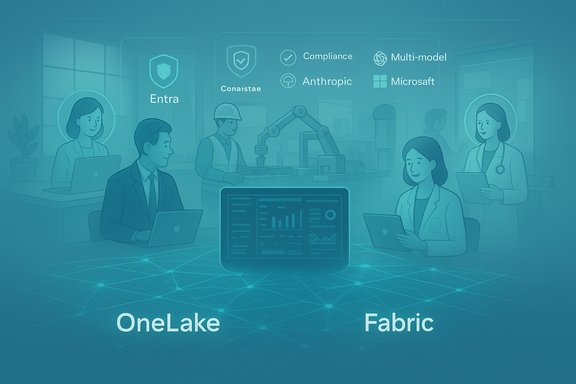
- Microsoft Fabric and OneLake: a unified data plane that reduces silos and provides a governed “single source of truth” (OneLake) for analytics and AI. Fabric integrates diverse database services so analytics and AI can run across hybrid and multi‑cloud environments without forcing constant platform switches. The goal: ground LLMs and agents with curated, governed data to reduce hallucination risk and provide auditable lineage.
- Azure Copilot and Copilot Studio: product surfaces and developer tooling to build domain copilots and agent orchestration, connecting models to business systems, identity (Entra) and security controls. Together with Foundry, Copilot Studio becomes the bridge from a model endpoint to real business workflows.
What this architecture enables in practice
- Faster time‑to‑production for RAG (retrieval‑augmented generation) pipelines.
- Centralised governance and observability for model inference and data access.
- Procurement and billing simplicity by routing model usage through existing Azure consumption commitments for enterprise customers.
Real customers, measurable outcomes: case studies showing business impact
Microsoft and its partner ecosystem have pushed a string of industry examples that illustrate how the architecture is applied and scaled.Finance: UBS — speed and compliance for client transactions
UBS’s Smart Technologies and Advanced Analytics Team (STAAT) built STAAT Assist on Azure to extract client information automatically and populate transfer requests, letting advisors approve transactions with a single click. The result: faster approvals, reduced friction and better client experience across regulated workflows. This kind of integration demonstrates how AI can be embedded in core transactional processes while sitting inside governed Azure environments.Agriculture: Land O’Lakes — mobile, field‑ready assistance
Land O’Lakes built the Oz assistant using models on Azure AI Foundry to deliver fast, mobile answers to farmers’ questions about planting, harvesting and crop management. Field agents and growers get contextual responses grounded in domain data, turning AI into an operational tool rather than a novelty. This is an example of domain copilots that deliver high utility in constrained connectivity and mobile contexts.Retail & Brands: Ralph Lauren and Levi Strauss & Co. — commerce and employee productivity
Ralph Lauren’s Ask Ralph uses Azure AI for conversational styling suggestions that turn customer interactions into high‑margin engagements and deeper loyalty. Levi Strauss & Co. uses Azure‑native orchestrator agents embedded in Microsoft Teams to coordinate subagents across corporate, retail and warehouse environments — surfacing policies, holidays and workflows inside the employee experience. These examples show how AI enhances both customer‑facing experiences and internal productivity, unlocking new revenue opportunities and lowering operational friction.Healthcare: Lucerne Cantonal Hospital — scheduling and caregiver time reclaimed
Working with Microsoft partners, Lucerne Cantonal Hospital built an AI‑powered shift‑scheduling solution in Teams that cut planning time by two‑thirds, saving many nurses two to three days monthly spent on administrative scheduling. That time was redirected to patient care and team management — a direct improvement to both staff wellbeing and clinical focus. This is a classic illustration of how AI can return “time” to scarce human resources.Manufacturing: Mercedes‑Benz digital factory — energy and uptime gains
Mercedes‑Benz deployed Azure AI across its global production network to surface production anomalies, investigate machine malfunctions and drive efficiency on the factory floor. By giving employees a self‑serve Digital Factory Chat to analyze production metrics, Mercedes reduced energy consumption by more than 20% in targeted deployments and improved uptime through predictive insights. This underscores how edge and factory AI can produce measurable savings at scale.Life sciences: Hetero and Cloud4C — compliance, automation and cost reduction
In regulated manufacturing, pharmaceutical company Hetero worked with Audree Infotech and Cloud4C to deploy a cloud‑native architecture on Azure that unified data, automated quality and compliance reporting, and supported AI workflows for root‑cause analysis. The result: infrastructure cost reductions of roughly 40%, automation of over 4,000 documents monthly, and saved staff hours in the tens of thousands — outcomes that translate into faster product cycles and easier market entry.What sets successful “frontier firms” apart
Microsoft identifies a set of behavioural and technical patterns that differentiate high‑performing adopters — the so‑called “frontier firms” — from late adopters. These are worth framing as a checklist for IT leaders:- Empower employees by automating repetitive work so teams focus on creative and strategic tasks.
- Reimagine customer engagement with personalised, data‑driven experiences and domain copilots.
- Transform business processes for accuracy, speed and operational resilience.
- Accelerate innovation by standardising the data and model foundations to bring products to market faster.
The partner economy: why Microsoft’s ecosystem matters
Partners as the force multiplier
Microsoft’s partners are central, not peripheral. They:- Design and implement secure data foundations.
- Build industry‑specific copilots and agents.
- Provide managed operations, compliance frameworks and co‑sell pathways to accelerate procurement and deployment.
A repeatable delivery pattern for enterprises
The recurring, successful pattern looks like this:- Modernise and consolidate data into a governed fabric (OneLake / Fabric).
- Build domain‑specific retrieval indexes and curated datasets to ground models.
- Choose appropriate model backends (OpenAI, Anthropic, etc. routed through Foundry.
- Deploy copilots / agents with integrated security, monitoring and compliance checks.
- Operate and iterate with partner‑led managed services.
Model choice, procurement and the Anthropic expansion: verified facts and caveats
Microsoft’s platform messaging emphasises model neutrality — enterprises can pick models (OpenAI, Anthropic, Hugging Face, Microsoft) depending on capability, cost and compliance needs. In 2025 Microsoft added Anthropic’s Claude family to Foundry, making multiple Claude variants available to enterprise customers through a serverless model surface and integrating Claude into Copilot experiences. That change materially broadened model choice inside Azure AI Foundry.Important caveats and verification:
- Publicly reported commitments associated with Anthropic’s Azure deal include large, staged commercial and capacity figures. These reports describe Anthropic committing to significant Azure compute purchases over time and Microsoft/NVIDIA making staged investments. However, the headlines use “up to” language and describe long‑term commercial commitments rather than single, upfront cash transfers. Treat the headline numbers as strategic commitments that unfold over multi‑year terms rather than immediate cash figures. This nuance has been documented in multiple independent briefings.
- For enterprises, the practical implication isn’t the dollar figure itself but the outcome: Azure now offers a production‑grade route to multiple frontier models within a single governance and billing framework, which simplifies procurement for large customers.
Benefits and measurable ROI — what the data shows
Organisations that move beyond one‑off pilots and treat AI as an integrated layer report measurable outcomes in five categories:- Productivity: Employees spend less time on routine tasks; nursing staff and back‑office teams reclaim hours previously consumed by scheduling and document work. Estimated time savings in documented cases range from days per month per individual to thousands of hours across plants or departments.
- Efficiency and cost reduction: Manufacturing and data‑centre optimisations have produced energy and infrastructure savings; Mercedes reported >20% energy reductions in specific deployments, and Hetero reported infrastructure cost reductions in the range of 40% after cloud modernisation.
- Speed to market: Copilots and agent orchestration reduce manual handoffs in product development and customer engagement, accelerating product launches and personalised marketing campaigns.
- Revenue and customer lifetime value: Conversational commerce examples like Ask Ralph demonstrate how contextual AI can drive higher‑margin customer interactions and increase conversion and loyalty.
- Compliance and auditability: By combining Fabric, Entra identity controls and Foundry governance features, firms can keep inference and data access inside auditable, policy‑driven workflows — crucial for financial services and life sciences. The BlackRock Aladdin re‑architecture on Azure is cited as an example of integrating reasoning, orchestration and compliance in one governed workflow.
Risks, limitations and guardrails — what IT leaders must watch
Adopting enterprise AI successfully requires careful attention to risk. Key cautions:- Data quality and grounding: Without curated, authoritative datasets to ground prompts, LLM outputs can hallucinate. The Fabric / OneLake approach helps but is not a silver bullet; organisations must invest in data pipelines, indexing and continuous validation.
- Governance and regulatory compliance: Financial services, healthcare and life sciences require strict controls on data residency, audit trails and model explainability. Enterprises must bake compliance checks into the model invocation path and include human‑in‑the‑loop approvals where required. Examples in the field show governance is implementable but non‑trivial.
- Vendor lock‑in vs multi‑model risk: While Microsoft’s multi‑model Foundry reduces single‑vendor risk, organisations must still design for portability and avoid tight coupling of business logic to a single model API. Carefully architected model abstraction layers mitigate this risk.
- Cost governance and observability: Model inference costs can escalate quickly. Enterprises need observability, tagging and budget controls to manage spend across teams and agents. The Azure Consumption Commitment integration is helpful, but operational controls remain essential.
- Environmental and ethical impacts: Large models have non‑trivial energy footprints and ethical risks. Firms should apply cost‑and‑impact optimization strategies (use lower‑cost model variants where appropriate, optimise prompts, cache responses) and enforce bias‑testing and red‑teaming for high‑impact use cases.
Practical roadmap: five steps for CIOs and IT leaders
- Consolidate your data into a governed, searchable fabric (OneLake, Fabric or equivalent). Start with the highest‑value datasets for core workflows.
- Build retrieval indexes and provenance controls so any model answer is traceable to source data. This reduces hallucination risk.
- Prototype domain copilots with clear KPIs tied to time, cost and revenue; instrument them for observability. Use partners to accelerate industry‑specific compliance.
- Establish a governance fabric that covers identity, DLP and model access; require human approvals where necessary. This is non‑negotiable for regulated sectors.
- Run a cost and impact review monthly; optimise by routing lower‑cost models for high‑volume, low‑risk queries and reserving frontier models for critical reasoning tasks.
Conclusion: from tools to operating model
Microsoft’s current proposition for enterprise AI is pragmatic: provide a unified data plane, support model and deployment choice, and mobilise a partner ecosystem to operationalise AI at scale. The architecture — Foundry for models and agents, Fabric/OneLake for data, Copilot surfaces for users — is designed to reduce pilot fatigue and make AI an operational capability rather than an experimental novelty.The real measure for CIOs will be whether AI investments return time and money, enable new revenue streams and reduce operational risk — not whether a particular model or demo performs well in isolation. The case studies from manufacturing to healthcare and finance show those outcomes are achievable when organisations treat data, governance and partner execution as the core project, not an afterthought.
For enterprises ready to move from experiments to execution, the repeatable pattern is clear: unify your data, pick the right models, embed copilots into real workflows, and use partner‑led delivery to scale securely. The companies that make those moves fastest are the ones changing their operating models — and, ultimately, their industries.
Source: Technology Record How Microsoft is helping businesses turn AI and data into real-world impact
